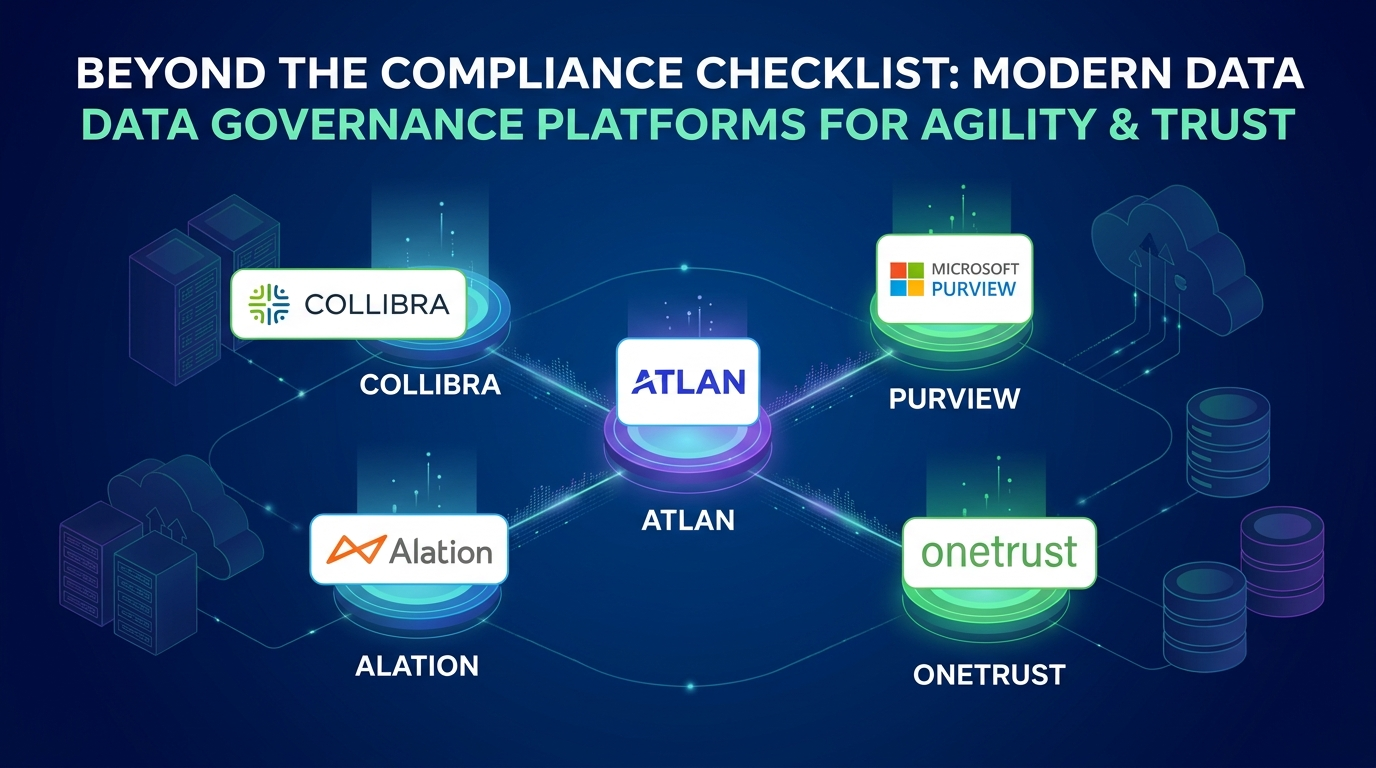
Organizations scaling their modern data estates quickly encounter a complex operational dilemma: as data ingestion accelerates across multi-cloud warehouses, SaaS applications, and data lakes, ensuring data privacy, regulatory compliance, and data trust becomes nearly impossible through manual oversight. When data teams operate without structured policies, sensitive Personally Identifiable Information (PII) spreads unchecked, access permissions become dangerously broad, and regulatory mandates (such as GDPR, CCPA, and HIPAA) face constant risk of breach. Treating data governance as a static, bureaucratic compliance checklist enforced by rigid spreadsheets stifles innovation and frustrates data consumers.
Data Governance Platforms provide centralized, automated frameworks designed to discover sensitive data, enforce access policies, manage data lineage, and ensure compliance across complex enterprise data ecosystems. Navigating the modern data governance software market requires understanding how platforms differentiate across automated policy enforcement, active metadata management, and business user collaboration.
Understanding the Shift to Active Data Governance
Data governance encompasses the overall management of data availability, usability, integrity, and security within an enterprise.
Historically, legacy data governance tools functioned as passive policy repositories—heavy binders or static document libraries that outlined rules but lacked programmatic enforcement capabilities. Modern data governance platforms have evolved into active systems that integrate directly into data infrastructure to automate security policies, monitor data quality, and enforce privacy guardrails in real time.
A professional data governance architecture typically governs several critical operational areas:
- Automated Sensitive Data Discovery: Scanning databases, cloud storage buckets, and pipelines automatically to classify PII, financial records, and intellectual property.
- Access Control and Privacy Masking: Enforcing dynamic row-level and column-level masking policies so users only view data permitted by their organizational role.
- Data Ownership and Stewardship Workflows: Assigning clear business ownership to datasets, ensuring accountability for data quality and compliance.
- Policy Enforcement and Auditability: Maintaining continuous compliance reporting and audit logs to satisfy regulatory requirements without manual intervention.
The fundamental objective is to balance data democratization—giving teams fast access to the data they need—with rigorous security and compliance.
Key Evaluation Criteria for Data Governance Solutions
Selecting an enterprise-grade data governance platform requires examining automation depth, integration flexibility across the modern data stack, and ease of adoption for business users.
Automated Classification versus Manual Tagging
Manually tagging thousands of database columns is unfeasible. Leading governance platforms leverage machine learning and pattern matching to discover and classify sensitive data automatically as soon as new tables are created.
Integration with Cloud Warehouses and Transformation Tools
An effective governance tool must integrate natively with modern cloud data warehouses (Snowflake, BigQuery), data integration pipelines (Fivetran), and transformation frameworks (dbt) to enforce security policies where data lives.
Business Glossary and Collaborative Stewardship
Governance fails if it is handled solely by IT. The best platforms provide intuitive business glossaries and collaboration workflows that enable non-technical business stewards to define terms and approve data access requests easily.
Leading Data Governance Platforms and Solutions
The data governance software market features comprehensive enterprise governance suites alongside modern active metadata and privacy platforms.
Collibra Data Intelligence Cloud
Collibra is the established enterprise leader in comprehensive data governance, data privacy, and compliance management, trusted by highly regulated global institutions.
- Primary Focus: Enterprise data governance, regulatory compliance, privacy management, and policy workflows.
- Deployment Model: Cloud SaaS platform.
- Significant Advantage: Unmatched depth in enterprise-grade policy management, compliance auditing, and multi-department governance workflows.
- Important Licensing: Complex architecture and heavier enterprise licensing make it less agile for rapid, startup-style cloud data teams.
Alation
Alation is a powerful data governance and catalog platform renowned for its strong focus on collaborative data stewardship, crowdsourced definitions, and behavioral analytics.
- Primary Focus: Collaborative data discovery, stewardship workflows, and data governance.
- Deployment Model: Cloud SaaS or hybrid enterprise deployment.
- Significant Advantage: Exceptional focus on user collaboration and machine-learning-driven recommendations that guide users toward trusted, compliant datasets.
- Important Licensing: Requires active organizational change management and dedicated data stewardship engagement to drive adoption.
Atlan
Atlan is a modern, collaborative active metadata platform built specifically for the modern data stack, offering agile governance, automated classification, and deep cloud data stack integrations.
- Primary Focus: Active data governance, automated PII tagging, and seamless modern data stack integration.
- Deployment Model: Cloud SaaS platform.
- Significant Advantage: Outstanding modern user interface, developer APIs, and deep native integrations with tools like Snowflake, dbt, and Airflow.
- Important Licensing: Advanced, highly customized legacy enterprise compliance workflows require careful configuration during onboarding.
Microsoft Purview
Microsoft Purview is a unified data governance service designed to map and govern data across on-premises, multi-cloud, and SaaS environments within the Microsoft ecosystem.
- Primary Focus: Microsoft-native data governance, sensitive data classification, and compliance mapping.
- Deployment Model: Fully managed cloud service on Azure.
- Significant Advantage: Frictionless integration with Microsoft 365 security, Azure SQL, Power BI, and enterprise Active Directory compliance policies.
- Important Licensing: Best optimized for enterprises standardized on the Microsoft technology ecosystem.
OneTrust DataGovernance
OneTrust is a market leader in privacy, security, and trust software, offering robust data governance modules focused heavily on privacy regulations and data lineage.
- Primary Focus: Privacy compliance, data governance, risk management, and regulatory adherence.
- Deployment Model: Cloud SaaS platform.
- Significant Advantage: Exceptional depth in managing global privacy regulations (GDPR, CCPA) and automating privacy impact assessments.
- Important Licensing: Specialized focus on privacy and risk management means technical data engineering governance features are lighter compared to dedicated data catalogs.
Platform Comparison Overview
| Product | Primary Focus | Deployment Model | Significant Advantage | Important Licensing |
| Collibra | Enterprise data governance and regulatory compliance | Cloud SaaS | Unmatched enterprise governance depth, privacy tracking, and policy workflows | Complex architecture can feel heavy for agile cloud data teams |
| Alation | Collaborative data discovery and crowdsourced stewardship | Cloud / Hybrid | Strong focus on user collaboration and intelligent dataset recommendations | Requires active data stewardship and organizational adoption |
| Atlan | Active metadata and modern data stack governance | Cloud SaaS | Exceptional modern UI with deep native integrations (Snowflake, dbt) | Advanced custom compliance workflows require careful setup |
| Microsoft Purview | Multi-cloud data governance and Microsoft ecosystem mapping | Managed Azure | Seamless security integration with Microsoft 365, Azure, and Power BI | Best optimized for organizations standardized on Microsoft tech |
| OneTrust | Privacy compliance and risk management workflows | Cloud SaaS | Industry-leading global privacy regulation and compliance automation | Technical data engineering governance features are lighter |
Operational Risks and Common Pitfalls
Implementing data governance platforms without structured planning introduces severe adoption hurdles and operational friction.
Treating Governance as a Top-Down Police Force
Enforcing rigid, restrictive data access policies without consulting business users, causing frustrated analysts to bypass governance controls through shadow IT and unmanaged spreadsheets.
Boiled-Ocean Implementation Strategies
Attempting to govern every data asset across the entire enterprise on day one instead of starting with high-priority domains and expanding iteratively.
Neglecting Automated Policy Maintenance
Writing static data classification rules that are never updated as new data pipelines and cloud tables are introduced, rendering compliance monitoring inaccurate.
Questions to Guide Vendor Selection
Before procuring a data governance platform, data engineering leads and compliance officers should address several critical operational questions:
- What are our primary compliance drivers—global privacy regulations (OneTrust/Collibra), or modern data stack observability and security (Atlan)?
- Do we need a heavy enterprise compliance suite (Collibra) or an agile, developer-friendly active governance tool (Atlan)?
- How easily does the platform integrate with our existing cloud data warehouses and transformation pipelines?
- What level of business-user tooling is provided for non-technical data stewards to manage policies and approve access requests?
Making the Final Decision
Choosing a data governance platform depends heavily on an organization’s regulatory burden, team culture, and architectural stack.
Organizations facing heavy global regulatory oversight and complex multi-department compliance mandates frequently choose Collibra. Enterprises seeking a modern, agile active governance platform with exceptional integrations across the modern data stack lean toward Atlan. Organizations prioritizing crowdsourced data stewardship lean toward Alation, while heavily Microsoft-centric enterprises achieve seamless security mapping using Purview. For organizations where privacy compliance and risk management are paramount, OneTrust provides specialized capabilities.
Ultimately, modern data governance platforms transform compliance from a bureaucratic bottleneck into an automated, trusted foundation that empowers the entire enterprise to leverage data safely and effectively.
