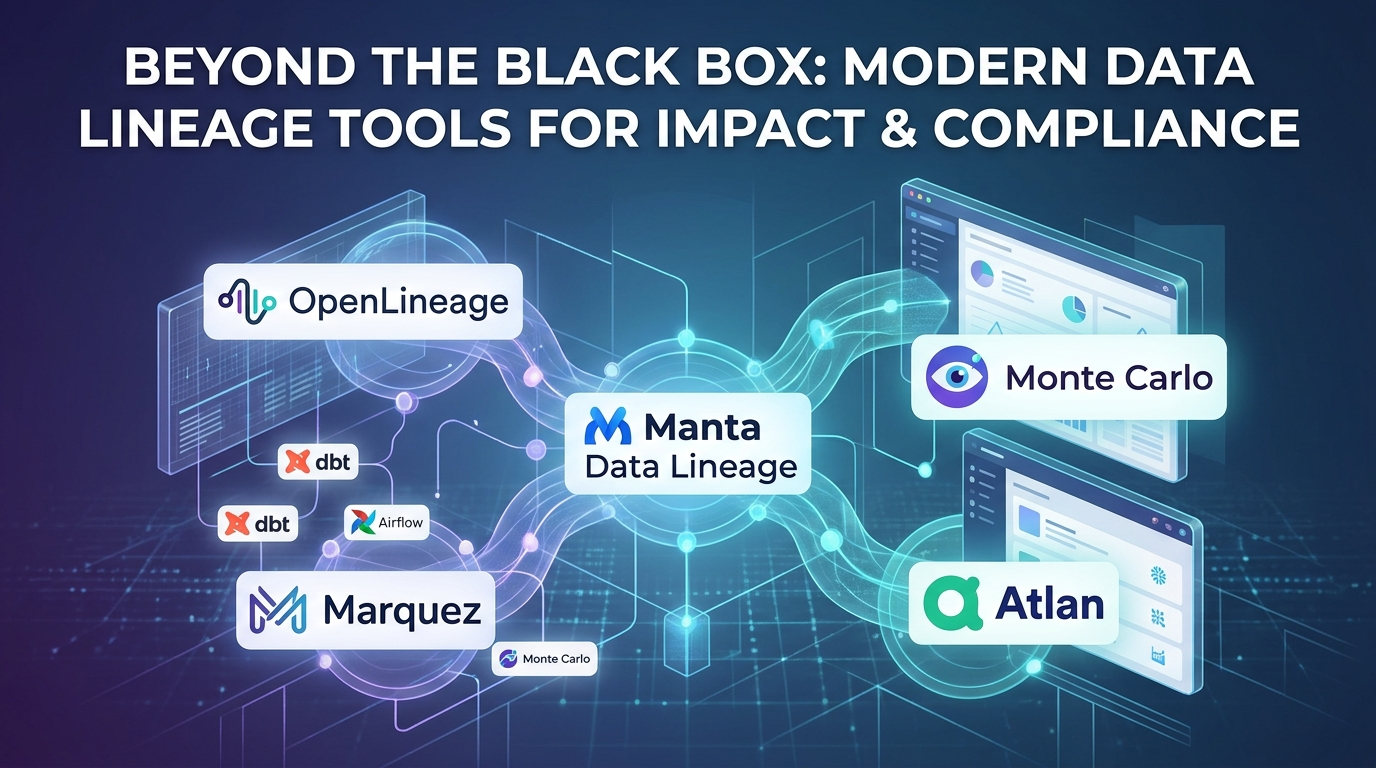
Data engineers, analytics leaders, and compliance officers operating in modern data stacks frequently face an opaque web of transformations. When an executive asks why a key quarterly revenue dashboard suddenly displays anomalous figures, or when a data engineer needs to know what downstream tables will break if a source column in an upstream production database is renamed, discovering the answer usually involves hours of frantic SQL querying, manual code inspection across scattered Git repositories, and guesswork. As data estates scale to millions of tables across multi-cloud warehouses and streaming pipelines, flying blind without visibility into data movement is a recipe for operational failure.
Data Lineage Tools provide automated mapping, impact analysis, and visualization capabilities designed to track data from its origin through every transformation, join, and dashboard. Navigating the modern data lineage software landscape requires understanding how platforms differentiate across automated SQL parsing, runtime tracking, and active governance integration.
Understanding the Mechanics of Data Lineage
Data lineage is the lifecycle documentation that tracks the origin, movement, characteristics, and transformation of data as it flows from source systems to consumption endpoints.
Unlike static data dictionaries that only describe what a table looks like today, data lineage explains the chronological path and operational dependencies of data over time.
A professional data lineage architecture typically governs several critical operational capabilities:
- Automated Parsing and AST Extraction: Utilizing Abstract Syntax Tree (AST) parsers to analyze SQL queries, Python scripts, dbt models, and ETL pipeline definitions automatically without manual documentation.
- Column-Level and Table-Level Lineage: Mapping dependencies down to individual table columns (showing precisely how column
Aplus columnBcreated columnC) alongside high-level table dependencies. - Impact and Root-Cause Analysis: Simulating upstream and downstream changes instantly to identify what dashboards will break before code is deployed, or tracing backward from a corrupted metric to find the exact upstream source failure.
- Regulatory Auditing and Compliance: Satisfying data governance mandates (such as GDPR, CCPA, or BCBS 239) by proving exactly where sensitive consumer data originates and where it is stored or shared.
The fundamental objective is to replace opaque black-box data pipelines with complete, transparent end-to-end visibility.
Key Evaluation Criteria for Data Lineage Solutions
Selecting an enterprise-grade data lineage tool requires examining automated parsing depth, integration breadth across the modern data stack, and real-time runtime tracking.
Automated Parsing versus Manual Annotation
Early data lineage solutions required data engineers to manually draw connections and annotate workflows in a UI, which became outdated the moment a pipeline script changed. Modern enterprise lineage tools rely on automated code parsers that extract lineage directly from source code repositories and data warehouses.
Integration with Transformation and Orchestration Stacks
An effective data lineage tool must integrate natively with transformation frameworks (like dbt), orchestrators (Airflow, Prefect), cloud data warehouses (Snowflake, BigQuery), and BI reporting tools (Tableau, Looker) to construct a unified dependency graph.
Column-Level Granularity and Accuracy
Table-level lineage shows that Table A feeds Table B, but column-level lineage reveals the exact transformation logic connecting individual fields. Evaluating whether a tool provides reliable column-level tracking across complex SQL dialects is vital for rigorous impact analysis.
Leading Data Lineage Tools and Platforms
The data lineage software market features dedicated metadata and observability platforms alongside comprehensive enterprise data governance suites.
OpenLineage and Marquez
OpenLineage is an open-source standard for collecting metadata and lineage from data pipelines, paired with Marquez as the reference implementation and visualization backend.
- Primary Focus: Open-source lineage collection, standard metadata telemetry, and pipeline observability.
- Deployment Model: Open-source framework / self-hosted open-source server.
- Significant Advantage: Open standard supported across multiple orchestration engines (Airflow, Spark, dbt), preventing vendor lock-in for data engineering teams.
- Important Limitation: Requires technical engineering effort to implement, configure, and maintain compared to turnkey commercial SaaS platforms.
Manta Data Lineage
Manta is a specialized, enterprise-grade automated data lineage platform renowned for its deep, deterministic parsing capabilities across legacy databases, ETL tools, and complex mainframe environments.
- Primary Focus: Deep automated code parsing, legacy database lineage, and rigorous compliance auditing.
- Deployment Model: On-premises or cloud-managed enterprise deployment.
- Significant Advantage: Unmatched depth in scanning complex legacy codebases (stored procedures, COBOL, SSIS, Informatica) to build comprehensive deterministic lineage graphs.
- Important Limitation: Implementation and configuration overhead can be substantial, catering primarily to large traditional enterprise IT estates.
Monte Carlo (Lineage Module)
Monte Carlo is an industry leader in data observability that includes powerful automated data lineage features as part of its broader data reliability platform.
- Primary Focus: End-to-end data observability, automated pipeline lineage, and incident root-cause analysis.
- Deployment Model: Cloud SaaS platform.
- Significant Advantage: Seamlessly combines automated lineage graphs with real-time data anomaly detection, allowing engineers to see immediately how pipeline failures impact downstream consumers.
- Important Limitation: Focuses primarily on observational and pipeline lineage rather than deep legacy database code parsing.
Atlan (Lineage & Active Metadata)
Atlan provides a modern, collaborative active metadata platform that combines automated data cataloging with robust multi-hop data lineage and governance workflows.
- Primary Focus: Collaborative active metadata, multi-hop lineage visualization, and agile governance.
- Deployment Model: Cloud SaaS platform.
- Significant Advantage: Outstanding modern user interface, deep integrations with the modern data stack (Snowflake, dbt, Airflow), and intuitive business-user accessibility.
- Important Limitation: Advanced custom parsing for obscure, proprietary on-premises data systems requires careful configuration.
Platform Comparison Overview
| Product | Primary Focus | Deployment Model | Significant Advantage | Important Limitation |
| OpenLineage | Open-source lineage telemetry and standard metadata collection | Open-Source / Self-Hosted | Universal open standard preventing vendor lock-in across orchestrators | Requires internal engineering resources to deploy and maintain |
| Manta | Deep automated parsing of legacy and enterprise databases | On-Prem / Cloud | Exceptional depth in scanning legacy stored procedures and ETL scripts | Implementation and configuration overhead cater to large enterprises |
| Monte Carlo | Data observability integrated with automated pipeline lineage | Cloud SaaS | Unifies lineage graphs directly with real-time data anomaly detection | Focused on observability rather than deep legacy database parsing |
| Atlan | Collaborative active metadata and multi-hop lineage UI | Cloud SaaS | Outstanding modern user interface with deep modern data stack integrations | Custom parsing of obscure on-premises systems needs setup |
Operational Risks and Common Pitfalls
Implementing data lineage tools without proper architectural planning introduces severe operational blind spots and maintenance fatigue.
Relying on Static, Manually Maintained Diagrams
Creating manual lineage diagrams in documentation software that are never updated when pipeline code changes, rendering them inaccurate and untrustworthy within weeks.
Incomplete Lineage Coverage Across the Data Stack
Failing to connect end-to-end lineage across the entire stack—such as capturing transformations in the data warehouse while missing upstream ingestion scripts or downstream BI reports.
Ignoring Column-Level Precision
Relying solely on coarse table-level lineage, forcing engineers to manually inspect hundreds of lines of SQL code to identify which specific column caused a calculation error.
Questions to Guide Vendor Selection
Before procuring a data lineage tool, data engineering leads and governance officers should address several critical operational questions:
- Do we need automated lineage parsing for legacy on-premises databases and stored procedures (like Manta), or are we operating entirely within the modern cloud data stack (Atlan/Monte Carlo)?
- Does the platform extract lineage automatically from our transformation tools (dbt) and orchestrators (Airflow)?
- Do we require column-level lineage for rigorous impact analysis, or is table-level lineage sufficient for our compliance needs?
- Should we adopt an open-source standard (OpenLineage) or a turnkey commercial SaaS platform?
Making the Final Decision
Choosing a data lineage tool depends heavily on an organization’s legacy infrastructure, cloud maturity, and governance requirements.
Organizations operating entirely within the modern cloud data stack seeking collaborative discovery and automated lineage frequently choose Atlan. Teams prioritizing real-time data observability paired with automated incident lineage lean toward Monte Carlo. Enterprises managing massive, complex estates of legacy databases, stored procedures, and traditional ETL tools rely on the deep parsing power of Manta, while engineering teams committed to open-source standards adopt OpenLineage.
Ultimately, modern data lineage tools turn opaque data webs into transparent, auditable pathways, empowering data teams to understand, trust, and manage their data assets with absolute confidence.
