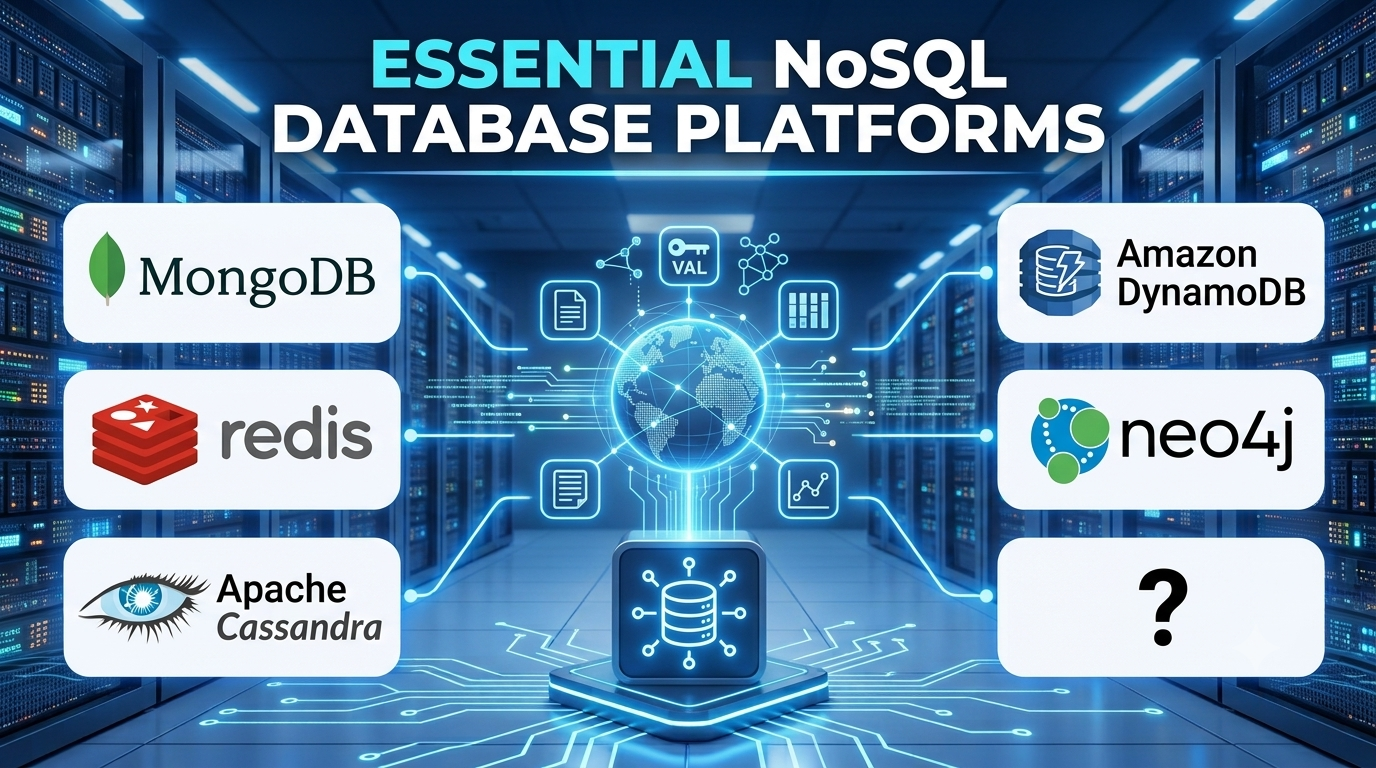
Application developers building high-velocity, cloud-native systems frequently encounter the strict limitations of traditional relational databases. When dealing with semi-structured user profiles, real-time activity feeds, high-frequency Internet of Things (IoT) sensor streams, or global catalog catalogs that scale to millions of concurrent writes, enforcing rigid table schemas and complex multi-table JOIN operations can create severe performance bottlenecks.
NoSQL (Not Only SQL) database platforms were engineered to shatter these scaling barriers, offering flexible data models, lightning-fast horizontal scalability, and high availability across distributed multi-cloud clusters. Navigating the modern NoSQL software landscape requires understanding how platforms differentiate across data models—document, key-value, wide-column, and graph—and how they manage the trade-offs of the CAP theorem.
Understanding the Four Core NoSQL Data Models
Unlike relational databases that organize all information into uniform tables and rows, NoSQL databases utilize diverse data models tailored specifically to particular access patterns and application workflows:
- Document Databases: Storing data as flexible, self-describing documents (typically JSON, BSON, or XML), allowing developers to store nested objects and variable attributes without pre-defining table schemas.
- Key-Value Stores: Operating as high-speed hash tables where every item is stored as a key-value pair, optimized for ultra-fast read and write operations in caching and session management.
- Wide-Column Stores: Organizing data into rows and dynamic columns grouped into column families, engineered for massive analytical queries and high-throughput write operations across distributed clusters.
- Graph Databases: Storing data as nodes, edges, and properties, designed specifically to map complex, highly connected relationships such as social networks or fraud detection webs.
The fundamental objective is to align database architecture directly with application data structures, eliminating the friction of object-relational mapping (ORM).
Key Evaluation Criteria for NoSQL Platforms
Selecting an enterprise-grade NoSQL database requires examining consistency models, horizontal scale capability, and query flexibility.
Consistency Models and the CAP Theorem
Distributed NoSQL databases must balance Consistency, Availability, and Partition Tolerance. Evaluating a platform requires understanding whether it operates on strict linearizable consistency or eventual consistency, and how it behaves during network partition events.
Horizontal Scalability and Sharding Mechanics
True NoSQL architecture scales horizontally by adding inexpensive commodity servers to a distributed cluster (sharding) rather than upgrading a single machine. Examining how a database manages automated rebalancing and partition failover is vital for long-term growth.
Query Indexing and Aggregation Capabilities
Early NoSQL databases sacrificed query flexibility for speed, supporting only primary key lookups. Modern enterprise NoSQL platforms offer robust secondary indexing, full-text search, and powerful aggregation pipelines that rival traditional relational querying.
Leading NoSQL Database Platforms and Solutions
The NoSQL software market features industry-standard document stores alongside specialized key-value caches and graph databases.
MongoDB
MongoDB is the world’s leading document database platform, renowned for its flexible JSON-based document model, powerful query aggregation framework, and robust Atlas cloud managed service.
- Primary Focus: Flexible document storage, rapid application development, and multi-cloud database scaling.
- Deployment Model: Self-hosted open-source/Enterprise Advanced or fully managed via MongoDB Atlas.
- Significant Advantage: Exceptional developer familiarity, rich secondary indexing, and powerful aggregation pipelines that bridge the gap between NoSQL flexibility and SQL-like querying.
- Important Limitation: In-memory caching and complex unindexed queries can consume high memory overhead if schema design is poorly optimized.
Redis (Redis Enterprise)
Redis is an ultra-fast, in-memory data structure store used primarily as a database, cache, message broker, and streaming engine.
- Primary Focus: Sub-millisecond in-memory caching, session management, and real-time data processing.
- Deployment Model: Self-hosted open-source or fully managed Redis Enterprise.
- Significant Advantage: Unmatched execution speed, keeping datasets in RAM to deliver microsecond response times for high-traffic applications.
- Important Limitation: RAM-based storage can become cost-prohibitive for massive multi-terabyte datasets unless paired with persistent disk tiering.
Apache Cassandra
Apache Cassandra is a highly scalable, distributed wide-column store designed to handle massive volumes of data across commodity servers with zero single points of failure.
- Primary Focus: Massive write-heavy workloads, continuous availability, and multi-datacenter replication.
- Deployment Model: Self-hosted distributed cluster or managed cloud wrappers.
- Significant Advantage: Masterless architecture ensures that if a server node fails, the cluster continues accepting reads and writes without interruption.
- Important Limitation: Complex data modeling is required upfront based on specific query patterns; ad-hoc querying without primary key definitions is difficult.
Amazon DynamoDB
Amazon DynamoDB is a fully managed, serverless key-value and document database service provided by AWS that delivers single-digit millisecond performance at any scale.
- Primary Focus: Fully managed serverless NoSQL storage with automatic scaling and enterprise security.
- Deployment Model: Fully managed cloud service native to AWS.
- Significant Advantage: Complete elimination of server infrastructure management, scaling seamlessly from zero to millions of requests per second automatically.
- Important Limitation: Tightly coupled to the Amazon Web Services ecosystem, making multi-cloud or on-premises hybrid migrations challenging.
Neo4j
Neo4j is the pioneer and leading graph database platform, built specifically to store and navigate highly connected data relationships with exceptional traversal performance.
- Primary Focus: Connected data relationship mapping, fraud detection, recommendation engines, and knowledge graphs.
- Deployment Model: Self-hosted enterprise server or AuraDB fully managed cloud service.
- Significant Advantage: Native graph storage engine and Cypher query language allow lightning-fast traversal of deep, multi-hop relationships that choke relational databases.
- Important Limitation: Specialized use-case architecture means it is not designed to function as a general-purpose key-value cache or document store.
Platform Comparison Overview
| Product | Primary Focus | Deployment Model | Significant Advantage | Important Limitation |
| MongoDB | Flexible document storage and rich query aggregation | Self-Hosted / Atlas Cloud | Intuitive JSON document model and powerful secondary indexing | Unoptimized schemas can cause high memory consumption |
| Redis | Sub-millisecond in-memory caching and real-time data | Self-Hosted / Enterprise | Unrivaled microsecond read/write execution speed | RAM storage costs scale rapidly with massive datasets |
| Apache Cassandra | Massive write scale and continuous high availability | Distributed Cluster | Masterless architecture with zero single points of failure | Rigid data modeling required upfront based on query patterns |
| Amazon DynamoDB | Fully managed serverless key-value and document storage | Managed AWS Cloud | Zero server administration with automatic global scaling | Tightly bound to the AWS cloud ecosystem |
| Neo4j | Connected graph traversal and relationship mapping | Self-Hosted / Aura Cloud | Native graph engine optimized for deep multi-hop relationship queries | Specialized focus makes it unsuitable for general key-value caching |
Operational Risks and Common Pitfalls
Implementing NoSQL database platforms without understanding their distributed architecture introduces severe operational hazards.
Ignoring Access Patterns During Schema Design
Designing NoSQL schemas without knowing exact application query patterns in advance leads to inefficient data duplication, unindexed queries, and poor cluster performance.
Assuming Unlimited Scaling Without Cost Management
While NoSQL databases scale horizontally, provisioning massive distributed clusters or failing to monitor cloud read/write throughput units can lead to staggering cloud infrastructure bills.
Neglecting Data Consistency Trade-Offs
Choosing eventual consistency without building application-level conflict resolution mechanisms can lead to data race conditions and inconsistent user experiences.
Questions to Guide Vendor Selection
Before procuring or deploying a NoSQL database platform, software architects and engineering leaders should address several critical operational questions:
- What is the primary data access pattern—document retrieval, in-memory caching, wide-column analytics, or graph relationship traversal?
- Does the workload demand strict linearizable consistency, or can the application tolerate eventual consistency during network partitions?
- What are the hosting requirements—do we require a fully managed serverless cloud service, or a self-hosted multi-datacenter cluster?
- How does the platform scale with data volume, and what tooling is provided for automated backups and point-in-time recovery?
Making the Final Decision
Choosing a NoSQL database platform depends heavily on an organization’s data model requirements, scalability targets, and cloud deployment strategy.
Applications requiring flexible document structures and rich query capabilities frequently choose MongoDB. Systems demanding ultra-fast caching and session management rely on Redis, while high-velocity IoT streams and massive write volumes leverage Apache Cassandra. Teams building strictly within the AWS ecosystem achieve seamless operations using serverless DynamoDB, whereas applications built around complex connected relationships adopt graph leaders like Neo4j.
Ultimately, modern NoSQL database platforms empower engineering teams to conquer extreme scale and complex data variety, providing the high-performance foundation required by modern distributed applications.
