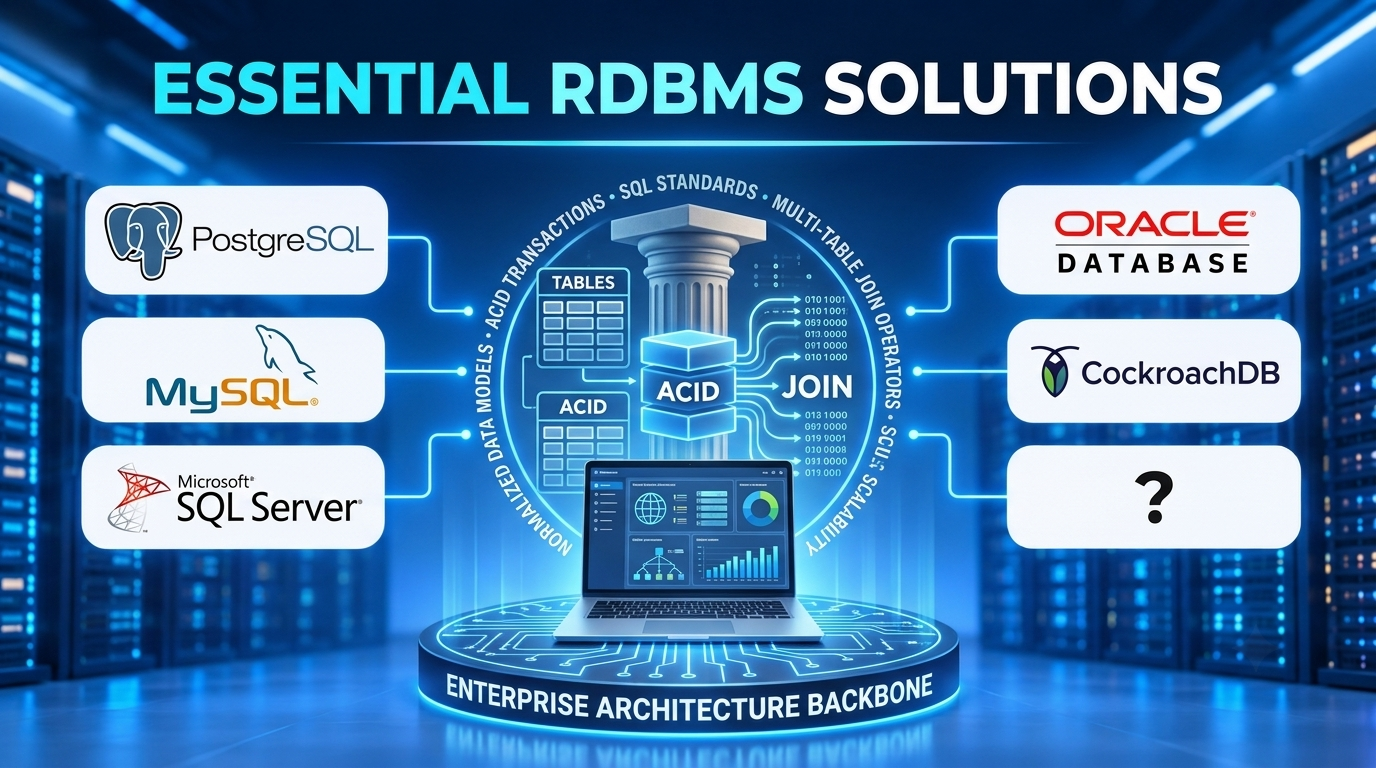
Developers and architects building high-scale, cloud-native applications frequently face intense pressure to adopt trendy NoSQL datastores, document databases, or distributed key-value caches, operating under the assumption that traditional relational databases are too rigid or difficult to scale horizontally. Yet, when applications require strict financial ledger accuracy, complex transactional integrity, and multi-table relational queries without data corruption, NoSQL alternatives often introduce massive application-layer complexity.
Relational Database Management Systems (RDBMS) organize data into structured tables with strict schema definitions, enforcing Atomicity, Consistency, Isolation, and Durability (ACID) guarantees that safeguard enterprise data integrity. Navigating the modern RDBMS software landscape requires understanding how established commercial databases, powerful open-source engines, and cloud-native distributed relational platforms differentiate across performance, scale, and cost.
Understanding the Architecture of Modern Relational Databases
A Relational Database Management System is a software system designed to store, retrieve, manage, and manipulate relational data structured in tables consisting of rows and columns. Relationships between tables are established using primary and foreign keys, enabling complex, normalized data models.
Unlike unstructured or semi-structured data stores, an enterprise RDBMS enforces rigorous structural rules and transactional guarantees:
- ACID Transactions: Ensuring that complex multi-step operations execute completely or fail safely without leaving databases in a partially updated state.
- Structured Query Language (SQL): Providing a standardized, expressive declarative language for filtering, joining, aggregating, and modifying relational data.
- Indexing and Query Optimization: Utilizing B-trees, hash indexes, and cost-based query planners to retrieve millions of rows in milliseconds.
- Concurrency Control: Managing simultaneous user reads and writes safely using locking mechanisms and multi-version concurrency control (MVCC).
The fundamental objective is to provide absolute data reliability and flexibility, ensuring that business applications can query and mutate complex data structures with complete transactional confidence.
Key Evaluation Criteria for RDBMS Selection
Selecting an enterprise relational database requires examining horizontal scalability, open-source licensing freedom, and cloud integration depth.
Horizontal Scalability versus Vertical Scaling Limits
Traditional RDBMS architectures scaled primarily by upgrading physical server hardware (vertical scaling). Modern enterprise workloads require distributed relational databases that can scale horizontally across multiple nodes while maintaining strict ACID compliance.
Total Cost of Ownership (TCO) and Licensing
Commercial relational databases (such as Oracle or Microsoft SQL Server) offer world-class enterprise support and advanced tuning tools, but carry staggering licensing and core-based software fees. Open-source alternatives (PostgreSQL and MySQL) eliminate licensing barriers while offering robust enterprise capabilities.
Cloud-Native Management and Global Replication
Deploying and maintaining high-availability clusters, automated failovers, and cross-region read replicas requires robust cloud tooling. Evaluating an RDBMS involves checking whether the platform provides seamless managed cloud deployment or requires complex self-hosted administration.
Leading Relational Database Management Systems
The RDBMS market features powerful open-source community standards alongside heavy-duty commercial enterprise platforms and cloud-native distributed engines.
PostgreSQL
PostgreSQL is widely regarded as the world’s most advanced open-source relational database, praised for its exceptional extensibility, standards compliance, and robust handling of complex analytical and transactional workloads.
- Primary Focus: Open-source relational database management, advanced data types (JSONB, GIS), and extensibility.
- Deployment Model: Self-hosted open-source or managed via major cloud providers.
- Significant Advantage: Zero licensing fees combined with enterprise-grade features, an active developer community, and unmatched support for complex SQL queries and extensions.
- Important Limitation: High-throughput write scaling across distributed nodes requires third-party clustering extensions or specialized cloud wrappers.
MySQL
MySQL is the world’s most popular open-source relational database, powering a massive share of global web applications, content management systems, and high-traffic internet properties.
- Primary Focus: High-speed web application database hosting, read-heavy workloads, and straightforward replication.
- Deployment Model: Self-hosted open-source or managed cloud service (such as Amazon Aurora MySQL).
- Significant Advantage: Incredible speed, vast web ecosystem integration, and straightforward replication setup for web-scale applications.
- Important Limitation: Historically offered weaker compliance with strict SQL standards compared to PostgreSQL, though modern versions have closed this gap significantly.
Microsoft SQL Server
Microsoft SQL Server is an enterprise-grade relational database management system designed specifically for Windows and Linux environments, deeply integrated into the Microsoft enterprise software ecosystem.
- Primary Focus: Enterprise data management, business intelligence integration, and high-performance T-SQL workloads.
- Deployment Model: On-premises Windows/Linux server or Azure SQL managed cloud service.
- Significant Advantage: Exceptional enterprise integration with Visual Studio, Active Directory, SSIS data pipelines, and Azure cloud infrastructure.
- Important Limitation: High commercial licensing costs for enterprise editions and core-based software deployments.
Oracle Database
Oracle Database is the undisputed heavyweight champion of enterprise commercial relational databases, engineered to handle massive, mission-critical corporate workloads, financial ledgers, and high-volume transactions.
- Primary Focus: Mission-critical enterprise transaction processing, massive data warehousing, and extreme high availability.
- Deployment Model: On-premises engineered systems, hybrid cloud, or Oracle Cloud Infrastructure (OCI).
- Significant Advantage: Unmatched enterprise scalability, advanced security features, and extreme performance tuning for massive corporate data estates.
- Important Limitation: Extremely high software licensing costs, rigorous audit requirements, and steep administrative complexity.
CockroachDB
CockroachDB is a cloud-native, distributed SQL database built from the ground up to scale horizontally, offering ANSI SQL compatibility combined with survivable multi-region ACID transactions.
- Primary Focus: Distributed relational data storage, global cloud scaling, and automatic failure resiliency.
- Deployment Model: Cloud SaaS or self-hosted distributed cluster.
- Significant Advantage: Combines the familiarity of relational SQL with the infinite horizontal scalability and resilience of NoSQL distributed architectures.
- Important Limitation: Complex SQL queries involving heavy cross-shard joins can incur higher latency penalties compared to single-node relational databases.
Platform Comparison Overview
| Product | Primary Focus | Deployment Model | Significant Advantage | Important Limitation |
| PostgreSQL | Advanced open-source SQL, extensibility, and data types | Self-Hosted / Managed Cloud | Zero licensing cost, robust standards compliance, and massive extension ecosystem | Horizontal write scaling requires specialized clustering setups |
| MySQL | High-speed web application hosting and read scalability | Self-Hosted / Managed Cloud | Extremely fast for web traffic and widely supported across CMS platforms | Advanced enterprise features lag behind PostgreSQL and Oracle |
| Microsoft SQL Server | Enterprise applications and Microsoft ecosystem integration | On-Prem / Azure Cloud | Seamless integration with Visual Studio, Active Directory, and Azure | Expensive commercial licensing costs for enterprise tiers |
| Oracle Database | Mission-critical enterprise transactions and massive scale | On-Prem / OCI Hybrid | Unmatched enterprise scale, security, and performance tuning | Prohibitively expensive software licensing and strict audit rules |
| CockroachDB | Cloud-native distributed SQL and global multi-region scale | Distributed Cloud / SaaS | True horizontal scaling with distributed ACID transactional guarantees | Complex queries with cross-shard joins can incur network latency |
Operational Risks and Common Pitfalls
Implementing a relational database management system without proper architectural planning introduces severe performance bottlenecks.
Poor Indexing Leading to Full Table Scans
Failing to analyze query execution plans and omitting necessary indexes on foreign keys and search columns causes databases to perform resource-intensive full table scans as data volume grows.
Ignoring Connection Pooling Limits
Opening a new database connection for every incoming web request without a connection pooler exhausts available memory and connection threads rapidly under high traffic.
Inappropriate Schema Normalization
Over-normalizing databases into dozens of separate tables can force excessive, complex JOIN operations that degrade read performance in high-throughput read-heavy applications.
Questions to Guide Vendor Selection
Before procuring or deploying a relational database management system, software architects and engineering leaders should address several critical operational questions:
- Is the workload primarily read-heavy, write-heavy, or balanced, and how well does the RDBMS handle horizontal scaling or read replication for that pattern?
- What are the total cost drivers, including open-source community support versus commercial software licensing and core-based fees?
- Does the database support our required data types (such as JSONB, spatial data, or vector embeddings for AI applications)?
- How robust is the automated backup, disaster recovery, and point-in-time recovery tooling provided by the platform?
Making the Final Decision
Choosing a relational database management system depends heavily on an organization’s application architecture, budget, and scalability requirements.
Organizations seeking a powerful, free, open-source database with robust standards compliance and extensibility frequently choose PostgreSQL. Web-scale applications requiring high-speed read performance and simple replication lean toward MySQL. Enterprises heavily standardized on Microsoft software achieve seamless operations using Microsoft SQL Server, while large multinational corporations managing mission-critical financial systems rely on Oracle. Conversely, modern cloud-native architectures requiring infinite horizontal scaling with SQL semantics adopt distributed databases like CockroachDB.
Ultimately, modern Relational Database Management Systems remain the undisputed foundation of enterprise data architecture, providing the structure, reliability, and transactional integrity that modern businesses demand.
