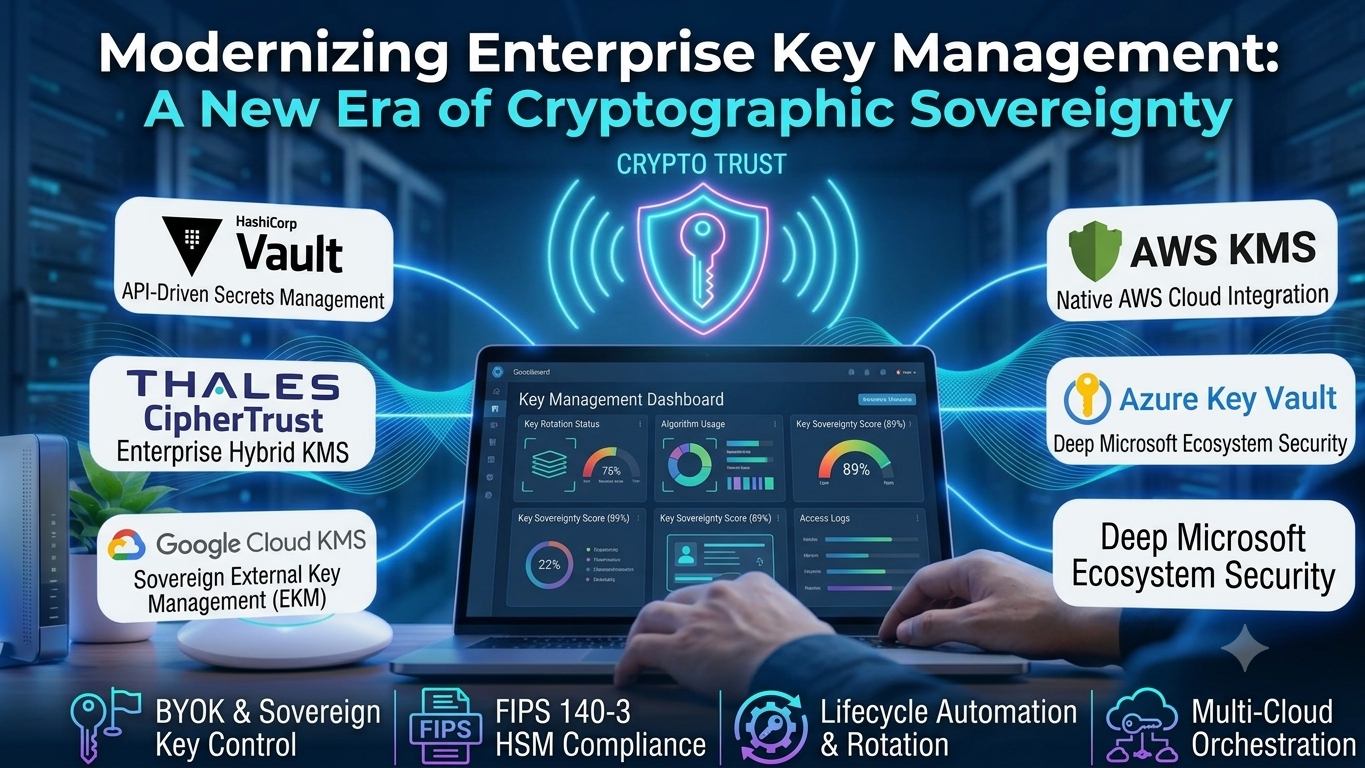
Organizations across every industry sector rely on encryption to protect sensitive data, secure cloud applications, and satisfy strict regulatory compliance mandates. Yet, deploying robust encryption algorithms like AES-256 or RSA is only half the battle. The true vulnerability in any cryptographic architecture is not the mathematical strength of the cipher, but how the cryptographic keys themselves are generated, stored, distributed, rotated, and retired. Storing encryption keys in hardcoded configuration files, local server directories, or unmanaged cloud buckets exposes enterprises to catastrophic security breaches.
Key Management Systems (KMS) provide centralized, secure hardware and software platforms that automate the entire lifecycle of cryptographic keys. Selecting the right key management solution requires understanding how platforms differentiate across hardware security modules (HSMs), cloud-native key vaults, and multi-cloud key orchestration architectures.
Understanding the Cryptographic Key Lifecycle
A Key Management System is an enterprise software and hardware solution designed to manage the creation, exchange, storage, use, rotation, and destruction of cryptographic keys. Without a centralized KMS, organizations quickly encounter cryptographic sprawl, where developers create unmanaged keys across disparate servers, leading to lost data recovery keys, expired certificates, and severe compliance violations.
A professional key management architecture typically governs several critical operational stages:
- Secure Key Generation: Creating cryptographically strong keys using certified random number generators that comply with rigorous standards (such as FIPS 140-2 or FIPS 140-3).
- Access Control and Authorization: Enforcing strict separation of duties and role-based access control (RBAC) to ensure that only authorized applications and users can request cryptographic operations.
- Automated Key Rotation: Regularly replacing active encryption keys with new ones to limit the amount of data exposed if a single key is ever compromised.
- Secure Key Archiving and Destruction: Retaining archived keys safely to decrypt historical data while ensuring terminated keys are permanently and securely destroyed.
The primary objective is to maintain absolute cryptographic control and audibility across all enterprise applications without slowing down developer velocity.
Key Evaluation Criteria for KMS Platforms
Selecting an enterprise-grade key management system requires examining hardware security compliance, multi-cloud integration, and API extensibility.
FIPS 140-2 and FIPS 140-3 Compliance Validation
For government, financial, and healthcare institutions, a KMS must be backed by validated Hardware Security Modules (HSMs) meeting rigorous FIPS security levels to guarantee that physical and logical key extraction is mathematically and physically impossible.
Multi-Cloud and Hybrid Key Orchestration
Modern enterprises rarely operate within a single cloud provider. An effective KMS must manage keys seamlessly across multi-cloud environments (AWS, Azure, Google Cloud) and on-premises data centers through a single unified control plane.
Bring Your Own Key (BYOK) and External Key Management (EKM)
Organizations migrating sensitive workloads to public clouds often require strict sovereignty over their encryption keys. Leading KMS platforms support BYOK and EKM capabilities, allowing enterprises to generate and store keys on-premises while authorizing cloud services to use them without relinquishing ultimate key ownership.
Leading Key Management Systems and Platforms
The key management software market features dedicated enterprise hardware security specialists alongside cloud-native developer platforms.
HashiCorp Vault
HashiCorp Vault is the premier developer-centric secrets management and key management platform, designed to secure, store, and tightly control access to tokens, passwords, certificates, and encryption keys across dynamic cloud infrastructure.
- Primary Focus: Developer-first secrets management, dynamic data encryption-as-a-service, and multi-cloud secret orchestration.
- Deployment Model: Self-hosted or cloud-managed service with robust REST APIs and CLI tools.
- Significant Advantage: Exceptional developer extensibility and dynamic secrets generation that integrates seamlessly with modern containerized microservices architectures.
- Important Limitation: Requires dedicated DevOps and engineering expertise to configure, scale, and maintain securely in production.
AWS Key Management Service (KMS)
AWS KMS is a managed service that makes it easy for developers and security teams to create and control the cryptographic keys used across Amazon Web Services and external applications.
- Primary Focus: Cloud-native key management integrated deeply with the AWS ecosystem.
- Deployment Model: Fully managed cloud service backed by dedicated cloud HSMs.
- Significant Advantage: Frictionless integration with AWS cloud services (S3, RDS, EBS) and simplified management of multi-tenant cloud security.
- Important Limitation: Optimized primarily for workloads hosted within the AWS ecosystem, making multi-cloud orchestration more complex.
Thales CipherTrust Data Security Platform
Thales CipherTrust is an enterprise-grade data security and key management platform designed to centralize encryption and key control across complex hybrid and multi-cloud environments.
- Primary Focus: Enterprise key management, hardware security module (HSM) integration, and multi-cloud data protection.
- Deployment Model: On-premises appliances, virtual instances, and cloud-managed services.
- Significant Advantage: Unmatched enterprise capability in managing keys across legacy infrastructure, databases, and multi-cloud environments under strict regulatory standards.
- Important Limitation: High commercial cost and complex enterprise licensing cater primarily to large corporate organizations.
Google Cloud Key Management Service (Cloud KMS)
Google Cloud KMS is a cloud-native cryptographic key management service that allows organizations to manage encryption keys and control cryptographic operations in Google Cloud.
- Primary Focus: Cloud-native key management and external key management (EKM) for Google Cloud workloads.
- Deployment Model: Fully managed cloud service.
- Significant Advantage: Strong external key management (EKM) integrations allowing keys to be held outside Google’s infrastructure while securing cloud data.
- Important Limitation: Geared primarily toward organizations standardized on Google Cloud Platform infrastructure.
Azure Key Vault
Azure Key Vault is a cloud service for securely storing and accessing secrets, encryption keys, and certificates, deeply integrated into the Microsoft Azure and enterprise security ecosystem.
- Primary Focus: Cloud-native secrets and key management for Microsoft Azure environments.
- Deployment Model: Fully managed cloud service integrated with Azure Active Directory.
- Significant Advantage: Seamless integration with Azure workloads, Windows security features, and Microsoft 365 identity management.
- Important Limitation: Best optimized for enterprises standardized on the Microsoft Azure cloud ecosystem.
Platform Comparison Overview
| Product | Primary Focus | Deployment Model | Significant Advantage | Important Limitation |
| HashiCorp Vault | Developer secrets management and dynamic encryption | Self-Hosted / Cloud API | Superior developer extensibility and microservice integration | Requires dedicated DevOps engineering management |
| AWS KMS | Cloud-native key management for AWS services | Managed Cloud | Frictionless integration with Amazon Web Services infrastructure | Optimized primarily for the AWS ecosystem |
| Thales CipherTrust | Enterprise hybrid and multi-cloud key management | On-Prem / Virtual / Cloud | Unmatched enterprise control across legacy and multi-cloud stacks | High commercial cost and enterprise complexity |
| Google Cloud KMS | Cloud-native crypto management and EKM | Managed Cloud | Robust External Key Management (EKM) options | Geared heavily toward Google Cloud Platform users |
| Azure Key Vault | Cloud secrets and key management for Azure | Managed Cloud | Seamless integration with Azure security and Active Directory | Best suited for Azure-centric enterprise environments |
Operational Risks and Common Pitfalls
Implementing key management systems without rigorous administrative protocols introduces catastrophic security vulnerabilities.
Catastrophic Master Key Loss
If administrative access controls are misconfigured or master recovery keys are lost, encrypted data across connected enterprise databases and cloud storage volumes becomes permanently unrecoverable.
Storing Secrets in Plaintext Configuration Files
Relying on developer convenience by storing API tokens and encryption passwords in plaintext environment variables or Git repositories bypasses KMS protection entirely.
Neglecting Key Rotation Schedules
Failing to establish automated key rotation policies allows static encryption keys to remain active indefinitely, increasing the window of vulnerability if a key is ever compromised.
Questions to Guide Vendor Selection
Before procuring a key management system, security architects and cloud engineers should address several critical operational questions:
- Does the platform support FIPS 140-2 or FIPS 140-3 validated hardware security modules to meet our regulatory compliance mandates?
- Can the KMS centralize key management across our multi-cloud environment (AWS, Azure, GCP) and on-premises data centers?
- What level of developer tooling and API support is available to automate key generation and secrets retrieval within CI/CD pipelines?
- How does the system enforce separation of duties between cloud administrators and security officers?
Making The Final Decision
Choosing a key management system depends heavily on an organization’s cloud infrastructure architecture, regulatory obligations, and development workflows.
Cloud-native enterprises and development teams building microservices across multi-cloud environments frequently choose HashiCorp Vault for its unmatched API-driven flexibility. Organizations standardized on specific cloud providers achieve seamless integration using native services like AWS KMS, Azure Key Vault, or Google Cloud KMS. Conversely, large multinational enterprises and financial institutions managing complex hybrid infrastructures rely on rigorous enterprise solutions like Thales CipherTrust.
Ultimately, modern Key Management Systems ensure that cryptographic keys remain secure, auditable, and fully under organizational control, safeguarding enterprise data against evolving cyber threats.
