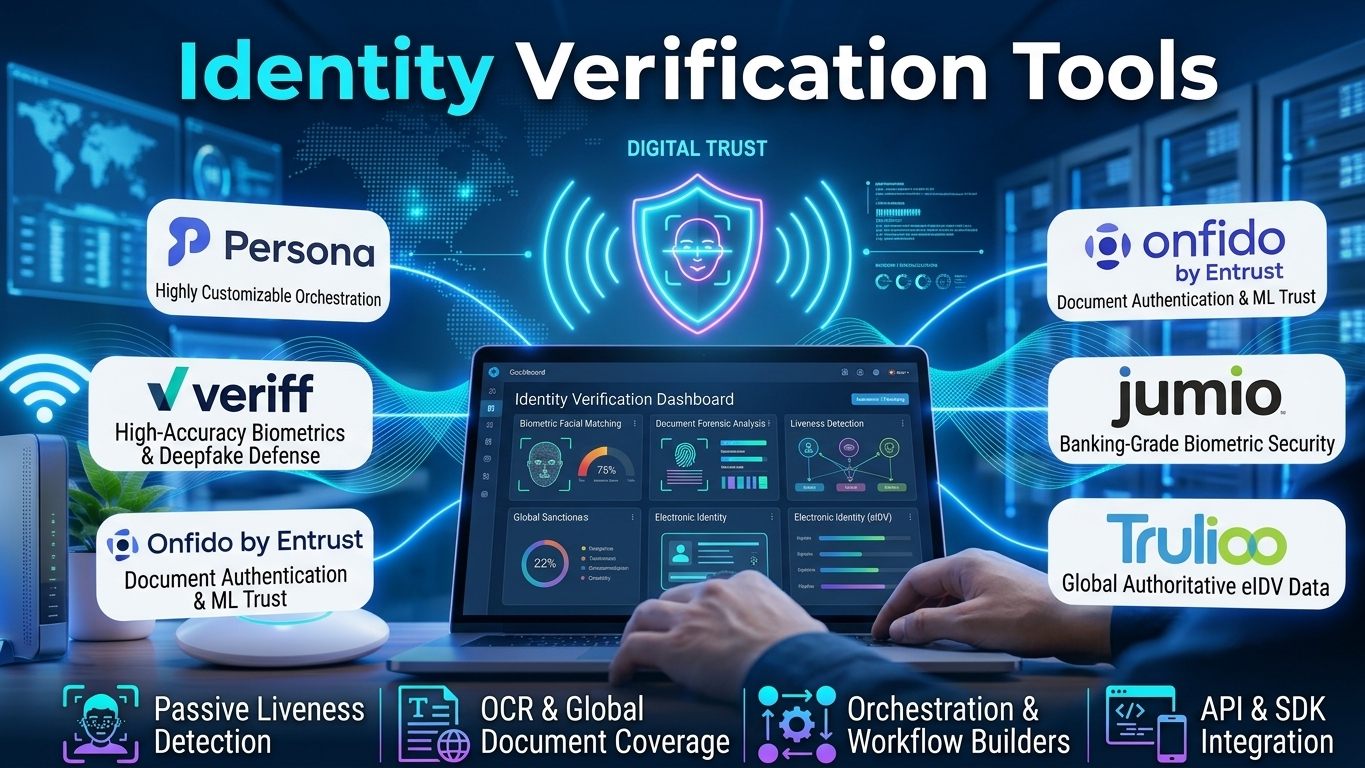
Organizations operating in the digital economy face an uncomfortable operational paradox: customers demand instant, frictionless onboarding, yet digital fraudsters deploy sophisticated generative artificial intelligence, deepfakes, and stolen synthetic identities to exploit every open registration form. Relying on traditional manual verification methods—such as asking users to upload a blurry photo of a driver’s license and waiting days for a back-office team to review it—results in unacceptable customer drop-off rates and soaring operational overhead.
Identity Verification (IDV) tools automate the entire verification lifecycle, combining document forensics, passive biometric liveness detection, database cross-matching, and machine learning to confirm a user’s identity in seconds. Selecting the right IDV solution requires balancing conversion rate optimization, fraud defense robustness, and global regulatory compliance.
Understanding the Core Components of Modern IDV Architecture
Identity verification software encompasses enterprise platforms designed to authenticate that a digital user is who they claim to be by verifying their physical identity documents and matching them to live biometric data.
Unlike basic authentication tools that merely check passwords or send SMS multi-factor verification codes, modern IDV platforms validate the foundational truth of a user’s real-world identity.
A professional identity verification platform typically governs several critical operational stages:
- Document Capture and Forensic Analysis: Ingesting images of passports, national ID cards, or driver’s licenses, and inspecting security features, microprinting, and holographic elements for signs of forgery.
- Biometric Facial Recognition and Liveness Detection: Capturing a live selfie or short video to match facial geometry against the ID document while performing active or passive liveness checks to prevent spoofing via printed photos, masks, or synthetic deepfake videos.
- Electronic Identity Verification (eIDV): Cross-referencing user-submitted data (name, address, date of birth) against authoritative government databases, credit bureaus, and utility registries without requiring document uploads.
- Orchestration and Risk Scoring: Aggregating verification signals into a unified risk score and routing users through customizable fallback workflows based on regional risk profiles.
The primary objective is to stop fraudulent actors instantly while ensuring legitimate customers experience a seamless, frictionless onboarding flow.
Key Evaluation Criteria for IDV Solutions
Selecting an enterprise IDV platform requires examining biometric accuracy, fraud detection sophistication, and developer integration flexibility.
Passive versus Active Liveness Detection
Friction is the primary enemy of conversion rates. Active liveness checks require users to follow specific instructions (such as blinking or turning their head), which can frustrate users. Leading IDV tools utilize passive liveness detection, analyzing facial micro-movements and lighting reflections automatically during a normal selfie capture without requiring user action.
Global Document Coverage and OCR Accuracy
For multinational enterprises, an IDV tool must accurately parse and authenticate thousands of diverse document formats across multiple alphabets and languages. Superior optical character recognition (OCR) ensures names and identification numbers are extracted flawlessly.
Developer SDKs and Custom Workflow Orchestration
Integrating identity checks into mobile apps and web portals should not require months of custom engineering. Top-tier IDV platforms provide robust, lightweight SDKs (iOS, Android, Web) and low-code orchestration builders that allow compliance teams to adjust verification steps dynamically.
Leading Identity Verification Platforms and Tools
The identity verification software market features specialized biometric security innovators alongside comprehensive enterprise trust platforms.
Persona
Persona provides a highly customizable identity infrastructure platform that enables organizations to orchestrate bespoke verification flows using modular components and developer-friendly APIs.
- Primary Focus: Flexible identity orchestration, automated verification workflows, and secure data governance.
- Deployment Model: Cloud SaaS platform with low-code workflow builders and robust SDKs.
- Significant Advantage: Unmatched customization flexibility, allowing compliance teams to build and modify verification steps dynamically without heavy engineering support.
- Important Limitation: Building highly tailored, multi-layered verification flows demands greater upfront configuration time.
Veriff
Veriff is an AI-powered identity verification platform renowned for its high-accuracy biometric facial matching and rapid decisioning speed, designed to prevent sophisticated identity fraud.
- Primary Focus: High-accuracy biometric authentication, fraud prevention, and video-assisted verification.
- Deployment Model: Cloud SaaS platform with native mobile and web SDKs.
- Significant Advantage: Exceptional biometric matching accuracy and robust computer vision models capable of detecting subtle document tampering and deepfake attempts.
- Important Limitation: Pricing tiers and enterprise structures are optimized primarily for high-volume mid-market and enterprise operations.
Onfido (by Entrust)
Onfido delivers trusted enterprise identity verification powered by proprietary machine learning technology, helping global brands automate customer onboarding securely.
- Primary Focus: Document authentication, biometric facial verification, and fraud intelligence.
- Deployment Model: Cloud SaaS platform with enterprise-grade SDK integrations.
- Significant Advantage: Strong reputation for regulatory compliance and robust machine learning models trained on global fraud patterns.
- Important Limitation: Custom workflow branching can feel more rigid compared to modular orchestration-first platforms.
Jumio
Jumio is a long-standing enterprise leader in AI-powered identity verification, offering highly secure document scanning and biometric authentication trusted by major global banks.
- Primary Focus: Enterprise-grade biometric verification, KYC compliance, and document scanning.
- Deployment Model: Cloud SaaS platform with robust enterprise SDKs.
- Significant Advantage: Industry-leading biometric accuracy and proven enterprise compliance standards trusted by heavily regulated financial institutions.
- Important Limitation: Pricing models and enterprise contract structures are tailored primarily for large-scale operations.
Trulioo
Trulioo provides global identity verification through a single API, specializing heavily in instant electronic identity verification (eIDV) via authoritative data sources worldwide.
- Primary Focus: Global electronic identity verification (eIDV) and database cross-matching.
- Deployment Model: Cloud SaaS platform via unified API.
- Significant Advantage: Extensive access to trusted government and bureau databases globally, enabling instant verification without requiring document uploads in many regions.
- Important Limitation: Relies heavily on underlying government and credit bureau data availability, which can vary across emerging markets.
Platform Comparison Overview
| Product | Primary Focus | Deployment Model | Significant Advantage | Important Limitation |
| Persona | Highly customizable identity orchestration and workflows | Cloud SaaS / API | Unmatched low-code workflow flexibility and developer control | Requires greater upfront technical configuration |
| Veriff | High-accuracy biometric matching and deepfake defense | Cloud SaaS / SDK | Superior computer vision models for detecting subtle document fraud | Enterprise pricing geared toward high-volume operations |
| Onfido | Enterprise identity verification and machine learning trust | Cloud SaaS / SDK | Proven compliance standards and robust global fraud intelligence | Workflow branching is less modular than orchestration tools |
| Jumio | Enterprise-grade biometric authentication and ID scanning | Cloud SaaS / Enterprise | Trusted banking-grade biometric accuracy and security standards | Contract structures optimized primarily for large enterprises |
| Trulioo | Global electronic identity and database verification | Cloud SaaS / API | Instant verification via authoritative government and bureau data | Dependent on local database availability in specific regions |
Operational Risks and Common Pitfalls
Implementing identity verification tools without structured testing can introduce severe user friction and security gaps.
Prioritizing Security at the Expense of User Conversion
Setting biometric thresholds too aggressively or demanding excessive document uploads for low-risk users drives high customer drop-off rates at checkout or onboarding.
Failing to Detect Modern AI Spoofing and Deepfakes
Relying on legacy document scanning tools that lack passive liveness detection leaves organizations vulnerable to fraudsters using AI-generated deepfakes and high-resolution printed masks.
Ignoring Regional Data Privacy Regulations
Collecting and storing biometric facial scans and government identity documents globally requires strict adherence to regional privacy laws, such as GDPR and biometric privacy statutes.
Questions to Guide Vendor Selection
Before procuring an identity verification platform, product managers, compliance officers, and engineering leaders should address several critical operational questions:
- What is the platform’s average decision latency during document capture and biometric matching? Does it verify users in seconds?
- Does the vendor support passive liveness detection to ensure a frictionless user experience during selfie capture?
- How comprehensive is the vendor’s document coverage in our primary target geographic markets?
- Can the platform orchestrate fallback workflows automatically if a primary database check or document scan fails?
Making the Final Decision
Choosing an identity verification tool depends heavily on an organization’s user acquisition goals, risk tolerance, and developer resources.
Organizations seeking ultimate workflow flexibility and rapid developer integration frequently choose orchestration platforms like Persona. Enterprises prioritizing rigorous biometric accuracy and deepfake defense often select computer vision leaders like Veriff or Onfido, while financial institutions and global enterprises rely on established standards like Jumio or Trulioo.
Ultimately, modern identity verification tools strike the balance between frictionless digital onboarding and impenetrable fraud defense, establishing secure digital trust across every customer interaction.
