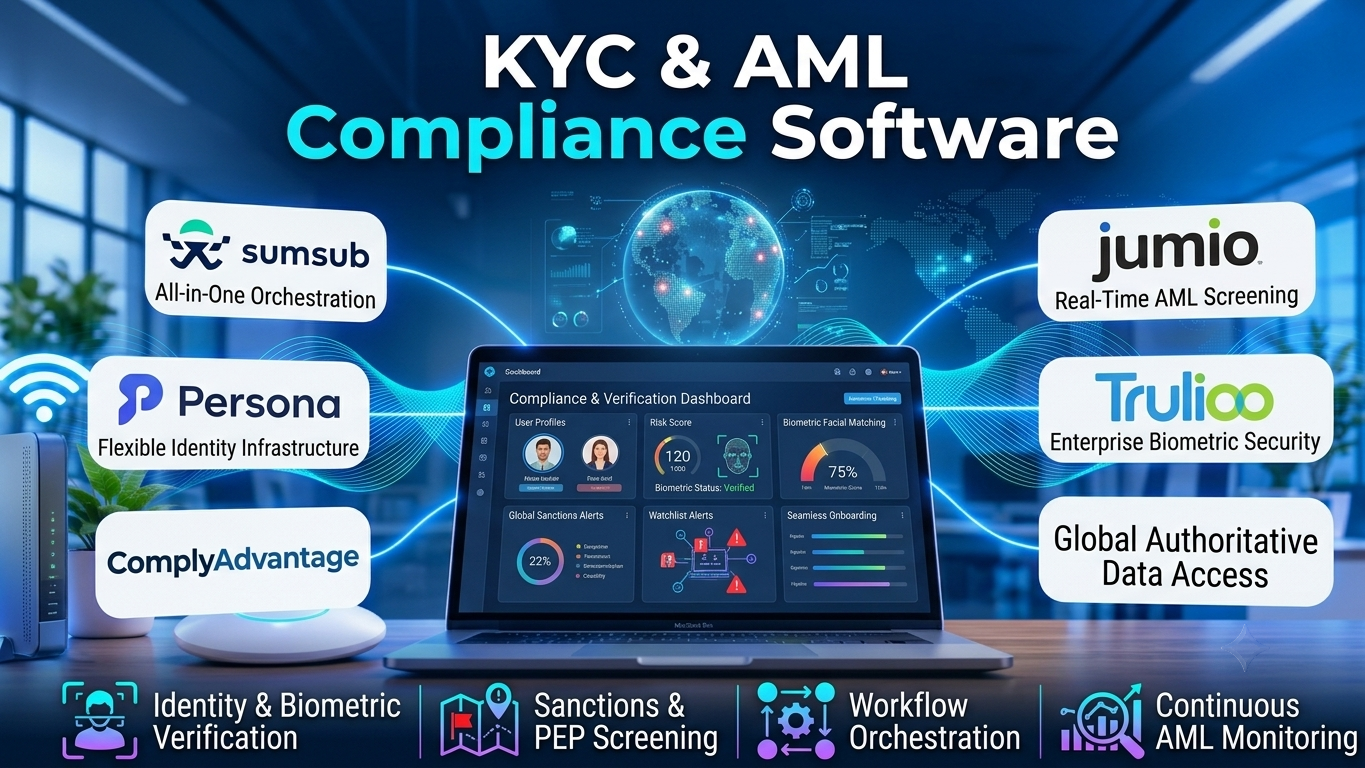
Financial institutions, fintech startups, cryptocurrency exchanges, and digital marketplaces operate under an intense regulatory microscope. Onboarding a new customer instantly via a frictionless mobile application is essential for business growth, but letting an unverified user slip through the cracks can result in devastating consequences: multi-million-dollar regulatory fines, criminal liability for money laundering, and severe reputational damage.
Historically, Know Your Customer (KYC) and Anti-Money Laundering (AML) compliance relied on manual document reviews, physical identity checks, and static spreadsheets. That manual approach creates severe operational bottlenecks and high error rates. Modern KYC and AML compliance tools automate identity verification, document authentication, biometric facial recognition, global watchlist screening, and transaction monitoring in milliseconds. Selecting the right compliance software requires balancing rigorous regulatory adherence with a seamless customer onboarding experience.
Understanding the Dual Pillars of Compliance
While frequently bundled together under a single compliance banner, KYC and AML serve distinct yet deeply integrated functions within financial operations:
- Know Your Customer (KYC): The foundational process of verifying the identity of a customer during onboarding. This involves collecting official identity documents (passports, driver’s licenses), verifying document authenticity, and matching live biometric selfies to the ID.
- Anti-Money Laundering (AML): The ongoing monitoring framework designed to prevent criminals from disguising illegally obtained funds as legitimate income. AML workflows include screening users against Politically Exposed Persons (PEPs) and global sanctions lists, checking adverse media databases, and monitoring ongoing transaction behavior for suspicious patterns.
The fundamental objective is to establish absolute trust during onboarding while maintaining continuous vigilance against financial crime throughout the customer lifecycle.
Key Evaluation Criteria for Compliance Platforms
Selecting an enterprise KYC and AML software suite requires examining verification accuracy, global database coverage, and API flexibility.
Automated Document Authentication and Liveness Detection
Fraudsters increasingly rely on sophisticated deepfakes, printed masks, and forged digital documents to bypass automated onboarding. Leading KYC platforms incorporate advanced liveness detection and forensic document analysis to confirm that a live human is presenting a genuine, unaltered physical identity card.
Real-Time Sanctions and Watchlist Screening
AML monitoring requires continuous screening against global watchlists, including OFAC, Interpol, EU sanctions lists, and extensive adverse media databases. A robust platform updates these lists in real time to prevent regulatory breaches.
Orchestration and Modular Workflow Flexibility
Every jurisdiction has unique regulatory mandates. An effective compliance platform provides modular workflow orchestration, allowing compliance officers to customize onboarding steps dynamically based on a user’s risk score, geographic location, or transaction volume.
Leading KYC and AML Compliance Platforms
The compliance software market features agile digital-first identity verification innovators alongside comprehensive enterprise AML transaction monitoring suites.
Sumsub
Sumsub is an all-in-one verification platform offering robust KYC, KYB (Know Your Business), AML screening, and fraud prevention tools tailored for global digital enterprises.
- Primary Focus: Full-lifecycle verification, anti-fraud protection, and customizable onboarding workflows.
- Deployment Model: Cloud SaaS platform with flexible REST APIs and native mobile SDKs.
- Significant Advantage: Exceptional global document coverage spanning thousands of document types across over two hundred jurisdictions.
- Important Limitation: Advanced customization of complex multi-tier risk scoring rules requires dedicated compliance administration.
Persona
Persona provides a highly customizable identity infrastructure platform that allows companies to build bespoke verification flows tailored to their exact risk requirements and user experience standards.
- Primary Focus: Flexible identity orchestration, automated verification, and secure data handling.
- Deployment Model: Cloud SaaS platform with developer-friendly APIs and low-code workflow builders.
- Significant Advantage: Unmatched workflow customization and developer flexibility, making it easy to tailor verification steps dynamically.
- Important Limitation: Building highly customized compliance flows requires greater upfront configuration and technical resource allocation.
ComplyAdvantage
ComplyAdvantage delivers AI-driven financial crime data and AML screening solutions, specializing in real-time sanctions screening and automated adverse media monitoring.
- Primary Focus: Real-time AML screening, PEP monitoring, and adverse media intelligence.
- Deployment Model: Cloud SaaS platform via API integration.
- Significant Advantage: Proprietary, real-time risk database that updates instantly, significantly reducing false positives compared to legacy static databases.
- Important Limitation: Focuses primarily on AML screening and monitoring, requiring integration with a separate partner for document-based KYC verification.
Jumio
Jumio is a long-standing enterprise leader in AI-powered identity verification, offering highly secure document scanning and biometric authentication trusted by major global banks.
- Primary Focus: Enterprise-grade biometric identity verification and document authentication.
- Deployment Model: Cloud SaaS platform with robust enterprise SDKs.
- Significant Advantage: Industry-leading biometric accuracy and proven enterprise compliance standards trusted by heavily regulated financial institutions.
- Important Limitation: Pricing models and enterprise contract structures are tailored primarily for large-scale operations.
Trulioo
Trulioo provides global identity verification through a single API, offering instant access to authoritative data sources to verify both individuals and business entities worldwide.
- Primary Focus: Global electronic identity verification (eIDV) and business verification.
- Deployment Model: Cloud SaaS platform via unified API.
- Significant Advantage: Extensive access to trusted government and bureau databases globally, enabling instant verification without requiring document uploads in many regions.
- Important Limitation: Relies heavily on underlying government and credit bureau data availability, which can vary across emerging markets.
Platform Comparison Overview
| Product | Primary Focus | Deployment Model | Significant Advantage | Important Limitation |
| Sumsub | Full-lifecycle KYC, KYB, and anti-fraud orchestration | Cloud SaaS / SDK | Massive global document type and jurisdiction coverage | Complex risk rule tuning requires administrative expertise |
| Persona | Highly customizable identity orchestration and workflows | Cloud SaaS / API | Unmatched low-code workflow flexibility and developer control | Requires greater upfront technical configuration |
| ComplyAdvantage | Real-time AML screening, PEPs, and adverse media | Cloud SaaS / API | Proprietary real-time risk database reducing false positives | Focuses on AML screening, needing a separate KYC document partner |
| Jumio | Enterprise-grade biometric authentication and ID scanning | Cloud SaaS / Enterprise | Trusted banking-grade biometric accuracy and security standards | Pricing and structures are optimized primarily for large enterprises |
| Trulioo | Global electronic identity and business verification | Cloud SaaS / API | Access to authoritative global bureau and government databases | Dependent on local database availability in specific regions |
Operational Risks and Common Pitfalls
Implementing compliance software without structured oversight introduces significant regulatory and business risks.
High False-Positive Rates Causing Friction
Overly sensitive AML screening rules can flag legitimate customers with common names as potential sanctions matches, forcing manual compliance reviews that delay onboarding and frustrate users.
Relying on Fragmented Point Solutions
Using one vendor for document scanning, another for watchlist screening, and a third for transaction monitoring creates data silos and integration blind spots that regulators audit harshly.
Ignoring Local Data Privacy Regulations
Collecting and storing biometric facial scans and government identity documents globally requires strict adherence to regional privacy laws, such as GDPR and biometric privacy statutes.
Questions to Guide Vendor Selection
Before procuring KYC and AML compliance software, compliance officers, risk managers, and engineering leaders should address several critical operational questions:
- How extensive is the vendor’s document and data coverage in our primary target geographic markets?
- What is the average verification latency during onboarding? Does the platform deliver results fast enough to prevent user drop-off?
- How does the system handle false positives during AML screening, and what tools are provided for compliance analysts to conduct manual reviews efficiently?
- Is the platform capable of scaling seamlessly from identity verification (KYC) into ongoing transaction monitoring (AML)?
Making the Final Decision
Choosing a KYC and AML compliance platform depends heavily on an organization’s regulatory environment, geographic footprint, and risk tolerance.
Fintechs and digital platforms seeking all-in-one orchestration and global document coverage frequently choose flexible platforms like Sumsub or Persona. Enterprises requiring deep, real-time financial crime screening often integrate specialized databases like ComplyAdvantage, while traditional financial institutions needing banking-grade biometric verification rely on enterprise leaders like Jumio or Trulioo.
Ultimately, modern KYC and AML compliance software turns regulatory obligations into a streamlined competitive advantage, securing the enterprise while welcoming legitimate customers instantly.
