Security teams frequently run routine scans, collect hundreds of vulnerability alerts, and still struggle to answer a foundational operational question: which flaws actually expose the organization to immediate compromise, and how should remediation efforts be prioritized?
A vulnerability assessment tool is only the starting point. Without proper context, asset discovery, and workflow integration, scanning reports turn into unmanageable lists of common vulnerabilities and exposures (CVEs) that overwhelm engineering teams and obscure critical risks. Selecting the right platform requires looking past raw vulnerability counts to evaluate how effectively a tool discovers assets, minimizes false positives, and communicates risk to both technical operators and leadership.
Understanding What Vulnerability Assessment Tools Actually Do
Vulnerability assessment is the systematic process of identifying, quantifying, and prioritizing security weaknesses in systems, applications, networks, and cloud environments. Unlike penetration testing, which simulates a targeted human attack to test specific defenses, vulnerability assessment is designed for continuous, broad coverage across an organization’s digital surface.
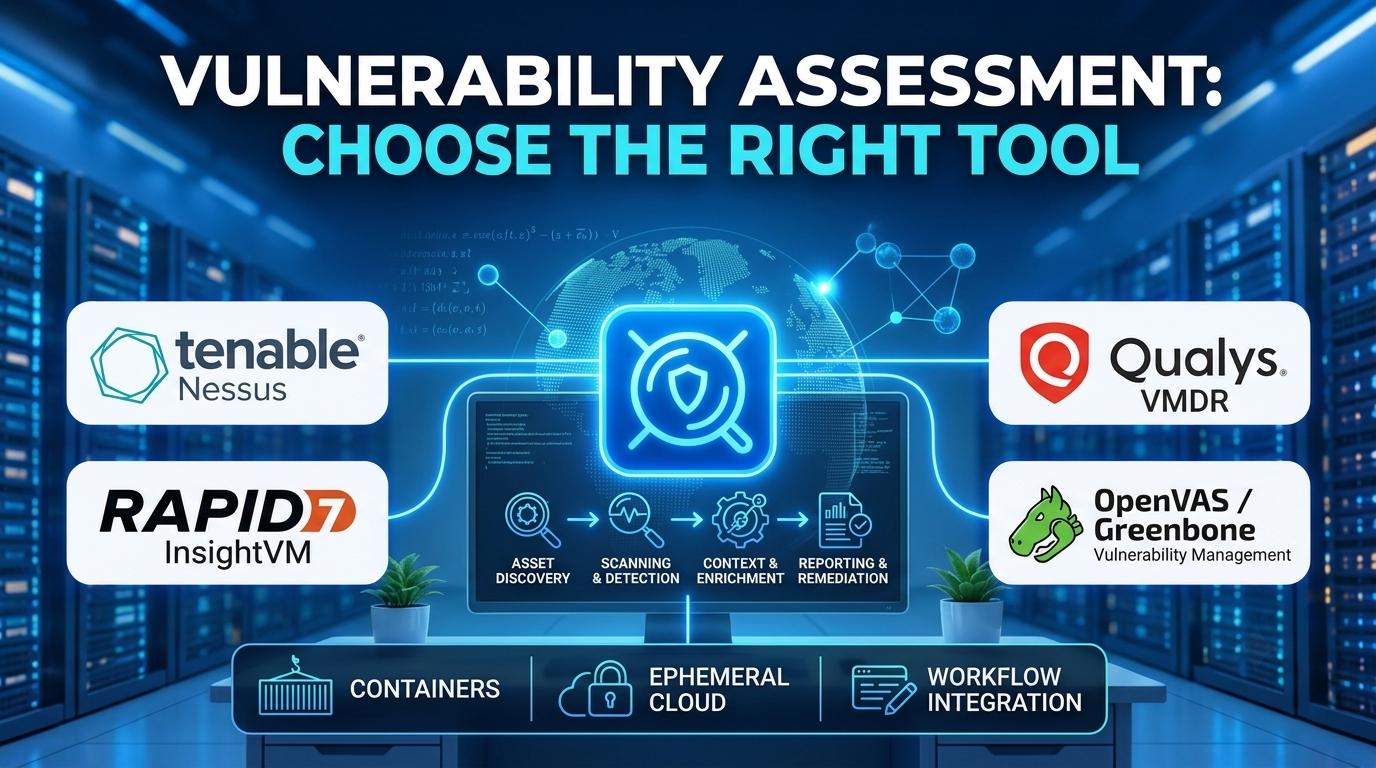
A robust assessment workflow typically involves several distinct stages:
- Asset Discovery: Identifying every active IP address, server, container, application, and cloud resource operating within the network perimeter and internal segments.
- Scanning and Detection: Probing assets using authenticated (credentialed) and unauthenticated methods to detect missing patches, misconfigurations, and outdated software packages.
- Contextualization and Enrichment: Combining raw vulnerability data with threat intelligence, asset criticality ratings, and exploit availability to determine real-world risk.
- Reporting and Remediation: Delivering actionable data to system administrators, developers, or patch management pipelines through ticketing systems and dashboards.
The core objective is to move away from treating all vulnerabilities as equal threats and instead focus remediation resources where exposure meets actual exploitability.
Key Criteria for Evaluating Assessment Platforms
Choosing a vulnerability assessment platform involves analyzing several technical and operational factors that dictate long-term success.
Asset Visibility and Scope Coverage
An effective tool must discover shadow IT, ephemeral cloud instances, and remote endpoints. Modern environments span local data centers, multi-cloud architectures, and containerized workloads. A platform restricted to traditional IP-based network scanning will miss container vulnerabilities and serverless misconfigurations.
Credentialed versus Uncredentialed Scanning
While uncredentialed network scans reveal perimeter exposures and open ports, they offer limited insight into internal package versions and local misconfigurations. Credentialed scanning logs into targets securely to inspect installed software, registry settings, and file permissions, yielding a far more accurate vulnerability inventory.
Signal-to-Noise Ratio and False Positives
Vulnerability scanners notoriously generate false positives due to banner grabbing and version-string matching. Platforms that incorporate threat intelligence feeds, exploit validation, and configuration validation help security teams filter out noise and focus on verified risks.
Integration with Existing Workflows
Discovery data is useless if it remains siloed inside a security dashboard. Seamless integration with ticketing platforms (such as Jira or ServiceNow), patch management tools, and CI/CD pipelines ensures that identified weaknesses reach the engineers responsible for remediation without manual intervention.
Leading Vulnerability Assessment Platforms
The market includes a broad spectrum of solutions, ranging from enterprise-grade commercial platforms to open-source utilities designed for specific security engineering workflows.
Tenable Nessus and Tenable Enterprise
Tenable provides some of the most widely deployed scanning engines in the industry. Known for its extensive vulnerability plugin library and precise detection capabilities, Nessus serves as a standard benchmark for infrastructure scanning.
- Primary Focus: Comprehensive infrastructure, network, and active directory assessment.
- Deployment Model: On-premises management, hybrid sensors, and cloud-native SaaS options.
- Significant Advantage: Massive vulnerability coverage database with frequent updates matching newly disclosed threat vectors.
- Important Limitation: Advanced asset tagging, continuous monitoring, and enterprise management require higher-tier commercial licenses.
Qualys VMDR (Vulnerability Management, Detection, and Response)
Qualys offers a cloud-native platform that unifies asset discovery, vulnerability assessment, threat prioritization, and patch patching workflows into a single interface.
- Primary Focus: Enterprise-scale cloud and hybrid vulnerability management.
- Deployment Model: Cloud-delivered platform using lightweight local sensors and agents.
- Significant Advantage: Centralized visibility across distributed environments without requiring complex on-premises server infrastructure.
- Important Limitation: Initial agent deployment and tuning across complex network topologies require deliberate administrative planning.
Rapid7 InsightVM
InsightVM focuses heavily on risk prioritization, remediation workflows, and visualization, helping teams understand how vulnerabilities cluster across business units.
- Primary Focus: Risk-prioritized vulnerability management and remediation tracking.
- Deployment Model: SaaS-managed platform with on-premises or cloud collectors.
- Significant Advantage: Translates raw risk scores into live remediation dashboards and integrates tightly with developer and IT ticketing workflows.
- Important Limitation: Licensing costs scale with the number of assets, which can escalate quickly in dynamic cloud environments.
OpenVAS / Greenbone Vulnerability Management
For organizations requiring an open-source alternative, Greenbone provides a robust, standards-compliant vulnerability assessment solution built around the OpenVAS scanning engine.
- Primary Focus: Open-source network vulnerability scanning and management.
- Deployment Model: Self-hosted virtual appliance or container deployment.
- Significant Advantage: Zero software licensing fees and full control over infrastructure data and scanning routines.
- Important Limitation: Requires significant in-house Linux administration and security expertise to maintain, tune, and troubleshoot.
Platform Comparison Overview
| Product | Primary Focus | Deployment Model | Significant Advantage | Important Limitation |
| Tenable Nessus | Deep infrastructure scanning | Hybrid / On-Prem / Cloud | Extensive plugin library and vulnerability coverage | Advanced enterprise features require higher tiers |
| Qualys VMDR | Cloud-native VM and response | SaaS / Cloud Agent | Unified asset discovery and patch tracking | Initial agent deployment requires careful planning |
| Rapid7 InsightVM | Remediation and risk visibility | SaaS / Collector | Excellent developer and IT workflow integrations | Asset-based licensing can scale up quickly |
| Greenbone / OpenVAS | Open-source vulnerability scanning | Self-Hosted | Full data control and no licensing fees | Demands significant internal maintenance expertise |
Operational Considerations and Common Pitfalls
Implementing a vulnerability assessment program involves navigating several organizational and technical hurdles.
Treating All Findings with Equal Urgency
Attempting to patch every low-severity vulnerability simultaneously leads to operational burnout. Effective programs focus remediation efforts on vulnerabilities that have verified exploits available in the wild, affect mission-critical assets, or reside on internet-facing perimeters.
Scanning Without Stakeholder Alignment
Running aggressive vulnerability scans against production databases or fragile industrial control systems without prior coordination can cause service degradation or application downtime. Maintenance windows, scan rate limiting, and exclusion lists are essential operational safeguards.
Neglecting Asset Lifecycle Management
An organization cannot secure assets it does not know exist. Static asset lists quickly drift out of date in modern cloud and remote work environments. Automated asset discovery must run continuously to catch newly spun-up instances before an adversary finds them.
Questions to Guide Vendor Selection
Before committing to a vulnerability assessment platform, security architects and IT leaders should address specific operational questions:
- How does the platform handle dynamic cloud assets, containers, and temporary virtual machines without inflating licensing counts?
- Does the solution support authenticated scanning smoothly across Linux, Windows, and specialized operating systems without generating excessive administrative overhead?
- How are vulnerability scores calculated? Are they based solely on CVSS metrics, or do they factor in active threat intelligence and real-world exploit availability?
- What automated integrations exist for pushing findings directly into existing incident response, ticketing, and patch deployment pipelines?
Making the Final Decision
Choosing a vulnerability assessment platform depends heavily on an organization’s operational maturity, resource capacity, and architectural footprint.
Organizations with dedicated security operations teams managing complex hybrid environments often benefit from established SaaS platforms like Qualys or Rapid7, where automated asset discovery and remediation workflows reduce manual tracking. Conversely, teams with strict data sovereignty requirements or constrained software budgets can leverage open-source solutions like Greenbone to build capable scanning foundations, provided they invest the necessary engineering time into maintenance.
Regardless of the chosen software, the true value of vulnerability assessment lies not in generating endless reports, but in establishing a repeatable, disciplined rhythm of discovery, prioritization, and remediation.
