A security team can subscribe to dozens of threat feeds and still struggle to answer a basic question: does this indicator matter to our organization, and what should we do about it?
A suspicious IP address, domain, file hash, or vulnerability reference is only a starting point. Without context, it may be outdated, duplicated, incorrectly classified, or irrelevant to the systems an organization actually operates. Analysts need to understand where an indicator came from, how reliable it is, which campaigns or threat actors it relates to, and whether it should change a detection or response decision.
That is the problem a Threat Intelligence Platform (TIP) is designed to address. It brings intelligence from different sources into a managed environment where teams can normalize, enrich, correlate, investigate, share, and distribute it to security tools.
The important distinction is that a TIP is not simply a feed aggregator. Its value comes from turning disconnected observations into intelligence that can support a specific defensive decision. The right platform depends less on how many feeds it advertises and more on how well it connects intelligence to the organization’s analysts, controls, and operational priorities.
What a threat intelligence platform actually does
Threat intelligence is information about cyber threats that has been collected, assessed, and given enough context to support a decision. It can describe:
- Indicators of compromise (IOCs): IP addresses, domains, URLs, file hashes, email addresses, and other observable artifacts associated with suspicious or malicious activity.
- Threat actors: Groups or individuals associated with campaigns, infrastructure, tools, and techniques.
- Tactics, techniques, and procedures (TTPs): The methods adversaries use to gain access, move through environments, maintain persistence, or achieve their objectives.
- Campaign intelligence: Information connecting incidents, infrastructure, malware, and adversary activity into a broader operation.
- Vulnerability intelligence: Evidence about vulnerabilities being exploited, the actors using them, and the environments at risk.
- Strategic intelligence: Assessments of threat trends, industry targeting, geopolitical developments, and changes in the wider risk environment.
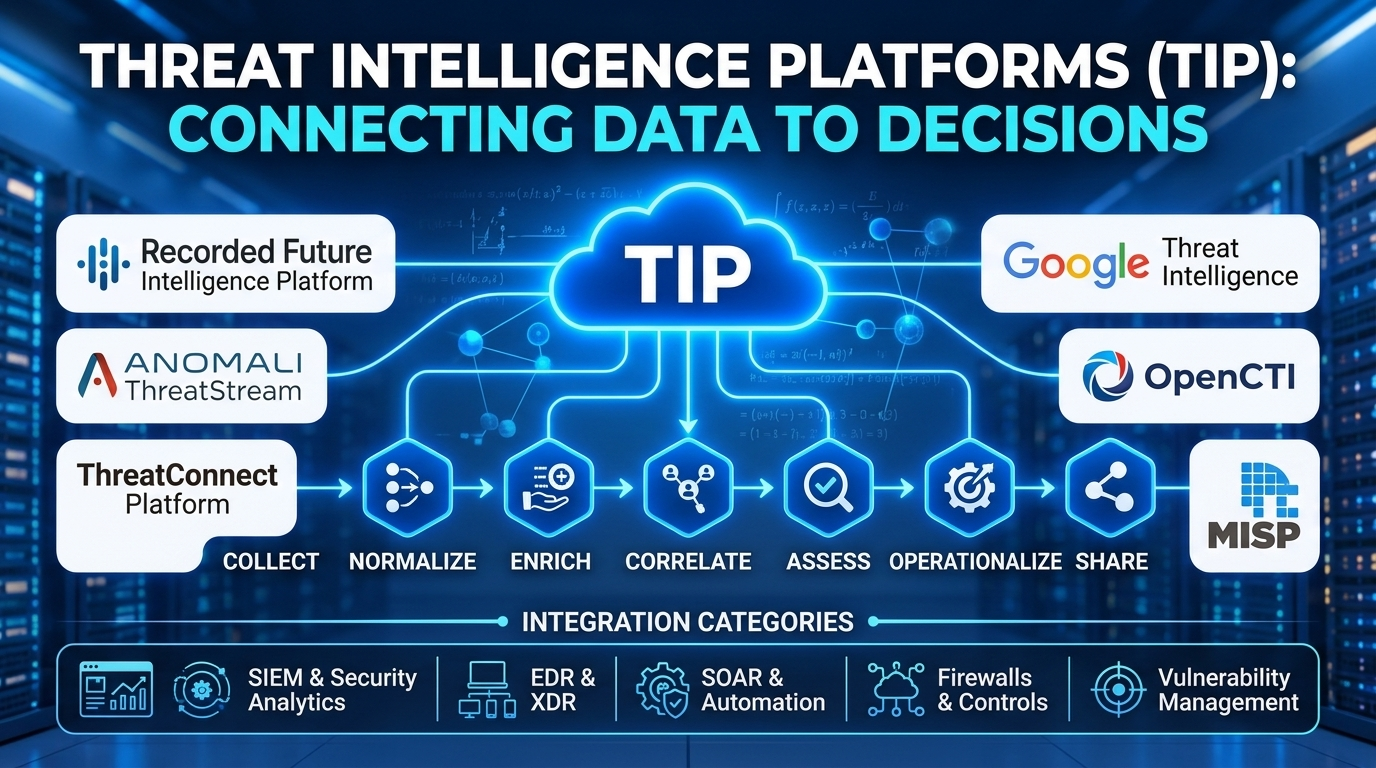
A TIP provides a working environment for managing these different forms of intelligence. A typical workflow looks like this:
- Collect: Import information from commercial subscriptions, open-source feeds, internal investigations, partner communities, and security products.
- Normalize: Convert different formats into consistent records and identify duplicate or conflicting entries.
- Enrich: Add context such as reputation, malware associations, threat actor relationships, sightings, and source information.
- Correlate: Connect related indicators, reports, campaigns, vulnerabilities, and internal events.
- Assess: Let analysts review reliability, confidence, relevance, and potential impact.
- Operationalize: Send useful intelligence to SIEM, EDR, firewall, email security, vulnerability management, and other defensive systems.
- Share: Distribute appropriate intelligence to internal teams or trusted external communities.
The process is not necessarily linear. An investigation may reveal new indicators that are fed back into the platform, while a new threat report may cause analysts to revisit older incidents.
The objective is to make intelligence useful throughout security operations rather than leave it in a collection of reports and spreadsheets.
A TIP is not the same as a threat feed, SIEM, or threat research portal
These categories overlap, but they solve different problems.
| Technology | Primary responsibility | Where it fits |
|---|---|---|
| Threat intelligence feed | Supplies indicators or intelligence reports | Provides raw or curated external information |
| Threat Intelligence Platform | Manages, enriches, correlates, and distributes intelligence | Connects intelligence sources to security workflows |
| SIEM | Collects and analyzes security events and logs | Detects suspicious activity across an environment |
| SOAR | Coordinates security workflows and response automation | Executes repeatable actions and playbooks |
| EDR/XDR | Detects and investigates activity across endpoints and other security layers | Provides telemetry, detection, and response capabilities |
| Threat research portal | Provides reports, reputation lookups, and investigative resources | Helps analysts research specific threats |
A threat feed can be valuable without being a TIP. Likewise, a SIEM may use threat intelligence to improve detection, but its primary purpose is event analysis rather than managing the complete intelligence lifecycle.
A threat research portal may offer excellent information about malware, infrastructure, or threat actors without providing all the functions required to operate an organization’s own intelligence program.
This distinction matters during procurement. Buying several overlapping subscriptions does not automatically create a mature intelligence capability.
Threat intelligence platforms worth evaluating
The following products represent different approaches to intelligence management. They are not ranked: some emphasize commercial intelligence and analyst research, while others focus on structured intelligence management, sharing, or integration with existing security operations.
Recorded Future Intelligence Platform
Commercial intelligence platform
Recorded Future Intelligence Platform is oriented toward organizations that want externally collected intelligence to inform security decisions across multiple teams.
Its platform brings together intelligence from sources such as the open web, dark web, technical feeds, and customer telemetry. Recorded Future describes its Intelligence Graph as the system connecting these sources and helping users identify relationships between threats and their organization. Its integrations and APIs connect intelligence with SIEM, SOAR, endpoint, identity, network security, and vulnerability management workflows. Recorded Future+1
The distinction is its emphasis on providing intelligence as an ongoing service rather than simply giving an organization a place to store its own indicators. This can be relevant to teams that need external context about threat actors, campaigns, exposed credentials, vulnerabilities, and risks affecting their industry.
However, organizations should examine how much of the platform’s intelligence is relevant to their own environment. A large volume of external reporting is not automatically useful. Buyers should assess source transparency, confidence information, regional and industry relevance, API entitlements, and the extent to which intelligence can be incorporated into existing workflows.
It is worth evaluating when the organization needs broad external intelligence and has the analysts and security tools to act on it.
Anomali ThreatStream
Commercial threat intelligence management
Anomali ThreatStream is designed to collect, manage, enrich, and operationalize intelligence from multiple sources.
Its documented capabilities include importing observables, investigating threat entities, using third-party enrichment, and accessing intelligence through REST APIs. Anomali also documents cloud and on-premises access options, including an air-gapped offering for environments with restricted connectivity. docs.anomali.com+2
The practical appeal is its focus on making intelligence available to security operations rather than treating it as a separate research activity. An organization can assess how it would use ThreatStream to consolidate feeds, enrich alerts, and distribute relevant information to other security systems.
Anomali’s current product direction also emphasizes managed intelligence, curated indicators, and the connection between threat context and operational decisions. These are vendor-described capabilities, so prospective customers should validate the exact functions included in the proposed subscription. Anomali+1
The main purchasing consideration is the relationship between the platform and the organization’s existing tools. Buyers should check API limits, connector availability, deployment requirements, data retention, and the cost of additional intelligence sources. An extensive integration catalogue is useful only when the required integrations work with the organization’s actual products and licensing arrangements.
ThreatConnect Platform
Threat intelligence operations and collaboration
ThreatConnect Platform brings threat intelligence operations together with security operations and cyber risk management workflows.
Its platform documentation describes capabilities for managing threat intelligence, collaborating across teams, and using intelligence and risk context to support security decisions. ThreatConnect also positions automation and analytics as part of its wider platform. knowledge.threatconnect.com
This makes it relevant to organizations where intelligence work is shared across analysts, incident responders, and risk teams. Rather than focusing exclusively on collecting indicators, the platform is intended to help teams manage intelligence as an operational process.
A buyer should examine how the platform represents intelligence relationships, handles analyst workflows, and connects with existing security systems. It is also important to understand how much customization is required to reflect the organization’s own intelligence requirements.
ThreatConnect is worth considering when collaboration, intelligence operations, and risk-oriented workflows are central requirements. Organizations that only need a lightweight feed collector may find a dedicated intelligence management platform more than they need.
Google Threat Intelligence
Commercial intelligence and threat research
Google Threat Intelligence combines intelligence and expertise associated with Google, Mandiant, and VirusTotal.
Its documented capabilities include indicator enrichment, threat actor and campaign research, malware analysis, threat hunting, vulnerability prioritization, and intelligence-informed alert triage. Google also describes using its intelligence within existing security workflows and supporting integrations with security products. Google Cloud+2
The platform’s appeal is the combination of large-scale threat data, specialist research, and technical investigation resources. For an incident response team, the ability to pivot from an indicator to related files, infrastructure, malware behavior, or campaign information can be more valuable than receiving another basic reputation score.
Google’s published subscription structure includes different service tiers, with pricing provided through sales rather than a simple universal public price. Buyers should confirm API allowances, access to specific intelligence capabilities, and which features are included in the proposed subscription. Google Cloud
Google Threat Intelligence is particularly relevant when an organization needs substantial external research and technical investigation capabilities. It should not automatically be treated as a replacement for a dedicated internal intelligence management workflow; the fit depends on how the organization manages its own intelligence records and sharing processes.
OpenCTI
Open-source cyber threat intelligence management
OpenCTI is an open-source platform for structuring, storing, organizing, and visualizing cyber threat intelligence.
It is built around a knowledge-management approach. Analysts can represent relationships among threat actors, campaigns, malware, tools, infrastructure, vulnerabilities, and other intelligence entities. The platform supports structured intelligence exchange through STIX 2.1 and uses connectors to import, enrich, and export information. docs.opencti.io+1
This relationship-oriented model is useful when an organization wants to move beyond isolated indicators. For example, an analyst investigating a suspicious domain may want to understand its relationship to infrastructure, malware, a campaign, or a known threat actor. OpenCTI provides a framework for organizing those connections.
The trade-off is operational responsibility. Its documented deployment architecture includes the platform, workers, connectors, and supporting infrastructure such as a search engine, message broker, and storage services. Production deployment therefore requires infrastructure planning, maintenance, monitoring, and appropriate technical expertise. OpenCTI Documentation+1
OpenCTI is a strong candidate for organizations that want control over their intelligence data model and are prepared to operate a self-managed platform. It is not automatically a low-effort alternative simply because its source code is available.
MISP
Open-source intelligence sharing and collaboration
MISP is designed for collecting, structuring, correlating, and sharing threat intelligence.
Its capabilities include event and attribute management, correlation, taxonomies, threat actor and malware modelling through galaxies, collaboration, and controlled information sharing. MISP also provides an API, Python tooling, and extension mechanisms for integrating intelligence into other systems. misp-project.org+1
One of MISP’s most important characteristics is its sharing model. Organizations can control the distribution of intelligence through sharing groups and distribution settings, including controls at the attribute level. This matters when information must be exchanged with partners without exposing every detail to every recipient.
MISP is often a practical choice for teams that want to build or participate in intelligence-sharing communities. Its public feeds can also help organizations begin working with external indicators, although every feed still needs to be assessed for quality, relevance, and permitted use. misp-project.org
The trade-off is that teams must take responsibility for deployment, configuration, feed selection, maintenance, and integration. MISP can support substantial intelligence workflows, but it does not remove the need for analysts to assess the information being shared.
How the platforms differ in practice
A feature checklist can make products appear more similar than they really are. The more useful comparison is the operational model each one supports.
| Platform | Main emphasis | Deployment or access model | Important consideration |
|---|---|---|---|
| Recorded Future | External intelligence and risk context | Commercial platform | Assess the relevance of intelligence to the organization’s sector and assets |
| Anomali ThreatStream | Intelligence aggregation, enrichment, and operationalization | Cloud and documented on-premises options | Validate connector coverage, API entitlements, and subscription scope |
| ThreatConnect | Intelligence operations, collaboration, and risk workflows | Commercial platform | Assess workflow fit and required customization |
| Google Threat Intelligence | External research, malware intelligence, and threat investigation | Commercial service | Confirm access to the specific research, API, and analysis capabilities required |
| OpenCTI | Structured intelligence knowledge management | Self-managed open-source platform | Requires infrastructure and connector operations |
| MISP | Intelligence sharing, correlation, and collaboration | Self-managed open-source platform | Feed quality, sharing governance, and maintenance remain the organization’s responsibility |
These products should not be treated as interchangeable. Recorded Future and Google Threat Intelligence place considerable emphasis on external intelligence and research. OpenCTI and MISP provide organizations with platforms for managing their own intelligence knowledge and sharing workflows. Anomali and ThreatConnect occupy broader operational management positions.
A buyer may even use more than one of these approaches. For example, a commercial intelligence subscription could supply external research while an internal platform manages intelligence relationships and controlled sharing. The important question is whether that combination creates useful capabilities or simply duplicates data and administration.
The standards that determine whether intelligence can move between tools
Interoperability is one of the most important technical considerations in a TIP evaluation. Intelligence that cannot be exchanged reliably may remain trapped in a vendor console or require custom scripts to reach the rest of the security environment.
Two standards are especially relevant.
STIX: a structured way to describe threat intelligence
Structured Threat Information Expression (STIX) provides a standardized way to represent cyber threat intelligence in a machine-readable format.
Instead of treating every indicator as an isolated string, STIX can represent objects and relationships such as threat actors, campaigns, malware, infrastructure, vulnerabilities, and observed activity. This gives systems a shared structure for exchanging more meaningful intelligence. oasis-open.github.io+1
For buyers, STIX support is useful when they need to exchange intelligence between different platforms or preserve relationships when exporting data. However, supporting the same standard does not guarantee that every product handles every object, relationship, or extension identically. Test the specific data types and workflows that matter.
TAXII: a mechanism for exchanging intelligence
Trusted Automated Exchange of Intelligence Information (TAXII) is a protocol designed to exchange cyber threat intelligence over HTTPS. It is commonly used alongside STIX to provide a standardized method for sharing structured intelligence between systems. oasis-open.github.io+1
A platform may support TAXII as a client, server, or both. Those roles are not identical. An organization should establish whether it needs to retrieve intelligence from external collections, publish its own collections, or exchange information bidirectionally.
Before selecting a platform, test whether it can import, export, and preserve the intelligence fields and relationships your team actually uses.
The buying decision that matters most: intelligence quality versus intelligence volume
A platform that imports thousands of indicators may look impressive in a demonstration. But high-volume ingestion can create a new problem if the organization cannot determine which records are reliable, current, and relevant.
Consider a hypothetical security team that receives several feeds containing the same suspicious domain. One source describes it as malicious, another reports it as suspicious, and a third has not updated its record for months. If the platform simply merges these records, the analyst may see a misleading result.
A useful intelligence workflow should preserve:
- Source provenance: Where the information originated and how it entered the platform.
- Confidence: How strongly the available evidence supports the assessment.
- Validity period: Whether the indicator is still considered relevant.
- Context: Why the indicator is associated with a threat.
- Sightings: Whether the organization or trusted partners have observed it.
- Handling restrictions: Whether the information can be shared externally.
- Analyst assessment: Whether a human reviewer has accepted, rejected, or modified the original information.
Confidence and severity should not be treated as interchangeable. An indicator may have high confidence of being malicious but low relevance to a particular organization. Another may be uncertain but important enough to investigate because it appears in a critical system.
The platform should help analysts preserve that distinction.
Integration is where a TIP earns its place
A threat intelligence platform becomes operationally useful when it can deliver relevant intelligence to the tools that enforce or investigate security decisions.
The integration requirements will vary by organization, but several connections deserve particular attention.
SIEM and security analytics
A SIEM can compare incoming events with threat intelligence to add context to alerts and help prioritize investigations. The TIP should be able to deliver useful indicators and associated context without overwhelming the SIEM with stale or low-confidence records.
Check whether integrations support more than basic indicator transfer. Context such as source, confidence, expiration, and threat relationships can make a meaningful difference to how analysts interpret a match.
EDR and XDR
Endpoint security tools can use threat intelligence to support investigation and detection workflows. A TIP may help distribute relevant indicators or provide context about suspicious files, domains, and infrastructure.
The important question is whether the receiving product can use the information in a meaningful way. A successful API connection does not necessarily mean that the endpoint tool will apply every field or relationship.
SOAR and automation
SOAR platforms can use intelligence to enrich alerts, select playbooks, and support response decisions. For example, an investigation workflow might query a TIP for information about a domain before deciding whether an alert deserves escalation.
Automated actions should depend on the quality and confidence of the intelligence. Blocking an indicator simply because it appears in one feed can disrupt legitimate business activity if the information is incorrect or outdated.
Firewalls, DNS security, and email protection
These controls can use selected intelligence to identify or restrict suspicious infrastructure, domains, URLs, or other indicators.
Before enabling automatic distribution, determine how the receiving product handles updates, removals, expiration, and false positives. A platform that sends an indicator to a firewall but does not reliably communicate when it becomes invalid can create long-lived operational problems.
Vulnerability management
Threat intelligence can help vulnerability teams distinguish between theoretical exposure and vulnerabilities associated with active exploitation or relevant campaigns.
This is particularly valuable when an organization has more vulnerabilities than it can remediate immediately. However, intelligence should inform prioritization rather than replace asset criticality, exposure assessment, exploitability analysis, and business impact.
Open-source versus commercial platforms
The choice between open-source and commercial intelligence tools is not simply a matter of licensing cost.
Open-source platforms such as MISP and OpenCTI provide control over deployment, data handling, customization, and the intelligence model. They can be attractive to organizations that have technical staff and want to build their own intelligence workflows.
Their costs are less visible than a subscription price. Infrastructure, upgrades, connector development, feed maintenance, monitoring, access control, backups, and analyst training all require resources.
Commercial platforms may reduce the effort required to acquire external intelligence, maintain integrations, or access specialist research. They can also provide support and managed services, depending on the subscription.
However, commercial licensing can introduce dependencies on a vendor’s data model, API limits, subscription tiers, and integration ecosystem. Organizations should understand how they can export their intelligence and what happens to their workflows if a contract changes.
A practical decision looks like this:
- Choose a commercial intelligence service when external research, curated intelligence, and specialist threat context are major requirements.
- Consider OpenCTI when structured intelligence relationships, customization, and control over the intelligence knowledge base are priorities.
- Consider MISP when community sharing, indicator correlation, and controlled distribution are central to the program.
- Evaluate a broader commercial TIP when analysts need a managed way to aggregate feeds, enrich information, collaborate, and distribute intelligence into security operations.
A small team with limited analyst capacity should be especially careful about adopting a self-managed platform that requires ongoing administration. A free licence does not make a system free to operate.
What organizations should test before committing
A product demonstration can show an attractive dashboard without revealing how the platform behaves under everyday operational conditions. A pilot should therefore use realistic data and workflows rather than a vendor-provided sample alone.
A useful evaluation can follow one indicator from ingestion to action.
- Import intelligence from at least two sources with overlapping or conflicting records.
- Confirm that the platform preserves source information and handles duplicates sensibly.
- Enrich an indicator and inspect the evidence behind its reputation or confidence assessment.
- Connect the indicator to a relevant threat report, campaign, or other intelligence object where supported.
- Send the information to a representative security tool.
- Confirm that the receiving tool preserves the fields needed by analysts.
- Change or expire the original indicator and check how that update is distributed.
- Export the intelligence and assess whether it remains usable outside the platform.
- Review permissions and confirm that sensitive intelligence is shared only with authorized users and groups.
The pilot should also measure the work required from analysts. If every imported record needs manual cleanup, or if integrations regularly require custom scripts, the platform may shift more work than it removes.
Questions to ask during a vendor evaluation
Data and intelligence quality
- Which intelligence sources are included in the subscription?
- Can analysts see the original source and supporting evidence?
- How are confidence, freshness, and expiration represented?
- How are conflicting reports and duplicate indicators handled?
- Can internal intelligence be combined with commercial and community sources?
Integration and interoperability
- Are the required SIEM, EDR, SOAR, firewall, and vulnerability management integrations supported?
- Are integrations native, partner-provided, or custom-built?
- Does the platform support the necessary STIX and TAXII workflows?
- Are API access and usage limits included in the proposed subscription?
- Can data be exported in a format that preserves important relationships?
Governance and deployment
- Which deployment regions and hosting arrangements are available?
- Where is intelligence stored and processed?
- Can access be restricted by team, role, or sharing group?
- How are audit records and data retention handled?
- What controls are available for sensitive or restricted intelligence?
Commercial and operational considerations
- Is pricing based on users, data volume, subscriptions, API consumption, or a combination?
- Are additional feeds and integrations charged separately?
- What support and onboarding services are included?
- What infrastructure and staff are needed to operate the platform?
- What happens to stored intelligence and integrations if the subscription ends?
These questions are more useful than comparing vendor feed counts or dashboard screenshots. They reveal whether the platform can support the organization’s actual intelligence lifecycle.
Common mistakes that undermine a threat intelligence program
Treating every indicator as equally important
An IP address or domain can change ownership, become inactive, or be reused for legitimate purposes. Intelligence needs context and a validity period. Automatically treating every match as malicious can create false positives and unnecessary response work.
Subscribing to feeds without defining their purpose
A feed should support a specific requirement, such as monitoring threats targeting an industry, enriching incident investigations, or improving detection coverage. If a source does not change a decision or improve a workflow, its ongoing value is questionable.
Confusing threat attribution with certainty
Threat actor names and campaign associations are analytical assessments. Different research groups may use different naming conventions or reach different conclusions. A TIP should preserve source attribution and confidence rather than present every association as unquestionable fact.
Ignoring intelligence expiration
Indicators can become stale. A platform should support expiration, review, and distribution of changes so that old intelligence does not remain active in downstream controls indefinitely.
Automating enforcement too early
A threat intelligence match is not always sufficient justification for blocking a domain, IP address, or file. Start with enrichment and analyst review. Introduce automatic enforcement only after the organization has tested the quality of its intelligence and the consequences of incorrect actions.
Buying a platform without assigning ownership
A TIP needs defined responsibility. Someone must manage feeds, review intelligence, maintain integrations, set sharing policies, and determine how intelligence affects detection and response. Without ownership, the platform can become another repository that collects information but does not influence security decisions.
When a dedicated TIP may be unnecessary
Not every organization needs a separate threat intelligence platform.
A small security team may already receive adequate intelligence through its SIEM, endpoint security service, managed security provider, or existing security subscriptions. If analysts rarely conduct threat research, do not exchange intelligence with partners, and have no need to manage large numbers of indicators, a dedicated platform may introduce more administration than value.
A standalone TIP becomes easier to justify when several of the following are true:
- Multiple intelligence sources need to be consolidated.
- Analysts repeatedly investigate the same indicators across different tools.
- The organization needs to preserve relationships between campaigns, actors, malware, and infrastructure.
- Intelligence must be shared with partners or separate business units under controlled policies.
- Security tools need a consistent source of enriched intelligence.
- Threat research and intelligence production are formal responsibilities.
- The organization needs to measure how intelligence influences detection, prioritization, or response.
The decision should be based on a real workflow gap, not the assumption that a more extensive security stack is automatically a better one.
Making the final choice
The strongest threat intelligence platform is the one that fits the organization’s intelligence maturity and security architecture.
Recorded Future and Google Threat Intelligence are worth examining when external research, curated intelligence, and threat context are priorities. Anomali ThreatStream and ThreatConnect deserve consideration when the requirement centers on managing intelligence operations and connecting information to security workflows. OpenCTI and MISP are compelling alternatives for organizations that value self-managed intelligence knowledge, customization, and sharing.
There is no reason to buy the largest platform available if the team cannot use its intelligence effectively. Start by identifying the decisions that currently lack reliable threat context. Then select a small set of representative sources, test how the platform handles conflicting and aging information, and follow intelligence through to the security tools that need it.
A successful TIP should make it easier to answer three questions: What do we know, why do we trust it, and what should change because of it? If a platform cannot help the team answer those questions in its everyday workflow, a larger feed catalogue will not solve the underlying problem.
