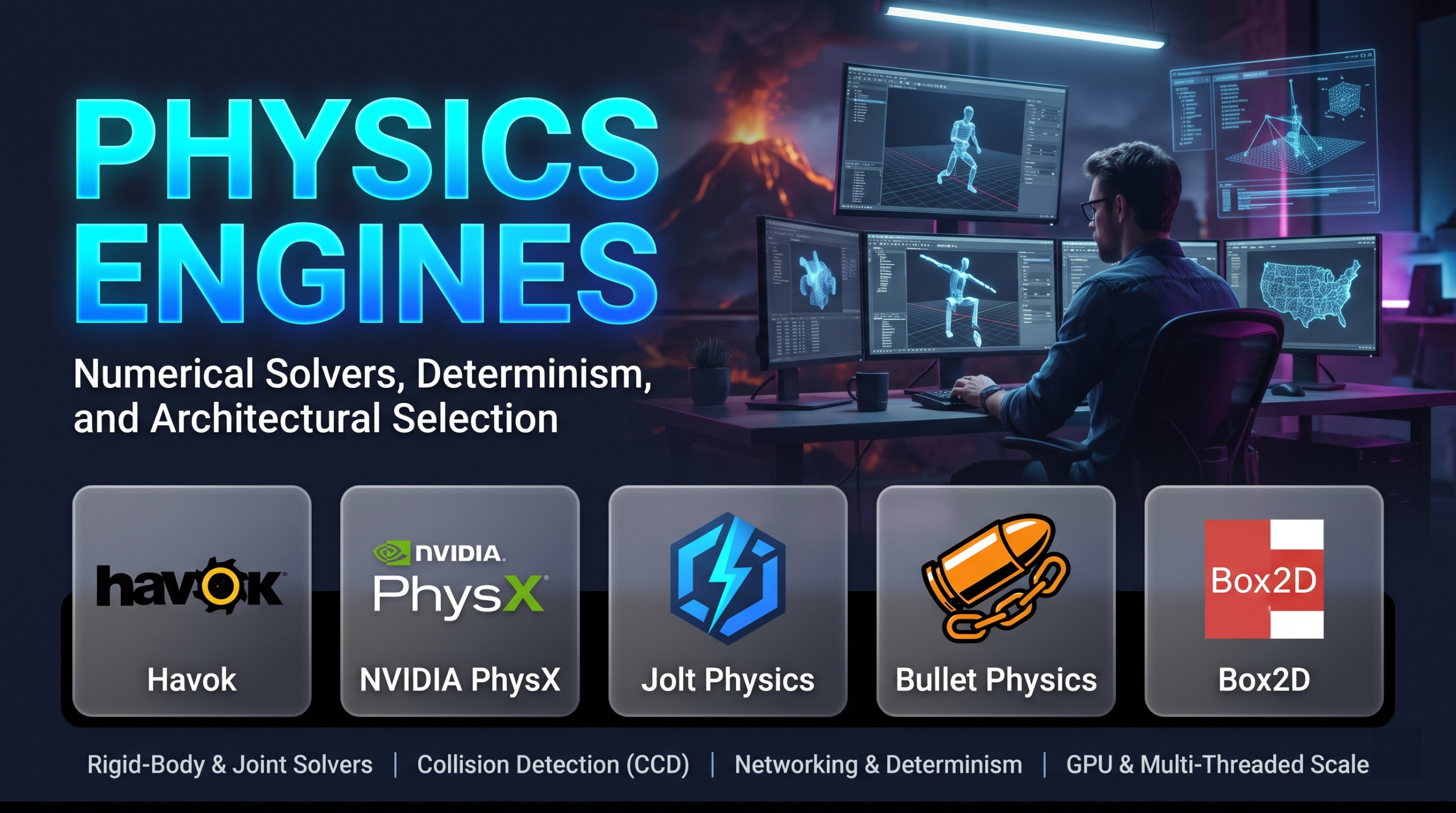
Real-time physics engines do not simulate physical reality. Instead, they produce computationally stable, visually plausible approximations of classical mechanics within non-negotiable performance budgets. In an interactive simulation or competitive multiplayer game running at sixty or one hundred twenty frames per second, a physics thread has between eight and sixteen milliseconds to complete its entire pipeline. Within that window, it must detect broad-phase bounding collisions, execute narrow-phase geometric intersections, build constraint islands, resolve non-penetration impulses, and integrate velocity and position vectors.
The central challenge in production engineering is not simply calculating motion; it is managing algorithmic compromise. Achieving absolute mathematical accuracy typically requires non-linear differential equations and microscopic timesteps that would reduce an interactive application to single-digit frame rates. Conversely, aggressive shortcuts introduce visible failure modes: tunneling (fast-moving objects passing straight through thin geometry), constraint stretching in complex ragdoll joints, energy drift that causes resting bodies to jitter indefinitely, and simulation divergence across networked clients.
Selecting a physics engine requires evaluating the fundamental architecture of its constraint solver, its deterministic guarantees, its memory layout, and its threading model against the target hardware.
Core Numerical Solver Architectures
The simulation pipeline of any rigid-body physics engine is governed by its approach to constraint resolution. A solver must enforce physical laws—preventing solid bodies from intersecting, preserving joint distances, and applying friction—under tight computational limits. Modern production engines rely on three primary solver paradigms.
1. Projected Gauss-Seidel (Impulse-Based Solvers)
The industry baseline for real-time interactive physics. The solver iteratively processes individual contacts and joint constraints sequentially, applying velocity impulses to eliminate relative motion along constraint normal vectors.
- Mechanics: Constraints are accumulated into an impulse manifold and solved iteratively across several passes per simulation tick.
- Operational Strengths: Highly performant, predictable CPU utilization, and easily handles thousands of disconnected rigid bodies in arbitrary arrangements.
- Failure Modes: Mass-ratio sensitivity. When a lightweight object is pinned between two massive bodies, or when complex joints form closed kinematic loops, PGS struggles to converge within typical iteration budgets (e.g., 4 to 8 iterations). The physical consequence is visible joint sponginess, constraint elongation, and explosive energy injection if constraints fight one another.
2. Position-Based Dynamics (PBD) and Extended PBD (XPBD)
Rather than computing velocity impulses and integrating them into positions over time, PBD manipulates spatial vertices and object positions directly, calculating velocities implicitly at the end of the step.
- Mechanics: Constraints are formulated directly on position vectors. Extended PBD (XPBD) introduces compliance factors that decouple constraint stiffness from the simulation timestep.
- Operational Strengths: Exceptional stability for deformable meshes, cloth simulation, ropes, and character ragdolls. PBD eliminates the explosive velocity spikes common in impulse solvers when objects penetrate deeply.
- Failure Modes: Rigid-body interactions can feel unnaturally damped or rubbery compared to impulse solvers, requiring higher iteration counts to simulate completely stiff structural mechanisms.
3. Direct Sparse and Featherstone Solvers
Used when articulating exact robotic assemblies or complex mechanical kinematic chains where joints must remain mathematically rigid without drift.
- Mechanics: Solves constraints globally as a coupled system or utilizes specialized algorithms (such as Featherstone’s Articulated Body Algorithm) that run in linear time relative to the number of linked joints.
- Operational Strengths: Zero constraint drift. Ideal for industrial robotics, automotive suspension modeling, and precision simulation.
- Failure Modes: Substantially higher per-body computational overhead. Does not scale efficiently to hundreds of random, unconstrained debris fragments colliding dynamically in an open arena.
Primary Physics Engines Compared
The modern physics simulation ecosystem features mature commercial middleware, highly optimized engine-native solvers, robotics research frameworks, and open-source alternatives.
| Engine / Middleware | Primary Specialization | Solver Architecture | Supported Languages / Integrations | Critical Operational Advantage | Core Operational Limitation |
| Havok Physics | AAA console and PC gaming, complex character ragdolls | Optimized Sequential Impulse / Linear Complementarity | C++, C#; custom engine SDKs | Industry-leading stability under extreme stress; advanced destruction and character-cloth toolchains | Proprietary enterprise licensing; closed source; substantial initial integration overhead |
| NVIDIA PhysX | General-purpose gaming, robotics, GPU-accelerated simulation | Projected Gauss-Seidel & TGS (Temporal Gauss-Seidel) | C++, Python; native Unreal Engine integration (legacy), Omniverse | GPU-accelerated rigid-body and particle solvers; open-source (BSD-3); comprehensive robotics bindings | High CPU overhead on complex multi-joint chains compared to dedicated robotic direct solvers |
| Jolt Physics | Multi-core 3D action, open worlds, modern multithreading | Iterative Impulse-Based (SIMD/AVX optimized) | C++, C# bindings; Godot Engine plugin, custom engines | Exceptional multi-core task scheduling; highly cache-friendly data layouts; native SIMD vectorization | Newer ecosystem compared to legacy engines; fewer turnkey visual authoring tools out of the box |
| Bullet Physics | Open-source robotics, VFX pre-visualization, academic simulation | Projected Gauss-Seidel, Featherstone (btMultiBody) | C++, Python; Blender, ROS (Robot Operating System) | Permissive zlib license; integrated articulated-body algorithms for robotics; platform ubiquity | Aging codebase; single-threaded bottlenecks in legacy modules; inconsistent contact caching on complex meshes |
| Box2D | Dedicated 2D physics, side-scrollers, platformers, top-down tactical | Iterative Sequential Impulse with continuous collision (TOI) | C, C++, broad multi-language ports | Industry benchmark for 2D physical stability; deterministic continuous collision detection (CCD) | Strictly limited to planar 2D coordinate spaces; requires manual bridging for 3D environments |
| MuJoCo | Robotics research, biomechanics, reinforcement learning | Direct Convex Optimization / Continuous Contact Dynamics | C, Python; DeepMind ecosystem, gymnasium | Mathematically rigorous contact physics; analytical derivatives for machine-learning backpropagation | Not engineered for large-scale destruction or non-convex video game asset environments |
Detailed Engine Analysis
Havok Physics: The Enterprise Production Standard
Havok remains the reference platform for large-scale, high-budget interactive productions. Acquired by Microsoft, the middleware has evolved through decades of console generations, with its runtime code refined to extract predictable cycle counts from modern hardware architectures.
Havok’s primary competitive advantage is numerical stability under extreme edge-case collisions. When dozens of ragdoll characters, heavy vehicles, and destructible debris interact simultaneously inside a confined corridor, standard impulse solvers often introduce visible jitter or blow apart due to numerical instability. Havok mitigates this through proprietary contact clustering and stabilization passes that preserve joint integrity without demanding excessive solver iterations.
Its secondary strength is tooling:
- Havok Cloth and Destruction: Highly integrated runtimes that allow character artists to blend skeletal animations with physics-driven apparel and environmental demolition seamlessly.
- Memory Management: Custom memory allocators that run without dynamic heap allocation during the physics tick, preventing garbage collection pauses and frame drops.
The primary barrier is commercial accessibility. Havok is an enterprise-grade library requiring proprietary source-code licensing agreements, placing it out of reach for independent studios and open-source toolchains.
NVIDIA PhysX: Versatile Ecosystem Workhorse
PhysX is an open-source, multi-platform physics SDK that serves as the historical baseline for mainstream interactive 3D physics. It features both CPU and GPU execution paths, making it a staple of high-fidelity simulation and visual compute pipelines.
Architecturally, modern iterations of PhysX incorporate Temporal Gauss-Seidel (TGS) solvers:
- Traditional PGS solvers treat every timestep independently, calculating impulses from scratch.
- TGS retains contact impulses across sub-steps and accounts for position changes during the velocity iteration phase, resulting in noticeably stiffer joints, more realistic friction behavior, and faster convergence on resting stacks of objects.
Furthermore, through its integration into the NVIDIA Omniverse platform and the PhysX SDK, it bridges the gap between commercial gaming and robotics validation, offering OmniPVD (PhysX Visual Debugger) for frame-by-frame diagnostic tracing of contact manifolds and velocity vectors.
The operational trade-off lies in multi-threaded scheduling architecture. When integrated into custom game engines, orchestrating PhysX’s internal task scheduler alongside an external engine’s task-graph system can introduce thread contention unless careful thread-affinity configurations are enforced.
Jolt Physics: Modern Multi-Core Architecture
Developed by Jorrit Rouwe, Jolt Physics was created specifically to address the architectural shifts of modern multi-core computing. While older engines carry legacy code designed around single-core processors with bolted-on threading, Jolt was designed from its inception around job-based concurrency and SIMD instruction sets (AVX2, SSE4, NEON).
Key architectural characteristics include:
- Job System Neutrality: Jolt does not force an internal threading model on the host application. Instead, it exposes an abstract job system interface, allowing the engine’s physics tasks to execute directly inside the host game’s existing worker thread pool.
- Cache-Conscious Data Layout: Rigid-body transformation matrices, bounding volume hierarchies (BVH), and contact manifolds are aligned contiguously in memory, maximizing CPU cache-line efficiency during broad-phase collision sweeps.
- Rapid Adoption: Due to its superior multi-threaded throughput and permissive MIT license, Jolt has seen widespread adoption as a drop-in replacement for default physics solvers in commercial titles and open-source engines like Godot.
The primary limitation of Jolt is ecosystem age. While its core rigid-body and character virtual-controller modules are rock-solid, it lacks decades of specialized historical toolchains—such as bespoke visual editors for vehicle suspension tuning or deep biomechanical joint muscle models—requiring developers to build more authoring tooling in-house.
Bullet Physics: The Open-Source Academic and Visual Effects Standard
Bullet Physics is a veteran open-source physics engine widely utilized across film visual effects pre-visualization, academic research, and computer-graphics tooling (functioning as the underlying physics engine inside Blender).
Bullet’s defining technical asset is its dual-solver capability:
- It includes a standard Sequential Impulse solver for real-time rigid-body games.
- It includes the btMultiBody framework, which implements Featherstone’s Articulated Body Algorithm. This allows kinematic robotic arms and closed industrial mechanisms to be simulated with exact physical linkages, eliminating the springy drift common to standard iterative solvers.
Bullet is distributed under the permissive zlib license, allowing free commercial deployment. However, its codebase reflects its long evolutionary history. Threading optimization across modern AVX pipelines requires navigating legacy modules, and its contact-caching algorithms can experience micro-jitter when complex, non-convex dynamic meshes slide against dense static triangle meshes.
Box2D: The Definitive Two-Dimensional Engine
Created by Erin Catto, Box2D is the foundational standard for two-dimensional rigid-body physics. Nearly every modern 2D engine—from Unity and Godot to custom frameworks—either integrates Box2D directly or implements its underlying mathematical principles.
Box2D’s architectural hallmark is deterministic continuous collision detection (CCD):
- Rather than checking object bounds only at discrete intervals (which causes high-speed bullets or fast characters to tunnel through walls), Box2D calculates exact time-of-impact (TOI) intervals using conservative advance algorithms.
- It resolves contact impulses cleanly, providing predictable, repeatable motion curves that are essential for skill-based platformers and physics puzzles.
Modern updates have overhauled the engine’s core into high-performance C, shifting internal storage toward contiguous arrays to maximize SIMD pipeline utilization while preserving its clean API. The only structural limitation of Box2D is its scope: it is strictly engineered for two dimensions, meaning rotational inertia and constraint friction around three-dimensional axes must be handled by 3D alternatives.
The Networked Physics Problem: Determinism vs. Replication
When deploying physics in a multiplayer environment, engineering teams face a fundamental architectural choice: client-side prediction with server reconciliation or deterministic lockstep.
Deterministic Lockstep Demands
In lockstep models (common in real-time strategy and fighting games), only player inputs are transmitted over the network. Each client simulates the physical world locally, relying on the guarantee that identical inputs will yield identical physical positions.
- The Problem: IEEE-754 floating-point operations are not inherently deterministic across different CPU microarchitectures or compiler optimization levels. A calculation compiled via MSVC running on an Intel chip can produce a marginal floating-point variance compared to an ARM processor compiling the same code via Clang. Over hundreds of frames, this micro-divergence snowballs: a physics box falls to the left on Client A and to the right on Client B, causing total state desynchronization.
- The Solution: Achieving true cross-platform determinism requires fixed-point mathematics, custom deterministic math libraries, and strict control over solver iteration orders. Most general-purpose 3D engines (including standard configurations of PhysX and Bullet) are not deterministically identical across distinct CPU platforms out of the box.
Client Prediction and Snapshot Replication
In high-action multiplayer games (such as shooters or racing games), studios favor authoritative server replication:
- The client runs local physics predictions immediately to avoid perceived input lag.
- The authoritative server simulates the canonical world and broadcasts periodic state snapshots back to clients.
- If the client’s predicted position diverges from the server’s historical snapshot, the client must roll back its physical state, apply the correction, and re-simulate the physics steps up to the present frame. Physics engines that do not allow instantaneous state serialization and fast-forward re-simulation cannot support modern rollback networking.
Practical Selection Guidelines
Selecting the right physics engine requires matching project constraints to solver behaviors, licensing terms, and integration costs:
- For High-End Multi-Threaded 3D Action (Indie to AAA): Deploy Jolt Physics. Its job-system neutrality, modern SIMD data layout, and open-source licensing make it the highest-performing general-purpose 3D solver for modern multi-core PC and console platforms.
- For Large-Scale Enterprise Productions with Deep Ragdoll Systems: License Havok Physics. Its custom stabilization passes and production-proven memory architecture handle massive ragdoll density and destructible geometry with minimal visual instability.
- For 2D Action, Precision Platformers, and Physics Puzzles: Standardize on Box2D. Its deterministic continuous collision detection and rock-solid rotational constraints make it the industry baseline for 2D gameplay.
- For Articulated Robotics, Mechanical Mechanisms, and Kinematic Chains: Deploy Bullet Physics (using
btMultiBody) or evaluate direct optimization engines like MuJoCo for analytical scientific rigor. - For GPU-Accelerated Simulations and Synthetic Data Pipelines: Leverage NVIDIA PhysX, particularly when operating within accelerated visual computing pipelines or hardware-in-the-loop simulation frameworks.
Strategic Implementation Takeaway
Do not select a physics engine based on how many unconstrained cubes it can drop onto a flat plane in a single benchmark. Dropping five thousand rigid bodies tests raw broad-phase culling and memory throughput; it does not test the real-world operational bottlenecks of game development.
To properly evaluate an engine during pre-production, construct an adversarial stress test:
- Build a closed kinematic loop: link five articulated ragdoll joints together, sandwich a lightweight physical object between two dense, high-mass moving kinematic colliders, and introduce high-velocity collisions against non-convex mesh terrain.
- Evaluate solver convergence: measure joint stretching, penetration correction latency, and CPU thread utilization over extended runtimes.
- Test state serialization: verify how quickly the engine can extract, store, and restore its entire simulation manifold to validate rollback readiness for networked multiplayer.
The physics engine that maintains physical plausibility without constraint explosion while integrating cleanly into your engine’s multi-threaded worker architecture is the platform that will keep your production stable and within its performance envelope.
