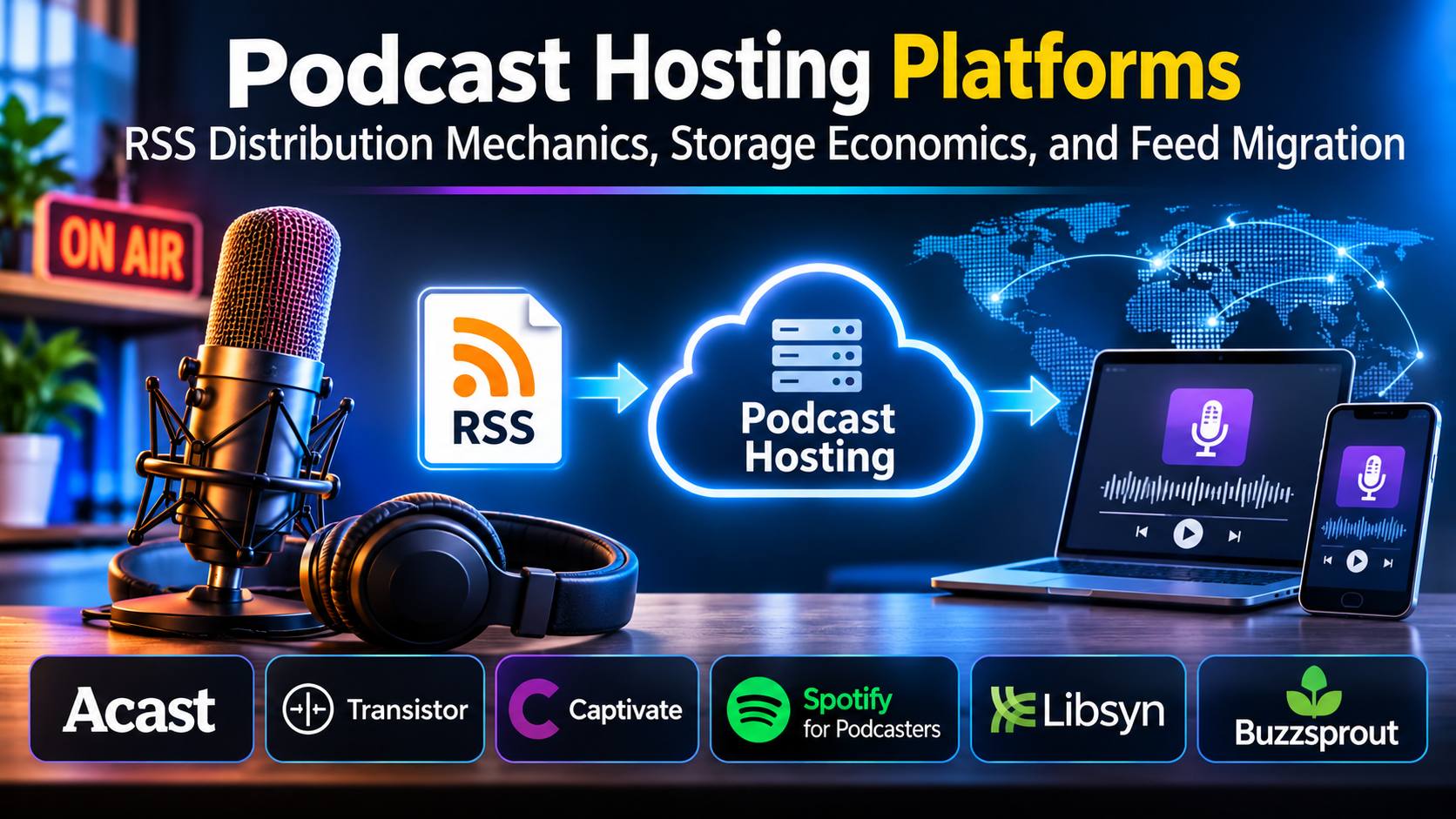
Producing an audio episode is only half the battle of podcasting. While audio editing software shapes the final mix, the podcast hosting platform dictates how that media reaches listeners across global distribution networks. A common misconception among new creators is that uploading an episode directly to listening apps like Apple Podcasts or Spotify is standard practice. In reality, listening applications do not store audio files; they act as directories that index Really Simple Syndication (RSS) feeds generated and hosted by specialized media servers.
Choosing a podcast host requires evaluating technical infrastructure rather than marketing slogans. Podcasters must weigh storage allowances, bandwidth limits, RSS feed portability, programmatic monetization tools, and dynamic ad insertion (DAI) capabilities. Selecting the wrong host can result in locked RSS feeds, high bandwidth penalties as shows scale, or rigid monetization terms that siphon revenue from growing networks.
Technical Foundations: RSS Feeds, Media Delivery, and ID3 Tagging
Understanding how a podcast host interacts with the global directory ecosystem prevents common distribution failures.
1. The Mechanics of the Podcast RSS Feed
An RSS feed is an Extensible Markup Language (XML) text document structured according to podcasting specification standards. When a creator uploads an MP3 file to a podcast host, the platform:
- Stores the audio file on an object storage server (such as Amazon S3 or Google Cloud Storage).
- Automatically updates the show’s master XML file, appending a new
<item>tag containing the media file’s secure URL, file size in bytes, exact duration, and episode show notes. - Publishes the XML feed to public directories. When a user taps “play” on their phone, the listening app pings the host’s RSS feed, reads the media URL, and streams the audio bytes directly from the host’s Content Delivery Network (CDN).
2. Feed Ownership and Redirects (301 Redirects)
The single most critical technical consideration when evaluating a host is RSS feed ownership.
- If a host owns the RSS feed URL (often tied to a subdomain provided by the platform), migrating to a new host later becomes difficult. If a creator cancels their account without setting up a permanent HTTP 301 redirect, all existing subscribers will lose access to new episodes.
- A professional podcast host must allow creators to anchor their RSS feeds to custom domains (e.g.,
feed.yourbrand.com), ensuring absolute feed portability and permanent subscriber retention regardless of underlying hosting infrastructure changes.
3. Dynamic Ad Insertion (DAI) and Stitching
Monetizing audio at scale requires dynamic ad insertion. Rather than baking sponsor reads permanently into the master audio file (static insertion), dynamic hosts use server-side stitching:
- When a listener requests an episode, the hosting server analyzes metadata (such as geographic location, device type, and download timestamp) and injects targeted pre-roll, mid-roll, or post-roll audio ads into the stream dynamically before delivering the file.
- This requires robust CDN edge caching and low-latency stitching servers to prevent playback stuttering or volume spikes between host audio and ad insertions.
Primary Podcast Hosting Platforms Compared
The podcast hosting ecosystem ranges from enterprise-grade programmatic publishing networks to simple, creator-focused distribution hubs and open-source solutions.
| Hosting Platform | Primary Target Audience | Monetization Infrastructure | RSS Feed Portability | Critical Operational Advantage | Core Operational Limitation |
| Acast | Professional podcasters, networks, advertisers | Dynamic ad insertion, programmatic marketplace, Patreon integration | Fully portable (Custom domain support) | Exceptional global ad sales network; robust DAI technology; excellent analytics dashboard | Takes a revenue share percentage on platform-brokered ads; interface can feel corporate for hobbyists |
| Transistor.fm | Professional creators, multi-show networks, businesses | Private podcasting feeds, programmatic ad integration | Fully portable (Custom domains standard) | Unlimited show creation on higher tiers; pristine multi-show management; built-in private subscriber feeds | Billed strictly by total monthly download volume rather than storage space |
| Captivate.fm | Independent growth-focused creators, agencies | Built-in CTA buttons, sponsor links, programmatic ads | Fully portable (Custom domains on all plans) | Advanced marketing and growth tools; dynamic show notes; unmetered show creation across all tiers | Tiered pricing scales aggressively as total monthly download numbers cross volume thresholds |
| Spotify for Podcasters (formerly Anchor) | Beginners, hobbyists, internal corporate shows | Spotify Audience Network, automated sponsorships | Portable (Subject to platform redirect policies) | 100% free hosting; unlimited storage and bandwidth; direct native integration into the Spotify ecosystem | Limited advanced analytics control; forces Spotify-centric promotional frameworks |
| Libsyn | Long-running legacy shows, enterprise publishers | Programmatic ads, custom mobile app add-ons | Fully portable (Custom domains supported) | Veteran reliability; highly stable infrastructure operating for decades; granular download reporting | Dated user interface; tiered pricing is bound strictly by monthly storage upload megabytes rather than downloads |
| Buzzsprout | Beginners, independent creators, small businesses | Affiliate marketplace, programmatic ad integration | Fully portable (Custom domain support) | Exceptionally user-friendly interface; automated podcast directory submission; visual episode optimization tools | Automatically deletes or archives older audio files on lower-tier plans if monthly upload limits are exceeded |
In-Depth Platform Analysis
Acast: Enterprise Monetization and Programmatic Ad Networks
Acast is an enterprise-grade podcast hosting and monetization platform engineered for professional creators, independent networks, and global media publishers.
Acast’s primary competitive advantage lies in its monetization infrastructure and dynamic ad insertion scale:
- The Acast Marketplace: Connects podcasters directly with major global brands looking for programmatic, host-read, or baked-in sponsorships. Creators do not need to secure their own advertisers; Acast’s sales teams monetize available inventory automatically.
- Open Ecosystem Philosophy: Unlike walled-garden platforms, Acast supports open RSS distribution while providing advanced analytics tracking across Apple, Spotify, Amazon Music, and independent RSS aggregators.
- Dynamic Content Targeting: Allows networks to swap out outdated sponsor spots or time-sensitive promotional reads retroactively across an entire catalog of archived episodes.
The trade-off is financial partnership. Acast operates on a revenue-share model for ads sold through its marketplace, and its advanced toolsets are engineered primarily for shows generating substantial monthly download volume.
Transistor.fm: Multi-Show Architecture and Private Podcasting
Transistor.fm is built specifically for professional creators, enterprise internal communications, and multi-show indie networks that require clean administrative separation between distinct podcasts.
Key architectural features include:
- Multi-Show Management: Allows users to host multiple distinct podcasts under a single account fee (up to specific tier limits), making it cost-effective for production agencies and corporate communications teams.
- Private Podcasting Feeds: Exceptional internal tooling for generating secure, password-protected RSS feeds for private corporate training, paid patron tiers, or internal team updates.
- Clean Analytics Suite: Tracks listener trends across standard IAB-compliant metrics without cluttering the interface with promotional upsells.
Transistor’s pricing model bills creators based on total monthly downloads across all shows rather than file storage size. For shows with massive audio files but modest download counts, this is cost-effective; for short-form, high-download shows, tier limits must be monitored carefully.
Captivate.fm: Growth-Driven Marketing and Agency Toolsets
Captivate.fm is engineered with a specific emphasis on audience growth, marketing attribution, and independent podcaster monetization.
Key differentiators include:
- Built-In Marketing Tools: Generates customizable podcast website landing pages featuring integrated call-to-action (CTA) buttons, email list collection forms, and automated social sharing links.
- Unmetered Show Creation: Allows creators to build unlimited shows and podcasts on every pricing tier, charging strictly based on aggregated monthly download volume.
- Advanced Link Shortening and Tracking: Integrates native analytics tracking links that allow creators to measure exact conversion rates from social media campaigns or guest appearances.
Captivate’s tiered pricing structure scales progressively as monthly downloads increase, making it essential for growing shows to evaluate traffic projections against tier pricing thresholds.
Spotify for Podcasters: Zero-Cost Entry and Ecosystem Integration
Spotify for Podcasters (formerly Anchor) provides a completely free podcast hosting model backed directly by Spotify’s infrastructure.
Its primary appeal is unfettered accessibility:
- Zero Financial Barrier: Offers unlimited audio storage and unlimited bandwidth at no cost, making it the primary gateway for hobbyists, internal corporate training channels, and first-time creators.
- Seamless Ecosystem Integration: Direct submission pipelines into Spotify, paired with native interactive features like Q&A boxes and listener polls embedded directly inside the Spotify mobile app.
The operational limitation is platform dependency and analytical depth. Advanced enterprise networks require granular IAB-certified analytics, custom domain RSS ownership, and programmatic ad network flexibility—features that free hosting models do not prioritize.
Libsyn: Veteran Stability and Enterprise Legacy Infrastructure
Libsyn (Liberated Syndication) is one of the oldest and most trusted podcast hosting platforms in the industry, having powered audio distribution since the early days of podcasting.
Libsyn’s core strength is bulletproof architectural reliability:
- Unwavering Uptime: Decades of operational stability ensure that master RSS feeds remain online and accessible to global directories without unexpected outages.
- Granular Feed Control: Provides deep access to raw XML tags, custom category mappings, and advanced FTP upload options for enterprise media organizations.
Libsyn’s structural drawback is its interface and pricing design. Unlike modern competitors that bill by download volume, Libsyn tiers are traditionally bound by monthly storage upload quotas (e.g., 400 MB per month). Uploading uncompressed, high-bitrate master WAV files or long-form multi-hour episodes can quickly push a creator into higher pricing tiers regardless of listener counts.
Workflow Economics: Evaluating Bandwidth Costs and Migration Risks
When budgeting for podcast hosting, creators frequently overlook long-term operational expenses:
1. Download Bandwidth vs. Storage Quotas
- Download-Based Pricing (Transistor, Captivate, Acast): You can upload hours of uncompressed audio files without penalty, but you pay based on how many times those files are downloaded by listeners each month. This aligns platform costs directly with audience scale.
- Storage-Based Pricing (Libsyn, Buzzsprout): You are allocated a specific upload allowance per month. If you exceed your megabyte limit, you must upgrade your tier or delete older content, which can break archive links.
2. The Danger of RSS Host Lock-In
If a podcaster launches a show using a proprietary hosting URL that cannot be redirected via a custom domain, migrating to a new host later risks destroying subscriber retention. Before publishing a pilot episode, verify that the host permits HTTP 301 redirects and supports custom RSS domains.
Practical Selection Guidelines
Selecting the right podcast hosting platform requires matching your show’s growth stage, monetization goals, and technical requirements to platform capabilities:
- For Enterprise Networks and High-Volume Shows Seeking Automated Monetization: Standardize on Acast. Its programmatic ad marketplace and professional DAI infrastructure deliver unmatched commercial revenue potential for established audiences.
- For Multi-Show Producers, Agencies, and Private Podcasting: Deploy Transistor.fm. The ability to host multiple independent shows under one account, combined with secure private feed generation, makes it ideal for professional production teams.
- For Independent Creators Focused on Marketing and Audience Growth: Choose Captivate.fm. Its unmetered show creation and built-in growth tools provide robust infrastructure for expanding podcasts.
- For Hobbyists, Internal Corporate Comms, and Zero-Budget Pilots: Utilize Spotify for Podcasters. Its free hosting model removes financial friction for testing new audio concepts.
- For Long-Running Legacy Archives Requiring Absolute Stability: Deploy Libsyn. Its decades of engineering reliability ensure dependable RSS distribution for institutional publishers.
Strategic Implementation Takeaway
Do not select a podcast host based on free promotional storage offers or superficial dashboard aesthetics.
Before committing a show to a hosting platform, execute an infrastructure validation test:
- Verify RSS feed ownership: confirm that the platform allows you to map your master RSS feed to a custom domain (
feed.yourshow.com) and guarantees full access to execute a 301 redirect if you ever decide to migrate hosts. - Review IAB compliance: ensure the analytics engine certifies downloads according to Internet Advertising Bureau standards, filtering out automated bot downloads and pre-fetch requests to give you accurate listener metrics.
- Test audio delivery performance: check CDN edge-node response times to ensure your listeners across global regions experience zero buffering lag when downloading large audio files.
The host that guarantees absolute RSS feed ownership, delivers transparent IAB-certified analytics, and scales its pricing model cleanly with your audience growth is the platform that will protect your show’s long-term distribution stability.
