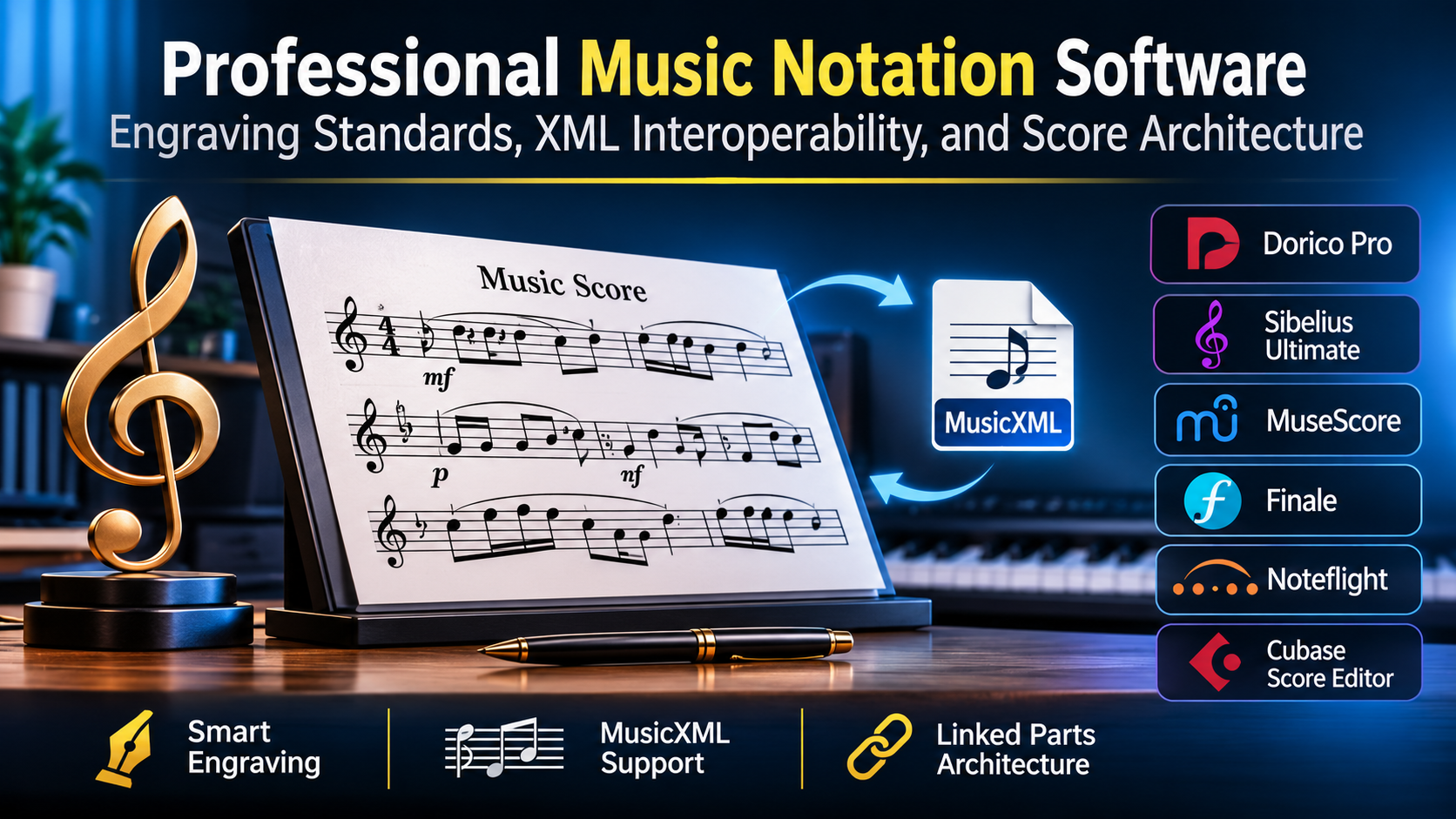
Music notation software bridges the gap between abstract composition and physical performance. While digital audio workstations (DAWs) interpret music through linear time, MIDI events, and audio buffers, professional scorewriters operate on a different set of rules entirely. They translate compositions into standardized graphic symbols—governing pitch, rhythm, articulation, and dynamic phrasing—that human musicians or automated orchestration engines can read with absolute clarity.
A common structural failure in music production and publishing is relying on general-purpose sequencing software to generate performance scores. Standard DAWs treat notation as a secondary byproduct of MIDI note data, resulting in unreadable scores cluttered with overlapping text, misaligned stems, and non-standard accidental placements. Professional publishing requires dedicated engraving engines built around strict spatial spacing algorithms, dynamic part extraction, and adherence to historical engraving rules.
Choosing the right music notation software requires analyzing how its layout engine handles graphical spacing, its compatibility with industry-standard interchange formats like MusicXML, its support for complex contemporary microtonal or electroacoustic scores, and its integration with virtual sample libraries for playback rendering.
Technical Foundations: Engraving Rules, Spacing, and Interchange Formats
Professional score production is governed by precise typographical and graphical conventions that separate amateur notation from publishing-ready sheets.
1. Optical Spacing vs. Linear Note Spacing
In amateur software, notes are spaced linearly based strictly on their mathematical duration (e.g., a quarter note occupies exactly twice the horizontal distance of an eighth note).
- Professional engraving engines utilize optical spacing algorithms. These algorithms calculate the horizontal density of note heads, accidentals, articulation marks, and lyric syllables, adjusting spacing dynamically to prevent visual collisions while maintaining readability across complex polyphonic textures.
2. MusicXML and Interoperability
Composers rarely complete an entire project within a single software ecosystem; sketches move between notation programs, copyists, and DAWs.
- MusicXML serves as the universal interchange standard for digital sheet music, encoding pitch, rhythm, expression, and layout metadata into structured XML text.
- A robust notation tool must import and export MusicXML cleanly without stripping complex tuplets, nested beam groups, or specialized performance directions.
3. Linked Parts Architecture
Historically, orchestrators had to maintain separate files for full conductor scores and individual instrumental parts, meaning a late note correction in the score required manual updates across dozens of individual part files.
- Modern notation software utilizes a linked parts database. Any pitch, articulation, or dynamic alteration made in the full score propagates instantly to the corresponding instrumental part, while allowing independent layout adjustments (such as system breaks and multi-measure rest spacing) to keep parts legible for performers.
Primary Music Notation Software Compared
The professional scoring ecosystem features comprehensive desktop engraving suites, rapid web-based composition platforms, advanced open-source notation editors, and tablet-first apps.
| Software Platform | Primary Production Focus | Core Architecture | Platform Support | Critical Operational Advantage | Core Operational Limitation |
| Steinberg Dorico Pro | Advanced orchestral scoring, publishing, complex meter management | Database-driven layout engine | Windows, macOS, iPadOS | Unrivaled automated spacing engine; handles complex multi-meter and flow-based project structures seamlessly | Steep learning curve for users transitioning from traditional manual note-entry paradigms |
| Avid Sibelius Ultimate | Film scoring, commercial publishing, educational arranging | Object-oriented page layout | Windows, macOS | Industry standard for quick Hollywood film scoring workflows and extensive third-party plugin integration | Aging underlying architecture; subscription-only licensing model with persistent update costs |
| MuseScore Pro / Studio | General composition, open-source publishing, educational use | WYSIWYG vector-based engraving | Windows, macOS, Linux | Completely free and open-source (FOSS); active global community; robust MusicXML support and cloud sharing | Complex, highly dense orchestral templates can occasionally require manual collision cleanup |
| MakeMusic Finale (Legacy/Archive) | Historical standard for engraving, engraving customization | Page-layout graphic matrix | Windows, macOS | Historical pioneer of computer music notation with extensive custom plug-in support (JW Plugins) | Discontinued by developer; lack of active maintenance, security patches, or modern OS compatibility updates |
| Noteflight | Cloud-based collaborative composition, education | Browser-based client-side rendering | Cross-platform (Web browser) | Instant cross-device cloud collaboration; zero installation overhead; excellent for classroom environments | Requires an active internet connection; lacks the deep, granular engraving overrides needed for major orchestral print publishing |
| Steinberg Cubase (Score Editor) | MIDI-to-score conversion for DAW producers | Integrated MIDI-transcription engine | Windows, macOS | Direct integration inside a high-end DAW; eliminates export round-trips for producers sketching cue sheets | Not a dedicated publishing suite; lacks advanced multi-movement book layouts and professional part-extraction controls |
In-Depth Platform Analysis
Steinberg Dorico Pro: The Modern Standard for Automated Engraving
Steinberg Dorico Pro represents a generational shift in music notation software design. Developed by the core team behind previous industry standards, Dorico was built from the ground up to address the limitations of legacy software.
Dorico’s primary technical advantage lies in its database-driven layout engine and flow architecture:
- Flow-Based Project Management: Instead of locking music into a rigid, continuous document, Dorico organizes music into “flows”—independent movements or song sections that can be freely re-ordered, combined into a single master score, or extracted into separate instrumental parts dynamically.
- Intelligent Spacing and Collision Avoidance: Dorico automatically calculates the placement of lyrics, dynamic wedges, expression text, and note stems without requiring manual dragging. If a composer inserts a note into a crowded measure, the entire system reflows instantly while maintaining professional engraving spacing rules.
- Playback and VST3 Integration: Integrates tightly with Steinberg’s audio engine, allowing complex orchestral sample libraries (such as VSL or BBC Symphony Orchestra) to map articulation keyswitches automatically from standard notation markings.
The trade-off is workflow philosophy. Dorico approaches score entry with a modal, keyboard-driven paradigm (using popovers for dynamics, tempos, and notations) that requires an adjustment period for users accustomed to clicking notes onto a static staff.
Avid Sibelius Ultimate: The Established Commercial Heavyweight
Avid Sibelius Ultimate is the veteran market leader used extensively across Hollywood film scoring stages, Broadway pit orchestras, and academic institutions worldwide.
Key technical attributes include:
- The Magnetic Layout Engine: Automatically prevents score elements from colliding, ensuring that accidentals do not overlap noteheads and that staff text clears dynamic markings.
- Comprehensive Ecosystem Integration: Supports extensive third-party plugin suites (such as Plugscore and specialized font sets) and integrates smoothly with Pro Tools for audio-to-video scoring workflows.
- Avid Cloud Collaboration: Allows multiple arrangers to work on the same score simultaneously across different locations, streamlining fast-turnaround film scoring deadlines.
The primary operational constraint is corporate licensing structure. Sibelius operates under strict subscription terms, and users must navigate recurring update fees to maintain compatibility with modern operating system patches.
MuseScore: The Open-Source Publishing Standard
MuseScore has evolved from a simple open-source utility into a professional-grade notation suite capable of producing publication-quality scores.
Its core strengths include:
- Zero Licensing Barriers: Distributed completely free under open-source licenses, making advanced scoring tools accessible to students, independent composers, and global communities without financial overhead.
- Robust MusicXML Compatibility: Reliable import and export engines that allow users to exchange complex scores with proprietary software suites like Dorico and Sibelius with minimal formatting loss.
- Active Development and Community Plugin Ecosystem: Supported by a dedicated developer base that continuously introduces performance upgrades, engraving improvements, and cloud-backed score sharing libraries.
While MuseScore handles standard orchestral, choral, and lead-sheet workflows exceptionally well, massive contemporary scores with non-standard graphic notation or complex microtonal accidental systems may still require manual spatial adjustments compared to Dorico’s automated engine.
Workflow Economics: Evaluating the Cost of Score Production
Software licensing fees represent only part of the investment required to run an efficient music engraving department:
1. The Copyist and Engraving Labor Ratio
In professional publishing, preparing a complex orchestral score for print involves extensive manual layout correction.
- Software that features intelligent collision avoidance and dynamic part linking (such as Dorico) drastically reduces the hours a copyist must spend adjusting staff spacing, cue notes, and page turns.
- Minimizing layout clean-up time directly lowers production costs for publishing houses and independent composers.
2. Interchange Fidelity and Score Migration
When migrating historical catalogs or collaborating across diverse studio teams, formatting loss during file conversion can ruin production schedules. Software that maintains strict adherence to standard MusicXML schemas ensures that musical intent—such as phrasing slurs, hidden rests, and specialized tuplets—survives the transition between distinct software environments.
Practical Selection Guidelines
Selecting the appropriate music notation software requires aligning your composition scale, publishing requirements, and collaborative workflow with the software’s structural capabilities:
- For Complex Orchestral Publishing, Film Scoring, and Modern Ensembles: Standardize on Steinberg Dorico Pro. Its intelligent spacing engine, flow management, and automated layout tools provide the highest quality engraved output with the least manual intervention.
- For Commercial Film Workflows, Educational Arranging, and Standard Studio Collaboration: Deploy Avid Sibelius Ultimate. Its widespread industry familiarity and robust plugin support make it a reliable choice for fast-turnaround media scoring.
- For Independent Composers, Students, and Budget-Conscious Publishers: Standardize on MuseScore. Its professional feature set, open-source accessibility, and powerful MusicXML tools deliver full-scale engraving capability without recurring subscription fees.
- For Cloud-Based Classroom Collaboration and Quick Lead-Sheet Sharing: Use Noteflight for accessible, browser-based multi-user composition across cross-platform devices.
Strategic Implementation Takeaway
Do not evaluate music notation software by inputting a simple eight-bar melody into a blank template. Clean, short melodies conceal the formatting bottlenecks that emerge during full-scale projects.
Before standardizing a scoring pipeline around a notation suite, run a rigorous engraving stress test:
- Import a dense, multi-movement orchestral or chamber work via MusicXML featuring overlapping tuplets, shifting time signatures, divisi string sections, and complex multi-voice polyphony.
- Insert a new measure into the middle of the most complex movement, and test how the software handles page breaks, system wrapping, and collision avoidance across both the full conductor score and individual instrumental parts.
- Export the file to PDF and MusicXML, verifying that typography, articulation spacing, and dynamic alignment conform to professional publishing standards.
The software that processes complex polyphonic structures without layout distortion, maintains absolute synchronization between scores and parts, and delivers pristine print-ready output is the toolchain that will protect your creative focus throughout your composition career.
