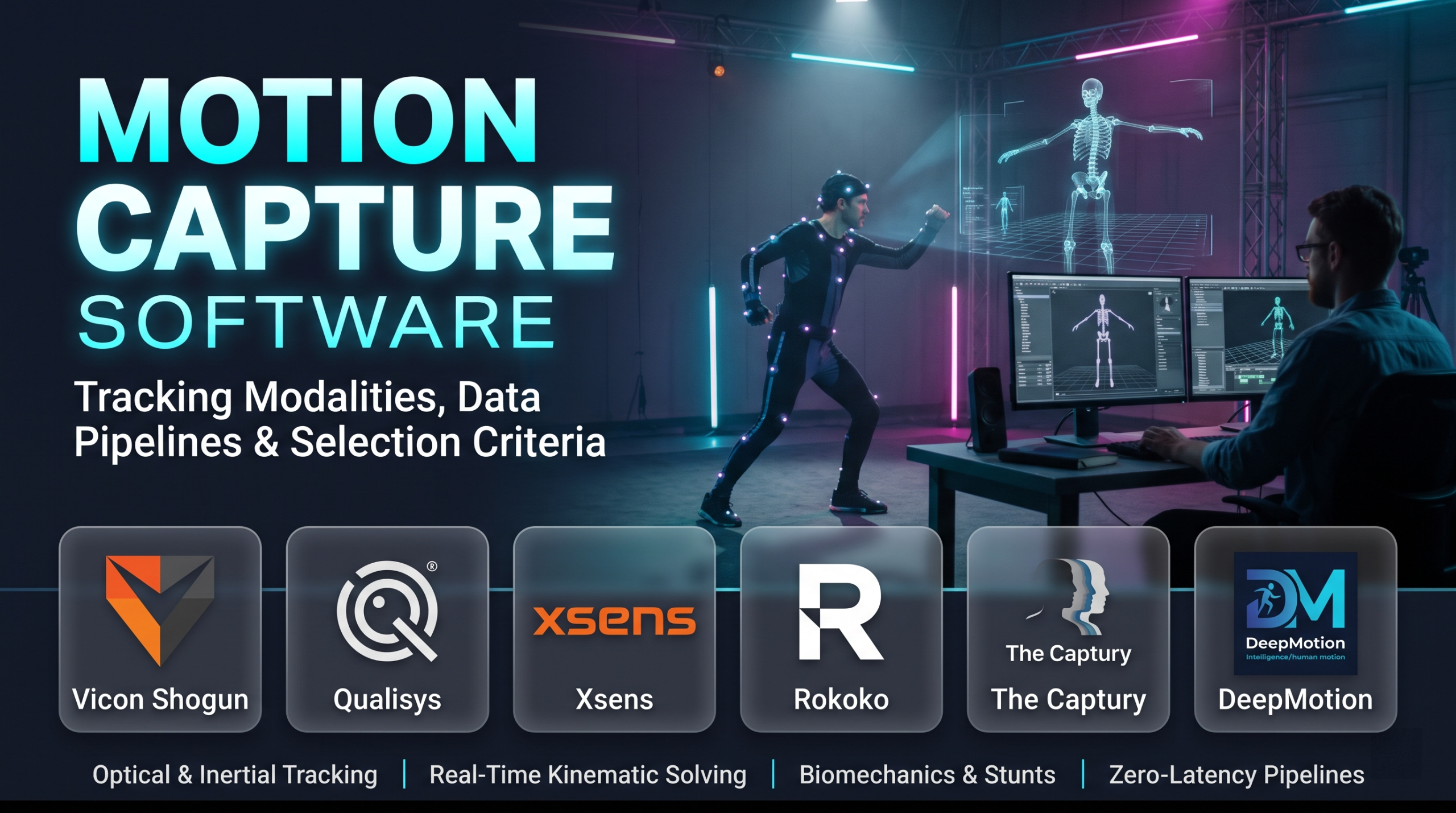
Motion capture has shifted from an exclusive visual effects luxury into an operational necessity across game development, virtual production, biomechanical analysis, and immersive simulation. However, capturing human movement and translating it into clean, anatomically valid skeletal transforms remains technically demanding. The challenge is rarely acquiring positional coordinates; it is resolving the physical ambiguities that occur between sensory hardware and virtual animation rigs.
Every tracking modality introduces distinct operational hurdles. Optical passive systems struggle with marker occlusion when performers interact closely. Inertial measurement units (IMUs) suffer from magnetic interference and progressive spatial drift. Single-camera and multi-camera computer vision solutions must deduce depth from flattened two-dimensional pixel arrays while resolving rapid, self-occluding actions.
Behind the hardware lies the software engine: the layer responsible for 2D-to-3D point reconstruction, kinematic joint fitting, real-time spatial filtering, and bidirectional integration with digital content creation (DCC) pipelines. Selecting a motion capture platform requires matching your studio’s spatial constraints, data fidelity tolerances, latency budgets, and post-processing capacities to the tracking software’s underlying data architecture.
The Four Primary Tracking Modalities
Motion capture software packages are engineered around specific sensor inputs and mathematical reconstruction models.
1. Optical Marker-Based Tracking (Passive and Active)
Optical tracking utilizes circular arrays of synchronized infrared or near-infrared cameras to track retroreflective spherical markers (passive) or synchronized strobing LEDs (active) placed across a performer’s anatomical landmarks.
- Reconstruction Pipeline: Software correlates 2D marker positions across multiple camera perspectives using epipolar geometry to resolve 3D spatial points. A rigid or calibrated skeletal constraint model is then fitted to the marker cloud.
- Production Advantage: Millimeter-level spatial accuracy, exceptional rotational precision, and zero cumulative position drift over time.
- Operational Bottlenecks: Line-of-sight dependency. If markers are occluded by props or other actors, the software must rely on predictive trajectory algorithms. Any unresolved gaps require labor-intensive manual marker cleanup.
2. Inertial Tracking (IMU Sensor Arrays)
Inertial motion capture uses sensor suites comprising triaxial accelerometers, gyroscopes, and magnetometers strapped directly to body segments.
- Reconstruction Pipeline: Rather than tracking external spatial coordinates, inertial software measures angular velocity, orientation changes, and acceleration vectors. The software integrates these variables forward through forward kinematics along a rigid hierarchy of calibrated bone lengths.
- Production Advantage: No optical occlusion, infinite capture volume, rapid setup, and complete independence from dedicated capture studio volumes.
- Operational Bottlenecks: Lack of absolute global position references. Because positions are derived by double-integrating accelerations, slight calibration offsets cause cumulative position drift. The software must implement complex zero-velocity update algorithms (ZUPT) when feet contact the floor to artificially pin the character in world space.
3. Markerless Computer Vision (AI and Multi-Camera RGB/RGB-D)
Markerless systems leverage deep neural networks trained on volumetric pose datasets to identify human joints directly from standard high-frame-rate video streams.
- Reconstruction Pipeline: Deep learning models generate 2D heatmaps of anatomical keypoints per frame across multiple cameras. The software bundles these into a spatial optimization solver that maps human movement onto an underlying digital skeleton.
- Production Advantage: Zero calibration suits, zero body markers, and minimal performer preparation, enabling capture of natural movement, sports action, and background crowds without performer fatigue.
- Operational Bottlenecks: Latency and foot-contact stability. Deep-learning inference adds computational delay, making ultra-low-latency broadcast streaming harder to sustain. Fine finger movements and micro-interactions often lack the sharpness delivered by optical or glove-based sensors.
4. Dedicated Facial Capture and Biomechanical Suites
Specialized systems built around high-density head-mounted cameras (HMC) or optical clinical rigs designed to solve specific non-skeletal deformations.
- Reconstruction Pipeline: Analyzes optical markers, infrared surface meshes, or neural video streams to drive blendshapes (such as the Facial Action Coding System, or FACS) or muscle activation dynamics.
- Production Advantage: Isolates minute deformations that skeletal body capture engines cannot resolve.
Primary Motion Capture Software Platforms Compared
The software ecosystem spans high-end optical processing suites, versatile inertial solvers, standalone markerless AI engines, and real-time animation retargeting middleware.
| Software Platform | Tracking Modality | Primary Output & Target Pipeline | Input Hardware Ecosystem | Critical Operational Advantage | Core Operational Limitation |
| Vicon Shōgun | Optical (Passive & Active) | Real-time live streaming to Unreal/Unity; clean FBX/VMC to Maya | Vicon optical camera systems | Flawless real-time skeletal solving; automated marker label recovery; sub-millimeter clinical precision | Premium enterprise cost; requires dedicated optical studio infrastructure and regular calibration |
| Qualisys Track Manager (QTM) | Optical (Passive & Active) | High-speed C3D, FBX, real-time OpenSound Control (OSC), SDKs | Qualisys optical hardware | Dual-purpose architecture supporting biomechanical measurement and entertainment animation | Smaller entertainment-specific asset library; interface tailored heavily toward lab analytics |
| Movella Xsens Animate | Inertial (IMU) | BVH, FBX, live network streaming into DCC and game engines | Xsens MVN sensor suits and straps | Industry reference for magnetic-drift rejection; captures reliable data in non-studio field environments | Lacks global external spatial reference; requires careful foot-contact handling to prevent sliding |
| Rokoko Studio | Hybrid (Inertial, Optical Face, Video AI) | Real-time streaming plugins, FBX, BVH export | Smartsuit Pro, Smartgloves, standard webcams | Accessible pricing model; integrated ecosystem handling body, fingers, and face under a unified UI | Susceptible to magnetic environment interference; requires manual trajectory grounding in tight spaces |
| The Captury | Markerless Multi-Camera | Real-time tracking data, clean skeletal FBX | Off-the-shelf industrial and machine-vision cameras | Highly robust multi-actor tracking without markers or specialized suits | Demands clean multi-camera placement and heavy GPU compute allocations for real-time tracking |
| DeepMotion Animate 3D | Markerless AI (Single/Multi-Video) | Browser-based cloud processing (FBX, BVH, GLTF) | Any standard single-camera video source | Zero hardware footprint; turn video files into 3D animations directly through cloud pipelines | Asynchronous processing only; cannot deliver live real-time interactive performance capture |
In-Depth Platform Analysis
Vicon Shōgun: The Gold Standard for Optical Production
Vicon Shōgun is the standard platform for high-end virtual production stages, AAA performance capture volumes, and visual effects facilities. Designed to process data streams from dozens or hundreds of high-speed optical cameras, Shōgun splits its workflow into two applications: Shōgun Live for real-time capture and streaming, and Shōgun Post for offline data cleaning and multi-actor solving.
The platform’s primary technical strength is unbroken real-time marker recovery:
- Automated Labeling and Solving: Legacy optical software frequently suffered from “marker swapping,” where intersecting limbs caused the software to confuse left and right markers. Shōgun uses real-time kinematic fitting that preserves character identity even when performers wrestle, roll on the floor, or carry large props.
- Engine Native Streaming: Real-time data feeds directly into game engines via Vicon’s LiveLink integration, allowing directors to watch digital characters perform inside final virtual scenes with near-zero latency.
The trade-off is organizational. Vicon systems represent massive investments in specialized optical cameras, custom ceiling rigging, active synchronization boxes, and dedicated stage space. Operating Shōgun requires trained motion capture technicians who understand rigid-body calibrations and spatial coordinate alignment.
Qualisys Track Manager (QTM): Precision Across Engineering and Media
Qualisys Track Manager approaches motion tracking with equal emphasis on engineering precision and creative production. QTM serves as the control hub for Qualisys cameras, capturing high-speed movement across sports biomechanics, underwater robotics, and interactive entertainment.
Key technical attributes include:
- Hybrid Data Export: QTM excels at delivering raw scientific C3D coordinate data alongside standard animated skeletal hierarchies (FBX). This makes it valuable for university laboratories and sports-science studios that license their data to athletic gear manufacturers and game studios simultaneously.
- Daisy-Chained Real-Time Integration: Features mature software development kits (C++, Python, C#) alongside real-time streaming directly into Unreal Engine, Unity, and MotionBuilder.
While QTM provides exceptional camera calibration diagnostics and handles active, passive, and video markers, its core user interface retains an analytical scientific layout. Game animation teams unfamiliar with biomechanical coordinate systems may encounter an initial workflow learning curve compared to entertainment-centric alternatives.
Movella Xsens Animate: The Standard in Inertial Solving
Xsens Animate (part of the Movella ecosystem) is the established benchmark for production-grade inertial motion capture. By bypassing optical cameras entirely, Xsens allows teams to capture stunts, vehicle entries, and action sequences across practical locations, outdoor environments, and industrial facilities.
The core differentiator is magnetic immunity and engine-level biomechanical modeling:
- Magnetic Drift Rejection: Older inertial suits lose calibration when near steel reinforced concrete, vehicles, or metal staging. Xsens incorporates sensor-fusion algorithms that filter out local magnetic anomalies, preserving directional stability.
- On-Body Processing: The system fits data to an advanced 23-joint anatomical human model that strictly respects human biological range-of-motion constraints, preventing the disjointed hyper-extensions common to cheaper IMU packages.
The primary limitation remains floor contact and global drift. Because an inertial suit has no cameras tracking its distance from the ground, the software must infer floor position based on foot acceleration data. Uneven terrain, climbing stairs, or prolonged hand-to-floor contacts require post-capture adjustment to completely eliminate subtle foot-sliding artifacts.
Rokoko Studio: Democratizing Modular Indie Capture
Rokoko Studio functions as an accessible, unified hub for independent game developers, virtual creators, and pre-visualization teams. The software consolidates disparate input streams—including the Smartsuit Pro II, Smartgloves, and phone-based facial capture—into a single recording and retargeting canvas.
Key software features include:
- Unified Ecosystem: Rokoko Studio allows a solo creator to track body, hands, and face simultaneously, previewing the blended performance in real-time on custom imported character meshes.
- Live Streaming Plugins: Turnkey streaming protocols send animation directly into Blender, Maya, Unreal Engine, and Unity without complex network setup.
- Dual-Tier Processing: Includes built-in filters for foot-locking, treadmilling compensation, and joint smoothing, alongside an optional cloud-based AI processing layer for refining raw inertial output.
However, Rokoko’s inertial pipeline remains subject to the physical limitations of cost-effective sensor hardware. In spaces with heavy electromagnetic interference, or during complex floor work (such as combat rolls), the software requires more extensive post-capture cleanup than high-end optical solutions.
The Captury: High-End Production Without Markers
The Captury represents the high-water mark for enterprise-grade markerless optical tracking. Operating on synchronized video arrays from standard industrial cameras, it tracks complex human kinematics without requiring actors to wear suits, harnesses, or tracking dots.
Its technical capabilities center on volumetric silhouette matching:
- Multi-Actor Environmental Tracking: The software extracts 3D actor silhouettes from background environments in real time, fitting a flexible internal skeleton to the actor’s volume. It handles multiple performers interacting simultaneously, complete with standard wardrobe, footwear, and loose props.
- Flexible Capture Spaces: Scalable from small living-room setups to massive warehouse-scale volumes simply by adjusting camera lenses and network topology.
The operational bottleneck is computational cost. Running real-time volumetric silhouette tracking across multiple high-speed RGB camera feeds requires high-performance multi-GPU capture workstations and robust network infrastructure to process multiple uncompressed video streams simultaneously.
DeepMotion Animate 3D: Cloud-Native Video-to-Animation
DeepMotion takes a completely software-first, hardware-agnostic approach by providing markerless motion capture through a cloud-based web platform.
The system is engineered for maximum workflow convenience:
- Single-Camera Input: Developers upload simple single-camera video files (captured via smartphone or downloaded from archival footage), and DeepMotion’s neural networks calculate 3D motion, physics-based ground contacts, and facial tracking.
- Physics-Aware Processing: Unlike basic 2D pose estimators, DeepMotion incorporates a physics solver that prevents ground penetration, simulates gravity, and ensures joints do not bend beyond anatomical limits.
The trade-off is architectural: because processing occurs asynchronously in the cloud, DeepMotion cannot be used for live virtual production, live streaming, or real-time interactive game mechanics. It serves as a rapid asset-generation tool for animators looking to block out animation sequences without donning hardware.
Technical Considerations: Latency, Cleanup, and Pipeline Debt
Acquisition costs represent only a portion of the investment in a motion capture pipeline. Operational overhead accumulates across three areas:
1. The Post-Capture Cleanup Ratio
Vendors routinely demonstrate raw, unfiltered data that looks pristine during slow, deliberate movements. However, fast combat, complex falls, and multi-actor occlusions introduce errors:
- Optical systems can drop occluded markers, requiring clean-up artists to reconstruct spatial paths frame-by-frame.
- Inertial systems can introduce rotational float, requiring manual foot-planting and world-space re-grounding.
- Markerless video solutions can miscalculate limb depth during axial motion directly toward the lens.
In production pipelines, an hour of raw captured motion often requires three to ten hours of manual cleanup in software like Autodesk MotionBuilder or Blender before it is production-ready. Choosing a software platform with robust built-in inverse kinematics (IK) constraint recovery significantly reduces downstream labor.
2. Network Latency in Virtual Production
For virtual production environments running LED volumes, capture latency directly dictates whether a camera-tracked actor can interact convincingly with dynamic real-time backgrounds. Motion capture software must maintain pipeline latencies below thirty milliseconds—from physical motion, through sensor polling and kinematic solving, to network packet broadcast (via UDP/OSC or custom engine plugins). Platforms requiring heavy algorithmic smoothing over multiple frames introduce perceptible visual lag that can disrupt live performance.
Practical Selection Guidelines
Selecting the right motion capture software requires matching tracking mechanics to spatial resources and production needs:
- For AAA Game Studios, Large VFX Stages, and Multi-Actor Combat: Invest in Vicon Shōgun. Its sub-millimeter optical precision, automated marker recovery, and rock-solid real-time engine streaming remain unmatched for high-density, multi-performer productions.
- For Dual-Purpose Biomechanics, Sports Analytics, and Animation: Deploy Qualisys Track Manager. It provides the mathematical data validity required for scientific gait analysis while maintaining direct streaming paths into modern DCC engines.
- For Stunt Work, Field Production, and Variable Real-World Environments: Standardize on Movella Xsens Animate. Its magnetic anomaly rejection algorithms and suit durability make it the premier tool for capture beyond the confines of a dedicated stage.
- For Indie Studios, Solo Animators, and Rapid Prototyping: Deploy Rokoko Studio. Its modular integration of body, hands, and facial capture under an affordable licensing model provides the fastest path to fully rigged character animation for budget-conscious teams.
- For High-Volume Markerless Capture Across Varied Costumes: Deploy The Captury. It eliminates suit-donning overhead and tracks performers in regular apparel across expansive volumes.
- For Browser-Based, Asynchronous Animation Generation from Video: Use DeepMotion Animate 3D to convert archived video clips into production-ready skeletal animation files without owning hardware.
Strategic Implementation Takeaway
Do not select a motion capture software platform based on demonstrations involving isolated actors making slow, deliberate gestures in ideal studio conditions. Real production is messy: performers collide, fall to the floor, roll, pick up props, and move at high velocity.
Before committing to a platform, execute an adversarial production test:
- Have two performers wear the target hardware or perform within the camera volume.
- Direct them to execute a rapid sequence involving a close grapple, a floor roll, a quick recovery to a sprint, and an interaction with a hand-held prop.
- Evaluate the raw software output without manual intervention: check for marker swapping, foot sliding, rotational joint explosion, and the time required to clean the data to production-ready standards.
The software that maintains skeletal integrity through rapid occlusion and real-world physical chaos with minimal manual cleanup is the platform that will keep your production schedule on track and within budget.
