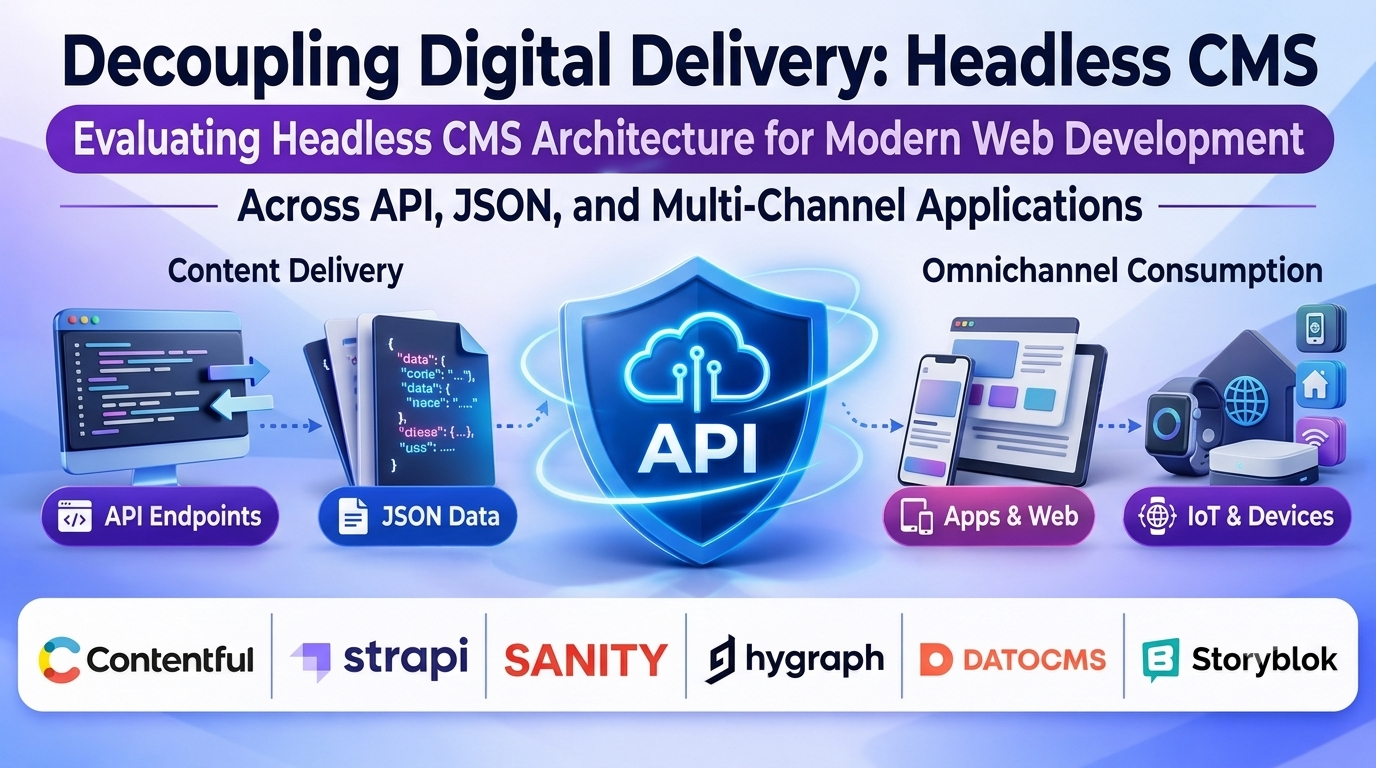
The traditional content management system—where the database, admin dashboard, and frontend presentation templates are tightly bound together—frequently falls short in modern multi-channel development. When engineering teams need to deliver structured content simultaneously to React or Next.js web applications, native iOS and Android apps, smart wearables, and IoT digital displays, a monolithic CMS creates severe architectural bottlenecks.
By separating the content repository (the “body”) from the presentation layer (the “head”), a headless CMS delivers content purely via structured REST or GraphQL APIs. Choosing the right headless content management platform requires evaluating content modeling flexibility, developer tooling, caching infrastructure, and editorial governance.
The Architectural Mechanics of Headless Publishing
Implementing a headless CMS shifts how development and editorial teams collaborate. Understanding the core technical components ensures your team selects an architecture that scales without introducing maintenance overhead:
- Content-as-a-Service (CaaS) Repositories: Content is stored as discrete, schema-defined JSON objects rather than fully rendered HTML pages, allowing any frontend framework to consume and display data however it sees fit.
- API Delivery Layers: High-performance REST and GraphQL endpoints fetch precise data fields on demand, drastically reducing payload sizes and optimizing rendering speeds across mobile and web clients.
- Separation of Concerns: Developers maintain complete control over frontend codebases, deployment pipelines, and hosting environments, while content editors work within a dedicated, distraction-free administrative dashboard.
Leading Headless CMS Platforms Compared
1. Contentful
Contentful stands as the enterprise market leader in headless content infrastructure, built specifically to power digital experiences at massive global scale.
- Primary Use Case: Enterprise omnichannel content delivery, large-scale mobile applications, and decoupled web ecosystems.
- Key Differentiators: Powerful content modeling engine; robust GraphQL and REST APIs; advanced localization and multi-space governance; enterprise-grade security and compliance (SOC 2, ISO).
- Limitations: Pricing scales rapidly with API request volume and user seats; can feel overly complex for smaller, single-site projects.
- Best Suited For: Enterprise engineering teams managing multi-channel digital products requiring rigorous security and scalability.
2. Strapi
Strapi is the leading open-source headless CMS that allows JavaScript and TypeScript developers to build and self-host custom API architectures with complete data sovereignty.
- Primary Use Case: Custom API-driven web applications, self-hosted developer projects, and cost-controlled content repositories.
- Key Differentiators: 100% open-source under the MIT license; highly customizable Node.js core; flexible plugin system; native support for PostgreSQL, MySQL, and SQLite.
- Limitations: Requires internal server administration expertise for self-hosted deployments, security hardening, and database scaling.
- Best Suited For: Development teams seeking absolute data ownership, custom API logic, and zero licensing fees.
3. Sanity.io
Sanity approaches content management as structured data, pairing a real-time collaborative editing environment with a powerful open-source studio and query language.
- Primary Use Case: Real-time collaborative publishing, rich editorial workflows, and highly tailored content applications.
- Key Differentiators: Portable Structured Content query language (GROQ); fully customizable open-source editing studio (Sanity Studio); real-time multi-user editing.
- Limitations: Content modeling and GROQ querying require a learning curve for developers transitioning from traditional SQL or REST habits.
- Best Suited For: Digital product teams and editorial groups demanding real-time collaboration and deeply customized editing interfaces.
4. Hygraph (formerly GraphCMS)
Hygraph is a native GraphQL-first headless CMS designed for federated content architectures and complex content relationships.
- Primary Use Case: Content federation, digital media catalogs, and highly interconnected data schemas.
- Key Differentiators: Native GraphQL schema definition; advanced content federation capabilities combining multiple APIs into a single endpoint; robust relational mapping.
- Limitations: Smaller community ecosystem compared to older legacy market players; interface is strictly optimized for technical developers.
- Best Suited For: Engineering teams heavily standardized on GraphQL seeking advanced content federation across multiple data sources.
5. DatoCMS
DatoCMS offers a high-performance headless CMS favored by frontend developers for its lightning-fast global CDN delivery and exceptional developer experience.
- Primary Use Case: Jamstack web applications, high-performance marketing sites, and localized digital publishing.
- Key Differentiators: Blazing-fast GraphQL content delivery API backed by global CDNs; automated image optimization and transformation pipeline; intuitive modular content blocks.
- Limitations: Less suited for complex, highly nested enterprise relational data compared to heavyweight database-driven platforms.
- Best Suited For: Frontend developers building high-speed Jamstack sites and modern marketing properties using frameworks like Next.js or Nuxt.
6. Storyblok
Storyblok bridges the gap between headless architecture and visual editing by providing a unique component-based visual builder for content creators.
- Primary Use Case: Marketing websites and headless projects that require drag-and-drop visual page building for non-technical editors.
- Key Differentiators: Visual preview editor that allows marketers to edit headless content in real time; component-based visual builder; robust localization workflows.
- Limitations: Visual editing features require upfront configuration of frontend components to mirror the visual builder accurately.
- Best Suited For: Marketing teams and agencies that love headless performance but refuse to sacrifice the drag-and-drop page-building experience.
Feature Comparison Matrix
| Product | Primary Focus | Deployment Model | API Architecture | Significant Advantage | Important Limitation |
| Contentful | Enterprise Omnichannel Scale | Cloud (SaaS) | REST & GraphQL | Enterprise-grade security and advanced localization | High pricing tiers for large API volumes |
| Strapi | Self-Hosted Node.js APIs | Self-Hosted / Open-Source | REST & GraphQL | Complete data ownership and customizable core | Requires server maintenance and IT overhead |
| Sanity.io | Structured Content & Real-Time Sync | Cloud / Open-Source Studio | GROQ & GraphQL | Real-time collaboration and custom editing studio | Custom setup required for frontend rendering |
| Hygraph | Native GraphQL Content Federation | Cloud (SaaS) | GraphQL Primary | Advanced content federation across multiple sources | Interface tailored primarily for developers |
| DatoCMS | Jamstack Performance & Assets | Cloud (SaaS) | GraphQL | Superior asset management and CDN delivery | Less optimized for deep enterprise relational mapping |
| Storyblok | Visual Editing for Headless Sites | Cloud (SaaS) | REST & GraphQL | Outstanding visual drag-and-drop editor for marketers | Requires initial component configuration work |
Evaluating Technical and Operational Trade-Offs
Transitioning to a headless CMS introduces distinct architectural trade-offs that extend beyond software licensing fees:
- Frontend Responsibility Shift: In a monolithic CMS, the platform handles routing, templating, and rendering. With a headless CMS, your development team assumes full responsibility for building and hosting the frontend application, managing SEO tags, handling server-side rendering (SSR), and implementing caching strategies.
- Editor Experience vs. Developer Freedom: Developers appreciate raw JSON payloads and flexible schemas, but content editors accustomed to traditional WYSIWYG page builders can struggle without well-designed visual editing components or structured preview environments.
- API Rate Limits and Bandwidth Costs: SaaS headless platforms price their tiers based on API request frequency, asset bandwidth, and content item counts. High-traffic applications must carefully implement CDN caching layers to prevent unexpected overage fees.
Making Your Decision
The optimal headless CMS aligns directly with your technical stack and editorial requirements. If your enterprise demands rigorous security, global scalability, and multi-region governance, a robust enterprise SaaS content platform is unmatched. Development teams seeking complete data control and custom API logic will find maximum value in open-source, self-hosted Node.js solutions. Organizations that want headless performance without sacrificing visual page-building tools for marketing teams should prioritize platforms featuring native visual editors. Evaluate your frontend framework, developer resources, and editorial workflow before decoupling your content architecture.
