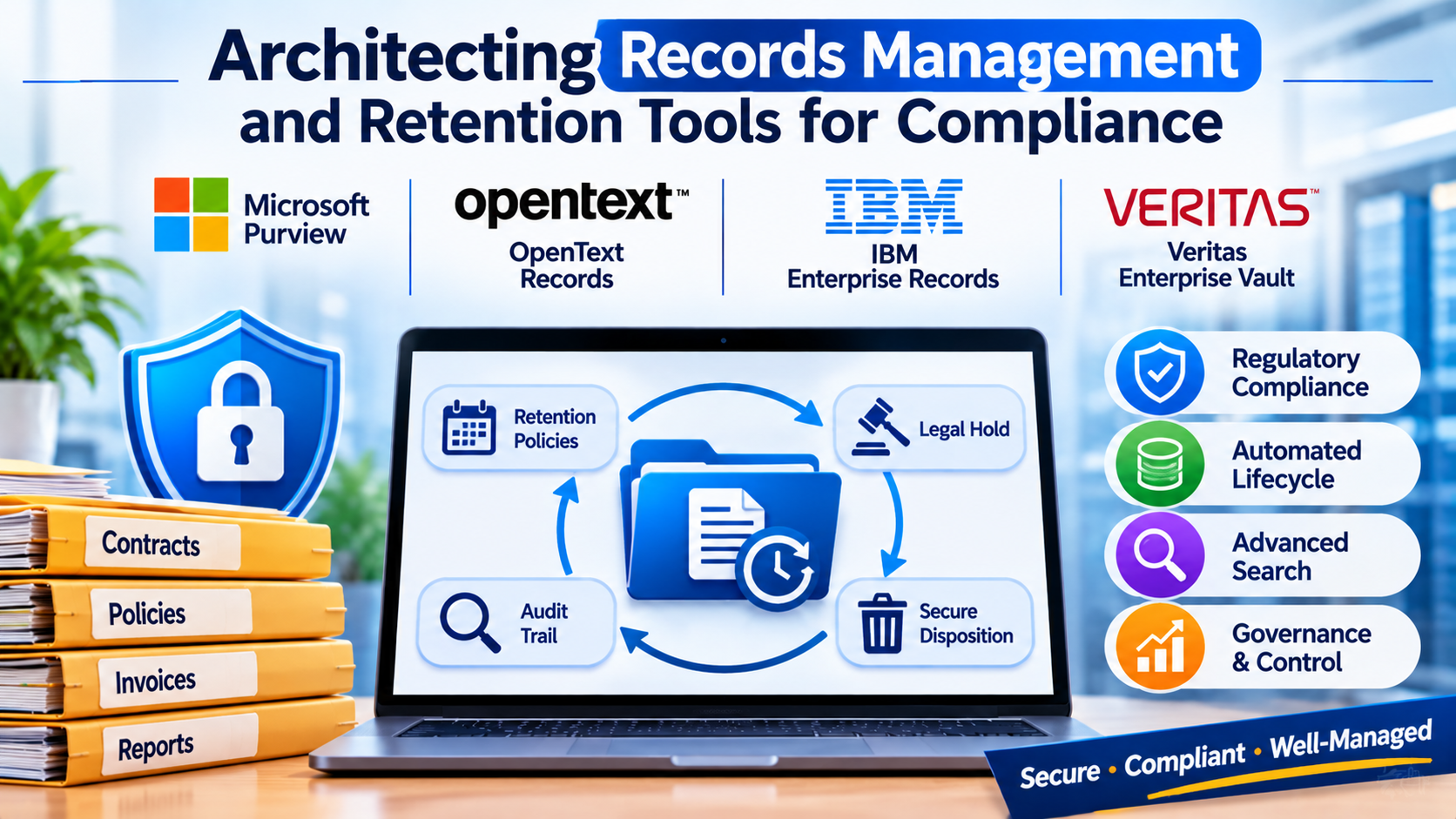
Corporate data accumulation is frequently treated as an asset until a regulatory audit, litigation discovery request, or security breach forces a reckoning. Storing every email, financial record, and customer file indefinitely exposes an organization to massive legal liability, bloated storage costs, and severe compliance penalties. Conversely, deleting records prematurely violates statutory retention mandates.
Deploying records management and retention tools requires bridging the gap between legal retention schedules and day-to-day document workflows, ensuring that corporate data is retained precisely as long as legally required and securely destroyed the moment its lifecycle expires.
The Core Mandate of Automated Retention Architecture
Traditional file storage systems rely heavily on manual user discipline—expecting employees to categorize files, apply retention labels, and purge obsolete documents. In practice, this approach fails entirely; users hoard data to avoid making retention decisions, creating massive dark data liabilities.
Modern records management solutions shift the burden from human memory to automated policy engines by enforcing specific architectural capabilities:
- File Plan Management: Structuring organizational records into formal schedules based on regulatory mandates, government statutes, and internal governance policies.
- Event-Based Triggers: Initiating retention clocks not just from a file’s creation date, but upon specific business triggers, such as an employee’s departure, a contract’s formal termination, or a project’s closure.
- Legal Hold Integration: Automatically suspending automated deletion routines for specific custodians or record classes when litigation or regulatory investigations arise.
- Disposition Auditing: Generating cryptographically verifiable proof of destruction certificates to satisfy legal and regulatory oversight during audits.
Leading Records Management Platforms and Technical Differentiators
1. Microsoft Purview Records Management
Microsoft Purview integrates retention and disposition controls directly into the Microsoft 365 ecosystem, allowing organizations to govern data across SharePoint, Exchange, Teams, and OneDrive.
- Primary Use Case: Enterprise-wide data governance and automated record declaration across Microsoft productivity and collaboration tools.
- Key Differentiators: Native integration across cloud collaboration apps; adaptive retention scopes targeting specific user groups; and automated regulatory records declarations via machine learning classifiers.
- Limitations: Advanced cross-platform governance for non-Microsoft repositories requires specialized connectors and can become complex to configure.
- Best Suited For: Enterprises deeply embedded in the Microsoft 365 cloud ecosystem seeking unified compliance controls.
2. OpenText Records Management
OpenText provides industrial-grade records management engineered for highly regulated global corporations, government bodies, and heavily audited industries.
- Primary Use Case: Complex, multi-jurisdictional physical and electronic records management, secure archiving, and rigid disposition workflows.
- Key Differentiators: Unmatched compliance certifications (such as DoD 5015.2 standards); sophisticated physical-to-digital record tracking; and automated disposition reviews requiring multi-tiered management sign-off.
- Limitations: High implementation complexity and steep total cost of ownership requiring dedicated administrative specialists.
- Best Suited For: Global enterprises, financial institutions, and government agencies operating under strict statutory retention laws.
3. IBM Enterprise Records
IBM Enterprise Records delivers robust lifecycle governance designed to help organizations manage both physical and electronic records under a single compliance policy framework.
- Primary Use Case: Enterprise-scale compliance enforcement, legal hold management, and unified physical-electronic archiving.
- Key Differentiators: Deep integration with enterprise content repositories; advanced disposition workflow orchestration; and comprehensive audit reporting for regulatory bodies.
- Limitations: Requires robust technical infrastructure and extensive administrative configuration to deploy effectively.
- Best Suited For: Large legacy enterprises managing hybrid physical and digital record environments.
4. Veritas Enterprise Vault
Veritas specializes in archiving and compliance for unstructured data communications, particularly electronic mail, instant messaging, and collaborative communications platforms.
- Primary Use Case: Email archiving, communications surveillance, and rapid eDiscovery search across massive data volumes.
- Key Differentiators: Exceptional indexing and search performance for millions of archived messages; robust journaling and compliance archiving capabilities.
- Limitations: Primarily focused on communications and unstructured messaging rather than broad physical records management.
- Best Suited For: Financial services and legal firms requiring rigorous email and messaging compliance archiving.
Feature Comparison Matrix
| Product | Primary Focus | Deployment Model | Compliance Standards | Significant Advantage | Important Limitation |
| Microsoft Purview | M365 Ecosystem Governance | Cloud (SaaS) | ISO, GDPR, HIPAA | Native integration across Microsoft collaboration apps | Complex configuration for external repositories |
| OpenText Records | Industrial Regulatory Compliance | On-Prem / Hybrid / Cloud | DoD 5015.2, SEC, FDA | Unsurpassed global compliance and physical tracking | High implementation overhead and cost |
| IBM Enterprise Records | Hybrid Physical & Digital Archiving | On-Prem / Hybrid | ISO, DoD standards | Unified policy engine for mixed record types | Steep learning curve and resource-heavy |
| Veritas Enterprise Vault | Communications & Email Archiving | On-Prem / Hybrid / Cloud | SEC, FINRA, GDPR | Lightning-fast eDiscovery and messaging indexing | Narrower focus outside communications archiving |
Evaluating Technical and Operational Trade-Offs
Deploying records management and retention software requires balancing aggressive legal risk mitigation against operational user friction:
- In-Place Management vs. Separate Repositories: Moving records to a separate, locked archive vault ensures strict compliance but disrupts daily user access. Modern cloud governance tools increasingly favor in-place management—applying retention labels directly where users work without moving files—though this requires careful permission locking.
- The Danger of Over-Retention: Many organizations retain data indefinitely “just in case,” failing to realize that stored data becomes discoverable in litigation. Implementing automated disposition schedules reduces legal exposure by ensuring obsolete data is legally purged.
- Cross-Border Data Residency: Global organizations must reconcile conflicting retention laws across jurisdictions. A record that must be deleted after five years in one country might be legally required to be retained for ten years in another, necessitating geo-aware retention policies.
Making Your Decision
The optimal records management solution depends directly on your organizational footprint and regulatory environment. If your enterprise operates primarily within cloud-native productivity suites, an integrated ecosystem compliance tool provides seamless protection with minimal user disruption. Highly regulated global entities managing complex physical archives and strict statutory mandates require industrial-grade ECM records suites with verified compliance certifications. Financial and legal institutions handling heavy communications volume should prioritize dedicated messaging and email archiving platforms. Evaluate your compliance liabilities, cross-border obligations, and deployment capacity before finalizing your retention architecture.
