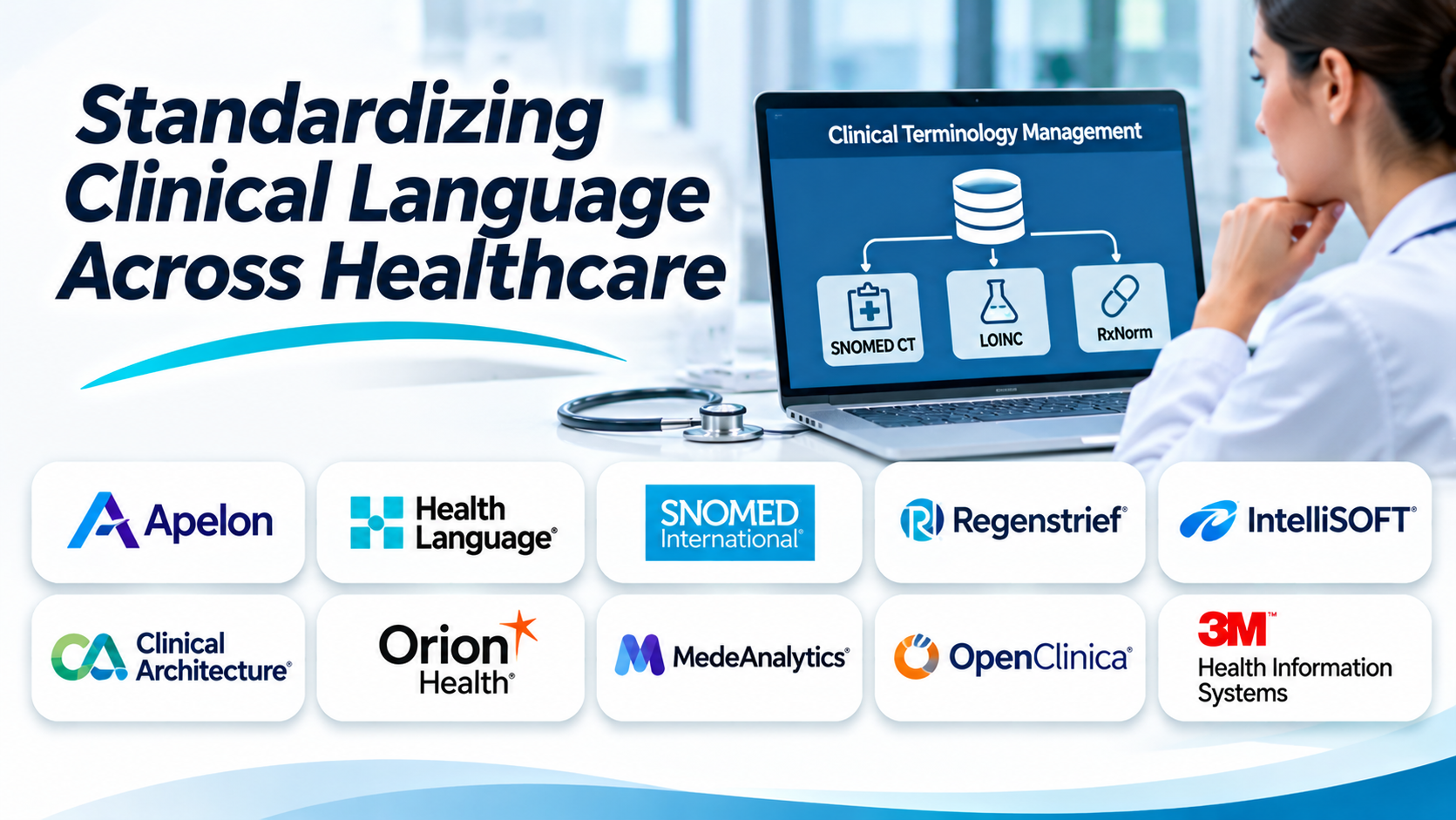
Introduction
Healthcare organizations generate extensive clinical information through patient consultations, diagnostic procedures, laboratory tests, and treatment activities. Consistent clinical terminology helps healthcare professionals interpret and exchange this information accurately.
Different healthcare applications may use different names, abbreviations, and codes to describe identical clinical concepts. These inconsistencies can create difficulties in information exchange, clinical reporting, medical research, and healthcare analytics.
Clinical terminology management tools help organizations maintain standardized medical vocabularies, classifications, code mappings, and concept relationships. These applications provide structured environments for managing clinical information across healthcare technology systems.
Modern terminology platforms support standards such as Systematized Nomenclature of Medicine Clinical Terms (SNOMED CT), Logical Observation Identifiers Names and Codes (LOINC), and the International Classification of Diseases (ICD). Some platforms also provide terminology services through Fast Healthcare Interoperability Resources (FHIR) application programming interfaces (APIs).
Selecting suitable clinical terminology software requires consideration of supported standards, licensing requirements, interoperability capabilities, deployment preferences, and organizational resources. Healthcare providers, software developers, research institutions, and government agencies may have different terminology management requirements.
This guide examines ten clinical terminology management tools, including their features, benefits, advantages, limitations, and practical applications. It also provides comparison tables, selection recommendations, an implementation example, and frequently asked questions.
What Are Clinical Terminology Management Tools?
Clinical terminology management tools are software applications that help healthcare organizations organize, maintain, distribute, and use standardized medical concepts and codes. They support consistent representation of clinical information across healthcare applications and organizational departments.
Clinical terminology systems describe healthcare concepts such as diseases, symptoms, procedures, medications, anatomical structures, and laboratory observations. Standardized concepts can help applications interpret information consistently even when healthcare professionals use different expressions.
Terminology servers provide programmatic access to clinical code systems, value sets, concept mappings, and terminology validation services. Terminology authoring platforms provide additional capabilities for creating, reviewing, and maintaining controlled clinical vocabularies.
Effective terminology management requires appropriate governance, clinical expertise, version control, licensing arrangements, and ongoing maintenance. Software can support these responsibilities but cannot independently guarantee the clinical correctness of every terminology mapping.
Common Applications of Clinical Terminology Management Tools
- Clinical Documentation: Standardize medical concepts recorded during patient consultations.
- Electronic Health Record Integration: Maintain consistent terminology across Electronic Health Record (EHR) applications.
- Medical Coding: Support appropriate relationships between clinical concepts and administrative classifications.
- Laboratory Standardization: Map local laboratory test identifiers to standardized observation codes.
- Healthcare Interoperability: Support consistent interpretation of exchanged clinical information.
- Clinical Research: Establish standardized concepts for research datasets and patient cohort identification.
- Public Health Reporting: Organize clinical information for applicable surveillance and reporting requirements.
- Clinical Decision Support: Provide standardized terminology foundations for appropriately validated clinical rules.
Essential Components of Clinical Terminology Management
| Component | Primary Function |
|---|---|
| Code System Management | Maintains standardized clinical codes |
| Concept Management | Organizes clinical meanings and descriptions |
| Value Set Management | Defines collections of codes for specific applications |
| Concept Mapping | Establishes relationships between terminology systems |
| Terminology Server | Provides programmatic terminology access |
| Version Management | Maintains terminology release information |
| Hierarchy Navigation | Supports exploration of concept relationships |
| Terminology Validation | Checks codes against supported terminology resources |
| Authoring Workflows | Supports controlled terminology development |
| Governance | Establishes responsibilities and approval procedures |
| Search Services | Helps applications locate relevant concepts |
| Distribution Services | Publishes approved terminology resources |
| Interoperability APIs | Connects terminology resources with healthcare applications |
Top 10 Clinical Terminology Management Tools
The following comparison includes commercial terminology platforms, open-source terminology servers, vocabulary management environments, and specialized clinical terminology resources. The numbering organizes the comparison rather than representing independently measured performance rankings.
1. SNOMED International Snowstorm
Short Description
Snowstorm is an open-source terminology server developed within the SNOMED International technology ecosystem. It provides terminology services designed primarily around SNOMED CT and its extensive clinical concept relationships.
The platform supports searching, retrieving, and exploring clinical concepts through programmatic interfaces. Healthcare software developers can use these services when building applications that require standardized clinical terminology.
Snowstorm is particularly relevant to national healthcare infrastructure projects, terminology service providers, and organizations implementing SNOMED CT. Its support for terminology branches and versions can help organizations manage different terminology releases and extensions.
Implementation requires appropriate technical infrastructure, terminology content, operational expertise, and applicable licensing arrangements. Although the software is open source, access to particular terminology content may be subject to separate licensing conditions.
Key Features
- SNOMED CT Services: Provides access to supported clinical concepts and descriptions.
- Concept Search: Supports retrieval of concepts using clinical terms.
- Hierarchy Navigation: Enables exploration of clinical concept relationships.
- Expression Constraint Language: Supports applicable Expression Constraint Language (ECL) queries.
- Terminology Versioning: Maintains information about supported terminology releases.
- Branch Management: Supports terminology branches and extension workflows.
- FHIR Terminology Services: Provides supported standardized terminology operations.
- REST APIs: Enables integration with compatible healthcare applications.
- Open-Source Architecture: Allows organizations to inspect and adapt the software.
Benefits
- Supports standardized clinical documentation.
- Improves SNOMED CT accessibility.
- Facilitates terminology integration.
- Supports complex clinical concept queries.
- Reduces dependence on static terminology files.
- Improves terminology release management.
- Supports national and organizational terminology infrastructure.
Pros
- Open-source software.
- Strong SNOMED CT specialization.
- Supports complex concept relationships.
- Relevant healthcare interoperability capabilities.
- Suitable for developer-led implementations.
- Supports terminology extension environments.
Cons
- Requires technical deployment expertise.
- Infrastructure maintenance remains an organizational responsibility.
- Terminology content licensing must be assessed.
- Broader terminology requirements may require complementary systems.
- Clinical governance requires separate organizational processes.
Use Cases
- EHR Integration: Provide standardized clinical concept search services.
- National Terminology Services: Distribute supported SNOMED CT resources.
- Clinical Concept Exploration: Navigate relationships between medical concepts.
- Terminology Extensions: Support organization-specific terminology development environments.
- Clinical Analytics: Retrieve concepts satisfying defined terminology constraints.
- Healthcare Application Development: Integrate terminology services into clinical software.
Best For
- Healthcare software developers.
- National terminology service providers.
- SNOMED CT implementation teams.
- Healthcare interoperability engineers.
- Public health technology organizations.
- Clinical informatics specialists.
2. CSIRO Ontoserver
Short Description
Ontoserver is a clinical terminology server developed by Australia’s Commonwealth Scientific and Industrial Research Organisation (CSIRO). It provides standardized terminology services supporting healthcare interoperability and clinical information management.
The platform supports FHIR terminology resources, including code systems, value sets, and concept maps. These capabilities help healthcare applications access standardized terminology through consistent interfaces.
Ontoserver is relevant to healthcare organizations implementing shared terminology infrastructure across multiple clinical applications. Its terminology distribution capabilities can support coordinated access to approved terminology resources.
Organizations should evaluate supported terminology content, deployment options, commercial arrangements, and operational requirements. Clinical terminology governance and mapping validation remain important responsibilities throughout implementation.
Key Features
- FHIR Terminology APIs: Supports standardized terminology service operations.
- Code System Management: Provides access to supported clinical code systems.
- Value Set Expansion: Retrieves codes belonging to defined value sets.
- Code Validation: Checks codes against supported terminology resources.
- Concept Mapping: Supports applicable FHIR concept map operations.
- SNOMED CT Support: Provides access to supported SNOMED CT content.
- Terminology Syndication: Supports distribution of terminology resources.
- Clinical Search: Enables terminology retrieval through supported search functions.
- Version Management: Maintains access to supported terminology versions.
Benefits
- Improves healthcare interoperability.
- Supports centralized terminology access.
- Facilitates standardized code validation.
- Reduces duplicated terminology infrastructure.
- Supports consistent value set distribution.
- Improves application integration.
- Strengthens terminology resource management.
Pros
- Strong FHIR terminology orientation.
- Supports multiple terminology resources.
- Relevant national healthcare infrastructure applications.
- Supports terminology distribution.
- Suitable for enterprise integration.
- Provides standardized terminology operations.
Cons
- Deployment arrangements require assessment.
- Commercial licensing may apply.
- Integration requires technical expertise.
- Terminology content licensing remains relevant.
- Clinical mappings require qualified review.
Use Cases
- FHIR Application Development: Provide terminology operations to healthcare applications.
- Shared Terminology Infrastructure: Centralize terminology access across organizations.
- Clinical Code Validation: Check codes against approved value sets.
- Terminology Distribution: Publish approved terminology resources.
- Clinical Data Exchange: Support consistent interpretation of coded information.
- Healthcare Integration: Connect multiple applications with common terminology services.
Best For
- Healthcare interoperability programs.
- Hospital technology departments.
- National digital health organizations.
- FHIR application developers.
- Healthcare integration specialists.
- Enterprise clinical informatics teams.
3. Termlex TermSpace
Short Description
TermSpace is a clinical terminology authoring and management environment associated with Termlex. It supports structured development and maintenance of clinical terminology resources, particularly within SNOMED CT-related workflows.
The platform helps terminology specialists organize concepts, descriptions, relationships, and controlled terminology content. Collaborative authoring environments can improve coordination between clinical experts and terminology administrators.
TermSpace is relevant to organizations developing terminology extensions or maintaining specialized clinical vocabularies. Its authoring orientation complements terminology servers that concentrate on distributing approved resources to operational applications.
Prospective users should confirm current product availability, supported authoring functions, integration options, and commercial terms. Terminology development requires qualified personnel and established clinical review procedures.
Key Features
- Terminology Authoring: Supports controlled clinical terminology development.
- Concept Editing: Organizes relevant clinical concept information.
- Description Management: Maintains terminology descriptions and synonyms.
- Relationship Management: Supports applicable clinical concept relationships.
- Extension Development: Assists specialized terminology development activities.
- Collaborative Workflows: Supports coordination between terminology contributors.
- Terminology Review: Facilitates assessment of proposed content changes.
- Content Organization: Maintains structured terminology resources.
- Terminology Export: Supports applicable content distribution workflows.
Benefits
- Improves terminology authoring coordination.
- Supports specialized vocabulary development.
- Reduces fragmented terminology documentation.
- Facilitates clinical content review.
- Improves terminology maintenance.
- Supports structured concept organization.
- Strengthens terminology governance.
Pros
- Specialized terminology authoring orientation.
- Relevant SNOMED CT applications.
- Supports collaborative terminology development.
- Suitable for clinical informatics specialists.
- Provides structured content management.
- Complements terminology server infrastructure.
Cons
- Current commercial offering requires confirmation.
- Requires specialized terminology knowledge.
- Integration scope should be assessed.
- Clinical review remains necessary.
- Operational terminology services may require complementary tools.
Use Cases
- Clinical Vocabulary Development: Create specialized terminology resources.
- SNOMED CT Extensions: Support development of applicable extension content.
- Terminology Review: Coordinate proposed clinical terminology changes.
- Concept Maintenance: Maintain descriptions and relationships.
- Clinical Content Governance: Organize authoring responsibilities.
- Terminology Publication: Prepare approved resources for distribution.
Best For
- Clinical terminology authors.
- Medical vocabulary specialists.
- National terminology centers.
- Healthcare research organizations.
- Clinical informatics departments.
- Terminology extension development teams.
4. Intelligent Medical Objects (IMO Health)
Short Description
IMO Health provides clinical terminology and healthcare data quality solutions designed to improve the representation and usability of clinical information. Its terminology products connect clinician-friendly expressions with standardized healthcare concepts and codes.
The company’s technology is relevant to clinical documentation workflows where healthcare professionals need familiar medical language rather than direct interaction with complex coding systems. Terminology services can help preserve clinical meaning while supporting downstream information requirements.
IMO Health solutions also address healthcare data normalization and related information management requirements. These capabilities can be valuable to organizations integrating information from different clinical applications.
Healthcare organizations should evaluate specific IMO Health products, supported mappings, EHR integrations, and licensing arrangements. Administrative coding and clinical interpretation decisions require appropriate professional oversight.
Key Features
- Clinical Interface Terminology: Supports clinician-friendly medical expressions.
- Clinical Concept Mapping: Connects applicable expressions with standardized concepts.
- Medical Vocabulary Search: Supports retrieval of relevant clinical terminology.
- Documentation Integration: Connects compatible clinical documentation applications.
- Data Normalization: Supports standardization of heterogeneous clinical information.
- Terminology Content Maintenance: Provides updates within supported products.
- Coding Support: Assists applicable clinical-to-administrative coding workflows.
- Clinical Data Enrichment: Supports enhancement of relevant clinical information.
- Enterprise Integration: Connects compatible healthcare technology environments.
Benefits
- Improves clinical documentation usability.
- Supports standardized clinical information.
- Reduces inconsistent medical expressions.
- Facilitates healthcare data normalization.
- Supports downstream reporting requirements.
- Improves clinical information accessibility.
- Helps connect documentation with coding workflows.
Pros
- Strong clinical interface terminology orientation.
- Established healthcare industry specialization.
- Relevant EHR integration capabilities.
- Supports clinician-friendly documentation.
- Provides healthcare data quality solutions.
- Suitable for enterprise healthcare environments.
Cons
- Proprietary commercial licensing applies.
- Integration depends on selected applications.
- Mapping coverage requires evaluation.
- Local terminology requirements may require additional work.
- Software does not replace professional coding review.
Use Cases
- Clinical Documentation: Support familiar terminology during patient encounters.
- Problem List Management: Standardize relevant clinical problem descriptions.
- Healthcare Data Normalization: Organize information from different applications.
- Medical Coding Support: Connect clinical expressions with applicable classifications.
- EHR Modernization: Improve terminology capabilities within clinical applications.
- Clinical Analytics: Prepare standardized information for downstream analysis.
Best For
- Hospitals and health systems.
- EHR software providers.
- Clinical documentation teams.
- Healthcare data quality departments.
- Medical coding organizations.
- Clinical informatics professionals.
5. Apelon Distributed Terminology System (DTS)
Short Description
Apelon Distributed Terminology System is an established terminology management technology designed to organize and distribute controlled vocabularies. Its architecture addresses terminology access, concept relationships, and integration with enterprise applications.
The system is relevant to healthcare organizations maintaining multiple terminology resources and locally developed vocabularies. Structured terminology repositories can help organizations reduce inconsistencies across clinical information systems.
Apelon DTS has been used in terminology management environments requiring controlled content maintenance and programmatic access. Its established architecture makes it particularly relevant to organizations operating existing DTS-based infrastructure.
Current distribution arrangements, supported releases, maintenance options, and integration capabilities should be verified before adoption. Organizations evaluating modern FHIR-native infrastructure should assess whether complementary components are required.
Key Features
- Terminology Repository: Maintains structured vocabulary resources.
- Concept Management: Organizes terminology concepts and associated properties.
- Relationship Management: Supports relevant relationships between concepts.
- Vocabulary Search: Enables retrieval of terminology information.
- Local Vocabulary Support: Maintains organization-specific terminology content.
- Terminology Distribution: Supports access to approved terminology resources.
- Programmatic Interfaces: Enables compatible application integration.
- Terminology Administration: Supports repository management activities.
- Multiple Vocabulary Management: Organizes different terminology resources.
Benefits
- Centralizes controlled vocabularies.
- Improves terminology consistency.
- Supports local vocabulary management.
- Facilitates application integration.
- Reduces duplicated terminology repositories.
- Improves clinical concept accessibility.
- Supports established terminology infrastructure.
Pros
- Established terminology management architecture.
- Supports multiple vocabulary resources.
- Relevant healthcare terminology applications.
- Provides structured concept management.
- Suitable for existing DTS environments.
- Supports programmatic terminology access.
Cons
- Current support arrangements require verification.
- Modern interoperability requirements need assessment.
- Technical administration may be substantial.
- User experience depends on available components.
- Migration planning may be necessary.
Use Cases
- Enterprise Vocabulary Management: Maintain centralized terminology resources.
- Local Code Management: Organize institution-specific clinical vocabularies.
- Terminology Integration: Provide terminology access to compatible applications.
- Concept Relationship Management: Maintain relevant semantic relationships.
- Legacy System Maintenance: Support established terminology infrastructure.
- Vocabulary Distribution: Provide approved terminology content to applications.
Best For
- Existing Apelon DTS customers.
- Healthcare terminology administrators.
- Enterprise clinical informatics teams.
- Organizations maintaining local vocabularies.
- Healthcare integration departments.
- Legacy terminology modernization programs.
6. Health Language by Wolters Kluwer
Short Description
Health Language provides clinical terminology and healthcare data standardization capabilities within the Wolters Kluwer healthcare technology portfolio. Its solutions help organizations organize and normalize clinical information across healthcare applications.
The technology addresses challenges associated with different clinical vocabularies, local codes, and inconsistent medical descriptions. Relevant terminology services can help organizations connect clinical information with standardized representations.
Health Language is particularly relevant to healthcare enterprises, payers, and healthcare software providers managing heterogeneous clinical information. Its terminology content and mapping capabilities can support data exchange, analytics, and related operational requirements.
Organizations should confirm current product packaging, supported terminology standards, mapping coverage, and integration arrangements. Clinical equivalence and administrative coding relationships must be evaluated according to the intended application.
Key Features
- Clinical Terminology Content: Provides supported healthcare vocabulary resources.
- Terminology Mapping: Connects applicable concepts across terminology systems.
- Data Normalization: Supports standardization of heterogeneous healthcare information.
- Vocabulary Management: Organizes supported clinical terminology resources.
- Clinical Search: Supports retrieval of relevant medical concepts.
- Local Code Mapping: Assists standardization of organization-specific codes.
- Terminology Updates: Provides updates within supported commercial offerings.
- Healthcare Integration: Connects compatible enterprise healthcare applications.
- Data Quality Support: Helps identify and address terminology inconsistencies.
Benefits
- Improves clinical information consistency.
- Supports healthcare data exchange.
- Facilitates local code normalization.
- Improves downstream analytics.
- Reduces duplicated mapping activities.
- Supports enterprise terminology governance.
- Strengthens clinical data usability.
Pros
- Established healthcare terminology expertise.
- Relevant commercial terminology content.
- Supports clinical data normalization.
- Suitable for complex healthcare environments.
- Provides mapping-related capabilities.
- Relevant payer and provider applications.
Cons
- Commercial licensing requires evaluation.
- Mapping suitability depends on intended use.
- Integration requires appropriate technical resources.
- Product packaging may change.
- Clinical validation remains necessary.
Use Cases
- Healthcare Data Integration: Standardize information from different clinical applications.
- Laboratory Mapping: Connect applicable local test codes with standard terminology.
- Clinical Data Warehousing: Prepare consistent information for analytics.
- Healthcare Reporting: Support standardized clinical reporting.
- Payer Data Management: Normalize relevant healthcare information.
- Terminology Governance: Maintain consistent vocabulary management processes.
Best For
- Healthcare enterprises.
- Health insurance organizations.
- Clinical data analytics teams.
- Healthcare software providers.
- Laboratory integration specialists.
- Enterprise terminology management departments.
7. HAPI FHIR JPA Server
Short Description
HAPI FHIR is an open-source Java-based healthcare interoperability framework that provides tools for implementing FHIR applications. Its Java Persistence API (JPA) server includes terminology services supporting relevant FHIR resources and operations.
The server can store and manage code systems, value sets, concept maps, and other healthcare information resources. Developers can use its terminology capabilities when building integrated FHIR-based healthcare applications.
HAPI FHIR is particularly useful for organizations requiring a general healthcare interoperability server with terminology functionality. It differs from dedicated clinical terminology authoring platforms because its primary orientation is application infrastructure.
Implementation requires Java development expertise, database administration, security configuration, and appropriate terminology content. Organizations should test terminology operation performance against their expected vocabulary sizes and workloads.
Key Features
- FHIR Resource Management: Stores supported healthcare interoperability resources.
- CodeSystem Resources: Maintains supported terminology code system definitions.
- ValueSet Resources: Organizes defined collections of clinical codes.
- ConceptMap Resources: Maintains supported terminology mapping information.
- Value Set Expansion: Supports applicable expansion operations.
- Code Validation: Checks codes through supported terminology operations.
- Terminology Lookup: Retrieves applicable code information.
- Java Integration: Supports development within Java-based applications.
- Open-Source Framework: Enables inspection and customization of software components.
Benefits
- Supports standardized healthcare interoperability.
- Reduces custom terminology API development.
- Connects terminology with broader FHIR infrastructure.
- Supports flexible application development.
- Improves access to structured terminology resources.
- Enables self-managed deployment.
- Facilitates healthcare technology experimentation.
Pros
- Open-source software.
- Established FHIR developer ecosystem.
- Supports multiple healthcare resource types.
- Flexible deployment architecture.
- Relevant terminology operations.
- Suitable for custom healthcare applications.
Cons
- Requires software engineering expertise.
- Not a dedicated clinical terminology authoring platform.
- Large terminology datasets require performance assessment.
- Operational maintenance remains an organizational responsibility.
- Clinical terminology content must be obtained separately.
Use Cases
- FHIR Server Development: Implement healthcare interoperability infrastructure.
- Clinical Code Validation: Validate codes using supported terminology resources.
- Value Set Management: Store and retrieve application-specific value sets.
- Healthcare Integration: Connect terminology with clinical information services.
- Research Applications: Build experimental healthcare interoperability environments.
- Custom Terminology Services: Develop application-specific terminology functionality.
Best For
- Java developers.
- Healthcare software engineering teams.
- FHIR implementation specialists.
- Research technology departments.
- Healthcare interoperability architects.
- Organizations requiring customizable infrastructure.
8. Open Concept Lab (OCL)
Short Description
Open Concept Lab is an open-source terminology management platform designed to support collaborative development and distribution of standardized healthcare terminology. It provides structured environments for managing concepts, mappings, terminology sources, and collections.
The platform is particularly relevant to global health programs and organizations developing shared clinical dictionaries. Its collaborative architecture can help distributed healthcare teams maintain consistent terminology resources.
Open Concept Lab supports terminology management through web-based interfaces and programmatic services. Organizations can use these capabilities to establish controlled vocabularies for healthcare applications and information exchange initiatives.
Implementation requires clear terminology ownership, review responsibilities, content licensing, and deployment planning. Organizations should evaluate supported interoperability operations and integration requirements for their intended applications.
Key Features
- Concept Management: Maintains structured clinical terminology concepts.
- Mapping Management: Organizes relationships between terminology concepts.
- Terminology Sources: Maintains distinct vocabulary repositories.
- Collections: Organizes selected concepts and mappings for specific applications.
- Version Management: Supports controlled terminology releases.
- Collaborative Authoring: Enables distributed terminology development.
- Terminology APIs: Provides programmatic access to supported resources.
- Content Distribution: Supports sharing of approved terminology content.
- Open-Source Architecture: Enables adaptable terminology management deployments.
Benefits
- Supports collaborative vocabulary development.
- Improves terminology consistency across projects.
- Facilitates clinical dictionary management.
- Reduces duplicated terminology development.
- Supports distributed healthcare organizations.
- Improves terminology version management.
- Enables flexible terminology integration.
Pros
- Open-source terminology management platform.
- Strong collaborative authoring orientation.
- Relevant global health applications.
- Supports concepts and mappings.
- Provides programmatic access.
- Suitable for shared clinical dictionaries.
Cons
- Self-managed deployments require technical resources.
- Clinical governance must be established separately.
- Terminology licensing requirements still apply.
- Specialized terminology operations require evaluation.
- Integration complexity varies by application.
Use Cases
- Global Health Terminology: Maintain shared clinical dictionaries.
- Local Vocabulary Development: Organize healthcare-specific terminology resources.
- Concept Mapping: Maintain relationships between local and standard concepts.
- Collaborative Authoring: Coordinate terminology development across organizations.
- Terminology Distribution: Publish approved vocabulary collections.
- Healthcare Application Integration: Connect applications with terminology repositories.
Best For
- Global health organizations.
- Public health programs.
- Open-source healthcare projects.
- Clinical dictionary administrators.
- Research institutions.
- Collaborative terminology development teams.
9. NLM Unified Medical Language System (UMLS)
Short Description
The Unified Medical Language System is a terminology integration resource maintained by the United States National Library of Medicine (NLM). It brings together information from numerous biomedical vocabularies and classification systems.
The UMLS Metathesaurus organizes biomedical concepts, terminology expressions, and relationships across included vocabulary sources. Its Semantic Network provides additional information about biomedical concept categories and relationships.
UMLS is particularly valuable to biomedical researchers, clinical informatics specialists, and developers working on terminology integration or natural language processing. It is a terminology resource and associated service ecosystem rather than a complete enterprise terminology authoring platform.
Users must comply with applicable UMLS access conditions and source vocabulary licensing requirements. Organizations may require additional terminology management applications to operationalize UMLS content within production healthcare environments.
Key Features
- Metathesaurus: Integrates information from supported biomedical vocabularies.
- Concept Unique Identifiers: Provides identifiers for integrated biomedical concepts.
- Semantic Network: Organizes biomedical semantic categories and relationships.
- Vocabulary Relationships: Provides relationships from supported terminology sources.
- Terminology Search: Supports retrieval of biomedical terminology information.
- API Access: Provides programmatic access through supported services.
- Downloadable Resources: Enables authorized local processing of terminology content.
- Synonym Information: Organizes alternative expressions associated with concepts.
- Source Vocabulary Identification: Maintains information about contributing vocabularies.
Benefits
- Supports biomedical terminology integration.
- Improves clinical concept discovery.
- Facilitates biomedical research.
- Supports natural language processing development.
- Provides access to extensive terminology relationships.
- Reduces duplicated vocabulary integration work.
- Improves understanding of biomedical semantic structures.
Pros
- Maintained by an established public research institution.
- Extensive biomedical vocabulary coverage.
- Valuable research and informatics resource.
- Supports programmatic terminology access.
- Provides structured semantic information.
- Relevant to terminology mapping projects.
Cons
- Not a complete enterprise terminology management platform.
- Source vocabulary licensing restrictions may apply.
- Large datasets require technical processing resources.
- Relationships require interpretation for specific clinical uses.
- Operational integration requires additional development.
Use Cases
- Biomedical Research: Explore terminology relationships across vocabulary sources.
- Natural Language Processing: Support identification of biomedical concepts in text.
- Terminology Integration: Investigate relationships between medical vocabularies.
- Clinical Informatics: Develop standardized concept representations.
- Medical Information Retrieval: Improve terminology-aware search applications.
- Research Data Preparation: Organize biomedical information for analytical projects.
Best For
- Biomedical researchers.
- Clinical informatics specialists.
- Medical natural language processing developers.
- Academic institutions.
- Healthcare data scientists.
- Terminology integration researchers.
10. OHDSI Athena
Short Description
Athena is a vocabulary access and distribution application associated with the Observational Health Data Sciences and Informatics (OHDSI) community. It provides access to standardized vocabulary resources used within the Observational Medical Outcomes Partnership (OMOP) Common Data Model.
The platform helps researchers and healthcare data engineers explore standardized concepts and obtain vocabulary resources for observational healthcare research. These resources support transformation of heterogeneous healthcare information into common analytical representations.
Athena is particularly relevant to organizations implementing the OMOP Common Data Model for real-world evidence studies and distributed healthcare research. Its primary purpose is vocabulary access and distribution rather than comprehensive enterprise clinical terminology authoring.
Users should evaluate vocabulary licensing conditions, supported releases, mapping suitability, and data transformation requirements. Clinical and analytical validation remain essential when applying standardized concepts to research datasets.
Key Features
- Standardized Vocabulary Access: Provides access to supported OMOP vocabulary resources.
- Concept Search: Enables exploration of standardized healthcare concepts.
- Vocabulary Downloads: Supports authorized retrieval of selected vocabulary resources.
- Concept Relationships: Provides access to relevant vocabulary relationships.
- Standard Concept Identification: Helps identify concepts used in standardized research representations.
- Source Code Mapping: Provides relevant relationships between source and standard concepts.
- Vocabulary Release Information: Supports identification of available vocabulary versions.
- OMOP Integration: Provides vocabulary resources for common data model implementations.
- Research Data Standardization: Supports terminology-related analytical data transformation.
Benefits
- Improves observational research data consistency.
- Supports standardized healthcare analytics.
- Facilitates OMOP data model implementation.
- Reduces duplicated vocabulary preparation.
- Improves research concept accessibility.
- Supports distributed research collaboration.
- Strengthens terminology foundations for real-world evidence studies.
Pros
- Established observational research ecosystem.
- Relevant standardized healthcare vocabulary resources.
- Supports common data model implementations.
- Valuable for healthcare data engineers.
- Provides concept exploration capabilities.
- Supports research data transformation workflows.
Cons
- Not a complete operational terminology server.
- Not primarily designed for clinical terminology authoring.
- Vocabulary licensing restrictions may apply.
- Data transformation requires technical expertise.
- Research mappings may not suit every clinical application.
Use Cases
- OMOP Implementation: Obtain vocabulary resources for standardized data models.
- Observational Research: Standardize relevant healthcare research information.
- Source Code Mapping: Explore relationships between source and standard concepts.
- Research Cohort Development: Identify terminology resources supporting cohort definitions.
- Real-World Evidence: Prepare standardized analytical datasets.
- Distributed Research Networks: Support consistent vocabulary use across institutions.
Best For
- Observational healthcare researchers.
- Healthcare data engineers.
- Pharmaceutical research organizations.
- Academic medical centers.
- Real-world evidence teams.
- OMOP Common Data Model implementation specialists.
Comparison Table: Top 10 Clinical Terminology Management Tools
| Platform | Primary Function | Best For | Standout Capability | Pricing Model |
|---|---|---|---|---|
| Snowstorm | Clinical terminology server | SNOMED CT implementations | Clinical concept relationships | Open-source software |
| Ontoserver | FHIR terminology server | Healthcare interoperability | Standardized terminology operations | Confirm licensing |
| TermSpace | Terminology authoring | Clinical vocabulary development | Collaborative authoring | Confirm with provider |
| IMO Health | Clinical interface terminology | Clinical documentation | Clinician-friendly terminology | Commercial quotation |
| Apelon DTS | Vocabulary management | Established terminology environments | Structured vocabulary repositories | Confirm availability |
| Health Language | Terminology and data normalization | Enterprise healthcare data | Clinical terminology mapping | Commercial quotation |
| HAPI FHIR JPA Server | FHIR infrastructure | Healthcare developers | Integrated terminology operations | Open-source software |
| Open Concept Lab | Collaborative terminology management | Global health programs | Concepts, mappings, and collections | Open-source software |
| UMLS | Biomedical terminology resource | Research and informatics | Integrated biomedical vocabularies | Access and license conditions apply |
| OHDSI Athena | Research vocabulary distribution | OMOP implementations | Standardized research vocabularies | Access and license conditions apply |
Open-source software does not necessarily eliminate infrastructure, implementation, maintenance, or terminology content licensing expenses. Organizations should evaluate the complete costs and applicable licensing requirements before adopting any terminology platform.
Functional Comparison
| Platform | Primary Orientation | Terminology Authoring | FHIR Orientation |
|---|---|---|---|
| Snowstorm | SNOMED CT services | Supports terminology development infrastructure | Supported operations |
| Ontoserver | Terminology services | Complementary authoring may be required | Core |
| TermSpace | Terminology authoring | Core | Confirm integration |
| IMO Health | Clinical documentation terminology | Product dependent | Confirm integration |
| Apelon DTS | Vocabulary management | Relevant capabilities | Requires assessment |
| Health Language | Data normalization | Product dependent | Confirm integration |
| HAPI FHIR | Healthcare interoperability | Resource-level management | Core |
| Open Concept Lab | Collaborative vocabulary management | Core | Evaluate supported operations |
| UMLS | Biomedical terminology integration | Not primary purpose | Not primary purpose |
| Athena | Research vocabulary distribution | Not primary purpose | Not primary purpose |
Which Clinical Terminology Management Tool Is Right for You?
For SNOMED CT Implementations
Snowstorm provides specialized terminology services relevant to organizations implementing SNOMED CT. Its concept search, hierarchy navigation, and terminology query capabilities make it suitable for developer-led terminology infrastructure.
For FHIR-Based Healthcare Interoperability
Ontoserver provides dedicated FHIR terminology services, while HAPI FHIR supports terminology operations within broader healthcare interoperability infrastructure. Organizations should evaluate terminology performance, supported operations, and deployment requirements.
For Clinical Terminology Authoring
TermSpace and Open Concept Lab provide relevant environments for developing and maintaining controlled terminology content. Selection should consider collaboration requirements, review workflows, terminology standards, and distribution arrangements.
For Clinical Documentation
IMO Health provides clinical interface terminology capabilities relevant to healthcare professionals documenting patient information. Organizations should evaluate integration with existing EHR applications and the suitability of supported terminology mappings.
For Enterprise Healthcare Data Normalization
Health Language provides terminology and data standardization capabilities relevant to organizations integrating heterogeneous clinical information. Its suitability depends on mapping coverage, source data characteristics, and enterprise integration requirements.
For Existing Terminology Infrastructure
Organizations operating Apelon DTS should evaluate existing functionality, support arrangements, and modernization requirements. Migration decisions should preserve approved terminology content, mappings, and relevant historical information.
For Biomedical Research
UMLS provides extensive biomedical terminology integration resources relevant to medical research and clinical informatics. Researchers should assess vocabulary licensing conditions and the suitability of available concept relationships.
For Observational Healthcare Analytics
OHDSI Athena provides standardized vocabulary resources relevant to OMOP Common Data Model implementations. Research organizations can use these resources alongside appropriate data transformation and validation processes.
Best Tools by User Type
| User Type | Recommended Platform to Evaluate | Primary Reason |
|---|---|---|
| National terminology administrator | Snowstorm | SNOMED CT infrastructure |
| Healthcare interoperability architect | Ontoserver | FHIR terminology services |
| Clinical terminology author | TermSpace | Specialized authoring workflows |
| Clinical documentation manager | IMO Health | Clinician-friendly terminology |
| Legacy terminology administrator | Apelon DTS | Established vocabulary management |
| Healthcare data quality manager | Health Language | Clinical data normalization |
| Healthcare software developer | HAPI FHIR | Customizable FHIR infrastructure |
| Global health terminology coordinator | Open Concept Lab | Collaborative vocabulary management |
| Biomedical researcher | UMLS | Integrated medical vocabularies |
| Observational research engineer | OHDSI Athena | OMOP vocabulary resources |
How to Choose the Best Clinical Terminology Management Tool
1. Identify Required Clinical Terminologies
Healthcare organizations may require SNOMED CT, LOINC, ICD, RxNorm, and other specialized terminology resources. Each terminology serves particular clinical, administrative, laboratory, medication, or analytical purposes.
Create an inventory of required vocabularies and their intended applications. Confirm that candidate platforms support the appropriate terminology content and versions.
2. Evaluate Terminology Licensing
Clinical terminology licensing conditions differ between vocabulary providers and geographic jurisdictions. Open-source terminology software does not automatically grant unrestricted access to every terminology resource.
Review content usage, redistribution, commercial deployment, and geographic licensing conditions. Establish appropriate procedures for maintaining licensing compliance throughout implementation.
3. Distinguish Authoring From Distribution
Terminology authoring involves creating and maintaining controlled vocabulary content. Terminology distribution involves providing approved content to clinical applications and other information systems.
Determine whether the organization requires both capabilities. A dedicated authoring environment and a terminology server may provide complementary functions within the same architecture.
4. Assess Healthcare Interoperability Requirements
Healthcare applications increasingly use FHIR resources and terminology operations to exchange structured information. Terminology services should support the specific operations required by connected applications.
Evaluate code lookup, code validation, value set expansion, and concept translation capabilities. Confirm support for applicable FHIR versions and implementation guides.
5. Review Concept Mapping Capabilities
Concept mapping connects terminology expressions or codes across different systems. Relationships may represent exact equivalence, broader meanings, narrower meanings, or other associations.
Evaluate whether the platform can represent mapping direction, relationship type, provenance, and review status. Qualified clinical personnel should assess mappings before operational use.
6. Evaluate Terminology Version Management
Clinical vocabularies change as medical knowledge, classification requirements, and terminology standards evolve. Updated releases may introduce new concepts, modify relationships, or retire existing codes.
Assess how candidate platforms maintain historical terminology versions and distribute approved updates. Healthcare applications should be able to interpret historical information according to appropriate terminology contexts.
7. Assess Search and Performance
Clinical terminology services may support high volumes of searches, code validations, and value set expansions. Complex terminology queries can require substantial computational resources.
Test representative clinical searches and integration workloads using realistic terminology datasets. Evaluate response times, scalability, availability, and operational monitoring.
8. Review Clinical Governance
Terminology governance establishes responsibilities for vocabulary selection, authoring, mapping, review, and publication. Effective governance helps prevent inconsistent or clinically inappropriate terminology changes.
Evaluate whether the platform supports controlled review workflows and traceable content changes. Establish clear responsibilities for clinical approval and terminology maintenance.
9. Evaluate Security and Deployment
Terminology servers may operate within healthcare infrastructure containing sensitive clinical information. Appropriate access controls and security arrangements are necessary even when terminology content itself is not confidential.
Review authentication, authorization, network security, backup arrangements, and operational monitoring. Avoid including unnecessary patient information in terminology service requests.
10. Calculate Total Cost of Ownership
Terminology management expenses can include software licensing, vocabulary licensing, infrastructure, implementation, mapping development, integration, and ongoing maintenance. Clinical review and terminology administration also contribute to operating costs.
Compare realistic deployment scenarios using expected terminology volumes and application requirements. Consider both financial costs and the operational consequences of inaccurate terminology information.
Practical Example: Implementing Clinical Terminology Management Across a Hospital Network
Consider a hypothetical healthcare network operating five hospitals, several outpatient clinics, and centralized laboratory services. Its clinical applications use different local codes and terminology descriptions for diagnoses, procedures, and laboratory observations.
Management wants to establish shared terminology infrastructure supporting consistent clinical documentation, healthcare interoperability, and analytics. All numerical values in this example are illustrative rather than measured results from a particular software provider.
Step 1: Establish Implementation Objectives
The healthcare network defines objectives covering terminology consistency, local code mapping, clinical documentation, and standardized information exchange. Each objective receives measurable performance indicators and assigned responsibilities.
Clinical safety and preservation of medical meaning remain primary considerations. Administrative efficiency is treated as a supporting benefit.
Step 2: Assess Existing Terminology Resources
| Operational Indicator | Current Value |
|---|---|
| Hospitals | 5 |
| Clinical applications | 12 |
| Local diagnosis codes | 8,000 |
| Local laboratory codes | 4,000 |
| Existing terminology mappings | 7,500 |
| Annual terminology-related support requests | 2,400 |
| Annual mapping review activities | 3,000 |
The implementation team identifies existing vocabulary sources, application dependencies, and local terminology ownership. This assessment helps establish the scope of terminology standardization.
Step 3: Select Appropriate Technology
The organization evaluates Snowstorm and Ontoserver for operational terminology services. Open Concept Lab is evaluated for collaborative vocabulary management, while IMO Health and Health Language are considered for relevant documentation and normalization requirements.
The final architecture is selected according to functional suitability, licensing, integration requirements, and clinical governance needs. Representative workflows are tested before procurement or production deployment.
Step 4: Establish Terminology Governance
A terminology governance committee includes clinical informatics specialists, laboratory professionals, medical coding experts, and healthcare integration engineers. The committee defines responsibilities for terminology selection, mapping approval, release management, and exception handling.
Changes affecting clinical interpretation require appropriate review. Approved terminology resources are distributed through controlled publication procedures.
Step 5: Standardize Local Diagnosis Codes
The organization evaluates its 8,000 local diagnosis codes against appropriate standardized terminology resources. Mapping specialists document relevant concept relationships and identify codes requiring additional clinical review.
Suppose 5,600 local diagnosis codes initially have approved mappings, representing 70% coverage. Following implementation, suppose 7,760 codes have approved mappings, increasing coverage to 97%.
The remaining 240 codes are maintained within a controlled exception process. Mapping coverage does not independently demonstrate clinical mapping accuracy.
Step 6: Normalize Laboratory Test Codes
Laboratory specialists evaluate 4,000 local test identifiers against applicable LOINC concepts. Mapping decisions consider relevant observation characteristics, including specimen, measurement properties, and testing methods where applicable.
Suppose approved mapping coverage increases from 75% to 96%. This represents an improvement of 21 percentage points.
Laboratory professionals review ambiguous mappings before approval. Incorrect equivalence between laboratory observations could affect clinical interpretation.
Step 7: Establish Shared Value Sets
The organization creates approved value sets for selected clinical documentation and information exchange workflows. Each value set includes documented ownership, intended use, terminology version information, and review requirements.
Clinical applications retrieve approved value sets through supported terminology services. Changes are tested before distribution to production applications.
Step 8: Integrate Clinical Applications
Healthcare integration engineers connect selected applications with centralized terminology APIs. Initial integrations support terminology search, code validation, and approved value set retrieval.
The implementation team tests connectivity failures, unavailable terminology services, and unexpected code values. Appropriate operational procedures are established to prevent disruption to essential clinical workflows.
Step 9: Improve Terminology Validation Performance
Suppose the network processes 500,000 relevant coded information records during a representative measurement period. Initially, 450,000 records pass applicable terminology validation checks, representing 90%.
Following implementation, suppose 490,000 records pass the same checks. Updated validation performance equals 98%, representing an improvement of eight percentage points.
Passing terminology validation confirms only the tested code-related requirements. It does not establish that the recorded clinical information is medically correct.
Step 10: Reduce Mapping Review Administration
Suppose the organization performs 3,000 mapping review activities annually, requiring an average of 30 administrative minutes each. Baseline annual administrative workload equals 1,500 hours.
After implementation, suppose average administrative effort decreases to 18 minutes per activity. Updated annual workload equals 900 hours, releasing 600 hours of administrative capacity.
Clinical review requirements remain unchanged where necessary. Administrative efficiency must not compromise mapping accuracy.
Step 11: Improve Terminology Support Operations
Suppose the healthcare network initially receives 2,400 terminology-related support requests annually. Following implementation, suppose annual support requests decrease to 1,500.
The illustrative reduction equals 900 requests, or 37.5%. Support personnel investigate remaining requests to identify recurring terminology and integration problems.
Step 12: Establish Terminology Release Management
The governance committee defines procedures for evaluating new terminology releases and identifying affected applications. Proposed updates are reviewed within a controlled testing environment.
Historical terminology versions remain accessible where required for interpreting existing clinical information. Approved updates are distributed according to established operational procedures.
Step 13: Calculate Annual Financial Benefits
The healthcare network evaluates measurable and non-overlapping operating expense reductions associated with terminology standardization. Hypothetical financial benefits are presented below.
| Benefit Category | Illustrative Annual Value |
|---|---|
| Reduced terminology support expenses | $45,000 |
| Reduced duplicated mapping administration | $55,000 |
| Reduced integration maintenance expenses | $50,000 |
| Reduced data reconciliation expenses | $65,000 |
| Reduced vocabulary administration expenses | $35,000 |
| Total gross annual benefits | $250,000 |
Suppose annual infrastructure, licensing, support, and administration expenses total $100,000. The illustrative annual net operating benefit equals $150,000.
Potential improvements in clinical safety are not assigned speculative financial values. Actual financial benefits should be verified using relevant operating records.
Step 14: Calculate Investment Payback
Suppose initial implementation expenses total $300,000, including infrastructure, integration, mapping preparation, clinical review, and training. Simple investment payback is calculated below.
$300,000 ÷ $150,000 = 2 years.
Assuming constant annual net operating benefits, simplified three-year return on investment (ROI) equals 50%. These calculations exclude taxes, financing costs, discount rates, and changing operating conditions.
Step 15: Monitor Terminology Management Performance
| Performance Indicator | Baseline | Illustrative Updated Result |
|---|---|---|
| Approved diagnosis mapping coverage | 70% | 97% |
| Approved laboratory mapping coverage | 75% | 96% |
| Terminology validation performance | 90% | 98% |
| Annual mapping review administration | 1,500 hours | 900 hours |
| Annual terminology support requests | 2,400 | 1,500 |
| Annual net operating benefit | Not applicable | $150,000 |
| Investment payback | Not applicable | 24 months |
Management continues monitoring mapping accuracy, terminology release quality, application performance, and clinical feedback. Continuous review helps identify terminology weaknesses and opportunities for improvement.
Common Mistakes to Avoid
1. Treating All Medical Terminologies as Interchangeable
Different clinical terminologies and classifications serve different purposes. Select terminology resources according to the intended clinical, administrative, laboratory, or analytical application.
2. Assuming Every Mapping Represents Exact Equivalence
Terminology mappings may represent different types of semantic relationships. Qualified reviewers should assess mapping suitability before using mapped information in clinical workflows.
3. Ignoring Terminology Licensing
Open-source terminology software may use content subject to separate licensing requirements. Review applicable content licenses before implementation and distribution.
4. Neglecting Historical Terminology Versions
Clinical information may contain codes from older terminology releases. Preserve appropriate historical context when updating terminology resources.
5. Confusing Research Vocabularies With Operational Clinical Terminology
Research vocabulary resources may support analytical standardization without satisfying every operational clinical requirement. Evaluate their suitability for the intended application.
6. Overlooking Clinical Governance
Terminology changes can affect clinical interpretation and downstream healthcare processes. Establish qualified review, approval, and publication responsibilities.
7. Relying Entirely on Automated Mapping
Automated mapping can assist terminology specialists but may generate inappropriate relationships. Clinical experts should review mappings according to their potential impact.
8. Underestimating Integration Workloads
Terminology services must operate reliably within connected healthcare applications. Test realistic workloads, failure scenarios, and operational dependencies.
9. Measuring Coverage Without Measuring Accuracy
High mapping coverage does not necessarily indicate correct terminology relationships. Establish quality review procedures alongside coverage measurements.
10. Failing to Maintain Terminology Resources
Clinical terminologies evolve as healthcare knowledge and standards change. Establish ongoing maintenance procedures rather than treating terminology implementation as a one-time project.
Frequently Asked Questions (FAQs)
1. What is clinical terminology management?
Clinical terminology management involves organizing, maintaining, reviewing, and distributing standardized medical concepts and codes. It supports consistent representation of healthcare information.
2. What is a clinical terminology server?
A clinical terminology server provides programmatic access to terminology resources and related operations. These operations may include concept search, code validation, value set expansion, and concept translation.
3. What is SNOMED CT?
SNOMED CT is a comprehensive clinical terminology used to represent healthcare concepts and their relationships. It supports structured clinical documentation and healthcare information exchange.
4. What is LOINC?
LOINC is a terminology standard used to identify laboratory tests, clinical observations, measurements, and related information. It helps healthcare applications exchange observation information consistently.
5. What is ICD?
The International Classification of Diseases is a classification system maintained by the World Health Organization. It supports standardized classification of diseases and related health information.
6. What is RxNorm?
RxNorm is a standardized medication terminology maintained by the United States National Library of Medicine. It provides normalized names and relationships for supported clinical drug concepts.
7. What is Snowstorm?
Snowstorm is an open-source terminology server associated with SNOMED International. It provides services relevant to SNOMED CT concept access, terminology queries, and healthcare application integration.
8. What is Ontoserver?
Ontoserver is a clinical terminology server developed by CSIRO. It provides FHIR terminology services and supports management and distribution of applicable terminology resources.
9. What is TermSpace?
TermSpace is a clinical terminology authoring and management environment associated with Termlex. Its capabilities are relevant to controlled vocabulary development and terminology maintenance.
10. What is IMO Health?
IMO Health provides clinical terminology and healthcare data quality solutions. Its technology supports clinician-friendly documentation and standardized clinical information.
11. What is Apelon DTS?
Apelon Distributed Terminology System is an established terminology management technology. Organizations should confirm current availability and support arrangements before adopting it.
12. What is Health Language?
Health Language provides clinical terminology and healthcare data normalization capabilities within the Wolters Kluwer portfolio. Its solutions support standardization of heterogeneous healthcare information.
13. What is HAPI FHIR?
HAPI FHIR is an open-source Java-based healthcare interoperability framework. Its JPA server provides supported FHIR terminology resources and operations.
14. What is Open Concept Lab?
Open Concept Lab is an open-source platform for collaborative terminology management. It supports concepts, mappings, terminology sources, collections, and controlled vocabulary distribution.
15. What is UMLS?
The Unified Medical Language System integrates information from numerous biomedical vocabularies. It is maintained by the United States National Library of Medicine.
16. What is OHDSI Athena?
OHDSI Athena provides access to standardized vocabulary resources used within the OMOP Common Data Model. It is particularly relevant to observational healthcare research and analytical data standardization.
17. What is a clinical concept?
A clinical concept represents a defined healthcare meaning, such as a disease, symptom, procedure, or observation. Terminology systems associate concepts with identifiers and relevant descriptions.
18. What is a code system?
A code system defines a collection of codes and their associated meanings. Healthcare applications use code systems to represent information consistently.
19. What is a value set?
A value set defines a collection of codes intended for a particular application or information exchange requirement. It may include codes from one or more code systems.
20. What is a concept map?
A concept map describes relationships between concepts or codes from different terminology systems. These relationships do not necessarily represent exact clinical equivalence.
21. What is FHIR terminology validation?
FHIR terminology validation checks whether a code satisfies applicable terminology resource requirements. It does not independently determine whether a clinical diagnosis or observation is correct.
22. What is value set expansion?
Value set expansion produces the codes included in a value set according to its definition and relevant terminology versions. Applications can use expanded value sets for selection and validation activities.
23. What is clinical data normalization?
Clinical data normalization involves transforming heterogeneous healthcare information into more consistent representations. Terminology mapping is an important component of many normalization workflows.
24. What is terminology authoring?
Terminology authoring involves creating, editing, reviewing, and maintaining controlled vocabulary content. It requires appropriate expertise and governance procedures.
25. Can terminology management tools integrate with EHR systems?
Yes, compatible terminology platforms can provide terminology services to EHR applications. Integration requirements depend on the selected products and supported interfaces.
26. Are clinical terminology tools available as open-source software?
Yes, Snowstorm, HAPI FHIR, and Open Concept Lab provide open-source software options. Terminology content, infrastructure, and support may still involve additional costs or licensing conditions.
27. Can artificial intelligence automate clinical terminology mapping?
Artificial intelligence can assist concept discovery and mapping suggestions. Qualified personnel should verify outputs before using them in clinical or other consequential healthcare workflows.
28. How much does clinical terminology management software cost?
Costs depend on software licensing, terminology content, deployment architecture, integration, and ongoing maintenance. Organizations should evaluate total ownership costs rather than software subscription expenses alone.
29. Why is terminology version management important?
Terminology version management helps organizations interpret information using the appropriate vocabulary release. It also supports controlled updates and historical information accessibility.
30. What makes clinical terminology management successful?
Successful terminology management combines appropriate standards, reliable technology, qualified clinical review, accurate mappings, and continuous governance. These elements help healthcare organizations maintain consistent and meaningful clinical information.
Conclusion
Clinical terminology management tools help healthcare organizations maintain standardized medical concepts, controlled vocabularies, and terminology mappings. These capabilities provide important foundations for clinical documentation, healthcare interoperability, medical research, and healthcare analytics.
Snowstorm and Ontoserver provide relevant terminology server capabilities, while HAPI FHIR supports terminology operations within broader healthcare interoperability infrastructure. Organizations should evaluate these platforms according to required standards, application architecture, and operational workloads.
TermSpace and Open Concept Lab address collaborative terminology development and vocabulary management requirements. Apelon DTS also provides established terminology management capabilities, although current support and modernization options should be assessed.
IMO Health and Health Language provide commercial capabilities relevant to clinical documentation and healthcare data normalization. UMLS and OHDSI Athena offer complementary terminology resources particularly valuable to biomedical informatics and observational healthcare research.
The most appropriate clinical terminology management solution depends on intended applications, supported vocabularies, licensing requirements, technical resources, and clinical governance arrangements. Successful implementation requires reliable terminology content, qualified review, controlled updates, and continuous evaluation of information quality.
