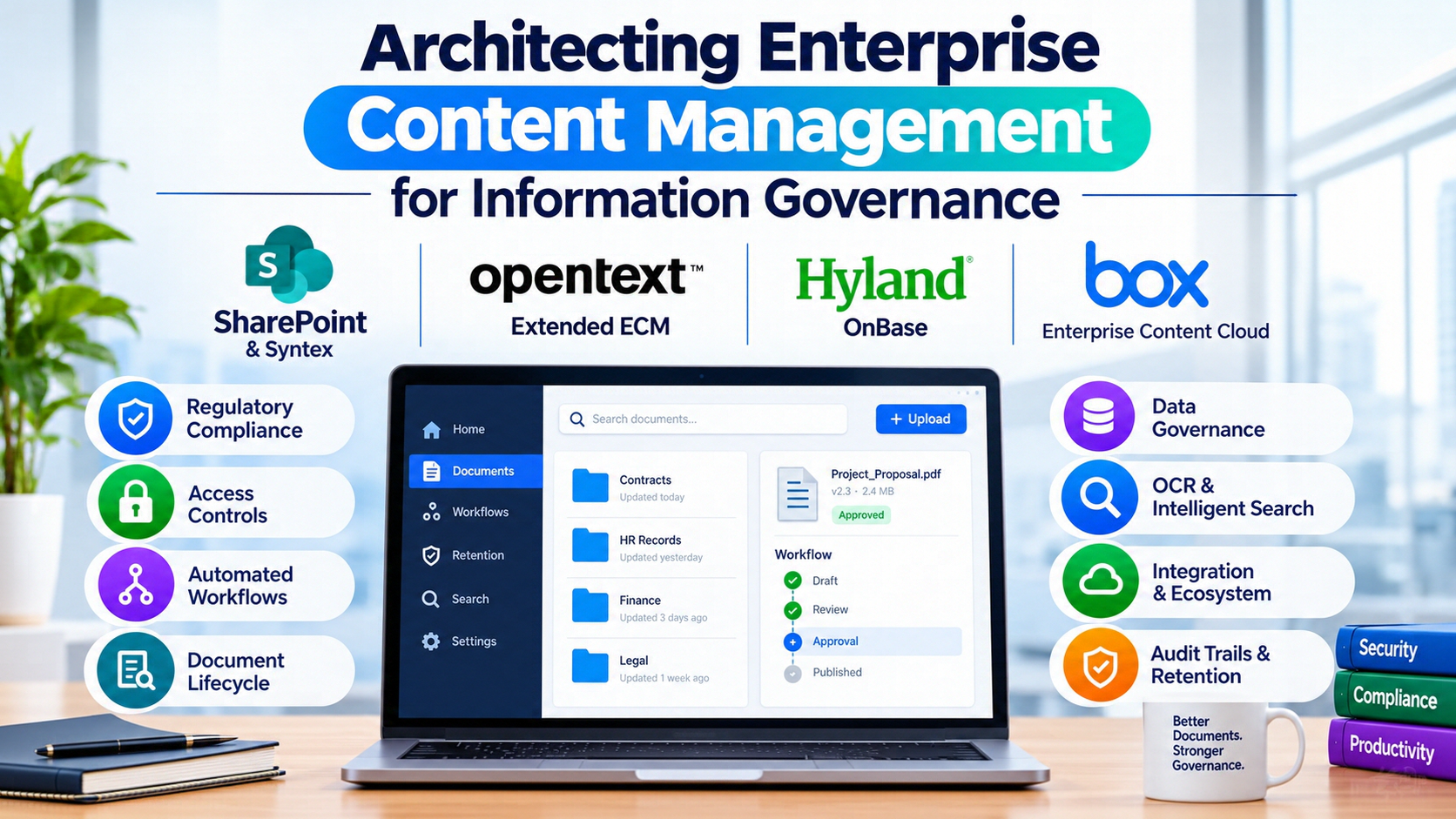
Organizations rarely struggle with a shortage of information; rather, they drown in an uncoordinated sprawl of digital artifacts. When enterprise knowledge fractures across unstructured shared drives, local hard drives, disparate cloud repositories, and legacy databases, operational efficiency plummets. Information governance becomes a fragile exercise in manual tracking, and regulatory compliance transforms into an ongoing operational risk.
Implementing an enterprise content management (ECM) strategy requires looking past simple document archiving to evaluate how information is captured, managed, preserved, and delivered across its entire lifecycle.
The Evolution of Content Architecture in the Enterprise
Enterprise content management has evolved from physical records management and basic digital archiving into a sophisticated discipline encompassing capture, collaboration, workflow automation, and records retention. Modern ECM platforms bridge the gap between unstructured data (such as contracts, emails, and multimedia) and structured enterprise applications (such as ERP and CRM systems).
When evaluating ECM architectures, organizations generally navigate three distinct deployment approaches:
- Monolithic Enterprise Suites: Comprehensive, heavy-duty platforms designed to manage every facet of corporate compliance, secure archiving, and complex document lifecycles across multinational operations.
- Cloud-Native Content Hubs: Flexible, web-scale platforms optimized for rapid deployment, seamless user adoption, and modern API-driven integrations with existing productivity tools.
- Federated Virtual Repositories: Architectures that leave documents in their native source systems while applying a unified governance, search, and metadata classification layer across disparate silos.
Recognizing how your organization’s regulatory burden intersects with these architectural models prevents costly platform mismatches.
Leading Enterprise Content Management Platforms Compared
1. Microsoft SharePoint and Syntex
SharePoint serves as the default enterprise content backbone for organizations leveraging the Microsoft 365 ecosystem, combining collaborative site management with robust compliance frameworks.
- Primary Use Case: Corporate intranet management, collaborative team workspaces, and automated records retention within Microsoft-centric environments.
- Key Differentiators: Deep native integration with Microsoft Teams and Office applications, advanced governance controls, and AI-powered content understanding via Syntex for automated tagging.
- Limitations: Complex permission inheritance and unmanaged site proliferation can create administrative overhead if not strictly governed.
- Best Suited For: Enterprises deeply invested in Microsoft infrastructure requiring integrated collaboration and standardized document security.
2. OpenText Extended ECM
OpenText stands as an industrial-grade ECM powerhouse designed for massive transactional volumes and highly regulated industries requiring strict auditability.
- Primary Use Case: Global enterprise content governance, deep ERP-integrated document control (SAP, Salesforce), and complex records management.
- Key Differentiators: Unmatched scalability for millions of active records, sophisticated automated disposition workflows, and extensive regulatory compliance certifications.
- Limitations: High total cost of ownership and complex implementation cycles requiring specialized administrative expertise.
- Best Suited For: Global corporations, financial institutions, and government bodies operating under rigorous regulatory mandates.
3. Hyland OnBase
Hyland OnBase focuses heavily on business process automation, bridging the gap between static document storage and dynamic operational workflows.
- Primary Use Case: Process-driven content management, healthcare patient record handling, and higher education administrative workflows.
- Key Differentiators: Powerful out-of-the-box workflow design engines, robust capture and OCR capabilities, and seamless integration with core line-of-business software.
- Limitations: Interface can feel utilitarian compared to modern cloud-native consumer applications.
- Best Suited For: Mid-to-large enterprises seeking to eliminate paper-heavy operational bottlenecks and automate multi-step document approvals.
4. Box Enterprise Content Cloud
Box bridges the gap between secure enterprise content management and consumer-grade usability, focusing on cloud-native collaboration and secure external sharing.
- Primary Use Case: Secure cloud content sharing, external partner collaboration, and decentralized enterprise document access.
- Key Differentiators: Exceptional third-party app integration ecosystem, robust data residency controls, and streamlined mobile access.
- Limitations: Less naturally suited for complex physical records management or deep legacy ERP archiving compared to heavy ECM suites.
- Best Suited For: Modern distributed enterprises prioritizing frictionless collaboration, secure external sharing, and cloud-native agility.
Feature Comparison Matrix
| Product | Primary Focus | Deployment Model | Integration Specialization | Significant Advantage | Important Limitation |
|---|---|---|---|---|---|
| SharePoint / Syntex | Collaborative Governance & Intranets | Cloud (M365) / Hybrid | Microsoft 365 & Teams | Native ecosystem alignment and AI tagging | Complex site proliferation risks |
| OpenText | Industrial Regulatory Compliance | On-Premises / Hybrid / Cloud | Deep ERP (SAP, Salesforce) | Unmatched enterprise scalability and audit rigor | High implementation cost and complexity |
| Hyland OnBase | Process Automation & Workflows | On-Premises / Cloud | Line-of-Business Applications | Robust visual workflow designer and capture | Steeper learning curve for custom adjustments |
| Box | Secure Cloud Collaboration | Cloud (SaaS) | Broad SaaS Ecosystem | Exceptional external sharing and mobile experience | Less focused on traditional physical records management |
Evaluating Technical and Operational Trade-Offs
Deploying an enterprise content management platform involves navigating significant operational realities beyond software licensing costs:
- Migration Complexity and Data Hygiene: Migrating decades of legacy file shares into an ECM platform without a clear taxonomy results in moving disorganization to a more expensive location. Enforcing metadata classification and removing redundant files prior to migration is essential.
- User Adoption vs. Strict Governance: If an ECM platform imposes cumbersome metadata entry requirements and rigid upload processes, users will actively bypass it in favor of consumer cloud storage. Striking the right balance between security compliance and user experience determines long-term success.
- Lifecycle Automation and Disposition: True ECM requires defining what happens to a document from creation to final destruction. Verify whether your chosen platform automates retention schedules securely to mitigate legal exposure during audits.
Making Your Decision
The optimal enterprise content management platform aligns directly with your organization’s regulatory environment and operational structure. If your enterprise relies heavily on collaborative workflows within the Microsoft ecosystem, a native cloud productivity suite provides immediate alignment. Organizations handling massive transactional volumes tied to enterprise resource planning systems benefit from industrial-grade platforms with deep ERP integrations. For businesses driven by complex approval processes and paper-to-digital capture, a process-automation-focused ECM delivers maximum operational value. Evaluate your compliance mandates, user adoption capacity, and integration requirements before committing to your content strategy.
