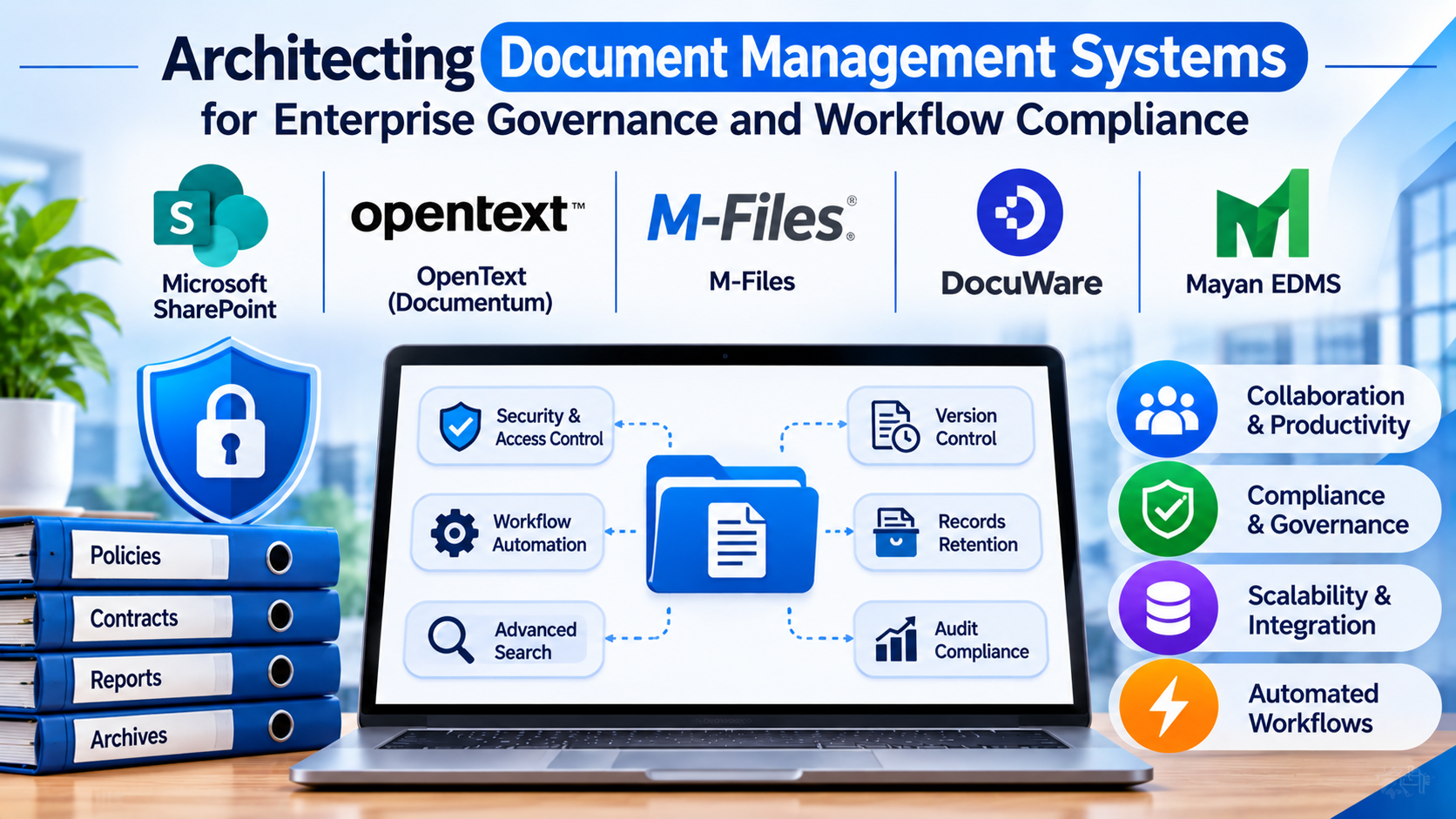
Organizations frequently hit a breaking point when shared network drives and unstructured cloud storage folders morph into digital labyrinths. What begins as a convenient repository for team files quickly devolves into conflicting file versions, missing audit trails, and serious regulatory exposure. When an enterprise must prove who modified a contract, ensure strict version locking across multi-departmental reviews, or automate document retention policies, standard folder directories fail entirely.
Choosing the right document management system (DMS) requires evaluating how a platform handles granular access controls, automated lifecycle governance, optical character recognition (OCR), and integration with core enterprise infrastructure.
The Divergence in Modern Document Management Architectures
The document management landscape is defined by three distinct operational paradigms, each built for specific regulatory environments and team scales:
- Enterprise Content Management (ECM) Suites: Built for large-scale corporate and heavily regulated sectors (such as finance, healthcare, and government). These platforms emphasize strict compliance, legal hold management, automated retention schedules, and comprehensive audit logging.
- Collaborative Cloud Document Hubs: Tailored for fast-moving businesses prioritizing real-time multi-author editing, frictionless web sharing, and deep integration with daily productivity suites over rigid administrative lockdowns.
- Open-Source and Self-Hosted Repositories: Designed for organizations requiring absolute data sovereignty, custom-built workflows, and on-premises deployment to satisfy stringent internal security mandates.
Understanding where your organizational compliance requirements intersect with these architectures prevents costly software mismatches during audits or migration projects.
Leading Document Management Platforms and Technical Differentiators
1. Microsoft SharePoint / Syntex
SharePoint serves as the foundational enterprise document management backbone for organizations anchored in the Microsoft 365 ecosystem.
- Primary Use Case: Enterprise-wide intranet knowledge management, secure corporate record retention, and deep Microsoft Teams document collaboration.
- Key Differentiators: Advanced governance policies, automated content understanding via AI-powered tagging (Microsoft Syntex), granular permission inheritance, and deep integration with Office applications.
- Limitations: Complex permission structures and site architectures require dedicated administrative oversight to prevent user confusion and security drift.
- Best Suited For: Enterprises heavily invested in Microsoft infrastructure requiring robust compliance and native identity management.
2. OpenText (Documentum)
OpenText stands as an industrial-grade enterprise content management platform designed for massive transaction volumes and highly regulated industries.
- Primary Use Case: Complex, highly regulated enterprise environments requiring rigorous document lifecycles and legal compliance tracking.
- Key Differentiators: Unmatched scalability for millions of documents; sophisticated records management with automated disposition; and deep regulatory compliance certifications (FDA, SEC, ISO).
- Limitations: High total cost of ownership; complex implementation timeline requiring specialized technical expertise.
- Best Suited For: Global enterprises, government bodies, and pharmaceutical companies operating under intense regulatory scrutiny.
3. M-Files
M-Files employs a metadata-driven architecture that eliminates traditional folder structures entirely, organizing documents by what they are rather than where they are stored.
- Primary Use Case: Multi-repository integration and intelligent, metadata-centric document search across fragmented enterprise data sources.
- Key Differentiators: Vault abstraction layer that connects to network shares and legacy databases without moving files; automated workflow routing based on document metadata; and AI-assisted classification.
- Limitations: Requires a fundamental shift in user habits away from traditional folder browsing toward metadata tagging.
- Best Suited For: Mid-to-large enterprises seeking to unify disparate document silos under a single intelligent search and governance layer.
4. DocuWare
DocuWare bridges the gap between digital document storage and advanced workflow automation, specializing in invoice processing and HR onboarding.
- Primary Use Case: Automated document capture, intelligent indexing, and multi-step approval workflow automation.
- Key Differentiators: Out-of-the-box workflow designer for automated approvals; robust OCR and barcode recognition for paper scanning; and seamless cloud deployment options.
- Limitations: Less suited for complex, multi-tiered enterprise record management compared to heavy ECM suites.
- Best Suited For: Small-to-midsize businesses automating paper-heavy accounting and administrative workflows.
5. Mayan EDMS
Mayan EDMS is a robust, open-source document management system designed for organizations requiring complete control over their deployment and data infrastructure.
- Primary Use Case: Self-hosted document archiving, open-source compliance management, and budget-conscious secure repositories.
- Key Differentiators: Completely free and open-source under the Apache license; built-in OCR processing engine; automated document transformation pipelines; and local data sovereignty.
- Limitations: Requires internal technical resources for server administration, security hardening, and ongoing maintenance.
- Best Suited For: Tech-forward organizations, research institutions, and privacy-conscious entities requiring self-hosted document control.
Feature Comparison Matrix
| Product | Primary Focus | Deployment Model | Indexing & Retrieval Style | Significant Advantage | Important Limitation |
| SharePoint | Enterprise Collaboration & Intranets | Cloud (M365) / Hybrid | Folder & Metadata Hybrid | Deep Microsoft 365 and Teams integration | Requires expert administrative governance |
| OpenText | Industrial Regulatory Compliance | On-Premises / Cloud | Hierarchical Record Management | Unmatched scalability and regulatory certifications | High implementation and operational cost |
| M-Files | Metadata-Driven Enterprise Search | Cloud / Hybrid / On-Prem | Metadata-Centric (Folder-free) | Unifies external repositories without moving files | Requires user adoption of metadata tagging |
| DocuWare | Workflow Automation & Invoicing | Cloud / On-Premises | Index-Driven & Workflow | Powerful visual workflow automation designer | Less suited for complex archival records |
| Mayan EDMS | Open-Source Secure Archiving | Self-Hosted / On-Premises | Tag & Metadata Based | Complete data sovereignty and zero licensing fees | Demands internal IT administration resources |
Evaluating Technical and Operational Trade-Offs
When establishing an enterprise document management strategy, software licensing costs represent only a fraction of the total investment. Evaluate these critical operational factors before committing:
- Migration and Ingestion Complexity: Moving terabytes of legacy file shares into a structured DMS requires meticulous data cleansing, deduplication, and metadata mapping. Failing to clean data prior to migration simply moves disorganization into an expensive new system.
- User Adoption vs. System Rigor: Highly secure systems with mandatory metadata tagging and strict approval workflows often frustrate users, leading them to bypass the official DMS and revert to unapproved consumer cloud storage. Balancing security with user-friendly search is vital.
- Auditability and Retention Mandates: Verify whether your platform supports automated retention schedules (auto-deletion or legal holds) that comply with legal requirements in your specific operating jurisdiction.
Making Your Decision
The optimal document management system depends directly on your organizational scale and regulatory environment. If your enterprise is deeply embedded in the Microsoft ecosystem and requires robust collaborative governance, a cloud-native enterprise suite provides seamless alignment. Organizations dealing with complex multi-system data silos benefit immensely from metadata-driven platforms that index files wherever they live. For businesses prioritizing automated invoice and approval workflows, a specialized workflow-automation DMS delivers immediate operational value. Evaluate your compliance mandates and migration capacity before standardizing your document infrastructure.
