Introduction
Print-on-demand allows creators and businesses to sell customized physical products without purchasing large quantities of inventory in advance.
Instead of producing hundreds of shirts, mugs, posters, or accessories before receiving orders, sellers work with fulfillment providers that manufacture eligible products after customers purchase them.
This model reduces upfront inventory requirements and makes it easier to test new designs.
However, print-on-demand does not eliminate business risk. Sellers still need to evaluate product quality, production costs, shipping times, customer service, returns, and profit margins.
Print-on-demand platforms differ in their product catalogs, printing technologies, integrations, fulfillment locations, and commercial models.
Some focus on providing production infrastructure for independent online stores. Others combine product creation with marketplaces or ready-made storefronts.
This guide compares ten print-on-demand platforms and explains how to select, test, and operate a reliable print-on-demand business.
What Are Print-on-Demand Platforms?
Print-on-demand platforms are services that manufacture or customize eligible products after customer orders are received.
They commonly support apparel, mugs, posters, phone cases, stationery, and other customizable merchandise.
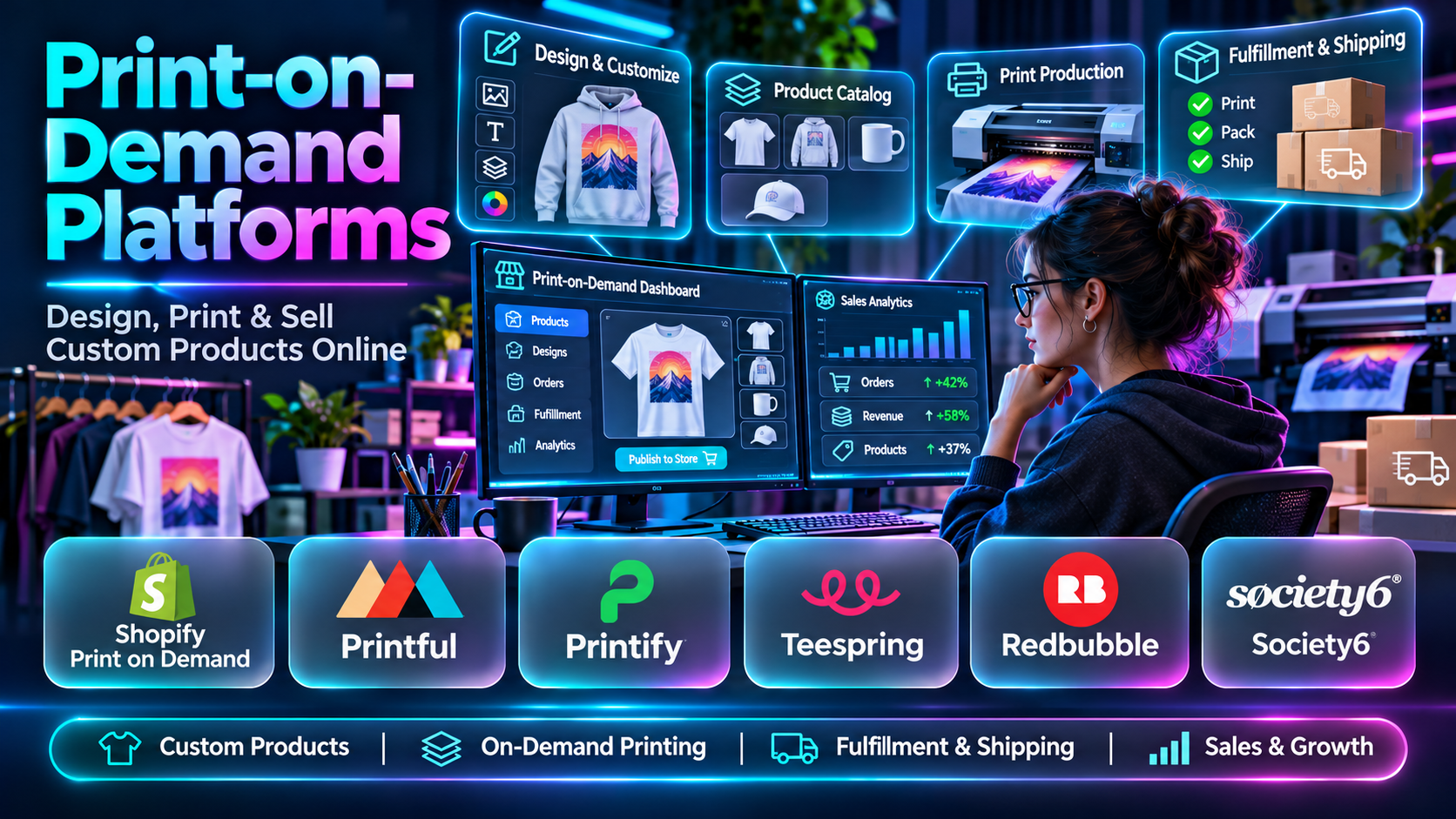
How Print-on-Demand Works
A seller creates a design and applies it to a supported product.
The product is listed in an online storefront or marketplace.
When a customer purchases the item, the order is transmitted to the production provider.
The provider prints or manufactures the product and arranges shipping according to the service agreement.
The seller receives revenue after applicable product, fulfillment, platform, and payment costs.
Print-on-Demand vs. Traditional Inventory
Traditional merchandise businesses often purchase inventory before making sales.
Print-on-demand businesses generally avoid large upfront product orders, but individual production costs may be higher.
The correct model depends on demand predictability, cash flow, customization requirements, and operational priorities.
Top 10 Print-on-Demand Platforms
1. Printful
Short Description
Printful provides print-on-demand production and fulfillment services for businesses and creators.
It connects with supported online stores and marketplaces, allowing sellers to offer customized products without managing conventional inventory.
Printful is particularly relevant to businesses seeking an established production workflow with store integrations, product customization, and order fulfillment.
Key Features
- Print-on-demand production: Manufactures eligible products after orders.
- Product catalog: Offers customizable merchandise.
- Store integrations: Connects supported commerce platforms.
- Design tools: Helps prepare product artwork.
- Mockup generation: Creates product previews.
- Order fulfillment: Processes production and shipping.
- Branding options: Supports applicable custom branding.
- Order tracking: Provides fulfillment information.
- Product samples: Supports quality evaluation.
Benefits
Printful can reduce inventory requirements and connect production directly with online stores.
Pros
- Broad merchandise catalog.
- Commerce integrations.
- Managed fulfillment.
- Mockup tools.
- Branding options.
Cons
- Per-item production costs.
- Shipping expenses.
- Limited control over production timing.
- Margins depend on pricing.
- Product availability varies by location.
Use Cases
- Branded apparel stores.
- Creator merchandise.
- Customized accessories.
Best For: Sellers seeking integrated print-on-demand fulfillment.
2. Printify
Short Description
Printify provides a print-on-demand platform connecting sellers with a network of printing providers.
Its model allows merchants to evaluate products and fulfillment partners according to relevant options.
Printify is especially useful for sellers who want flexibility in production sourcing, although differences between providers require careful quality and shipping evaluation.
Key Features
- Print provider network: Connects merchants with production partners.
- Product catalog: Offers customizable merchandise.
- Store integrations: Supports relevant commerce platforms.
- Product design tools: Helps create listings.
- Mockup generation: Produces product previews.
- Order routing: Coordinates fulfillment.
- Shipping options: Vary by provider and destination.
- Cost comparison: Supports relevant production choices.
- Order management: Tracks purchases and fulfillment.
Benefits
Printify can provide production flexibility and a broad range of merchandise options.
Pros
- Multiple printing providers.
- Broad product selection.
- Commerce integrations.
- Pricing flexibility.
- Suitable for varied product categories.
Cons
- Quality varies by provider.
- Shipping consistency differs.
- Supplier selection requires research.
- Returns depend on applicable policies.
Use Cases
- Apparel businesses.
- Custom gift shops.
- Multi-product print-on-demand stores.
Best For: Sellers comparing different print providers.
3. Gelato
Short Description
Gelato provides print-on-demand services through a distributed production network.
Its platform is relevant to businesses selling customized products across multiple geographic markets.
Gelato’s production model can help sellers evaluate local or regional fulfillment opportunities, although availability depends on product type and destination.
Key Features
- Distributed production: Uses supported production partners.
- Print-on-demand catalog: Offers customizable products.
- Store integrations: Connects relevant commerce systems.
- Order automation: Supports production workflows.
- Product customization: Applies submitted designs.
- Shipping coordination: Supports eligible destinations.
- Order tracking: Provides fulfillment visibility.
- Business tools: Supports relevant merchant operations.
Benefits
Gelato can help international sellers manage customized product fulfillment through distributed production.
Pros
- International production orientation.
- Commerce integrations.
- Automated fulfillment.
- Relevant to global sellers.
Cons
- Product availability varies geographically.
- Quality depends on production arrangements.
- Shipping costs vary.
- Some products have limited customization.
Use Cases
- International poster sales.
- Customized stationery.
- Global merchandise businesses.
Best For: Sellers targeting multiple geographic markets.
4. Gooten
Short Description
Gooten provides print-on-demand fulfillment technology for e-commerce businesses.
Its services help merchants connect product sales with production and shipping workflows.
Gooten is particularly relevant to businesses seeking scalable fulfillment operations rather than a consumer-facing merchandise marketplace.
Key Features
- Print-on-demand fulfillment: Produces eligible products after orders.
- Product catalog: Offers customizable merchandise.
- Commerce integrations: Connects supported stores.
- Order management: Organizes fulfillment activity.
- Production network: Coordinates relevant suppliers.
- Automation: Reduces repetitive order processing.
- Shipping workflows: Supports applicable destinations.
- Operational reporting: Provides fulfillment information.
Benefits
Gooten can help merchants outsource customized product production and order fulfillment.
Pros
- Fulfillment-oriented platform.
- Commerce integration.
- Product variety.
- Relevant to growing businesses.
Cons
- Supplier-dependent production.
- Product quality requires testing.
- Shipping varies.
- Less suitable for sellers wanting a built-in consumer marketplace.
Use Cases
- E-commerce merchandise.
- Customized home products.
- Multi-product stores.
Best For: Businesses seeking outsourced print-on-demand fulfillment.
5. SPOD
Short Description
SPOD is a print-on-demand service associated with the Spread Group ecosystem.
It provides customizable products and production services for eligible e-commerce workflows.
SPOD is particularly relevant to merchants prioritizing straightforward product customization and fulfillment integration.
Current service availability, integrations, and geographic coverage should be verified before adoption.
Key Features
- On-demand printing: Produces customized products.
- Merchandise catalog: Offers supported items.
- Store integration: Connects eligible commerce environments.
- Design customization: Applies artwork to products.
- Order fulfillment: Coordinates production and shipping.
- Product previews: Supports listing preparation.
- Order tracking: Provides relevant status information.
- Production workflows: Supports merchant operations.
Benefits
SPOD can reduce inventory requirements for customized merchandise sellers.
Pros
- Print-on-demand specialization.
- Store-oriented workflows.
- Product customization.
- Managed fulfillment.
Cons
- Current availability requires verification.
- Product catalog restrictions.
- Regional shipping differences.
- Limited control over production.
Use Cases
- Custom apparel.
- Branded merchandise.
- E-commerce product testing.
Best For: Merchants evaluating Spread Group print-on-demand services.
6. Apliiq
Short Description
Apliiq specializes in custom apparel production and related branding services.
Its offerings are relevant to clothing brands seeking more apparel-oriented customization than conventional basic printing.
Apliiq can be useful for sellers interested in developing a recognizable clothing brand rather than simply placing graphics on generic products.
Key Features
- Custom apparel: Supports eligible clothing products.
- Print-on-demand services: Provides applicable production.
- Branding options: Supports selected labels and customization.
- Design application: Applies artwork to garments.
- Product catalog: Offers apparel options.
- Fulfillment: Supports eligible order processing.
- Commerce integration: Connects supported selling systems.
- Brand development tools: Supports relevant apparel workflows.
Benefits
Apliiq can help independent clothing businesses create more distinctive branded apparel.
Pros
- Apparel specialization.
- Branding options.
- Custom clothing focus.
- Relevant to fashion entrepreneurs.
Cons
- Narrower product scope.
- Customization may increase costs.
- Production timelines vary.
- Requires careful sample testing.
Use Cases
- Streetwear brands.
- Custom clothing labels.
- Premium creator apparel.
Best For: Apparel-focused print-on-demand businesses.
7. Redbubble
Short Description
Redbubble is an online marketplace where independent artists can offer designs on supported merchandise.
Unlike fulfillment services that primarily integrate with external stores, Redbubble provides a marketplace-oriented selling experience.
Artists upload designs and apply them to eligible products, while the platform manages relevant customer transactions and production workflows.
Key Features
- Artist marketplace: Provides product discovery.
- Design uploads: Supports original artwork.
- Merchandise catalog: Offers customizable products.
- Product previews: Displays designs on merchandise.
- Order processing: Handles eligible purchases.
- Production fulfillment: Coordinates printing and shipping.
- Artist earnings: Provides applicable payment information.
- Store profiles: Organizes artist products.
Benefits
Redbubble allows artists to test merchandise sales without building an independent store.
Pros
- Built-in marketplace.
- No conventional inventory requirement.
- Multiple merchandise categories.
- Accessible artist workflow.
Cons
- Marketplace competition.
- Limited storefront control.
- Platform fees and earnings rules.
- Customer relationships are platform-dependent.
Use Cases
- Selling illustration merchandise.
- Offering stickers and posters.
- Testing artwork demand.
Best For: Artists seeking marketplace-based print-on-demand sales.
8. Society6
Short Description
Society6 is an artist-oriented marketplace associated with artwork and home decor products.
Its print-on-demand model has supported independent artwork on eligible merchandise and decorative products.
Because marketplace ownership, operations, and product programs can change, sellers should verify current availability and artist participation terms before relying on Society6.
Key Features
- Artist marketplace: Presents creative products.
- Artwork uploads: Supports eligible designs.
- Home decor products: Offers relevant merchandise categories.
- Product previews: Displays artwork applications.
- Production services: Supports applicable printing.
- Order processing: Coordinates purchases.
- Fulfillment: Manages relevant delivery operations.
- Artist earnings: Provides applicable compensation information.
Benefits
Society6’s model is relevant to artists interested in artwork-driven home products.
Pros
- Art and design orientation.
- Home decor relevance.
- Marketplace model.
- Outsourced production.
Cons
- Current seller availability requires verification.
- Platform control over product programs.
- Marketplace competition.
- Earnings arrangements vary.
Use Cases
- Art prints.
- Decorative products.
- Home decor artwork.
Best For: Artists evaluating print-on-demand home decor marketplaces.
9. Zazzle
Short Description
Zazzle is a marketplace for customizable products, gifts, stationery, and other merchandise.
It allows designers to offer artwork and product templates that customers can personalize.
Zazzle is especially relevant to sellers whose products benefit from customization, such as invitations, gifts, and event-related merchandise.
Key Features
- Custom product marketplace: Supports personalized merchandise.
- Design uploads: Allows original artwork.
- Product templates: Supports customer customization.
- Merchandise catalog: Offers multiple categories.
- Marketplace checkout: Handles eligible purchases.
- Production services: Coordinates customized manufacturing.
- Fulfillment: Supports order delivery.
- Designer earnings: Provides relevant compensation information.
Benefits
Zazzle can help designers monetize customizable products through an established marketplace.
Pros
- Personalization capabilities.
- Broad product categories.
- Marketplace discovery.
- Outsourced production.
Cons
- Competitive marketplace.
- Limited independent brand control.
- Earnings depend on pricing arrangements.
- Product quality varies by category.
Use Cases
- Personalized invitations.
- Custom gifts.
- Event stationery.
Best For: Designers selling personalized products.
10. TeePublic
Short Description
TeePublic is a marketplace for artist-designed apparel and related merchandise.
It provides a relatively direct way for designers to upload artwork and offer products without independently managing production.
TeePublic is especially relevant to illustrators and graphic designers focused on wearable artwork.
Key Features
- Artist storefronts: Presents designs.
- Design uploads: Supports original graphics.
- Apparel catalog: Offers relevant clothing products.
- Product previews: Displays merchandise designs.
- Marketplace checkout: Processes eligible orders.
- On-demand printing: Supports production.
- Order fulfillment: Coordinates shipping.
- Artist earnings: Provides payment information.
Benefits
TeePublic can help artists sell apparel designs through a managed marketplace.
Pros
- Artist-oriented platform.
- Apparel specialization.
- Managed fulfillment.
- Accessible setup.
Cons
- Marketplace competition.
- Limited pricing and branding control.
- Earnings depend on platform policies.
- Less suitable for complex independent stores.
Use Cases
- Graphic T-shirts.
- Illustration merchandise.
- Artist apparel collections.
Best For: Designers selling artwork-driven apparel.
Print-on-Demand Platforms Comparison Table
| Platform | Model | Main Strength | Main Limitation | Best For |
|---|---|---|---|---|
| Printful | Fulfillment service | Integrations and branding | Production costs | Branded stores |
| Printify | Provider network | Supplier choice | Variable quality | Cost-conscious sellers |
| Gelato | Distributed production | Geographic coverage | Regional product differences | International sellers |
| Gooten | Fulfillment service | Order automation | Supplier dependency | E-commerce businesses |
| SPOD | Fulfillment service | Merchandise printing | Verify current availability | Apparel merchants |
| Apliiq | Apparel production | Clothing customization | Narrower catalog | Fashion brands |
| Redbubble | Marketplace | Artist discovery | Limited brand control | Illustrators |
| Society6 | Art marketplace | Home decor focus | Verify seller availability | Visual artists |
| Zazzle | Marketplace | Personalization | Competition | Gift designers |
| TeePublic | Marketplace | Apparel designs | Pricing control | Graphic artists |
How to Choose the Right Print-on-Demand Platform
Decide Between Marketplace and Fulfillment Service
Marketplaces provide a customer-facing sales environment.
Fulfillment services generally connect with a separate online store.
Choose according to how much control you want over branding and customer relationships.
Compare Product Catalogs
Check whether the provider offers the exact products, sizes, colors, and materials required.
Evaluate Printing Quality
Order samples and inspect print clarity, placement, durability, and garment quality.
Compare Production Costs
Calculate the cost of each product, printing, packaging, shipping, and additional services.
Assess Shipping Coverage
Verify production locations, delivery destinations, and estimated fulfillment times.
Review Store Integrations
Check compatibility with Shopify, WooCommerce, Etsy, and other relevant systems.
Evaluate Branding Options
Determine whether custom labels, packaging inserts, or branded materials are available.
Understand Returns
Review how damaged products, manufacturing defects, and customer size changes are handled.
Test Order Automation
Place test orders and verify that product information and shipping details transfer correctly.
Review Financial Sustainability
Calculate expected net margins under realistic shipping, advertising, and return scenarios.
Best Print-on-Demand Platforms by User Type
| User Type | Recommended Platform | Reason |
|---|---|---|
| Branded merchandise store | Printful | Store integrations |
| Seller comparing suppliers | Printify | Provider selection |
| International seller | Gelato | Distributed production |
| Growing e-commerce merchant | Gooten | Fulfillment workflows |
| Apparel merchant | SPOD | On-demand printing |
| Clothing brand | Apliiq | Apparel customization |
| Independent illustrator | Redbubble | Marketplace access |
| Home decor artist | Society6 | Artwork products |
| Personalized gift designer | Zazzle | Product customization |
| Graphic T-shirt artist | TeePublic | Apparel marketplace |
Practical Step-by-Step Example: Launching a Print-on-Demand T-shirt Business
A designer wants to sell original graphic T-shirts without purchasing inventory.
Step 1: Identify the audience. Choose a specific design theme and customer group.
Step 2: Create original artwork. Prepare high-resolution files and verify intellectual property rights.
Step 3: Compare providers. Evaluate product quality, pricing, shipping, and integrations.
Step 4: Choose a shirt. Select appropriate materials, sizes, and colors.
Step 5: Order samples. Inspect print quality and garment construction.
Step 6: Calculate pricing. Include production, shipping, fees, advertising, and expected returns.
Step 7: Create product listings. Use accurate mockups, descriptions, and size charts.
Step 8: Configure the store. Connect the fulfillment service and test order processing.
Step 9: Launch the collection. Promote products through relevant audience channels.
Step 10: Review performance. Monitor sales, margins, returns, customer feedback, and delivery reliability.
For example, a T-shirt selling for $28 with $13 in production costs, $5 in seller-paid shipping, and $2 in payment and platform fees leaves $8 before advertising, taxes, refunds, and other operating expenses.
This illustrates why print-on-demand pricing should be based on complete costs rather than product price alone.
Common Mistakes and How to Avoid Them
1. Skipping Product Samples
Mockups do not guarantee actual print quality.
Inspect physical products.
2. Ignoring Shipping Costs
Shipping can significantly reduce margins.
Calculate costs by destination.
3. Using Low-resolution Artwork
Poor files may produce blurry prints.
Follow provider specifications.
4. Choosing Products Only by Price
Cheap products may create customer dissatisfaction.
Evaluate materials and quality.
5. Using Copyrighted Designs Without Permission
Unauthorized designs can create legal problems.
Use original or properly licensed artwork.
6. Selling Too Many Products Immediately
Large catalogs increase management complexity.
Start with a focused selection.
7. Ignoring Return Policies
Production defects and customer concerns require clear procedures.
Review provider and consumer protection requirements.
8. Assuming Print-on-Demand Guarantees Profit
Revenue depends on demand, pricing, costs, and customer acquisition.
Track net margins.
Frequently Asked Questions
1. What is print-on-demand?
It is a production model where eligible products are manufactured after orders are placed.
2. How does print-on-demand work?
A customer orders a customized product, and a provider produces and ships it.
3. Is print-on-demand profitable?
It can be, depending on pricing, costs, demand, and marketing.
4. Do sellers need inventory?
Generally, print-on-demand reduces the need for pre-purchased inventory.
5. What products can be printed on demand?
Common examples include apparel, mugs, posters, stationery, and accessories.
6. What is the difference between Printful and Printify?
Printful provides integrated fulfillment services, while Printify emphasizes access to multiple print providers.
7. Is Gelato suitable for international selling?
Its distributed production approach is relevant to international fulfillment.
8. What is a print-on-demand marketplace?
It is a platform where customers can discover and purchase customized products directly.
9. Can artists sell on Redbubble?
Eligible artists can offer designs through its marketplace.
10. Can print-on-demand integrate with Shopify?
Several fulfillment providers support Shopify integrations.
11. What is a product mockup?
It is a preview showing how a design may appear on a product.
12. Should sellers order samples?
Yes. Samples help verify quality.
13. What is direct-to-garment printing?
It is a printing method that applies ink directly to suitable garments.
14. What is sublimation printing?
It is a printing process commonly used for compatible materials and products.
15. What is embroidery?
It is a decoration method that stitches designs into fabric.
16. How long does fulfillment take?
Production and shipping times vary by provider and destination.
17. Can sellers use custom packaging?
Some providers offer selected branding options.
18. Can print-on-demand support international orders?
Many providers support eligible international destinations.
19. Are returns accepted?
Policies vary by seller, provider, product, and applicable law.
20. How should sellers price products?
Include production, shipping, fees, advertising, and other relevant costs.
21. Can print-on-demand businesses scale?
Yes, although fulfillment reliability and margins remain important.
22. Do sellers need graphic design skills?
Original designs are important, but creators may use appropriately licensed tools or professional design services.
23. Can print-on-demand be combined with stocked inventory?
Yes. Hybrid merchandise businesses are common.
24. What is the biggest print-on-demand challenge?
Maintaining consistent product quality and sustainable margins.
25. Which print-on-demand platform is best?
The best choice depends on product type, quality, integrations, shipping coverage, and commercial goals.
Final Thoughts
Print-on-demand platforms make customized merchandise accessible without requiring large upfront inventory purchases.
Printful, Printify, Gelato, Gooten, and SPOD provide fulfillment-oriented services. Apliiq focuses on apparel customization, while Redbubble, Society6, Zazzle, and TeePublic offer marketplace-oriented selling models.
The right platform depends on the seller’s product requirements, desired brand control, production quality, shipping needs, and financial expectations.
A sustainable print-on-demand business requires original designs, reliable fulfillment, accurate pricing, and consistent customer service.
