Choosing a source code management (SCM) platform is one of the highest-friction decisions an engineering organization makes. Unlike a monitoring agent or an internal dashboard, your SCM tool sits directly in the daily path of every commit, code review, branch merge, and security audit. Migrating repositories later—along with years of pull request discussions, webhook integrations, branch protection rules, and CI/CD triggers—requires substantial engineering effort.
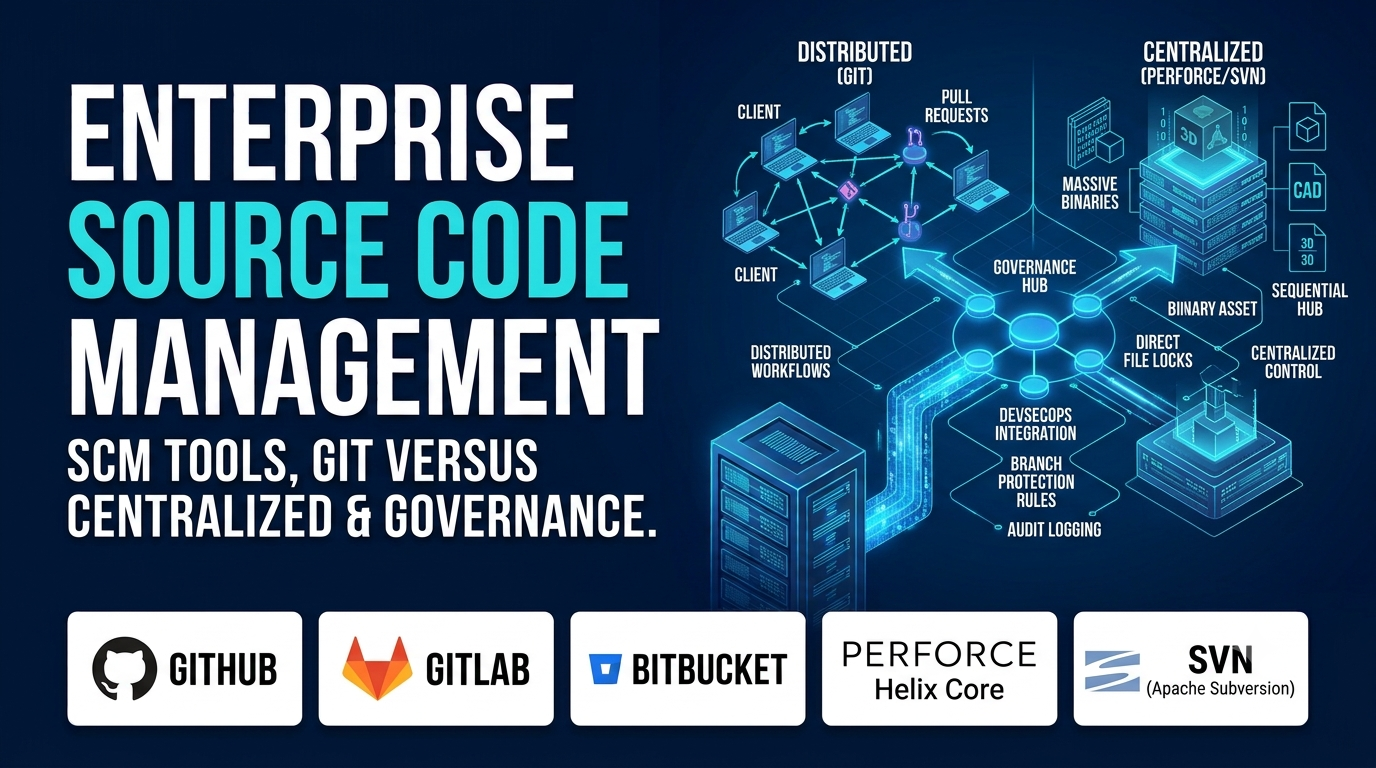
Today, the SCM landscape splits along two foundational axes: the underlying version control system (distributed Git versus centralized engines built for massive binary assets) and the hosting and governance platform layered on top of it (cloud-hosted DevSecOps suites versus lightweight self-hosted servers). Understanding how these layers interact prevents organizations from paying for enterprise lifecycle suites they never use—or outgrowing a simple repository host once compliance and repository scale become bottlenecks.
Version Control Engines vs. Hosting Platforms
A common source of confusion when evaluating SCM tools is treating the version control protocol and the collaboration platform as the same thing.
- The Version Control Engine manages file history, branching, merging, and diff tracking at the storage and CLI level. Git dominates standard application development because every developer holds a full local clone of the repository, making branching and offline work nearly instantaneous. However, centralized engines such as Perforce Helix Core and Apache Subversion (SVN) remain active in industries where cloning multi-terabyte repositories or locking unmergeable binary files is mandatory.
- The SCM Hosting and Collaboration Platform wraps that engine in web-based code review (pull or merge requests), granular access controls, audit logging, issue tracking, and automated build triggers. GitHub, GitLab, Bitbucket, and Gitea all use Git underneath, yet they impose very different workflows, governance models, and operational costs.
Major SCM Platforms and Version Control Systems
GitHub — Ecosystem Reach and Developer Workflow Standard
GitHub is the largest cloud-hosted Git platform, combining source hosting with Pull Requests, GitHub Actions, GitHub Packages, and native security scanning via GitHub Advanced Security (secret scanning, dependency review, and CodeQL static analysis).
Its primary differentiator is ecosystem gravity. Nearly every third-party developer tool, IDE extension, security scanner, and cloud deployment service integrates with GitHub first. For enterprise buyers, GitHub Enterprise offers both multi-tenant cloud hosting (with enterprise managed users and data residency options) and GitHub Enterprise Server for self-hosted deployment. The main trade-off is cost structure: while core repository hosting is affordable, unlocking advanced compliance controls, code-scanning seats, and enterprise governance features across large engineering headcounts increases per-user licensing expenses significantly.
GitLab — Single-Application DevSecOps Governance
GitLab builds source code management directly into an end-to-end software delivery platform that spans planning, repository hosting, CI/CD, container registries, and application security testing within a unified data model. Its Merge Request interface emphasizes strict approval rules, code owners, merge trains (queuing and testing sequential merges against updated target branches), and integrated vulnerability reports.
GitLab appeals strongly to organizations that prefer running a self-managed instance on their own infrastructure—supporting Linux packages, Docker, and Kubernetes Helm charts with feature parity between SaaS and self-hosted tiers. However, teams that already rely on separate best-of-breed tools (such as Jira for planning and CircleCI or Jenkins for builds) may find GitLab’s all-in-one interface heavier than necessary if they only need Git hosting.
Bitbucket — Native Integration for Atlassian-Centric Organizations
Maintained by Atlassian, Bitbucket is built around tight integration with Jira Software and Confluence. Developers can transition Jira issues automatically via commit messages, view build statuses and deployment environments directly inside Jira tickets, and enforce merge checks tied to Jira issue states.
Bitbucket Cloud includes built-in CI/CD through Bitbucket Pipelines, while Atlassian has shifted its self-hosted customers from Bitbucket Server toward Bitbucket Data Center for high-availability enterprise deployments. Bitbucket is the most natural choice for organizations heavily standardized on Atlassian workflows, though its third-party integration marketplace and community ecosystem are smaller than GitHub’s.
Azure Repos — Enterprise Microsoft and Azure Alignment
Part of the Azure DevOps suite, Azure Repos provides unlimited private Git repositories (alongside legacy Team Foundation Version Control support) integrated with Microsoft Entra ID (formerly Azure Active Directory), Azure Boards, and Azure Pipelines.
Its branch policies allow fine-grained enforcement of build validation, required reviewers, comment resolution, and merge strategies (such as squash-only or semi-linear merges). For enterprises operating within Microsoft licensing agreements and Azure cloud governance boundaries, Azure Repos offers straightforward identity management and low incremental cost. Outside Microsoft-centric environments, however, its UI and ecosystem feel less cohesive than GitHub—which Microsoft also owns and actively invests in as its primary developer-facing platform.
Gitea and Forgejo — Lightweight Self-Hosted Git Forge
For teams that want fast, self-hosted Git repositories, pull requests, and basic package registries without the memory footprint of full enterprise DevSecOps suites, Gitea—and its community-governed fork, Forgejo—offer compelling open-source alternatives. Distributed as a single Go binary, either platform can run reliably on minimal VPS hardware or small Kubernetes clusters while supporting SSH/HTTP Git operations, LDAP/OAuth authentication, and GitHub-compatible Actions runners.
These lightweight forges work well for small engineering teams, internal infrastructure repositories, air-gapped networks, and homelabs. Their limitation is enterprise governance depth: organizations requiring complex compliance auditing, granular organization-wide security policies, or vendor-backed SLA support will find commercial platforms more complete.
Perforce Helix Core — Centralized Control for Massive Binaries and Monorepos
When a project consists of hundreds of gigabytes of compiled binaries, 3D textures, CAD assemblies, or massive game engine assets, standard Git workflows degrade rapidly—even with Git LFS (Large File Storage). Perforce Helix Core uses a centralized client-server architecture where developers sync only the specific directory slices and file revisions they need, rather than downloading entire repository histories.
Helix Core provides exclusive file locking (preventing two artists from editing an unmergeable binary asset simultaneously), granular file-level permissions, and high-throughput replication via edge servers for globally distributed studios. It is the standard in AAA game development, semiconductor design, and digital media production, though its centralized model and commercial licensing are unnecessary for standard text-based web and cloud software.
Apache Subversion (SVN) — Legacy Centralized Version Control
Apache Subversion remains in active maintenance across government agencies, embedded systems teams, and long-lived enterprise codebases that predate Git’s rise. SVN stores a single authoritative repository on a central server, uses sequential integer revision numbers, and supports path-based authorization down to individual subdirectories. While SVN lacks Git’s offline branching agility and modern pull-request ecosystems, it remains stable for workflows built around linear trunk development and strict binary locking.
Side-by-Side Comparison of SCM Tools
| Platform / Tool | Underlying Model | Hosting Options | Standout Strength | Primary Trade-Off |
| GitHub | Distributed (Git) | SaaS Cloud & Self-Hosted Enterprise | Unmatched third-party ecosystem, Actions automation, and developer familiarity | Advanced security and enterprise governance features raise per-seat costs |
| GitLab | Distributed (Git) | SaaS Cloud & Self-Managed (Omnibus/K8s) | Unified SCM, CI/CD, and security scanning with merge trains and strong self-hosting | Interface and resource footprint can feel heavy if you only use Git hosting |
| Bitbucket | Distributed (Git) | SaaS Cloud & Data Center (Self-Hosted) | Deep bidirectional workflow integration with Jira and Confluence | Smaller external integration ecosystem compared to GitHub |
| Azure Repos | Distributed (Git) & TFVC | SaaS Cloud & Azure DevOps Server | Seamless Entra ID authentication and Microsoft enterprise licensing alignment | Slower feature velocity compared to GitHub |
| Gitea / Forgejo | Distributed (Git) | Self-Hosted (Single Go binary / Docker) | Ultra-low hardware footprint, fast deployment, and open-source control | Lighter enterprise compliance, auditing, and support guarantees |
| Perforce Helix Core | Centralized | Self-Hosted & Cloud-Deployed | Handles multi-terabyte repositories, binary file locking, and partial workspace syncs | Centralized workflow overhead and commercial licensing costs |
| Apache Subversion | Centralized | Self-Hosted | Mature linear revision tracking and directory-level access control | Lacks distributed offline branching and modern code-review ergonomics |
Key Evaluation Criteria Before Committing
Repository Architecture: Monorepo vs. Polyrepo Performance
Not all SCM tools scale equally under extreme repository sizes. If your organization uses a single massive monorepo with tens of thousands of commits per day, verify how well candidate platforms support partial clones, shallow clones, sparse-checkout, and commit-graph indexing—and whether web UI diff rendering times out on large pull requests.
Code Review and Merge Governance
Look beyond basic pull requests to examine how a platform protects main branches under high commit volume:
- Does it support CODEOWNERS rules that automatically assign domain experts based on file paths?
- Can it enforce merge queues or merge trains so two pull requests that pass CI individually do not break the main branch when merged together?
- Does it support cryptographic commit signing verification (GPG, SSH, or S/MIME) to prove commit authorship?
Identity, Access Boundaries, and Compliance Evidence
For regulated industries, an SCM platform is a critical audit boundary. Verify support for SAML 2.0 single sign-on, SCIM automated user provisioning/deprovisioning, IP allow-listing, immutable audit log streaming, and push protection that blocks accidental secret commits before they reach the remote repository.
True Total Cost of Ownership (TCO)
Seat licensing is only one part of SCM cost. When comparing SaaS plans against self-hosted deployments, factor in:
- Storage and bandwidth overages for Git LFS objects and build artifacts
- Compute minutes for bundled CI/CD runners
- Administrative engineering hours required for self-hosted upgrades, database backups, high-availability clustering, and disaster recovery drills
Selecting the Right SCM Foundation
- Choose GitHub when developer velocity, third-party tool compatibility, and open-source workflow familiarity are top priorities across cloud-native software teams.
- Choose GitLab when you want a single self-managed or cloud platform governing source control, CI/CD, and security compliance under one roof.
- Choose Bitbucket when your engineering organization already runs its project management and release tracking inside Jira and values tight ticket-to-commit traceability.
- Choose Gitea or Forgejo when you need fast, self-hosted Git infrastructure with minimal operational overhead and full open-source ownership.
- Choose Perforce Helix Core when your repositories consist of massive binary assets, game engines, or hardware design files that break Git’s distributed storage model.
Before finalizing a platform decision, migrate a representative set of active repositories—including your largest repository by file size and your busiest repository by pull-request volume—to benchmark clone speeds, web diff responsiveness, branch protection rules, and CI webhook latency under real developer workflows.
