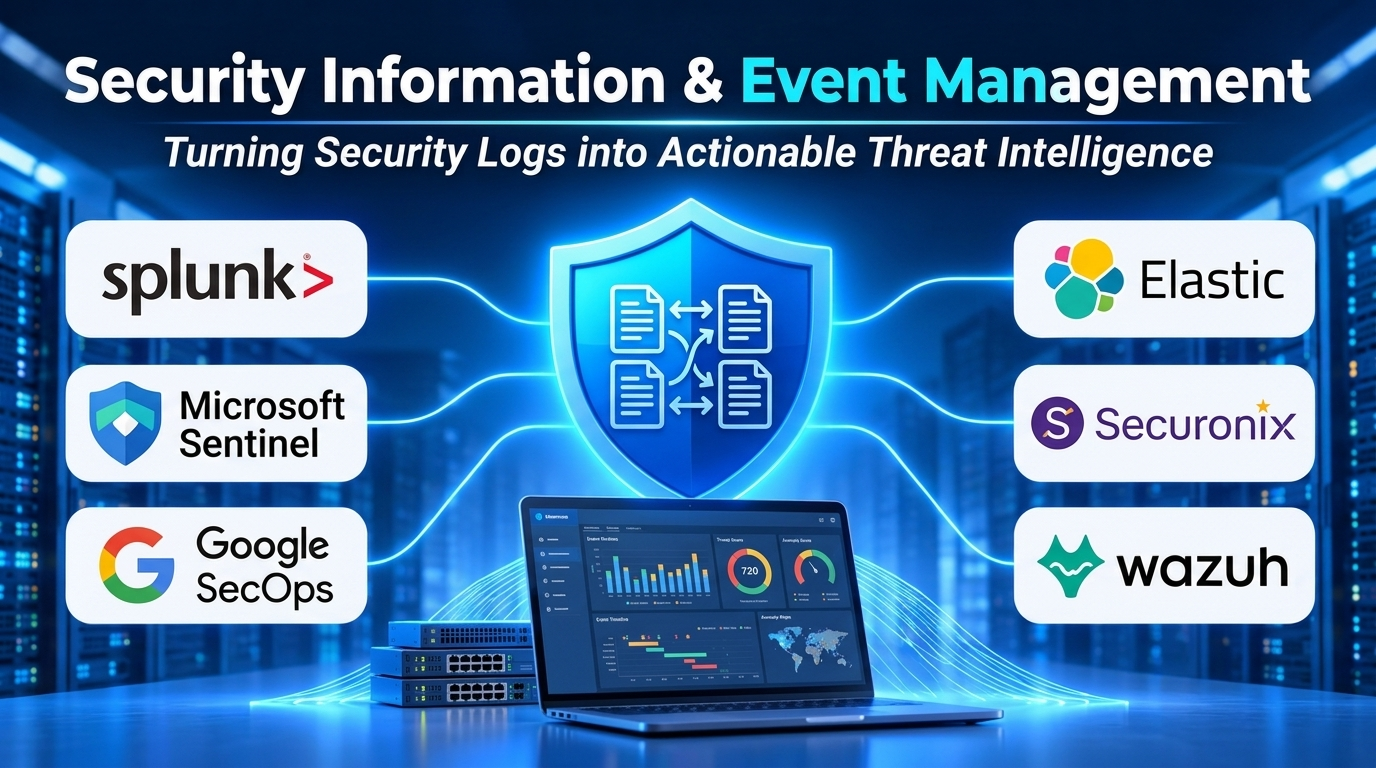
A security team can collect millions of events every day and still miss an important attack. The problem is rarely a shortage of logs. It is the difficulty of connecting activity across endpoints, user accounts, cloud services, applications, and network infrastructure before suspicious behaviour becomes a serious incident.
That is the problem Security Information and Event Management (SIEM) platforms are designed to address. They bring security-related data into a shared environment, make it searchable, identify patterns that deserve investigation, and help analysts coordinate a response.
However, SIEM products differ considerably in how they collect data, normalize events, detect threats, manage investigations, and charge for long-term storage. Some are built around cloud-native security operations. Others offer extensive customization, established enterprise workflows, or self-managed infrastructure.
The right choice depends less on how many features appear in a product brochure and more on whether an organization can collect the right evidence, detect meaningful activity, and investigate incidents without creating an unsustainable operational or financial burden.
What a SIEM platform actually does
A SIEM platform collects and analyzes security events generated by an organization’s technology environment. Typical sources include:
- Identity providers and authentication services
- Firewalls, routers, switches, and network security appliances
- Servers, workstations, and endpoint protection products
- Cloud infrastructure and SaaS applications
- Databases, web servers, and business applications
- Email security systems and access management platforms
- Vulnerability scanners and threat intelligence feeds
The platform brings these events together so analysts can investigate activity that might otherwise appear unrelated.
Consider a hypothetical example. An employee account signs in from an unusual location, accesses a sensitive cloud resource, and then attempts to connect to several internal systems. Each event might be recorded by a different security product. A SIEM can correlate those records, associate them with the same identity, and raise an incident for investigation.
This is more useful than treating each event as an isolated alert.
SIEM, log management, XDR, and SOAR are not interchangeable
These categories overlap, but they solve different problems.
| Technology | Primary responsibility |
|---|---|
| SIEM | Collects, normalizes, correlates, searches, and analyzes security events |
| Log management | Stores and organizes operational and application logs |
| XDR | Correlates security signals across endpoints, identities, networks, email, and cloud environments |
| SOAR | Automates investigation and response workflows across security tools |
| EDR | Monitors endpoint activity and supports endpoint-level detection and response |
| NDR | Analyzes network activity to identify suspicious communication and behaviour |
Modern platforms increasingly combine several of these capabilities. A SIEM may include automation, endpoint detection, behavioural analytics, or extended detection and response features.
That does not mean every product offers the same depth in each area. Buyers should identify which capabilities are native, which require separate licensing, and which depend on integrations with other products.
The real SIEM buying decision: what data should you pay to retain and analyze?
A SIEM can only identify activity represented in the data it receives. Connecting every available source may appear to offer comprehensive visibility, but it can also increase ingestion costs, storage requirements, processing demands, and alert volume.
The objective should be to collect data that supports meaningful security decisions.
For example, authentication events can help identify unusual account access. Endpoint telemetry can provide evidence of suspicious processes. Firewall records can reveal unexpected connections. Cloud audit logs can show changes to permissions or infrastructure.
The value of each source depends on the organization’s architecture and threat model.
A practical data-prioritization exercise should answer four questions:
- What security question does this data help answer? A log source should support a detection, investigation, compliance, or operational requirement.
- Can the data be interpreted correctly? Different systems may use different timestamps, field names, identity formats, and event structures.
- How long must it remain searchable? Investigation requirements and regulatory obligations may demand different retention periods.
- What happens if the source stops reporting? Missing telemetry can create blind spots that are difficult to distinguish from normal inactivity.
A SIEM implementation should also distinguish between raw events, normalized records, alerts, and incidents. Raw events preserve the original evidence. Normalized records make cross-source analysis easier. Alerts identify suspicious conditions, while incidents group related findings into an investigation.
A platform that produces many alerts without useful context can increase the workload of an already busy security team.
SIEM platforms worth evaluating
The following products represent different approaches to security information and event management. They are not presented as a universal ranking: their suitability depends on data sources, deployment requirements, analyst skills, existing infrastructure, and total operating cost.
Splunk Enterprise Security: Flexible security analytics for complex environments
Splunk Enterprise Security is built on the Splunk data platform and is designed for organizations that need extensive search, correlation, investigation, and security analytics capabilities.
Its appeal is closely connected to the broader Splunk ecosystem. Organizations can work with security and operational machine data, build searches and dashboards, and develop detection logic around their own environment. Enterprise Security adds security-focused workflows, including correlation searches and investigation capabilities.
Splunk’s current security offering also brings together SIEM, SOAR, UEBA, threat intelligence, and detection engineering capabilities. Its editions and deployment choices should be evaluated against the actual requirements of the organization rather than assuming that every capability is included in every package. Splunk+2
The flexibility is valuable, but it has an operational cost. Effective deployments require people who understand data onboarding, field normalization, search performance, detection engineering, and platform administration. Poorly designed ingestion policies can make the platform expensive before the security team has gained meaningful visibility.
Licensing also deserves close attention. Splunk documents workload-based and ingestion-based pricing options, and Enterprise Security licensing is connected to the underlying Splunk platform’s capacity model. Buyers should calculate the cost of the full data pipeline, not just the security application. Splunk+1
Splunk is particularly worth evaluating when an organization already uses Splunk extensively or needs a highly customizable security analytics environment. A smaller team without the skills to maintain searches and data pipelines may find a more managed platform easier to operate.
Microsoft Sentinel: A natural option for Microsoft-centric environments
Microsoft Sentinel is a cloud-native SIEM designed to collect and analyze security information across Microsoft services, other cloud platforms, and external infrastructure.
Its data connectors can bring in information from services such as Microsoft Entra ID, Azure resources, and third-party systems. It also supports common collection approaches including Syslog, Common Event Format, and REST APIs. Normalization helps make information from different sources more consistent for analysis. Microsoft Learn+1
A central part of Sentinel’s workflow is its use of analytics rules, incidents, hunting queries, and workbooks. Analysts can investigate incidents, explore relationships between entities, and write queries using Kusto Query Language (KQL). Automation rules and playbooks built with Azure Logic Apps can connect security events to operational workflows such as ticket creation and response actions. Microsoft Learn+1
The platform is particularly attractive to organizations already invested in Microsoft cloud and security services. Existing identity, endpoint, and cloud telemetry can provide a useful foundation for security correlation.
The main consideration is its consumption-based economics. Sentinel pricing depends on data ingestion and selected tiers, while supporting Azure infrastructure can introduce additional costs. Microsoft documents pay-as-you-go and commitment-tier options, alongside separate considerations for data retention and other infrastructure usage. Microsoft Learn+1
Organizations should model daily ingestion before committing. They should also review which events belong in the analytics tier and which can be retained in a lower-cost data tier for occasional investigation.
Sentinel is a strong candidate for cloud-oriented organizations that want to build security operations around Microsoft services. It is less attractive when a business needs a completely independent, infrastructure-neutral operating model and does not want to manage its security workflows through Microsoft’s cloud ecosystem.
Google Security Operations: Built for large-scale security telemetry
Google Security Operations is a cloud service designed to retain, normalize, search, and analyze large volumes of security and network telemetry.
Its architecture uses a normalized data model to make information from different sources easier to investigate together. Data can be collected through forwarders and other ingestion methods, then processed for search, detection, and incident investigation. Google Cloud Documentation+1
This approach is particularly relevant to organizations that need to investigate activity across extensive infrastructure rather than operate only around a small collection of security appliances.
Google’s offering combines SIEM and SOAR capabilities, with package differences affecting available detection features, environments, threat intelligence, and data pipeline management. The published pricing structure is based on ingestion, with package-specific capabilities and retention terms. Google Cloud+1
One important procurement consideration is data retention. Buyers should verify how long raw logs and normalized events remain available, whether extended retention is included, and whether deletion requirements can be met. Google documents default retention and options for extending it, while noting that manual deletion of retained log data is not available through the ordinary interface. Google Cloud Documentation
Google Security Operations is worth considering for enterprises with substantial telemetry volumes and a need for centralized investigation across distributed environments. Its suitability depends on data residency requirements, ingestion economics, and the organization’s willingness to operate a cloud-based security platform.
IBM QRadar SIEM: An established enterprise option with deployment considerations
IBM QRadar SIEM has a long-standing presence in enterprise security operations. Its SIEM capabilities are used to analyze security events and provide analysts with visibility into potentially important activity.
QRadar should be evaluated with particular attention to the deployment model. IBM continues to document its on-premises QRadar SIEM offering and states that existing on-premises customers will continue to receive IBM features and support, including security and critical bug fixes. IBM
The SaaS situation is different. IBM’s QRadar SaaS assets were acquired by Palo Alto Networks, so buyers should not assume that the cloud service and the IBM-managed on-premises product follow the same commercial or product roadmap. IBM
This distinction matters during procurement. Organizations considering QRadar should establish exactly which product, support arrangement, licensing agreement, and migration path are being offered.
For businesses with existing QRadar deployments, the decision may involve maintaining established integrations and detection workflows rather than replacing the platform simply because another product has a newer cloud architecture.
For new buyers, the important question is whether the specific QRadar offering under consideration fits the organization’s future deployment strategy and support expectations.
Elastic Security: A flexible platform for teams that want control over their data
Elastic Security uses the Elastic data platform to support security monitoring, detection, investigation, and response.
Its defining characteristic is the relationship between security analytics and the underlying search and data infrastructure. Teams can build security workflows around indexed data, integrations, detection rules, and queries rather than relying entirely on a closed security appliance.
Elastic supports self-managed deployments and cloud-based options. Its self-managed offering gives organizations control over infrastructure and deployment, including environments that need to operate on-premises or without an external cloud connection. Elastic+1
Elastic also publishes detection rules and supports integrations that help connect security data sources to its platform. Its security offering increasingly combines SIEM, endpoint security, investigation, and response capabilities. Elastic+1
The flexibility is useful, but it should not be confused with zero administration. Self-managed environments require infrastructure planning, storage management, upgrades, access controls, and careful performance tuning. Search and analytics costs can also become significant when large volumes of data need to remain immediately accessible.
Elastic Security is a good candidate for organizations that value deployment flexibility, searchable data, and the ability to customize security workflows. It may be less suitable for teams seeking a fully managed service with minimal infrastructure responsibility.
Securonix Unified Defense SIEM: Behavioural analytics and enterprise security operations
Securonix Unified Defense SIEM focuses on bringing detection, investigation, and response workflows together for enterprise security teams.
Its platform combines SIEM with capabilities including user and entity behaviour analytics (UEBA), SOAR, threat intelligence, and data pipeline management. Securonix describes its approach as connecting signals across identity, cloud, endpoint, network, and SaaS environments. Modern AI-Powered Security Operations
UEBA is particularly relevant when an organization needs to identify activity that differs from the normal behaviour of a user, account, or system. For example, an account that usually accesses a small set of business applications might suddenly begin accessing unrelated systems or performing unusual operations.
Behavioural analytics can help surface this activity, but the results depend on the quality and context of the underlying data. A legitimate change in an employee’s role, a new application rollout, or an unusual business process can also produce anomalies.
Securonix is worth evaluating for enterprises that want behavioural analytics and broader security operations workflows within a unified platform. Buyers should examine how detections are explained, how analysts validate risk scores, and how automated actions remain governed.
Wazuh: An open-source route to SIEM and security monitoring
Wazuh offers a different proposition from the commercial enterprise platforms.
It is a free and open-source security platform that combines SIEM and XDR capabilities. Its architecture includes an endpoint agent, a central server, an indexer, and a dashboard. The agent collects endpoint security information, while the central components process, index, and present the resulting data. Wazuh also supports agentless monitoring for certain devices through methods such as Syslog and SSH. Wazuh documentation+1
This architecture gives organizations control over deployment and data handling. It can be useful for smaller security teams, technical learning environments, and organizations that want to build their own monitoring infrastructure without starting with a commercial SIEM contract.
However, open-source licensing does not eliminate operating costs. The organization still needs suitable infrastructure, storage, backup arrangements, upgrades, rule tuning, and people capable of investigating alerts. As the number of monitored systems grows, capacity planning and maintenance become increasingly important.
Wazuh also offers a cloud service, giving organizations an alternative to maintaining all central components themselves. Wazuh documentation
Wazuh is a credible starting point for organizations that can manage their own security infrastructure. It should not automatically be treated as an equivalent replacement for every enterprise SIEM: advanced workflows, support expectations, integrations, and operational requirements need to be compared directly.
How the platforms differ
The table below summarizes the practical distinctions that matter when creating an initial shortlist.
| Platform | Main strength | Deployment approach | Important consideration |
|---|---|---|---|
| Splunk Enterprise Security | Flexible analytics and extensive security data investigation | Cloud and self-managed options | Licensing and data engineering can become complex |
| Microsoft Sentinel | Cloud-native security operations and Microsoft ecosystem integration | Cloud service | Ingestion and supporting Azure costs need careful modelling |
| Google Security Operations | Centralized analysis of large-scale security telemetry | Cloud service | Retention, package limits, and data residency need verification |
| IBM QRadar SIEM | Established enterprise SIEM workflows | On-premises offering; SaaS assets have a separate ownership history | Confirm the exact product and support arrangement |
| Elastic Security | Search-driven analytics and deployment flexibility | Cloud and self-managed | Infrastructure and platform administration remain important |
| Securonix Unified Defense SIEM | Behavioural analytics and integrated enterprise SecOps | Enterprise platform; confirm offered deployment terms | Validate detection explainability and automation governance |
| Wazuh | Open-source SIEM and XDR capabilities | Self-managed or cloud service | Requires technical ownership and operational maintenance |
The technical details that can make or break a SIEM deployment
A product demonstration may show polished dashboards and impressive detection examples. The more important questions concern what happens when the platform is connected to the organization’s actual infrastructure.
Data normalization determines whether events can be correlated
Security products often describe similar activity in different ways.
One system may identify a user through an email address, another through an internal account identifier, and another through a cloud-specific principal ID. Timestamps may use different time zones or formats. Network events may represent the same device through different IP addresses.
Normalization attempts to make these records consistent enough for analysis.
Without reliable normalization, correlation rules may miss related events or generate misleading results. Before purchasing a SIEM, test whether it correctly interprets the organization’s most important data sources.
Pay particular attention to:
- Identity and asset resolution
- Timestamp handling
- Field extraction and parsing
- Cloud account and subscription identifiers
- Firewall and network event formats
- Custom application logs
- Changes to vendor log schemas
A connector that successfully transfers events is not necessarily a connector that makes those events useful.
Detection engineering requires more than installing default rules
Most SIEM platforms offer prebuilt detection content. This can accelerate deployment, but default rules should be treated as a starting point.
An organization needs to understand which events trigger each rule, what evidence is required, and whether the rule is relevant to its environment.
For example, repeated failed logins might indicate a password attack. They might also result from an expired password stored in an automated service. A useful detection should consider context rather than treating every repeated failure as equally suspicious.
A mature SIEM programme therefore needs:
- Detection rules mapped to actual business risks
- Clear ownership of detection logic
- Regular testing and tuning
- Documented investigation procedures
- Monitoring for missing or delayed telemetry
- A process for reviewing false positives and missed detections
Detection quality is an operational responsibility, not a feature that can be purchased once and forgotten.
Retention is a security and financial decision
Security investigations do not always begin immediately after suspicious activity occurs. An organization may need to examine earlier authentication events, network activity, or administrative changes to understand the full scope of an incident.
That makes retention an important part of SIEM design.
However, keeping every event in the most expensive searchable tier may not be necessary. Some platforms offer different storage tiers or retention arrangements. Others use ingestion or workload-based pricing that can make data volume a major cost driver.
A sensible retention strategy separates:
- Frequently queried security events
- Data needed for active investigations
- Historical records retained for compliance or audit requirements
- Low-value operational events that do not need long-term security analysis
The correct policy depends on the organization’s incident response requirements, contractual obligations, and applicable regulations.
Automation should not outrun human oversight
SIEM platforms increasingly connect alerts to automated response workflows. These may enrich an incident, open a service ticket, notify an analyst, disable an account, or initiate other actions through connected systems.
Automation can reduce repetitive work, but it can also amplify a mistaken detection.
A useful implementation begins with low-risk actions such as enrichment, notification, and ticket creation. More disruptive actions should require stronger confidence, clear approval rules, and a tested rollback process.
Organizations should establish who can authorize automated actions, which systems are allowed to execute them, and how every action is recorded.
SIEM pricing: the cost of collecting data is only the beginning
SIEM pricing is difficult to compare because vendors use different commercial models.
Common approaches include:
- Ingestion-based pricing: Charges depend on the volume of data collected.
- Workload-based pricing: Costs are linked to the processing or compute resources used.
- Commitment tiers: Organizations reserve a specified capacity in exchange for a different rate.
- Subscription or package pricing: A defined set of platform capabilities is purchased under a commercial agreement.
- Self-managed licensing: The organization pays for the required software subscription or support while operating its own infrastructure.
For example, Microsoft Sentinel documents pay-as-you-go and commitment-tier approaches, while Splunk offers workload and ingestion pricing options. Google Security Operations publishes package-based pricing with ingestion as a central factor. Microsoft Learn+2
The advertised platform price does not necessarily represent the full cost of ownership.
A realistic budget should account for:
- Data ingestion and processing
- Searchable storage and long-term retention
- Cloud infrastructure or on-premises hardware
- Data forwarding and network transfer
- Additional security capabilities and integrations
- Professional services and deployment work
- Detection engineering and ongoing maintenance
- Analyst training and operational staffing
A platform with a lower entry price can become expensive if it requires extensive customization. A more expensive managed service may reduce infrastructure work but introduce dependency on the vendor’s cloud, retention model, and commercial terms.
The most useful comparison is the cost of operating the required security workflow, not the cost of purchasing a licence in isolation.
Choosing a SIEM for organizations in India
Organizations operating in India should evaluate SIEM products against their actual data-handling and compliance obligations rather than assuming that a vendor’s global service automatically satisfies every requirement.
The Digital Personal Data Protection framework, sector-specific regulatory obligations, contractual requirements, and internal security policies may affect how particular information is collected, processed, retained, and accessed.
The exact obligations depend on the organization, the type of data involved, and the services it operates. A SIEM purchase should therefore include a review by the organization’s legal, privacy, and security teams.
Questions worth asking vendors include:
- Where will security logs and associated personal data be processed and stored?
- Can the organization select an appropriate service region?
- Which personnel and subprocessors can access the data?
- How are data retention and deletion requests handled?
- Can access to sensitive logs be restricted and audited?
- What happens to data when the contract ends?
- Are support and incident-response processes compatible with internal requirements?
Data residency should be assessed alongside technical suitability. A platform that offers the right detection capabilities may still be unsuitable if its data-processing arrangements conflict with the organization’s obligations.
How to evaluate a SIEM before committing
A proof of concept should test the platform against real security questions rather than simply demonstrate that logs can be imported.
A useful pilot can be organized around a small set of high-value scenarios.
Start with critical data sources. Connect identity, endpoint, cloud, and network telemetry that represents the organization’s most important assets. Confirm that events arrive consistently and that missing data can be detected.
Test a realistic investigation. Choose a scenario such as suspicious account access followed by an unusual administrative action. Check whether the SIEM can connect the events and present enough context for an analyst to understand what happened.
Examine detection quality. Review the logic behind generated alerts. Test ordinary business activity that could resemble suspicious behaviour, and determine whether the platform can reduce unnecessary noise without hiding meaningful events.
Measure operational effort. Record how much engineering work is required to onboard sources, create rules, maintain parsers, and investigate incidents. A platform that works only with extensive specialist intervention may not suit a small team.
Validate cost assumptions. Estimate ingestion, storage, retention, and processing using representative data volumes. Include the cost of the infrastructure and personnel needed to operate the service.
Test response governance. Begin with non-disruptive automation. Confirm that approvals, permissions, audit records, and rollback procedures work as intended before enabling more consequential actions.
The pilot should produce evidence that the platform can answer the organization’s priority security questions at a manageable operating cost.
When an organization may not need a full SIEM
A SIEM is not automatically necessary for every business.
A small organization with limited infrastructure, few security tools, and no dedicated security operations staff may gain little from purchasing an enterprise platform before it has established basic security controls.
It may be more practical to begin with centralized logging, reliable endpoint protection, identity monitoring, cloud-native security alerts, and a documented incident response process.
The need for a SIEM becomes stronger as the environment grows more complex: multiple cloud providers, a larger workforce, distributed infrastructure, sensitive data, regulatory requirements, or a dedicated security operations function.
The key is to avoid purchasing a platform that the organization cannot properly configure, monitor, or investigate.
The right SIEM is the one your team can operate effectively
Splunk Enterprise Security and Elastic Security are worth examining when search flexibility and control over security analytics are important. Microsoft Sentinel is a natural candidate for organizations with significant Microsoft infrastructure. Google Security Operations offers a cloud-based approach to large-scale telemetry analysis. Securonix emphasizes behavioural analytics and broader security operations workflows. IBM QRadar remains relevant to organizations evaluating its established on-premises offering, while Wazuh provides an open-source route for teams prepared to manage their own infrastructure.
None of these choices removes the need for sound security operations.
Before selecting a platform, establish which events matter, how long they must remain available, who will maintain detection logic, and how analysts will investigate incidents. Then test those requirements against real data and realistic scenarios.
A SIEM should make security activity easier to understand and act upon. If it only creates another place to store logs and review alerts, the organization has bought a data collection system—not an effective security operations capability.
