An endpoint security alert is only the beginning of an investigation. When a suspicious process appears on an employee’s laptop, security teams need to know what started it, which files or accounts it affected, whether similar activity occurred elsewhere, and what action will contain the threat without disrupting legitimate work.
That is the problem Endpoint Detection and Response (EDR) is designed to address. Unlike traditional antivirus, which primarily focuses on preventing known malicious files and behaviors, EDR continuously collects endpoint activity, identifies suspicious patterns, helps analysts reconstruct incidents, and supports response actions.
Yet buying an EDR platform is not simply a matter of choosing the product with the longest detection-feature list. Its value depends on the quality of its telemetry, the context behind its alerts, the speed and safety of its response capabilities, and the organization’s ability to operate it consistently.
The most important purchasing decision is therefore not which platform claims to detect the most threats. It is which one can help the organization identify meaningful incidents, investigate them efficiently, and respond within its actual staffing and technical constraints.
What EDR Actually Does During a Security Incident
EDR is a combination of endpoint telemetry collection, threat detection, investigation, and response capabilities. It is designed to give security teams visibility into activity on devices such as desktops, laptops, and servers, including activity that may not trigger a traditional antivirus alert.
An EDR deployment generally involves an endpoint sensor or agent, a central management and analytics service, and an investigation interface used by security staff. The sensor records selected events, the platform analyzes them for suspicious patterns, and analysts use the resulting alerts and evidence to decide what happened and what to do next.
A simplified incident might unfold like this:
- Activity is recorded: The endpoint agent collects relevant information about processes, file changes, system activity, and network connections.
- Suspicious behavior is identified: Detection logic flags activity that resembles malicious behavior, violates a security rule, or matches a known indicator.
- Related events are connected: The platform correlates events into an incident or timeline, helping analysts understand how activity developed.
- The incident is investigated: Analysts examine process relationships, affected devices, user context, and other available evidence.
- A response is taken: Depending on the platform and permissions, the team may isolate a device, stop a process, quarantine a file, block an indicator, or collect additional evidence.
- The environment is reviewed: Security staff determine whether other endpoints were affected and whether additional remediation is necessary.
The quality of the investigation depends on more than whether an alert appeared. An analyst needs enough context to distinguish a genuine threat from legitimate administrative activity. A suspicious command-line process, for example, may be part of routine IT maintenance or part of an attack. The surrounding process history, account activity, device role, and timing can change the interpretation.
This is why useful EDR platforms emphasize incident correlation and investigation context rather than simply producing a large volume of alerts. Microsoft Defender for Endpoint, for example, documents incident grouping, advanced hunting, and device response capabilities as part of its endpoint security workflow. Microsoft Learn+2
EDR, EPP, XDR, and MDR Are Not Interchangeable
Security vendors frequently package several capabilities under one platform name. Understanding the distinctions helps prevent buyers from comparing products that solve different problems.
| Security approach | Main responsibility | What it contributes |
|---|---|---|
| Endpoint Protection Platform (EPP) | Prevention | Blocks malware, exploits, malicious files, and other threats before or during execution |
| Endpoint Detection and Response (EDR) | Endpoint visibility and response | Records endpoint activity, detects suspicious behavior, supports investigations, and enables containment |
| Extended Detection and Response (XDR) | Cross-domain detection | Correlates security information from endpoints and other sources such as identity, email, cloud, and network systems |
| Managed Detection and Response (MDR) | Security operations service | Provides human-led or service-supported monitoring, investigation, threat hunting, and response |
EPP and EDR are complementary. Prevention reduces the number of incidents that reach the investigation stage; EDR helps teams understand and respond to activity that gets past preventive controls or requires deeper investigation.
XDR expands the investigation beyond endpoint telemetry. If an account is compromised and suspicious activity appears across a laptop, email service, and cloud environment, an XDR platform may help connect those events into a broader incident. EDR remains valuable even when XDR is present because endpoint activity provides important evidence about what happened on the device.
MDR addresses a different problem: staffing and operational expertise. An organization may own an EDR platform but lack the people available to monitor it around the clock. An MDR provider can supply some or all of that operational coverage, depending on the service agreement.
These categories overlap in commercial products. A vendor may sell endpoint prevention, EDR, XDR, and MDR through one platform or a collection of subscriptions. Buyers should evaluate the actual licensed capabilities and service responsibilities rather than relying on the product’s broad marketing label. ESET Online Help+2
The EDR Platforms Worth Evaluating
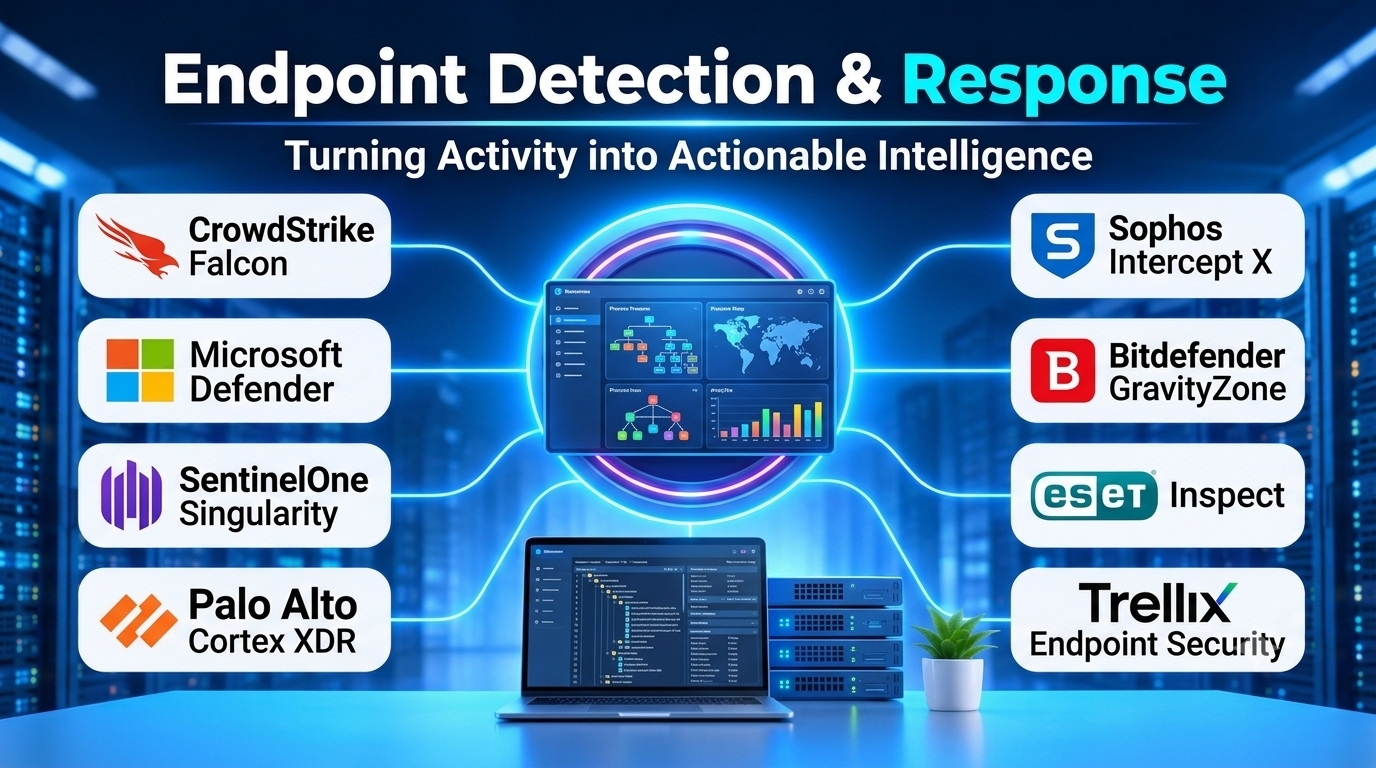
The products below represent different approaches to endpoint detection and response. Some are endpoint-first platforms, some are part of wider security ecosystems, and others combine EDR with prevention or cross-domain capabilities. They should be treated as a practical shortlist, not a universal ranking.
| Platform | Distinctive approach | What to examine before choosing |
|---|---|---|
| CrowdStrike Falcon Insight XDR | Endpoint-focused detection with an expansion path into XDR | Subscription scope, telemetry requirements, and platform dependencies |
| Microsoft Defender for Endpoint | Endpoint detection integrated with Microsoft’s security ecosystem | Licensing, supported operating systems, and the wider Microsoft environment |
| SentinelOne Singularity Endpoint | Behavioral detection and automated endpoint response | Automation policies, rollback applicability, and investigation workflows |
| Palo Alto Networks Cortex XDR | Correlation of endpoint and broader security telemetry | Value of integrations and fit with the organization’s security architecture |
| Sophos EDR | Endpoint investigation and response with prevention and managed-service options | Existing endpoint products, operational skills, and service requirements |
| Bitdefender GravityZone EDR | Prevention-led endpoint security with incident correlation and visualization | Module availability, licensing, and deployment architecture |
| ESET PROTECT with EDR/XDR capabilities | Endpoint security with behavioral detection and configurable response | Current cloud packaging, on-premises requirements, and migration considerations |
| Wazuh | Open-source SIEM and XDR capabilities with endpoint agents and response automation | Engineering effort, rule tuning, infrastructure, and operational ownership |
CrowdStrike Falcon Insight XDR: Endpoint Detection with a Wider Security View
CrowdStrike’s Falcon platform is widely associated with endpoint detection and response, while Falcon Insight XDR extends the approach by correlating endpoint information with telemetry from other security domains.
The practical appeal is the ability to begin with endpoint investigations and expand visibility through additional data sources. Its incident-oriented workflows are intended to help security teams connect related activity rather than investigate disconnected alerts independently. CrowdStrike’s product documentation describes native and third-party telemetry correlation, investigation workflows, and response capabilities within the broader Falcon platform. CrowdStrike.com+1
This approach is particularly relevant to organizations that want an endpoint-focused security foundation but expect to expand into broader detection and response operations.
The main evaluation issue is commercial and architectural scope. Buyers should establish which Falcon modules, integrations, retention capabilities, and response functions are included in the proposed subscription. They should also assess how much of the wider platform they realistically intend to use. A broad platform can be valuable, but unused modules do not automatically improve security outcomes.
Microsoft Defender for Endpoint: A Natural Candidate for Microsoft-Centered Environments
Microsoft Defender for Endpoint combines endpoint prevention, detection, investigation, and response capabilities within Microsoft’s security environment. Its documentation covers supported endpoint operating systems, threat detection, advanced hunting, incident investigation, and response actions such as device isolation and investigation-package collection. Microsoft Learn+2
Its strongest practical consideration is ecosystem fit. Organizations already using Microsoft security and identity services may benefit from bringing endpoint signals into a wider security operations workflow. Advanced hunting also gives experienced analysts a way to query security data and investigate activity beyond the alerts generated automatically.
However, buyers should not assume that every feature is included with every Microsoft subscription. Plan differences, supported operating systems, device onboarding requirements, and administrative permissions affect what teams can actually use.
A useful proof of concept should test the organization’s real device mix, alert-handling process, and response permissions. It should also confirm how Defender will coexist with any existing endpoint security agent. Microsoft documents EDR-related capabilities across multiple plans, but the available actions and features vary by plan. Microsoft Learn+2
SentinelOne Singularity Endpoint: Automation and Recovery-Oriented Response
SentinelOne positions Singularity Endpoint around behavioral detection, automated containment, investigation, and remediation. Its product material describes Storyline correlation, which connects related endpoint events into a more coherent incident narrative, and rollback capabilities intended to reverse certain unwanted system changes. SentinelOne+1
This emphasis on automation can be useful for organizations that want to reduce the amount of manual work required during endpoint incidents. A team can benefit when related process and file activity is presented as one understandable sequence rather than a collection of unrelated alerts.
Rollback deserves particular scrutiny during evaluation. Buyers should verify which operating systems, file changes, and incident scenarios are supported, and understand what rollback can and cannot restore. It should not be treated as a replacement for backups, disaster recovery, or a complete incident response plan.
Organizations should also test automated actions against legitimate business applications. A response that isolates a critical workstation or terminates an essential process can interrupt operations even when the platform is functioning as designed.
Palo Alto Networks Cortex XDR: Endpoint Security Within a Broader Detection Architecture
Cortex XDR is designed to correlate security information across endpoints and other data sources. Its broader architecture makes it relevant to organizations that want endpoint detection connected to network, identity, cloud, and other security operations data.
Palo Alto Networks describes Cortex XDR as a platform for detecting, investigating, and responding to threats using information from multiple security domains. The product’s value therefore depends partly on the telemetry sources an organization connects and how well those sources represent its actual environment. Palo Alto Networks+1
This can be attractive to organizations already invested in Palo Alto Networks security products or planning a more consolidated security operations environment.
The trade-off is that a wider platform requires careful integration planning. Buyers should identify which data sources are supported in their intended configuration, whether additional licensing is required, and whether the security team can use the wider incident context effectively. A platform that collects more information is not automatically better if analysts cannot prioritize and investigate it.
Sophos EDR: Combining Endpoint Investigation with Operational Support
Sophos EDR combines endpoint security with investigation and response capabilities. Its product documentation describes suspicious-activity investigation, risk-prioritized detections, response actions, and support for using Sophos Endpoint or a non-Sophos endpoint protection agent in supported configurations. Endpoint Detection and Response
That flexibility is worth examining for organizations that are not ready to replace their existing endpoint protection. It may provide a route to adding investigation capabilities while retaining parts of an established endpoint environment.
Sophos also offers managed security services, which can be relevant to organizations without a fully staffed security operations team. However, the distinction between buying software and buying an operational service must remain clear. Buyers should establish who monitors alerts, who validates incidents, who authorizes containment, and who is responsible for remediation.
For smaller IT teams, the important question is not just whether the product has advanced investigation features. It is whether the organization can use them consistently without creating another stream of alerts that nobody has time to investigate.
Bitdefender GravityZone EDR: Prevention and Incident Visualization
Bitdefender’s GravityZone platform combines endpoint prevention with detection and response capabilities. Its EDR material emphasizes event correlation, attack visualization, investigation context, and response recommendations. The platform also offers broader security capabilities, so the exact modules and subscription scope matter when comparing it with more narrowly packaged EDR products. Bitdefender+2
The emphasis on visualizing an incident can help teams understand how suspicious activity developed across endpoints. This is useful when an organization needs to move from an alert to a clearer picture of the affected devices and possible attack path.
Buyers should check which GravityZone modules are included in the proposed package and whether the intended deployment requires additional components. The EDR capability may depend on the selected configuration and agent modules. It is also important to test how the platform handles the organization’s real applications and endpoint workloads rather than assuming that a prevention-led architecture will behave identically in every environment.
ESET PROTECT: EDR Capabilities Within a Consolidated Security Platform
ESET’s endpoint detection and response capabilities are associated with ESET Inspect and the wider ESET PROTECT platform. ESET Inspect documentation describes behavioral rules, incident management, threat hunting, and response actions such as process termination, executable blocking, and endpoint isolation. ESET Online Help+1
An important purchasing detail is the product’s cloud packaging. ESET is consolidating its cloud EDR/XDR capabilities into ESET PROTECT, while ESET Inspect On-Prem remains a separate offering. Organizations evaluating ESET should therefore confirm the current console, connector, licensing, and migration arrangements that apply to their deployment rather than relying on older product descriptions. ESET Online Help+1
ESET may suit organizations that want endpoint protection and detection capabilities managed within a unified security environment. The key evaluation question is whether the cloud or on-premises architecture aligns with the organization’s operational requirements, especially if it has existing ESET deployments or integrations.
Wazuh: An Open-Source Route for Teams Willing to Own the Engineering
Wazuh is an open-source security platform that combines SIEM and XDR capabilities. Its agents collect endpoint information and support functions such as log collection, file integrity monitoring, vulnerability detection, configuration assessment, and incident response. The platform includes an active response capability that can run configured actions when specified alerts or rules trigger. Wazuh+2
Its main distinction is control and flexibility. Organizations can inspect and customize rules, connect different data sources, and build workflows around their own infrastructure. This can make Wazuh attractive to technically capable teams, educational environments, laboratories, and organizations with specific self-hosting requirements.
However, open-source availability does not make the system operationally free. Teams must plan for deployment, storage, updates, rule tuning, alert triage, response testing, and ongoing maintenance. Poorly configured automated responses can also disrupt legitimate systems; Wazuh’s own documentation warns that response scripts need careful implementation. Capabilities · Wazuh documentation+1
Wazuh should not automatically be treated as a drop-in replacement for every commercial EDR platform. Its capabilities and operating model differ, and organizations must determine whether they can provide the engineering and security operations needed to make the deployment effective.
Specialist Tools That Complement an EDR Deployment
Not every useful endpoint security tool is a full commercial EDR platform. Some projects focus on forensic investigation, endpoint visibility, or system querying. They can strengthen an existing security operation, but their roles should be understood before comparing them directly with commercial products.
Velociraptor: Endpoint Forensics and Incident Response
Velociraptor is an open-source endpoint monitoring, digital forensics, and incident response platform. Its documentation describes capabilities for endpoint monitoring, forensic collection, threat hunting, and investigation through its Velociraptor Query Language (VQL). Digging deeper!+2
Its strength is investigative flexibility. Security teams can collect endpoint information, examine system state, and build queries or artifacts for specific investigative requirements. This makes it particularly relevant to digital forensics and incident response teams that need detailed endpoint evidence.
Velociraptor is not simply a commercial EDR product with a free license. It requires technical expertise to deploy, administer, and use effectively. Organizations considering it should decide whether they need a specialist investigation platform alongside an EDR product or have the skills to build a wider endpoint monitoring workflow around it.
osquery: Query-Based Endpoint Visibility
osquery exposes operating-system information through SQL-like queries. It can help administrators and security teams inspect processes, users, network connections, and other endpoint information. Wazuh documentation describes an integration that allows osquery to be managed through Wazuh agents and its collected information to be analyzed within the platform. System inventory · Wazuh documentation
Its value lies in flexible endpoint inspection rather than providing a complete EDR workflow on its own. Organizations generally need additional detection rules, event management, investigation processes, and response mechanisms to turn endpoint queries into an operational security capability.
What Separates a Useful EDR Platform from a Noisy One?
A product demonstration can make almost any EDR platform look capable. The more revealing questions concern the quality of its evidence, the accuracy of its detections, and how well its response functions work in the buyer’s environment.
1. Endpoint telemetry and investigation context
An EDR platform needs sufficient visibility to explain suspicious activity. Relevant telemetry may include:
- Process creation and parent-child process relationships
- File creation, modification, and deletion events
- Network connections and related process information
- User and account context
- Relevant operating-system and application activity
- Security events associated with suspicious behavior
The important issue is not collecting every possible event. Excessive collection can increase storage requirements and complicate investigations. Buyers should understand what the product records, what it omits, how long information is retained, and whether historical searches are available.
Ask vendors to demonstrate how an analyst can trace an alert back to its initiating activity and identify related events on other devices.
2. Detection quality and false-positive handling
EDR platforms use different combinations of behavioral analytics, rules, indicators of compromise, machine learning, and threat intelligence.
A detection engine that generates many alerts may still be difficult to operate if it repeatedly flags legitimate activity. False positives consume analyst time, while false negatives can leave malicious activity unnoticed.
Evaluate detection quality using scenarios relevant to the organization’s environment. Include normal administrative operations, common business applications, and legitimate software deployment activity. The objective is to determine whether the platform can distinguish suspicious behavior from routine work.
Independent evaluations can provide useful evidence, but their methodology matters. MITRE ATT&CK Evaluations, for example, assess how products identify and describe adversary behavior. MITRE explains that its evaluations are intended to inform product decisions rather than create a universal vendor ranking. Results should be interpreted in the context of the scenarios tested, the product configuration, and the organization’s own requirements. attackevals.mitre.org+1
3. Incident correlation and root-cause analysis
A single suspicious event rarely explains an entire security incident.
Consider a hypothetical situation in which a user’s laptop generates several alerts over a short period. One alert relates to an unusual process, another concerns a file modification, and another identifies suspicious network activity.
If the EDR platform presents these as unrelated events, an analyst may need to investigate each one separately. If it connects them into a coherent incident timeline, the analyst can more easily understand the sequence and identify the affected assets.
During a product demonstration, ask the vendor to show:
- How related alerts are grouped
- Whether the original process or event can be identified
- How the platform displays affected users and devices
- Whether analysts can search historical endpoint activity
- How evidence is preserved for later investigation
- Whether incident context can be exported or shared with other security tools
The quality of these workflows can have a substantial effect on investigation time.
4. Response actions and automation controls
Response capabilities determine what the security team can do after identifying a threat.
Common actions include device isolation, process termination, file quarantine, blocking indicators, and collecting forensic information. Some platforms also support automated remediation and recovery features.
Automation should be configurable. A low-risk action may be suitable for automatic execution, while a response affecting a business-critical server may require human approval.
Before enabling automated containment, establish:
- Which users can authorize response actions
- Which actions require approval
- Whether actions can be reversed
- How administrators are notified
- How the platform handles devices that are temporarily offline
- How response activity is recorded for audit and investigation
A well-designed response process should reduce the time needed to contain genuine threats without creating unnecessary business interruptions.
5. Endpoint performance and compatibility
An EDR agent runs on the devices it protects. Its impact on CPU usage, memory, storage, battery life, network traffic, and application behavior matters.
This is especially important in environments with older hardware, specialized software, virtual desktops, development workstations, and servers running critical workloads.
Check the vendor’s supported operating systems and versions against the actual device inventory. Do not assume that Windows, macOS, and Linux support means identical functionality across all three.
A pilot should include representative devices, not just a few recently purchased laptops. Test the applications and workloads that users depend on, and monitor agent health during normal business activity.
6. Integrations and data access
EDR becomes more useful when it fits into the organization’s wider security workflow.
Important integration areas include:
- SIEM platforms for centralized security monitoring
- SOAR tools for coordinated response workflows
- Identity providers for user and account context
- Ticketing systems for incident ownership and tracking
- Vulnerability management tools for exposure prioritization
- Threat intelligence sources for additional investigation context
- Cloud and network security platforms for broader detection
Ask whether integrations are native, API-based, or dependent on third-party connectors. Confirm whether they require additional subscriptions and whether they support the specific data fields and response actions the organization needs.
A product with an extensive integration catalogue may still be a poor fit if the required connector is unavailable in the selected plan.
Cloud, On-Premises, and Hybrid Deployment: What Should Buyers Consider?
Most organizations will evaluate EDR as a centrally managed service, but deployment architecture still affects security, administration, and cost.
| Deployment approach | Practical advantage | Main consideration |
|---|---|---|
| Cloud-managed | Centralized management without maintaining the entire management infrastructure locally | Connectivity, data handling, subscription terms, and service availability |
| On-premises | Greater control over locally hosted management components and data flows | Infrastructure, maintenance, upgrades, backup, and staffing |
| Hybrid | Combines local infrastructure with cloud-based management or services | Integration complexity and responsibility across environments |
Cloud-managed EDR can reduce the infrastructure burden for organizations without dedicated security platform administrators. It can also make it easier to manage distributed devices from a central console.
On-premises deployments may be relevant where internal policies, network architecture, or operational constraints require greater local control. However, the organization becomes responsible for maintaining the management environment and ensuring it remains available and secure.
Hybrid architectures can accommodate mixed environments, but buyers should understand where endpoint telemetry is processed, where it is stored, and which services remain dependent on external connectivity.
For organizations operating in India, data handling deserves specific attention. Buyers should examine where telemetry and investigation records are processed and stored, how vendor support personnel can access them, and whether contractual arrangements meet applicable Indian data protection requirements and sector-specific obligations. Organizations should obtain appropriate legal and compliance advice rather than treating a vendor’s general compliance statement as proof that a particular deployment meets every obligation.
The Costs That Matter Beyond the Subscription
EDR pricing is not always straightforward. Vendors may price by endpoint, user, device category, subscription tier, or a wider security platform bundle. Some capabilities may be available only through higher plans or additional modules.
The subscription is only one part of the total cost of ownership.
| Cost area | Why it matters |
|---|---|
| Endpoint licensing | Costs increase with the number and type of protected devices |
| Advanced detection features | Threat hunting, extended retention, and advanced investigation may require higher tiers |
| Managed services | Continuous monitoring and expert response can add recurring service costs |
| Data retention | Longer telemetry retention can affect storage and licensing expenses |
| Integration | Connectors, APIs, and additional platform subscriptions may add costs |
| Deployment | Onboarding, migration, policy configuration, and testing require staff time |
| Administration | Rule tuning, agent maintenance, alert review, and reporting create ongoing work |
| Incident response | Specialist investigation and recovery may require additional expertise or services |
A low-cost subscription can become expensive if the organization needs extensive external support to operate it. Conversely, a higher-priced platform may be economically sensible if it replaces multiple overlapping tools and reduces administrative work.
The right comparison is the total cost of operating the security capability, not simply the quoted price per endpoint.
How to Evaluate EDR Before Committing
A structured proof of concept is more useful than relying entirely on demonstrations or feature comparisons.
The evaluation should use a representative group of devices and a documented set of requirements. It should also involve the people who will actually administer the platform and investigate its alerts.
Start with the environment
Document the endpoint inventory before requesting proposals.
Include:
- Windows, macOS, and Linux devices
- Workstations and servers
- Remote and office-based devices
- Virtual machines and cloud workloads
- Business-critical applications
- Existing antivirus and endpoint security agents
- Current SIEM, identity, and ticketing systems
This helps identify compatibility gaps and prevents vendors from demonstrating capabilities on an environment that does not resemble the organization’s own.
Use realistic evaluation scenarios
The proof of concept should cover several different operational situations:
- A suspicious process that requires investigation.
- An alert involving a legitimate administrative application.
- A device that needs containment while preserving investigation evidence.
- An incident involving more than one endpoint.
- A device that temporarily loses connectivity.
- A response action that should require administrator approval.
These scenarios should be designed and approved by the organization’s security team. Testing should take place in a controlled environment, with clear limits and a recovery plan.
Measure operational outcomes
Rather than assigning arbitrary product scores, record observations that matter to the security team.
| Evaluation area | What to observe |
|---|---|
| Detection | Did the platform identify the relevant activity and provide useful context? |
| Investigation | Could analysts reconstruct the sequence of events without excessive manual work? |
| Alert quality | Were legitimate activities correctly distinguished from suspicious ones? |
| Response | Could the team contain the test incident safely and efficiently? |
| Compatibility | Did the agent work across the intended devices and applications? |
| Performance | Did endpoint workloads remain acceptable during the pilot? |
| Administration | Were deployment, policy management, and troubleshooting manageable? |
| Integration | Did the required data and response workflows function as expected? |
Keep a record of product configuration during the evaluation. A detection result may depend on enabled policies, exclusions, agent versions, and integration settings. Without that information, comparing vendors can produce misleading conclusions.
Common EDR Buying Mistakes
Selecting a platform based on alert volume
More alerts do not necessarily mean better detection. A product that creates a large number of low-context alerts may increase the workload of an already busy security team.
Prioritize actionable incidents, investigation quality, and the ability to distinguish legitimate activity from threats.
Buying advanced features without operational ownership
Threat hunting, advanced investigations, and automated response require people who understand the platform and the organization’s environment.
If no one is responsible for reviewing alerts, tuning policies, and coordinating incidents, advanced functionality may remain underused.
Organizations with limited security staffing should evaluate managed services alongside software licensing.
Assuming EDR replaces antivirus and other preventive controls
EDR is not a reason to remove every preventive security measure. Endpoint protection, patch management, application control, identity security, backups, and network controls still contribute to defense.
The objective is to create complementary layers rather than rely on one product to address every security problem.
Enabling automatic response without testing business impact
Automatically isolating a device can be appropriate during a confirmed incident. However, isolating a critical server or terminating an essential process can disrupt business operations.
Define approval requirements and test response policies before using them in production.
Ignoring endpoint coverage gaps
An organization may have a well-configured EDR platform on employee laptops but limited visibility into servers, remote devices, or specialized systems.
Maintain an accurate inventory and track agent deployment and health. An endpoint that is missing its agent or has stopped reporting creates a visibility gap.
Treating a vendor benchmark as a guarantee
Independent evaluations can help compare detection behavior, but no test can reproduce every organization’s applications, users, network architecture, and threat exposure.
Use benchmark results as one source of evidence, then validate the product against the environment it will actually protect.
Which EDR Approach Makes Sense for Different Organizations?
There is no single platform that is automatically suitable for every organization. The decision depends on the security team’s experience, existing infrastructure, endpoint mix, and need for operational support.
- Organizations centered on Microsoft technologies: Microsoft Defender for Endpoint is a logical candidate to evaluate, particularly when integration with the wider Microsoft security environment is important.
- Organizations prioritizing endpoint-focused detection: CrowdStrike Falcon Insight XDR and SentinelOne Singularity Endpoint are worth comparing for their respective investigation, telemetry, and response approaches.
- Organizations with a wider Palo Alto Networks security architecture: Cortex XDR deserves consideration where cross-domain telemetry and consolidated security operations are priorities.
- Organizations seeking endpoint security with operational support options: Sophos is worth evaluating, especially when the organization needs to consider managed security services.
- Organizations seeking prevention-led endpoint security with EDR capabilities: Bitdefender GravityZone offers a combination worth examining, with particular attention to module and subscription requirements.
- Organizations already using ESET: ESET PROTECT is worth evaluating for its integrated endpoint and EDR/XDR capabilities, while confirming the appropriate cloud or on-premises product arrangement.
- Technically capable teams seeking an open-source platform: Wazuh can provide a flexible SIEM and XDR foundation, provided the organization can operate and maintain it.
- Incident response and forensic teams: Velociraptor can complement an EDR deployment with specialist endpoint investigation and evidence collection.
These are starting points for evaluation, not declarations of product superiority. The best shortlist is the one that reflects the organization’s actual devices, staffing, security architecture, and response requirements.
Questions to Ask During an EDR Vendor Demonstration
A useful vendor demonstration should reveal how the product behaves in an investigation, not just how its dashboard looks.
Ask:
- Which operating systems and device types receive full EDR functionality?
- What endpoint events are collected, and which are not?
- How long is endpoint telemetry retained under the proposed subscription?
- Can analysts reconstruct the process and event sequence behind an alert?
- How are related alerts grouped into incidents?
- Which response actions are available, and which require additional licensing?
- Can automated response actions require approval?
- How are false positives investigated and managed?
- What happens when an endpoint is offline?
- Which integrations are included, and which require additional subscriptions?
- Where is telemetry stored and processed?
- What support is available during deployment and major incidents?
- Can the organization export investigation records if it changes providers?
- What are the costs of adding devices, increasing retention, or enabling managed services?
The answers should be documented and checked against the proposed contract. A verbal assurance during a demonstration is not a substitute for a confirmed product capability or service commitment.
Choosing EDR Is Really a Decision About Response Readiness
An EDR platform is valuable when it helps an organization move from a suspicious endpoint event to a well-understood, appropriately handled incident. That requires more than detection technology. It requires useful telemetry, reliable investigation workflows, safe response controls, compatible agents, and people who know what to do with the information.
For an organization with an established security operations team, the priority may be detailed endpoint visibility, flexible threat hunting, and integration with existing security tools. A smaller IT department may place greater importance on simple administration and managed response. A technically capable organization with strict infrastructure requirements may prefer an open-source or self-hosted approach, provided it can support the engineering workload.
Before choosing a platform, define what the security team must be able to see, investigate, and do. Then test those requirements against representative devices and realistic operational scenarios.
The strongest EDR choice is not necessarily the platform with the broadest feature set. It is the one the organization can deploy consistently, operate responsibly, and use to make better security decisions when an incident occurs.
