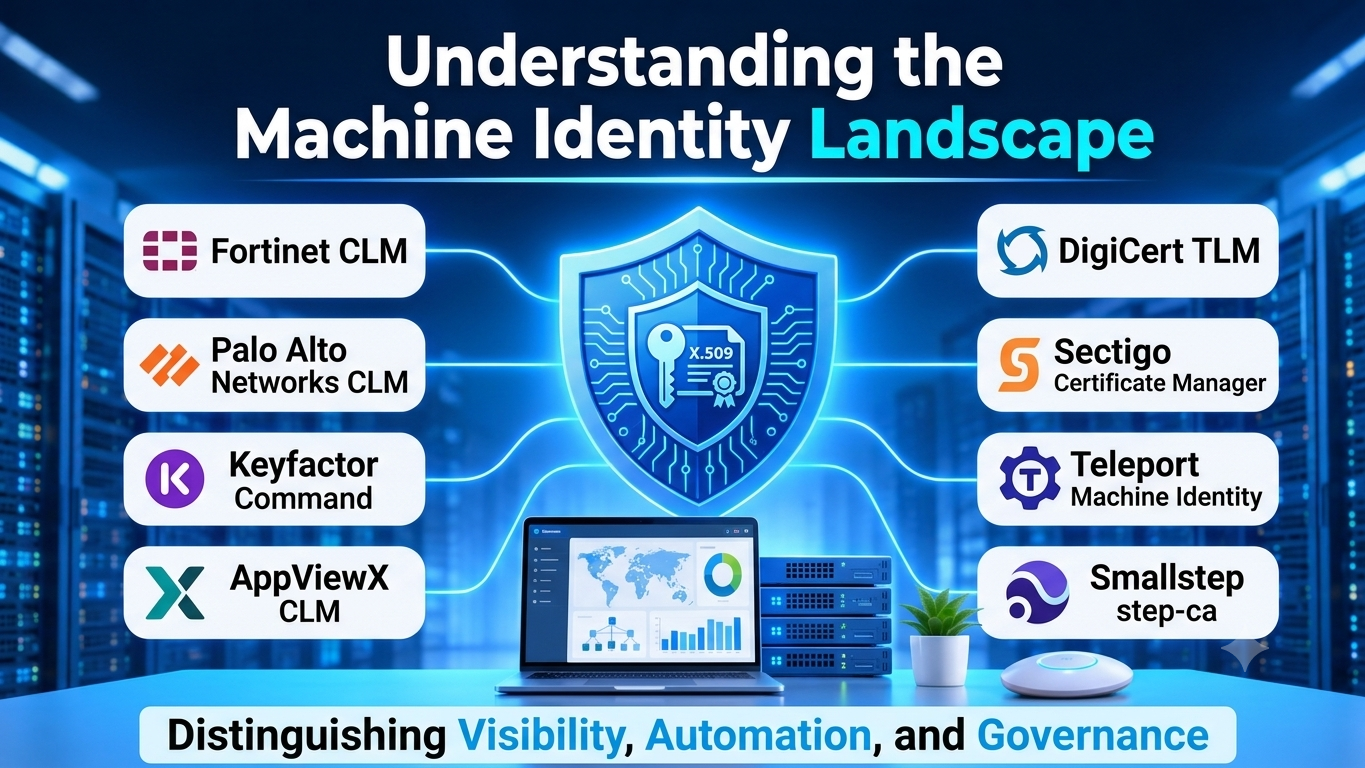
A machine identity rarely attracts attention while it is working. A TLS certificate lets a service establish an encrypted connection; an SSH key lets an administrator or automation process authenticate; a workload credential allows an application to communicate with another service. But when these identities expire, become exposed, or remain active after their original purpose disappears, the consequences can reach far beyond the identity itself.
The challenge is that machine identities are spread across infrastructure, cloud environments, applications, devices, and development pipelines. They may be issued by different certificate authorities, stored in different systems, and managed by teams that do not share a common inventory. A certificate management tool may solve part of this problem without governing workload authentication. A secrets manager may protect credentials without discovering every certificate in an enterprise.
That distinction is central to choosing a machine identity management platform. The useful question is not simply which product has the longest feature list, but which part of the identity lifecycle needs to become more visible, automated, and governable.
The identity problem is broader than certificates
A machine identity is a digital identity that allows a non-human entity to prove what it is and authenticate to another system. The entity might be a server, application, container, API, network device, automated pipeline, or connected device.
The credentials behind these identities can take several forms:
- TLS certificates: Authenticate servers and clients, and support encrypted connections.
- SSH keys and certificates: Authenticate users, hosts, and automated processes accessing infrastructure.
- Workload identities: Identify running applications and services, often through short-lived cryptographic credentials.
- Code-signing certificates and keys: Establish the authenticity and integrity of software artifacts.
- API credentials and tokens: Allow applications and services to authenticate to APIs.
- Device certificates: Give connected devices a verifiable identity throughout their operational lifecycle.
These credentials are related, but managing them is not one uniform task. A certificate lifecycle management (CLM) platform may discover certificates issued by multiple certificate authorities and automate renewal. A workload identity system may issue short-lived credentials after verifying a running workload. A secrets manager may store and generate credentials without providing a complete inventory of every certificate deployed across an enterprise.
The term machine identity management therefore describes an overlapping technology landscape rather than one standardized product category.
Four capabilities that buyers should distinguish
Certificate lifecycle management covers the discovery, enrollment, issuance, deployment, renewal, replacement, and revocation of digital certificates. It is particularly important when an organization operates certificates from multiple public and private certificate authorities.
Public key infrastructure (PKI) provides the trust framework for issuing and validating certificates. It includes certificate authorities, registration processes, cryptographic keys, and policies. Some platforms provide PKI alongside lifecycle management; others integrate with existing certificate authorities.
Workload identity management gives applications and services identities they can use to authenticate to other workloads or infrastructure. It is particularly relevant to microservices, containers, Kubernetes, and automated deployment pipelines.
SSH and secrets management protects credentials used to access servers, applications, databases, and other resources. It may include key discovery, rotation, secure storage, dynamic credential generation, and access policies.
A company can need all four capabilities, but that does not mean it should buy four separate platforms. The starting point should be the identity types it operates and the specific lifecycle problems it needs to solve.
Platforms worth evaluating
The following products represent different approaches to machine identity management. They are grouped by their principal strengths rather than ranked as though they were interchangeable. Product capabilities described here reflect vendor documentation; they should not be interpreted as independent performance testing.
Enterprise certificate lifecycle management
Keyfactor Command
Keyfactor Command is designed for organizations that need centralized visibility and automation across large certificate environments.
Its focus is certificate lifecycle governance across public, private, and cloud-based certificate authorities. The platform supports certificate discovery, inventory, renewal automation, provisioning, policy controls, reporting, and integrations with infrastructure and operational tools.
One of its important characteristics is its orchestration model. Keyfactor uses orchestrators and integrations to connect certificate workflows with endpoints such as servers, network devices, cloud workloads, and other infrastructure. This matters because issuing a replacement certificate is only part of the task: the new certificate must also reach the correct endpoint and be deployed successfully.
Keyfactor is worth considering when certificate operations are distributed across multiple teams and environments, and administrators need a common control plane.
The trade-off: Its breadth introduces integration and deployment work. Buyers should map the certificate authorities and endpoints they actually use, then confirm which integrations and orchestrators are required. The SaaS and deployment architectures also have specific configuration requirements, so organizations should not assume every deployment supports an identical integration model. PKI & Machine Identity Automation+1
AppViewX Certificate Lifecycle Management
AppViewX focuses on certificate lifecycle automation and governance across enterprise infrastructure.
Its platform is relevant to organizations managing certificates across hybrid and multicloud environments, Kubernetes, network infrastructure, and private PKI. The product documentation describes certificate discovery, centralized inventory, issuance, renewal, deployment, policy enforcement, reporting, and integration with enterprise systems.
A notable aspect of AppViewX is its emphasis on connecting certificate operations to the infrastructure where certificates are used. For organizations with load balancers, network appliances, application delivery systems, and complex endpoint environments, deployment orchestration can be just as important as certificate issuance.
AppViewX also addresses cryptographic governance, including visibility into certificate algorithms and key characteristics. That can help teams identify older cryptographic configurations and plan controlled changes.
The trade-off: The platform’s value depends on how well its integrations match the organization’s actual infrastructure. Buyers should test certificate discovery and deployment against representative endpoints rather than relying on a general integration count. They should also examine how private keys are handled, stored, and protected in the chosen architecture. AppViewX+2
DigiCert Trust Lifecycle Manager
DigiCert Trust Lifecycle Manager is part of the DigiCert ONE platform and combines certificate lifecycle management with PKI services.
Its documentation describes certificate discovery, inventory, monitoring, policy management, issuance, renewal automation, and integrations. It is designed to manage certificates across environments and can support public and private certificate use cases.
A relevant distinction is its relationship with DigiCert’s certificate authority services. Organizations already using DigiCert may find it useful to manage issuance and lifecycle operations within a connected ecosystem. The platform also documents CA-agnostic certificate management, which is important for enterprises that have certificates issued by more than one authority.
Its product tiers differ in scope. The documented offering ranges from foundational certificate inventory and automation to more advanced integrations and enterprise capabilities. Buyers should confirm which features are included in the specific edition being considered.
The trade-off: Organizations with complex multi-CA environments should examine the exact coverage of external certificate authorities, automation methods, and integrations in their proposed plan. A product’s ability to manage certificates issued by different authorities should not be confused with every authority offering identical issuance and renewal workflows. DigiCert+2
Sectigo Certificate Manager
Sectigo Certificate Manager is a certificate lifecycle management platform designed to discover, issue, renew, replace, and manage public and private certificates.
Its CA-agnostic positioning is relevant to organizations that want centralized oversight without requiring every certificate to originate from the same certificate authority. The platform documents integrations and automation across certificate workflows, including ACME, SCEP, and other enterprise processes.
Sectigo’s role as a certificate authority is also relevant. Organizations can evaluate both its certificate services and its lifecycle management capabilities, while still examining how the platform handles certificates issued elsewhere.
The practical attraction is the combination of certificate issuance and lifecycle automation. A team that wants to reduce the number of disconnected processes for certificate discovery, deployment, and renewal may find this approach useful.
The trade-off: Buyers should distinguish between monitoring an external certificate and being able to renew or replace it through an automated workflow. The available process can depend on the issuing authority, certificate type, and integration. Confirm those details for the organization’s existing certificate estate. Certificate Lifecycle Management+2
Workload and machine-to-machine identity
Teleport Machine and Workload Identity
Teleport approaches machine identity through short-lived credentials and identity-based access.
Its Machine and Workload Identity capabilities are designed to replace long-lived secrets with automatically issued and renewed credentials. The platform uses the tbot agent to obtain and manage identities for machines and workloads. Depending on the use case, credentials can be used for infrastructure access, cloud authentication, CI/CD workflows, and workload-to-workload communication.
Teleport also documents SPIFFE-compatible workload identities, including X.509 certificates and JWT-based identity documents. These can support mutual TLS and other authentication patterns.
An important distinction is that Teleport documents both Machine & Workload Identity for access to resources protected by Teleport and a separate Workload Identity capability based on the SPIFFE standard. These are not identical workflows: one is tied to Teleport-protected access, while the other is designed for broader workload-to-workload identity use.
The trade-off: Organizations should understand where the Teleport control plane and agents sit in their architecture, how workloads join the system, and which credential types are compatible with their target services. Replacing static credentials also requires changes to application and deployment workflows; it is not simply a matter of installing an agent. Teleport+3
Smallstep Certificate Manager and step-ca
Smallstep offers both a commercial Certificate Manager and the open-source step-ca certificate authority.
The two should be distinguished. Certificate Manager is a hosted commercial product built on step-ca, with a management console, hosted certificate authorities, alerts, API access, and additional management capabilities. step-ca is the self-hostable certificate authority used to issue and manage X.509 and SSH certificates.
The open-source project supports automated certificate issuance and renewal through ACME, as well as provisioners that can use OIDC tokens and cloud instance identity documents. It can issue short-lived certificates for servers, clients, and Kubernetes workloads.
Smallstep is particularly relevant to engineering teams that want to build a private certificate authority into application and infrastructure workflows rather than operate certificate management entirely through a large enterprise control plane.
The trade-off: step-ca is not a complete enterprise certificate discovery and governance platform. Its documentation identifies limitations involving multiple issuing authorities, device attestation, active revocation options, and some legacy enrollment protocols. Organizations with complex PKI requirements should evaluate these limitations before making it the foundation of their certificate architecture. Smallstep+3
SSH keys and secrets-based identity operations
ManageEngine Key Manager Plus
ManageEngine Key Manager Plus concentrates on SSH key management, SSL certificate management, and digital key storage.
Its capabilities include discovering SSH servers, managing associated users and keys, creating and deploying SSH keys, rotating deployed keys, discovering SSL certificates, and scheduling recurring operations.
This makes it a more focused option than broad machine identity platforms. It is particularly relevant to IT teams that need centralized control over SSH access and SSL certificate administration without necessarily adopting a wider workload identity architecture.
The product also provides role-based administration, allowing different users to manage or view specific SSH and SSL resources.
The trade-off: Its documented discovery and management focus is on SSH keys, PGP keys, and SSL certificates rather than every form of machine identity. Organizations that need workload attestation, SPIFFE-based identity, or broad cloud-native workload governance should evaluate complementary technologies. Key Manager Plus User Guide+3
HashiCorp Vault PKI Secrets Engine
HashiCorp Vault is primarily a secrets management platform, but its PKI secrets engine makes it relevant to machine identity architecture.
The engine can generate dynamic X.509 certificates for workloads without requiring each service to follow a manual certificate request and approval process. Vault’s authentication and authorization mechanisms determine which clients can request certificates and which issuance roles they can use.
Short-lived certificates are an important part of this model. Rather than distributing a shared, long-lived certificate to multiple application instances, services can obtain individual certificates with defined lifetimes.
Vault is particularly relevant to organizations that already use it to manage application secrets and want to extend the same platform into certificate issuance.
The trade-off: Vault’s PKI engine is not equivalent to a full enterprise certificate lifecycle management platform. It can issue and manage certificates, but organizations may still need separate discovery, endpoint deployment, enterprise-wide inventory, and governance capabilities. Its operation also requires careful configuration of PKI roles, certificate lifetimes, authorization policies, and CA architecture. HashiCorp Developer+3
The standards behind cloud-native machine identity
Commercial platforms are only part of the landscape. Open standards and implementations can provide the foundation for workload identity, particularly when applications run across different cloud providers, container platforms, and infrastructure environments.
SPIFFE and SPIRE
SPIFFE, the Secure Production Identity Framework for Everyone, is an open standard for identifying software workloads across heterogeneous environments.
It defines a common identity format called a SPIFFE ID and a cryptographically verifiable identity document called an SVID. Workloads can use these identities to authenticate to other services, including through mutual TLS.
SPIRE is an implementation of the SPIFFE specifications. It performs node and workload attestation, verifies information about the environment in which a workload is running, and issues identities to workloads that satisfy configured registration rules.
The distinction matters:
- SPIFFE defines the identity framework and its interfaces.
- SPIRE implements the framework and provides identity issuance and attestation.
- A commercial platform may use SPIFFE-compatible identities while adding management, policy, access, or operational capabilities around them.
SPIFFE and SPIRE are particularly relevant to organizations building distributed systems where workloads need portable identities without depending on shared, long-lived secrets.
However, adopting SPIFFE does not automatically provide enterprise-wide certificate discovery, SSH key governance, or centralized certificate lifecycle management. Those responsibilities may require additional components. SPIFFE+3
Comparing the approaches
The following table is intended to clarify product positioning rather than establish a universal ranking.
| Product or technology | Primary focus | Where it fits | Important consideration |
|---|---|---|---|
| Keyfactor Command | Enterprise certificate lifecycle management | Large certificate estates and multi-environment operations | Integration and orchestration requirements |
| AppViewX CLM | Certificate lifecycle automation | Hybrid infrastructure, network devices, and enterprise PKI | Validate endpoint coverage and key handling |
| DigiCert Trust Lifecycle Manager | Certificate lifecycle and PKI | Organizations managing public and private certificates | Check edition-specific integrations and CA workflows |
| Sectigo Certificate Manager | Certificate lifecycle management | Centralized discovery, issuance, and renewal | External CA workflows may differ |
| Teleport Machine and Workload Identity | Short-lived machine and workload credentials | Infrastructure access, CI/CD, and service authentication | Requires integration into workload and access workflows |
| Smallstep Certificate Manager | Hosted private certificate management | Teams seeking managed private CA capabilities | Confirm supported use cases and product requirements |
| Smallstep step-ca | Self-hosted certificate authority | Developer-led private PKI and automated issuance | Not a complete enterprise discovery platform |
| ManageEngine Key Manager Plus | SSH keys and SSL certificates | Centralized IT key and certificate administration | Narrower identity scope |
| HashiCorp Vault PKI | Dynamic certificate issuance | Applications and workloads already using Vault | Requires complementary discovery and governance where needed |
| SPIFFE and SPIRE | Standardized workload identity | Distributed applications and cloud-native infrastructure | Requires implementation and operational expertise |
The most important distinction is between managing an existing certificate estate and changing how workloads obtain their identities.
A traditional CLM platform helps answer questions such as:
- Which certificates exist?
- Who owns them?
- Which authority issued them?
- When will they expire?
- Where must a replacement be deployed?
A workload identity system addresses different questions:
- What workload is making this request?
- How can it prove its identity?
- Should it receive a credential?
- How long should that credential remain valid?
- Which other workloads or resources should trust it?
These capabilities can complement one another, but one does not automatically replace the other.
How to choose the right architecture
The most useful selection process begins with the organization’s identity problems rather than a vendor shortlist.
When certificate visibility is the main problem
Consider a certificate lifecycle management platform when the organization has certificates distributed across servers, load balancers, network devices, cloud environments, and internal certificate authorities.
The immediate objective is to establish a reliable inventory and automate renewal and deployment.
Keyfactor Command, AppViewX CLM, DigiCert Trust Lifecycle Manager, and Sectigo Certificate Manager are relevant products to evaluate.
The decision should depend on certificate discovery coverage, authority integrations, deployment automation, governance requirements, and the complexity of the existing PKI environment.
When workloads still depend on static credentials
Consider workload identity when applications, containers, and automation pipelines rely heavily on stored credentials.
The objective is to move toward credentials that can be issued dynamically, have limited lifetimes, and are associated with a verifiable workload identity.
Teleport, SPIFFE/SPIRE, and Smallstep-based approaches are relevant starting points.
Vault can also contribute where dynamic certificate issuance and secrets management are already part of the infrastructure.
When SSH access is difficult to govern
If the primary problem involves unmanaged SSH keys, shared administrative access, or inconsistent rotation practices, a focused SSH key management solution may be sufficient.
ManageEngine Key Manager Plus is one product to evaluate for this requirement.
Organizations with broader privileged access needs should also examine whether their existing privileged access management platform already covers the relevant machine credentials.
When an organization needs its own certificate authority
Some organizations need to control their own certificate issuance rather than rely entirely on public certificate authorities.
This can arise in internal application environments, private networks, development infrastructure, and service-to-service authentication.
Smallstep step-ca and HashiCorp Vault PKI are relevant options, although their architectures and operational responsibilities differ.
The organization must be prepared to manage CA security, signing keys, trust distribution, issuance policies, certificate lifetimes, backups, and recovery procedures.
The evaluation criteria that matter most
A convincing product demonstration should prove that the platform can handle the organization’s actual identity workflows. A feature checklist alone cannot establish that.
Discovery must cover the real environment
Ask vendors to demonstrate how they discover certificates, keys, and workloads across the infrastructure in scope.
Determine whether discovery is agent-based, agentless, API-driven, or dependent on scheduled scans.
Also establish which environments cannot be discovered automatically. An inventory that omits important network devices, cloud accounts, or internal certificate stores can create a false sense of coverage.
Renewal must include deployment
Certificate renewal is not complete when a new certificate has been issued.
The replacement must reach the correct server, service, application, or device. The system using it must load the new certificate successfully, and the previous credential must be retired according to policy.
A pilot should test the entire process, including failure handling and rollback.
Workload identity must establish meaningful trust
For workload identity solutions, examine how a workload proves its identity before receiving credentials.
A system that issues short-lived credentials is not automatically secure if its initial enrollment process relies on a poorly protected bootstrap secret.
Ask which attestation methods are supported, how trust is established, and what happens when a workload moves between nodes or environments.
Private keys need appropriate protection
Certificate management involves more than certificate files. Private keys are particularly sensitive because possession of the key can allow an entity to impersonate the identity associated with it.
Evaluate:
- Where private keys are generated.
- Whether keys can remain on their original devices.
- How keys are encrypted and stored.
- Whether hardware security modules are supported where required.
- Who can export or access key material.
- How backup and recovery work.
- Whether key rotation can be completed without disrupting dependent services.
The correct model depends on the threat environment and operational requirements. Centralizing every private key is not automatically the safest architecture.
Automation needs clear ownership and accountability
Automation can reduce manual work, but it also makes incorrect policies more consequential.
Check whether the platform supports role-based access control, approval workflows, audit records, ownership assignment, and controlled revocation.
The organization should be able to establish who requested an identity, who approved it, which system received it, and what happened when it was renewed or revoked.
Interoperability should be tested rather than assumed
Check compatibility with the actual certificate authorities, cloud providers, Kubernetes environments, operating systems, network devices, CI/CD systems, and IT service management tools in use.
Standards such as ACME and SPIFFE can improve interoperability, but standards support does not guarantee that every vendor integration behaves identically.
Confirm the supported protocol versions, implementation limits, and required product editions.
Hidden costs that can change the buying decision
Machine identity management costs extend beyond the software subscription.
The most significant cost drivers are often operational.
Integration engineering: Connecting certificate authorities, endpoints, deployment systems, and existing security tools can require considerable engineering effort.
Infrastructure changes: Moving from static credentials to short-lived identities may require application changes, new agents, updated deployment pipelines, and modifications to authentication logic.
PKI administration: Organizations operating private certificate authorities need people who understand trust chains, signing keys, issuance policies, revocation, and recovery.
Endpoint coverage: A platform may require additional connectors, modules, or deployment components to manage certain infrastructure types.
Licensing complexity: Pricing may depend on certificates, endpoints, identities, workloads, modules, or deployment size. These units are not directly comparable across vendors.
Operational support: Teams must monitor failed renewals, certificate deployment errors, identity issuance problems, and changes to trust relationships.
A lower subscription price may therefore result in a higher total cost if the organization must build and maintain extensive integration workflows itself.
Before purchasing, request a cost model based on the actual inventory and expected growth of the identity environment.
A practical pilot that tests more than a dashboard
A useful pilot should include a representative selection of production-like systems rather than an isolated demonstration environment.
Consider including:
- A public TLS certificate issued by an external authority.
- A private certificate used by an internal application.
- A network endpoint that requires automated certificate deployment.
- A workload running in a container or Kubernetes environment.
- An SSH key used by an automation process.
- A service that currently depends on a long-lived credential.
The exact selection should reflect the organization’s architecture.
For certificate lifecycle management, test discovery, ownership attribution, renewal, deployment, expiry alerts, and revocation.
For workload identity, test enrollment, attestation, credential issuance, renewal, access authorization, and auditability.
For secrets management, test credential access policies, rotation, application integration, and recovery.
The pilot should also deliberately test failure scenarios. What happens if a certificate authority becomes unavailable? What happens when a renewal fails? Can a compromised credential be revoked? Can the application continue operating safely during a controlled replacement?
A platform that performs well in a clean demonstration may behave differently when it encounters legacy systems, incomplete ownership data, and unusual deployment requirements.
Common mistakes when selecting machine identity software
Buying certificate management when the real problem is workload authentication
A CLM platform can help prevent certificate expiration and manage certificate inventories. It does not necessarily provide workload attestation or replace static application credentials.
If the core requirement is service-to-service authentication, evaluate workload identity architectures as well.
Assuming every machine identity is a certificate
Certificates are important, but machine identities can also rely on SSH keys, tokens, API credentials, and other authentication mechanisms.
An organization should define which identity types fall within the scope of its security program before deciding that one certificate-focused product covers everything.
Treating issuance as lifecycle management
Issuing a credential is only one stage of its lifecycle.
Discovery, ownership, deployment, renewal, revocation, and retirement are equally important. A solution that automates issuance but leaves deployment and retirement to manual processes may not solve the underlying operational problem.
Replacing static credentials without planning the migration
Short-lived credentials can improve security, but applications must know how to request, receive, renew, and use them.
A migration should identify dependencies, update application authentication flows, and test failure handling before existing credentials are removed.
Ignoring recovery and business continuity
Certificate authorities and identity services are critical infrastructure.
Organizations should plan how they will recover signing services, restore configuration, protect root keys, and maintain trust if a control plane becomes unavailable.
The platform’s high-availability and disaster recovery design should be evaluated alongside its everyday features.
Questions to ask before committing
A useful vendor evaluation should establish whether the platform fits the organization’s actual operating model.
- Which machine identity types can the product discover and manage?
- Can it work with multiple public and private certificate authorities?
- Which endpoints can receive certificates automatically?
- Does it support the protocols and integrations already used by our infrastructure?
- How are private keys generated, stored, protected, and recovered?
- Can workloads obtain short-lived credentials without embedding long-lived secrets?
- What workload attestation methods are available?
- How are identity ownership and access approvals handled?
- What happens when renewal, deployment, or revocation fails?
- Which capabilities require additional modules or licenses?
- Can the platform export inventory, audit records, and operational data?
- What are the deployment, support, and recovery responsibilities?
Ask for demonstrations using the organization’s own representative workflows wherever possible. This is more useful than a generic presentation of features.
The right platform depends on what needs to become manageable
Machine identity management is not a single software problem. It is a combination of certificate governance, PKI operations, workload authentication, secrets protection, and access administration.
For enterprises dealing with large and fragmented certificate estates, Keyfactor Command, AppViewX CLM, DigiCert Trust Lifecycle Manager, and Sectigo Certificate Manager offer different approaches to certificate lifecycle automation.
For organizations moving toward short-lived workload credentials, Teleport, Smallstep, and SPIFFE-based architectures deserve closer examination. ManageEngine Key Manager Plus is relevant to more focused SSH key and SSL certificate administration, while HashiCorp Vault PKI is useful where dynamic certificate issuance needs to fit into an existing secrets management architecture.
The strongest choice is not necessarily the platform that claims to manage the most identity types. It is the one that can discover the identities that matter, establish meaningful trust, automate the lifecycle reliably, and integrate with the systems that depend on those identities.
Before committing, identify the dominant problem, test the complete workflow, and calculate the operational work required to keep the system reliable. That is a more defensible basis for choosing machine identity management software than a feature count or an arbitrary ranking.
