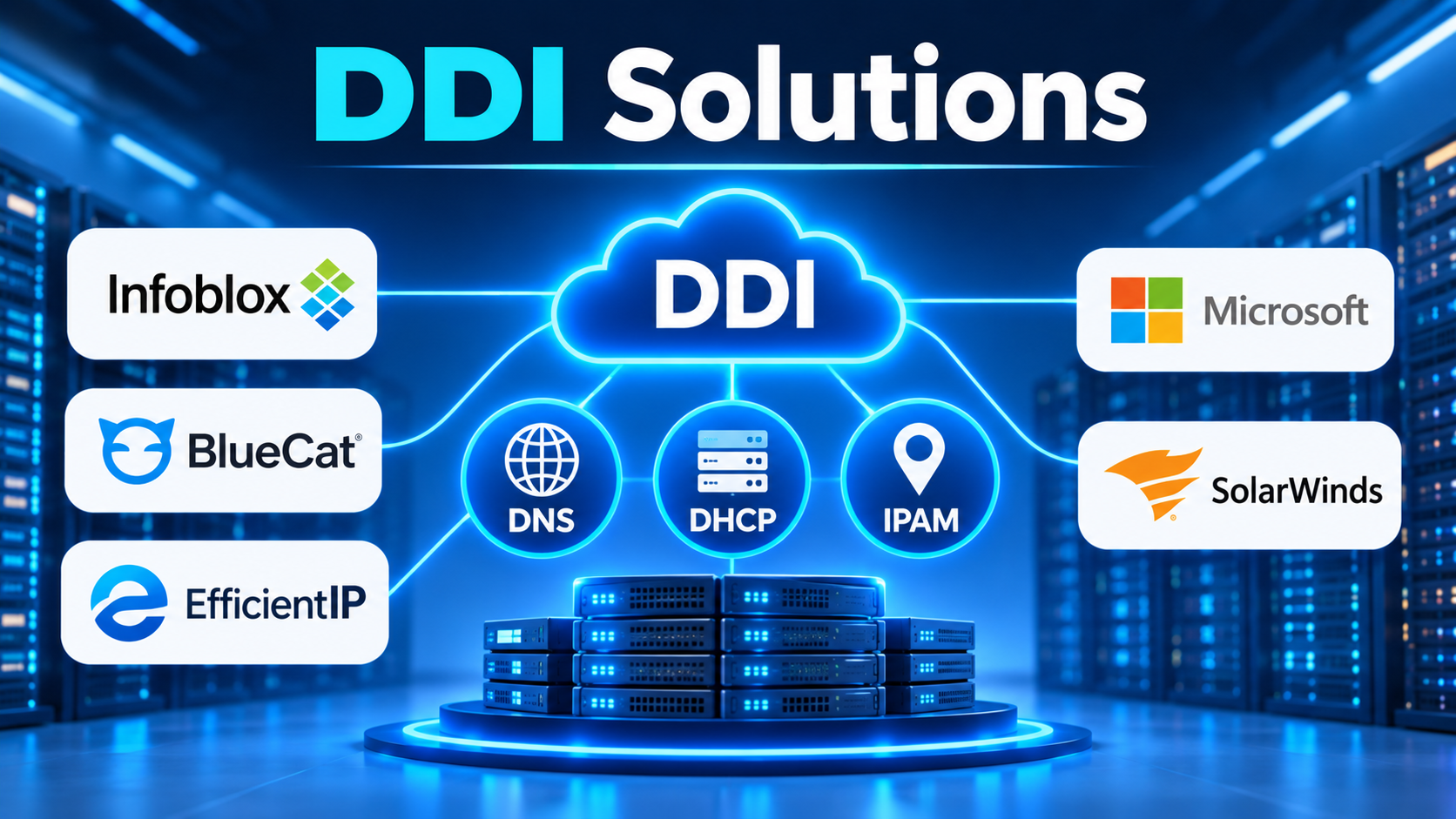
When a newly provisioned virtual machine receives an IP address from DHCP, fails to register its forward A record in internal DNS, and collides with a static reservation documented only in a separate IPAM database, the resulting outage rarely looks like a core infrastructure problem at first. Application teams blame firewall rules or load balancers, while network engineers spend hours manually reconciling split-horizon zones, DHCP failover scopes, and subnet allocation tables.
DDI platforms—which integrate DNS, DHCP, and IP Address Management (IPAM) into a single coordinated control plane—exist to eliminate that operational drift. Rather than treating name resolution, dynamic address leasing, and subnet planning as three separate administrative silos, a true DDI system executes them as a single atomic transaction. However, because DDI solutions range from heavyweight hardened appliance grids to cloud-managed overlays and open-source composable stacks, buying the wrong architecture can lock your team into excessive appliance maintenance or leave critical cloud and Active Directory workflows disconnected.
What Distinguishes True DDI From Standalone DNS or IPAM Tools
Many organizations assume they have DDI simply because they run Microsoft Active Directory DNS/DHCP alongside an open-source IPAM tracker. In practice, three architectural capabilities separate an integrated DDI platform from loosely connected point tools:
- Transactional State Synchronization: When an administrator or API call reserves an IP address, creates a DHCP host reservation, or provisions a new subnet, the DDI engine updates the IPAM utilization tree, configures the DHCP scope options, and publishes forward (
A/AAAA) and reverse (PTR) DNS records simultaneously—with rollback protection if any step fails. - Protocol-Level High Availability and Survivability: Core DNS and DHCP services cannot go offline when a central management console undergoes maintenance or loses WAN connectivity. Enterprise DDI platforms separate the central management database from distributed protocol-serving nodes (using Anycast BGP, DHCP failover peers, or local survivability caches) so branch offices continue leasing addresses and resolving internal names even during a central outage.
- Delegated Governance and Auditability: Large organizations cannot give every application developer or regional IT technician unrestricted root access to core DNS zones and DHCP pools. DDI platforms provide granular Role-Based Access Control (RBAC), change-approval workflows, and immutable audit logs attributing every record modification to a specific user or API token.
Primary DDI Platforms Across Enterprise, Cloud, and Open-Source Architectures
The platforms below represent established, actively maintained DDI solutions spanning commercial appliance grids, overlay managers, cloud-native control planes, and open-source software stacks.
Infoblox NIOS and Universal DDI
is the most widely deployed commercial DDI platform in large enterprises, available both through its traditional NIOS appliance grid architecture and its cloud-managed Universal DDI suite.
- Where it excels: High-scale, mission-critical internal and hybrid DDI with native DNS-layer security. Infoblox organizes physical or virtual appliances into a resilient Grid that replicates state across data centers, automates DNSSEC signing and key rollover, synchronizes with Microsoft Active Directory DNS/DHCP servers, and discovers cloud VPC/VNet resources across AWS, Azure, and Google Cloud. Its BloxOne Threat Defense integration inspects DNS queries at the resolver layer to block domain generation algorithms (DGAs), ransomware command-and-control callbacks, and DNS data exfiltration before traffic reaches perimeter firewalls.
- Operational trade-offs: Infoblox represents a major capital and operational commitment. Licensing spans Grid appliances, DDI modules, cloud discovery connectors, and threat-defense subscriptions, while managing large NIOS grids requires dedicated administrative training.
- Deployment and licensing: Physical hardware appliances, virtual appliances (VMware, KVM, Hyper-V, cloud IaaS), and cloud-managed SaaS control planes under commercial enterprise subscriptions.
BlueCat Integrity and BlueCat Micetro
approaches the DDI market with two distinct deployment models: BlueCat Integrity (a full-stack DDI platform built on BlueCat Address Manager and hardened DNS/DHCP Server appliances) and BlueCat Micetro (formerly Men&Mice, a non-disruptive DDI overlay).
- Where it excels: Giving enterprises a choice between replacing legacy DNS/DHCP servers or unifying them in place. BlueCat Integrity provides strict policy enforcement, multi-layered delegated administration, and high-availability appliance pairs tailored for regulated financial, healthcare, and government environments. Conversely, BlueCat Micetro sits above existing Microsoft Active Directory DNS/DHCP, ISC BIND, Kea, PowerDNS, AWS Route 53, and Azure DNS—providing a single API, RBAC layer, and IPAM database without requiring a forklift migration of underlying protocol servers.
- Operational trade-offs: Running BlueCat Integrity requires deploying and maintaining proprietary BDDS protocol servers across sites, whereas Micetro depends on the underlying capabilities and availability of the third-party DNS/DHCP engines it orchestrates.
- Deployment and licensing: Commercial enterprise licensing across physical/virtual appliances (Integrity) or lightweight software controllers (Micetro) scaled by managed IP addresses and servers.
EfficientIP SOLIDserver
centers its SOLIDserver DDI suite on policy-driven automation, multi-vendor DNS/DHCP orchestration, and DNS security intelligence.
- Where it excels: Hybrid DDI automation and SmartArchitecture templates. SOLIDserver can manage both EfficientIP’s own hardened DNS/DHCP appliances and external Microsoft or cloud DNS/DHCP services from one repository. Its SmartArchitecture engine automates the deployment of complex DNS topologies—such as multi-master, stealth primary, and Anycast configurations—while its Guardian DNS firewall module analyzes query behavior to detect cache poisoning, tunneling, and DDoS amplification attempts.
- Operational trade-offs: EfficientIP has a smaller North American channel ecosystem than Infoblox or BlueCat, though it maintains strong adoption across European enterprises, telecom operators, and public-sector networks. Buyers should verify local engineering support availability during procurement.
- Deployment and licensing: Hardware appliances, virtual machines, and cloud deployments licensed commercially by appliance capacity and managed IP/resource tiers.
SolarWinds IPAM with Integrated DNS/DHCP Management
functions as a software-based DDI overlay built specifically for organizations standardized on Microsoft Windows Server DNS/DHCP, Cisco IOS DHCP, and ISC BIND.
- Where it excels: Rapid operational visibility for mid-sized IT teams that have no intention of replacing Microsoft Active Directory DNS and DHCP with proprietary appliances. SolarWinds polls existing servers to consolidate DHCP scope utilization, automate split-scope failover configuration, detect IP address conflicts across subnets, and let administrators create or edit DNS records and DHCP reservations from a single web console.
- Operational trade-offs: Because SolarWinds relies on existing Windows, Cisco, or BIND servers to serve packets rather than providing its own hardened protocol appliances, DNS/DHCP performance, DNSSEC automation, and Anycast survivability remain bounded by those underlying servers. Licensing is metered by total managed IP addresses, which requires careful subnet scoping.
- Deployment and licensing: Self-hosted on Windows Server with Microsoft SQL Server, priced via commercial per-IP subscription or perpetual tiers.
ISC Kea + PowerDNS + NetBox (Open-Source Composable DDI Stack)
For service providers, cloud-native engineering teams, and Linux-first organizations that prefer open-source software over proprietary appliances, combining ISC Kea
(DHCP), PowerDNS
(Authoritative and Recursor DNS), and NetBox
(IPAM and Network Source of Truth) creates a modular, API-driven DDI architecture.
- Where it excels: Zero vendor lock-in, high packet-per-second throughput, and native Infrastructure-as-Code integration. ISC Kea replaces legacy ISC DHCPD with a modern, REST-API-configurable DHCPv4/DHCPv6 engine supporting PostgreSQL/MySQL lease backends and high-availability failover; PowerDNS exposes a clean HTTP API for dynamic zone updates and automated DNSSEC; and NetBox serves as the central IPAM and DCIM source of truth that drives both services via webhooks, Ansible, or custom Python middleware.
- Operational trade-offs: This is a composable architecture rather than a turnkey product. Your internal engineering team owns integration glue code, schema upgrades, high-availability clustering, and security patching across three separate open-source projects.
- Deployment and licensing: Self-hosted on Linux/containers under open-source licenses (MPL 2.0 for Kea, GPLv2 for PowerDNS, Apache 2.0 for NetBox), with optional commercial support subscriptions available from ISC, Open-Xchange, and NetBox Labs.
Comparing DDI Platforms by Deployment and Architectural Model
| Platform / Stack | DDI Architectural Model | Underlying DNS/DHCP Engines | Cloud & Hybrid Integration | Security & Governance Highlights | Licensing & Deployment |
| Infoblox (NIOS / Universal DDI) | Full-stack appliance grid + cloud SaaS | Proprietary hardened DNS/DHCP + MS AD sync | Native AWS, Azure & GCP VPC/DNS discovery | BloxOne DNS threat defense, DNSSEC & granular RBAC | Hardware/virtual appliances + SaaS; Commercial enterprise |
| BlueCat Integrity / Micetro | Choice of full-stack appliances or overlay | Proprietary BDDS appliances OR MS/BIND/Cloud | Multi-cloud DNS/IPAM unification across major clouds | Delegated administration, approval workflows & DNS firewall | Appliances (Integrity) or software overlay (Micetro); Commercial |
| EfficientIP SOLIDserver | Unified appliance + multi-vendor overlay | Proprietary SOLIDserver + MS/Cloud orchestration | Cloud discovery & hybrid DNS/IPAM synchronization | SmartArchitecture topologies & Guardian DNS security | Hardware/virtual appliances; Commercial enterprise |
| SolarWinds IPAM | Software management overlay | Existing Windows Server, Cisco IOS & BIND | Polls cloud DNS/IPAM alongside on-prem subnets | Split-scope DHCP wizards, conflict alerts & delegated RBAC | Self-hosted Windows/SQL; Commercial per-IP license |
| ISC Kea + PowerDNS + NetBox | Composable open-source DDI stack | ISC Kea (DHCP) + PowerDNS (DNS) + NetBox (IPAM) | API/webhook-driven synchronization with cloud/IaC | Full GitOps auditability via NetBox & API token scoping | Self-hosted Linux/Docker; Open Source + optional vendor support |
Five Critical Questions to Ask During a DDI Evaluation
Replacing or unifying core DNS and DHCP infrastructure touches every device on the network. Before committing to a platform, validate five operational behaviors in a lab pilot:
- Forklift Replacement vs. Overlay Coexistence: Does the platform require migrating all existing Microsoft Active Directory DNS zones and DHCP scopes onto proprietary appliances, or can it manage existing Windows and cloud DNS/DHCP servers non-disruptively while you migrate critical subnets in phases?
- Active Directory Domain Controller Compatibility: In Windows-heavy enterprises, domain controllers rely on dynamic secure DNS updates (
GSS-TSIG) for SRV records (_ldap,_kerberos). Verify how cleanly the DDI platform handles AD-integrated zones without breaking domain controller replication or GPO authentication. - Cloud Ephemeral Workload Velocity: Containers, autoscaling cloud instances, and Kubernetes ingress controllers create and destroy IP and DNS records in seconds. Test whether the DDI platform’s API rate limits and database replication can absorb high-churn automation calls without slowing down user-facing DNS resolution.
- DHCP Lease Exhaustion and Failover Recovery: Simulate a primary DHCP server failure and a WAN link disconnect at a remote branch. Confirm how fast failover peers assume lease responsibilities and whether local branch survivability keeps endpoints online until WAN connectivity returns.
- True Total Cost of Ownership Across IPv6 and Cloud: Ask vendors how they count “managed IP addresses” or “active objects.” A licensing model that counts every discovered cloud container IP or sparsely allocated IPv6 subnet can unexpectedly double renewal costs compared to appliance- or server-based licensing.
Choosing the Right DDI Path for Your Infrastructure
Organizations running large, regulated, or multi-site networks where DNS downtime or IP conflicts carry severe business risk benefit most from full-stack commercial DDI platforms like Infoblox, BlueCat Integrity, or EfficientIP SOLIDserver, which combine hardened protocol survivability with built-in DNS threat protection and delegated governance.
If your immediate priority is eliminating spreadsheet chaos and unifying Microsoft Active Directory DNS/DHCP without ripping out existing Windows servers, an overlay platform such as BlueCat Micetro or SolarWinds IPAM delivers fast consolidation with minimal architectural disruption. Conversely, infrastructure teams with strong Linux and Python/Ansible automation capabilities can assemble NetBox, ISC Kea, and PowerDNS into an API-native DDI stack that avoids recurring per-IP licensing fees entirely.
