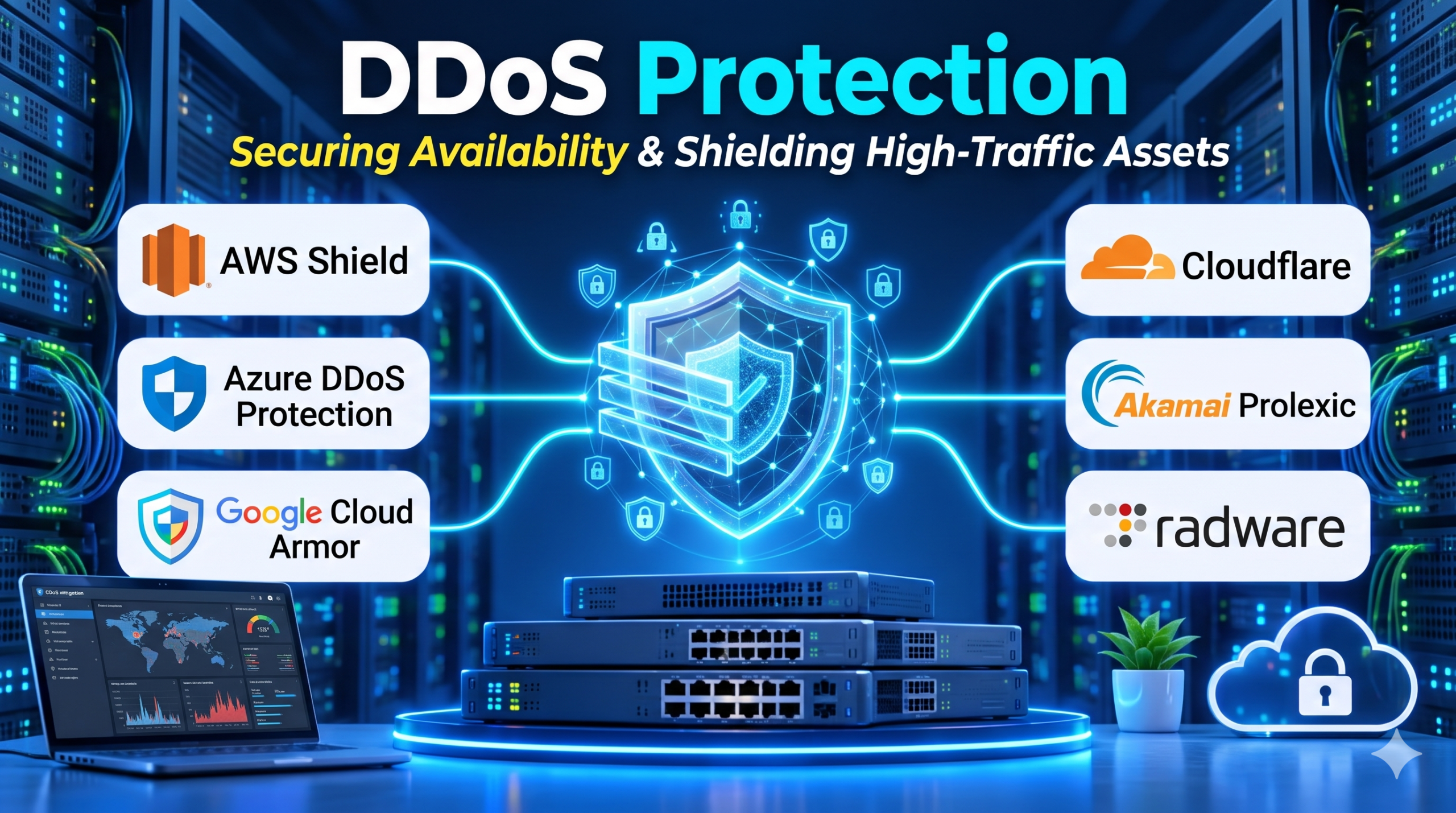
A distributed denial-of-service (DDoS) attack can make a perfectly healthy website, API, or network unavailable without compromising a single account or stealing a single record. By overwhelming bandwidth, exhausting connection capacity, or sending application requests that consume disproportionate resources, attackers can interrupt legitimate access and create substantial operational costs.
The difficulty for organizations is that DDoS attacks do not all target the same part of an infrastructure. A flood of network packets requires a different mitigation approach from an HTTP request flood designed to exhaust application resources. DNS infrastructure, cloud workloads, gaming services, financial platforms, and enterprise networks also have different availability requirements.
This is why DDoS protection is not simply a matter of installing another firewall. Effective defense requires identifying where malicious traffic can be absorbed, how legitimate requests can be distinguished from attack traffic, and what happens when an attack exceeds the capacity of the organization’s existing infrastructure.
Modern DDoS protection platforms address these challenges through cloud-based traffic scrubbing, globally distributed edge networks, behavioral analysis, automated mitigation, and dedicated network appliances. Some are integrated into existing cloud ecosystems, while others are designed specifically for telecommunications providers, large enterprises, and organizations operating their own infrastructure.
The important purchasing decision is not which vendor claims to block the largest attacks. It is which protection architecture can defend the organization’s actual internet-facing services without introducing unacceptable latency, operational complexity, or unexpected costs.
Understanding What DDoS Protection Actually Needs to Defend
DDoS protection tools are designed to identify and mitigate distributed traffic intended to disrupt the availability of internet-facing services. Their capabilities vary according to the network layers they protect and the infrastructure through which traffic passes.
Three attack categories are particularly important when evaluating a platform.
Network-layer attacks
Network and transport-layer attacks primarily target infrastructure and connection capacity.
Common examples include:
- UDP floods that generate excessive traffic toward network services.
- SYN floods that exploit the TCP connection-establishment process.
- Reflection and amplification attacks that use third-party services to generate disproportionately large responses.
- Protocol-based attacks that consume network device or connection-processing resources.
These attacks can overwhelm internet connections, routers, firewalls, and other infrastructure before application-level security controls have an opportunity to respond.
Application-layer attacks
Layer 7 attacks target the behavior of web applications and APIs rather than simply generating large quantities of network traffic.
An attacker might distribute requests across numerous source addresses, repeatedly access resource-intensive endpoints, or generate traffic that resembles normal application usage.
This makes detection more complicated. A request can be syntactically valid and still contribute to an attack.
Application-layer protection therefore depends heavily on traffic baselines, behavioral analysis, request characteristics, rate controls, and integration with web application security systems.
DNS-based attacks
DNS infrastructure translates domain names into the addresses needed to reach online services. If authoritative DNS infrastructure becomes unavailable or overwhelmed, otherwise healthy applications may become difficult or impossible to access through their domain names.
DNS protection must therefore be considered separately from ordinary web-server protection.
An organization should verify whether a proposed service protects authoritative DNS infrastructure, recursive DNS services, or merely the web applications that depend on DNS resolution. These are related but different responsibilities.
The Architectural Difference That Matters Most
Before comparing vendors, buyers should understand the distinction between cloud scrubbing, edge-based mitigation, and on-premises protection.
| Protection approach | How it works | Most relevant environment | Main consideration |
|---|---|---|---|
| Cloud scrubbing | Routes traffic through distributed mitigation infrastructure that filters malicious traffic | Public-facing services and large networks | Routing, capacity, and provider dependencies |
| Edge-based protection | Detects and mitigates suspicious traffic near distributed network entry points | Websites, APIs, and globally distributed applications | Proxy compatibility and origin exposure |
| On-premises mitigation | Uses dedicated appliances or network infrastructure to inspect and filter traffic | Enterprise networks and service providers | Cannot independently overcome an already saturated upstream connection |
| Hybrid protection | Combines local mitigation with external cloud-based filtering | Large enterprises and complex infrastructure | Integration and coordination between protection layers |
Cloud scrubbing is particularly important for volumetric attacks. When an organization’s internet connection becomes saturated, a security appliance sitting behind that connection cannot restore the bandwidth needed to receive legitimate traffic. Filtering must happen upstream.
On-premises protection, meanwhile, can provide valuable visibility and rapid mitigation for attacks that reach the organization’s network without overwhelming its connection.
The strongest architecture for a large or complex environment may therefore combine both approaches rather than relying on one product category.
DDoS Protection Tools Worth Evaluating
The following platforms represent different approaches to availability protection. They are not interchangeable, and their inclusion should not be interpreted as a universal ranking.
1. Cloudflare DDoS Protection
blog.cloudflare.com
Cloudflare is a particularly accessible starting point for organizations protecting public websites and internet-facing applications. Its DDoS protection operates across network and application layers through its distributed edge infrastructure.
One important distinction is that Cloudflare includes standard DDoS protection across its Free, Pro, Business, and Enterprise plans. This makes it relevant to smaller website operators as well as organizations requiring more advanced controls.
Its protection architecture uses automatically managed mitigation rulesets to identify and respond to different attack patterns. Additional capabilities include adaptive DDoS protection and specialized network protections for eligible services.
What distinguishes it: The combination of a globally distributed reverse-proxy network, CDN functionality, DNS services, and automatically managed DDoS mitigation. Organizations can consolidate several internet-edge functions instead of purchasing a separate service for every requirement.
Where it requires attention: Traffic must actually pass through the relevant Cloudflare protection services. Exposed origin IP addresses, unproxied services, and unsupported traffic paths can create protection gaps. Advanced capabilities also depend on the service and subscription configuration.
Suitable for: Websites, SaaS applications, APIs, smaller businesses, and enterprises looking for integrated edge protection.
2. AWS Shield
allhandsontech.com
AWS Shield is designed for organizations operating applications and infrastructure within the Amazon Web Services ecosystem.
Its two principal offerings serve different requirements.
- AWS Shield Standard: Automatically provides protection against common network and transport-layer DDoS attacks for AWS customers without an additional Shield subscription.
- AWS Shield Advanced: Adds expanded protection, more sophisticated detection and mitigation capabilities, DDoS cost protection, and access to specialist incident-response assistance subject to the required AWS support arrangements.
Shield Advanced integrates with services such as Amazon CloudFront, Elastic Load Balancing, Amazon Route 53, and Amazon EC2. It can also work alongside AWS WAF to provide application-layer controls.
The integration with AWS infrastructure is its most important practical advantage. Security teams can coordinate DDoS protection with existing cloud resources rather than introducing an entirely separate network architecture.
However, Shield Advanced has a more involved cost structure than basic protection. Its pricing documentation describes a subscription commitment and additional usage-related charges. Organizations should evaluate the complete cost of protected resources, data transfer, and supporting services before subscribing.
What distinguishes it: Native integration with AWS networking, load balancing, application security, and centralized security management.
Where it requires attention: It is most attractive when the protected infrastructure already uses AWS. Organizations with substantial non-AWS infrastructure may need complementary providers to maintain consistent protection.
Suitable for: AWS-hosted applications, enterprise cloud workloads, SaaS platforms, and organizations requiring coordinated cloud security management.
3. Azure DDoS Protection
azure.microsoft.com
Azure DDoS Protection is Microsoft’s managed network-layer defense service for resources hosted within Azure.
Its primary advantage is integration with Azure virtual networks and public IP resources. Protection can be associated with a virtual network without requiring application code changes or a separate traffic-filtering appliance.
Microsoft provides different protection tiers, including IP Protection and Network Protection. The distinction matters because the appropriate option depends on the number of public IP resources, the required protection capabilities, and the organization’s network architecture.
Azure DDoS Protection primarily addresses Layers 3 and 4. Organizations protecting web applications also need appropriate application-layer defenses, such as Azure Web Application Firewall.
This separation is important. Purchasing network-layer protection does not automatically provide every control needed to distinguish legitimate HTTP requests from sophisticated application-layer floods.
What distinguishes it: Integration with Azure networking, resource monitoring, and cloud infrastructure administration.
Where it requires attention: Its strongest fit is Azure-hosted infrastructure. Buyers should separately evaluate application-layer requirements, regional resource coverage, and the economics of protecting multiple public IP addresses.
Suitable for: Microsoft-centric organizations, Azure-hosted applications, enterprise virtual networks, and businesses already using Azure security management.
4. Google Cloud Armor
cloud.google.com
Google Cloud Armor combines DDoS protection with application security policies at Google’s network edge.
It is particularly relevant to organizations deploying services through Google Cloud Load Balancing and other supported infrastructure.
The platform provides protection against network and protocol-based attacks, volumetric application-layer attacks, and other web threats. Its security policies allow administrators to define traffic-handling rules, while Adaptive Protection can help identify suspicious application traffic patterns.
An important distinction is that not all capabilities are included in the same service tier. Standard network protection and advanced network mitigation have different coverage and subscription requirements.
For example, Google’s documentation distinguishes standard network DDoS protection from advanced protection available to eligible Cloud Armor Enterprise subscribers.
Cloud Armor is therefore best evaluated as part of a broader Google Cloud security architecture rather than as an isolated firewall replacement.
What distinguishes it: Edge-based protection combined with configurable security policies, application-layer defenses, and integration with Google Cloud load-balancing infrastructure.
Where it requires attention: Buyers must understand which endpoints, load balancers, regions, and subscription tiers their architecture requires. Advanced network protection is not automatically available for every deployment configuration.
Suitable for: Google Cloud applications, API-driven services, enterprises using Google Cloud networking, and organizations requiring integrated edge security.
5. Akamai Prolexic
akamai.com
Akamai Prolexic addresses a different market requirement from cloud-native protection services. It is designed for organizations that need dedicated DDoS mitigation across complex networks, including cloud, on-premises, and hybrid environments.
The service uses traffic routing and distributed scrubbing infrastructure to inspect incoming traffic, identify attack traffic, and forward legitimate traffic toward protected infrastructure.
A significant advantage is deployment flexibility. Akamai offers always-on and on-demand protection models, allowing organizations to choose how traffic enters its mitigation infrastructure.
Always-on protection routes relevant inbound traffic through the service continuously. On-demand protection is activated when an attack occurs, although it requires a reliable detection and routing response process.
Prolexic also supports hybrid deployments and offers on-premises protection powered by Corero. This is particularly relevant to organizations that cannot move all their internet-facing infrastructure behind a conventional cloud proxy.
What distinguishes it: Dedicated enterprise DDoS mitigation infrastructure, flexible routing arrangements, and support for cloud, on-premises, and hybrid deployments.
Where it requires attention: Implementation may involve BGP routing, GRE tunnels, IP addressing requirements, network coordination, and operational planning. The correct deployment model must be established before an incident occurs.
Suitable for: Large enterprises, telecommunications providers, financial institutions, hosting companies, and organizations operating critical network infrastructure.
6. NETSCOUT Arbor
netscout.com
NETSCOUT Arbor is particularly relevant to network operators and organizations that require detailed visibility into traffic flows rather than relying exclusively on application-edge protection.
Its product portfolio includes Arbor Sightline, Arbor Threat Mitigation System, Arbor Edge Defense, and Arbor Cloud.
These products serve related but distinct roles.
Arbor Sightline focuses on network traffic visibility and DDoS detection. It helps network teams understand traffic behavior and coordinate mitigation.
Arbor Threat Mitigation System provides traffic filtering capabilities for larger network environments.
Arbor Edge Defense offers inline, on-premises protection. Its cloud-signaling capabilities can coordinate local defense with Arbor Cloud mitigation when an attack requires additional external capacity.
Arbor Cloud provides cloud-based mitigation, including on-demand protection.
This product separation is important because NETSCOUT Arbor should not be evaluated as though every component performs the same function.
Its strongest appeal is the ability to coordinate network-level visibility, detection, and mitigation across different infrastructure locations.
What distinguishes it: Network-focused telemetry and a portfolio that supports local, cloud-based, and hybrid mitigation strategies.
Where it requires attention: The platform is more specialized than a typical website security subscription. Deployment, traffic-flow visibility, routing integration, and skilled network administration are important considerations.
Suitable for: Internet service providers, telecommunications operators, hosting providers, large enterprises, and organizations with substantial network infrastructure.
7. Radware Cloud DDoS Protection
radware.com
Radware provides specialized DDoS mitigation for organizations requiring protection against both infrastructure-level and application-level attacks.
Its cloud DDoS services use behavioral analysis and automated mitigation to identify suspicious traffic patterns. The platform is designed to address different attack vectors rather than relying exclusively on fixed signatures or simple traffic-volume thresholds.
One important area of differentiation is application-layer protection. Not every DDoS attack generates unusually large bandwidth consumption. Some attacks use comparatively ordinary-looking HTTP requests to overwhelm specific application functions.
Radware’s cloud web DDoS protection is designed to address sophisticated application-layer attacks, including scenarios where organizations want to avoid sharing their TLS certificates with an external mitigation provider.
The broader portfolio also includes network analytics, threat intelligence, and additional security services.
What distinguishes it: A specialized focus on behavioral detection and mitigation across network and application layers.
Where it requires attention: Buyers should establish which services are included in their proposed deployment, how application traffic is inspected, what certificate arrangements are required, and which capabilities depend on additional subscriptions.
Suitable for: Enterprises, financial services, digital platforms, hosting providers, and organizations with complex application security requirements.
8. Fastly DDoS Protection
fastly.com
Fastly DDoS Protection is an edge-based service designed to defend applications, APIs, and origin servers against common DDoS attacks.
Its primary appeal is the integration of mitigation with Fastly’s edge delivery infrastructure.
The service provides dashboards for monitoring DDoS-related events and traffic patterns. Administrators can configure protection behavior using three particularly useful operating modes:
- Logging: Records suspected attack traffic without immediately blocking it.
- Blocking: Blocks traffic identified by the protection rules.
- Challenge: Issues dynamic challenges to traffic identified as suspicious.
This flexibility is valuable when a security team wants to observe how detection rules behave before enabling more aggressive mitigation.
For organizations with highly variable traffic, the ability to begin in logging mode can help reduce the risk of blocking legitimate users through poorly tuned rules.
What distinguishes it: Integration with edge delivery and application security, alongside configurable logging, blocking, and challenge-based mitigation.
Where it requires attention: Fastly’s DDoS Protection is disabled by default and must be enabled for the relevant services. Buyers should validate coverage for their protocols, traffic paths, and origin infrastructure rather than assuming that an edge application service protects every network endpoint.
Suitable for: API providers, digital businesses, application developers, and organizations already using Fastly’s edge infrastructure.
Comparing the Platforms by Deployment and Protection Strategy
The following comparison emphasizes architectural fit rather than attempting to rank vendors by unverified performance claims.
| Platform | Primary protection approach | Infrastructure fit | Distinguishing capability |
|---|---|---|---|
| Cloudflare | Distributed edge mitigation | Websites, APIs, mixed hosting | Standard DDoS protection across its plans |
| AWS Shield | Cloud-native managed protection | AWS | Integration with AWS infrastructure |
| Azure DDoS Protection | Cloud-native network protection | Azure | Virtual network and public IP protection |
| Google Cloud Armor | Edge-based network and application protection | Google Cloud | Configurable security policies and Adaptive Protection |
| Akamai Prolexic | Cloud scrubbing and hybrid mitigation | Enterprise, cloud, on-premises | Flexible always-on and on-demand deployment |
| NETSCOUT Arbor | Network detection and mitigation | Service providers and enterprise networks | Traffic visibility and coordinated hybrid defense |
| Radware | Behavioral cloud mitigation | Enterprise and application infrastructure | Network and application-layer protection |
| Fastly | Edge-based application protection | Websites and APIs | Logging, blocking, and challenge modes |
A crucial distinction is that AWS Shield, Azure DDoS Protection, and Google Cloud Armor are closely integrated with their respective cloud ecosystems. Akamai Prolexic and NETSCOUT Arbor address more complex network environments, while Cloudflare and Fastly offer edge-based approaches that can combine availability protection with other internet delivery and security services.
Radware occupies a specialist position with an emphasis on behavioral DDoS detection and mitigation.
There is no defensible universal winner across these different deployment models.
How to Choose the Right DDoS Protection Platform
The most effective selection process begins with the infrastructure being protected, not the vendor’s advertised attack capacity.
For websites and smaller businesses
A smaller organization operating a public website may not need a dedicated enterprise mitigation appliance.
Cloudflare is a practical starting point because standard DDoS protection is included across its plans. It also offers CDN and DNS functionality, reducing the need to manage several independent edge services.
Fastly is worth evaluating when an organization already uses its delivery infrastructure and needs more control over application-level traffic handling.
The important consideration is whether the origin server remains accessible through alternative routes that bypass the protection layer.
For AWS, Azure, and Google Cloud workloads
Organizations should first evaluate the security services integrated into their existing cloud environments.
- AWS users should examine AWS Shield alongside AWS WAF and CloudFront.
- Microsoft Azure users should evaluate Azure DDoS Protection alongside Azure Web Application Firewall.
- Google Cloud users should consider Cloud Armor and its available network and application protection tiers.
Using native services can simplify administration and integration. However, organizations operating workloads across multiple cloud providers should examine whether their protection policies remain consistent across environments.
For enterprise networks and telecommunications providers
Large organizations with their own network infrastructure often need more than a conventional website protection service.
Akamai Prolexic and NETSCOUT Arbor are particularly relevant because their deployment approaches accommodate complex routing arrangements, dedicated mitigation infrastructure, and hybrid protection.
Radware is another specialist option for organizations prioritizing behavioral analysis and sophisticated application-layer mitigation.
These deployments require greater preparation, including network engineering, traffic visibility, incident-response coordination, and clearly defined escalation procedures.
For organizations protecting APIs
API availability deserves separate consideration because legitimate and malicious requests can look similar at the network level.
A platform should support:
- Application-specific traffic baselines.
- Rate limiting and request controls.
- Behavioral analysis.
- Monitoring of unusual endpoint activity.
- Integration with API gateways and application security policies.
- Visibility into blocked, challenged, and permitted requests.
A basic network-layer mitigation service may keep an internet connection available while leaving an expensive application endpoint vulnerable to resource-exhaustion attacks.
The Costs That Buyers Often Overlook
DDoS protection pricing is difficult to compare because vendors use different commercial models.
Some provide standard protection as part of an existing subscription, while others charge for dedicated mitigation services, protected resources, traffic volumes, or additional operational support.
Several cost factors deserve attention before procurement.
Protected resource count: Cloud platforms may charge according to the number of public IP addresses, subscriptions, or protected resources.
Traffic and bandwidth: Organizations should understand how normal traffic, attack traffic, data transfer, and mitigation capacity affect billing.
Subscription commitments: Enterprise protection can involve minimum commitments, contractual terms, or additional support requirements.
Network integration: BGP configuration, GRE tunnels, routing changes, and hardware requirements can introduce implementation expenses.
Operational staffing: A technically sophisticated platform may require security engineers and network administrators to configure, monitor, and maintain it.
Additional security services: WAF protection, bot management, API security, DNS protection, and managed incident response may be separate products or subscription components.
For example, AWS Shield Standard provides basic protection without an additional Shield subscription, whereas Shield Advanced has a separate subscription and associated usage considerations.
Similarly, Azure DDoS Protection has different pricing arrangements for its protection tiers.
A meaningful comparison should therefore consider the total cost of ownership rather than the advertised entry-level subscription.
Geographic Considerations for Organizations Operating in India
Organizations serving customers in India should evaluate DDoS protection from a regional infrastructure perspective.
A provider’s global presence does not automatically guarantee the best experience for Indian users. Network routing, interconnection quality, upstream providers, and the location of protected infrastructure all influence how traffic reaches an application.
Before selecting a platform, consider the following:
- Regional traffic routing: Determine how Indian users’ traffic reaches the provider’s mitigation infrastructure.
- Latency: Evaluate the additional network delay introduced by traffic inspection and routing.
- Indian hosting infrastructure: Check compatibility with the organization’s existing hosting provider, data centre, or cloud region.
- ISP coordination: Large organizations may need coordination between their DDoS provider, internet service provider, and network operator.
- Data governance: Understand where traffic metadata, security logs, and associated operational information are processed and retained.
- Support coverage: Confirm whether incident-response assistance is available during the organization’s critical operating hours.
For Indian enterprises, financial services, e-commerce businesses, and digital service providers, these considerations can be as important as the provider’s advertised mitigation capacity.
Organizations subject to applicable Indian cybersecurity and data-protection requirements should also obtain appropriate legal and compliance advice before finalizing their deployment.
Implementing DDoS Protection Without Creating New Availability Problems
Purchasing a protection service does not automatically create a resilient architecture. Configuration mistakes can leave services exposed or cause legitimate traffic to be blocked.
A structured implementation process helps reduce these risks.
1. Identify every internet-facing asset
Create an inventory of public IP addresses, websites, APIs, DNS infrastructure, remote access services, and other externally accessible systems.
Pay particular attention to services that do not operate through the primary website or CDN.
2. Establish normal traffic behavior
Understand normal traffic volume, geographic distribution, request patterns, peak usage, and application resource consumption.
Without a baseline, distinguishing unusual traffic from a legitimate traffic spike becomes more difficult.
3. Select protection according to attack exposure
Determine whether the primary risk involves network saturation, protocol abuse, HTTP request floods, DNS availability, or multiple attack categories.
Choose the protection architecture accordingly.
4. Test detection before aggressive mitigation
Where supported, begin with monitoring or logging modes.
Observe how the platform classifies traffic and identify potential false positives before enabling blocking or challenge-based controls.
5. Protect the origin infrastructure
If an application uses a reverse proxy or CDN, verify that attackers cannot simply bypass the protection layer and connect directly to the origin server.
Restrict origin access to approved traffic paths wherever the architecture allows.
6. Prepare an incident-response process
Define who can change routing, activate emergency mitigation, communicate with providers, and investigate suspicious traffic.
Record the escalation contacts and required technical information before an incident occurs.
7. Review protection continuously
Traffic patterns change as applications grow, new endpoints are introduced, and customer behavior evolves.
Regularly review mitigation events, false positives, protected assets, routing configurations, and service costs.
Questions to Ask Before Purchasing a DDoS Protection Service
A product demonstration should establish how the service behaves under realistic operating conditions.
Rather than focusing exclusively on marketing claims, ask vendors:
- Which network and application layers are protected?
- Does protection cover public IP addresses, websites, APIs, DNS, and non-web protocols?
- Is mitigation always-on or activated on demand?
- Where does traffic get inspected and filtered?
- What happens when an attack exceeds the provider’s available mitigation capacity?
- Does the deployment require BGP announcements, GRE tunnels, or DNS changes?
- Can legitimate traffic be incorrectly blocked during mitigation?
- What visibility is available into detected attacks and mitigation decisions?
- Which features require additional subscriptions?
- What incident-response assistance is included in the contract?
- How is customer traffic metadata handled and retained?
- What happens if the mitigation provider itself experiences an availability problem?
These questions help expose differences that ordinary feature comparisons often miss.
Frequently Asked Questions
What is the difference between a DDoS protection tool and a firewall?
A firewall controls network traffic according to security policies, while DDoS protection focuses on maintaining availability during distributed attacks.
Traditional firewalls can help filter unwanted traffic, but they may become overwhelmed when an attack saturates the network connection or exhausts connection-processing resources.
DDoS mitigation services provide additional detection, traffic filtering, and upstream mitigation capabilities.
Can a CDN protect a website against DDoS attacks?
Yes. Many CDNs provide DDoS mitigation as part of their edge infrastructure.
By distributing traffic across a large network and filtering suspicious requests before they reach the origin server, a CDN can reduce the impact of many attacks.
However, CDN protection does not automatically cover every protocol, public IP address, or service operated by an organization.
Is free DDoS protection sufficient for a business website?
It can be sufficient for certain websites, particularly when their requirements align with the protection included in the free service.
Cloudflare provides standard DDoS protection across its Free plan, making it a useful starting point.
However, businesses with complex applications, dedicated network infrastructure, specialized protocols, or demanding incident-response requirements may need additional protection.
What is the difference between DDoS protection and WAF protection?
DDoS protection aims to preserve service availability by identifying and mitigating distributed traffic attacks.
A Web Application Firewall (WAF) examines HTTP traffic and applies security rules to help protect applications against malicious requests and common web vulnerabilities.
The technologies overlap in application-layer DDoS defense, but they are not interchangeable. Organizations often deploy both.
Can on-premises DDoS protection stop large volumetric attacks?
On-premises appliances can detect and mitigate certain attacks before they affect internal systems.
However, they cannot independently solve a situation where malicious traffic has already saturated the organization’s upstream internet connection.
For large volumetric attacks, upstream ISP mitigation or cloud-based scrubbing is generally necessary.
Should organizations use more than one DDoS protection provider?
Some organizations benefit from multiple protection layers, particularly when they operate across different clouds, networks, and application environments.
A hybrid approach can combine on-premises detection with external traffic scrubbing and application-layer protection.
However, additional providers also introduce routing complexity, operational responsibilities, and potentially higher costs. Redundancy should solve a clearly identified availability risk rather than simply increase the number of security products.
Making the Final Selection
DDoS protection is ultimately an infrastructure availability decision, not simply a security software purchase.
For websites and smaller digital businesses, Cloudflare offers an accessible combination of edge delivery and standard DDoS mitigation. Organizations already committed to AWS, Azure, or Google Cloud should examine the protection services available within their existing environments before introducing another provider.
For complex enterprise networks, Akamai Prolexic and NETSCOUT Arbor offer approaches designed around dedicated mitigation infrastructure and hybrid deployment requirements. Radware deserves consideration when behavioral detection and sophisticated application-layer defense are important. Fastly is relevant to organizations seeking integrated edge protection with configurable traffic-handling controls.
The right decision depends on three questions: what infrastructure needs protection, where malicious traffic must be filtered, and how much operational complexity the organization can reasonably manage.
A successful deployment should preserve access for legitimate users, provide clear visibility into mitigation activity, and remain effective when the organization’s normal traffic patterns change. That is a more meaningful measure of DDoS protection than choosing a platform simply because its marketing materials advertise the largest numbers.
