Distributed systems rarely fail because a single function computes the wrong integer; they fail at network boundaries—when a third-party payment gateway times out, an upstream microservice returns a schema change, or a shared staging environment goes offline mid-sprint. Waiting for every dependent team or external vendor sandbox to become available stalls continuous delivery and makes deterministic failure testing nearly impossible.
Mocking and service virtualization tools solve this dependency bottleneck by standing in for unavailable, rate-limited, or expensive systems. Yet engineering teams frequently conflate lightweight code-level mocks, HTTP stub servers, and full-scale enterprise service virtualization platforms. Deploying an enterprise protocol-virtualization suite to stub three JSON endpoints creates unnecessary operational overhead, while relying on basic unit-level mocks leaves network serialization, latency injection, and stateful workflows untested until production.
Where API Mocking Ends and Service Virtualization Begins
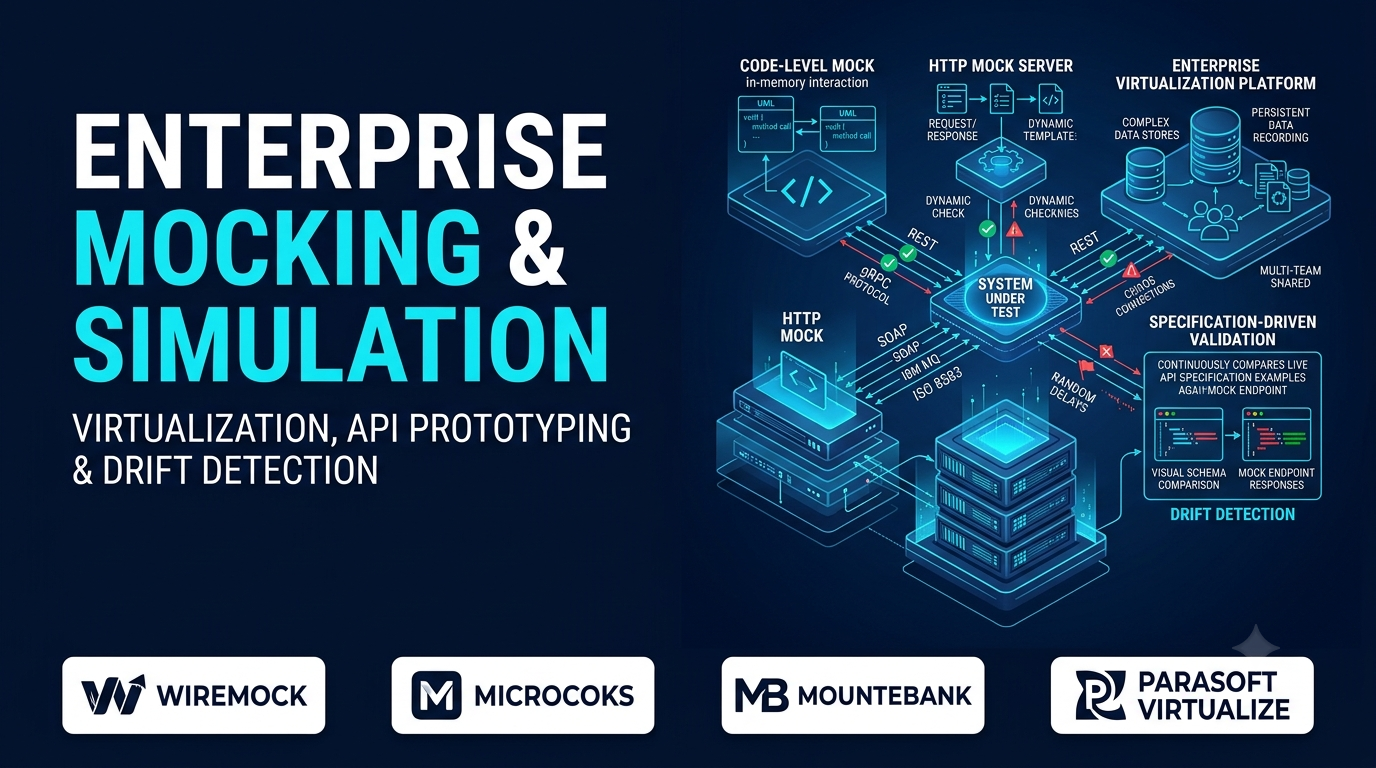
Although vendors often use the terms interchangeably, API mocking and service virtualization operate at different layers of the software stack and address distinct engineering constraints.
- Code-Level Mocking Libraries (such as Mockito, Sinon, or
unittest.mock) intercept method calls in memory within a single process. They verify internal interactions during unit tests without opening network sockets, meaning serialization formats, HTTP headers, and TLS handshakes are bypassed entirely. - HTTP/API Mocking Servers run as standalone processes or embedded network interceptors. They speak real network protocols—primarily REST, GraphQL, or gRPC—allowing the system under test to make genuine network calls against configured request/response rules, dynamic templates, and simulated latency.
- Service Virtualization Platforms extend beyond standard HTTP APIs into stateful behavior, non-HTTP enterprise protocols (such as MQ, JMS, ISO 8583, JDBC, or mainframe CICS), traffic recording and replay, and multi-team shared environments capable of sustaining high-throughput performance testing.
Recognizing which boundary you need to simulate prevents both under-testing network behavior and over-buying heavyweight infrastructure.
Leading Mocking and Service Virtualization Tools by Architecture
WireMock — The Standard for Programmable HTTP Simulation
WireMock has become the foundational open-source tool for HTTP-based API mocking across JVM and polyglot microservice stacks. It can run embedded directly inside JUnit tests or as a standalone Docker container for integration and system testing.
WireMock’s core strength lies in its expressive request-matching engine (matching on URLs, headers, JSONPath, XPath, and regex patterns) paired with Handlebars response templating, stateful scenarios, and fault injection (such as malformed responses, connection resets, and fixed or random delays). Teams that need managed collaboration, role-based access control, and OpenAPI-driven workspace syncing can adopt WireMock Cloud, while keeping test definitions portable with the open-source core. Its primary limitation is scope: WireMock is strictly focused on HTTP/HTTPS, making it unsuitable for legacy message queues or proprietary binary protocols.
Mockoon — Lightweight Local and CLI API Mocking
Mockoon prioritizes speed and low setup friction for frontend and backend developers who need realistic local APIs without writing configuration code or managing complex JVM runtimes. Its desktop application provides a clean graphical interface for defining routes, response rules, latency, and proxy forwarding, while its companion CLI (@mockoon/cli) allows those exact environment files to run headlessly inside Docker containers and CI/CD pipelines.
Mockoon excels when teams want to prototype APIs from OpenAPI specifications or unblock frontend development locally. However, for complex programmatic assertions—such as verifying exact call counts and payload sequences directly inside automated Java or Go test suites—code-first runners like WireMock or Mountebank offer tighter test-runner integration.
Mountebank — Multi-Protocol Over-the-Wire Test Doubles
Maintained as an open-source, Node.js-based tool, Mountebank distinguishes itself by supporting multiple network protocols out of the box—including HTTP, HTTPS, TCP, and SMTP—with community plugins extending support to gRPC, GraphQL, and LDAP.
Rather than configuring mocks solely through static files, Mountebank exposes a REST API that test suites call at runtime to create and tear down “imposters” dynamically. It also supports proxy-and-record modes to capture real upstream traffic and convert it into replayable stubs, alongside JavaScript injection for custom response logic. While Mountebank bridges the gap between simple HTTP mockers and enterprise protocol simulators, its JSON configuration syntax can become verbose for deeply nested conditional responses.
Microcks — Specification-Driven Mocking and Contract Validation
Microcks approaches mocking through an API-first governance lens. Instead of manually authoring stub rules, teams import existing API artifacts—such as OpenAPI, AsyncAPI, GraphQL schemas, gRPC Protobuf files, or Postman collections—and Microcks automatically turns those specifications and their embedded examples into live mock endpoints.
Crucially, Microcks also works in reverse: it can run automated contract-conformance tests against your actual service implementation to verify that code matches the published specification. Native Kubernetes deployment support and coverage of event-driven protocols (Kafka, AMQP, MQTT via AsyncAPI) make Microcks particularly valuable for platform engineering teams standardizing microservices governance. Teams that do not maintain rigorous API specifications, however, will extract less value from its artifact-driven workflow.
Hoverfly — Lightweight Proxy Simulation for CI Pipelines
Written in Go and distributed as a single binary, Hoverfly acts as a lightweight man-in-the-middle proxy that records live HTTP/HTTPS traffic between services and replays it deterministically during automated builds.
Hoverfly separates its workflows into explicit operational modes—such as capture, simulate, synthesize, and diff (which compares live upstream responses against recorded baselines to detect breaking API changes). Its minimal memory footprint and single-binary deployment make it easy to embed inside ephemeral CI runners without consuming significant container resources. Its trade-off is a smaller ecosystem and fewer out-of-the-box enterprise governance features compared to WireMock or commercial suites.
Mock Service Worker (MSW) — Network-Level Interception for Browser and Node.js
For frontend and full-stack JavaScript/TypeScript teams, Mock Service Worker solves a recurring problem: maintaining separate mock setups for browser development, unit tests, and end-to-end tests. In the browser, MSW registers an actual Service Worker that intercepts outgoing fetch and XMLHttpRequest calls at the network layer; in Node.js, it intercepts requests via native request-interception modules.
Because your application executes real network requests without knowing they are intercepted, the exact same request handlers work across local browser development, Vitest/Jest component tests, and Playwright runs. MSW is purpose-built for JavaScript/TypeScript ecosystems and is not designed as a multi-team backend service virtualization server.
OpenText Service Virtualization & Parasoft Virtualize — Enterprise Protocol Virtualization
In banking, telecommunications, healthcare, and insurance environments, critical backend dependencies often speak non-web protocols—such as IBM MQ, JMS, CICS, SAP RFC, JDBC, or ISO 8583 financial messaging.
Commercial platforms like OpenText Service Virtualization (formerly Micro Focus) and Parasoft Virtualize are engineered specifically for these heterogeneous enterprise estates. They capture traffic across mainframe, database, and message-bus layers, model stateful data-driven responses, and simulate realistic throughput bottlenecks for high-volume performance testing. These platforms carry substantial licensing costs and require dedicated QA infrastructure specialists, making them excessive for cloud-native organizations running standard REST and gRPC microservices.
Capability Comparison Across Mocking and Virtualization Tools
| Tool | Primary Scope | Supported Protocols | Deployment Model | Standout Strength | Primary Trade-Off |
| WireMock | Programmable API mocking | HTTP, HTTPS (gRPC via extensions) | Embedded JVM library, standalone JAR, Docker, Cloud | Rich request matching, stateful scenarios, and fault injection | Focused primarily on HTTP/HTTPS ecosystems |
| Mockoon | Local & CI API prototyping | HTTP, HTTPS | Desktop GUI app + headless CLI / Docker | Fast visual setup with zero-friction CI portability via CLI | Less suited for complex programmatic test assertions |
| Mountebank | Multi-protocol network stubs | HTTP, HTTPS, TCP, SMTP (+ plugins) | Standalone Node.js server / Docker | Dynamic REST-configured imposters across non-HTTP TCP protocols | Verbose JSON configuration for complex conditional logic |
| Microcks | Spec-driven mocking & testing | REST, GraphQL, gRPC, Kafka, MQTT, AMQP | Kubernetes, Docker, Podman | Generates mocks and contract tests directly from OpenAPI/AsyncAPI | Requires disciplined API specification maintenance |
| Hoverfly | Traffic capture & replay proxy | HTTP, HTTPS | Single Go binary, Docker, Kubernetes | Ultra-low resource footprint and built-in diff mode for drift detection | Smaller plugin ecosystem than WireMock |
| MSW | Frontend & Node.js network mocking | HTTP, HTTPS, GraphQL (via handlers) | In-browser Service Worker & Node.js runtime | Reuses identical network mocks across dev, unit, and E2E browser tests | Limited strictly to JavaScript/TypeScript runtimes |
| Parasoft / OpenText SV | Enterprise service virtualization | HTTP, MQ, JMS, JDBC, SAP, Mainframe, ISO 8583 | Enterprise server / private cloud | Simulates stateful legacy protocols at load-testing scale | High commercial licensing and administrative complexity |
Four Evaluation Factors That Determine Real-World Success
1. Drift Detection Between Mocks and Live Providers
The single biggest operational risk in service virtualization is mock drift: your virtualized dependency continues returning a clean 200 OK while the real upstream team has added a required field or altered an error payload. Look for tools that mitigate drift through specification validation (like Microcks validating against OpenAPI/AsyncAPI), contract testing integration (such as pairing mocks with Pact), or proxy diffing modes (like Hoverfly’s diff mode) that periodically compare live sandbox responses against recorded stubs.
2. Stateful Behavior vs. Stateless Request/Response
Many API workflows cannot be tested with static lookup tables. Testing an order lifecycle requires POST /orders to create a resource that a subsequent GET /orders/{id} retrieves and DELETE /orders/{id} removes. Verify whether a tool supports stateful state machines, dynamic response templating, or in-memory data buckets rather than forcing engineers to hardcode brittle sequences of static endpoints.
3. Chaos and Latency Modeling
Happy-path mocks give teams false confidence. Resilient distributed systems must be verified against slow downstream connections, chunked trickle responses, intermittent 503 Service Unavailable spikes, and TLS handshake failures. Prioritize tools that treat latency distributions and network-level faults as first-class configuration primitives.
4. Source-Control Friendliness and CI Isolation
GUI-only mocking tools often create governance bottlenecks when mock definitions live inside proprietary databases or shared staging servers where one team’s edits break another team’s build. Favor tools whose stub definitions serialize cleanly as human-readable JSON, YAML, or code committed directly alongside application source code, allowing every pull request to spin up isolated virtual dependencies.
Selecting the Right Tool for Your Stack
- For frontend and full-stack TypeScript teams: Start with Mock Service Worker (MSW) to share realistic network-level mocks across browser development, component testing, and Playwright suites without standing up external infrastructure.
- For backend microservices and JVM/polyglot CI pipelines: WireMock offers the most mature balance of programmatic control, fault injection, and containerized execution for HTTP APIs.
- For platform teams governing OpenAPI and event-driven architectures: Microcks turns existing API and AsyncAPI contracts into both shared mocks and automated compliance checks.
- For non-HTTP network protocols (TCP, SMTP, or legacy enterprise message buses): Evaluate Mountebank for lightweight multi-protocol TCP/SMTP needs, or Parasoft Virtualize / OpenText Service Virtualization when mainframes, MQ, and high-concurrency load simulations are mandatory requirements.
Before rolling out a tool across engineering teams, run a pilot against your most fragile external integration: configure a stateful multi-step workflow, inject random 2-second latency spikes, and verify how cleanly the mock definition can be versioned and executed inside an ephemeral pull-request pipeline.
