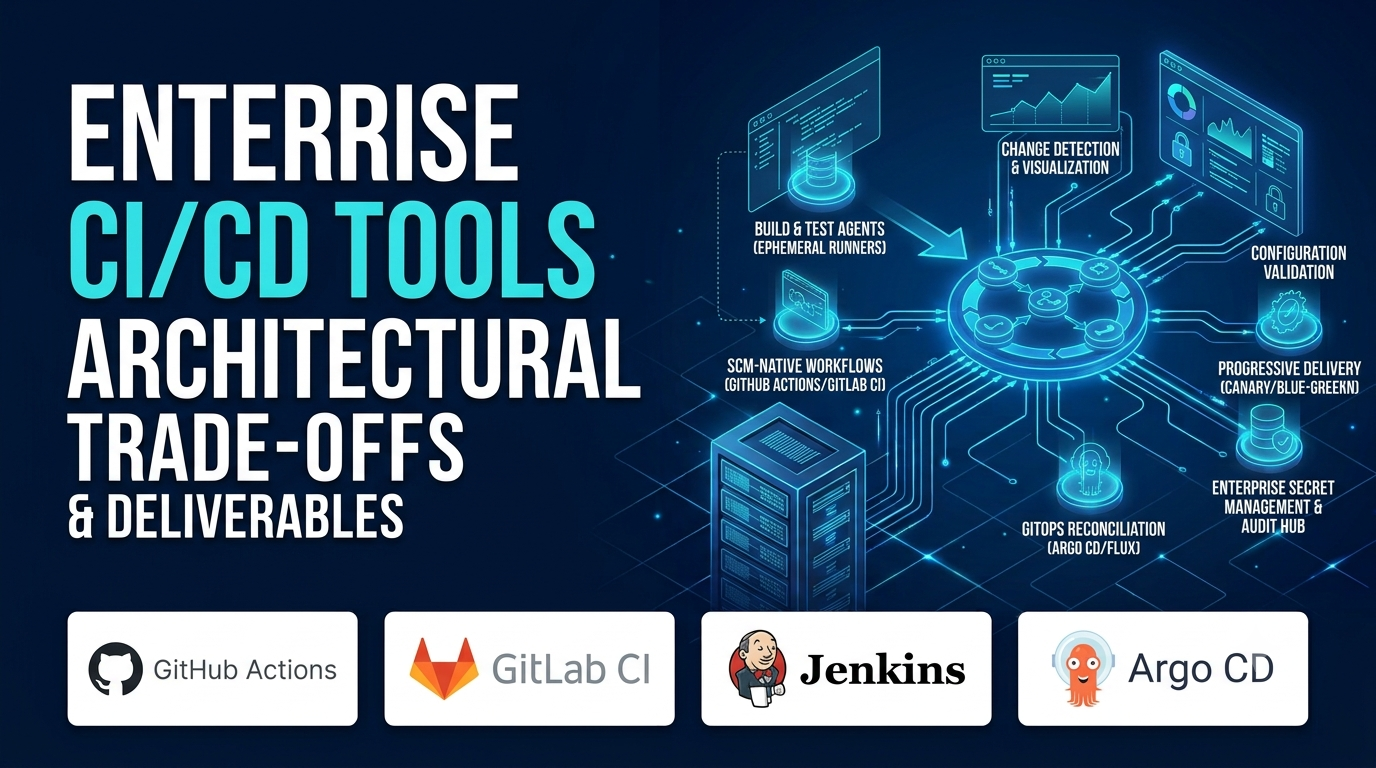
Selecting a continuous integration and continuous delivery (CI/CD) platform rarely fails because a tool cannot run a shell script inside a container. Every major platform executes build steps, runs test suites, and pushes container images. Instead, engineering organizations hit friction months or years after adoption—when YAML sprawl slows down onboarding across dozens of repositories, self-hosted runner maintenance consumes platform engineering hours, or imperative deployment scripts collide with Kubernetes cluster state.
Evaluating CI/CD tools requires separating continuous integration (compiling code, running automated tests, scanning artifacts) from continuous delivery (orchestrating progressive rollouts, managing environment approvals, and reconciling production infrastructure). Some platforms unify both stages inside your source control provider, while others specialize exclusively in build orchestration or declarative cluster synchronization.
Three Distinct Models in Modern CI/CD Architecture
Before comparing individual products, technical leads should identify which operational model aligns with their infrastructure footprint and governance requirements.
1. SCM-Native CI/CD Platforms
Tools like GitHub Actions and GitLab CI/CD embed pipeline execution directly alongside source repositories, pull requests, and issue tracking. Authentication, branch protection rules, and secret scoping are tightly coupled to repository permissions.
- Core advantage: Minimal context switching for developers and zero synchronization overhead between code hosting and build triggers.
- Primary trade-off: Complex multi-repository orchestration and cross-organization governance can become difficult to standardize without building shared workflow templates or internal tooling.
2. Dedicated Build and Pipeline Orchestrators
Standalone CI/CD systems—such as Jenkins, CircleCI, Buildkite, and TeamCity—operate independently of where source code lives. They connect to GitHub, GitLab, or Bitbucket via webhooks and APIs while maintaining their own execution engines, caching layers, and runner fleets.
- Core advantage: Superior flexibility for heterogeneous source control environments, specialized build hardware (such as macOS, GPU, or bare-metal runners), and advanced pipeline caching.
- Primary trade-off: Introduces an additional control plane to secure, integrate with identity providers, and maintain alongside your version control system.
3. Declarative GitOps Continuous Delivery Engines
Tools like Argo CD and Flux do not compile source code or run unit tests. Instead, they run inside Kubernetes clusters, continuously watching Git repositories containing declarative manifests (Helm charts, Kustomize overlays, or raw YAML) and automatically reconciling live cluster state whenever desired state drifts or updates.
- Core advantage: Eliminates the security risk of giving external CI runners administrative credentials to production Kubernetes clusters, while providing continuous drift detection and instant Git-based rollbacks.
- Primary trade-off: Purpose-built for Kubernetes and declarative infrastructure; traditional virtual machines, mobile app store releases, and bare-metal deployments still require imperative release pipelines.
Evaluating the Leading CI/CD Platforms
GitHub Actions — Workflow Automation Built Around Repository Events
GitHub Actions extends CI/CD into a general-purpose event automation engine triggered by pull requests, releases, schedules, and webhook dispatches. Its marketplace of reusable community and vendor-maintained actions dramatically accelerates common tasks such as cloud OIDC authentication, container builds, and security scanning.
For teams already hosting code on GitHub, adopting Actions eliminates separate vendor contracts and user management. Teams can mix GitHub-hosted ephemeral runners with self-hosted runners for private network access or custom hardware. However, as organizations scale to hundreds of repositories, YAML duplication and supply-chain governance—such as pinning third-party actions to immutable commit SHAs and enforcing organization-wide reusable workflows—become critical operational responsibilities.
GitLab CI/CD — Unified DevSecOps Pipeline Architecture
GitLab CI/CD is integrated natively into GitLab’s single-application platform, connecting merge requests, container registries, package repositories, and built-in security scanners (SAST, DAST, dependency scanning) within a single data model. Pipelines are defined in .gitlab-ci.yml using directed acyclic graphs (DAGs) via the needs keyword, allowing downstream jobs to start immediately when upstream dependencies finish rather than waiting for entire pipeline stages to complete.
Its modular gitlab-runner binary deploys cleanly across Kubernetes, Docker, Linux, Windows, and macOS. The main trade-off is architectural coupling: organizations get the strongest return when standardizing on GitLab for source code management as well, whereas running GitLab CI against external repositories reduces some of its native merge-request integration advantages.
Jenkins — Maximum Extensibility with Self-Managed Overhead
Jenkins remains one of the most widely deployed open-source automation servers, backed by an unmatched ecosystem of over a thousand plugins and programmatic Jenkinsfile pipelines written in Groovy. If an organization needs to integrate legacy mainframe compilers, custom hardware test benches, or bespoke on-premises tooling, Jenkins can almost certainly be scripted to support it.
That flexibility comes with a well-documented operational cost. Because Jenkins relies heavily on third-party plugins for core capabilities, administrators must actively manage plugin compatibility, controller upgrades, and security advisories. While modern deployments use Jenkins Configuration as Code (JCasC) and ephemeral Kubernetes agents to eliminate manual UI configuration, teams without dedicated platform administration capacity often find managed cloud runners far less burdensome.
CircleCI — High-Speed Cloud Execution and Granular Caching
CircleCI focuses on build velocity and developer productivity for cloud-hosted engineering teams. It provides fine-grained control over execution environments (Docker, Linux VMs, macOS, and Windows), flexible resource classes, dynamic configuration generation, and intelligent test splitting that distributes test suites across parallel containers based on historical timing data.
Reusable configuration packages (“Orbs”) encapsulate complex vendor integrations into versioned, parameterized YAML blocks. CircleCI is particularly strong for teams battling slow test suites in monorepos or mobile iOS/Android builds. Organizations must monitor credit consumption carefully, however, as oversized resource classes and unoptimized parallelization can cause monthly compute spend to scale rapidly.
Buildkite — Hybrid Control Plane with Self-Hosted Compute
Buildkite separates its architecture cleanly into two layers: a hosted SaaS control plane that manages pipeline visualization, permissions, and audit logs, and an open-source, lightweight agent (buildkite-agent) that runs exclusively on your own cloud or on-premises infrastructure.
This hybrid model appeals strongly to security-conscious enterprises and high-scale engineering teams. Source code, secrets, and build artifacts never leave your private VPC, and you pay raw cloud infrastructure rates (such as AWS EC2 Spot instances) for compute rather than per-minute SaaS markups. Buildkite also supports dynamic pipelines—allowing a build step to generate and upload subsequent pipeline steps programmatically at runtime. The trade-off is that your team owns runner autoscaling, image patching, and node lifecycle management.
Argo CD — Kubernetes-Native GitOps Continuous Delivery
Argo CD operates as a Kubernetes controller that continuously monitors running applications and compares their live cluster state against target manifests stored in Git. When a CI pipeline builds a new container image and updates an image tag in the deployment repository, Argo CD detects the change and synchronizes the cluster automatically or after manual approval.
By adopting a pull-based deployment model, Argo CD removes the need to store production cluster credentials inside CI secrets. Combined with Argo Rollouts, it also enables progressive delivery strategies such as canary releases and blue-green deployments driven by Prometheus or Datadog metrics. Because it handles only the CD side of Kubernetes workloads, teams pair Argo CD with an upstream CI engine such as GitHub Actions, GitLab CI, or Jenkins.
Tekton — Cloud-Native Kubernetes Pipeline Building Blocks
Developed under the Continuous Delivery Foundation, Tekton provides Kubernetes Custom Resource Definitions (CRDs)—such as Task, Pipeline, and PipelineRun—that turn Kubernetes itself into a cloud-native CI execution engine. Every pipeline step runs as a dedicated container inside a Kubernetes Pod, giving platform teams native integration with Kubernetes RBAC, network policies, and workload identities.
Tekton is best viewed as a framework for building internal developer platforms rather than an out-of-the-box developer portal. While it offers exceptional portability and standardization across Kubernetes clusters, small teams often find its verbose CRD manifests and minimal native UI steeper to adopt than turnkey SaaS runners.
Comparison of CI/CD Tools by Operational Model
| Platform | Primary Role | Hosting & Execution Model | Pipeline Definition | Standout Strength | Key Operational Trade-Off |
| GitHub Actions | Full CI/CD & repo automation | SaaS control plane; hosted or self-hosted runners | YAML workflows | Tightest GitHub PR integration and massive reusable action ecosystem | Requires governance discipline to prevent YAML sprawl and third-party action risk |
| GitLab CI/CD | Full DevSecOps CI/CD | SaaS or self-managed; modular multi-OS runners | YAML with DAG (needs) support | Unified SCM, registries, and built-in security scanning in one platform | Strongest value requires using GitLab for source code management |
| Jenkins | General-purpose CI/CD orchestrator | Self-hosted controller and build agents | Groovy (Jenkinsfile) & JCasC | Unrivaled plugin breadth for legacy, hybrid, and custom hardware stacks | High ongoing maintenance for controller upgrades and plugin security |
| CircleCI | Cloud-native CI/CD acceleration | SaaS control plane; hosted or self-hosted runners | YAML with reusable Orbs | Automated test splitting, macOS support, and granular caching controls | Credit-based compute pricing requires active resource-class governance |
| Buildkite | Hybrid enterprise CI/CD | SaaS control plane + self-hosted agents | YAML & dynamic runtime scripts | Keeps source code and compute inside private cloud while offloading UI/control plane | Engineering team must manage runner autoscaling and host maintenance |
| Argo CD | Kubernetes GitOps CD | Self-hosted Kubernetes controller | Declarative Helm / Kustomize / YAML | Pull-based cluster reconciliation, drift detection, and progressive delivery | Covers Kubernetes CD only; requires a separate CI tool to build artifacts |
| Tekton | Cloud-native CI framework | Kubernetes-native CRDs | Kubernetes YAML manifests | Standardized, portable building blocks for internal developer platforms | Steep configuration verbosity; intended as platform plumbing rather than turnkey UI |
Four Hidden Cost and Risk Drivers in CI/CD Selection
Secret Sprawl and Long-Lived Credentials
Legacy CI setups rely on static cloud API keys and deployment tokens stored in encrypted environment variables. Modern security standards favor short-lived, identity-based authentication using OpenID Connect (OIDC), allowing build jobs to request temporary cloud credentials scoped to a specific repository, branch, and workflow. Verify that any shortlisted tool supports native OIDC federation with AWS, Google Cloud, Azure, or HashiCorp Vault.
Ephemeral vs. Persistent Runner Hygiene
Persistent self-hosted build servers accumulate leftover Docker layers, cached dependencies, and temporary files over time—leading to “works on the runner” builds that cannot be reproduced cleanly. Whether you use managed cloud runners or self-hosted Kubernetes pods, prioritize ephemeral execution environments that spin up clean per job and mount explicit, content-addressed caches.
Monorepo Change Detection
In large repositories housing dozens of services, running the entire test suite on every commit wastes compute budget and delays merges. Evaluate how cleanly a platform supports path-based filtering, dynamic matrix generation, or integration with build systems like Bazel, Nx, or Turborepo so pipelines execute only the targets affected by a pull request.
Pipeline Portability vs. Vendor Lock-In
The more business logic you embed inside proprietary YAML DSLs, platform-specific expressions, and vendor plugins, the harder it becomes to migrate later. Encapsulating build, test, and packaging logic inside standard scripts, Makefiles, or container targets (docker build, make test) keeps your CI configuration thin and portable across runners.
Choosing the Right Architecture for Your Team
- Standardize on GitHub Actions or GitLab CI/CD when your repositories already live on those platforms and you want rapid developer onboarding without managing separate orchestration infrastructure.
- Choose Buildkite when enterprise security policies require keeping all source code, secrets, and compute inside your own cloud accounts, but your platform team does not want to maintain a self-hosted web UI and database.
- Choose CircleCI when optimizing wall-clock build speed across complex test suites or Apple/mobile build matrices is your highest priority.
- Pair your CI engine with Argo CD once your production workloads standardize on Kubernetes, separating artifact creation from declarative cluster synchronization.
- Retain or deploy Jenkins primarily when deep integration with legacy on-premises systems, specialized hardware interfaces, or custom Groovy orchestration outweighs the cost of dedicated administration.
Before committing organization-wide, run a representative pilot repository through two candidates—measuring cold-cache build time, warm-cache incremental speed, OIDC secret setup, and the clarity of failure diagnostics when a multi-stage pipeline breaks.
