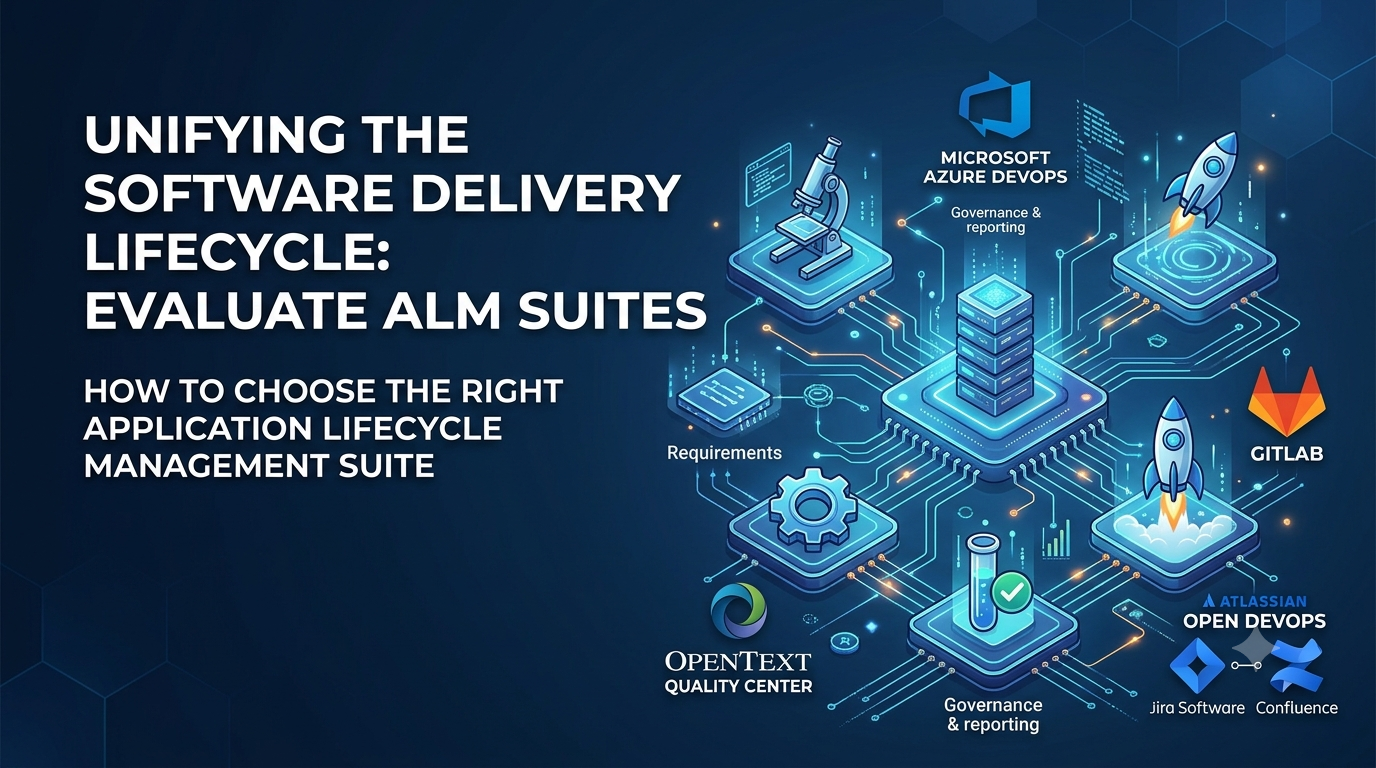
When software engineering is distributed across fragmented, disconnected point tools—requirements tracked in Word, agile backlogs managed in Jira, test cases documented in TestRail, source code hosted on GitHub, and releases executed via Jenkins—the “digital thread” of delivery breaks down. Engineering leaders lose visibility into delivery velocity, QA teams execute test runs against outdated requirements, and compliance officers spend weeks manually assembling audit evidence.
Application Lifecycle Management (ALM) suites provide a unified governance and execution environment spanning the entire software development lifecycle: requirements definition, agile project management, version control, quality assurance and test management, CI/CD build deployment, and governance reporting. Evaluating ALM platforms requires distinguishing between integrated developer-centric cloud ALM suites, regulated safety-critical enterprise ALM suites, and flexible best-of-breed toolchain integrations.
Five Core Capabilities That Define Modern ALM Suites
Combining several standalone tools into a single browser bookmark folder is not an ALM strategy; true ALM suites provide five foundational architectural controls:
- Unified Cross-Artifact Traceability: Maintaining a living digital thread that links high-level business requirements directly to user stories, Git branches, code commits, automated and manual test runs, bug reports, and production release tags within a single shared database.
- Integrated Test Case Management and Quality Gates: Native test planning, test case authoring, parameterized execution runs, and automated test result ingestion—preventing user stories from moving to “Released” without verified test coverage.
- End-to-End Governance, Baselines, and Audit Logging: Capturing immutable audit trails for every change across requirements, tests, and deployments—supporting point-in-time baseline comparisons and e-signature compliance (e.g., FDA 21 CFR Part 11).
- Unified Multi-Disciplinary Agile and Waterfall Support: Supporting hybrid project methodologies—allowing regulated systems teams to maintain structured V-model phase gates and formal verification while engineering squads execute two-week Scrum or Kanban sprints.
- Continuous Deployment and Release Orchestration: Linking software release packages directly to pipeline deployments, automated security scans, and change-management approval records.
Leading Application Lifecycle Management (ALM) Suites
Microsoft Azure DevOps (ADO)
Microsoft Azure DevOps (ADO) is one of the most widely deployed, comprehensive ALM platforms across the global software landscape. Uniting Azure Boards (agile planning, sprint backlogs, work item tracking), Azure Repos (Git repos), Azure Pipelines (cross-platform CI/CD), Azure Test Plans (manual and exploratory test management), and Azure Artifacts (package hosting), ADO delivers an end-to-end delivery environment. It supports hybrid cloud and on-premises deployments (Azure DevOps Server) with deep integration into Visual Studio, GitHub, and Microsoft Azure.
Enterprise IT departments, software product companies, and organizations invested in the Microsoft development ecosystem favor Azure DevOps for its broad functional coverage and reliable enterprise scalability.
Siemens Polarion ALM
Siemens Polarion ALM is an established enterprise benchmark for regulated software, embedded systems, and safety-critical product development (automotive ASPICE/ISO 26262, medical device IEC 62304, aerospace DO-178C). Powered by its LiveDoc technology, Polarion allows multidisciplinary engineering teams to manage requirements, test execution, defect resolution, and compliance documentation within a unified browser interface. Its live traceability graph tracks every artifact from top-down requirement to test verification run automatically.
Enterprises developing embedded systems, automotive controls, and medical technologies requiring strict regulatory compliance alongside agile development standardize heavily on Polarion ALM.
GitLab (The DevSecOps Platform)
While historically viewed as a Git repository and CI runner, GitLab has evolved into a comprehensive, single-application DevSecOps ALM platform. Combining planning (epics, roadmaps, issue boards), source code management, continuous integration, static and dynamic application security testing (SAST/DAST), container registry, and CD release management into a single unified data model, GitLab eliminates toolchain integration debt and administrative overhead.
Organizations seeking to replace sprawling multi-vendor toolchains with a single platform that unites developers, security engineers, and operations teams standardize on GitLab.
Atlassian Open DevOps (Jira Software, Confluence, Bitbucket, Compass)
Rather than forcing an all-in-one monolithic codebase, Atlassian delivers a modular, ecosystem-driven ALM experience. Centered around Jira Software, it ties requirements and documentation in Confluence, source code in Bitbucket (or GitHub/GitLab), test management via marketplace add-ons (such as Xray or Zephyr), and deployment pipelines through integrated CI/CD tools.
Organizations that want the flexibility to assemble best-of-breed testing, documentation, and source control tools around the industry’s most widely adopted agile tracking platform standardize on the Atlassian suite.
OpenText ALM / Quality Center (formerly Micro Focus)
OpenText ALM / Quality Center is a classic enterprise ALM and test-governance suite, deeply entrenched across large financial institutions, insurance corporations, and government agencies with extensive legacy application portfolios. Known for rigorous quality assurance management, complex multi-project test planning, and centralized defect governance, OpenText ALM caters to large enterprise IT environments maintaining large-scale regression test beds.
Large financial institutions and traditional enterprise IT departments with heavy legacy software landscapes and centralized QA offices rely on OpenText ALM.
Application Lifecycle Management Suites Comparison
| Suite | Architectural Model | Requirements & Testing Depth | DevSecOps & CI/CD Native Breadth | Governance & Compliance Focus | Best Fit |
| Azure DevOps | Comprehensive modular cloud/server ALM | High (Azure Boards + dedicated Azure Test Plans) | Very High (Azure Pipelines + deep GitHub/Azure integration) | Enterprise IT governance, audit logging & enterprise compliance | Organizations built on Microsoft ecosystems & enterprise IT squads |
| Siemens Polarion ALM | Regulated safety-critical browser ALM | Exceptional (LiveDoc requirements, FMEA risk & integrated tests) | Moderate–High (Integrates with Jenkins, Git, Jira & CI/CD tools) | Best-in-class compliance (ISO 26262, IEC 62304, DO-178C, ASPICE) | Embedded systems, automotive, medical device & industrial manufacturers |
| GitLab | Single-application unified DevSecOps platform | Moderate–High (Issue boards, epics & native test-result parsing) | Exceptional (Market-leading native CI/CD, SAST, DAST & release automation) | High (Unified data model, branch protection & compliance pipelines) | Modern engineering teams replacing fragmented multi-vendor toolchains |
| Atlassian Open DevOps | Modular best-of-breed ALM ecosystem | Very High (Jira + Confluence + Xray/Zephyr test plugins) | High (Bitbucket Pipelines or integrated GitHub/GitLab/Jenkins) | High (Atlassian Access, SOC 2, audit trails & marketplace add-ons) | Organizations prioritizing best-of-breed tools centered around Jira |
| OpenText ALM (Quality Center) | Legacy enterprise QA & test governance suite | Exceptional in formal Test Management; moderate in agile planning | Moderate (Integrates with modern CI tools via connectors) | Very High (Strict separation of duties, corporate IT audit trails) | Large banks, insurance carriers & enterprise IT running large legacy test suites |
Common ALM Implementation Pitfalls to Avoid
- Deploying a Monolithic ALM Suite Without Cleaning Up Fragmented Processes: Purchasing an enterprise ALM suite to resolve organizational silos without standardizing requirements structures, branching strategies, and testing gates simply automates existing chaos. Establish clear engineering handoff criteria before software deployment.
- Forcing Embedded Systems Engineers and Cloud Developers Into the Same Mold: Embedded hardware/firmware teams require strict V-model traceability and formal baselines, whereas cloud web engineers prioritize rapid continuous deployment. Choose an ALM platform (like Polarion or Azure DevOps) that flexibly supports both paradigms.
- Neglecting Test Automation Ingestion: An ALM platform that only accommodates manual test-case checklists forces developers to maintain offline automated testing scripts. Ensure your ALM suite ingests automated test results directly from CI/CD test runners via standardized APIs.
Selecting the Right ALM Suite
Align your ALM investment with your regulatory environment, technical infrastructure, and software architecture:
- For Scaled Enterprise Software Development on Microsoft Stack: Standardize on Microsoft Azure DevOps.
- For Safety-Critical Embedded Systems (Medical, Automotive, Aerospace): Choose Siemens Polarion ALM to guarantee live traceability and regulatory compliance.
- For Modern Cloud-Native Teams Eliminating Toolchain Overhead: Standardize on GitLab to unite planning, source code, security scanning, and deployment in one application.
- For Organizations Wanting Custom Best-of-Breed Tooling Centered on Jira: Deploy the Atlassian Open DevOps ecosystem.
- For Large Financial Institutions Managing Massive Legacy QA Environments: Utilize OpenText ALM / Quality Center.
