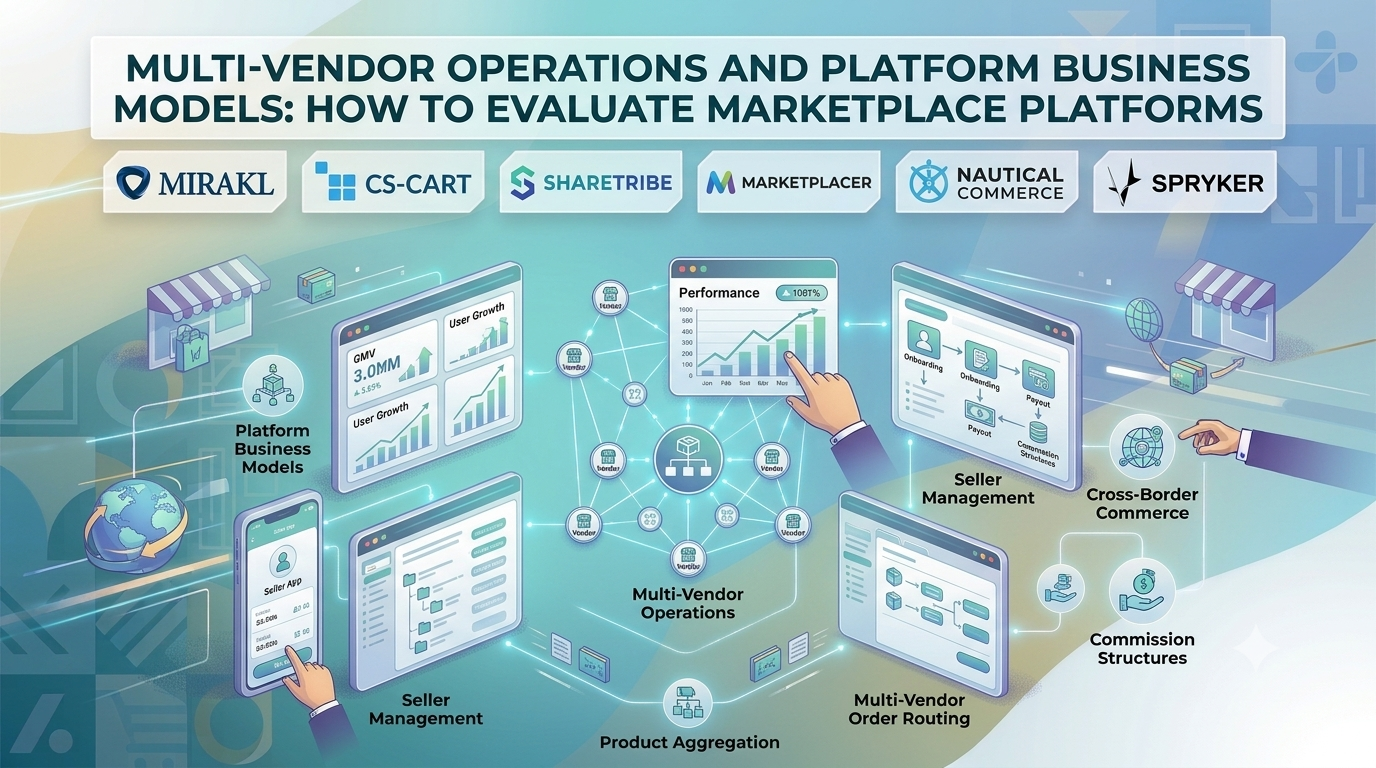
Transitioning from a traditional single-seller e-commerce retail model to a multi-vendor marketplace is one of the most effective ways to expand catalog depth, test new product categories without inventory risk, and capture high-margin platform commission revenue. However, operating a marketplace introduces complex operational dynamics that standard e-commerce carts cannot handle: onboarding thousands of third-party sellers, synchronizing decentralized vendor product catalogs, splitting checkout payments across multiple merchants, and automating vendor commission payouts while ensuring brand quality.
Marketplace platforms provide the technical infrastructure to operate a multi-vendor digital ecosystem—managing vendor portals, automated seller payouts, split shopping carts, seller performance scoring, and product listing approvals. Evaluating marketplace software requires distinguishing between enterprise marketplace transformation platforms, turnkey multi-vendor SaaS suites, and marketplace enablement extensions for existing e-commerce storefronts.
Five Core Capabilities That Separate Marketplace Platforms From Standard E-Commerce
A standard shopping cart processes an order from a single inventory source; marketplace platforms govern multi-party commerce networks across five essential pillars:
- Vendor Self-Service Portals and Catalog Ingestion: Providing third-party sellers with dedicated dashboards to manage product listings, bulk-upload inventory via CSV/API, configure shipping zones, and process fulfillment orders—with automated catalog approval guardrails for the marketplace operator.
- Split Orders, Multi-Vendor Carts, and Distributed Routing: Enabling a customer to add items from three distinct third-party sellers into a single shopping cart—automatically splitting the transaction into separate fulfillment orders and routing them to respective sellers.
- Escrow, Commission Splitting, and Automated Seller Payouts: Splitting transaction funds at checkout—withholding the marketplace operator’s commission fee, remitting local sales taxes, holding seller funds in escrow until delivery is verified, and disbursing net balances via automated banking rails (such as Stripe Connect).
- Seller Performance and SLA Governance: Tracking vendor fulfillment metrics (time-to-ship, tracking upload compliance, cancellation rates, customer disputes)—automatically penalizing, suspending, or de-prioritizing sellers who fail to maintain platform quality standards.
- Headless Integration and Marketplace Extension: Powering custom marketplace frontends via comprehensive APIs, or layering multi-vendor operational capabilities directly on top of established e-commerce engines (Adobe Commerce, Shopify, BigCommerce, Salesforce Commerce Cloud).
Leading Marketplace Platforms
Mirakl
Mirakl is the global enterprise standard for enterprise marketplace and dropship platforms, powering multi-vendor transformations for major global retailers, department stores, and B2B distributors (such as Best Buy, Macy’s, and Toyota Material Handling). Mirakl operates as an enterprise marketplace engine that integrates on top of existing e-commerce storefronts (Adobe Commerce, Salesforce Commerce Cloud, SAP Commerce) via APIs. It provides deep vendor onboarding, catalog curation, multi-currency seller payouts, and advanced dropship management at massive enterprise scale.
Global retail enterprises and large B2B distributors seeking to launch enterprise marketplaces with established seller networks and industrial-strength governance standardize on Mirakl. Implementation involves substantial enterprise consulting, dedicated operations teams, and enterprise platform licensing.
CS-Cart Multi-Vendor
CS-Cart Multi-Vendor is a comprehensive, standalone multi-vendor marketplace platform built to operate an independent marketplace out of the box. Offering both cloud subscriptions and full on-premises, self-hosted source-code access, CS-Cart includes advanced vendor administration panels, multi-tier commission structures, vendor-specific shipping methods, micro-stores for individual sellers, and an extensive add-on marketplace.
Entrepreneurs, regional marketplace operators, and mid-market organizations seeking a complete, feature-rich multi-vendor platform with direct access to source code and no mandatory revenue-sharing fees favor CS-Cart Multi-Vendor.
Sharetribe
Sharetribe is a leading marketplace platform engineered specifically for rental, service, and peer-to-peer (P2P) marketplaces (similar to Airbnb, TaskRabbit, or multi-vendor booking sites). Offering both a no-code visual marketplace builder for rapid prototyping and an open-source, developer-extensible headless software architecture (Sharetribe Developer Platform), it specializes in date-based bookings, location-based listings, calendar availability, and integrated multi-party escrow payments via Stripe Connect.
Founders, startups, and service platforms launching peer-to-peer rentals, freelance networks, or service-booking marketplaces rely heavily on Sharetribe. It is less suited for high-SKU physical retail with warehouse fulfillment.
Marketplace Enablement Extensions (Nautical Commerce, Marketplacer, Spryker)
For modern headless and mid-to-large retail platforms:
- Nautical Commerce delivers a modern, headless multi-vendor platform uniting marketplace infrastructure, seller portals, and fintech ledger operations for brands and B2B businesses.
- Marketplacer provides an agile, API-first SaaS marketplace platform that connects to existing frontends (Shopify, BigCommerce) to expand catalog breadth through verified third-party suppliers.
- Spryker provides an enterprise composable commerce engine particularly strong in complex B2B marketplace procurement, multi-currency enterprise procurement, and IoT-driven commerce.
Shopify Multi-Vendor Marketplace Add-ons (Webkul)
For brands running on Shopify that want to introduce multi-vendor capabilities without enterprise replatforming, apps like Webkul Multi-Vendor Marketplace convert standard Shopify stores into basic multi-vendor hubs—allowing third-party sellers to upload products and fulfill orders through a shared Shopify storefront.
Marketplace Platforms Comparison
| Platform | Architectural Role | B2B, B2C, or Service Focus | Integration & Deployment Model | Seller Governance & Payouts | Best Fit |
| Mirakl | Enterprise marketplace SaaS suite | B2C retail & B2B industrial distribution | API-first layer on top of enterprise ERP/e-commerce (SAP, SFCC) | Comprehensive (Automated seller vetting, SLA compliance & payouts) | Global retailers, department stores & enterprise B2B distributors |
| CS-Cart Multi-Vendor | Standalone multi-vendor e-commerce suite | Physical product retail & digital marketplaces | Standalone platform (Cloud SaaS or on-premises source code) | High (Granular vendor plans, commissions & separate payout engines) | Mid-market businesses & entrepreneurs building dedicated product marketplaces |
| Sharetribe | Peer-to-peer (P2P) & rental marketplace engine | Services, rentals, bookings & peer-to-peer | No-code builder + headless developer framework | High (Stripe Connect escrow, calendar availability & review systems) | Service-booking networks, peer-to-peer rentals & freelance platforms |
| Marketplacer | Modular cloud marketplace platform | Omnichannel retail & dropship networks | Connects natively to Shopify, BigCommerce & headless frontends | High (Curated supplier catalogs, automated order routing & tracking) | Retail brands expanding existing e-commerce stores into marketplaces |
| Nautical Commerce | Headless multi-vendor commerce platform | B2B commerce, hybrid retail & marketplaces | API-first headless architecture + multi-tenant ledgers | Very High (Integrated financial payout ledger & multi-vendor shipping) | Tech-forward brands & B2B businesses needing custom marketplace logic |
Common Marketplace Implementation Pitfalls to Avoid
- Underestimating the “Chicken-and-Egg” Marketplace Cold-Start Problem: Technology is only half the battle; launching a marketplace platform with zero active sellers attracts no buyers, while having no buyers discourages quality sellers from onboarding. Secure anchor vendors with committed product catalogs before public platform launch.
- Failing to Automate Multi-Vendor Sales Tax Compliance: In the United States and Europe, “Marketplace Facilitator” legislation legally requires the marketplace operator—not the third-party seller—to calculate, collect, and remit sales tax on all marketplace transactions in jurisdictions where economic nexus is met. Integrate automated marketplace tax software from day one.
- Neglecting Supplier Catalog Data Hygiene: Permitting thousands of vendors to upload unstructured product data creates messy search experiences: duplicate product listings, conflicting titles, and missing attributes. Enforce strict category taxonomy and catalog approval validation gates.
Selecting the Right Marketplace Platform
Match your marketplace software to your transactional model, existing technology stack, and business scale:
- For Tier-1 Enterprise Retailers and Large B2B Distributors: Standardize on Mirakl to deploy an enterprise-grade marketplace on top of existing e-commerce systems.
- For Dedicated, Standalone Multi-Vendor Product Marketplaces: Choose CS-Cart Multi-Vendor for a complete out-of-the-box platform with full codebase ownership options.
- For Peer-to-Peer Rentals, Bookings, and Service Marketplaces: Standardize on Sharetribe for calendar-based availability and built-in escrow payment flows.
- For Growing E-Commerce Brands Expanding Storefronts With Third-Party Vendors: Integrate Marketplacer or Nautical Commerce to add marketplace capabilities to existing Shopify or BigCommerce stores.
