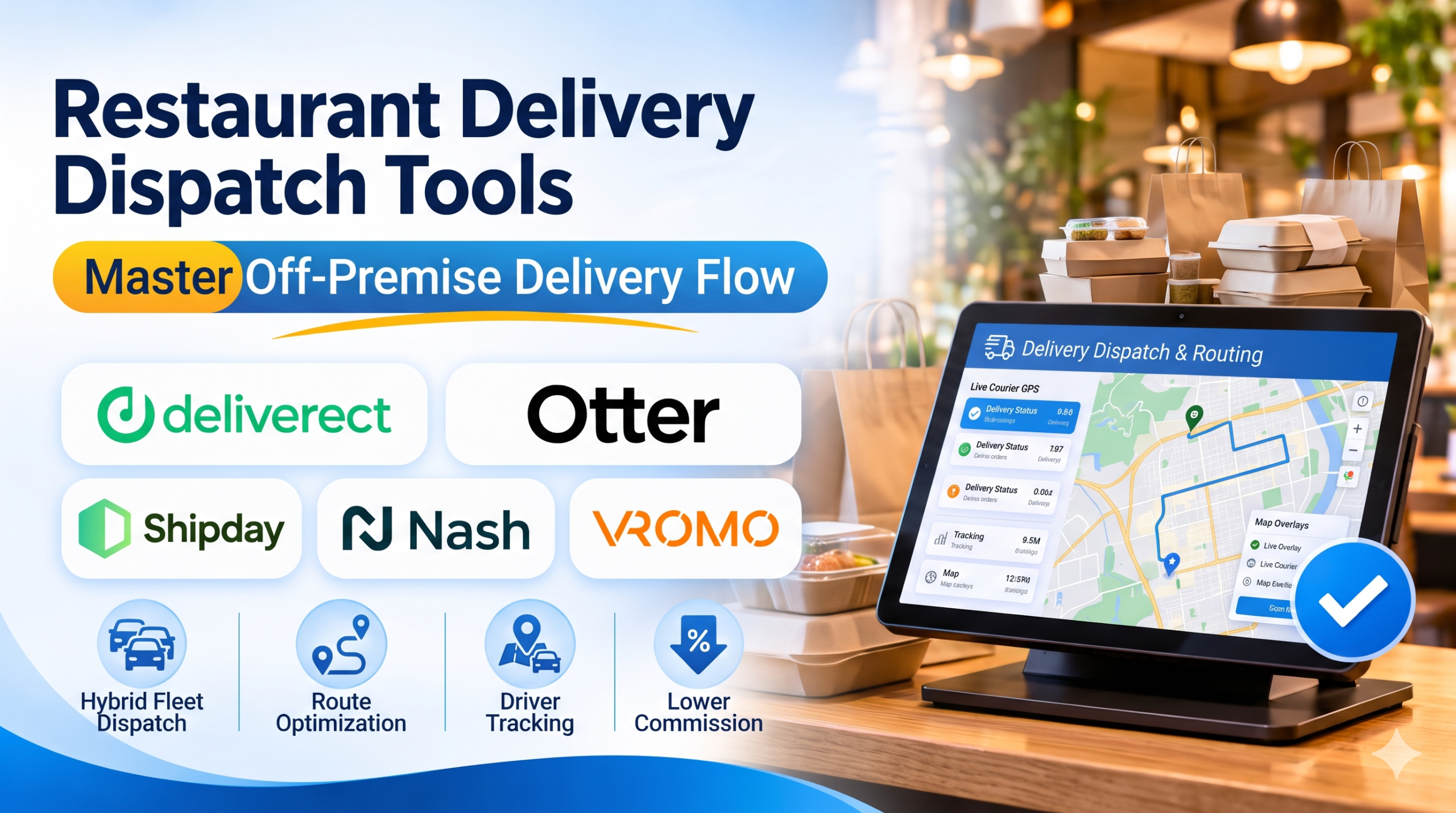
Off-premise dining has permanently transformed restaurant unit economics. Yet relying exclusively on third-party marketplace delivery apps (DoorDash, Uber Eats, Grubhub) can cost operators 15% to 30% in commission fees on every order, while stripping the restaurant of direct customer contact data. Conversely, operating an in-house delivery fleet without automated dispatch technology leads to cold food, delayed deliveries, and inefficient driver routes.
Restaurant delivery dispatch tools bridge this gap—aggregating digital orders across in-house online ordering and third-party channels, optimizing delivery routes, automating dispatch to internal drivers, or dynamically routing overflow orders to on-demand white-label delivery networks (such as DoorDash Drive or Uber Direct). Evaluating delivery dispatch software requires distinguishing between hybrid self-delivery and on-demand delivery dispatchers, third-party delivery order aggregators, and fleet route optimization engines.
Five Core Capabilities That Define Modern Restaurant Delivery Dispatch Platforms
Manually assigning tickets to delivery drivers on a clipboard is inefficient; modern dispatch systems automate logistics across five core capabilities:
- Hybrid Fleet Dispatching (Self-Delivery + On-Demand Overflow): Allowing operators to utilize low-cost in-house drivers for dense, local delivery runs during normal shifts, while automatically offloading overflow tickets or long-distance orders to third-party white-label couriers (DoorDash Drive, Uber Direct) during peak rushes.
- Dynamic Order Batching and Route Optimization: Clustering multiple delivery orders heading in the same geographic direction onto a single driver’s run—calculating travel times, food preparation readiness, and hot-holding windows so food arrives at proper serving temperatures.
- Kitchen Prep and Driver Arrival Synchronization: Pacing kitchen firing tickets based on real-time driver GPS tracking—firing the ticket to the Kitchen Display System (KDS) only when the courier is within an optimal travel radius to prevent packaged food from sitting under heat lamps.
- Driver Mobile App and Turn-by-Turn Telemetry: Providing dedicated mobile apps (iOS and Android) for in-house drivers with optimized turn-by-turn navigation, order verification, curbside delivery notes, gate codes, and digital contactless proof-of-delivery (photo and signature).
- Real-Time Customer Tracking and SMS Notifications: Delivering branded, live map tracking links via automated SMS to diners (“Your driver is 3 minutes away”)—reducing “Where Is My Order?” (WISMO) phone calls to host stands during dinner rush.
Leading Restaurant Delivery Dispatch Tools
Deliverect
Deliverect is an industry standard in omnichannel delivery order management and kitchen dispatch aggregation. Connecting third-party delivery channels (DoorDash, Uber Eats, Deliveroo), direct digital storefronts, and virtual ghost kitchens directly into the restaurant’s core POS and Kitchen Display System (KDS), Deliverect eliminates the counter clutter of managing multiple tablets. Its dispatch module (Deliverect Dispatch) allows operators to route orders automatically to in-house drivers or third-party on-demand delivery fleets based on cost and availability.
Multi-unit operators, fast-casual chains, and virtual brand ghost kitchens processing high delivery volumes across multiple ordering channels standardize on Deliverect.
Otter
Otter (by CloudKitchens) provides an integrated order aggregation, delivery dispatch, and kitchen management platform. Otter consolidates online orders from all delivery services into a single auto-accepting tablet, updates menus across channels simultaneously, and provides a centralized dispatch management hub. Its Order Protection feature automatically tracks down missing delivery orders, disputes unfair third-party marketplace cancellations, and recovers lost delivery revenue.
Restaurants and ghost kitchens seeking an all-in-one aggregation hub with automated order-dispute resolution and simplified tablet management favor Otter.
Shipday
Shipday is a dedicated, cost-effective delivery dispatch and route management platform engineered specifically for local restaurants, meal prep services, and small retail delivery fleets. Offering seamless plug-and-play integrations with Shopify, WooCommerce, Toast, Square, and Clover, Shipday automates route planning, driver tracking, and customer SMS updates. Crucially, Shipday includes native 1-click fallback to on-demand third-party delivery networks (DoorDash Drive, Uber Direct) when internal drivers are unavailable.
Independent restaurants and mid-market food brands launching in-house delivery programs to reclaim customer relationships without heavy upfront software investment rely on Shipday.
Nash
Nash operates as an API-first delivery orchestration platform that connects businesses to a vast network of on-demand third-party delivery fleets. Instead of managing in-house drivers, restaurants use Nash to automatically select the optimal delivery partner (Uber Direct, DoorDash Drive, local courier networks) for every single order based on speed, cost, and reliability score, while providing a white-labeled customer tracking experience.
Digital-first restaurant brands, enterprise catering groups, and fast-casual concepts that want to offer direct online ordering without employing full-time delivery drivers deploy Nash.
VROMO
VROMO is a specialized restaurant delivery management software platform tailored for high-volume enterprise delivery operations and restaurant chains. Offering deep driver dispatch automation, customized driver apps, live map tracking, and automated routing to third-party delivery service providers during demand spikes, VROMO helps enterprise restaurant groups optimize their off-premise delivery fleet economics.
Restaurant Delivery Dispatch Tools Comparison
| Platform | Architectural Role | Driver Fleet Model | Third-Party Courier Overflow | POS & Delivery Aggregation | Best Fit |
| Deliverect | Enterprise delivery aggregator & dispatch engine | Hybrid (In-house fleet + third-party networks) | Very High (Seamless routing to on-demand courier networks) | Exceptional (Integrates with all major POS & delivery channels) | Multi-unit brands, ghost kitchens & fast-casual chains |
| Otter | All-in-one delivery tablet aggregator & ops hub | Hybrid (Consolidates orders & dispatches fleets) | High (Native partnerships with major delivery services) | Very High (Consolidates all delivery tablets into one) | Ghost kitchens, virtual brands & multi-channel restaurants |
| Shipday | Dedicated restaurant dispatch & driver routing app | Hybrid (Optimized for internal drivers + on-demand backup) | Very High (Instant 1-click DoorDash/Uber on-demand backup) | High (Native plugins for Toast, Square, Shopify, WooCommerce) | Independent restaurants & local chains operating direct delivery |
| Nash | API-first third-party delivery orchestration engine | 100% On-Demand Network (No internal driver management) | Exceptional (Aggregates dozens of national & local courier fleets) | High (Open APIs, connects to major digital ordering systems) | Digital-first restaurants wanting on-demand delivery without drivers |
| VROMO | Enterprise delivery fleet management platform | Hybrid (Advanced internal driver optimization + overflow) | Very High (Automated multi-fleet overflow logic) | High (Integrates with enterprise POS and online ordering) | Large restaurant chains & high-volume delivery operations |
Common Delivery Dispatch Pitfalls to Avoid
- Deploying In-House Delivery Without On-Demand Courier Fallbacks: Relying exclusively on two in-house drivers means that on a rainy evening with 25 simultaneous delivery orders, delivery times stretch past 90 minutes. Always configure an automated third-party courier overflow rule (DoorDash Drive, Uber Direct) to absorb demand surges.
- Ignoring Direct-to-Consumer First-Party Ordering Incentives: Launching a direct delivery platform without offering diners an incentive to order directly (e.g., lower menu prices, exclusive loyalty points, or free delivery) leaves customers ordering through third-party apps that charge 20% to 30% commissions.
- Failing to Automate Driver-to-Kitchen Handshake Timing: Dispatching a delivery driver to the restaurant the moment an order is placed online ensures the driver will spend 15 minutes waiting in the lobby during the dinner rush, inflating delivery costs. Pacing dispatch to kitchen prep time optimizes driver turnaround.
Selecting the Right Restaurant Delivery Dispatch Tool
Align your delivery dispatch software with your fleet model and order volume:
- For Multi-Channel Restaurants Drowning in Delivery Tablets: Standardize on Deliverect or Otter to aggregate orders directly into your POS and manage multi-platform dispatch.
- For Independent Restaurants Running an In-House Driver Fleet: Deploy Shipday for route optimization, driver tracking, and on-demand courier backups.
- For Brands Wanting Direct Ordering Without Employing Drivers: Choose Nash to automate white-label delivery dispatch across Uber Direct and DoorDash Drive.
- For Enterprise Restaurant Chains With Dedicated Fleet Logistics: Standardize on VROMO.
