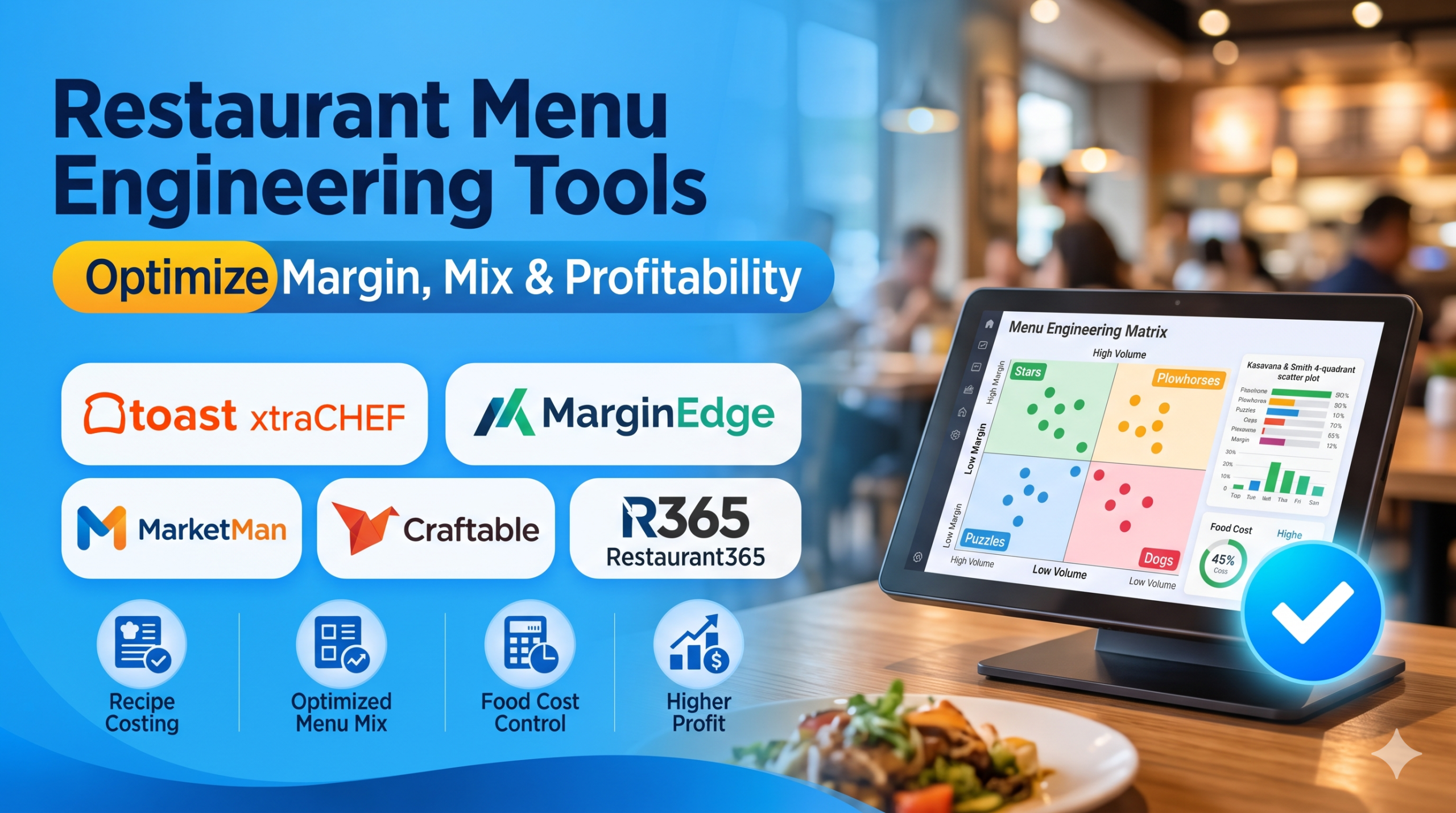
A restaurant menu is not merely a price list; it is an establishment’s primary merchandising tool. Yet most restaurateurs still design menus based on gut feeling, printing identical layouts year after year while raw wholesale ingredient costs fluctuate. High-cost, low-margin items are displayed prominently in the center of the menu, while high-profit specialties remain buried in low-visibility corners—quietly eroding prime costs and restaurant profitability.
Restaurant menu engineering tools combine transactional Point of Sale (POS) sales mix data with ingredient-level recipe costing. They classify dishes across the classic Boston Consulting Group (BCG) / Kasavana & Smith Menu Engineering Matrix (Stars, Plowhorses, Puzzles, and Dogs), calculate real contribution margins, and simulate pricing adjustments. Evaluating menu engineering software requires distinguishing between dedicated food-costing and recipe-management platforms, POS-embedded sales mix analytics, and digital menu board merchandising tools.
Five Core Capabilities That Separate Menu Engineering From Simple Spreadsheets
Calculating food cost percentages in an Excel sheet is static; dedicated menu engineering tools deliver continuous operational intelligence across five areas:
- Kasavana & Smith Matrix Categorization: Automatically mapping every menu item on a four-quadrant scatter plot based on Popularity (sales volume) versus Profitability (contribution margin):
- Stars: High popularity, high margin (maintain quality and promote).
- Plowhorses: High popularity, low margin (re-cost recipes or increase price).
- Puzzles: Low popularity, high margin (reposition, rename, or re-merchandise).
- Dogs: Low popularity, low margin (re-engineer or eliminate from the menu).
- Automated Plate Costing and Ingredient Price Indexing: Linking recipes directly to incoming supplier invoices—automatically recalculating the exact plate cost of an item the moment wholesale cheese, poultry, or produce prices shift.
- Contribution Margin vs. Food Cost Percentage Optimization: Shifting management focus from traditional food cost percentages (which can be misleading) to gross contribution margin dollars—recognizing that an item with a 40% food cost that generates $24 in cash margin is more valuable than an item with a 15% food cost that yields only $4 in cash margin.
- Visual Menu Layout and Eye-Tracking Psychology Modeling: Providing heatmaps and structural recommendations based on menu psychology—guiding placement in prime focal zones (e.g., the top-right corner of a two-panel menu), anchor pricing, decoy placement, and font styling to guide diner selection.
- Simulated “What-If” Menu Modeling: Forecasting the total gross margin and sales-mix impact of proposed adjustments (e.g., “What happens to quarterly gross profit if we raise the burger price by $1.50 and adjust the portion size of the steak garnish?”).
Leading Menu Engineering and Recipe Costing Tools
Toast xtraCHEF
Toast xtraCHEF is a premier automated food-cost intelligence and recipe-management platform built natively into the Toast restaurant ecosystem. Using optical character recognition (OCR), xtraCHEF extracts line-item ingredient prices from scanned or snapped vendor invoices, updating inventory cost tables automatically. It calculates precise, real-time recipe plate costs, tracks ingredient price volatility across distributors, and feeds sales-mix data directly into menu profitability analytics.
Restaurants operating on the Toast platform seeking an automated, hands-off bridge between vendor invoices, recipe costing, and menu engineering rely heavily on xtraCHEF.
MarginEdge
MarginEdge is a widely adopted restaurant back-office and food-cost management platform designed to eliminate manual data entry. Operators photograph or upload vendor invoices, and MarginEdge digitizes them within 24 hours, automatically updating inventory pricing, mapping GL codes to accounting software (QuickBooks, Sage Intacct), and recalculating recipe plate costs. Its menu analysis module pairs digitized costs with POS sales-mix data to provide a dynamic Kasavana & Smith menu matrix.
Independent restaurants, multi-unit operators, and hospitality groups looking for a comprehensive back-office platform that unifies invoice bill-pay, commissary accounting, and menu engineering favor MarginEdge.
MarketMan
MarketMan provides an international cloud-based inventory and recipe management platform tailored for quick-service restaurants, full-service dining, and franchises. Offering robust recipe costing, waste tracking, automated supplier ordering, and allergen management, MarketMan integrates with a wide array of POS platforms (Square, Clover, Toast, Lightspeed). Its menu engineering reporting highlights unprofitable items, tracks cost-of-goods-sold (COGS) variance, and alerts managers when ingredient price spikes threaten dish profitability.
Multi-unit franchises and growing restaurant brands seeking a flexible, POS-agnostic recipe costing and menu engineering suite favor MarketMan.
Craftable (formerly Beverage Analytics / BevSpot)
Craftable is an enterprise-grade profit management platform with distinctive, market-leading strength in high-margin beverage programs, bars, and hospitality dining. Combining detailed plate and pour costing, real-time POS depletion, and automated vendor purchasing, Craftable excels at modeling drink profitability, batch cocktail costing, and kitchen recipe engineering for hospitality groups and hotel food-and-beverage programs.
Hospitality groups, cocktail lounges, and full-service dining venues where beverage sales represent a significant portion of total revenue rely heavily on Craftable.
Restaurant365 (R365)
Restaurant365 is the enterprise standard in all-in-one restaurant accounting, inventory, scheduling, and food-cost operations. For menu engineering, R365 connects sales data from the POS directly with general-ledger accounts, enterprise supplier contracts, and recipe costs, delivering high-level financial reporting and menu contribution analytics across dozens of locations.
Restaurant Menu Engineering Tools Comparison
| Platform | Primary Focus | Invoice Ingestion Method | Recipe & Plate Costing Depth | POS Integration Ecosystem | Best Fit |
| Toast xtraCHEF | Integrated food costing for Toast POS | Automated mobile/scanner OCR invoice parsing | Very High (Dynamic plate costing & price-trend alerts) | Native to Toast ecosystem only | Restaurants and groups operating exclusively on Toast |
| MarginEdge | Restaurant back-office, bill-pay & menu analysis | Guaranteed 24-hr human-verified OCR invoice parsing | Exceptional (Detailed recipe modeling & Kasavana matrix) | Universal (Integrates with Toast, Square, Clover, Aloha, etc.) | Operators wanting hands-off invoice processing + menu analysis |
| MarketMan | POS-agnostic inventory & recipe management | Automated invoice scanning & manual entry options | High (Portion costing, waste logging & allergen mapping) | Universal (Square, Toast, Clover, Lightspeed & open APIs) | Multi-unit franchises & growing international restaurant brands |
| Craftable | Beverage-heavy profit & food/pour management | Mobile invoice photo upload & digital EDI imports | Exceptional (Market leader in pour/drink & food costing) | Major POS systems (MICROS, Aloha, Toast, Square) | Bars, nightlife venues, hotels & beverage-driven concepts |
| Restaurant365 | Enterprise restaurant accounting & operational ERP | Enterprise EDI feeds & centralized invoice processing | Very High (Fully integrated with corporate P&L and balance sheets) | Universal enterprise POS connectors | Enterprise multi-unit restaurant groups & corporate franchises |
Common Menu Engineering Pitfalls to Avoid
- Costing Recipes Only Once When the Menu Launches: Ingredient costs are volatile. Costing a recipe once in March and failing to re-evaluate it when wholesale beef prices jump 22% in July turns profitable “Stars” into margin-draining “Plowhorses.” Automate invoice syncing to keep plate costs current.
- Focusing on Food Cost Percentage Instead of Dollar Margin: Eliminating an upscale seafood dish with a 38% food cost that nets $28 in cash margin, in favor of a pasta dish with a 16% food cost that nets $8 in cash margin, damages overall cash flow. Always optimize for contribution margin dollars.
- Keeping “Dogs” on the Menu Out of Habit: Retaining low-popularity, low-margin dishes because a single regular orders them creates kitchen complexity, inventory prep waste, and slower line speeds. Trim underperforming items systematically to keep kitchen execution efficient.
Selecting the Right Menu Engineering Tool
Match your menu engineering software to your operational model, POS ecosystem, and beverage volume:
- For Operators Standardized on the Toast Ecosystem: Deploy Toast xtraCHEF for unified invoice capture and recipe costing.
- For Restaurants Seeking Hands-Off Invoice Digitization and Multi-POS Flexibility: Standardize on MarginEdge.
- For Multi-Unit Franchises Prioritizing Universal POS Compatibility: Choose MarketMan.
- For Bars, Breweries, and Beverage-Driven Full-Service Concepts: Deploy Craftable to optimize pour costs alongside kitchen dishes.
- For Large Enterprise Multi-Unit Groups Requiring Full Financial ERP Integration: Implement Restaurant365.
