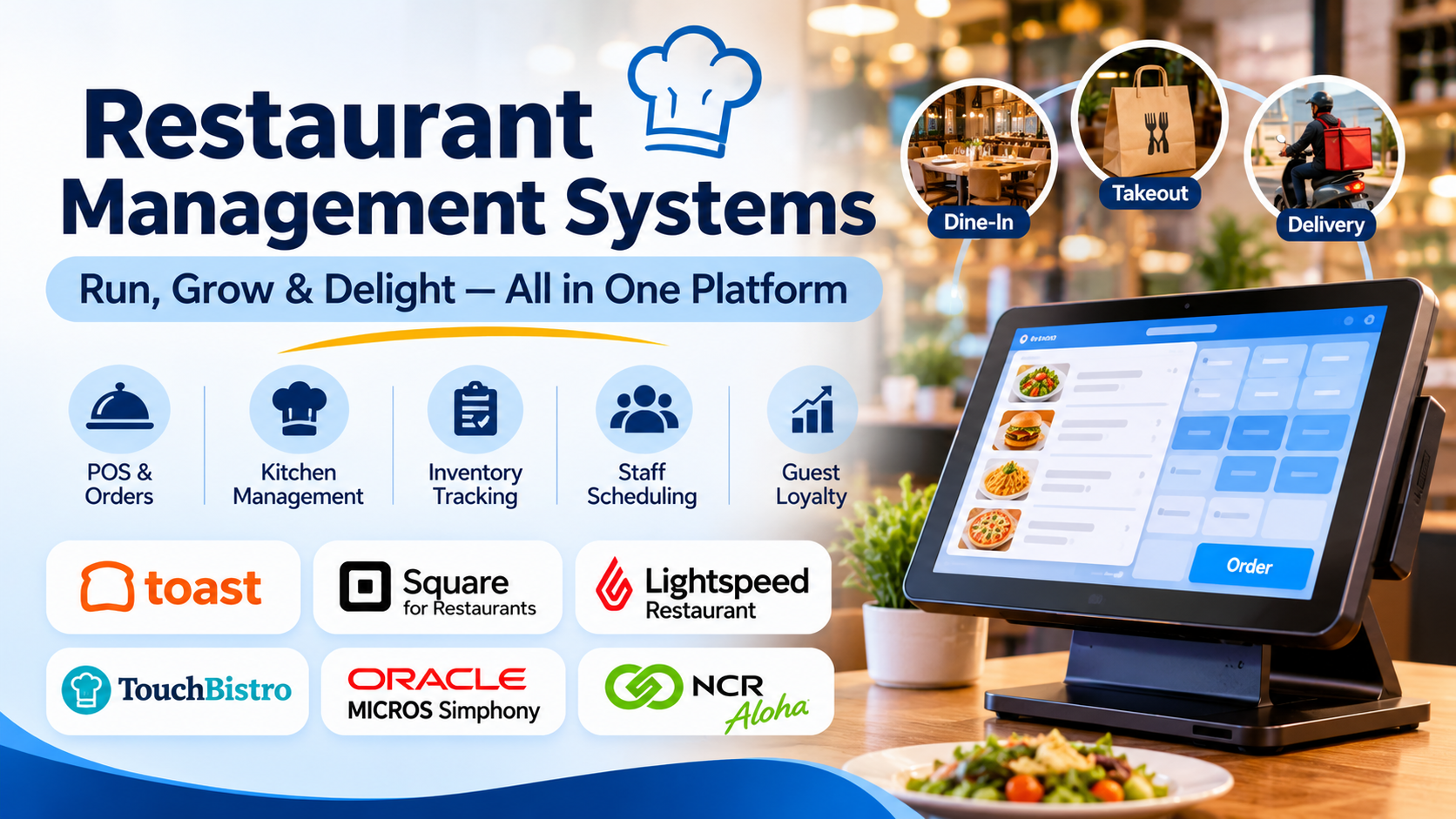
The modern restaurant is no longer a self-contained dining room operating on paper tickets and an isolated cash register. Today’s operators balance dine-in tables, mobile order-and-pay, third-party delivery tablets (DoorDash, Uber Eats), off-premise catering, kitchen routing, recipe-level inventory management, and labor scheduling across shifting shifts. When these functions run on disconnected point software, kitchen staff face ticket chaos, food waste eats into margins, and 86’d items remain orderable online.
A Restaurant Management System (RMS) provides an end-to-end operational operating system—uniting the front-of-house Point of Sale (POS), Kitchen Display System (KDS), table management, menu syndication, inventory costing, and payroll. Evaluating an RMS requires distinguishing between cloud-first modern POS/RMS platforms, specialized fast-casual and quick-service systems, and enterprise multi-unit hospitality management suites.
Five Core Capabilities That Separate Modern RMS From Legacy Cash Registers
Basic touch-screen POS hardware records transactions; production-grade restaurant management systems synchronize operations across five foundational areas:
- Integrated Multi-Channel Menu Management: Updating menu items, modifiers, pricing, and 86’d status once in a central dashboard—instantly synchronizing changes across physical POS terminals, server handhelds, QR-code table ordering, online storefronts, and third-party delivery apps.
- Offline Transaction Processing and Hardware Resilience: Continuing to process credit cards, print kitchen tickets, and send orders to Kitchen Display Systems (KDS) during internet outages—automatically reconciling transactions once local network connectivity restores.
- Recipe-Level Inventory Tracking and Theoretical vs. Actual Food Costing: Tracking raw ingredient depletion in real time as menu items sell (e.g., deducting 6 oz of beef and one brioche bun per burger sold)—comparing theoretical usage against physical inventory counts to identify kitchen waste, over-portioning, and shrinkage.
- Labor Scheduling, Tip Pooling, and Compliance: Building shift rosters against forecasted dining demand, tracking hourly employee clock-ins, automating tip pooling/distribution compliance across front- and back-of-house staff, and exporting clean payroll files.
- Guest CRM, Loyalty, and Marketing Integration: Consolidating guest dining history, spend frequency, dietary preferences, and contact details into actionable guest profiles that drive targeted automated email and SMS marketing campaigns.
Leading Restaurant Management Systems
Toast
Toast is the dominant cloud-native restaurant management platform in the North American hospitality industry, built specifically for the food and beverage sector on an Android hardware foundation. Toast unifies front-of-house POS terminals, handheld server tablets (Toast Go), Kitchen Display Systems, digital ordering, third-party delivery integration, recipe inventory management (Toast xtraCHEF), payroll, and team management into a single vertical ecosystem.
Independent restaurants, fast-casual operations, and expanding multi-location restaurant groups seeking an all-in-one ecosystem with hardware engineered specifically for food service standardize heavily on Toast. Its primary trade-offs include required long-term payment processing commitments and fees for add-on software modules.
Square for Restaurants
Square for Restaurants brings Square’s accessible, transparent payment model into food service. Offering clean table layouts, course management, conversational modifier ordering, kitchen display routing, and native online ordering, Square for Restaurants allows operators to launch operations quickly on standard iPad hardware or dedicated Square Register consoles with no long-term software contracts.
Bars, cafes, small full-service restaurants, and pop-up concepts seeking rapid deployment, transparent flat-rate payment processing, and low software overhead favor Square for Restaurants. Very large multi-unit operations with complex kitchen routing often require deeper enterprise inventory tools.
Lightspeed Restaurant
Lightspeed Restaurant delivers a sophisticated cloud management platform engineered for full-service dining, fine dining, hospitality groups, and boutique hotel food operations. Known for its flexible floor plan design, complex coursing, multi-menu scheduling, integrated inventory management, and raw data reporting, Lightspeed handles high-touch dining operations cleanly.
Full-service operators, hospitality groups, and international concepts requiring deep table management, sophisticated course pacing, and multi-currency/multi-region compliance rely on Lightspeed Restaurant.
TouchBistro
TouchBistro is an iPad-based restaurant management system built around a hybrid cloud architecture—running core operations locally on an in-restaurant network while backing up operational data to the cloud. This architecture ensures that order routing, kitchen printing, and table management function with zero latency and zero dependency on external internet uptime. TouchBistro includes dedicated modules for reservations, online ordering, inventory, and staff management.
Full-service and quick-service operators located in areas with unreliable internet infrastructure, or those who prefer iPad-native hardware ergonomics, favor TouchBistro.
Oracle MICROS Simphony and NCR Aloha (Enterprise Tier-1 Giants)
For global hotel chains, airport concession networks, sports stadiums, and enterprise multi-unit restaurant brands:
- Oracle MICROS Simphony is the enterprise hospitality benchmark, handling thousands of concurrent terminals, complex international fiscal compliance, centralized multi-property menu hierarchies, and deep enterprise supply chain integrations.
- NCR Aloha remains deeply entrenched across major enterprise casual-dining and fast-food restaurant chains, delivering high-reliability hardware and extensive enterprise customization.
Restaurant Management Systems Comparison
| Platform | Primary Market Role | Hardware & OS Ecosystem | Offline Resilience Model | Inventory & Back-Office Depth | Best Fit |
| Toast | All-in-one cloud restaurant ecosystem | Proprietary rugged Android hardware (Toast Go) | High (Offline card processing & local network printing) | Very High (Recipe costing & invoice parsing via xtraCHEF) | Independent full-service, fast-casual & multi-unit brands |
| Square for Restaurants | Accessible, fast-deploy restaurant POS | iOS (iPads) & proprietary Square hardware | Moderate (Standard offline card processing) | Moderate (Standard item-level inventory; basic recipes) | Small cafes, bars, quick-service & emerging full-service |
| Lightspeed Restaurant | Full-service & fine-dining hospitality suite | iOS (iPads) & commercial desktop terminals | High (Local network fallback modes) | High (Built-in inventory, ingredient tracking & production) | High-end full-service dining, bars & boutique hotel F&B |
| TouchBistro | Hybrid-cloud iPad restaurant platform | iOS (iPad-native hardware suites) | Very High (Local server network keeps tables & KDS running) | High (Ingredient-level tracking, menu engineering & costing) | Restaurants wanting local-network speed with cloud analytics |
| Oracle MICROS Simphony | Global enterprise hospitality & stadium suite | Enterprise industrial hardware & commercial tablets | Very High (Enterprise multi-server failover architecture) | Exceptional (Global supply chain, multi-property enterprise ERP) | Enterprise restaurant chains, hotels, casinos & stadiums |
| NCR Aloha | Enterprise multi-unit restaurant standard | Industrial POS hardware & cloud-connected terminals | Very High (Proven on-premises failover resilience) | Very High (Enterprise back-office, labor & inventory modules) | National restaurant franchises & high-volume corporate chains |
Common RMS Implementation Pitfalls to Avoid
- Signing Long-Term Contracts With Bundled Payment Processing Without Auditing Effective Rates: Many modern RMS vendors offer hardware or software discounts while locking the restaurant into non-negotiable proprietary payment processing with higher processing spreads. Calculate the total annual cost of software, hardware leases, and effective payment processing fees combined.
- Neglecting to Standardize Menu Modifiers Before Launch: Setting up inconsistent menu modifiers (e.g., configuring “dressing on the side” as three different text options across salads, burgers, and appetizers) creates kitchen confusion, clutters KDS screens, and prevents accurate ingredient depletion.
- Underestimating Kitchen Display System (KDS) Placement and Network Cable Runs: Relying on consumer-grade Wi-Fi to transmit kitchen tickets in a busy restaurant full of stainless steel appliances, heat lamps, and water vapor causes dropped orders. Always install commercial-grade Ethernet cables to kitchen screens and terminal stations.
Selecting the Right Restaurant Management System
Match your RMS investment to your service model, unit count, and operational complexity:
- For Fast-Casual and Multi-Unit Full-Service Restaurants in North America: Standardize on Toast for seamless handheld ordering, integrated KDS, and automated recipe costing.
- For High-End Full-Service and Fine-Dining Concepts: Choose Lightspeed Restaurant for deep table layout customization, complex coursing, and polished guest management.
- For Small Food Concepts, Bars, and Cafes Seeking Simplicity: Deploy Square for Restaurants on iPad hardware with zero long-term contract lock-in.
- For Operators With Unreliable Internet Infrastructure: Use TouchBistro for its hybrid local-network reliability.
- For Global Enterprise Franchises, Stadiums, and Hotel Groups: Standardize on Oracle MICROS Simphony or NCR Aloha.
