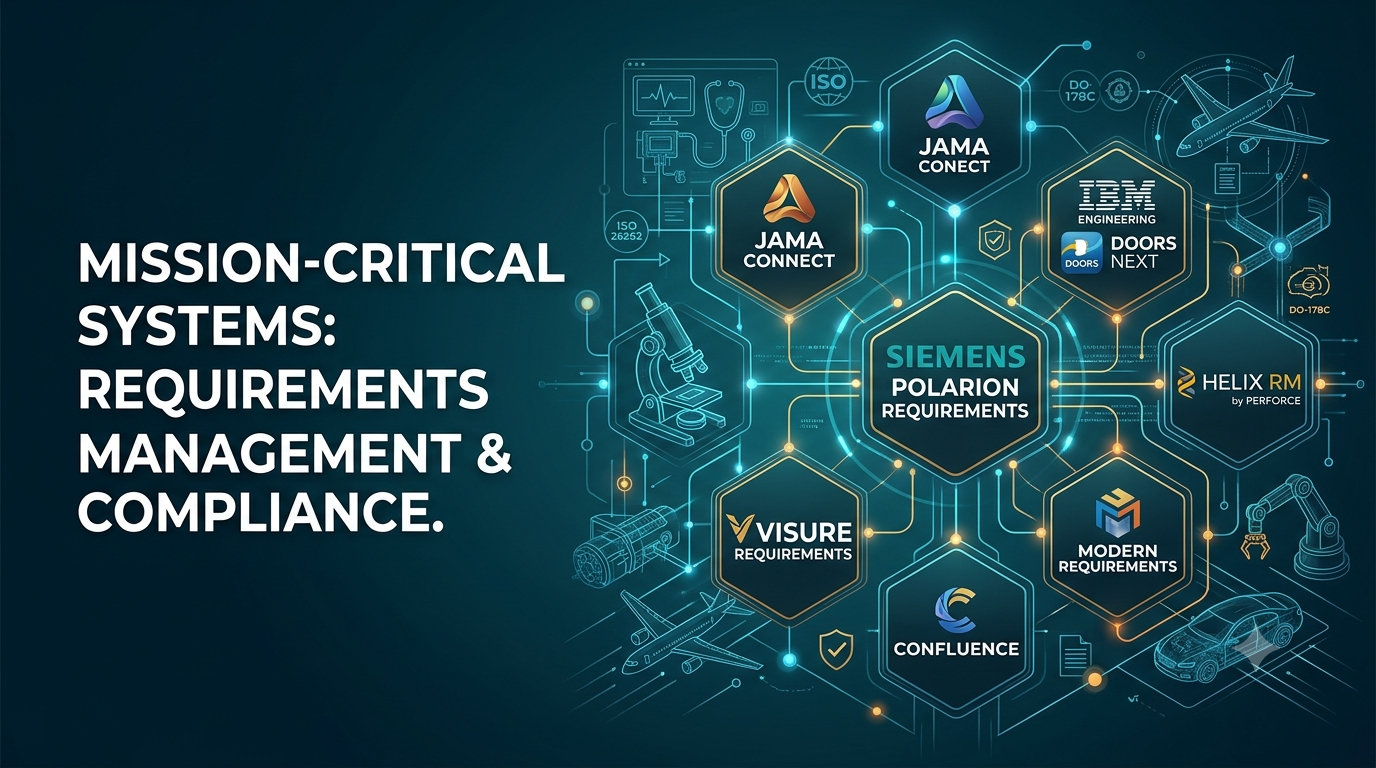
In consumer web applications, an ambiguous user story results in a minor UI bug that can be hotfixed in twenty minutes. In regulated and safety-critical engineering—medical devices, aerospace systems, automotive electrification (ISO 26262), defense, and industrial robotics—an ambiguous requirement or broken specification link can cause catastrophic physical failure, multi-million-dollar product recalls, and failed regulatory audits.
Requirements management tools establish an auditable, end-to-end digital thread that connects top-down user needs, system requirements, hardware and software specifications, risk analyses (FMEA/ISO 14971), test cases, and regulatory verification evidence. Evaluating requirements management platforms requires distinguishing between enterprise safety-critical systems engineering suites, agile collaborative requirements platforms, and lightweight requirements extensions.
Five Core Capabilities That Separate Dedicated Requirements Management From Document Folders
Managing specifications in Word documents and Excel sheets creates fractured versioning; dedicated requirements platforms enforce five critical engineering controls:
- Item-Level Granularity and Baselines: Treating every requirement as an individual, version-controlled database item with its own unique identifier, revision history, and change attribution—allowing teams to freeze, compare, and sign off on complete baseline snapshots at key project gates.
- Bidirectional End-to-End Traceability Matrices: Generating live Traceability Matrices linking high-level customer requirements down through system specs, subsystem components, code commits, and verification test runs—instantly surfacing orphaned requirements or unverified specifications.
- Automated Impact Analysis and Suspect Links: Automatically flagging dependent specifications as suspect whenever an upstream requirement is modified—alerting systems engineers to review and re-verify downstream architecture, test plans, and hazard assessments before building hardware.
- Regulatory and Safety Standard Verification: Structuring data models to comply with strict engineering standards—such as DO-178C / DO-254 (aerospace), ISO 26262 (automotive functional safety), IEC 62304 / FDA 21 CFR Part 820 (medical devices), and IEC 61508 (industrial safety).
- Formal Electronic Signatures and Change Control: Enforcing compliant electronic signatures (complying with FDA 21 CFR Part 11 and ISO standards) and engineering change review boards before any baseline requirement can be edited or deprecated.
Leading Requirements Management Platforms
Jama Connect
Jama Connect is a market leader in modern requirements management and end-to-end traceability for complex, safety-critical product development. Spanning medical devices, automotive (supporting ISO 26262 and ASPICE), aerospace, defense, and industrial machinery, Jama Connect replaces disconnected spreadsheets and legacy tools with a collaborative, web-based platform. Its standout strengths include Live Traceability, automated risk management (integrating FMEA directly with specifications), streamlined review center workflows, and pre-configured industry frameworks that accelerate regulatory compliance audits.
Systems engineering teams building complex physical products with embedded software who need audit-ready compliance without the usability friction of legacy suites rely heavily on Jama Connect.
IBM Engineering Requirements Management DOORS (and DOORS Next)
IBM DOORS is the long-standing industry benchmark for enterprise requirements management across aerospace, defense, automotive, and large government infrastructure programs. While the classic DOORS desktop edition is deeply entrenched across global defense contractors, DOORS Next modernizes the platform with a web-based architecture built on the Jazz platform and Open Services for Lifecycle Collaboration (OSLC). It excels at managing massive, multi-tiered requirements hierarchies containing hundreds of thousands of interconnected objects.
Global aerospace primes, defense contractors, and massive systems enterprises with long product lifecycles and strict government auditing requirements standardize on IBM DOORS, accepting high administrative complexity and specialized systems-engineering requirements.
Siemens Polarion Requirements (and Polarion ALM)
Siemens Polarion Requirements provides a browser-based requirements engineering platform that combines the familiarity of a document editor with the underlying rigor of a structured database. Its standout feature is its LiveDoc technology—allowing engineers to view, edit, and collaborate on specifications as if working in a standard word processor, while the platform breaks down text, tables, and diagrams into trackable, version-controlled requirements items in the background.
Automotive, medical technology, and industrial equipment manufacturers seeking balanced document-style drafting, native Jira/Git integrations, and full regulatory traceability favor Polarion.
Helix RM (by Perforce)
Part of the Perforce Application Lifecycle Management ecosystem, Helix RM offers a scalable requirements management solution tailored for hardware, software, and medical device development. It provides visual traceability matrices, automated suspect link notifications, customizable approval workflows, and deep integration with Helix ALM (integrating test cases and issue management) and Jira.
Engineering organizations seeking structured requirements traceability and compliance tracking with a lower total cost of ownership than Tier-1 enterprise suites frequently deploy Helix RM.
Modern Agile Requirements Extensions (Visure, Confluence + Comala, Modern Requirements)
- Visure Requirements ALM delivers an AI-assisted requirements platform designed for safety-critical and business-critical systems, combining risk analysis, bug tracking, and compliance verifications with customizable user workflows.
- Modern Requirements4DevOps embeds requirements management, baseline comparisons, and traceability matrices directly inside Azure DevOps, making it an accessible choice for engineering teams already standardized on Microsoft cloud environments.
Requirements Management Tools Comparison
| Platform | Primary Industry Focus | Traceability & Suspect-Linking Depth | Compliance & Regulatory Frameworks | Editing Experience | Best Fit |
| Jama Connect | Medical devices, automotive, aerospace & defense | Very High (Live Traceability, automated suspect links & risk sync) | Turnkey frameworks for ISO 26262, IEC 62304, FDA, DO-178C | Modern collaborative web interface & Review Center | Safety-critical product engineering teams needing modern collaboration |
| IBM DOORS / DOORS Next | Global aerospace, defense, automotive & government | Exceptional (Unrivaled scale across millions of linked objects) | Standard benchmark across global defense & aerospace mandates | Classic desktop (DOORS) / Jazz web environment (Next) | Defense primes, government aerospace & massive systems-engineering projects |
| Siemens Polarion | Automotive, medical, transportation & industrial | Very High (Bidirectional live links across ALM artifacts) | ASPICE, ISO 26262, IEC 62304, FDA 21 CFR Part 11 | LiveDoc interface (Document-like web drafting + database rigor) | Teams wanting document-style usability paired with database control |
| Helix RM (Perforce) | Medical technology, discrete hardware & software | High (Visual traceability matrices & automated suspect flags) | Medical device compliance, ISO standards & general safety | Web-based grid and itemized forms | Mid-market engineering teams seeking structured ALM at a balanced cost |
| Visure Requirements | Aerospace, automotive, medical & energy | High (Integrated risk management, test tracking & AI assistance) | ISO 26262, DO-178C, IEC 62304, CMMI, FMEA | Flexible web & desktop clients | Safety-critical organizations adopting AI-assisted requirements validation |
| Modern Requirements | Software & systems teams on Microsoft stack | High (Trace analysis, baselines & review workflows in ADO) | General compliance tracking & audit readiness | Embedded directly inside Azure DevOps screens | Engineering organizations standardized entirely on Azure DevOps |
Common Requirements Management Pitfalls to Avoid
- Managing High-Stakes Specifications in Desktop Word and Excel Files: Relying on shared network drives to track safety-critical requirements inevitably leads to uncoordinated redlines, broken cell references, and missing audit trails. Transition to a database-backed system of record where every requirement is uniquely version-controlled.
- Ignoring Suspect Links and Post-Change Ripple Effects: Modifying an upstream specification without reviewing flagged suspect links downstream ensures that software developers write code against obsolete specs, or that verification teams execute invalid test suites. Enforce structured change reviews before releasing baselines.
- Treating Requirements Traceability as a Post-Hoc Audit Exercise: Waiting until two weeks before an external regulatory audit to reverse-engineer traceability matrices wastes engineering hours and uncovers missing tests when it is too late to fix them. Maintain traceability continuously throughout development.
Selecting the Right Requirements Management Tool
Match your requirements tooling to your product risk profile, team size, and regulatory framework:
- For Modern Safety-Critical Systems (Medical, Automotive, Aerospace): Standardize on Jama Connect for robust live traceability, risk management, and collaborative review workflows.
- For Global Defense Primes and Massive Multi-Tier Systems Projects: Deploy IBM DOORS / DOORS Next for proven handling of massive data scale.
- For Engineers Seeking Document-Style Drafting With Database Rigor: Choose Siemens Polarion Requirements for its LiveDoc technology.
- For Microsoft-Centric Teams Running on Azure DevOps: Integrate Modern Requirements4DevOps to add compliance matrices directly inside your existing repos and boards.
