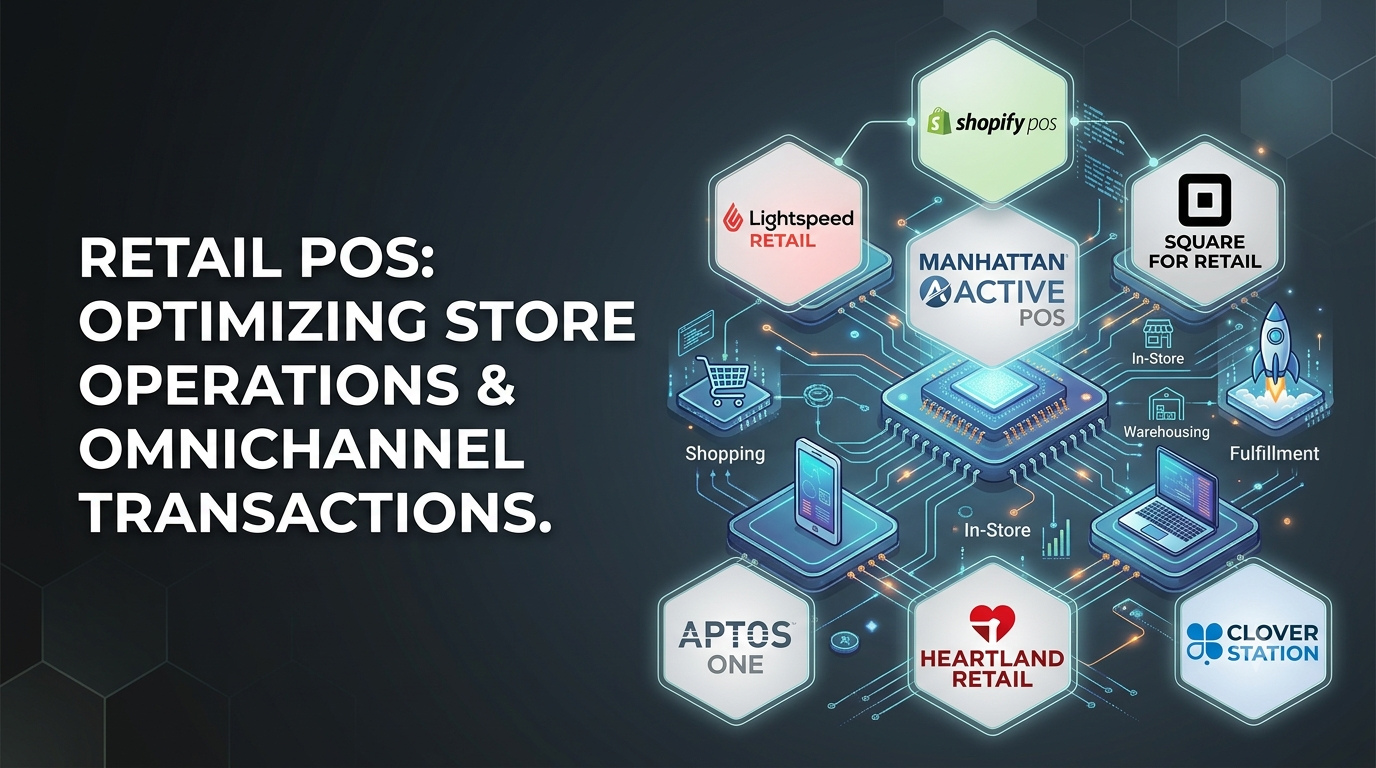
A retail Point of Sale (POS) is no longer just a cash drawer connected to a receipt printer. When a retail customer buys an item online and attempts to return it at a physical store, or asks a sales associate whether a specific jacket size is available at another downtown location, a legacy, offline register fails completely. Fragmented inventory databases cause accidental stockouts, sales associates lose upsell opportunities, and customers walk out the door.
Retail Point of Sale (POS) systems serve as the transactional, operational, and customer engagement hub of modern retail stores—processing payments, managing multi-store inventory, synchronizing omnichannel orders (BOPIS, Ship-from-Store), administering loyalty programs, and routing real-time sales data to ERP and accounting systems. Evaluating retail POS software requires distinguishing between unified omnichannel retail commerce platforms, modern cloud-first tablet POS suites, and accessible small-business registers.
Five Core Capabilities That Separate Modern Retail POS From Legacy Cash Registers
Traditional cash registers simply record receipts; modern cloud retail POS platforms deliver five essential operational capabilities:
- Unified Omnichannel Inventory Synchronization: Updating inventory counts across physical retail locations, warehouse distribution centers, and e-commerce storefronts in real time—enabling Buy-Online-Pick-Up-in-Store (BOPIS), endless aisle ordering (shipping out-of-stock floor items to a customer’s home), and cross-channel returns.
- Offline Mode and Transaction Continuity: Processing credit card payments, scanning barcodes, and printing receipts securely even when store internet connectivity drops—synchronizing queued transactions automatically with the cloud once connections restore.
- Integrated Hardware Ecosystem and Mobile POS (mPOS): Supporting both stationary checkout lanes and portable tablet/handheld terminals—pairing with barcode scanners, receipt printers, cash drawers, and modern payment terminals (EMV chip, NFC contactless, Apple Pay, Google Pay).
- Clienteling, Customer Profiles, and Loyalty Integration: Surfacing unified customer purchase histories, lifetime value, and preferred sizes to store associates on the floor—allowing personalized recommendations and unified loyalty point redemption across online and offline channels.
- Staff Management, Shift Scheduling, and Role-Based Permissions: Tracking employee clock-in/out hours, individual sales commissions, cash-drawer audit reconciliations, and granular register permissions (restricting manual discounts, refunds, and price overrides to authorized managers).
Leading Retail Point of Sale (POS) Systems
Shopify POS
Shopify POS is a market leader in unifying physical retail with digital e-commerce. Built natively on the core Shopify commerce platform, Shopify POS turns mobile tablets and dedicated POS hardware into an omnichannel retail terminal. Inventory, customer profiles, gift cards, discounts, and order histories are shared across online stores and physical locations without complex middleware. Its mobile POS terminals allow associates to check inventory and process sales from anywhere on the retail floor.
D2C brands expanding into physical storefronts, multi-location boutique retailers, and omnichannel businesses already operating on Shopify standardize heavily on Shopify POS. Its primary trade-off is tight coupling to the broader Shopify ecosystem and payments infrastructure.
Lightspeed Retail
Lightspeed Retail is an established cloud POS platform built for complex, inventory-intensive retail businesses—such as bicycle shops, apparel boutiques, jewelry stores, sporting goods, and outdoor retailers. Renowned for its advanced multi-store inventory management, integrated vendor catalogs (allowing retailers to order stock directly from hundreds of pre-loaded brand catalogs), matrix inventory (style, size, color), and sophisticated reporting, Lightspeed handles intricate operational stock demands.
Independent retailers and growing multi-store brands managing high-SKU inventory complexity across multiple locations favor Lightspeed Retail.
Square for Retail
Square for Retail transformed the retail POS landscape by pairing accessible software with straightforward, predictable transaction pricing. Offering inventory tracking, barcode printing, vendor purchase orders, and customer management on an approachable iOS and Android interface, Square allows retailers to launch operations quickly without complex hardware contracts or long-term commitments.
Small retail shops, specialty boutiques, pop-up stores, and startups seeking fast deployment, integrated payment processing, and transparent pricing rely heavily on Square for Retail. Highly complex enterprises with intricate multi-tier ERP architectures often require more customizable enterprise POS systems.
Manhattan Active Point of Sale and Aptos ONE (Enterprise Tier-1 Suites)
For global retail chains, department stores, and multi-banner brand conglomerates managing hundreds of high-volume stores:
- Manhattan Active POS is a microservices-based, cloud-native enterprise POS engineered for high-volume retail, providing advanced clienteling, unified omnichannel fulfillment, and resilient offline capabilities.
- Aptos ONE provides a composable, cloud-native store commerce platform that decouples business logic from physical hardware, powering high-throughput enterprise retail operations globally.
Heartland Retail and Clover Station
- Heartland Retail is a cloud-based POS and inventory platform designed specifically by retailers for multi-store apparel, footwear, and specialty lifestyle brands—excelling in real-time cross-store stock lookups and customer relationship tracking.
- Clover Station (by Fiserv) provides a versatile, counter-top hardware and software POS ecosystem widely deployed across independent retail storefronts through merchant service banking networks.
Retail Point of Sale Systems Comparison
| POS Platform | Architectural Scope | Multi-Store Inventory & Matrix Depth | Omnichannel & E-Commerce Integration | Hardware & Payment Model | Best Fit |
| Shopify POS | Unified online & offline commerce suite | High (Real-time sync across web & physical locations) | Exceptional (Built natively on the Shopify commerce engine) | Proprietary Shopify hardware + integrated Shopify Payments | Brands operating on Shopify expanding into physical retail |
| Lightspeed Retail | Inventory-heavy specialist retail POS | Very High (Pre-loaded vendor catalogs, matrix SKUs, POs) | High (Integrated e-commerce module & open API connectors) | iPad & desktop configurations + Lightspeed Payments | Complex, high-SKU retailers (bike, apparel, jewelry, sports) |
| Square for Retail | Accessible, fast-deploy cloud retail POS | Moderate (Barcodes, stock alerts, basic purchase orders) | High (Integrates with Square Online, social selling & APIs) | Proprietary Square Registers, Terminals & iPad stands | Specialty boutiques, pop-ups & independent retail startups |
| Manhattan Active POS | Enterprise tier-1 omnichannel store platform | Exceptional (Enterprise multi-node inventory & distributed order routing) | Very High (Unifies store POS directly with enterprise WMS & OMS) | Hardware-agnostic cloud microservices architecture | Global multi-store retail chains, department stores & large brands |
| Heartland Retail | Multi-store lifestyle & apparel cloud POS | High (Real-time cross-location inventory & transfers) | High (Integrates with BigCommerce, Shopify & custom APIs) | Cloud web/iOS app + flexible payment terminals | Multi-store apparel, footwear & lifestyle retailers |
| Clover Station | Merchant-banking hardware POS ecosystem | Moderate (Product variants, category tracking, basic stock) | Moderate (Clover App Market integrations & online ordering) | Proprietary counter-top Clover hardware via merchant banks | Independent retail storefronts using traditional merchant processors |
Common Retail POS Implementation Pitfalls to Avoid
- Choosing a POS Without Testing Real-World Offline Resilience: Store internet connections fail during severe weather or local ISP outages. If your POS cannot process offline card payments, look up local stock, and queue transactions securely, your registers close and sales stop. Always verify offline operational continuity.
- Failing to Standardize Matrix Inventory Before Launch: Migrating thousands of unstructured SKUs where sizes and colors are entered as separate unlinked products clutters floor searches and inventory replenishment. Structure items into clean parent-variant matrices (e.g., Brand → Style → Color → Size) before importing data into a new POS.
- Ignoring Payment Processing Fee Structures: Low software subscription fees can be offset by mandatory, non-negotiable payment processing markups. Calculate your total cost of ownership by evaluating both software seat costs and effective payment transaction fees across card types.
Selecting the Right Retail Point of Sale System
Align your retail POS investment with your store footprint, SKU complexity, and omnichannel strategy:
- For Omnichannel Brands Operating on Shopify: Standardize on Shopify POS for unified inventory, customer loyalty, and order management.
- For High-SKU, Complex Independent Retailers (Bikes, Apparel, Specialty): Choose Lightspeed Retail for robust inventory matrices and pre-loaded supplier catalogs.
- For Small Retail Boutiques and Pop-Up Shops Prioritizing Simplicity: Deploy Square for Retail for accessible hardware, fast setup, and transparent pricing.
- For Global Multi-Store Retail Enterprises: Standardize on Manhattan Active POS or Aptos ONE for microservices scalability and deep supply chain integration.
