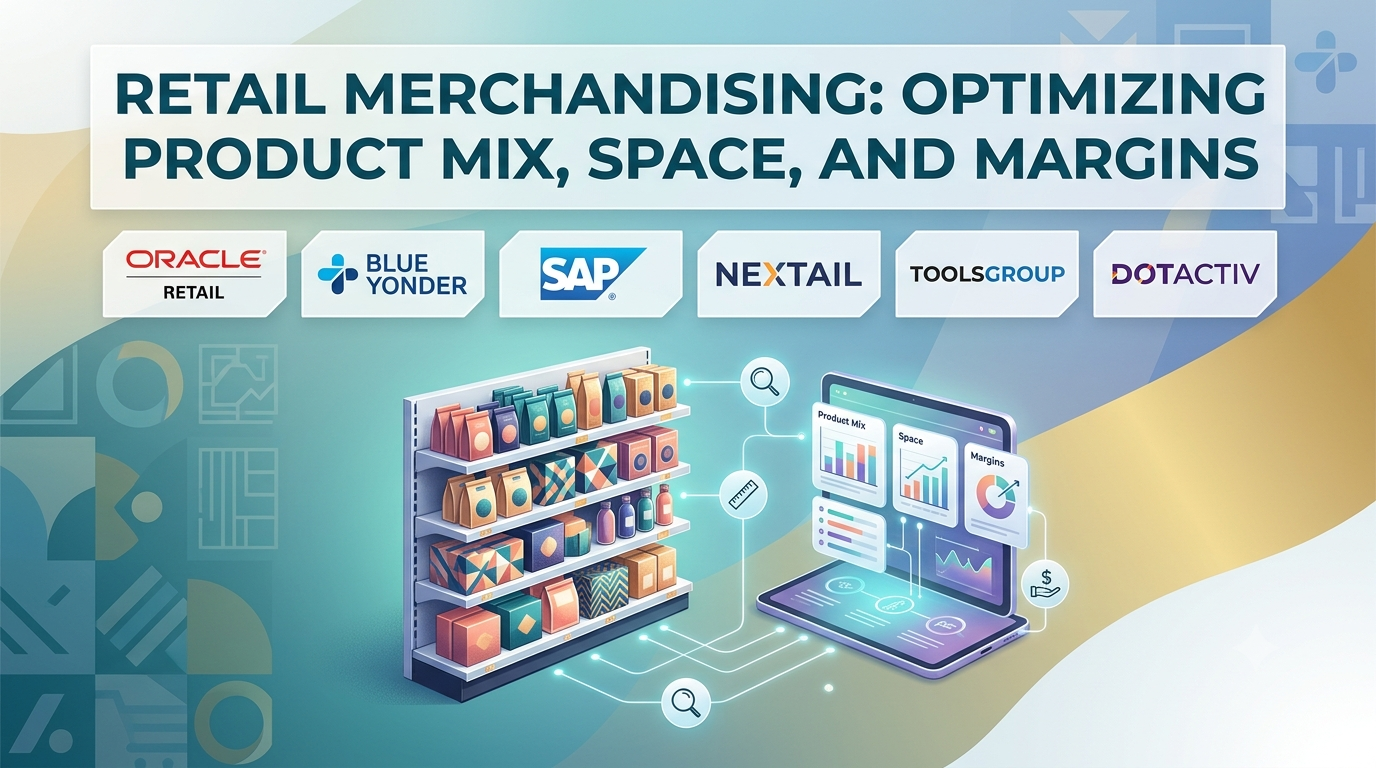
Even the most polished retail store or modern e-commerce website fails if it displays the wrong product mix: high-demand sizes stock out during peak shopping weekends while slow-moving styles gather dust on display racks, requiring deep clearance markdowns that erode gross margins. Merchandisers who manage assortments via manual spreadsheets and fragmented sales reports spend their time cleaning data rather than anticipating consumer demand and maximizing return on inventory investment.
Retail merchandising tools optimize the commercial product lifecycle—governing assortment planning, visual merchandising and planogramming, demand forecasting, promotional pricing/markoffs, and inventory allocation and replenishment. Evaluating retail merchandising platforms requires distinguishing between enterprise AI-driven merchandise planning suites, visual planogram and space-planning software, and agile omnichannel inventory optimization engines.
Five Core Capabilities of Modern Retail Merchandising Software
Basic inventory reports tell you what sold yesterday; dedicated retail merchandising platforms optimize commercial outcomes across five operational pillars:
- Pre-Season and In-Season Assortment Planning: Allowing merchandise planners to model financial targets (sales, margin, inventory turn) top-down, translating them into granular bottom-up product cluster plans (style-color-size mixes, price tiers, and regional store allocations).
- Space Planning and Dynamic Planogramming: Generating compliance-ready 2D and 3D planograms that optimize visual shelf space, rack layout, and end-cap placement based on local sales velocity and physical fixture dimensions.
- AI-Driven Localized Demand Forecasting: Projecting future sales curves at the SKU-store-week level—accounting for seasonal shifts, local demographic preferences, marketing promotions, price elasticity, and external factors like regional weather patterns.
- Automated Allocation and Exception-Based Replenishment: Pushing initial merchandise buys from central distribution centers to optimal retail stores based on localized store grades, paired with automated reordering rules that trigger stock transfers before stockouts occur.
- Markdown Optimization and Promotional Lifecycle Pricing: Analyzing inventory sell-through curves in real time—recommending precise markdown percentages and promotional timing to clear seasonal stock while preserving gross margin.
Leading Retail Merchandising Tools
Oracle Retail Merchandising System (RMS / Merchandise Operations Management)
Oracle Retail is a long-standing enterprise benchmark for global tier-one retail merchandising. Part of the broader Oracle Retail suite, it governs the core merchandising transactional backbone—including purchasing, inventory valuation, cost/price management, supplier deals, and cross-channel inventory movements for massive supermarket chains, department stores, and global retail conglomerates.
Global multi-category retailers requiring enterprise-scale transactional governance, deep multi-currency cost management, and tight integration with Oracle financial and supply chain ERP architectures standardize on Oracle Retail. Its implementation involves significant consulting investment and extensive data standardization.
Blue Yonder (formerly JDA Software)
Blue Yonder is renowned for its space planning, planogramming, and category management solutions. Widely deployed across grocery, convenience, health and beauty, and consumer goods retail, Blue Yonder allows category managers to design detailed 3D visual planograms, optimize shelf capacity to reduce out-of-stocks, and simulate financial returns per square foot of retail space.
Retailers managing dense physical shelf layouts, extensive FMCG/CPG vendor assortments, and complex store planogram compliance favor Blue Yonder.
SAP Omnichannel Merchandise Planning
Integrated into the SAP S/4HANA Retail ecosystem, SAP Omnichannel Merchandise Planning provides enterprise-grade financial planning, assortment planning, and promotional management across physical and digital channels. It leverages the SAP HANA in-memory database to simulate financial merchandise plans across millions of SKU-location combinations in real time.
Large retail enterprises standardized on SAP enterprise software gain end-to-end data continuity from merchandise planning through warehouse logistics and financial ledger reconciliation.
Nextail and ToolsGroup (AI-Driven Inventory Optimization & Allocation)
For fast-fashion, apparel, and lifestyle brands where inventory lifecycles are brief and localized demand shifts quickly:
- Nextail uses predictive analytics and agile optimization algorithms to automate in-season allocation, dynamic store transfers, and first-price markdowns—ensuring inventory moves to locations with the highest probability of full-price sale.
- ToolsGroup (JustEnough) provides a modular retail planning platform covering demand forecasting, assortment planning, allocation, and automated replenishment for omnichannel brands and specialty retailers.
DotActiv and IABSort (Visual Planogramming & Accessible Space Planning)
- DotActiv delivers practical, accessible space planning, assortment optimization, and planogram generation software—popular among mid-market retailers, suppliers, and FMCG brands seeking professional visual planograms without the overhead of massive enterprise suites.
- IABSort and specialized cloud planning tools help emerging multi-channel brands plan initial product buys and seasonal size-curve ratios cleanly.
Retail Merchandising Tools Comparison
| Platform | Primary Architectural Strength | Planogramming & Space Planning | Assortment Planning & Demand AI | Ecosystem & ERP Alignment | Best Fit |
| Oracle Retail (RMS) | Enterprise retail transactional & operational backbone | Moderate (Integrates with Oracle space-planning modules) | Very High (Enterprise assortment, lifecycle pricing & cost control) | Native Oracle Cloud Retail, SCM & financial ERP | Global multi-category retailers, supermarkets & department stores |
| Blue Yonder | Industry-standard space planning & category management | Exceptional (Market-leading 2D/3D visual planograms & fixture optimization) | High (Category assortment & localized space elasticity) | Enterprise ERP connectors (SAP, Oracle) & retail supply chains | Grocery chains, FMCG brands, drugstores & multi-store retail |
| SAP Merchandise Planning | ERP-native omnichannel financial merchandise suite | Moderate (Pairs with SAP store space & visual modules) | Very High (Unified top-down/bottom-up financial & assortment planning) | Native SAP S/4HANA Retail & digital core | Enterprise retailers running core operations on SAP |
| Nextail | AI-driven dynamic allocation & agile store transfers | Light (Focuses on stock flow rather than shelf schematics) | Very High (Agile in-season replenishment, transfers & markdowns) | Modern cloud APIs, connects to standard retail ERPs/POS | Fast-fashion, apparel & lifestyle retail with short product lifecycles |
| ToolsGroup (JustEnough) | Modular retail demand planning & allocation suite | High (Integrated floor planning & space allocation) | High (Demand forecasting, promotions & multi-echelon replenishment) | Integrates with retail ERPs, WMS & inventory backbones | Omnichannel specialty retailers & consumer goods brands |
| DotActiv | Accessible visual planogramming & category management | Very High (Practical, visual shelf planograms & space analytics) | Moderate–High (Assortment planning & localized shelf range tools) | Exportable data models; integrates with standard retail databases | Mid-market retailers, FMCG suppliers & category managers |
Common Retail Merchandising Pitfalls to Avoid
- Planning Assortments Without Analyzing Local Store Space Constraints: Designing a broad pre-season product range without considering that Tier-3 suburban stores have 40% less linear shelf space than flagship urban stores leads to floor clutter and backroom overstock. Couple assortment planning directly with space-planning constraints.
- Using Historical Averages That Mask Size-Curve Stockouts: Ordering seasonal apparel using national historical sales curves ignores regional size variations. Ordering a standard size run across all stores ensures smaller sizes sell out instantly in some regions while larger sizes linger on discount racks. Apply localized, demand-calibrated size profiling.
- Delaying Markdowns Until the End of the Season: Waiting until the final weeks of a season to implement drastic 60% clearance discounts damages gross margins. Use dynamic markdown optimization tools to make smaller, targeted price adjustments earlier in the cycle to maintain steady sell-through.
Selecting the Right Retail Merchandising Tool
Match your merchandising software choice to your retail format, inventory velocity, and operational scale:
- For Tier-1 Global Supermarkets, Department Stores, and Retail Conglomerates: Standardize on Oracle Retail or SAP Omnichannel Merchandise Planning.
- For Grocery Chains, FMCG Brands, and Detailed Shelf-Space Optimization: Deploy Blue Yonder (or DotActiv for mid-market teams) for industry-standard 2D/3D planogramming.
- For Fast-Fashion, Footwear, and Apparel Brands Prioritizing Dynamic Stock Movement: Choose Nextail to automate in-season allocation, inter-store transfers, and full-price sell-through.
- For Omnichannel Specialty Retailers Seeking Unified Demand Planning: Implement ToolsGroup (JustEnough) for integrated forecasting, allocation, and replenishment.
