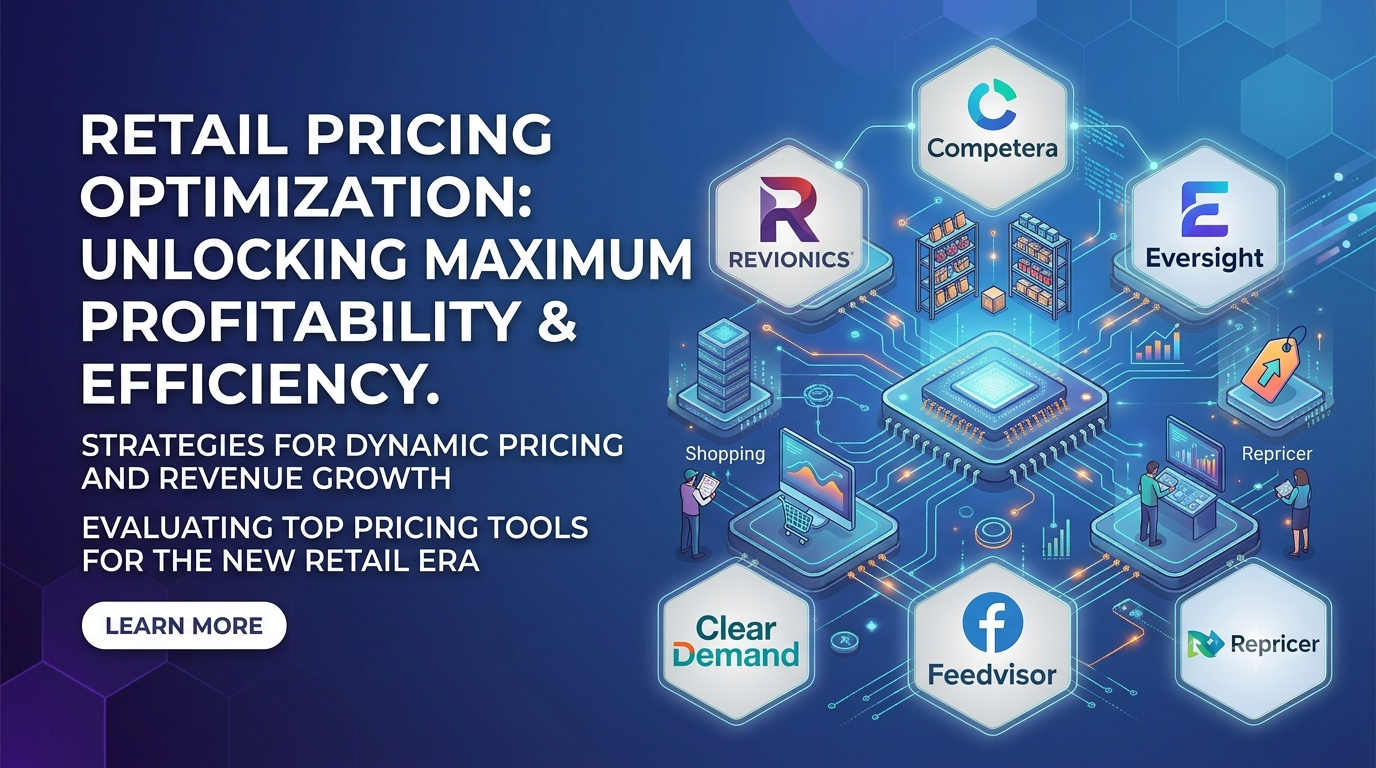
Setting prices using cost-plus rules or manual spreadsheet formulas leaves gross margin unprotected on both ends of the retail spectrum: high-velocity items sell out at unnecessarily steep discounts while price-sensitive categories are priced out of the market by aggressive digital competitors. When pricing adjustments require manual spreadsheet updates and batch uploads to enterprise resource planning (ERP) systems, retailers react days or weeks behind market shifts—eroding profitability and triggering chaotic clearance cycles.
Retail pricing optimization tools replace static price lists with dynamic, algorithm-driven pricing engines. They analyze cross-elasticity, competitor digital shelf data, localized demand curves, inventory aging rates, and promotional calendars to recommend or execute automated price changes across channels. Evaluating retail pricing software requires distinguishing between enterprise multi-echelon lifecycle pricing suites, high-frequency e-commerce repricers, and clearance/markdown optimization platforms.
Five Core Capabilities That Separate Pricing Optimization From Simple Repricers
Basic scraping tools match a competitor’s visible price; advanced retail pricing optimization systems balance multi-variable commercial models across five key areas:
- Cross-Price Elasticity and Cannibalization Modeling: Predicting how a price change on one SKU affects sales volume across substitute and complementary products (e.g., lowering the price on a private-label item without destroying brand-name margins, or discounting razor handles to drive razor cartridge volume).
- Key Value Item (KVI) and Price Image Strategy: Segmenting catalogs into perceived “price image” drivers (KVIs that consumers actively price-shop) versus long-tail non-KVIs where higher margins can be preserved without damaging overall brand price perception.
- Omnichannel Unified Price and Promotion Coordination: Coordinating localized physical store shelf pricing (integrating with Electronic Shelf Labels / ESLs) with e-commerce, mobile app, and third-party marketplace pricing to prevent channel arbitrage and customer friction.
- Lifecycle Pricing (Base, Promotional, and Markdown/Clearance): Managing the entire pricing curve over time—from initial full-price product introductions, through seasonal promotional events and trade fund spend, down to terminal salvage and clearance pacing that protects gross margin.
- Real-Time Competitor Intelligence and Digital Shelf Scraping: Monitoring competing product pricing, stock availability, and shipping fee structures across thousands of digital storefronts—weighting competitor matching against stock levels and delivery speed.
Leading Retail Pricing Optimization Tools
Revionics (an Aptos Company)
Revionics is an established enterprise benchmark in algorithmic retail pricing, serving multi-format supermarket chains, hypermarkets, pharmacies, convenience stores, and department stores globally. Powered by AI and machine learning models trained on decades of transaction data, Revionics handles the complete pricing lifecycle across base pricing, promotional planning, and end-of-season markdowns. Its algorithms model localized elasticity down to the store-item level while ensuring compliance with corporate price family rules and category margins.
Large retail enterprises and grocery networks with complex store tiers, multi-zone pricing, and extensive FMCG catalogs standardize heavily on Revionics. Implementation involves comprehensive data integration with enterprise ERP and POS systems.
Competera
Competera delivers an AI-powered pricing platform built for modern omnichannel retailers and pure-play e-commerce brands. Its engine unites Competitive Data (scraping millions of market data points daily) with Pricing Optimization (utilizing deep learning to calculate localized elasticity and demand impact). Competera allows pricing managers to model “what-if” rule scenarios, forecast revenue and margin changes, and automate real-time price updates through dynamic rule-and-algorithm hybrids.
Mid-market to large retailers in electronics, apparel, cosmetics, and general merchandise looking for faster time-to-value than legacy enterprise pricing suites favor Competera.
Eversight (by Instacart)
Eversight differentiates itself through continuous automated micro-testing and experimentation. Rather than guessing consumer willingness to pay based purely on historical observational data, Eversight runs real-time digital A/B and multi-variant pricing experiments (across digital shelves and in-store digital tags) to measure real-world elasticity. This empirical testing data feeds directly into base price and promotional trade spend optimization for retailers and CPG brands.
Consumer packaged goods (CPG) brands and modern grocery/convenience retailers seeking verified pricing elasticity through active market experimentation rely heavily on Eversight.
Repricer.com and FeedVisor (High-Frequency E-Commerce Repricers)
For marketplace-centric sellers and high-velocity digital retailers:
- Repricer.com is engineered for high-speed algorithmic repricing across Amazon, eBay, Walmart, and Shopify—optimizing prices every few minutes to win the Amazon Buy Box while enforcing strict floor and margin protections.
- Feedvisor combines AI-powered algorithmic repricing with automated Amazon and Walmart advertising management, orchestrating price changes and ad spend in tandem to maximize digital shelf profitability.
Clear Demand and SymphonyAI Retail CPG
- Clear Demand provides an omnichannel pricing, promotion, and markdown platform that emphasizes transparent, explainable AI rules tailored for grocery, drug, and discount retail.
- SymphonyAI Retail CPG delivers enterprise-grade category management, localized demand forecasting, and predictive price modeling for large-scale grocery and consumer goods operations.
Retail Pricing Optimization Tools Comparison
| Platform | Primary Market Role | Lifecycle Scope (Base, Promo, Markdown) | Data Inputs & Elasticity Depth | Channel Focus | Best Fit |
| Revionics | Enterprise multi-tier retail pricing suite | Comprehensive (Full base, promo & clearance optimization) | Very High (Store-SKU elasticity, cannibalization & family rules) | Omnichannel (Physical stores, web, app, ESL) | Supermarkets, drugstores, convenience & enterprise retail |
| Competera | AI-driven omnichannel pricing platform | High (Base pricing, competitive repricing & markdowns) | High (Competitive web intelligence + deep learning elasticity) | Omnichannel & Digital | Mid-market to enterprise retailers in electronics, fashion & retail |
| Eversight | Experimental micro-testing & promo optimization | High (Focuses heavily on promotions & base price tests) | High (Real-world digital A/B price elasticity experimentation) | Omnichannel retail & CPG | Grocery, convenience & CPG brands testing promotional elasticity |
| Repricer.com / Feedvisor | High-velocity digital marketplace repricers | Specialized (Competitive marketplace repricing) | Moderate (Competitor pricing, stock status & Buy Box telemetry) | Marketplaces (Amazon, Walmart, eBay, Shopify) | High-volume third-party sellers & digital brands on marketplaces |
| Clear Demand | Explainable AI pricing for grocery & retail | Comprehensive (Integrated base, promotion & markdown) | High (Price-image modeling & localized store clustering) | Omnichannel (Strong physical grocery focus) | Supermarket & regional retail chains wanting transparent rules |
Common Retail Pricing Optimization Pitfalls to Avoid
- Engaging in “Race-to-the-Bottom” Competitive Matching: Setting repricing algorithms to automatically undercut competitors by five cents without enforcing absolute gross-margin floors quickly triggers automated price wars that destroy profitability. Configure hard margin guardrails and inventory-velocity thresholds before activating automated rules.
- Treating All SKUs With Uniform Price Elasticity: Treating inelastic long-tail replacement parts the same as hyper-sensitive Key Value Items (KVIs) like milk or brand-name soda damages price perception while leaving money on the table. Segment catalogs rigorously by shopper price-awareness.
- Ignoring Inventory Stock Levels in Downstream Channels: Lowering prices on an item that only has three units remaining in a regional distribution center generates sudden demand spikes that result in stockouts and costly order cancellations. Bind pricing optimization engines directly to real-time inventory availability.
Selecting the Right Retail Pricing Optimization Tool
Match your software selection to your sales channels, catalog velocity, and format complexity:
- For Large-Scale Supermarkets, Pharmacies, and Multi-Store Retail: Standardize on Revionics or Clear Demand to govern complex localized base, promotional, and markdown pricing.
- For Modern Omnichannel Retailers Balancing Store and Web: Deploy Competera to blend competitive digital shelf scraping with algorithmic demand elasticity.
- For CPG Brands and Grocery Chains Seeking Active Elasticity Testing: Use Eversight to run real-world A/B pricing and promotional experiments.
- For High-Volume Amazon and Marketplace Merchants: Standardize on Repricer.com or Feedvisor to optimize Buy Box win rates and protect margins in real time.
