Introduction
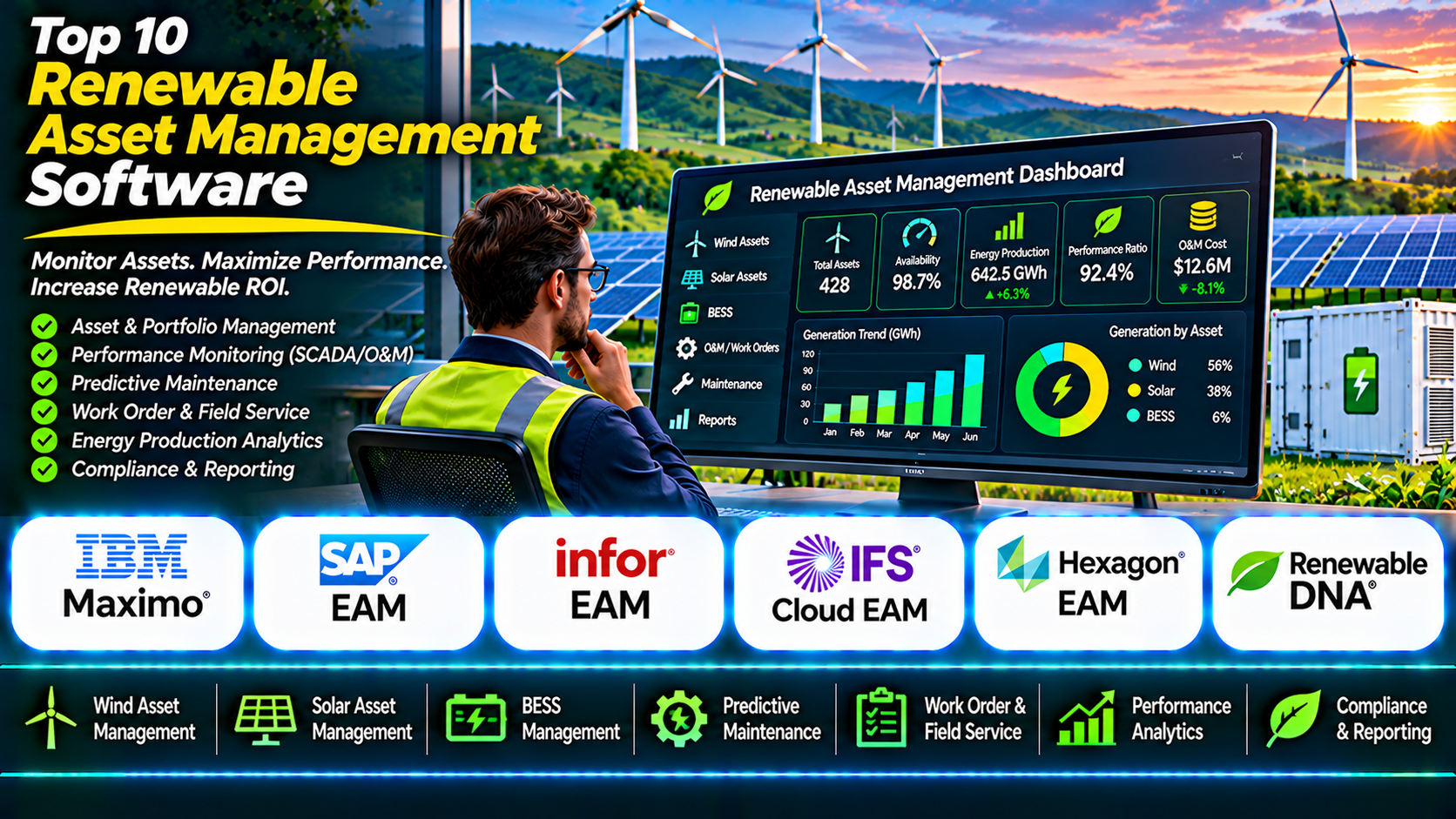
Renewable energy companies manage increasingly diverse portfolios of solar farms, wind turbines, battery storage systems, and other clean energy infrastructure. Maintaining these assets requires effective performance monitoring, maintenance planning, financial administration, and operational coordination.
Traditional asset management methods often depend on spreadsheets, disconnected monitoring applications, manual inspections, and separate financial records. These approaches become increasingly difficult to maintain as renewable energy portfolios expand across multiple locations.
Renewable asset management software helps organizations centralize asset information, monitor energy production, manage maintenance activities, evaluate equipment performance, and coordinate commercial operations throughout the asset lifecycle.
Modern platforms combine operational analytics, equipment monitoring, performance benchmarking, maintenance management, contract administration, and portfolio reporting. Some also incorporate predictive analytics to help operators identify emerging equipment problems.
Selecting the right renewable asset management software requires consideration of asset types, portfolio size, equipment compatibility, operational responsibilities, reporting requirements, and integration capabilities.
This guide examines ten renewable asset management platforms, comparing their features, benefits, advantages, limitations, practical applications, and suitability for different renewable energy organizations.
What Is Renewable Asset Management Software?
Renewable asset management software is a specialized digital application that helps organizations manage the operational, technical, commercial, and financial aspects of renewable energy assets.
These platforms collect and organize information from compatible monitoring systems, equipment controllers, weather services, maintenance applications, financial systems, and operational records. They help asset managers understand how individual assets and entire portfolios perform.
Renewable asset management extends beyond monitoring electricity production. It includes equipment availability, maintenance scheduling, contractual obligations, operational expenses, performance guarantees, regulatory reporting, and long-term investment planning.
Different platforms emphasize different responsibilities. Some specialize in technical performance monitoring, while others focus on commercial asset management, maintenance administration, or integrated portfolio oversight.
Core Components of Renewable Asset Management
| Component | Primary Function |
|---|---|
| Asset Register | Maintains equipment and facility information |
| Performance Monitoring | Tracks energy production and operational indicators |
| Maintenance Management | Coordinates inspections, repairs, and service activities |
| Predictive Analytics | Identifies emerging performance problems |
| Financial Management | Tracks revenue, expenses, and financial performance |
| Contract Management | Organizes contractual obligations and service agreements |
| Portfolio Reporting | Consolidates information across renewable assets |
| Document Management | Maintains technical and commercial documentation |
| Risk Management | Identifies operational and commercial risks |
Common Applications of Renewable Asset Management Software
- Solar Farm Management: Monitor photovoltaic production, inverter performance, equipment availability, and energy losses across solar installations.
- Wind Farm Management: Analyze turbine production, availability, operating conditions, and maintenance requirements.
- Battery Storage Management: Track supported battery performance indicators, operational availability, energy throughput, and degradation information.
- Predictive Maintenance: Identify unusual equipment behavior and emerging performance issues that require engineering investigation.
- Portfolio Performance Management: Compare energy production and operational performance across multiple renewable energy facilities.
- Commercial Asset Administration: Organize contracts, financial records, revenue information, and contractual performance obligations.
- Operations and Maintenance Coordination: Schedule inspections, document maintenance activities, and coordinate service providers.
- Investor and Stakeholder Reporting: Consolidate operational and financial information into structured reports for asset owners, investors, and management teams.
Top 10 Renewable Asset Management Software
The following comparison includes renewable-specific asset management platforms, technical performance applications, commercial portfolio management systems, and complementary enterprise asset management solutions.
The numbering organizes the comparison rather than representing independently tested rankings.
1. Power Factors Unity
Short Description
Power Factors Unity is a renewable energy software platform designed to support the management of utility-scale clean energy assets and portfolios.
Its broader capabilities address renewable energy monitoring, asset performance management, operational workflows, and related commercial administration. Organizations can use compatible applications to consolidate information from multiple renewable facilities.
The platform is particularly relevant to independent power producers and asset owners managing solar, wind, and battery storage projects across geographically distributed portfolios.
Organizations should evaluate the specific Unity applications included in their proposed deployment because technical monitoring, operational management, and commercial capabilities may have different configuration and licensing requirements.
Key Features
- Portfolio Monitoring: Consolidates operational information from compatible renewable energy facilities into centralized portfolio views.
- Asset Performance Analytics: Examines production, availability, and relevant equipment performance indicators.
- Equipment Data Integration: Connects with supported equipment controllers, monitoring systems, and operational information sources.
- Performance Loss Analysis: Helps asset managers investigate differences between expected and actual energy production.
- Operational Event Management: Organizes equipment events and relevant operational notifications.
- Maintenance Coordination: Supports applicable maintenance and operational workflow management.
- Commercial Asset Management: Provides relevant commercial administration capabilities through appropriate applications.
- Portfolio Reporting: Consolidates operational information for asset managers and stakeholders.
- Multi-Technology Management: Supports renewable portfolios containing different compatible energy technologies.
Benefits
- Improves visibility across geographically distributed assets.
- Reduces fragmented operational information.
- Supports structured performance investigation.
- Facilitates coordination between asset management teams.
- Improves portfolio reporting consistency.
- Supports renewable energy portfolio expansion.
- Helps identify opportunities to improve asset performance.
Pros
- Dedicated renewable energy software specialization.
- Relevant multi-technology portfolio capabilities.
- Comprehensive operational information management.
- Suitable for utility-scale renewable assets.
- Supports centralized performance analytics.
- Provides complementary renewable management applications.
Cons
- Commercial pricing requires individual evaluation.
- Implementation may involve extensive data integration.
- Available functionality depends on selected applications.
- Smaller portfolios may not require its complete capabilities.
- Historical information quality can affect analytical results.
Use Cases
- Utility-Scale Solar Management: Consolidate production and performance information across multiple solar farms.
- Wind Portfolio Monitoring: Compare turbine and wind farm operational indicators.
- Battery Storage Oversight: Review supported storage asset performance information.
- Renewable Performance Investigation: Identify production deviations requiring technical analysis.
- Operational Coordination: Organize relevant equipment events and maintenance activities.
- Investor Reporting: Prepare consistent portfolio performance information.
Best For
- Independent power producers.
- Utility-scale renewable asset owners.
- Solar and wind portfolio managers.
- Battery storage operators.
- Renewable operations departments.
- Large renewable energy investment portfolios.
2. Raptor Maps
Short Description
Raptor Maps is a solar asset management and analytics platform specializing in the technical management of photovoltaic installations.
The software helps solar organizations organize equipment information, inspection findings, asset condition records, and operational performance information. Its digital asset representation provides a structured view of solar infrastructure.
Raptor Maps is particularly relevant to solar asset owners and operations teams using aerial inspections, thermal imaging, and equipment-level analysis to investigate performance problems.
The platform should be evaluated primarily for solar technical asset management rather than assumed to replace every commercial accounting or enterprise maintenance application.
Key Features
- Solar Asset Digitization: Organizes solar equipment and facility information within digital asset representations.
- Inspection Management: Maintains findings from compatible aerial and field inspection workflows.
- Thermal Inspection Analytics: Helps identify relevant thermal anomalies in supported inspection information.
- Equipment-Level Visualization: Associates inspection findings with relevant photovoltaic equipment.
- Anomaly Classification: Organizes detected equipment abnormalities into structured categories.
- Asset Condition Tracking: Maintains historical information about identified equipment conditions.
- Performance Investigation: Supports examination of potential production losses associated with asset defects.
- Portfolio Reporting: Consolidates inspection and asset condition information across solar facilities.
- Remediation Coordination: Supports applicable workflows for reviewing and addressing inspection findings.
Benefits
- Improves visibility into solar equipment conditions.
- Supports structured inspection administration.
- Helps prioritize equipment investigations.
- Reduces fragmented inspection documentation.
- Facilitates maintenance planning.
- Improves historical asset condition tracking.
- Supports solar portfolio performance management.
Pros
- Strong solar industry specialization.
- Relevant aerial inspection capabilities.
- Detailed equipment-level asset information.
- Useful solar anomaly visualization.
- Suitable for utility-scale photovoltaic facilities.
- Supports structured inspection reporting.
Cons
- Primarily focused on solar energy assets.
- Commercial asset administration may require complementary software.
- Inspection quality influences analytical results.
- Commercial pricing requires evaluation.
- Integration with existing maintenance systems should be assessed.
Use Cases
- Solar Thermal Inspection: Review thermal abnormalities identified through compatible inspection workflows.
- Photovoltaic Equipment Mapping: Maintain structured records of solar modules and associated equipment.
- Maintenance Prioritization: Identify inspection findings requiring technical investigation.
- Solar Acquisition Assessment: Review available equipment condition information during technical due diligence.
- Portfolio Condition Reporting: Compare inspection findings across multiple solar farms.
- Remediation Tracking: Document progress on identified solar equipment issues.
Best For
- Utility-scale solar asset owners.
- Photovoltaic inspection companies.
- Solar operations and maintenance teams.
- Solar performance engineers.
- Renewable technical due diligence professionals.
- Solar portfolio managers.
3. Greenbyte
Short Description
Greenbyte is a renewable energy asset performance management solution associated with Power Factors.
The platform helps renewable energy organizations collect operational information, monitor production, analyze performance, and compare assets across distributed portfolios.
Greenbyte has particular relevance to wind and solar energy operations where asset managers require centralized visibility into equipment performance and operational availability.
Because Greenbyte belongs to the Power Factors product ecosystem, organizations should confirm current product availability, migration options, and relationships with Unity before treating the two as independent procurement alternatives.
Key Features
- Renewable Asset Monitoring: Presents supported operational information from renewable facilities.
- Production Analytics: Examines historical and current electricity generation records.
- Availability Management: Tracks relevant asset availability indicators.
- Equipment Information Integration: Receives information from compatible renewable equipment systems.
- Performance Benchmarking: Compares relevant operational indicators across assets.
- Event Management: Organizes supported equipment notifications and operational events.
- Historical Data Analysis: Maintains and examines available production histories.
- Portfolio Visualization: Presents consolidated information across renewable installations.
- Operational Reporting: Supports preparation of renewable performance reports.
Benefits
- Improves centralized renewable asset visibility.
- Supports comparison of asset performance.
- Reduces repetitive information consolidation.
- Facilitates operational performance investigation.
- Improves accessibility of production histories.
- Supports consistent portfolio reporting.
- Helps identify underperforming assets.
Pros
- Established renewable performance management specialization.
- Relevant wind and solar monitoring capabilities.
- Useful portfolio-level analytics.
- Supports compatible equipment information sources.
- Structured operational reporting.
- Relevant historical performance analysis.
Cons
- Product availability and roadmap require confirmation.
- Shares a vendor ecosystem with Power Factors Unity.
- Commercial administration may require complementary applications.
- Integration requirements vary by equipment.
- Commercial licensing requires evaluation.
Use Cases
- Wind Farm Monitoring: Analyze turbine production and operational availability.
- Solar Portfolio Analysis: Compare photovoltaic facility performance.
- Production Deviation Investigation: Review differences between expected and actual generation.
- Equipment Event Review: Investigate supported operational notifications.
- Historical Performance Reporting: Examine renewable production trends.
- Portfolio Benchmarking: Compare normalized performance indicators across facilities.
Best For
- Wind farm operators.
- Solar asset managers.
- Existing Greenbyte customers.
- Renewable performance analysts.
- Multi-site renewable portfolios.
- Organizations evaluating Power Factors migration options.
4. QOS Energy Qantum
Short Description
QOS Energy Qantum is a renewable energy monitoring and performance analytics platform associated with QOS Energy’s renewable software business.
The solution is designed to consolidate information from compatible renewable energy installations, analyze production performance, and support operational investigation.
Qantum is particularly relevant to organizations managing geographically distributed renewable assets and requiring consistent performance indicators across different equipment environments.
QOS Energy is part of the Power Factors ecosystem. Organizations should verify current product packaging and migration arrangements before evaluating Qantum as a separate purchasing option.
Key Features
- Multi-Site Monitoring: Consolidates supported renewable facility information.
- Production Performance Analytics: Examines generation and relevant performance indicators.
- Equipment Integration: Receives information from compatible renewable monitoring systems.
- Performance Benchmarking: Supports comparison of operational indicators across assets.
- Operational Notifications: Organizes relevant events and performance exceptions.
- Historical Information Analysis: Examines available renewable production records.
- Energy Loss Investigation: Supports analysis of potential production deviations.
- Configurable Dashboards: Presents relevant operational information for different responsibilities.
- Portfolio Reporting: Consolidates performance information for renewable stakeholders.
Benefits
- Improves renewable portfolio visibility.
- Supports structured production analysis.
- Reduces fragmented monitoring workflows.
- Facilitates investigation of underperformance.
- Supports consistent operational reporting.
- Improves access to historical performance records.
- Helps organizations compare distributed renewable assets.
Pros
- Renewable-specific performance analytics.
- Relevant multi-site monitoring functionality.
- Supports compatible equipment information sources.
- Useful operational dashboards.
- Suitable for geographically distributed portfolios.
- Established renewable monitoring heritage.
Cons
- Current product availability requires confirmation.
- Shares a vendor ecosystem with Unity and Greenbyte.
- Commercial asset management may require additional applications.
- Integration complexity varies.
- Pricing and support arrangements require evaluation.
Use Cases
- Solar Performance Monitoring: Examine photovoltaic generation and operational indicators.
- Wind Portfolio Analysis: Compare supported wind asset performance information.
- Renewable Production Reporting: Consolidate generation records across facilities.
- Underperformance Investigation: Review deviations requiring engineering analysis.
- Operational Event Monitoring: Organize relevant equipment notifications.
- Legacy Platform Evaluation: Assess existing Qantum deployments and migration requirements.
Best For
- Existing QOS Energy customers.
- Renewable performance engineers.
- Multi-site solar operators.
- Wind portfolio managers.
- Renewable operations departments.
- Organizations evaluating legacy platform modernization.
5. AlsoEnergy PowerTrack
Short Description
AlsoEnergy PowerTrack is a renewable energy monitoring and asset performance management solution within Stem’s renewable software portfolio.
The platform helps organizations collect and visualize information from compatible solar installations, energy storage systems, and related energy infrastructure.
PowerTrack is particularly relevant to solar asset owners, engineering teams, and operations providers requiring centralized production monitoring and equipment performance analysis.
Organizations should evaluate the specific PowerTrack configuration, compatible monitoring hardware, available storage capabilities, and integration with commercial or maintenance applications.
Key Features
- Solar Production Monitoring: Presents supported photovoltaic generation information.
- Equipment Performance Visualization: Displays relevant inverter, meter, and equipment indicators.
- Portfolio Management: Consolidates operational information across compatible installations.
- Performance Analytics: Examines production trends and relevant performance deviations.
- Event and Alert Management: Organizes supported equipment notifications.
- Historical Data Analysis: Maintains accessible production and operational histories.
- Energy Storage Monitoring: Supports applicable storage-related information workflows.
- Monitoring Infrastructure Integration: Connects with compatible data acquisition and monitoring equipment.
- Operational Reporting: Produces relevant renewable performance information.
Benefits
- Improves solar portfolio visibility.
- Supports equipment performance investigation.
- Reduces manual monitoring activities.
- Facilitates centralized operational reporting.
- Supports compatible solar and storage environments.
- Improves access to historical generation information.
- Helps identify production deviations.
Pros
- Established solar monitoring specialization.
- Relevant utility-scale and commercial solar applications.
- Supports compatible monitoring infrastructure.
- Useful equipment-level visualization.
- Centralized portfolio monitoring.
- Relevant solar and storage software ecosystem.
Cons
- Commercial pricing requires evaluation.
- Device compatibility depends on configuration.
- Full commercial asset management may require additional tools.
- Information quality depends on monitoring infrastructure.
- Storage functionality should be confirmed for specific deployments.
Use Cases
- Commercial Solar Monitoring: Track production across commercial photovoltaic installations.
- Utility-Scale Solar Operations: Monitor compatible solar farm equipment.
- Inverter Performance Analysis: Investigate equipment-level production deviations.
- Solar and Storage Oversight: Review supported hybrid energy asset information.
- Operational Alert Review: Organize relevant monitoring notifications.
- Portfolio Performance Reporting: Consolidate generation information for stakeholders.
Best For
- Solar asset owners.
- Commercial solar operators.
- Utility-scale photovoltaic companies.
- Renewable operations providers.
- Solar performance engineers.
- Solar and storage portfolio managers.
6. 3megawatt BluePoint
Short Description
BluePoint is a renewable asset management platform developed by 3megawatt, which became part of Power Factors.
The software focuses on structured asset administration, commercial information management, operational coordination, and renewable portfolio reporting.
BluePoint is particularly relevant to asset managers responsible for contracts, obligations, documents, operational records, and financial information across renewable energy projects.
Its commercial asset management orientation distinguishes it from platforms focused primarily on equipment telemetry. Organizations should confirm current BluePoint availability and integration or migration arrangements within the Power Factors ecosystem.
Key Features
- Renewable Asset Register: Maintains structured facility and asset information.
- Contract Administration: Organizes relevant renewable energy agreements and obligations.
- Document Management: Centralizes technical and commercial documentation.
- Task Management: Coordinates applicable asset management responsibilities.
- Commercial Information Tracking: Maintains relevant financial and commercial records.
- Obligation Monitoring: Helps track documented contractual requirements and deadlines.
- Portfolio Administration: Organizes information across renewable projects.
- Stakeholder Reporting: Supports structured asset management reports.
- Operational Information Integration: Connects relevant asset records with compatible information sources.
Benefits
- Improves commercial asset information organization.
- Reduces dependence on disconnected spreadsheets.
- Supports contractual obligation tracking.
- Facilitates consistent portfolio administration.
- Improves document accessibility.
- Supports coordination between commercial and technical teams.
- Simplifies stakeholder reporting workflows.
Pros
- Dedicated renewable asset administration heritage.
- Relevant contract and document management capabilities.
- Useful commercial portfolio workflows.
- Supports structured asset records.
- Suitable for renewable investment portfolios.
- Complements technical monitoring applications.
Cons
- Current product packaging requires confirmation.
- Shares the Power Factors vendor ecosystem.
- Detailed equipment monitoring may require complementary applications.
- Commercial pricing requires evaluation.
- Historical contract migration can require substantial preparation.
Use Cases
- Renewable Contract Management: Organize power purchase agreements and service contracts.
- Commercial Portfolio Administration: Maintain relevant project financial and operational records.
- Contractual Obligation Tracking: Monitor documented responsibilities and deadlines.
- Asset Documentation: Centralize technical and commercial records.
- Investor Reporting: Consolidate relevant portfolio information.
- Service Provider Coordination: Organize applicable operational responsibilities.
Best For
- Renewable commercial asset managers.
- Infrastructure investment funds.
- Independent power producers.
- Renewable contract administrators.
- Existing BluePoint customers.
- Renewable portfolio administration teams.
7. Bazefield
Short Description
Bazefield is a renewable energy operational monitoring and asset performance management platform associated with Envision Digital.
The platform helps organizations collect, organize, and analyze operational information from compatible wind, solar, and other renewable energy assets.
Bazefield is particularly relevant to operators managing heterogeneous renewable equipment and seeking centralized visibility into production, availability, and operational events.
Organizations should evaluate the current Bazefield offering, equipment compatibility, deployment arrangements, and available integrations with enterprise maintenance and commercial applications.
Key Features
- Renewable Operations Monitoring: Presents supported asset operational information.
- Multi-Vendor Equipment Integration: Connects with compatible equipment information sources.
- Production Analytics: Examines renewable generation and historical production trends.
- Availability Analysis: Tracks relevant operational availability indicators.
- Event Management: Organizes supported equipment events and notifications.
- Portfolio Visualization: Consolidates information across renewable facilities.
- Performance Benchmarking: Supports comparison of relevant operational indicators.
- Operational Reporting: Produces structured renewable performance information.
- Historical Data Management: Maintains accessible operational information histories.
Benefits
- Improves centralized renewable operations visibility.
- Supports heterogeneous equipment environments.
- Facilitates performance investigation.
- Reduces fragmented monitoring information.
- Supports consistent portfolio benchmarking.
- Improves operational reporting.
- Helps identify renewable production deviations.
Pros
- Established renewable operations specialization.
- Relevant wind and solar monitoring capabilities.
- Supports compatible multi-vendor environments.
- Useful operational performance analytics.
- Suitable for distributed renewable portfolios.
- Provides structured historical information management.
Cons
- Commercial pricing requires evaluation.
- Integration requirements vary by equipment.
- Financial administration may require additional applications.
- Analytical accuracy depends on source information quality.
- Current product packaging should be confirmed.
Use Cases
- Wind Farm Operations: Monitor turbine generation and availability.
- Solar Portfolio Monitoring: Review supported photovoltaic performance indicators.
- Multi-Vendor Asset Management: Consolidate compatible equipment information.
- Performance Benchmarking: Compare renewable facility operational indicators.
- Equipment Event Investigation: Review relevant operational notifications.
- Renewable Portfolio Reporting: Consolidate production and performance records.
Best For
- Wind energy operators.
- Solar portfolio managers.
- Renewable control center teams.
- Multi-vendor renewable asset owners.
- Performance engineering departments.
- Independent renewable power producers.
8. SkySpecs
Short Description
SkySpecs provides renewable energy asset management technology and services with a strong emphasis on wind turbine inspection, equipment condition assessment, and asset performance management.
Its software capabilities help organizations organize inspection findings, evaluate equipment conditions, manage technical asset information, and support maintenance planning.
SkySpecs is particularly relevant to wind asset owners seeking to improve visibility into blade conditions, equipment deterioration, inspection histories, and technical operational risks.
Organizations should evaluate the specific software and service components included in their proposed arrangement. Inspection services, condition monitoring, and asset management capabilities may have separate requirements.
Key Features
- Wind Asset Information Management: Maintains relevant turbine and equipment information.
- Inspection Data Administration: Organizes findings from supported inspection activities.
- Blade Condition Assessment: Supports structured review of wind turbine blade inspection information.
- Equipment Condition Tracking: Maintains historical records of identified equipment conditions.
- Maintenance Prioritization: Helps organize technical findings according to applicable priorities.
- Performance Information Analysis: Supports relevant renewable asset performance workflows.
- Portfolio Visualization: Presents applicable asset condition information across wind facilities.
- Technical Reporting: Consolidates inspection and condition assessment information.
- Operational Workflow Coordination: Supports applicable technical asset management activities.
Benefits
- Improves visibility into wind turbine conditions.
- Supports structured inspection management.
- Facilitates maintenance prioritization.
- Reduces fragmented technical documentation.
- Helps organizations investigate emerging equipment problems.
- Supports long-term asset condition tracking.
- Improves technical stakeholder reporting.
Pros
- Strong wind energy specialization.
- Relevant turbine inspection capabilities.
- Useful blade condition management workflows.
- Supports technical asset management.
- Suitable for geographically distributed wind portfolios.
- Combines relevant software and inspection expertise.
Cons
- Particularly focused on wind energy applications.
- Commercial administration may require complementary systems.
- Inspection results depend on information quality.
- Service and software costs require evaluation.
- Specialized technical findings require qualified interpretation.
Use Cases
- Wind Turbine Blade Inspection: Organize findings from supported blade inspection activities.
- Equipment Condition Assessment: Track documented turbine equipment abnormalities.
- Maintenance Planning: Prioritize technical investigations and approved maintenance work.
- Wind Portfolio Reporting: Compare relevant asset condition information.
- Technical Due Diligence: Review available turbine inspection histories.
- Long-Term Asset Management: Monitor documented changes in equipment condition.
Best For
- Wind farm owners.
- Wind turbine maintenance teams.
- Renewable technical asset managers.
- Blade inspection professionals.
- Wind energy investment portfolios.
- Wind equipment reliability engineers.
9. IBM Maximo Application Suite
Short Description
IBM Maximo Application Suite is an enterprise asset management platform designed to support equipment lifecycle management, maintenance administration, inspections, and asset reliability across multiple industries.
Renewable energy organizations can use Maximo to manage physical infrastructure, maintenance records, spare parts, service activities, and equipment condition information.
The platform is particularly relevant to large renewable operators requiring standardized enterprise maintenance processes across solar farms, wind farms, battery facilities, and other infrastructure.
Maximo is not exclusively a renewable energy performance monitoring application. Organizations may require dedicated renewable monitoring software to provide detailed production analytics and technology-specific performance indicators.
Key Features
- Enterprise Asset Register: Maintains structured equipment records and asset hierarchies.
- Work Order Management: Organizes approved maintenance activities and associated documentation.
- Preventive Maintenance: Supports scheduled maintenance programs based on configured requirements.
- Asset Condition Monitoring: Incorporates relevant condition information through supported applications.
- Inventory Management: Tracks spare parts and maintenance inventory.
- Inspection Management: Supports structured equipment inspection workflows.
- Maintenance Cost Tracking: Organizes relevant labor, material, and maintenance expense information.
- Reliability Analytics: Provides applicable analytical capabilities through selected suite components.
- Enterprise Integration: Connects with compatible financial, operational, and information systems.
Benefits
- Improves equipment lifecycle administration.
- Supports standardized maintenance processes.
- Reduces fragmented maintenance documentation.
- Facilitates spare parts management.
- Improves visibility into maintenance expenses.
- Supports structured inspection programs.
- Helps organizations manage diverse infrastructure assets.
Pros
- Comprehensive enterprise asset management functionality.
- Suitable for complex equipment portfolios.
- Relevant maintenance and inventory capabilities.
- Supports configurable asset hierarchies.
- Established enterprise integration ecosystem.
- Applicable across multiple renewable technologies.
Cons
- Not exclusively designed for renewable energy production analytics.
- Implementation may require substantial resources.
- Commercial licensing requires evaluation.
- Specialized configuration expertise may be necessary.
- Renewable-specific monitoring may require complementary software.
Use Cases
- Wind Turbine Maintenance: Organize preventive and corrective maintenance activities.
- Solar Equipment Administration: Maintain inverter, transformer, and other equipment records.
- Battery Facility Maintenance: Coordinate approved inspection and service activities.
- Spare Parts Management: Track replacement equipment and maintenance inventory.
- Maintenance Cost Analysis: Review labor and material expenditure records.
- Enterprise Asset Lifecycle Management: Standardize asset administration across renewable facilities.
Best For
- Large renewable energy operators.
- Enterprise maintenance departments.
- Integrated electricity utilities.
- Renewable equipment reliability teams.
- Multi-technology infrastructure owners.
- Organizations using enterprise asset management processes.
10. SAP Asset Performance Management
Short Description
SAP Asset Performance Management is an enterprise application designed to support equipment reliability, asset condition assessment, maintenance strategies, and risk-based asset management.
Renewable energy organizations can use applicable SAP asset management capabilities to evaluate equipment criticality, organize maintenance strategies, and connect asset performance information with broader enterprise processes.
The platform is particularly relevant to organizations already using SAP enterprise resource planning, maintenance management, and financial applications.
SAP Asset Performance Management should be evaluated as an enterprise reliability and asset management solution rather than a direct replacement for specialized renewable production monitoring platforms.
Key Features
- Asset Criticality Assessment: Helps classify equipment according to operational importance and applicable risk considerations.
- Maintenance Strategy Management: Supports development and administration of maintenance strategies.
- Asset Health Information: Organizes relevant equipment condition indicators.
- Reliability Assessment: Supports applicable equipment reliability analysis.
- Risk-Based Asset Management: Helps evaluate documented equipment risks and maintenance priorities.
- Enterprise Maintenance Integration: Connects with compatible SAP maintenance applications.
- Condition Information Integration: Incorporates relevant information from supported sources.
- Asset Performance Reporting: Presents applicable reliability and asset condition information.
- Enterprise Process Connectivity: Supports coordinated asset management and business workflows.
Benefits
- Improves structured equipment reliability management.
- Supports risk-based maintenance planning.
- Connects asset information with enterprise applications.
- Facilitates equipment criticality assessment.
- Improves consistency of maintenance strategies.
- Supports long-term infrastructure planning.
- Helps organizations prioritize asset management resources.
Pros
- Established enterprise technology ecosystem.
- Relevant asset reliability capabilities.
- Strong SAP integration orientation.
- Supports structured maintenance strategy development.
- Suitable for complex infrastructure portfolios.
- Applicable across renewable energy technologies.
Cons
- Renewable-specific generation analytics may require additional software.
- Implementation can require specialized SAP expertise.
- Commercial licensing requires evaluation.
- Integration requirements depend on existing architecture.
- Smaller renewable operators may prefer simpler applications.
Use Cases
- Renewable Equipment Criticality Assessment: Classify equipment according to documented operational importance.
- Wind Asset Reliability Management: Evaluate relevant turbine maintenance strategies.
- Solar Infrastructure Maintenance: Organize reliability information for critical photovoltaic equipment.
- Battery Facility Asset Management: Maintain relevant equipment condition and risk information.
- Enterprise Maintenance Strategy Development: Coordinate standardized maintenance approaches.
- Infrastructure Investment Planning: Use documented asset condition and reliability information to support planning.
Best For
- SAP-oriented renewable enterprises.
- Large electricity utilities.
- Renewable reliability engineers.
- Enterprise asset management departments.
- Infrastructure maintenance organizations.
- Multi-technology renewable asset owners.
Comparison Table: Top 10 Renewable Asset Management Software
| Software | Primary Function | Best For | Standout Capability | Pricing Model |
|---|---|---|---|---|
| Power Factors Unity | Integrated renewable asset management | Large renewable portfolios | Multi-technology portfolio oversight | Enterprise quotation |
| Raptor Maps | Solar technical asset management | Solar asset owners | Equipment-level inspection analytics | Commercial arrangements |
| Greenbyte | Renewable performance management | Wind and solar operators | Portfolio performance monitoring | Confirm current availability |
| QOS Energy Qantum | Renewable monitoring and analytics | Distributed renewable portfolios | Multi-site performance analytics | Confirm current availability |
| AlsoEnergy PowerTrack | Renewable monitoring | Solar and storage operators | Equipment performance visualization | Commercial arrangements |
| 3megawatt BluePoint | Commercial asset administration | Renewable asset managers | Contract and obligation management | Confirm current availability |
| Bazefield | Renewable operations management | Wind and solar operators | Multi-vendor operational monitoring | Commercial licensing |
| SkySpecs | Technical wind asset management | Wind farm owners | Turbine inspection and condition assessment | Software and service arrangements |
| IBM Maximo | Enterprise asset management | Large maintenance departments | Equipment lifecycle and maintenance management | Enterprise licensing |
| SAP Asset Performance Management | Asset reliability management | SAP-oriented enterprises | Risk-based maintenance strategies | Commercial licensing |
Important procurement consideration: Unity, Greenbyte, Qantum, and BluePoint belong to the Power Factors ecosystem. They represent distinct product heritages and functional approaches, not four independent competing vendors. Confirm current product availability and migration arrangements before creating a procurement shortlist.
Which Renewable Asset Management Software Is Right for You?
For Large Renewable Energy Portfolios
Power Factors Unity is worth evaluating when organizations manage diverse solar, wind, and storage assets.
Prioritize equipment compatibility, portfolio reporting, performance analytics, commercial functionality, and scalability.
For Utility-Scale Solar Farms
Raptor Maps and AlsoEnergy PowerTrack provide complementary approaches to solar asset management.
Raptor Maps emphasizes equipment condition and inspection information, while PowerTrack emphasizes operational monitoring and production performance.
For Wind Farm Operators
SkySpecs and Bazefield provide relevant wind asset management capabilities.
SkySpecs is particularly relevant to technical inspections and equipment condition management. Bazefield addresses broader operational monitoring and portfolio performance information.
For Commercial Renewable Asset Managers
BluePoint’s commercial asset management heritage makes it relevant to organizations managing contracts, obligations, documents, and portfolio administration.
Confirm whether these capabilities are currently available through BluePoint or a successor Power Factors application.
For Renewable Performance Analysts
Power Factors Unity, Bazefield, and PowerTrack are worth evaluating for centralized performance monitoring and operational analysis.
Existing Greenbyte and Qantum users should also evaluate their current support arrangements and migration options.
For Enterprise Maintenance Departments
IBM Maximo provides comprehensive equipment maintenance, work order, inspection, and inventory management capabilities.
Dedicated renewable monitoring applications may be required to provide detailed production information.
For SAP-Based Renewable Enterprises
SAP Asset Performance Management is particularly relevant when asset reliability activities need to connect with existing SAP maintenance and enterprise applications.
Evaluate integration requirements and complementary renewable monitoring capabilities.
For Renewable Infrastructure Investors
Integrated commercial and technical asset management capabilities are important for investors overseeing multiple renewable projects.
Power Factors’ commercial applications and compatible technical monitoring systems can support consolidated portfolio reporting.
Best Renewable Asset Management Software by User Type
| User Type | Platform to Evaluate | Primary Reason |
|---|---|---|
| Renewable portfolio director | Power Factors Unity | Integrated portfolio oversight |
| Solar inspection manager | Raptor Maps | Solar equipment condition analysis |
| Existing Greenbyte administrator | Greenbyte or Unity | Performance management continuity |
| Existing Qantum administrator | Qantum or Unity | Monitoring and analytics continuity |
| Solar operations manager | AlsoEnergy PowerTrack | Solar production monitoring |
| Commercial asset manager | BluePoint or successor application | Contract and obligation administration |
| Wind operations manager | Bazefield | Renewable operational monitoring |
| Wind reliability engineer | SkySpecs | Turbine condition assessment |
| Enterprise maintenance director | IBM Maximo | Maintenance and asset lifecycle management |
| SAP reliability manager | SAP Asset Performance Management | Integrated reliability strategies |
How to Choose the Best Renewable Asset Management Software
1. Identify Your Renewable Asset Types
Begin by documenting the renewable energy technologies within the portfolio.
Solar farms require monitoring of photovoltaic production, inverter performance, irradiance information, and equipment availability.
Wind farms require turbine production monitoring, wind resource information, equipment condition assessment, and availability analysis.
Battery storage facilities require different indicators, including energy throughput, state of charge, usable capacity, and degradation information.
A platform suitable for one renewable technology may not provide adequate functionality for another.
2. Define Technical and Commercial Responsibilities
Technical asset managers focus on equipment performance, availability, maintenance, and operational reliability.
Commercial asset managers focus on contracts, revenue, operating expenses, financial obligations, and stakeholder reporting.
Some organizations combine these responsibilities within one department. Others use separate technical and commercial applications.
Documenting these responsibilities helps determine whether an integrated platform or complementary specialist applications provide the most appropriate architecture.
3. Evaluate Equipment and Monitoring Compatibility
Renewable portfolios frequently contain equipment from multiple manufacturers.
Evaluate compatibility with inverters, wind turbine controllers, battery management systems, weather stations, energy meters, and existing supervisory monitoring infrastructure.
Confirm supported communication methods, historical information imports, measurement frequencies, and equipment identifiers.
Representative equipment integrations should be tested before implementation.
4. Assess Performance Analytics
Performance analytics should help organizations distinguish normal resource variability from potential equipment problems.
For example, lower solar production may result from reduced sunlight rather than equipment failure. Wind generation may decrease because of changing wind conditions or operational restrictions.
Evaluate whether the platform supports appropriate resource-adjusted performance indicators, expected production models, availability calculations, and loss categorization.
Analytical assumptions should remain transparent and subject to engineering review.
5. Review Maintenance Management Capabilities
Renewable assets require preventive maintenance, inspections, corrective repairs, and periodic equipment assessments.
Evaluate whether the software supports work orders, maintenance schedules, inspection records, service histories, spare parts information, and maintenance costs.
Some renewable performance platforms provide operational workflow management but require integration with dedicated enterprise asset management applications.
Organizations should establish clear responsibilities for transferring technical findings into approved maintenance activities.
6. Examine Contract Management Requirements
Renewable energy projects frequently involve power purchase agreements, equipment warranties, operations and maintenance contracts, land agreements, and financing arrangements.
Asset managers must track documented obligations, reporting deadlines, performance guarantees, and relevant commercial conditions.
Evaluate contract administration, document storage, obligation tracking, and integration with financial applications.
Software should support contractual administration without replacing qualified legal or commercial interpretation.
7. Evaluate Portfolio Reporting
Renewable energy organizations often report to investors, lenders, management teams, regulators, and commercial partners.
Different stakeholders may require different information, including production, availability, revenue, operating expenses, maintenance activities, and asset condition.
Evaluate configurable reporting, historical comparisons, information exports, and consistent performance indicator definitions.
Reports should clearly distinguish measured information, estimated values, and financial assumptions.
8. Assess Information Security
Renewable asset management applications may contain sensitive commercial records and operational infrastructure information.
Evaluate authentication, role-based permissions, encryption arrangements, audit records, backup procedures, and vendor security practices.
Connections with operational technology environments require appropriate security architecture and authorized integration procedures.
Access should be restricted according to legitimate business responsibilities.
9. Review Scalability and Product Roadmaps
Renewable portfolios may expand through acquisitions, new construction, and additional energy technologies.
Evaluate whether the platform can accommodate additional facilities, equipment manufacturers, measurement volumes, and user responsibilities.
Organizations should also review vendor acquisitions, product consolidation, migration arrangements, and long-term support commitments.
This is particularly important when evaluating established products that now belong to larger software ecosystems.
10. Calculate Total Cost of Ownership
Renewable asset management software costs can include:
- Software licensing or subscriptions.
- Monitoring infrastructure.
- Equipment integration services.
- Historical information migration.
- Inspection services.
- Maintenance application integrations.
- Commercial system integrations.
- Employee training.
- Information storage.
- Technical support.
- Future portfolio expansion.
Compare total costs against documented operational and commercial objectives rather than relying exclusively on initial subscription prices.
Practical Example: Managing a 150 MW Renewable Energy Portfolio
Consider an independent power producer managing three renewable energy facilities.
| Facility | Technology | Installed Capacity |
|---|---|---|
| Solar Farm A | Solar photovoltaic | 50 MW |
| Solar Farm B | Solar photovoltaic | 40 MW |
| Wind Farm C | Wind energy | 60 MW |
| Total | Mixed renewable portfolio | 150 MW |
The organization uses separate equipment monitoring applications, spreadsheets, and maintenance records.
Management wants to introduce centralized renewable asset management to improve performance visibility, maintenance coordination, commercial reporting, and long-term asset planning.
All figures in this example are hypothetical.
Step 1: Establish Asset Management Objectives
The organization defines the following objectives:
- Consolidate renewable production information.
- Improve equipment performance visibility.
- Standardize operational reporting.
- Identify significant production deviations.
- Coordinate approved maintenance activities.
- Track commercial obligations.
- Improve investor reporting.
- Monitor long-term asset performance.
These objectives establish measurable requirements for software evaluation.
Step 2: Create a Centralized Asset Register
The asset management team creates structured records for each renewable facility.
Records include facility capacity, equipment identifiers, commissioning information, maintenance histories, warranty documentation, monitoring infrastructure, and relevant commercial agreements.
Solar equipment records include modules, inverters, transformers, and energy meters.
Wind equipment records include turbines, blades, generators, and other relevant components.
Accurate asset relationships help ensure that operational findings are associated with the correct equipment.
Step 3: Evaluate Candidate Platforms
The organization evaluates Power Factors Unity, Bazefield, Raptor Maps, SkySpecs, and IBM Maximo.
The evaluation distinguishes centralized renewable monitoring from specialized inspection management and enterprise maintenance administration.
Representative information from all three renewable facilities is used to test compatibility, performance analytics, reporting, and maintenance workflows.
The organization selects a combination of applications according to documented requirements rather than assuming one platform must perform every function.
Step 4: Calculate Monthly Portfolio Production
Suppose the facilities generate the following electricity during a 30-day reporting period:
| Facility | Actual Production |
|---|---|
| Solar Farm A | 8,100 MWh |
| Solar Farm B | 6,300 MWh |
| Wind Farm C | 15,120 MWh |
| Total | 29,520 MWh |
Total monthly production:
8,100 + 6,300 + 15,120 = 29,520 MWh.
Centralized reporting helps management compare production across facilities without manually consolidating separate spreadsheets.
Step 5: Calculate Portfolio Capacity Factor
The portfolio has an installed capacity of 150 MW.
The reporting period contains:
30 × 24 = 720 hours.
Maximum theoretical production at continuous rated capacity:
150 × 720 = 108,000 MWh.
Actual production is 29,520 MWh.
Capacity factor:
29,520 ÷ 108,000 × 100 = 27.33%.
The illustrative portfolio capacity factor is approximately 27.3%.
Capacity factor depends on renewable resource availability, equipment performance, operational restrictions, and other factors. It should not be interpreted as equipment efficiency.
Step 6: Compare Expected and Actual Production
Suppose the portfolio’s resource-adjusted expected production is 31,000 MWh.
Actual production is 29,520 MWh.
Production shortfall:
31,000 − 29,520 = 1,480 MWh.
Percentage shortfall:
1,480 ÷ 31,000 × 100 = 4.77%.
The portfolio produces approximately 4.8% less electricity than expected.
The asset management team investigates potential causes, including equipment unavailability, resource modeling differences, curtailment, measurement problems, and other operational factors.
Step 7: Calculate Solar Performance Ratio
Suppose Solar Farm A has the following simplified monthly indicators:
- Actual AC energy production: 8,100 MWh.
- Installed DC capacity: 50 MWp.
- Plane-of-array irradiation: 200 kWh/m².
- Reference irradiance: 1 kW/m².
Final yield:
8,100 MWh ÷ 50 MWp = 162 hours.
Reference yield:
200 kWh/m² ÷ 1 kW/m² = 200 hours.
Performance ratio:
162 ÷ 200 × 100 = 81%.
The illustrative solar performance ratio is 81%.
Actual calculations require consistent measurement boundaries, accurate irradiation information, and clearly documented treatment of operational restrictions.
Step 8: Calculate Wind Turbine Availability
Suppose an individual wind turbine is included in a 720-hour reporting period.
It experiences 18 hours of downtime classified as unavailable under the selected methodology.
Available time:
720 − 18 = 702 hours.
Simplified time-based availability:
702 ÷ 720 × 100 = 97.5%.
The turbine’s illustrative availability is 97.5%.
Actual contractual availability calculations may exclude specific events or apply different classifications. Asset managers should follow the applicable contractual definitions.
Step 9: Estimate Revenue Associated With Production
Suppose all portfolio electricity is sold at an illustrative uniform price of $65 per MWh.
Monthly production is 29,520 MWh.
Illustrative gross electricity revenue:
29,520 × $65 = $1,918,800.
Actual revenue may depend on power purchase agreements, merchant electricity prices, settlement adjustments, curtailment compensation, and other commercial arrangements.
The software helps organize relevant production and commercial information, but financial calculations should follow applicable accounting and contractual requirements.
Step 10: Estimate the Value of a Production Shortfall
The portfolio’s illustrative production shortfall is 1,480 MWh.
Using the same hypothetical electricity price:
1,480 × $65 = $96,200.
The illustrative gross revenue difference is $96,200.
This figure does not establish recoverable revenue. Some production losses may result from unavoidable resource conditions, contractual restrictions, or other factors outside the asset manager’s control.
Step 11: Coordinate Maintenance Activities
Suppose solar inspection information identifies several equipment abnormalities requiring investigation.
The asset management team reviews the findings and assigns approved inspection or maintenance activities through its maintenance management application.
Personnel document relevant equipment conditions, maintenance findings, labor requirements, replacement parts, and completed work.
Subsequent performance information helps the team evaluate whether the documented issue has been resolved.
Step 12: Measure Maintenance Cost per MWh
Suppose monthly maintenance expenditure across the portfolio is $147,600.
Monthly electricity production is 29,520 MWh.
Maintenance cost per MWh:
$147,600 ÷ 29,520 = $5.00 per MWh.
The illustrative maintenance cost is $5 per MWh.
Management can compare this indicator across reporting periods while accounting for major repairs, seasonal production changes, warranty arrangements, and differences between renewable technologies.
Step 13: Evaluate Administrative Efficiency
Suppose employees previously spent 180 hours monthly consolidating performance information, preparing reports, and maintaining asset records.
After implementing centralized workflows, these activities require 110 hours monthly.
Monthly time saved:
180 − 110 = 70 hours.
Percentage reduction:
70 ÷ 180 × 100 = 38.89%.
Illustrative annual time savings:
70 × 12 = 840 staff hours.
Actual improvements depend on implementation quality, integration effectiveness, employee adoption, and existing operational processes.
Step 14: Establish Continuous Asset Management Reviews
Management introduces regular reviews of production, availability, maintenance expenditure, equipment conditions, contractual obligations, and portfolio performance.
Technical teams investigate significant operational deviations. Commercial teams review relevant financial information and contractual requirements.
The renewable asset management environment becomes an ongoing foundation for operational improvement and investment oversight.
Common Mistakes to Avoid When Implementing Renewable Asset Management Software
1. Confusing Monitoring With Complete Asset Management
Production monitoring provides important operational information but does not automatically address maintenance, contracts, financial administration, and asset lifecycle responsibilities.
Define the complete asset management scope before selecting software.
2. Ignoring Equipment Compatibility
Renewable facilities often contain equipment from multiple manufacturers and technology generations.
Test representative equipment integrations rather than assuming universal compatibility.
3. Comparing Assets Without Resource Normalization
Solar and wind facilities experience different weather conditions and resource availability.
Use appropriate resource-adjusted performance indicators when comparing assets.
4. Using Inconsistent Availability Definitions
Technical availability, contractual availability, and energy-based availability can produce different results.
Document the methodology used for each indicator and apply it consistently.
5. Treating Every Production Shortfall as Equipment Failure
Reduced production may result from weather variability, curtailment, measurement problems, or contractual restrictions.
Investigate the cause before assigning responsibility or estimating recoverable losses.
6. Neglecting Maintenance Integration
Identifying equipment abnormalities provides limited value when findings do not lead to appropriate investigation and maintenance workflows.
Establish clear responsibilities for reviewing findings and coordinating approved corrective activities.
7. Overlooking Commercial Asset Management
Renewable asset performance involves contractual obligations, revenue, expenses, warranties, and stakeholder reporting.
Ensure that commercial responsibilities are supported by appropriate applications and documented processes.
8. Ignoring Vendor Consolidation
Renewable software providers frequently acquire or consolidate existing products.
Review product roadmaps, migration requirements, support arrangements, and contractual commitments before procurement.
9. Underestimating Information Security
Renewable asset management platforms can contain sensitive operational and commercial information.
Establish appropriate access controls, integration safeguards, information retention policies, and security responsibilities.
10. Assuming Software Alone Improves Energy Production
Software helps identify performance issues and coordinate operational activities. Actual production improvements depend on equipment condition, maintenance effectiveness, renewable resources, engineering decisions, and commercial constraints.
Establish realistic performance objectives and evaluate contributing factors.
Frequently Asked Questions (FAQs)
1. What is renewable asset management software?
Renewable asset management software helps organizations manage renewable energy infrastructure, operational performance, maintenance activities, commercial information, and portfolio reporting.
2. Who uses renewable asset management software?
Independent power producers, renewable asset owners, utility companies, infrastructure investors, operations and maintenance providers, performance engineers, and commercial asset managers use these platforms.
3. What is Power Factors Unity?
Power Factors Unity is a renewable energy software platform supporting applicable portfolio monitoring, asset performance management, operational coordination, and commercial administration.
4. What is Raptor Maps?
Raptor Maps is a solar asset management and analytics platform specializing in photovoltaic equipment information, inspections, asset condition assessment, and related operational workflows.
5. What is Greenbyte?
Greenbyte is a renewable asset performance management solution associated with Power Factors, with established wind and solar monitoring capabilities.
6. What is QOS Energy Qantum?
Qantum is a renewable energy monitoring and performance analytics platform associated with QOS Energy and the broader Power Factors ecosystem.
7. What is AlsoEnergy PowerTrack?
PowerTrack is a renewable monitoring and asset performance management solution associated with Stem, particularly relevant to solar and compatible energy storage applications.
8. What is 3megawatt BluePoint?
BluePoint is a renewable asset administration platform with commercial asset management, contract administration, document management, and portfolio reporting heritage.
9. What is Bazefield?
Bazefield is a renewable operational monitoring and performance management platform supporting compatible wind, solar, and other renewable energy assets.
10. What is SkySpecs?
SkySpecs provides renewable asset management technology and services with particular emphasis on wind turbine inspections, equipment condition assessment, and technical asset management.
11. What is IBM Maximo?
IBM Maximo Application Suite is an enterprise asset management platform supporting equipment lifecycle administration, maintenance, inspections, inventory management, and applicable reliability analytics.
12. What is SAP Asset Performance Management?
SAP Asset Performance Management supports equipment reliability assessment, asset criticality, maintenance strategies, and integration with compatible enterprise asset management processes.
13. What is the difference between technical and commercial asset management?
Technical asset management focuses on equipment performance, maintenance, availability, and reliability. Commercial asset management focuses on contracts, revenue, expenses, obligations, and stakeholder reporting.
14. What is renewable energy asset performance management?
Asset performance management involves monitoring and analyzing renewable equipment and facility performance to support reliability, production efficiency, and informed maintenance decisions.
15. What is renewable energy capacity factor?
Capacity factor compares actual electricity production during a defined period with the theoretical production achievable at continuous rated capacity during that period.
16. What is solar performance ratio?
Solar performance ratio compares photovoltaic system final yield with reference yield derived from available solar irradiation, using consistent measurement boundaries and calculation methods.
17. What is wind turbine availability?
Wind turbine availability measures the proportion of a defined period during which a turbine meets the applicable availability criteria. Contractual and technical methodologies can differ.
18. What is renewable energy curtailment?
Curtailment occurs when renewable electricity production is restricted below the output otherwise available under prevailing resource and equipment conditions.
19. What is predictive maintenance in renewable energy?
Predictive maintenance uses relevant equipment condition information and analytical methods to identify emerging problems and support maintenance planning.
20. Can renewable asset management software detect solar panel defects?
Specialized platforms can help identify relevant abnormalities through compatible inspection and monitoring information. Qualified investigation is necessary to confirm defects and appropriate corrective actions.
21. Can renewable asset management software monitor wind turbine blades?
Specialized wind asset management platforms can organize blade inspection information and support condition assessment workflows.
22. Can these platforms manage battery storage assets?
Some renewable asset management platforms support battery storage monitoring and administration. Supported indicators, equipment compatibility, and operational capabilities vary.
23. Can renewable asset management software integrate with SCADA?
Many renewable platforms support information exchange with compatible supervisory control and data acquisition systems. Integration methods and security requirements should be evaluated.
24. What is a renewable asset register?
A renewable asset register is a structured inventory of renewable facilities, equipment, identifiers, technical characteristics, and relevant lifecycle information.
25. Can renewable asset management software manage power purchase agreements?
Commercial asset management applications may support contract records, obligations, reporting deadlines, and relevant commercial information associated with power purchase agreements.
26. What is maintenance cost per MWh?
Maintenance cost per MWh compares defined maintenance expenditure with electricity production during a consistent reporting period.
27. Can renewable asset management software improve energy production?
These platforms can help identify production deviations and support maintenance coordination. Actual improvements depend on the causes of underperformance and the effectiveness of corrective activities.
28. How much does renewable asset management software cost?
Costs vary according to portfolio capacity, asset count, selected applications, monitoring infrastructure, integrations, inspection services, implementation requirements, and ongoing support.
29. What should organizations test during software evaluation?
Organizations should test equipment compatibility, production analytics, asset records, maintenance workflows, reporting, commercial functionality, information security, and scalability using representative portfolio information.
30. What makes renewable asset management successful?
Successful renewable asset management requires accurate equipment information, reliable monitoring, appropriate performance indicators, qualified technical personnel, effective maintenance processes, commercial oversight, and continuous operational improvement.
Final Thoughts
Renewable asset management software provides an essential foundation for organizations managing solar, wind, battery storage, and other clean energy infrastructure. It helps asset owners consolidate information, evaluate performance, coordinate maintenance, and maintain commercial oversight.
Power Factors Unity and Bazefield provide relevant centralized renewable management capabilities. Raptor Maps, AlsoEnergy PowerTrack, and SkySpecs address specialized solar and wind technical management requirements. Established Greenbyte, Qantum, and BluePoint users should evaluate current product arrangements within the Power Factors ecosystem.
IBM Maximo and SAP Asset Performance Management provide complementary enterprise maintenance and reliability capabilities for organizations managing complex renewable infrastructure portfolios.
The most appropriate renewable asset management software depends on asset technologies, portfolio size, equipment compatibility, technical responsibilities, commercial requirements, integration architecture, and long-term operational objectives.
Successful renewable asset management requires more than monitoring dashboards and automated reports. Reliable information, appropriate performance methodologies, qualified engineering practices, effective maintenance coordination, and responsible commercial governance remain essential to maximizing the long-term value of renewable energy investments.
