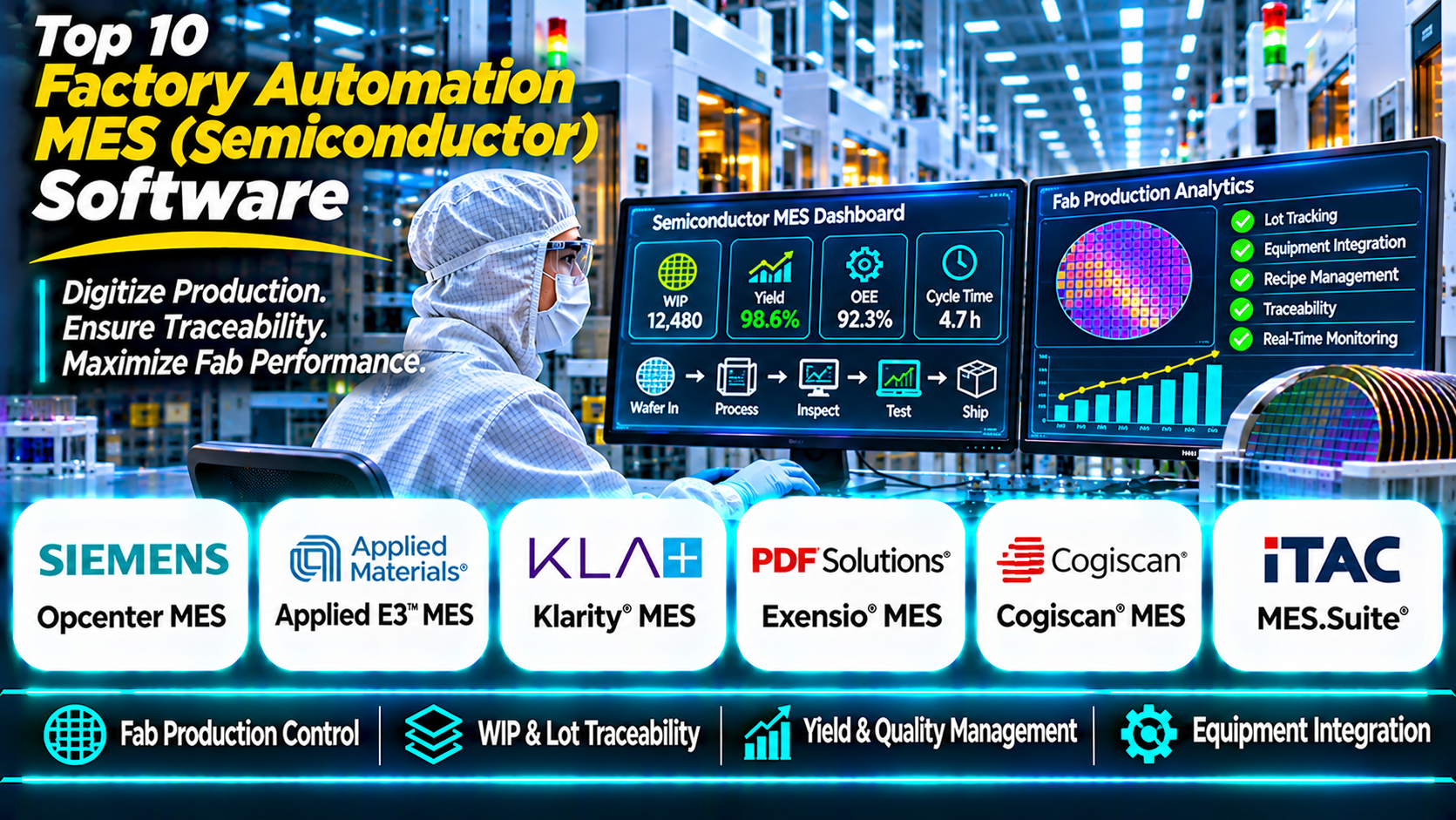
Introduction
Semiconductor manufacturing is one of the most complex industrial production environments. Fabrication facilities must coordinate hundreds of manufacturing operations, sophisticated processing equipment, material movements, quality inspections, and strict production requirements.
Traditional manufacturing management methods often depend on disconnected applications, manual production records, spreadsheets, and isolated equipment control systems. These approaches can create information gaps, production delays, inconsistent manufacturing procedures, and difficulties tracing semiconductor products throughout their manufacturing lifecycle.
Factory automation manufacturing execution systems, commonly called MES, help semiconductor manufacturers coordinate production activities, manage work-in-progress inventory, enforce manufacturing routes, and maintain detailed production histories. These platforms connect enterprise planning systems with manufacturing operations and compatible factory automation technologies.
Modern semiconductor MES platforms incorporate real-time production monitoring, wafer and lot tracking, equipment integration, automated dispatching, recipe management, statistical process control, and manufacturing performance analytics. These capabilities help organizations maintain production consistency and improve operational visibility.
Selecting the right semiconductor MES requires careful consideration of fabrication processes, manufacturing volumes, equipment compatibility, production complexity, automation requirements, and existing information infrastructure. Wafer fabrication facilities, semiconductor packaging companies, and outsourced assembly and test organizations may require substantially different capabilities.
This comprehensive guide examines ten factory automation MES platforms and complementary manufacturing execution technologies, explaining their features, benefits, advantages, limitations, practical applications, and suitability for semiconductor manufacturing environments.
What Is Factory Automation MES for Semiconductor Manufacturing?
Factory automation MES for semiconductor manufacturing is a category of industrial software that coordinates, monitors, documents, and controls manufacturing execution activities within semiconductor production facilities.
Semiconductor manufacturing involves complex production routes containing processes such as deposition, lithography, etching, cleaning, implantation, inspection, metrology, packaging, and electrical testing. Manufacturing execution systems help coordinate these activities according to approved production requirements.
A semiconductor MES maintains information about manufacturing lots, wafers, equipment, process routes, production schedules, material consumption, quality requirements, and operational events. It can exchange information with enterprise resource planning systems, equipment automation applications, advanced process control systems, and manufacturing analytics platforms.
Unlike general manufacturing execution software, semiconductor-oriented MES platforms frequently require support for reentrant manufacturing routes, detailed wafer genealogy, lot splitting and merging, equipment qualification, process queue-time restrictions, and highly automated material handling. The availability of these capabilities varies considerably between products.
Common Applications of Semiconductor Factory Automation MES
- Wafer and Lot Tracking: Maintains information about semiconductor wafers, manufacturing lots, processing status, and production locations.
- Production Route Management: Coordinates manufacturing activities according to approved process sequences and product requirements.
- Equipment Integration: Exchanges operational information with compatible semiconductor manufacturing equipment and automation systems.
- Work-in-Progress Management: Provides visibility into unfinished semiconductor products moving through manufacturing operations.
- Production Dispatching: Helps prioritize eligible manufacturing lots according to production requirements and operational constraints.
- Manufacturing Traceability: Maintains relationships between materials, wafers, equipment, process operations, and production outcomes.
- Quality Management: Supports manufacturing inspections, quality holds, nonconformance documentation, and approved disposition workflows.
- Manufacturing Performance Monitoring: Provides visibility into production throughput, cycle time, equipment utilization, and operational performance.
Essential Components of Semiconductor MES Platforms
| Component | Primary Function |
|---|---|
| Lot Management | Tracks manufacturing lots throughout production |
| Wafer Tracking | Maintains wafer-level manufacturing information |
| Route Management | Coordinates approved manufacturing sequences |
| Equipment Integration | Connects compatible manufacturing equipment |
| Recipe Management | Coordinates approved process recipe information |
| Production Dispatching | Prioritizes eligible manufacturing activities |
| WIP Management | Monitors work-in-progress inventory |
| Material Genealogy | Records relationships between materials and products |
| Quality Management | Coordinates inspections and quality-related workflows |
| Equipment Qualification | Supports enforcement of approved equipment eligibility |
| Manufacturing Analytics | Evaluates operational performance information |
| ERP Integration | Exchanges relevant enterprise planning information |
| Automation Integration | Connects compatible factory automation applications |
| Electronic Records | Maintains structured manufacturing documentation |
Top 10 Factory Automation MES for Semiconductor Manufacturing
The following comparison includes semiconductor-focused manufacturing execution systems, configurable enterprise MES platforms, and complementary manufacturing execution technologies.
Not every application provides native support for advanced wafer fabrication requirements. General-purpose manufacturing execution platforms should be evaluated carefully before deployment in semiconductor front-end manufacturing.
The numbering organizes the comparison rather than representing independently tested performance rankings.
1. Siemens Opcenter Execution Semiconductor
Short Description
Siemens Opcenter Execution Semiconductor is a manufacturing execution solution designed to address the complex operational requirements of semiconductor production.
The platform helps semiconductor manufacturers coordinate manufacturing activities, manage production routes, track wafers and lots, and maintain detailed manufacturing records.
Its semiconductor-oriented functionality is particularly relevant to organizations operating sophisticated production environments involving complex process sequences, equipment qualification requirements, manufacturing traceability, and quality management.
The broader Siemens digital manufacturing ecosystem provides complementary capabilities for manufacturing intelligence, production planning, scheduling, and engineering information integration.
Key Features
- Semiconductor Manufacturing Execution: Coordinates production activities using manufacturing models designed for semiconductor environments.
- Wafer and Lot Management: Maintains manufacturing information about wafers, lots, and applicable production relationships.
- Process Route Management: Supports complex manufacturing sequences and approved process requirements.
- Equipment Integration: Connects compatible semiconductor equipment and manufacturing automation systems.
- Manufacturing Genealogy: Records relationships between production materials, equipment, process activities, and manufacturing outcomes.
- Quality Management: Supports applicable manufacturing inspections, quality holds, and nonconformance workflows.
- Production Dispatching: Coordinates applicable manufacturing priorities and eligible production activities.
- Manufacturing Information Integration: Exchanges relevant information with compatible enterprise and operational systems.
- Production Performance Visibility: Provides structured manufacturing information for operational and engineering teams.
Benefits
- Improves visibility into semiconductor manufacturing activities.
- Supports consistent execution of approved production routes.
- Reduces dependence on disconnected manufacturing records.
- Improves manufacturing traceability.
- Facilitates coordination between production and engineering teams.
- Supports complex manufacturing automation requirements.
- Provides a foundation for enterprise manufacturing intelligence.
Pros
- Dedicated semiconductor manufacturing execution orientation.
- Suitable for complex manufacturing environments.
- Supports detailed manufacturing traceability.
- Relevant equipment integration capabilities.
- Broad digital manufacturing ecosystem.
- Supports enterprise manufacturing operations.
Cons
- Commercial licensing requires consultation.
- Implementation can require substantial technical resources.
- Equipment integration requires specialist expertise.
- Configuration must reflect actual manufacturing requirements.
- Organizational adoption may require extensive training.
Use Cases
- Wafer Fabrication: Coordinate complex semiconductor manufacturing routes.
- Lot Tracking: Maintain structured manufacturing lot histories.
- Production Quality Management: Coordinate manufacturing holds and quality assessments.
- Equipment Automation: Integrate compatible production equipment.
- Manufacturing Traceability: Investigate relationships between production materials and process activities.
- Enterprise Manufacturing Integration: Connect semiconductor operations with compatible enterprise systems.
Best For
- Semiconductor foundries.
- Integrated device manufacturers.
- Advanced wafer fabrication facilities.
- Semiconductor manufacturing engineers.
- Enterprise manufacturing operations.
- Organizations requiring semiconductor-specific MES functionality.
2. Critical Manufacturing MES
Short Description
Critical Manufacturing MES is an advanced manufacturing execution platform designed for complex manufacturing industries, including semiconductor production, electronics, medical devices, and industrial equipment.
The platform provides configurable manufacturing models, production execution workflows, equipment integration, material tracking, and manufacturing analytics capabilities.
Its semiconductor manufacturing capabilities are relevant to organizations requiring detailed lot and wafer management, complex manufacturing routes, production automation, and structured quality management.
Critical Manufacturing MES is particularly suitable for organizations modernizing manufacturing infrastructure and implementing integrated digital manufacturing environments.
Key Features
- Advanced Manufacturing Execution: Coordinates complex manufacturing operations using configurable production models.
- Material and Lot Tracking: Maintains structured information about manufacturing materials and production lots.
- Wafer-Level Management: Supports applicable semiconductor wafer tracking and manufacturing relationships.
- Equipment Automation Integration: Connects compatible production equipment and automation applications.
- Production Route Configuration: Supports complex manufacturing sequences and operational requirements.
- Quality Management: Coordinates applicable inspection, nonconformance, and corrective manufacturing workflows.
- Manufacturing Data Collection: Captures relevant operational measurements and production events.
- Manufacturing Analytics: Provides visibility into production performance and manufacturing information.
- Digital Manufacturing Integration: Supports compatible enterprise, equipment, and industrial information systems.
Benefits
- Improves manufacturing process visibility.
- Supports complex semiconductor production workflows.
- Facilitates equipment and operational information integration.
- Improves manufacturing traceability.
- Reduces fragmented production documentation.
- Supports configurable manufacturing requirements.
- Helps organizations modernize factory operations.
Pros
- Strong advanced manufacturing specialization.
- Relevant semiconductor manufacturing capabilities.
- Configurable manufacturing execution architecture.
- Supports complex production models.
- Provides integrated manufacturing information.
- Suitable for digital manufacturing modernization.
Cons
- Commercial pricing requires evaluation.
- Implementation requires detailed manufacturing process modeling.
- Legacy equipment integration may require additional development.
- Advanced configurations require specialist expertise.
- Large deployments require structured organizational change management.
Use Cases
- Semiconductor Front-End Manufacturing: Coordinate applicable wafer fabrication operations.
- Semiconductor Back-End Manufacturing: Manage packaging and assembly production workflows.
- Electronics Manufacturing: Coordinate complex component manufacturing activities.
- Factory Modernization: Replace fragmented legacy manufacturing execution applications.
- Manufacturing Quality Control: Manage inspections and production-related quality workflows.
- Equipment Integration: Connect compatible equipment with manufacturing execution processes.
Best For
- Semiconductor manufacturers.
- Advanced electronics manufacturers.
- Semiconductor packaging facilities.
- Digital manufacturing transformation teams.
- Manufacturing automation engineers.
- Organizations requiring configurable advanced MES platforms.
3. Applied Materials PROMIS
Short Description
PROMIS is an established semiconductor manufacturing execution system associated with Applied Materials’ factory automation software portfolio.
The system has historically supported semiconductor manufacturing operations through production tracking, manufacturing route management, material control, and equipment-related operational integration.
PROMIS is particularly relevant to established semiconductor fabrication facilities operating mature manufacturing technologies and existing factory automation infrastructure.
Because semiconductor MES installations can remain operational for many years, organizations evaluating PROMIS should distinguish existing deployment capabilities from current commercial availability, modernization options, and vendor support arrangements.
Key Features
- Manufacturing Lot Management: Tracks semiconductor manufacturing lots through applicable production activities.
- Process Route Execution: Coordinates manufacturing operations according to defined production sequences.
- Production Transaction Management: Records relevant manufacturing events and operational changes.
- Material Tracking: Maintains information about production materials and manufacturing status.
- Equipment Status Integration: Supports applicable equipment information and production connectivity.
- Work-in-Progress Visibility: Provides information about unfinished manufacturing materials.
- Manufacturing History: Maintains records of relevant production activities.
- Operational Rule Enforcement: Supports configured manufacturing execution requirements.
- Factory System Integration: Connects with compatible manufacturing and automation applications.
Benefits
- Supports structured semiconductor production execution.
- Maintains manufacturing lot visibility.
- Facilitates consistent production documentation.
- Supports established factory automation environments.
- Improves manufacturing history accessibility.
- Helps coordinate production operations.
- Provides continuity for compatible existing semiconductor installations.
Pros
- Established semiconductor MES heritage.
- Relevant wafer fabrication workflows.
- Supports complex manufacturing routes.
- Useful for compatible mature manufacturing environments.
- Provides manufacturing history and traceability.
- Relevant to existing Applied Materials factory automation installations.
Cons
- Current licensing and support arrangements require confirmation.
- Legacy implementations may require modernization.
- Integration with contemporary systems may require additional development.
- User experience varies according to implementation.
- Migration planning can be technically demanding.
Use Cases
- Established Wafer Fabs: Support existing semiconductor manufacturing execution environments.
- Mature Process Manufacturing: Coordinate applicable production routes.
- Manufacturing Lot Administration: Maintain structured lot histories.
- Legacy Factory Integration: Connect compatible established manufacturing applications.
- Production History Management: Preserve relevant manufacturing records.
- MES Modernization Assessment: Evaluate migration requirements for existing PROMIS installations.
Best For
- Established semiconductor fabrication facilities.
- Organizations with existing PROMIS deployments.
- Mature semiconductor process manufacturers.
- Factory automation administrators.
- Manufacturing infrastructure modernization teams.
- Organizations evaluating legacy MES continuity.
4. IBM SiView Standard
Short Description
IBM SiView Standard is an established semiconductor manufacturing execution and factory automation solution designed for sophisticated wafer fabrication environments.
The platform has historically supported complex manufacturing operations, production tracking, equipment integration, automated material handling coordination, and semiconductor factory management.
Its architecture is relevant to fabrication facilities requiring highly structured manufacturing execution processes and extensive integration between production applications.
Organizations evaluating SiView should confirm current commercial availability, support arrangements, technology compatibility, and modernization options. Existing installations may differ considerably in configuration and functionality.
Key Features
- Semiconductor Production Execution: Coordinates applicable semiconductor manufacturing operations.
- Wafer and Lot Tracking: Maintains production information for semiconductor wafers and lots.
- Complex Route Management: Supports manufacturing sequences involving repeated process operations.
- Equipment Integration: Connects compatible semiconductor manufacturing equipment.
- Factory Automation Coordination: Supports applicable integration with automated factory systems.
- Manufacturing Dispatching: Coordinates configured production selection and dispatching activities.
- Material Handling Integration: Supports compatible automated material handling workflows.
- Manufacturing Traceability: Maintains relevant production histories and material relationships.
- Factory Information Management: Organizes operational information across supported manufacturing activities.
Benefits
- Supports sophisticated semiconductor fabrication operations.
- Improves manufacturing material visibility.
- Facilitates coordination between factory automation systems.
- Supports detailed manufacturing histories.
- Helps maintain consistent manufacturing execution.
- Provides relevant automation integration capabilities.
- Supports established semiconductor factory architectures.
Pros
- Semiconductor-specific manufacturing heritage.
- Relevant advanced wafer fabrication capabilities.
- Supports complex manufacturing execution.
- Provides applicable factory automation integration.
- Suitable for compatible large-scale manufacturing environments.
- Relevant to established automated semiconductor fabs.
Cons
- Current commercial availability requires verification.
- Existing deployments may involve legacy technologies.
- Implementation requires specialist semiconductor automation expertise.
- Modernization can require significant technical planning.
- Commercial and technical support conditions should be confirmed.
Use Cases
- Automated Wafer Fabrication: Coordinate complex semiconductor manufacturing operations.
- Material Handling Coordination: Integrate compatible factory material movement systems.
- Production Route Management: Execute approved semiconductor manufacturing sequences.
- Equipment Connectivity: Exchange relevant manufacturing information with compatible equipment.
- Manufacturing Genealogy: Maintain wafer and lot production histories.
- Legacy MES Modernization: Evaluate existing semiconductor factory infrastructure.
Best For
- Large semiconductor fabrication facilities.
- Organizations with existing SiView installations.
- Advanced factory automation teams.
- Semiconductor production engineers.
- Manufacturing infrastructure specialists.
- Organizations evaluating established semiconductor MES architectures.
5. Eyelit MES
Short Description
Eyelit MES, within the Eyelit Technologies manufacturing software portfolio, provides manufacturing execution capabilities for complex industrial environments, including semiconductor and electronics production.
The platform helps organizations manage production workflows, track materials, coordinate manufacturing operations, and maintain structured manufacturing histories.
Its capabilities are particularly relevant to manufacturers requiring flexible manufacturing models, detailed traceability, production quality management, and equipment integration.
Eyelit can support organizations implementing new manufacturing execution environments or modernizing existing production management systems. Current modules and product packaging should be confirmed during evaluation.
Key Features
- Manufacturing Execution: Coordinates configured manufacturing activities and production transactions.
- Lot and Material Tracking: Maintains structured information about manufacturing materials.
- Production Workflow Configuration: Supports configurable manufacturing sequences and operational requirements.
- Equipment Integration: Connects compatible production equipment and automation systems.
- Manufacturing Genealogy: Records relationships between materials, process activities, and production outcomes.
- Quality Management: Supports applicable manufacturing quality assessments and disposition workflows.
- Production Data Collection: Captures relevant manufacturing measurements and operational events.
- Manufacturing Performance Reporting: Provides visibility into selected production indicators.
- Enterprise Integration: Exchanges information with compatible business and manufacturing applications.
Benefits
- Improves manufacturing execution visibility.
- Supports structured production workflows.
- Facilitates material traceability.
- Reduces disconnected manufacturing documentation.
- Improves coordination between manufacturing and quality teams.
- Supports configurable manufacturing requirements.
- Helps organizations modernize manufacturing operations.
Pros
- Relevant semiconductor and electronics manufacturing capabilities.
- Flexible manufacturing workflow configuration.
- Supports detailed material traceability.
- Provides applicable equipment integration.
- Suitable for complex manufacturing environments.
- Supports broader manufacturing operations management.
Cons
- Commercial licensing requires consultation.
- Implementation requires accurate manufacturing process models.
- Advanced automation may require additional integration.
- Available capabilities depend on selected products.
- Specialized wafer fabrication requirements should be tested.
Use Cases
- Semiconductor Production Execution: Coordinate applicable semiconductor manufacturing workflows.
- Electronics Manufacturing: Manage production activities and component traceability.
- Packaging Operations: Track manufacturing materials through assembly and packaging.
- Manufacturing Quality Management: Document quality assessments and production dispositions.
- Factory Modernization: Replace fragmented production tracking applications.
- Manufacturing Performance Monitoring: Evaluate relevant operational indicators.
Best For
- Semiconductor manufacturers.
- Electronics manufacturing organizations.
- Semiconductor assembly facilities.
- Manufacturing operations managers.
- Factory automation engineers.
- Organizations requiring flexible manufacturing execution.
6. camLine InFrame Synapse
Short Description
camLine InFrame Synapse is a manufacturing execution solution associated with camLine’s industrial manufacturing software portfolio.
The platform addresses manufacturing execution requirements in high-technology industries, including semiconductor and electronics production.
Its capabilities support structured production workflows, material tracking, manufacturing information management, and integration with compatible factory systems.
camLine also offers complementary manufacturing software for statistical process control, quality management, equipment integration, and manufacturing data analysis. Organizations should evaluate which capabilities belong to InFrame Synapse and which require separate products.
Key Features
- Manufacturing Execution Management: Coordinates configured production operations and manufacturing activities.
- Material Tracking: Maintains structured information about production materials and manufacturing status.
- Manufacturing Workflow Configuration: Supports organization-specific production sequences.
- Equipment Connectivity: Supports integration with compatible manufacturing equipment.
- Production Data Collection: Captures relevant manufacturing measurements and events.
- Manufacturing Traceability: Maintains relationships between production activities and materials.
- Quality Workflow Integration: Connects with applicable quality management and process control capabilities.
- Manufacturing Reporting: Provides structured visibility into production information.
- Factory Software Integration: Supports compatible camLine and third-party manufacturing applications.
Benefits
- Improves organization of manufacturing information.
- Supports high-technology manufacturing workflows.
- Facilitates material and production traceability.
- Improves coordination between manufacturing systems.
- Supports structured production data collection.
- Complements manufacturing quality management.
- Helps organizations establish integrated factory software environments.
Pros
- Relevant high-technology manufacturing specialization.
- Supports configurable manufacturing execution.
- Provides complementary quality and process control ecosystem.
- Useful for semiconductor and electronics environments.
- Supports applicable equipment integration.
- Provides structured manufacturing information management.
Cons
- Commercial pricing requires evaluation.
- Some functionality may require complementary modules.
- Semiconductor-specific requirements must be validated.
- Implementation requires technical preparation.
- Integration complexity depends on existing factory infrastructure.
Use Cases
- Semiconductor Manufacturing Execution: Coordinate applicable semiconductor production operations.
- Electronics Production Management: Track manufacturing materials and operational activities.
- Manufacturing Quality Integration: Connect production execution with compatible quality applications.
- Production Data Management: Maintain structured operational records.
- Equipment Integration: Connect supported manufacturing equipment.
- High-Technology Factory Modernization: Implement integrated manufacturing software workflows.
Best For
- Semiconductor manufacturers.
- Electronics manufacturing facilities.
- High-technology industrial organizations.
- Manufacturing quality departments.
- Factory integration specialists.
- Organizations using complementary camLine technologies.
7. SAP Digital Manufacturing
Short Description
SAP Digital Manufacturing is a cloud-oriented manufacturing operations and execution platform designed to connect enterprise business processes with manufacturing activities.
The platform supports production execution, operational information collection, manufacturing performance monitoring, and integration with compatible SAP enterprise applications.
Semiconductor packaging, assembly, electronics production, and other manufacturing environments can evaluate SAP Digital Manufacturing for relevant production execution requirements.
Advanced wafer fabrication requirements, including complex reentrant routes and semiconductor-specific wafer genealogy, should be validated carefully. SAP Digital Manufacturing is a broader industrial manufacturing platform rather than a universally applicable replacement for specialized semiconductor MES.
Key Features
- Production Execution: Coordinates configured manufacturing activities and production orders.
- Manufacturing Data Collection: Captures relevant production measurements and operational information.
- Material Traceability: Supports applicable manufacturing material tracking and genealogy.
- Enterprise Integration: Connects with compatible SAP enterprise resource planning applications.
- Manufacturing Performance Monitoring: Provides visibility into selected production indicators.
- Production Operator Interfaces: Supports configured manufacturing operator workflows.
- Equipment Connectivity: Connects with compatible industrial equipment and integration technologies.
- Quality Workflow Integration: Supports applicable manufacturing quality management processes.
- Cloud-Based Manufacturing Architecture: Provides cloud-oriented manufacturing execution and information management capabilities.
Benefits
- Improves integration between enterprise and manufacturing operations.
- Supports structured production execution.
- Facilitates manufacturing performance reporting.
- Improves production information accessibility.
- Supports consistent manufacturing workflows.
- Reduces fragmented business and production information.
- Provides a foundation for enterprise digital manufacturing.
Pros
- Strong SAP enterprise integration orientation.
- Relevant manufacturing execution functionality.
- Supports cloud-oriented manufacturing operations.
- Provides configurable production workflows.
- Useful for distributed manufacturing organizations.
- Suitable for compatible enterprise modernization programs.
Cons
- Advanced wafer fabrication requirements need careful evaluation.
- Commercial licensing requires consultation.
- Integration may require additional middleware or services.
- Cloud connectivity and deployment requirements must be assessed.
- Specialized semiconductor automation may require complementary systems.
Use Cases
- Semiconductor Packaging: Coordinate applicable assembly and packaging production activities.
- Electronics Manufacturing: Execute configured production orders.
- Enterprise Manufacturing Integration: Connect production activities with compatible SAP business systems.
- Production Performance Reporting: Monitor selected manufacturing indicators.
- Manufacturing Traceability: Maintain applicable material and production histories.
- Digital Manufacturing Transformation: Modernize compatible manufacturing execution environments.
Best For
- Organizations using SAP enterprise applications.
- Semiconductor packaging companies.
- Electronics manufacturers.
- Enterprise manufacturing operations.
- Digital transformation departments.
- Organizations prioritizing ERP and manufacturing integration.
8. Dassault Systèmes DELMIA Apriso
Short Description
DELMIA Apriso is an enterprise manufacturing operations management platform offered by Dassault Systèmes.
The platform provides manufacturing execution, quality management, material management, production visibility, and configurable operational workflows.
Its capabilities are relevant to complex manufacturing organizations requiring standardized production processes across multiple facilities.
Semiconductor assembly, packaging, electronics production, and selected high-technology manufacturing operations can evaluate DELMIA Apriso for applicable execution requirements. Advanced wafer fabrication functionality should be demonstrated using representative semiconductor production scenarios.
Key Features
- Manufacturing Execution: Coordinates configured manufacturing operations and production workflows.
- Global Manufacturing Standardization: Supports consistent operational processes across manufacturing locations.
- Material Management: Maintains applicable production material information.
- Manufacturing Traceability: Supports structured production histories and material relationships.
- Quality Management: Coordinates applicable inspections, nonconformance records, and manufacturing quality workflows.
- Production Data Collection: Captures relevant operational measurements and production events.
- Equipment Integration: Connects with compatible industrial equipment and automation systems.
- Manufacturing Performance Reporting: Provides visibility into selected operational indicators.
- Enterprise System Integration: Exchanges relevant information with compatible business and engineering applications.
Benefits
- Supports consistent manufacturing execution across facilities.
- Improves production traceability.
- Facilitates manufacturing quality management.
- Reduces disconnected operational records.
- Supports configurable manufacturing processes.
- Improves coordination between enterprise and factory operations.
- Provides centralized manufacturing performance visibility.
Pros
- Comprehensive manufacturing operations management functionality.
- Strong multi-site manufacturing orientation.
- Supports configurable production workflows.
- Relevant material and quality management capabilities.
- Suitable for complex enterprise manufacturing.
- Provides complementary digital manufacturing ecosystem.
Cons
- Semiconductor-specific wafer workflows require validation.
- Commercial licensing requires consultation.
- Enterprise implementation may require substantial resources.
- Complex configurations require specialist expertise.
- Advanced factory automation may require additional integration.
Use Cases
- Semiconductor Assembly: Coordinate applicable manufacturing assembly activities.
- Electronics Manufacturing: Manage complex production operations.
- Multi-Site Manufacturing Standardization: Establish consistent operational workflows.
- Manufacturing Quality Management: Coordinate inspections and nonconformance documentation.
- Production Traceability: Maintain relevant manufacturing histories.
- Enterprise Manufacturing Modernization: Integrate manufacturing execution with compatible enterprise applications.
Best For
- Large manufacturing organizations.
- Semiconductor packaging facilities.
- Electronics manufacturers.
- Multi-site production networks.
- Enterprise manufacturing operations managers.
- Organizations requiring integrated manufacturing operations management.
9. Rockwell Automation FactoryTalk ProductionCentre
Short Description
FactoryTalk ProductionCentre is a manufacturing execution and production management solution associated with Rockwell Automation’s industrial software portfolio.
The platform supports manufacturing execution, production tracking, quality management, material information, and integration with compatible industrial automation infrastructure.
Its capabilities are relevant to organizations requiring coordination between production management applications and factory-level automation technologies.
Semiconductor back-end manufacturing, electronics production, and selected high-technology manufacturing operations may benefit from applicable FactoryTalk ProductionCentre capabilities. Dedicated semiconductor wafer fabrication requirements should be evaluated separately.
Key Features
- Production Execution Management: Coordinates configured manufacturing activities.
- Manufacturing Material Tracking: Maintains relevant production material records.
- Quality Management: Supports applicable manufacturing inspections and quality workflows.
- Production Genealogy: Records relationships between production materials and manufacturing activities.
- Industrial Automation Integration: Connects with compatible factory automation systems.
- Production Data Collection: Captures relevant operational measurements and events.
- Manufacturing Workflow Configuration: Supports organization-specific production processes.
- Production Performance Reporting: Provides visibility into selected manufacturing indicators.
- Enterprise Connectivity: Exchanges information with compatible enterprise and manufacturing applications.
Benefits
- Improves coordination between production and automation systems.
- Supports structured manufacturing execution.
- Facilitates manufacturing traceability.
- Improves operational information accessibility.
- Supports consistent production workflows.
- Helps integrate quality and manufacturing activities.
- Provides visibility into manufacturing performance.
Pros
- Established industrial automation ecosystem.
- Relevant manufacturing execution functionality.
- Supports configurable production workflows.
- Provides applicable material and quality management capabilities.
- Useful for compatible industrial automation environments.
- Supports enterprise manufacturing integration.
Cons
- Not exclusively designed for semiconductor wafer fabrication.
- Commercial licensing requires evaluation.
- Specialized semiconductor workflows may require customization.
- Integration depends on equipment and system compatibility.
- Current product packaging and support arrangements should be confirmed.
Use Cases
- Semiconductor Packaging Operations: Coordinate applicable production execution activities.
- Electronics Assembly: Track materials and manufacturing operations.
- Factory Automation Integration: Connect compatible industrial automation infrastructure.
- Production Quality Management: Maintain structured manufacturing quality records.
- Manufacturing Genealogy: Preserve relevant production histories.
- Industrial Manufacturing Modernization: Integrate execution and automation applications.
Best For
- Semiconductor back-end manufacturing facilities.
- Electronics manufacturers.
- Industrial automation engineers.
- Manufacturing quality departments.
- Organizations using compatible Rockwell Automation technologies.
- Manufacturers requiring integrated production execution.
10. iBASEt Solumina
Short Description
iBASEt Solumina is a manufacturing operations management platform designed for complex discrete manufacturing environments.
The software supports manufacturing execution, production quality management, electronic work instructions, manufacturing traceability, and related operational workflows.
Although Solumina is strongly associated with aerospace, defense, and other complex manufacturing industries, its capabilities may be relevant to selected advanced electronics and semiconductor-related assembly operations.
It is included as a complementary manufacturing execution option for complex assembly and quality-intensive production rather than a dedicated front-end semiconductor fabrication MES.
Key Features
- Manufacturing Execution: Coordinates configured discrete manufacturing operations.
- Electronic Work Instructions: Provides structured instructions for approved production activities.
- Production Traceability: Maintains relevant manufacturing histories and material relationships.
- Quality Management: Supports applicable inspections, nonconformance records, and quality workflows.
- Manufacturing Documentation: Organizes production records and associated operational information.
- Process Configuration: Supports complex manufacturing sequences and controlled workflows.
- Engineering Information Integration: Connects with compatible engineering and product information systems.
- Production Data Collection: Captures relevant manufacturing measurements and operational events.
- Manufacturing Performance Visibility: Provides structured operational reporting.
Benefits
- Improves consistency of complex assembly operations.
- Supports detailed manufacturing documentation.
- Facilitates manufacturing quality management.
- Improves production traceability.
- Supports controlled manufacturing instructions.
- Helps coordinate engineering and production information.
- Reduces dependence on disconnected manufacturing records.
Pros
- Strong complex discrete manufacturing orientation.
- Relevant electronic work instruction capabilities.
- Supports detailed manufacturing documentation.
- Provides integrated quality management functionality.
- Useful for quality-intensive assembly environments.
- Supports configurable manufacturing execution.
Cons
- Not a dedicated semiconductor wafer fabrication MES.
- Commercial licensing requires consultation.
- Semiconductor-specific automation requires careful evaluation.
- Enterprise implementation can require substantial preparation.
- Specialized high-volume manufacturing requirements may require complementary software.
Use Cases
- Advanced Electronics Assembly: Coordinate complex assembly production activities.
- Specialized Semiconductor Packaging: Support applicable controlled assembly workflows.
- Electronic Manufacturing Instructions: Provide structured production instructions.
- Manufacturing Quality Documentation: Maintain relevant inspection and nonconformance records.
- Engineering-to-Manufacturing Integration: Connect approved engineering information with production activities.
- Complex Product Traceability: Maintain detailed production histories.
Best For
- Advanced electronics manufacturers.
- Complex discrete manufacturing organizations.
- Quality-intensive assembly facilities.
- Manufacturing engineering departments.
- Organizations requiring electronic work instructions.
- Specialized semiconductor-related manufacturing operations.
Comparison Table: Top 10 Semiconductor Factory Automation MES
| Software | Primary Function | Best For | Standout Capability | Pricing Model |
|---|---|---|---|---|
| Siemens Opcenter Execution Semiconductor | Semiconductor MES | Wafer fabrication and integrated manufacturers | Semiconductor-specific execution workflows | Commercial licensing |
| Critical Manufacturing MES | Advanced manufacturing execution | Semiconductor and electronics manufacturers | Configurable advanced manufacturing models | Commercial licensing |
| Applied Materials PROMIS | Established semiconductor MES | Existing and mature wafer fabs | Semiconductor production tracking | Confirm current availability |
| IBM SiView Standard | Semiconductor MES and factory automation | Established automated wafer fabs | Complex factory automation coordination | Confirm current availability |
| Eyelit MES | Manufacturing execution | Semiconductor and electronics production | Flexible production execution | Commercial licensing |
| camLine InFrame Synapse | High-technology manufacturing execution | Semiconductor and electronics facilities | Integrated factory software ecosystem | Commercial licensing |
| SAP Digital Manufacturing | Enterprise manufacturing execution | SAP-connected manufacturing organizations | ERP and manufacturing integration | Commercial subscription |
| DELMIA Apriso | Manufacturing operations management | Multi-site manufacturing networks | Global manufacturing standardization | Commercial licensing |
| FactoryTalk ProductionCentre | Manufacturing execution and automation integration | Compatible industrial production environments | Industrial automation connectivity | Commercial licensing |
| iBASEt Solumina | Complex discrete manufacturing execution | Specialized electronics assembly | Electronic work instructions and quality workflows | Commercial licensing |
Product availability, supported capabilities, pricing, deployment architecture, and integration arrangements should be confirmed directly with providers.
PROMIS and SiView are included because of their established semiconductor manufacturing heritage. Their suitability for new implementations depends on current commercial support and modernization arrangements.
General-purpose manufacturing execution platforms should not be assumed to provide native support for every advanced wafer fabrication requirement.
Which Semiconductor Factory Automation MES Is Right for You?
For Advanced Semiconductor Foundries
Siemens Opcenter Execution Semiconductor and Critical Manufacturing MES provide relevant semiconductor manufacturing execution capabilities.
Foundries should prioritize complex route management, wafer genealogy, equipment qualification, production dispatching, queue-time enforcement, and equipment automation integration.
For Established Semiconductor Fabrication Facilities
Applied Materials PROMIS and IBM SiView Standard may be relevant when organizations already operate these systems.
The evaluation should focus on operational continuity, support availability, integration requirements, modernization costs, and migration risks.
Existing installations should not automatically be replaced without understanding their operational dependencies.
For Semiconductor Packaging and Assembly
Eyelit MES, Critical Manufacturing MES, and Siemens Opcenter Execution Semiconductor provide relevant manufacturing execution capabilities.
Broader platforms such as SAP Digital Manufacturing and DELMIA Apriso may also be evaluated for applicable back-end manufacturing requirements.
For High-Technology Manufacturing
camLine InFrame Synapse provides relevant manufacturing execution capabilities within a broader high-technology manufacturing software ecosystem.
Organizations should evaluate integration with statistical process control, equipment information, quality management, and manufacturing analytics applications.
For Organizations Using SAP ERP
SAP Digital Manufacturing provides relevant integration capabilities for compatible SAP enterprise environments.
Organizations should evaluate production order integration, material consumption records, manufacturing performance information, and semiconductor-specific execution requirements.
For Multi-Site Manufacturing Networks
DELMIA Apriso provides enterprise manufacturing operations management capabilities relevant to organizations requiring standardized production processes across multiple locations.
The evaluation should address local manufacturing differences, enterprise information governance, and factory integration requirements.
For Industrial Automation Integration
FactoryTalk ProductionCentre provides relevant capabilities for organizations operating compatible industrial automation infrastructure.
Semiconductor manufacturers should test equipment connectivity, production execution workflows, manufacturing traceability, and integration with existing factory systems.
For Complex Electronics Assembly
iBASEt Solumina provides relevant electronic work instructions, quality management, and complex manufacturing execution capabilities.
It is particularly suitable for evaluation where manufacturing documentation and controlled assembly activities are more important than advanced wafer fabrication automation.
Best Semiconductor MES by User Type
| User Type | Software to Evaluate | Primary Reason |
|---|---|---|
| Advanced foundry operations manager | Siemens Opcenter Execution Semiconductor | Semiconductor-specific manufacturing execution |
| Digital fab modernization manager | Critical Manufacturing MES | Configurable advanced manufacturing architecture |
| Existing PROMIS administrator | Applied Materials PROMIS | Established manufacturing execution continuity |
| Automated fab infrastructure engineer | IBM SiView Standard | Semiconductor factory automation heritage |
| Semiconductor packaging manager | Eyelit MES | Flexible manufacturing execution |
| High-technology manufacturing engineer | camLine InFrame Synapse | Integrated manufacturing software capabilities |
| SAP enterprise architect | SAP Digital Manufacturing | Enterprise and manufacturing integration |
| Global manufacturing director | DELMIA Apriso | Multi-site operational standardization |
| Industrial automation specialist | FactoryTalk ProductionCentre | Compatible automation integration |
| Complex assembly engineer | iBASEt Solumina | Controlled manufacturing instructions |
How to Choose the Best Semiconductor Factory Automation MES
1. Define Semiconductor Manufacturing Requirements
Begin by documenting the manufacturing processes, product types, production volumes, and operational requirements of the facility.
Front-end wafer fabrication involves different manufacturing execution requirements from semiconductor packaging, assembly, electrical testing, and electronics production.
Identify whether the organization requires wafer-level tracking, lot splitting and merging, reentrant routes, equipment qualification, automated dispatching, and advanced factory automation.
Clearly defined requirements help distinguish specialized semiconductor MES platforms from broader manufacturing execution applications.
2. Evaluate Wafer and Lot Management
Semiconductor manufacturing requires accurate tracking of materials throughout complex production activities.
Evaluate whether the software supports relevant lot structures, wafer identifiers, carrier relationships, lot splitting, lot merging, manufacturing holds, and production history.
The platform should maintain reliable relationships between manufacturing materials and process operations.
Test representative scenarios involving abnormal production conditions, material transfers, rework, and manufacturing exceptions.
3. Assess Complex Manufacturing Route Management
Semiconductor fabrication frequently involves reentrant production routes, where wafers return to similar equipment groups at different manufacturing stages.
Evaluate support for repeated operations, conditional routing, approved rework, process dependencies, route revisions, and queue-time requirements.
Manufacturing route changes should remain subject to approved engineering and quality procedures.
A platform that supports simple linear production sequences may not adequately address advanced wafer fabrication requirements.
4. Review Equipment Automation Compatibility
Semiconductor factories may operate equipment from numerous manufacturers with different automation interfaces.
Evaluate support for applicable equipment communication standards, including SECS/GEM and relevant SEMI automation standards where required.
Organizations should test actual equipment connectivity rather than assuming standards support guarantees complete interoperability.
Equipment integration should address operational status, process events, recipe coordination, production transactions, and exception handling.
5. Examine Automated Material Handling Integration
Advanced semiconductor fabs may use automated material handling systems to transport wafer carriers between manufacturing equipment and storage locations.
Evaluate how the MES exchanges information with compatible material control systems, transport controllers, stockers, and equipment load ports.
The platform should maintain consistent information about material identity, location, transportation status, and manufacturing eligibility.
Physical automation and equipment safety controls must remain within appropriate dedicated control systems.
6. Evaluate Production Dispatching and Scheduling
Production dispatching determines which eligible manufacturing activity should occur next according to configured operational priorities.
Evaluate support for equipment availability, production priorities, process queue-time restrictions, manufacturing qualifications, and work-in-progress conditions.
Distinguish dispatching from production scheduling. Dispatching addresses operational selection decisions, while scheduling typically coordinates broader production plans and resource allocation.
Advanced optimization may require complementary scheduling applications.
7. Assess Manufacturing Quality and Traceability
Semiconductor manufacturers require detailed production histories to investigate defects, manufacturing excursions, and customer quality concerns.
Evaluate manufacturing genealogy, quality holds, inspection records, nonconformance management, approved dispositions, and audit histories.
The platform should preserve relevant relationships between manufacturing materials, equipment, process operations, and quality outcomes.
Manufacturing records must remain accessible according to applicable organizational and customer requirements.
8. Review Availability, Scalability, and System Resilience
Semiconductor fabrication facilities frequently operate continuously, making manufacturing system availability an important operational requirement.
Evaluate deployment architecture, transaction performance, system redundancy, disaster recovery arrangements, backup procedures, and operational recovery capabilities.
Test representative manufacturing transaction volumes and system failure scenarios.
Organizations should establish appropriate contingency procedures for maintaining safe and controlled manufacturing operations during system disruptions.
9. Evaluate Cybersecurity and Information Governance
Semiconductor manufacturing systems may contain commercially sensitive process information, proprietary production routes, equipment configuration details, and confidential manufacturing records.
Evaluate role-based access controls, authentication, audit records, network architecture, encryption, software update procedures, and integration security.
Manufacturing system access should follow appropriate industrial cybersecurity practices.
Changes to manufacturing configurations must remain controlled, documented, and restricted to authorized personnel.
10. Calculate Total Cost of Ownership
Semiconductor MES implementation costs extend beyond software licensing.
Potential expenses include equipment integration, manufacturing process modeling, infrastructure, implementation services, data migration, validation, employee training, technical support, and ongoing administration.
Legacy MES modernization may also require parallel operations, interface redevelopment, historical information migration, and carefully controlled production transitions.
Compare total ownership costs against operational requirements, implementation risks, expected manufacturing benefits, and long-term technology support.
Practical Example: Implementing Factory Automation MES in a Semiconductor Fabrication Facility
Consider a hypothetical semiconductor fabrication facility producing wafers for integrated circuit manufacturing.
The facility operates multiple processing areas, including deposition, lithography, etching, cleaning, inspection, and metrology.
Its existing manufacturing environment relies on disconnected production applications and partially manual manufacturing transactions.
The organization wants to implement an integrated semiconductor MES to improve production visibility, manufacturing traceability, cycle time, and operational coordination.
All numerical values below are hypothetical and illustrate manufacturing management calculations rather than actual product performance.
Step 1: Establish Manufacturing Objectives
The organization defines the following objectives:
- Centralize manufacturing execution information.
- Improve wafer and lot traceability.
- Integrate compatible manufacturing equipment.
- Reduce manual production transactions.
- Improve work-in-progress visibility.
- Monitor production cycle time.
- Support consistent manufacturing route execution.
- Improve production quality documentation.
These objectives establish the scope of the MES implementation.
Step 2: Evaluate Candidate Platforms
The organization evaluates Siemens Opcenter Execution Semiconductor and Critical Manufacturing MES for specialized semiconductor execution.
Eyelit MES and camLine InFrame Synapse are considered for applicable manufacturing workflow and integration requirements.
The evaluation uses representative manufacturing routes, equipment interfaces, wafer records, quality workflows, and production transaction scenarios.
The selected platform must demonstrate compatibility with the organization’s actual manufacturing requirements.
Step 3: Establish Manufacturing Information Models
The implementation team defines structured records for:
- Semiconductor products.
- Manufacturing lots.
- Individual wafers.
- Wafer carriers.
- Equipment groups.
- Manufacturing operations.
- Approved process routes.
- Equipment qualification records.
- Quality inspection requirements.
- Manufacturing transaction histories.
These records provide a foundation for consistent manufacturing execution.
Engineering and quality teams review relevant configurations before production deployment.
Step 4: Evaluate Equipment Integration Coverage
Suppose the facility operates 240 manufacturing equipment units.
During the initial implementation phase, 180 units are successfully connected to compatible manufacturing information interfaces.
Equipment integration coverage:
180 ÷ 240 × 100 = 75%.
The illustrative equipment integration coverage is 75%.
The remaining 60 units require additional interface development, technical evaluation, or approved alternative transaction procedures.
Integration coverage alone does not establish complete equipment automation functionality.
Step 5: Establish Manufacturing Lot Tracking
Suppose the facility releases 400 manufacturing lots during a defined production period.
Each lot contains an illustrative 25 wafers.
Total released wafers:
400 × 25 = 10,000 wafers.
The MES maintains relationships between manufacturing lots, individual wafers, carriers, process operations, and equipment histories.
The organization establishes appropriate procedures for recording material transfers, lot changes, quality holds, and manufacturing exceptions.
Step 6: Evaluate Manufacturing Traceability
Suppose complete manufacturing genealogy records are available for 9,700 of the 10,000 released wafers.
Manufacturing traceability coverage:
9,700 ÷ 10,000 × 100 = 97%.
The illustrative traceability coverage is 97%.
The remaining 300 wafer records require investigation.
The organization reviews missing transactions, information integration problems, and manufacturing record inconsistencies.
Step 7: Establish Work-in-Progress Monitoring
Suppose the facility has 4,000 wafers in work-in-progress inventory at the beginning of the reporting period.
During the period, 10,000 additional wafers enter production.
The facility completes 9,200 wafers and permanently removes 100 wafers from production through approved scrap dispositions.
Ending work-in-progress inventory:
4,000 + 10,000 − 9,200 − 100 = 4,700 wafers.
The illustrative ending work-in-progress inventory is 4,700 wafers.
The organization reconciles MES inventory records with relevant physical material information.
Step 8: Monitor Manufacturing Route Compliance
Suppose the facility records 50,000 manufacturing operation transactions during a defined evaluation period.
Of these, 49,500 satisfy the established route compliance criteria.
Manufacturing route compliance:
49,500 ÷ 50,000 × 100 = 99%.
The illustrative compliance rate is 99%.
The remaining 500 transactions require classification and review.
Some exceptions may represent approved rework or engineering activities rather than unauthorized manufacturing deviations.
Step 9: Evaluate Automated Transaction Coverage
Suppose 40,000 of the 50,000 manufacturing operation transactions are recorded through validated automated interfaces.
Automated transaction coverage:
40,000 ÷ 50,000 × 100 = 80%.
The illustrative automated transaction coverage is 80%.
The remaining 10,000 transactions use approved manual or alternative information collection workflows.
The organization evaluates transaction accuracy and operational reliability rather than focusing exclusively on automation percentages.
Step 10: Calculate Manufacturing Cycle Time Improvement
Suppose the baseline average manufacturing cycle time is 32 days for a defined product group.
After implementing validated operational improvements, the hypothetical average cycle time decreases to 28 days.
Absolute cycle time reduction:
32 − 28 = 4 days.
Percentage cycle time reduction:
4 ÷ 32 × 100 = 12.5%.
The illustrative manufacturing cycle time improvement is 12.5%.
Actual comparisons should account for product mix, production volume, equipment availability, manufacturing route differences, and changes in work-in-progress inventory.
Step 11: Evaluate Production Throughput
Suppose the facility previously completed an average of 8,500 wafers per month.
After the manufacturing improvement program, monthly completions increase to a hypothetical 9,200 wafers.
Additional monthly throughput:
9,200 − 8,500 = 700 wafers.
Percentage throughput improvement:
700 ÷ 8,500 × 100 = approximately 8.24%.
The illustrative throughput improvement is 8.24%.
The organization must investigate whether this increase is sustainable and whether it affects manufacturing quality, equipment maintenance, or product reliability.
Step 12: Evaluate Equipment Effectiveness
Suppose a selected manufacturing equipment group has the following hypothetical performance indicators:
- Availability: 90%.
- Performance: 95%.
- Quality: 98%.
Overall equipment effectiveness, commonly called OEE, is calculated as:
Availability × Performance × Quality.
Illustrative OEE:
0.90 × 0.95 × 0.98 × 100 = 83.79%.
The illustrative OEE is 83.79%.
Organizations should define appropriate equipment effectiveness measurements for semiconductor manufacturing and ensure that equipment states, production rates, and quality calculations are consistently represented.
Step 13: Evaluate Quality Hold Resolution
Suppose the MES records 160 manufacturing quality holds during the evaluation period.
Of these, 144 receive approved dispositions within their defined review deadlines.
On-time quality hold disposition:
144 ÷ 160 × 100 = 90%.
The illustrative on-time disposition rate is 90%.
Sixteen holds remain outside their assigned review deadlines.
Quality holds must not be released simply to improve performance indicators. Appropriate engineering and quality approvals remain necessary.
Step 14: Estimate Administrative Efficiency Improvements
Suppose the previous manual manufacturing transaction workflow requires an average of two minutes of administrative processing per transaction.
After automation, the hypothetical administrative processing requirement decreases to 30 seconds for each of 40,000 automated transactions.
Time saved per transaction:
2 minutes − 0.5 minutes = 1.5 minutes.
Total illustrative time savings:
40,000 × 1.5 = 60,000 minutes.
60,000 ÷ 60 = 1,000 hours.
The illustrative administrative time savings are 1,000 hours for the evaluation period.
This estimate excludes implementation, exception handling, system maintenance, and additional technical support requirements.
Step 15: Establish a Manufacturing Performance Dashboard
The organization creates a structured manufacturing dashboard.
| Manufacturing Indicator | Illustrative Result |
|---|---|
| Equipment integration coverage | 75% |
| Released manufacturing lots | 400 |
| Released wafers | 10,000 |
| Manufacturing traceability coverage | 97% |
| Ending work-in-progress inventory | 4,700 wafers |
| Manufacturing route compliance | 99% |
| Automated transaction coverage | 80% |
| Baseline cycle time | 32 days |
| Improved cycle time | 28 days |
| Cycle time reduction | 12.5% |
| Monthly throughput improvement | 8.24% |
| Selected equipment group OEE | 83.79% |
| On-time quality hold disposition | 90% |
| Administrative time savings | 1,000 hours |
The organization continues monitoring manufacturing operations, equipment integration, production exceptions, quality requirements, and operational performance.
The MES becomes part of a continuously maintained factory automation environment rather than a one-time software implementation.
Common Mistakes to Avoid When Implementing Semiconductor MES
1. Selecting a General MES Without Testing Semiconductor Requirements
General-purpose manufacturing execution platforms may not support complex wafer fabrication requirements without significant customization.
Test wafer tracking, reentrant routes, lot changes, queue-time constraints, equipment qualification, and manufacturing exceptions before selecting a platform.
2. Underestimating Equipment Integration Complexity
Semiconductor equipment may use different communication standards, interface implementations, software versions, and operational configurations.
Evaluate actual equipment connectivity and establish appropriate interface validation procedures.
3. Migrating Inaccurate Manufacturing Information
Incorrect product definitions, material identifiers, equipment records, and manufacturing routes can undermine MES reliability.
Establish structured information cleansing, migration, reconciliation, and approval procedures.
4. Ignoring Manufacturing Exceptions
Normal production workflows represent only part of semiconductor manufacturing operations.
MES implementations must also address equipment failures, quality holds, material discrepancies, approved rework, incomplete transactions, and other manufacturing exceptions.
5. Automating Unvalidated Manufacturing Processes
Automation can reproduce existing process errors more quickly if manufacturing requirements are poorly defined.
Validate production workflows and approved operational rules before introducing automated execution.
6. Overlooking Manufacturing System Availability
MES disruptions can affect production coordination, material visibility, and manufacturing information collection.
Establish appropriate redundancy, backup, disaster recovery, operational contingency, and system restoration procedures.
7. Confusing MES with Equipment Control
Manufacturing execution systems coordinate production activities but do not replace every equipment controller, industrial control system, or dedicated safety mechanism.
Maintain clear responsibilities between MES, equipment automation, process control, and physical safety systems.
8. Ignoring Employee Training
Manufacturing operators, equipment engineers, quality professionals, and system administrators require appropriate training for their responsibilities.
Provide practical instruction covering normal production activities, manufacturing exceptions, and approved recovery procedures.
9. Measuring Success Using Only Throughput
Higher production throughput does not necessarily establish improved manufacturing performance.
Evaluate cycle time, yield, quality, traceability, equipment availability, work-in-progress inventory, and operational stability alongside throughput.
10. Failing to Plan for Long-Term Maintenance
Semiconductor manufacturing technologies, equipment interfaces, product requirements, and operational processes evolve over time.
Establish controlled configuration management, software maintenance, cybersecurity updates, integration reviews, and continuous improvement procedures.
Frequently Asked Questions (FAQs)
1. What is semiconductor factory automation MES?
Semiconductor factory automation MES is manufacturing execution software that coordinates production activities, tracks wafers and lots, manages manufacturing routes, and integrates compatible factory automation systems.
2. Who uses semiconductor MES software?
Semiconductor foundries, integrated device manufacturers, wafer fabrication facilities, semiconductor packaging companies, assembly and test organizations, and manufacturing engineering teams use these systems.
3. What is Siemens Opcenter Execution Semiconductor?
Siemens Opcenter Execution Semiconductor is a manufacturing execution solution designed to support complex semiconductor production workflows, material tracking, manufacturing traceability, and compatible factory integration.
4. What is Critical Manufacturing MES?
Critical Manufacturing MES is an advanced manufacturing execution platform supporting complex manufacturing industries, including semiconductor and electronics production.
5. What is Applied Materials PROMIS?
PROMIS is an established semiconductor manufacturing execution system with a history of supporting wafer fabrication operations. Current licensing and support arrangements should be confirmed with the provider.
6. What is IBM SiView Standard?
IBM SiView Standard is an established semiconductor manufacturing execution and factory automation solution associated with sophisticated wafer fabrication environments. Current commercial availability requires confirmation.
7. What is Eyelit MES?
Eyelit MES provides manufacturing execution capabilities relevant to semiconductor, electronics, and other complex manufacturing environments.
8. What is camLine InFrame Synapse?
InFrame Synapse is a manufacturing execution solution associated with camLine’s high-technology manufacturing software portfolio.
9. Can SAP Digital Manufacturing support semiconductor production?
SAP Digital Manufacturing can support applicable semiconductor-related production workflows, particularly where enterprise integration is important. Advanced wafer fabrication requirements should be evaluated carefully.
10. What is DELMIA Apriso?
DELMIA Apriso is an enterprise manufacturing operations management platform supporting production execution, material management, quality workflows, and multi-site manufacturing standardization.
11. What is FactoryTalk ProductionCentre?
FactoryTalk ProductionCentre is a manufacturing execution solution associated with Rockwell Automation’s industrial software portfolio, supporting applicable production and automation integration workflows.
12. Can iBASEt Solumina support semiconductor manufacturing?
Solumina may support selected complex semiconductor-related assembly and electronics manufacturing activities. It is not primarily designed as an advanced wafer fabrication MES.
13. What is the difference between MES and ERP?
Enterprise resource planning software manages broader business activities such as procurement, financial management, and production planning. MES focuses on coordinating and documenting manufacturing execution.
14. What is the difference between MES and SCADA?
MES coordinates manufacturing activities and maintains production information. Supervisory control and data acquisition systems primarily monitor and supervise compatible industrial processes and equipment.
15. What is wafer tracking?
Wafer tracking involves maintaining information about individual semiconductor wafers, including manufacturing status, location, process history, and relevant production relationships.
16. What is semiconductor lot tracking?
Lot tracking involves maintaining structured information about groups of semiconductor wafers or devices as they move through manufacturing operations.
17. What is work-in-progress inventory?
Work-in-progress inventory consists of materials or products that have entered manufacturing but have not completed all required production activities.
18. What is a reentrant manufacturing route?
A reentrant manufacturing route involves products returning to similar equipment groups or processing areas at different stages of manufacturing.
19. What is semiconductor manufacturing genealogy?
Manufacturing genealogy records relationships between wafers, lots, materials, equipment, process operations, and other relevant manufacturing information.
20. What is SECS/GEM?
SECS/GEM refers to semiconductor equipment communication standards and equipment behavior models used to support communication between compatible manufacturing equipment and host systems.
21. What is an automated material handling system?
An automated material handling system coordinates physical movement and storage of manufacturing materials using compatible transportation and storage technologies.
22. What is semiconductor production dispatching?
Production dispatching determines which eligible manufacturing activity should occur next according to configured priorities, equipment availability, and operational constraints.
23. What is equipment qualification?
Equipment qualification establishes whether specific manufacturing equipment satisfies approved requirements for performing particular production operations.
24. What is recipe management in semiconductor manufacturing?
Recipe management involves controlling and coordinating approved manufacturing process instructions and parameter sets used by compatible production equipment.
25. What is a process queue-time restriction?
A process queue-time restriction defines an allowable time relationship between specified manufacturing operations according to approved process requirements.
26. What is overall equipment effectiveness?
Overall equipment effectiveness is a manufacturing performance indicator commonly calculated by multiplying availability, performance, and quality measurements.
27. Can semiconductor MES improve manufacturing yield?
MES can support yield improvement by improving manufacturing consistency, traceability, equipment integration, and production information availability. Actual yield improvement requires validated engineering actions and effective process controls.
28. Can semiconductor MES integrate with yield management software?
Yes. Compatible MES and yield management applications can exchange manufacturing histories, wafer information, equipment records, inspection results, and electrical test information.
29. How much does semiconductor MES software cost?
Costs depend on manufacturing complexity, selected modules, equipment integration, deployment architecture, production volumes, implementation services, training, and ongoing support.
30. What makes semiconductor MES implementation successful?
Successful implementation requires accurate manufacturing information, appropriate software selection, validated equipment integration, controlled production workflows, qualified engineering expertise, employee training, system resilience, and continuous operational improvement.
Final Thoughts
Factory automation MES platforms provide an essential foundation for semiconductor manufacturing execution, wafer and lot tracking, production coordination, equipment integration, manufacturing traceability, and operational performance monitoring.
Siemens Opcenter Execution Semiconductor and Critical Manufacturing MES provide specialized capabilities relevant to advanced semiconductor production. Eyelit MES and camLine InFrame Synapse offer additional manufacturing execution options for semiconductor and high-technology manufacturing environments.
Applied Materials PROMIS and IBM SiView Standard remain important examples of established semiconductor manufacturing execution technologies, although their current commercial availability and modernization arrangements require careful evaluation.
SAP Digital Manufacturing, DELMIA Apriso, FactoryTalk ProductionCentre, and iBASEt Solumina provide broader manufacturing execution capabilities that may be suitable for selected semiconductor packaging, electronics, and complex assembly requirements.
The most appropriate semiconductor MES depends on manufacturing processes, production volumes, equipment connectivity, automation requirements, existing infrastructure, information governance, and available engineering expertise.
Successful semiconductor factory automation requires more than digital manufacturing records and automated production transactions. Reliable manufacturing information, validated equipment interfaces, controlled engineering processes, qualified personnel, resilient infrastructure, and continuous operational improvement remain essential.
