Introduction
Yard management is an essential part of modern logistics, distribution, manufacturing, and supply chain operations. Businesses must coordinate incoming trucks, outgoing shipments, trailers, loading docks, parking locations, and yard equipment to maintain efficient product movement.
Traditional yard management processes often rely on spreadsheets, telephone calls, paper documents, radio communication, and manual trailer inspections. These methods can create operational delays, misplaced trailers, excessive vehicle waiting times, and inefficient loading dock utilization.
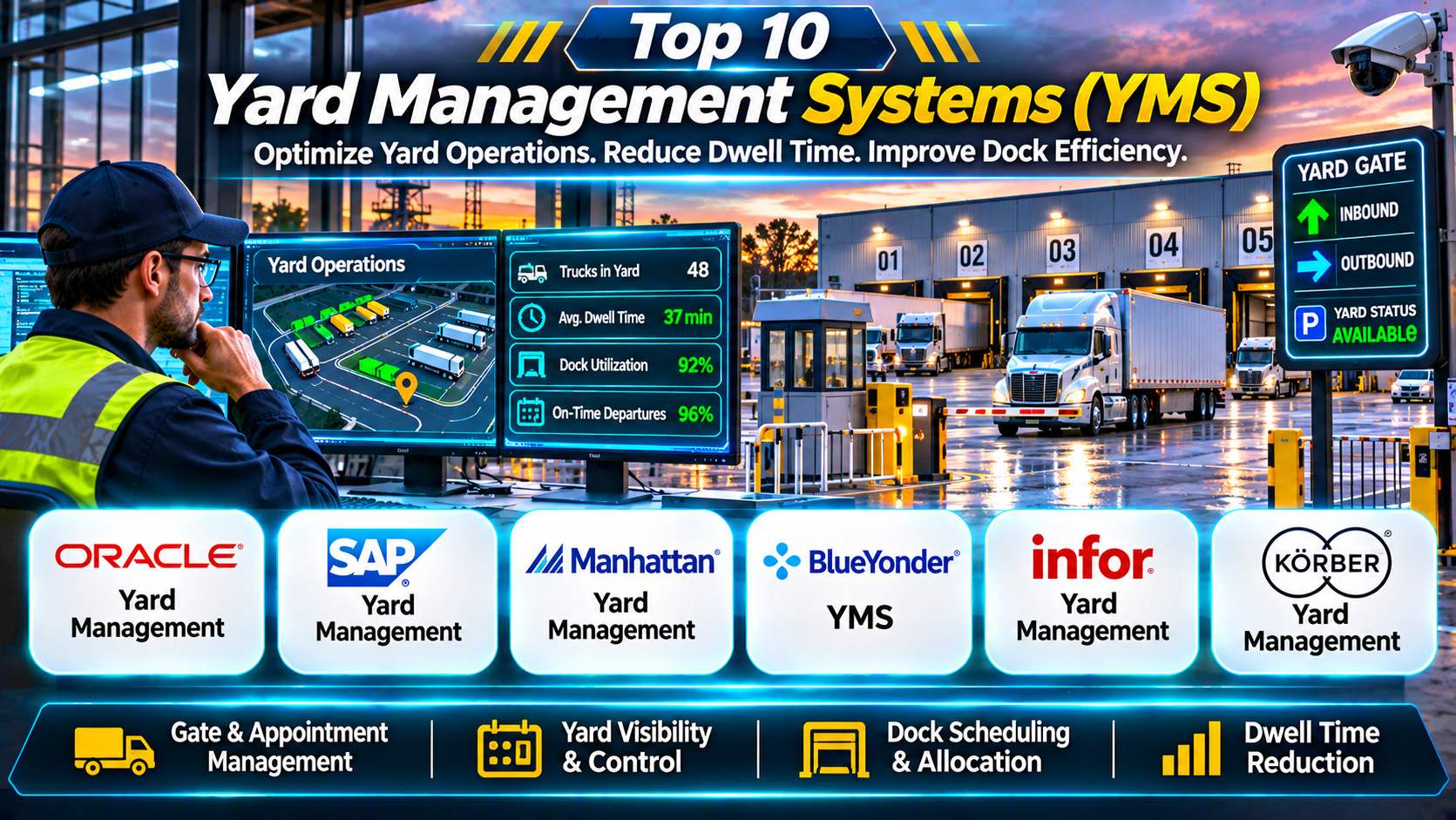
Yard Management Systems (YMS) provide centralized software capabilities that help organizations monitor vehicle movements, coordinate trailer locations, manage gate activities, schedule yard tasks, and improve communication between logistics teams.
Modern yard management platforms incorporate digital yard maps, automated gate processing, real-time tracking, appointment scheduling, mobile applications, and operational analytics. These capabilities help organizations establish greater visibility into activities occurring between transportation networks and warehouse facilities.
Selecting the right yard management system requires careful consideration of facility size, vehicle traffic, trailer volumes, loading dock capacity, integration requirements, automation objectives, and implementation costs. A manufacturing facility may require different capabilities from a large retail distribution center or third-party logistics terminal.
This comprehensive guide examines ten yard management systems, their key features, benefits, advantages, limitations, practical applications, and suitability for different operational environments.
What Are Yard Management Systems (YMS)?
Yard Management Systems are software platforms designed to coordinate and monitor the movement of trucks, trailers, containers, and other transportation assets within industrial yards, warehouses, distribution centers, and manufacturing facilities.
These systems provide a centralized operational environment for recording vehicle arrivals, assigning parking locations, coordinating trailer movements, managing loading dock assignments, and processing vehicle departures.
YMS platforms help bridge the operational gap between Warehouse Management Systems (WMS) and Transportation Management Systems (TMS). While warehouse software manages inventory inside a facility and transportation software coordinates freight movement between locations, yard management software focuses on activities occurring within the facility’s external logistics area.
Advanced yard management systems can incorporate automated identification technologies, digital gate management, real-time location information, intelligent task assignments, appointment scheduling, and operational performance monitoring.
Common Applications of Yard Management Systems
- Gate Management: Records vehicle arrivals and departures, verifies shipment information, and coordinates facility access.
- Trailer Tracking: Maintains information about trailer identities, locations, availability, and operational status.
- Dock Assignment: Coordinates trailer placement at appropriate loading and unloading docks.
- Yard Task Management: Assigns trailer movements and operational activities to yard drivers and equipment operators.
- Appointment Scheduling: Coordinates carrier arrival times with warehouse capacity and operational requirements.
- Detention Management: Tracks vehicle waiting times and identifies potential detention expenses.
- Yard Capacity Planning: Evaluates available parking spaces, loading docks, and trailer storage capacity.
- Operational Analytics: Measures yard throughput, vehicle dwell times, dock utilization, and movement efficiency.
Essential Components of Yard Management Software
| Component | Primary Function |
|---|---|
| Gate Management | Controls vehicle entry and exit workflows |
| Digital Yard Mapping | Represents trailer and parking locations |
| Trailer Inventory | Maintains transportation asset records |
| Dock Management | Coordinates loading dock assignments |
| Appointment Scheduling | Manages planned vehicle arrivals |
| Yard Task Management | Assigns trailer movement activities |
| Mobile Applications | Supports yard personnel and drivers |
| Real-Time Tracking | Provides updated asset location information |
| Carrier Communication | Coordinates information with transportation providers |
| Detention Monitoring | Tracks vehicle waiting periods |
| Yard Analytics | Evaluates operational performance |
| WMS Integration | Connects yard activities with warehouse operations |
| TMS Integration | Connects yard operations with transportation planning |
| Automated Identification | Supports compatible cameras, RFID, and other identification technologies |
YMS vs. WMS vs. TMS
| Software Category | Primary Focus | Typical Capabilities |
|---|---|---|
| Yard Management System | External facility logistics | Trailer tracking, gate management, yard movements |
| Warehouse Management System | Internal warehouse operations | Inventory, receiving, picking, packing |
| Transportation Management System | Freight transportation | Carrier selection, routing, freight execution |
| Dock Scheduling Software | Appointment coordination | Time slots, carrier bookings, dock availability |
| Fleet Management Software | Vehicle fleet operations | Vehicle tracking, maintenance, driver management |
| Real-Time Visibility Platform | Shipment and asset visibility | Location tracking, arrival predictions, exceptions |
These systems frequently operate together. An integrated logistics architecture can connect transportation arrival information with yard activities and warehouse receiving requirements.
Top 10 Yard Management Systems (YMS)
The following comparison includes dedicated yard management platforms, enterprise warehouse and logistics modules, and complementary yard automation solutions.
The numbering organizes the comparison rather than representing independently benchmarked software rankings. Available functionality depends on selected products, integrations, deployment configurations, and commercial agreements.
1. Manhattan Active Yard Management
Short Description
Manhattan Active Yard Management provides yard coordination capabilities within Manhattan Associates’ supply chain execution ecosystem.
The solution helps distribution facilities manage trailer inventories, gate activities, yard movements, and loading dock coordination. Its relationship with compatible Manhattan warehouse management applications allows businesses to connect yard operations with warehouse execution requirements.
Organizations can use integrated yard information to determine which trailers require unloading, which shipments are ready for departure, and which transportation assets are available for reassignment.
Manhattan is particularly relevant to large distribution networks seeking coordinated warehouse, transportation, and yard execution processes.
Key Features
- Digital Yard Visibility: Provides centralized information about trailer locations, parking areas, and operational status.
- Gate Processing: Supports structured vehicle arrival and departure workflows.
- Trailer Inventory Management: Maintains records of trailers entering, occupying, and leaving the facility.
- Dock Coordination: Helps align trailer assignments with warehouse loading and unloading requirements.
- Yard Movement Management: Coordinates trailer movement tasks according to operational priorities.
- Warehouse Integration: Connects compatible yard activities with Manhattan warehouse execution processes.
- Operational Reporting: Provides information about selected yard performance indicators.
- Exception Management: Helps personnel identify delayed activities and operational discrepancies.
- Cloud-Based Architecture: Supports applicable Manhattan Active deployment capabilities.
Benefits
- Improves visibility into trailer availability.
- Reduces dependence on manual yard inspections.
- Supports efficient loading dock coordination.
- Improves communication between yard and warehouse teams.
- Helps reduce unnecessary trailer movements.
- Supports transportation asset utilization.
- Facilitates standardized yard operating procedures.
Pros
- Strong enterprise supply chain ecosystem.
- Relevant warehouse integration capabilities.
- Suitable for complex distribution operations.
- Supports structured yard workflows.
- Provides centralized operational visibility.
- Relevant to multi-facility organizations.
Cons
- Enterprise implementation can require substantial resources.
- Commercial pricing requires consultation.
- Integration with external applications may require additional work.
- Advanced configuration requires specialist expertise.
- Smaller facilities may not need extensive functionality.
Use Cases
- Retail Distribution: Coordinate incoming supplier trailers with warehouse receiving priorities.
- E-commerce Fulfillment: Manage outbound trailer availability during high-volume shipping periods.
- Multi-Site Logistics: Standardize yard procedures across distribution facilities.
- Trailer Inventory Management: Identify available, loaded, empty, and occupied trailers.
- Dock Coordination: Align trailer movements with warehouse processing requirements.
- Enterprise Modernization: Connect yard operations with broader supply chain execution systems.
Best For
- Large distribution centers.
- Global retailers.
- Manhattan software customers.
- Enterprise logistics departments.
- E-commerce fulfillment networks.
- Multi-site warehouse operators.
2. Blue Yonder Yard Management
Short Description
Blue Yonder Yard Management provides yard operational capabilities within Blue Yonder’s broader supply chain execution portfolio.
The solution helps organizations coordinate vehicle arrivals, trailer locations, yard movements, dock assignments, and warehouse-related logistics activities.
Its integration opportunities with compatible warehouse and transportation applications can help businesses improve coordination between external freight operations and internal warehouse processes.
Blue Yonder is particularly relevant to retailers, manufacturers, and logistics providers managing complex distribution networks.
Key Features
- Yard Inventory Visibility: Maintains information about trailers and transportation assets within the facility.
- Gate Management: Supports vehicle check-in and check-out activities.
- Dock Assignment: Coordinates trailer placement according to operational requirements.
- Yard Task Coordination: Supports movement assignments for yard personnel.
- Appointment Coordination: Connects applicable planned arrivals with yard activities.
- Warehouse Integration: Aligns compatible yard processes with warehouse execution.
- Transportation Integration: Supports information exchange with applicable transportation applications.
- Operational Analytics: Provides visibility into yard performance and activity trends.
- Exception Monitoring: Helps managers investigate delayed or incomplete yard activities.
Benefits
- Improves coordination between logistics departments.
- Supports efficient trailer allocation.
- Helps reduce vehicle waiting times.
- Improves loading dock visibility.
- Supports warehouse receiving and shipping operations.
- Facilitates yard performance measurement.
- Helps organizations standardize logistics processes.
Pros
- Extensive supply chain execution portfolio.
- Relevant warehouse and transportation capabilities.
- Suitable for large distribution networks.
- Supports integrated logistics operations.
- Provides operational reporting opportunities.
- Relevant to retail and manufacturing environments.
Cons
- Implementation complexity varies by configuration.
- Commercial licensing requires evaluation.
- External system integration requires planning.
- Advanced functionality may require additional modules.
- Operational data quality affects performance.
Use Cases
- Retail Distribution: Coordinate store replenishment shipments and supplier deliveries.
- Manufacturing Logistics: Manage inbound material trailers and outbound finished goods.
- Third-Party Logistics: Coordinate yard activities across customer operations.
- Peak Season Management: Improve trailer and dock allocation during demand increases.
- Detention Reduction: Identify prolonged vehicle waiting periods.
- Supply Chain Execution: Connect yard activities with warehouse and transportation processes.
Best For
- Large retailers.
- Consumer goods manufacturers.
- Third-party logistics providers.
- Blue Yonder customers.
- Enterprise distribution networks.
- Supply chain execution teams.
3. SAP Yard Logistics
Short Description
SAP Yard Logistics is an enterprise solution designed to coordinate transportation assets and operational activities within logistics yards.
The platform supports structured yard processes involving vehicle arrivals, transportation units, parking locations, loading activities, and yard movements.
SAP Yard Logistics can connect with compatible SAP enterprise applications, including transportation and warehouse management technologies. This relationship helps organizations coordinate yard operations with broader logistics requirements.
The solution is particularly relevant to large manufacturing and distribution organizations operating SAP-based enterprise environments.
Key Features
- Yard Request Management: Supports structured requests for planned yard activities.
- Yard Order Processing: Coordinates operational instructions associated with yard movements.
- Transportation Unit Management: Maintains relevant information about vehicles and transportation assets.
- Gate Processing: Supports applicable vehicle entry and exit workflows.
- Yard Visualization: Represents relevant yard locations and transportation asset information.
- Task Management: Coordinates operational yard activities.
- Dock Coordination: Supports alignment between yard movements and loading requirements.
- SAP Integration: Connects compatible warehouse, transportation, and enterprise processes.
- Operational Monitoring: Provides visibility into yard activity status and exceptions.
Benefits
- Supports standardized enterprise yard processes.
- Improves transportation asset visibility.
- Connects yard operations with enterprise logistics.
- Facilitates structured task management.
- Helps coordinate warehouse and transportation activities.
- Supports complex industrial logistics environments.
- Improves operational information consistency.
Pros
- Strong SAP enterprise ecosystem.
- Relevant dedicated yard logistics functionality.
- Supports complex transportation workflows.
- Suitable for multinational organizations.
- Provides structured yard activity management.
- Relevant warehouse and transportation integration opportunities.
Cons
- Enterprise configuration can be complex.
- Licensing depends on selected architecture.
- Implementation may require specialist SAP resources.
- Integration with non-SAP systems requires evaluation.
- Smaller yards may require simpler alternatives.
Use Cases
- Automotive Manufacturing: Coordinate incoming component trailers and outbound vehicle logistics.
- Industrial Facilities: Manage transportation assets across complex industrial yards.
- Enterprise Distribution: Connect yard activities with warehouse execution.
- Transportation Coordination: Align vehicle arrivals with logistics plans.
- Multi-Site Standardization: Establish consistent yard management processes.
- SAP Modernization: Introduce structured yard logistics into enterprise operations.
Best For
- SAP-based enterprises.
- Automotive manufacturers.
- Industrial logistics facilities.
- Large distribution centers.
- Global manufacturing organizations.
- Enterprise transportation departments.
4. Kaleris Yard Management
Short Description
Kaleris provides supply chain execution and transportation asset management solutions that include yard management capabilities.
Its yard management technology helps organizations monitor trailers, coordinate gate operations, assign yard movements, and improve visibility into transportation assets.
The platform is relevant to businesses seeking to reduce manual yard checks and establish more reliable information about trailer locations, operational status, and facility capacity.
Kaleris also provides complementary logistics technologies that can support broader transportation and asset coordination requirements.
Key Features
- Trailer Tracking: Maintains information about trailer locations and status.
- Digital Yard Mapping: Provides a visual representation of applicable yard areas.
- Gate Management: Supports structured arrival and departure processing.
- Yard Task Assignment: Coordinates trailer movements and personnel activities.
- Dock Management: Supports loading dock allocation and trailer placement.
- Asset Visibility: Provides information about transportation asset availability.
- Mobile Workflows: Supports compatible yard personnel applications.
- Operational Analytics: Evaluates yard activity and performance information.
- Enterprise Integration: Connects compatible logistics and warehouse applications.
Benefits
- Improves trailer location visibility.
- Reduces manual yard inventory activities.
- Supports efficient trailer movement coordination.
- Helps identify prolonged vehicle dwell times.
- Improves transportation asset utilization.
- Facilitates communication between operational teams.
- Supports centralized yard management.
Pros
- Specialized logistics execution capabilities.
- Relevant trailer and asset management functionality.
- Suitable for complex industrial yards.
- Supports structured yard workflows.
- Provides complementary logistics technologies.
- Relevant to multi-site operations.
Cons
- Commercial pricing requires consultation.
- Integration complexity varies by environment.
- Real-time tracking may require compatible equipment.
- Implementation requires accurate facility mapping.
- Advanced functionality depends on selected products.
Use Cases
- Manufacturing Yards: Track inbound materials and outbound product trailers.
- Distribution Facilities: Coordinate trailer locations and dock assignments.
- Transportation Asset Management: Monitor available and occupied equipment.
- Yard Productivity Improvement: Evaluate trailer movement efficiency.
- Detention Monitoring: Identify excessive waiting periods.
- Multi-Facility Operations: Improve visibility across multiple logistics yards.
Best For
- Industrial manufacturers.
- Large distribution facilities.
- Logistics service providers.
- Transportation asset managers.
- Multi-site logistics organizations.
- Enterprises requiring specialized yard visibility.
5. YardView
Short Description
YardView is a dedicated yard management software solution designed to help organizations manage trailers, loading docks, gate activities, and yard movements.
The platform provides centralized yard information that helps managers identify trailer locations, operational status, and movement requirements.
YardView can support facilities transitioning from manual spreadsheets and radio-based coordination toward structured digital yard management processes.
Its dedicated operational focus makes it relevant to distribution centers, manufacturing facilities, food distribution operations, and third-party logistics providers.
Key Features
- Visual Yard Management: Displays applicable trailer positions and yard locations.
- Trailer Inventory: Maintains records of transportation assets within the facility.
- Gate Check-In: Supports structured vehicle arrival processing.
- Gate Check-Out: Records vehicle departures and associated operational information.
- Dock Management: Coordinates trailer assignments to loading and unloading docks.
- Yard Driver Communication: Supports applicable trailer movement instructions.
- Appointment Coordination: Helps connect planned arrivals with yard activities.
- Dwell Time Monitoring: Tracks relevant trailer occupancy and waiting periods.
- Reporting and Integration: Provides operational reporting and compatible system connectivity.
Benefits
- Improves yard inventory accuracy.
- Reduces dependence on paper records.
- Helps personnel locate trailers more efficiently.
- Supports loading dock coordination.
- Improves yard driver communication.
- Helps identify operational delays.
- Provides centralized yard performance information.
Pros
- Dedicated yard management orientation.
- Relevant visual yard capabilities.
- Supports practical trailer tracking workflows.
- Suitable for multiple facility types.
- Provides operational reporting.
- Useful for replacing manual yard processes.
Cons
- Commercial pricing requires consultation.
- Advanced automation may require complementary technologies.
- Integration depends on existing enterprise applications.
- Facility mapping requires preparation.
- Operational accuracy depends on consistent information updates.
Use Cases
- Distribution Yard Management: Maintain current trailer location records.
- Food Distribution: Coordinate incoming and outgoing refrigerated trailers.
- Manufacturing Logistics: Manage trailer staging and dock assignments.
- Gate Modernization: Replace manual arrival and departure records.
- Yard Driver Coordination: Assign and monitor trailer movement activities.
- Operational Reporting: Analyze yard dwell times and trailer utilization.
Best For
- Mid-sized and large distribution centers.
- Food distribution facilities.
- Manufacturing warehouses.
- Third-party logistics providers.
- Yard supervisors.
- Organizations replacing spreadsheet-based yard management.
6. PINC Yard Management
Short Description
PINC is a yard management technology associated with the Kaleris software portfolio. It is known for its emphasis on digital yard visibility, transportation asset tracking, and yard process automation.
PINC technologies can help organizations identify trailer locations and operational status through applicable software and automated identification infrastructure.
The solution is particularly relevant to facilities seeking to reduce manual trailer searches and improve the accuracy of yard inventory information.
Because PINC is associated with Kaleris, organizations should evaluate current product packaging and commercial availability directly with the provider rather than treating the two entries as entirely independent vendor alternatives.
Key Features
- Digital Yard Visibility: Provides centralized information about yard assets.
- Trailer Location Tracking: Supports compatible methods for identifying trailer locations.
- Automated Identification: Can incorporate applicable identification technologies according to deployment.
- Gate Automation: Supports compatible automated vehicle identification workflows.
- Yard Task Management: Coordinates trailer movement requirements.
- Asset Inventory Monitoring: Maintains information about transportation assets.
- Dock Coordination: Supports alignment between trailer availability and dock activities.
- Operational Reporting: Provides visibility into relevant yard performance indicators.
- System Integration: Connects compatible warehouse and logistics applications.
Benefits
- Helps reduce manual trailer searches.
- Improves transportation asset visibility.
- Supports yard inventory accuracy.
- Facilitates automated yard workflows.
- Improves coordination of trailer movements.
- Helps identify operational exceptions.
- Supports yard modernization initiatives.
Pros
- Strong yard visibility technology orientation.
- Relevant automated identification capabilities.
- Suitable for large trailer inventories.
- Supports digital yard modernization.
- Provides complementary asset tracking capabilities.
- Useful for reducing manual yard checks.
Cons
- Shares a vendor ecosystem with Kaleris.
- Current product packaging requires confirmation.
- Automated tracking may require hardware investment.
- Site conditions can affect identification performance.
- Integration and deployment require technical preparation.
Use Cases
- Automated Trailer Tracking: Identify transportation assets using compatible technologies.
- Large Yard Visibility: Monitor trailers across extensive parking areas.
- Gate Automation: Reduce manual vehicle identification activities.
- Asset Inventory Auditing: Improve consistency of yard inventory information.
- Trailer Search Reduction: Help personnel locate required equipment.
- Industrial Yard Modernization: Introduce automated visibility into existing logistics processes.
Best For
- Large industrial yards.
- High-volume distribution facilities.
- Transportation asset managers.
- Automated logistics environments.
- Yard modernization teams.
- Organizations evaluating Kaleris yard tracking technologies.
7. C3 Solutions Yard Management
Short Description
C3 Solutions provides yard management and dock scheduling software designed to help organizations coordinate logistics activities at distribution centers and industrial facilities.
Its yard management solution supports trailer inventory, gate processing, movement assignments, and operational visibility.
The complementary dock scheduling capabilities help businesses coordinate planned vehicle arrivals with available loading dock capacity and warehouse processing requirements.
C3 Solutions is particularly relevant to organizations seeking dedicated yard and appointment management functionality without replacing their entire enterprise software environment.
Key Features
- Yard Inventory Management: Maintains information about trailers and transportation assets.
- Visual Yard Representation: Displays applicable parking locations and operational status.
- Gate Management: Supports structured vehicle arrival and departure workflows.
- Yard Task Assignment: Coordinates trailer movement activities.
- Dock Scheduling Integration: Connects applicable appointment information with yard processes.
- Carrier Communication: Supports information exchange with transportation providers.
- Operational Alerts: Helps identify relevant exceptions and delayed activities.
- Performance Reporting: Evaluates yard activity and operational indicators.
- Enterprise Integration: Connects compatible warehouse and transportation applications.
Benefits
- Improves coordination between appointments and yard operations.
- Helps reduce vehicle waiting periods.
- Supports accurate trailer inventory records.
- Improves communication with carriers.
- Facilitates loading dock planning.
- Reduces dependence on manual scheduling.
- Supports structured yard management processes.
Pros
- Dedicated yard and dock management orientation.
- Relevant carrier appointment functionality.
- Suitable for distribution and manufacturing facilities.
- Supports centralized operational information.
- Provides practical integration opportunities.
- Useful for facilities modernizing manual processes.
Cons
- Commercial pricing requires consultation.
- Integration requirements vary by organization.
- Automated tracking may require complementary infrastructure.
- Carrier participation affects scheduling effectiveness.
- Complex yard configurations require preparation.
Use Cases
- Carrier Appointment Management: Coordinate planned vehicle arrivals.
- Distribution Yard Operations: Track trailer locations and movement requirements.
- Dock Congestion Reduction: Align arrival schedules with warehouse capacity.
- Manufacturing Logistics: Coordinate material deliveries and outbound shipments.
- Gate Processing: Standardize arrival and departure activities.
- Yard Performance Analysis: Evaluate dwell times and operational bottlenecks.
Best For
- Distribution center operators.
- Manufacturing facilities.
- Retail logistics departments.
- Third-party logistics providers.
- Dock scheduling managers.
- Organizations requiring integrated yard and appointment management.
8. GoRamp
Short Description
GoRamp provides logistics management software with capabilities for dock scheduling, yard management, and transportation coordination.
Its solutions help businesses organize vehicle arrivals, communicate with carriers, manage facility logistics, and improve visibility into loading and unloading activities.
GoRamp is particularly relevant to organizations seeking cloud-based tools for reducing manual scheduling, improving gate coordination, and managing transportation activities at warehouses.
Businesses should evaluate the depth of trailer tracking, movement optimization, and yard automation functionality available within their selected GoRamp configuration.
Key Features
- Dock Appointment Scheduling: Coordinates vehicle arrival time slots.
- Carrier Booking: Supports applicable carrier appointment workflows.
- Yard Visibility: Provides information about relevant facility logistics activities.
- Vehicle Check-In: Supports structured arrival processing.
- Loading Coordination: Helps align vehicle arrivals with operational capacity.
- Carrier Communication: Facilitates information exchange with transportation providers.
- Status Monitoring: Tracks applicable shipment and appointment progress.
- Operational Analytics: Provides visibility into waiting times and facility performance.
- Cloud-Based Integration: Supports compatible enterprise connectivity.
Benefits
- Reduces manual appointment coordination.
- Improves carrier communication.
- Supports loading dock utilization.
- Helps reduce arrival congestion.
- Improves facility logistics visibility.
- Facilitates structured vehicle processing.
- Supports cloud-based logistics modernization.
Pros
- Strong appointment scheduling orientation.
- Relevant yard management capabilities.
- Cloud-based operational approach.
- Suitable for growing logistics organizations.
- Supports carrier collaboration.
- Useful for replacing manual scheduling processes.
Cons
- Advanced yard optimization requirements need evaluation.
- Hardware-based tracking may require complementary systems.
- Commercial pricing depends on configuration.
- Integration requires operational preparation.
- Carrier adoption influences effectiveness.
Use Cases
- Warehouse Appointment Scheduling: Organize incoming and outgoing vehicle bookings.
- Facility Congestion Management: Reduce uncoordinated vehicle arrivals.
- Carrier Collaboration: Provide structured appointment information.
- Manufacturing Deliveries: Coordinate supplier arrivals with production requirements.
- Dock Performance Monitoring: Evaluate loading and unloading activity.
- Digital Logistics Modernization: Replace spreadsheets and manual booking processes.
Best For
- Mid-sized distribution facilities.
- Manufacturing warehouses.
- Growing logistics organizations.
- Transportation coordinators.
- Dock scheduling teams.
- Businesses prioritizing cloud-based facility logistics.
9. Opendock
Short Description
Opendock is a dock scheduling and facility logistics platform associated with Loadsmart.
The platform helps warehouses and transportation providers coordinate appointment bookings, vehicle arrivals, loading dock availability, and related operational information.
Its capabilities can support digital gate and yard-related workflows depending on the selected products and deployment configuration.
Opendock is particularly relevant to organizations whose primary yard management challenges involve appointment scheduling, carrier communication, and vehicle check-in rather than sophisticated trailer movement optimization.
Key Features
- Online Appointment Booking: Enables compatible carrier scheduling workflows.
- Dock Calendar Management: Displays planned loading and unloading appointments.
- Carrier Communication: Supports appointment-related information exchange.
- Vehicle Check-In: Provides applicable digital arrival workflows.
- Appointment Status Tracking: Maintains information about scheduled and completed activities.
- Facility Coordination: Helps warehouse personnel organize vehicle arrivals.
- Operational Reporting: Provides information about appointment and facility performance.
- Scheduling Rules: Supports applicable facility booking requirements.
- Enterprise Connectivity: Connects compatible operational systems.
Benefits
- Reduces telephone and email scheduling.
- Improves carrier appointment visibility.
- Supports predictable vehicle arrivals.
- Helps reduce loading dock congestion.
- Facilitates warehouse staffing coordination.
- Improves appointment record consistency.
- Supports digital facility logistics workflows.
Pros
- Specialized dock scheduling capabilities.
- Relevant carrier booking functionality.
- Useful for appointment-intensive facilities.
- Supports digital logistics workflows.
- Suitable for multiple warehouse locations.
- Can complement existing warehouse applications.
Cons
- Not necessarily equivalent to a comprehensive enterprise YMS.
- Advanced trailer tracking requires evaluation.
- Yard movement optimization may require complementary software.
- Carrier participation affects operational benefits.
- Commercial licensing requires confirmation.
Use Cases
- Retail Warehouse Scheduling: Coordinate supplier delivery appointments.
- Carrier Self-Service Booking: Reduce manual scheduling communication.
- Gate Check-In Modernization: Introduce applicable digital arrival workflows.
- Dock Capacity Planning: Organize appointments around available resources.
- Multi-Site Scheduling: Standardize carrier booking processes.
- Waiting Time Reduction: Improve coordination of vehicle arrivals.
Best For
- Appointment-intensive warehouses.
- Retail distribution facilities.
- Carrier scheduling departments.
- Manufacturing receiving teams.
- Logistics coordinators.
- Organizations requiring dock-focused yard management.
10. Peripass
Short Description
Peripass provides yard management and automation software designed to coordinate vehicle movements, gate processing, driver communication, and logistics facility activities.
The platform emphasizes digital yard workflows that can help organizations reduce manual administrative activities and improve communication with visiting drivers.
Its capabilities can support automated check-in, self-service driver registration, operational task coordination, and integration with compatible physical access infrastructure.
Peripass is particularly relevant to organizations seeking to automate repetitive yard processes while maintaining visibility into facility logistics activities.
Key Features
- Digital Gate Management: Supports structured vehicle entry and exit processes.
- Driver Self-Service: Enables applicable driver registration and check-in workflows.
- Yard Visibility: Provides information about vehicles and facility activities.
- Task Management: Coordinates relevant operational yard tasks.
- Driver Communication: Supports instructions and status information for visiting drivers.
- Access Automation: Connects compatible gate and access control technologies.
- Dock Coordination: Supports alignment between vehicle movements and loading activities.
- Operational Reporting: Evaluates relevant facility logistics performance.
- Enterprise Integration: Connects compatible warehouse and transportation applications.
Benefits
- Reduces repetitive gate administration.
- Improves communication with visiting drivers.
- Supports consistent vehicle processing.
- Helps reduce unnecessary waiting periods.
- Improves facility logistics visibility.
- Facilitates yard automation initiatives.
- Supports structured operational workflows.
Pros
- Strong yard automation orientation.
- Relevant driver self-service capabilities.
- Supports digital gate workflows.
- Suitable for high-volume logistics facilities.
- Provides integration opportunities with physical infrastructure.
- Useful for reducing manual administrative activities.
Cons
- Automation may require compatible hardware.
- Commercial pricing requires consultation.
- Site-specific configuration is necessary.
- Driver adoption requires appropriate instructions.
- Integration with existing systems requires planning.
Use Cases
- Automated Gate Processing: Streamline vehicle arrival and departure activities.
- Driver Registration: Reduce manual reception and registration tasks.
- Industrial Yard Automation: Coordinate vehicle movements through digital workflows.
- Distribution Center Logistics: Improve visibility into loading and unloading activities.
- Multilingual Driver Communication: Support applicable communication workflows for international carriers.
- Access Control Integration: Connect yard processes with compatible facility access equipment.
Best For
- High-volume logistics facilities.
- Manufacturing organizations.
- International distribution centers.
- Yard automation teams.
- Industrial facility managers.
- Organizations prioritizing driver self-service and gate automation.
Comparison Table: Top 10 Yard Management Systems
| Platform | Primary Function | Best For | Standout Capability | Pricing |
|---|---|---|---|---|
| Manhattan Active Yard Management | Enterprise yard execution | Large distribution networks | Warehouse execution integration | Commercial pricing |
| Blue Yonder Yard Management | Integrated yard operations | Retailers and manufacturers | Supply chain execution coordination | Commercial pricing |
| SAP Yard Logistics | Enterprise yard logistics | SAP-based organizations | Structured enterprise yard processes | Commercial licensing |
| Kaleris Yard Management | Yard and asset management | Industrial logistics facilities | Transportation asset visibility | Commercial pricing |
| YardView | Dedicated yard management | Distribution centers | Visual trailer inventory management | Commercial pricing |
| PINC | Yard tracking and automation | Large trailer yards | Automated asset visibility | Confirm current packaging |
| C3 Solutions | Yard and dock management | Appointment-intensive facilities | Yard and dock coordination | Commercial pricing |
| GoRamp | Cloud facility logistics | Growing logistics organizations | Carrier appointment management | Commercial subscription |
| Opendock | Dock scheduling and facility logistics | Warehouses prioritizing appointments | Carrier self-service booking | Commercial subscription |
| Peripass | Yard process automation | High-volume industrial facilities | Driver self-service and gate automation | Commercial pricing |
Product availability, commercial arrangements, integration requirements, and specific functionality should be confirmed with the relevant software providers.
PINC and Kaleris share a vendor ecosystem, while Opendock is primarily a dock scheduling and facility logistics solution. These distinctions should be considered when developing a procurement shortlist.
Which Yard Management System Is Right for You?
For Large Enterprise Distribution Networks
Manhattan Active Yard Management and Blue Yonder provide relevant enterprise yard management capabilities.
Organizations should evaluate their existing warehouse and transportation architecture, facility complexity, trailer volumes, and multi-site deployment requirements.
For SAP-Based Organizations
SAP Yard Logistics is particularly relevant to enterprises operating compatible SAP warehouse and transportation applications.
Businesses should evaluate integration architecture and determine whether existing SAP capabilities can support their required yard processes.
For Transportation Asset Visibility
Kaleris and its associated PINC technologies are relevant to organizations seeking improved trailer tracking and transportation asset visibility.
Facilities should assess whether automated identification infrastructure is necessary to achieve their operational objectives.
For Dedicated Yard Management
YardView provides a focused approach to trailer inventory, yard visibility, gate processing, and movement coordination.
It is relevant to facilities replacing manual yard records without undertaking a complete enterprise software replacement.
For Integrated Yard and Dock Scheduling
C3 Solutions provides complementary yard management and dock scheduling capabilities.
Organizations experiencing both appointment coordination problems and trailer movement inefficiencies should evaluate its integrated operational approach.
For Cloud-Based Logistics Coordination
GoRamp is relevant to businesses prioritizing carrier collaboration, appointment scheduling, and cloud-based facility logistics.
Its suitability depends on the complexity of the organization’s yard movement and asset tracking requirements.
For Appointment-Intensive Warehouses
Opendock is particularly relevant to facilities seeking to reduce manual appointment scheduling and improve carrier booking processes.
Organizations requiring comprehensive trailer movement management should evaluate complementary capabilities.
For Automated Gate and Driver Workflows
Peripass provides relevant yard automation and driver self-service functionality.
It is particularly suitable for organizations seeking to reduce manual reception activities and integrate compatible facility access technologies.
Best Yard Management Systems by User Type
| User Type | Platform to Evaluate | Primary Reason |
|---|---|---|
| Enterprise logistics director | Manhattan Active Yard Management | Integrated warehouse execution |
| Retail distribution manager | Blue Yonder | Supply chain coordination |
| SAP enterprise architect | SAP Yard Logistics | Enterprise integration |
| Transportation asset manager | Kaleris | Asset visibility |
| Distribution yard supervisor | YardView | Dedicated yard management |
| Yard automation engineer | PINC technologies | Automated identification |
| Dock and yard coordinator | C3 Solutions | Integrated appointment coordination |
| Growing logistics business | GoRamp | Cloud facility logistics |
| Carrier scheduling manager | Opendock | Appointment management |
| Industrial automation manager | Peripass | Gate and driver automation |
How to Choose the Best Yard Management System
1. Identify Operational Yard Challenges
Begin by documenting existing yard management problems.
Common challenges include misplaced trailers, excessive vehicle waiting times, loading dock congestion, inefficient trailer movements, inaccurate yard inventory records, and limited communication between operational teams.
Determine which problems create the greatest financial and operational consequences.
A facility experiencing appointment scheduling problems may not require the same technology as a large industrial yard managing hundreds of trailers.
2. Evaluate Yard Size and Operational Complexity
Yard management requirements depend on the number of parking spaces, loading docks, gate lanes, trailers, vehicle movements, and operational shifts.
A small warehouse may manage twenty trailers each day, while a large distribution center may coordinate hundreds of transportation assets.
Evaluate whether the platform can represent facility layouts, parking zones, trailer classifications, movement restrictions, and operational priorities.
Complex facilities should also assess support for multiple yards and interconnected logistics locations.
3. Assess Trailer Tracking Capabilities
Trailer visibility is a fundamental requirement for many yard management implementations.
Evaluate whether the system uses manual location updates, mobile scanning, RFID, GPS, camera-based identification, or other compatible technologies.
Manual updates may be sufficient for smaller facilities. Automated identification may provide additional value in environments with large trailer inventories and frequent movements.
Organizations should assess identification accuracy, infrastructure requirements, environmental conditions, and maintenance expenses.
4. Review Gate Management Functionality
Gate management processes establish the initial operational record for visiting vehicles.
Evaluate whether the platform supports driver registration, shipment verification, appointment validation, trailer identification, access control integration, and departure processing.
Facilities with high vehicle traffic may benefit from automated identification and self-service registration.
However, automated workflows must include appropriate exception handling for unrecognized vehicles, incorrect documents, and system interruptions.
5. Evaluate Dock Scheduling Integration
Yard management and dock scheduling are closely related but address different operational requirements.
Appointment scheduling determines when vehicles should arrive. Yard management coordinates their activities after arrival.
Evaluate whether the software connects appointments with gate processing, trailer staging, dock availability, and warehouse readiness.
Effective coordination can reduce congestion and prevent vehicles from arriving before the facility has sufficient processing capacity.
6. Assess Yard Movement Optimization
Trailer movements consume employee time, fuel, equipment capacity, and operational resources.
Evaluate whether the platform supports structured movement assignments, task priorities, equipment availability, and movement status tracking.
Advanced systems may provide optimization capabilities that help reduce unnecessary travel and improve trailer positioning.
Movement instructions must account for safe operating procedures, vehicle restrictions, pedestrian areas, and local facility requirements.
7. Review WMS and TMS Integration
Yard management software frequently exchanges information with warehouse and transportation systems.
Relevant information includes shipment identifiers, purchase orders, transportation appointments, trailer numbers, dock assignments, inventory readiness, and departure status.
Evaluate available APIs, connectors, synchronization methods, and integration monitoring capabilities.
Establish clear ownership of each information category to avoid conflicting records between systems.
8. Evaluate Mobile and Driver Workflows
Yard personnel often work outside traditional office environments.
Assess whether the software supports compatible mobile devices, vehicle-mounted terminals, driver kiosks, and practical communication workflows.
Consider outdoor visibility, weather conditions, network coverage, device durability, and language requirements.
Operational interfaces should be simple enough for personnel to use without creating unnecessary distractions during vehicle operation.
9. Assess Reporting, Security, and Scalability
Evaluate reporting capabilities for trailer dwell time, gate processing duration, dock utilization, yard inventory accuracy, movement productivity, and detention exposure.
Review user permissions, audit records, authentication, data protection, system availability, and business continuity arrangements.
Organizations should also determine whether the platform can support future facility expansion and increasing vehicle traffic.
10. Calculate Total Cost of Ownership
YMS implementation costs may include software licensing, integration, mobile devices, automated identification infrastructure, access control equipment, facility mapping, employee training, and ongoing maintenance.
Potential benefits include reduced detention expenses, fewer manual trailer searches, improved yard driver productivity, lower administrative costs, and more efficient dock utilization.
Financial assessments should distinguish measurable avoided costs from theoretical operational improvements.
Practical Example: Implementing a Yard Management System in a Retail Distribution Center
Consider a hypothetical retail distribution center operating twenty-four loading docks, two vehicle gates, and a yard containing 180 trailer parking spaces.
The facility receives supplier deliveries and dispatches products to retail stores across a regional distribution network.
Its existing yard processes depend on spreadsheets, radio communication, manual gate records, and periodic trailer inspections.
Management wants to introduce a centralized yard management system to improve trailer visibility, reduce vehicle waiting times, optimize dock coordination, and control operational expenses.
All numerical values in this example are hypothetical and do not represent measured results from any listed software provider.
Step 1: Establish Operational Objectives
The organization defines the following objectives:
- Improve trailer inventory accuracy.
- Reduce vehicle gate processing time.
- Reduce unnecessary trailer movements.
- Improve loading dock utilization.
- Reduce trailer dwell times.
- Improve carrier appointment coordination.
- Reduce detention expenses.
- Improve yard driver productivity.
- Strengthen facility access records.
- Establish centralized operational visibility.
Each objective receives a measurable performance indicator and an accountable operational manager.
Step 2: Document Existing Yard Infrastructure
| Facility Component | Quantity |
|---|---|
| Loading docks | 24 |
| Vehicle gates | 2 |
| Trailer parking spaces | 180 |
| Yard tractors | 8 |
| Yard drivers | 16 |
| Average daily vehicle arrivals | 160 |
| Average daily trailer movements | 320 |
| Annual operating days | 300 |
The organization documents parking zones, gate lanes, trailer staging areas, loading docks, pedestrian routes, equipment restrictions, and operational procedures.
This information establishes the foundation for digital yard mapping.
Step 3: Evaluate Candidate Platforms
The organization evaluates Manhattan Active Yard Management and Blue Yonder for integrated enterprise yard execution.
YardView and C3 Solutions are considered for dedicated yard management and appointment coordination.
Kaleris is evaluated for transportation asset visibility, while Peripass is considered for gate automation and driver self-service.
The organization compares integration requirements, implementation expenses, tracking capabilities, and operational suitability.
Step 4: Create a Digital Yard Map
The facility establishes unique identifiers for each operational location.
Examples include:
- Inbound staging areas.
- Outbound trailer parking.
- Empty trailer zones.
- Refrigerated trailer spaces.
- Maintenance areas.
- Loading docks.
- Vehicle gate lanes.
- Restricted operational areas.
Each location receives relevant capacity, equipment, and operational attributes.
Accurate location definitions help personnel maintain reliable trailer inventory records.
Step 5: Standardize Trailer and Vehicle Information
The organization establishes consistent records for:
- Trailer identification numbers.
- Carrier names.
- Vehicle registration information.
- Shipment references.
- Appointment identifiers.
- Trailer load status.
- Parking locations.
- Arrival timestamps.
- Movement activity records.
- Departure timestamps.
Duplicate records and inconsistent identifiers are resolved before implementation.
Step 6: Measure Baseline Trailer Inventory Accuracy
Suppose a physical yard audit identifies 150 trailers.
Of these trailers, 132 have correctly recorded locations and status information.
Baseline yard inventory accuracy:
132 ÷ 150 × 100 = 88%.
After introducing digital yard management, suppose 147 trailers have correct location and status records.
Updated inventory accuracy:
147 ÷ 150 × 100 = 98%.
The illustrative improvement is ten percentage points.
The organization continues conducting periodic physical audits to validate digital records.
Step 7: Evaluate Gate Processing Time
Suppose the average vehicle gate processing time is twelve minutes.
The facility processes 160 vehicle arrivals each day.
Baseline aggregate arrival processing time:
160 × 12 = 1,920 minutes, or 32 hours per day.
After introducing digital check-in and appointment verification, suppose average processing time decreases to five minutes.
Updated aggregate processing time:
160 × 5 = 800 minutes, or approximately 13.33 hours per day.
Illustrative aggregate processing time reduction:
32 − 13.33 = approximately 18.67 hours per day.
This represents combined processing duration across vehicle arrivals, not necessarily equivalent employee labor savings.
Step 8: Calculate Average Trailer Dwell Time
Suppose the facility records the following dwell times for five representative trailers.
| Trailer | Baseline Dwell Time | Updated Dwell Time |
|---|---|---|
| Trailer A | 8 hours | 5 hours |
| Trailer B | 10 hours | 7 hours |
| Trailer C | 6 hours | 4 hours |
| Trailer D | 12 hours | 8 hours |
| Trailer E | 9 hours | 6 hours |
| Total | 45 hours | 30 hours |
Baseline average dwell time:
45 ÷ 5 = 9 hours.
Updated average dwell time:
30 ÷ 5 = 6 hours.
Illustrative reduction:
(9 − 6) ÷ 9 × 100 = 33.33%.
Actual dwell time performance should be evaluated using a representative population and consistent arrival and departure definitions.
Step 9: Evaluate Yard Occupancy
Suppose 144 of the facility’s 180 parking spaces are occupied during a representative observation period.
Yard occupancy:
144 ÷ 180 × 100 = 80%.
If improved trailer coordination reduces occupied spaces to 117 during a comparable period:
117 ÷ 180 × 100 = 65%.
The illustrative reduction is fifteen percentage points.
Lower occupancy may provide additional operational flexibility, but managers should also consider shipment volumes and trailer availability.
Step 10: Calculate Loading Dock Utilization
The facility operates twenty-four docks for sixteen hours per day.
Available dock hours:
24 × 16 = 384 dock hours.
Suppose baseline productive dock occupancy is 230.4 hours.
Baseline utilization:
230.4 ÷ 384 × 100 = 60%.
After improving appointment coordination and trailer staging, suppose productive dock occupancy increases to 288 hours.
Updated utilization:
288 ÷ 384 × 100 = 75%.
The illustrative improvement is fifteen percentage points.
Organizations should avoid pursuing maximum dock utilization without maintaining capacity for delays, maintenance, and unexpected arrivals.
Step 11: Evaluate Yard Movement Productivity
Suppose yard drivers complete 320 trailer movements using 128 paid labor hours.
Baseline movement productivity:
320 ÷ 128 = 2.5 movements per paid labor hour.
After improving task assignments and trailer positioning, suppose the same workforce completes 384 comparable movements.
Updated productivity:
384 ÷ 128 = 3 movements per paid labor hour.
Illustrative improvement:
(3 − 2.5) ÷ 2.5 × 100 = 20%.
Managers must verify that movement productivity improvements maintain safe driving practices and appropriate working conditions.
Step 12: Reduce Unnecessary Trailer Movements
Suppose the facility completes 96,000 trailer movements annually.
Operational analysis identifies 12,000 movements that could potentially be avoided through improved staging and task coordination.
Assume the organization successfully eliminates 8,000 unnecessary movements.
If the fully avoidable variable expense is $7 per movement:
8,000 × $7 = $56,000.
The estimated annual variable cost savings are $56,000.
Fixed equipment and employee expenses should not be counted as savings unless they are actually reduced.
Step 13: Calculate Detention Cost Savings
Suppose the facility incurs 4,800 billable detention hours annually.
The average applicable detention charge is $75 per hour.
Baseline annual detention expenses:
4,800 × $75 = $360,000.
After improving gate processing, dock scheduling, and trailer coordination, suppose billable detention decreases to 2,400 hours.
Updated detention expenses:
2,400 × $75 = $180,000.
Illustrative annual detention savings:
$360,000 − $180,000 = $180,000.
Actual detention charges depend on carrier agreements, free waiting periods, documentation, and contractual terms.
Step 14: Evaluate Administrative Savings
Suppose the organization avoids 1,500 annual hours of manual trailer reconciliation, gate administration, and duplicate data entry.
Assuming an avoidable labor expense of $24 per hour:
1,500 × $24 = $36,000.
The estimated annual administrative savings are $36,000.
If employees remain employed and use the released time for other activities, the organization should treat the improvement as additional operational capacity unless an actual financial saving is documented.
Step 15: Estimate Annual Financial Benefits
Suppose the organization validates the following non-overlapping financial benefits.
| Benefit Category | Estimated Annual Value |
|---|---|
| Reduced detention expenses | $180,000 |
| Avoided unnecessary trailer movements | $56,000 |
| Avoidable administrative expenses | $36,000 |
| Reduced emergency yard equipment expenses | $28,000 |
| Total gross annual benefits | $300,000 |
Suppose annual software, infrastructure maintenance, integration support, and administration expenses total $90,000.
Annual net operating benefit:
$300,000 − $90,000 = $210,000.
The organization validates that these savings are achievable and do not overlap.
Step 16: Calculate Investment Payback and ROI
Suppose the initial YMS implementation investment is $350,000.
Simple payback:
$350,000 ÷ $210,000 = approximately 1.67 years.
The illustrative payback period is twenty months.
Assuming constant annual net benefits, simplified three-year return on investment is:
(($210,000 × 3) − $350,000) ÷ $350,000 × 100 = 80%.
These calculations exclude taxes, financing costs, discount rates, implementation delays, and changes in shipment volumes.
Step 17: Establish Continuous Performance Monitoring
| Performance Indicator | Baseline | Illustrative Updated Result |
|---|---|---|
| Trailer inventory accuracy | 88% | 98% |
| Average gate processing time | 12 minutes | 5 minutes |
| Average trailer dwell time | 9 hours | 6 hours |
| Representative yard occupancy | 80% | 65% |
| Productive dock utilization | 60% | 75% |
| Yard movement productivity | 2.5 movements/hour | 3 movements/hour |
| Annual billable detention | 4,800 hours | 2,400 hours |
| Annual detention expenses | $360,000 | $180,000 |
| Annual gross financial benefits | Not applicable | $300,000 |
| Annual net operating benefit | Not applicable | $210,000 |
| Illustrative investment payback | Not applicable | 20 months |
The organization continues monitoring vehicle traffic, trailer availability, employee safety, dock performance, carrier compliance, and operational costs.
Additional automation capabilities are introduced after the initial implementation demonstrates reliable operational performance.
Common Mistakes to Avoid When Implementing Yard Management Systems
1. Selecting Software Without Evaluating Yard Requirements
Organizations sometimes purchase sophisticated yard management systems without identifying their primary operational challenges.
Document facility requirements and prioritize functionality that directly addresses measurable business problems.
2. Ignoring Yard Mapping Accuracy
Incorrect parking location definitions and incomplete facility maps can reduce trailer tracking reliability.
Establish accurate digital location records and update them when physical yard layouts change.
3. Overlooking Trailer Identification Standards
Inconsistent trailer numbers and duplicate transportation asset records can create operational discrepancies.
Establish consistent identification rules across yard, warehouse, transportation, and carrier systems.
4. Treating Dock Scheduling and Yard Management as Identical
Appointment scheduling coordinates planned arrivals, while yard management controls activities occurring within the facility.
Evaluate both requirements independently and establish appropriate integration between them.
5. Underestimating Integration Complexity
Disconnected warehouse, transportation, and yard systems can create conflicting shipment and trailer records.
Define information ownership, synchronization requirements, integration monitoring, and exception handling before implementation.
6. Automating Inefficient Processes
Automation does not automatically correct poorly designed yard procedures.
Review existing operational workflows and remove unnecessary activities before introducing automated gate or movement management technologies.
7. Neglecting Employee and Driver Training
Yard personnel, gate operators, warehouse employees, and visiting drivers must understand the new processes.
Provide practical instructions, accessible communication, and appropriate support during implementation.
8. Ignoring Yard Safety Requirements
Productivity objectives must not encourage unsafe vehicle movements or excessive operating speeds.
Ensure that movement assignments respect facility traffic rules, pedestrian safety requirements, equipment restrictions, and approved working procedures.
9. Overestimating Financial Benefits
Reduced vehicle waiting time does not always translate directly into reduced detention charges or labor expenses.
Calculate benefits using documented contractual costs, actual avoided expenses, and realistic operational assumptions.
10. Failing to Maintain Continuous Improvement
Vehicle traffic, trailer volumes, warehouse layouts, carrier relationships, and distribution requirements change over time.
Review yard performance indicators, operational rules, and software configurations regularly.
Frequently Asked Questions (FAQs)
1. What is a Yard Management System?
A Yard Management System is software that helps organizations coordinate trucks, trailers, containers, gate activities, parking locations, loading docks, and transportation asset movements within logistics facilities.
2. Who uses yard management software?
Distribution centers, manufacturing facilities, retailers, wholesalers, food distribution companies, third-party logistics providers, and industrial logistics terminals use yard management software.
3. What is Manhattan Active Yard Management?
Manhattan Active Yard Management provides yard execution capabilities that can connect trailer management, gate activities, yard movements, and dock coordination with compatible warehouse applications.
4. What is Blue Yonder Yard Management?
Blue Yonder Yard Management provides yard operational capabilities within Blue Yonder’s supply chain execution portfolio, supporting trailer visibility, gate processing, and logistics coordination.
5. What is SAP Yard Logistics?
SAP Yard Logistics is an enterprise software solution supporting structured yard processes, transportation unit management, operational tasks, and compatible SAP logistics integration.
6. What is Kaleris Yard Management?
Kaleris Yard Management provides yard execution and transportation asset visibility capabilities supporting trailer tracking, gate management, movement coordination, and operational reporting.
7. What is YardView?
YardView is a dedicated yard management software solution supporting trailer inventory, digital yard visibility, gate activities, dock coordination, and operational reporting.
8. What is PINC Yard Management?
PINC is yard management and asset visibility technology associated with Kaleris, with an emphasis on digital trailer tracking and applicable automated identification capabilities.
9. What is C3 Solutions?
C3 Solutions provides yard management and dock scheduling software supporting trailer inventory, appointment coordination, gate activities, and facility logistics workflows.
10. What is GoRamp?
GoRamp provides cloud-based logistics software supporting dock scheduling, yard-related operations, carrier collaboration, and transportation coordination.
11. What is Opendock?
Opendock is a dock scheduling and facility logistics platform supporting carrier appointment bookings, vehicle arrival coordination, and applicable digital check-in workflows.
12. What is Peripass?
Peripass provides yard management and automation software supporting digital gate processing, driver self-service, operational task coordination, and compatible access infrastructure integration.
13. What is the difference between YMS and WMS?
YMS manages transportation assets and activities within external facility yards, while WMS manages inventory and operational activities inside warehouses.
14. What is the difference between YMS and TMS?
YMS coordinates vehicles and trailers within logistics facilities, while TMS manages freight transportation planning and execution between locations.
15. What is trailer dwell time?
Trailer dwell time measures how long a trailer remains within a defined facility or operational area between specified arrival and departure events.
16. What is truck detention?
Truck detention refers to waiting periods that exceed applicable contractual free time and may result in additional carrier charges.
17. What is yard occupancy?
Yard occupancy measures the proportion of available yard parking capacity occupied during a defined observation period.
18. What is dock utilization?
Dock utilization measures the proportion of available loading dock time used for defined operational activities.
19. What is a digital yard map?
A digital yard map represents facility locations, parking spaces, loading docks, staging areas, and relevant transportation asset positions.
20. What is a yard jockey?
A yard jockey, also called a yard driver or spotter driver, operates specialized equipment to move trailers between parking locations and loading docks within a facility.
21. Can yard management systems use RFID?
Yes. Compatible yard management deployments can use RFID technologies to identify transportation assets and support automated location or gate records.
22. Can YMS platforms integrate with GPS tracking?
Yes. Some yard management platforms can integrate compatible GPS or telematics information to improve transportation asset visibility.
23. Can yard management software automate gate operations?
Yes. Applicable solutions can integrate cameras, identification technologies, driver kiosks, access control equipment, and digital registration workflows to automate selected gate activities.
24. Does every warehouse need a YMS?
No. Smaller warehouses with limited vehicle traffic may operate effectively using basic scheduling and inventory records. Dedicated YMS software becomes more valuable as yard complexity increases.
25. Can YMS software reduce detention expenses?
Yes. Improved appointment coordination, gate processing, trailer visibility, and dock allocation can help reduce avoidable detention expenses. Actual savings depend on operational conditions and carrier agreements.
26. What is yard movement optimization?
Yard movement optimization involves coordinating trailer movement assignments, operational priorities, equipment availability, and facility locations to reduce unnecessary movements and improve resource utilization.
27. Can yard management systems support refrigerated trailers?
Yes. Yard management systems can track refrigerated trailer locations and status. Specialized temperature monitoring generally requires compatible sensors, telematics, or cold chain monitoring integrations.
28. How much does yard management software cost?
Costs vary according to facility size, vehicle volumes, selected modules, deployment requirements, integration complexity, automation hardware, implementation services, and ongoing support.
29. How should yard management success be measured?
Organizations should evaluate trailer inventory accuracy, gate processing duration, trailer dwell time, yard occupancy, dock utilization, movement productivity, detention expenses, and safety performance.
30. What makes a YMS implementation successful?
Successful implementation requires accurate facility information, reliable transportation asset records, appropriate software selection, effective system integration, employee training, carrier participation, safe operating procedures, and continuous performance improvement.
Final Thoughts
Yard Management Systems help organizations improve transportation asset visibility, coordinate trailer movements, reduce operational delays, optimize loading dock activities, and strengthen communication between logistics teams.
Manhattan Active Yard Management, Blue Yonder, and SAP Yard Logistics provide enterprise-oriented yard management capabilities. Kaleris and its associated PINC technologies address transportation asset visibility and applicable yard automation requirements.
YardView and C3 Solutions provide dedicated yard management capabilities, while GoRamp and Opendock are relevant to organizations prioritizing appointment scheduling and facility logistics coordination. Peripass provides specialized capabilities for digital gate processing, driver self-service, and yard automation.
The most appropriate yard management system depends on facility size, trailer volumes, operational complexity, existing warehouse and transportation applications, automation requirements, and available implementation resources.
Successful yard management requires more than digital tracking software. Accurate information, coordinated logistics processes, safe working practices, effective communication, realistic performance measurement, and continuous operational improvement remain essential for efficient and reliable yard operations.
