Introduction
Warehouse labor management plays an essential role in maintaining efficient distribution operations, controlling operating expenses, and meeting customer delivery expectations. Warehouse managers must coordinate employees, equipment, inventory movements, order fulfillment activities, and changing workloads throughout each working day.
Traditional labor management methods often rely on spreadsheets, manual attendance records, supervisor observations, and historical productivity reports. These methods can make it difficult to identify staffing shortages, understand operational bottlenecks, and allocate employees effectively.
Warehouse labor management tools help organizations plan staffing requirements, monitor operational productivity, establish labor standards, and improve workforce utilization. These platforms connect workforce information with warehouse activities such as receiving, replenishment, picking, packing, and shipping.
Modern warehouse labor management software can incorporate workload forecasting, engineered labor standards, employee performance analytics, workforce scheduling, and operational dashboards. These capabilities help distribution centers respond to seasonal demand, changing order volumes, and workforce availability.
Selecting the right warehouse labor management solution requires careful consideration of warehouse size, operational complexity, existing warehouse management systems, workforce policies, integration requirements, and implementation costs. An e-commerce fulfillment center may require different capabilities from a refrigerated distribution facility or a regional wholesale warehouse.
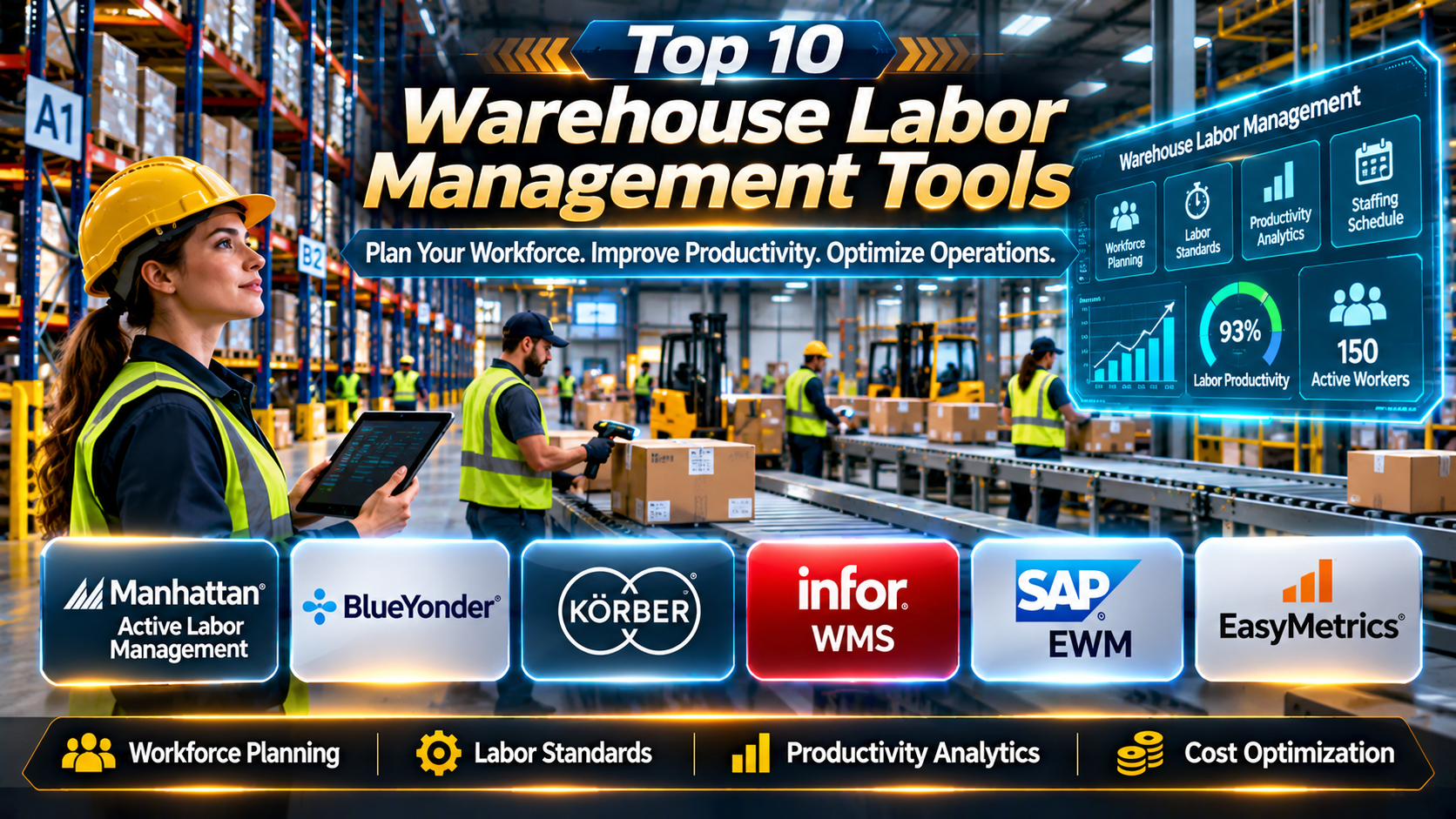
This comprehensive guide examines ten warehouse labor management tools, their features, benefits, advantages, limitations, practical applications, and suitability for different warehouse environments.
What Are Warehouse Labor Management Tools?
Warehouse labor management tools are software solutions designed to help distribution centers, fulfillment facilities, and warehouse operators plan, measure, coordinate, and improve workforce activities.
These platforms collect information about employee working hours, assigned tasks, completed warehouse transactions, operational workloads, and productivity indicators. Managers use this information to understand staffing requirements and evaluate operational performance.
Dedicated labor management systems often incorporate engineered labor standards that estimate the time required to complete specific warehouse activities under defined working conditions. These standards help organizations compare expected workloads with available workforce capacity.
Warehouse labor management software frequently integrates with warehouse management systems, enterprise resource planning applications, time and attendance systems, and workforce scheduling platforms. These integrations help connect operational activities with workforce planning and performance management.
Common Applications of Warehouse Labor Management Tools
- Workforce Planning: Estimates staffing requirements according to expected warehouse workloads and operational priorities.
- Labor Productivity Monitoring: Measures completed warehouse activities relative to relevant working hours and operational standards.
- Employee Scheduling: Coordinates shift assignments, workforce availability, and staffing requirements.
- Engineered Labor Standards: Establishes reasonable task completion expectations based on work methods and operating conditions.
- Labor Cost Management: Evaluates workforce expenses associated with receiving, picking, packing, shipping, and other warehouse activities.
- Operational Performance Analysis: Identifies productivity trends, process bottlenecks, and resource allocation opportunities.
- Employee Coaching: Provides contextual performance information that supervisors can use to identify training and process improvement requirements.
- Workload Forecasting: Anticipates staffing requirements according to incoming shipments, customer orders, seasonal demand, and fulfillment commitments.
Essential Components of Warehouse Labor Management Software
| Component | Primary Function |
|---|---|
| Workforce Planning | Estimates employee requirements |
| Labor Scheduling | Coordinates shifts and employee assignments |
| Task Tracking | Records warehouse activities |
| Engineered Labor Standards | Establishes expected task completion times |
| Productivity Analytics | Evaluates operational performance |
| Attendance Integration | Connects working-hour information |
| Labor Cost Analysis | Evaluates workforce expenses |
| Employee Coaching | Supports constructive performance improvement |
| Workload Forecasting | Anticipates operational staffing requirements |
| Performance Dashboards | Displays workforce and warehouse indicators |
| WMS Integration | Connects warehouse transactions with labor information |
| Reporting | Supports operational and workforce analysis |
Warehouse LMS vs. WMS vs. Workforce Management Software
| Software Category | Primary Focus | Typical Capabilities |
|---|---|---|
| Labor Management System (LMS) | Warehouse labor productivity | Labor standards, task performance, utilization |
| Warehouse Management System (WMS) | Warehouse inventory and execution | Receiving, picking, packing, shipping |
| Workforce Management Software | Employee administration and scheduling | Attendance, shifts, payroll integration |
| Warehouse Execution System (WES) | Operational task orchestration | Work prioritization and resource coordination |
| Enterprise Resource Planning (ERP) | Enterprise business management | Finance, procurement, inventory, accounting |
A comprehensive warehouse technology environment may combine several of these software categories. Dedicated labor management systems provide operational productivity analysis, while workforce management applications address employee scheduling, attendance, and administrative requirements.
Top 10 Warehouse Labor Management Tools
The following comparison includes dedicated warehouse labor management systems, integrated warehouse software modules, and complementary workforce management platforms.
The numbering organizes the comparison rather than representing independently benchmarked rankings. Product capabilities depend on selected modules, licensing arrangements, integrations, and deployment configurations.
1. Manhattan Active Labor Management
Short Description
Manhattan Active Labor Management is an enterprise warehouse labor management solution within Manhattan Associates’ supply chain technology ecosystem.
The platform helps distribution centers connect warehouse activities with workforce performance information, labor planning, operational standards, and employee productivity analysis.
Its integration with compatible Manhattan warehouse management capabilities can help organizations establish a more coordinated relationship between warehouse execution and labor management.
Manhattan Active Labor Management is particularly relevant to large distribution facilities that manage complex fulfillment requirements, multiple warehouse processes, and substantial workforces.
Key Features
- Labor Planning: Helps managers estimate staffing requirements according to expected warehouse activities.
- Engineered Labor Standards: Supports structured performance expectations for applicable warehouse tasks.
- Employee Performance Monitoring: Evaluates completed activities against relevant operational standards.
- Warehouse Activity Integration: Connects compatible warehouse execution information with labor management workflows.
- Productivity Analytics: Examines workforce performance across employees, shifts, and operational areas.
- Performance Coaching: Provides information that supervisors can use during constructive employee coaching.
- Labor Utilization Analysis: Helps identify opportunities to improve workforce allocation.
- Operational Reporting: Displays selected warehouse labor and productivity indicators.
- Cloud-Based Architecture: Supports applicable Manhattan Active deployment and software update capabilities.
Benefits
- Improves visibility into warehouse workforce activities.
- Supports more informed staffing decisions.
- Helps identify operational productivity bottlenecks.
- Facilitates consistent labor performance assessments.
- Connects warehouse execution with labor management.
- Supports employee training and coaching initiatives.
- Helps organizations evaluate warehouse operating costs.
Pros
- Strong enterprise warehouse management ecosystem.
- Dedicated labor management capabilities.
- Suitable for complex distribution facilities.
- Supports structured labor standards.
- Relevant operational analytics.
- Integration opportunities with Manhattan Active applications.
Cons
- Enterprise implementation may require substantial resources.
- Commercial pricing requires consultation.
- Labor standards require careful development.
- Integration with external systems may require additional work.
- Smaller warehouses may not require extensive functionality.
Use Cases
- E-commerce Fulfillment: Evaluate staffing requirements according to customer order volumes.
- Retail Distribution: Monitor workforce performance across receiving and shipping operations.
- Multi-Site Warehousing: Establish consistent labor management practices across distribution centers.
- Productivity Improvement: Investigate differences between expected and actual task completion times.
- Employee Coaching: Identify training requirements using contextual performance information.
- Seasonal Staffing: Estimate workforce requirements during peak fulfillment periods.
Best For
- Large distribution centers.
- E-commerce fulfillment facilities.
- Retail warehouse operators.
- Manhattan Active customers.
- Enterprise logistics departments.
- Multi-site warehouse organizations.
2. Blue Yonder Labor Management
Short Description
Blue Yonder Labor Management provides warehouse workforce planning and productivity management capabilities within Blue Yonder’s supply chain execution ecosystem.
The solution helps warehouse operators evaluate labor requirements, establish operational performance expectations, and monitor workforce activities across distribution processes.
Organizations can use compatible warehouse execution information to understand relationships between operational workloads, staffing availability, and employee productivity.
Blue Yonder is particularly relevant to large retailers, manufacturers, and logistics providers seeking integrated warehouse and labor management capabilities.
Key Features
- Labor Standards Management: Supports development and application of structured warehouse task standards.
- Workforce Planning: Evaluates labor requirements according to operational workloads.
- Productivity Measurement: Tracks relevant employee and operational performance indicators.
- Performance Reporting: Provides visibility into warehouse labor activities.
- Warehouse Management Integration: Connects compatible warehouse transactions with workforce information.
- Labor Cost Analysis: Supports evaluation of workforce expenses across operational activities.
- Employee Performance Coaching: Provides information supporting supervisor-led improvement discussions.
- Workload Analysis: Helps identify staffing imbalances and operational constraints.
- Multi-Site Management: Supports standardized labor management across applicable warehouse environments.
Benefits
- Improves warehouse labor visibility.
- Supports efficient workforce allocation.
- Helps identify process improvement opportunities.
- Facilitates labor cost management.
- Supports operational planning during demand fluctuations.
- Improves coordination between supervisors and warehouse managers.
- Supports consistent performance measurement.
Pros
- Established supply chain software ecosystem.
- Dedicated warehouse labor management functionality.
- Relevant labor planning capabilities.
- Suitable for enterprise distribution.
- Supports performance analytics.
- Integration opportunities with Blue Yonder warehouse applications.
Cons
- Implementation complexity varies by environment.
- Commercial licensing requires evaluation.
- Accurate labor standards require engineering expertise.
- Data quality affects performance assessments.
- Advanced configurations may require specialist support.
Use Cases
- Retail Warehouse Operations: Coordinate staffing with store replenishment requirements.
- Third-Party Logistics: Evaluate labor expenses across customer operations.
- Manufacturing Distribution: Align workforce capacity with finished goods shipments.
- Peak Season Planning: Estimate additional staffing requirements.
- Operational Benchmarking: Compare similar warehouse activities across facilities.
- Labor Cost Management: Identify processes requiring excessive workforce resources.
Best For
- Global retailers.
- Consumer goods manufacturers.
- Third-party logistics providers.
- Enterprise distribution centers.
- Blue Yonder customers.
- Warehouse industrial engineering teams.
3. Körber Labor Management
Short Description
Körber provides warehouse labor management capabilities within its broader supply chain software portfolio.
Its labor management solutions help organizations measure warehouse activities, evaluate workforce productivity, establish performance standards, and identify operational improvement opportunities.
Körber’s warehouse technology ecosystem includes warehouse management, automation, voice-directed workflows, and other operational applications that can complement labor management initiatives.
The exact labor management functionality and integration options depend on the selected Körber products and commercial configuration.
Key Features
- Labor Performance Measurement: Evaluates workforce productivity using applicable warehouse activity information.
- Engineered Standards: Supports structured task completion expectations.
- Workforce Planning: Helps managers evaluate staffing requirements.
- Operational Dashboards: Displays relevant warehouse performance indicators.
- Warehouse Data Integration: Connects compatible warehouse transactions with labor records.
- Labor Cost Reporting: Supports analysis of workforce-related operational expenses.
- Performance Coaching: Provides information supporting employee development.
- Process Analysis: Helps identify inefficient warehouse work methods.
- Multi-Department Reporting: Evaluates performance across warehouse operational areas.
Benefits
- Improves understanding of warehouse labor requirements.
- Supports productivity improvement initiatives.
- Helps organizations evaluate staffing decisions.
- Facilitates structured performance measurement.
- Supports warehouse process standardization.
- Improves visibility into workforce expenses.
- Provides integration opportunities with warehouse technologies.
Pros
- Extensive warehouse technology ecosystem.
- Relevant labor performance functionality.
- Supports complex distribution environments.
- Suitable for process improvement programs.
- Provides operational reporting capabilities.
- Offers complementary warehouse applications.
Cons
- Product packaging requires confirmation.
- Implementation may require specialist services.
- Commercial pricing is configuration-dependent.
- Labor standards require ongoing maintenance.
- Third-party integration complexity can vary.
Use Cases
- Warehouse Productivity Analysis: Evaluate workforce performance across operational processes.
- Voice-Directed Warehousing: Connect applicable warehouse activity information with labor analysis.
- Distribution Center Modernization: Introduce structured labor management alongside warehouse software.
- Employee Development: Identify work methods requiring additional training.
- Labor Budgeting: Estimate workforce expenses according to expected workloads.
- Operational Standardization: Establish consistent performance measurement across warehouse departments.
Best For
- Distribution center operators.
- Industrial warehouse managers.
- Körber software customers.
- Third-party logistics companies.
- Warehouse engineering departments.
- Organizations modernizing warehouse operations.
4. Infor WMS Labor Management
Short Description
Infor WMS provides warehouse management capabilities that can include labor management functionality supporting workforce productivity, operational performance, and resource planning.
The platform connects warehouse activities such as receiving, putaway, replenishment, picking, packing, and shipping with relevant operational information.
Integrated labor management capabilities help organizations evaluate employee performance within the context of warehouse execution rather than relying entirely on separate manual records.
Infor WMS is particularly relevant to manufacturers, distributors, retailers, and logistics providers seeking integrated warehouse operations management.
Key Features
- Warehouse Labor Tracking: Records applicable workforce activities associated with warehouse operations.
- Labor Standards: Supports relevant task performance expectations.
- Productivity Reporting: Evaluates employee and departmental operational performance.
- Warehouse Task Integration: Connects labor information with warehouse execution activities.
- Workforce Utilization Analysis: Helps identify staffing and resource allocation opportunities.
- Operational Dashboards: Displays selected warehouse labor indicators.
- Performance Analysis: Supports investigation of productivity differences.
- Inventory Workflow Integration: Connects workforce activities with relevant inventory transactions.
- Enterprise Connectivity: Supports compatible Infor and external enterprise integrations.
Benefits
- Connects warehouse labor information with operational transactions.
- Improves workforce productivity visibility.
- Supports informed staffing decisions.
- Facilitates warehouse process analysis.
- Helps reduce manual performance reporting.
- Supports operational standardization.
- Improves coordination between warehouse departments.
Pros
- Integrated warehouse management environment.
- Relevant labor management capabilities.
- Strong inventory and warehouse execution functionality.
- Suitable for manufacturing and distribution.
- Supports enterprise integration.
- Provides centralized operational information.
Cons
- Advanced functionality depends on configuration.
- Commercial pricing requires consultation.
- Implementation requires warehouse process preparation.
- Dedicated workforce scheduling may require complementary software.
- Existing labor standards may require migration.
Use Cases
- Wholesale Distribution: Evaluate workforce requirements for inventory handling.
- Manufacturing Warehouses: Coordinate labor activities with production-related material movements.
- Third-Party Logistics: Monitor warehouse performance across customer accounts.
- Inventory Replenishment: Evaluate labor resources associated with stock movements.
- Order Fulfillment: Analyze picking and packing productivity.
- Warehouse Modernization: Consolidate operational and workforce information.
Best For
- Infor WMS customers.
- Wholesale distributors.
- Manufacturing organizations.
- Retail distribution centers.
- Logistics service providers.
- Integrated warehouse operations teams.
5. SAP Extended Warehouse Management
Short Description
SAP Extended Warehouse Management, commonly called SAP EWM, is an enterprise warehouse management solution supporting complex inventory handling and warehouse execution requirements.
Its labor management capabilities can support the planning and evaluation of warehouse workforce activities through applicable workload, resource, and performance management functions.
Organizations can connect warehouse activities with compatible SAP enterprise applications, enabling broader coordination between logistics, procurement, manufacturing, and business operations.
SAP EWM is particularly relevant to large organizations operating SAP-based enterprise environments and requiring structured warehouse labor management.
Key Features
- Labor Management: Supports applicable planning and evaluation of warehouse workforce activities.
- Planned Workload Management: Estimates expected operational workloads.
- Executed Workload Tracking: Records relevant completed warehouse activities.
- Labor Standards: Supports structured expected task durations.
- Resource Management: Coordinates applicable warehouse resources and task assignments.
- Warehouse Task Management: Organizes inventory handling and execution activities.
- Performance Evaluation: Supports comparison of planned and executed workloads.
- Warehouse Monitoring: Provides operational visibility across warehouse processes.
- SAP Integration: Connects compatible warehouse activities with enterprise business applications.
Benefits
- Connects labor management with warehouse execution.
- Supports structured workload evaluation.
- Improves visibility into warehouse activities.
- Facilitates enterprise logistics coordination.
- Helps organizations evaluate resource utilization.
- Supports standardized warehouse processes.
- Provides integration opportunities within SAP environments.
Pros
- Comprehensive enterprise warehouse functionality.
- Relevant labor management capabilities.
- Strong SAP integration ecosystem.
- Suitable for complex warehouse operations.
- Supports detailed warehouse task information.
- Relevant to multinational organizations.
Cons
- Enterprise configuration can be complex.
- Licensing depends on deployment and functionality.
- Labor management requires appropriate setup.
- Employee scheduling may require separate applications.
- Implementation can involve substantial resources.
Use Cases
- Enterprise Distribution: Coordinate warehouse resources across large facilities.
- Manufacturing Logistics: Evaluate workforce activities associated with production supply.
- Warehouse Workload Planning: Estimate operational requirements using warehouse task information.
- Resource Utilization: Investigate warehouse resource allocation.
- Performance Measurement: Compare expected and completed warehouse workloads.
- SAP Logistics Modernization: Integrate labor management into enterprise warehouse operations.
Best For
- SAP-based enterprises.
- Automotive manufacturers.
- Large industrial warehouses.
- Global distribution organizations.
- Enterprise logistics managers.
- Companies requiring integrated warehouse execution.
6. Oracle Warehouse Management Cloud
Short Description
Oracle Warehouse Management Cloud is a cloud-based warehouse execution platform designed to support inventory management, fulfillment, distribution, and operational visibility.
Its applicable workforce and workforce-productivity capabilities help organizations evaluate warehouse activities and understand employee-related operational performance.
Oracle WMS can connect with compatible enterprise applications, supporting coordination between inventory management, customer orders, transportation, and warehouse execution.
Organizations requiring comprehensive engineered labor standards or advanced workforce scheduling should evaluate the relevant Oracle functionality and complementary applications separately.
Key Features
- Warehouse Activity Tracking: Records relevant warehouse execution transactions.
- Productivity Reporting: Supports analysis of completed warehouse activities.
- Task Management: Coordinates applicable warehouse work assignments.
- Operational Dashboards: Provides visibility into warehouse performance.
- Inventory Tracking: Connects operational activities with inventory movements.
- Order Fulfillment Management: Supports picking, packing, and shipping workflows.
- Mobile Warehouse Execution: Enables compatible mobile warehouse activities.
- Enterprise Integration: Connects warehouse operations with supported enterprise systems.
- Cloud Deployment: Provides cloud-based warehouse management capabilities.
Benefits
- Improves warehouse operational visibility.
- Supports workforce productivity analysis.
- Connects employee activities with warehouse transactions.
- Facilitates inventory and fulfillment coordination.
- Reduces dependence on manual warehouse records.
- Supports cloud-based warehouse modernization.
- Provides information for staffing and process decisions.
Pros
- Cloud-based warehouse management architecture.
- Strong inventory execution capabilities.
- Relevant operational reporting.
- Supports complex fulfillment environments.
- Integration opportunities with Oracle applications.
- Suitable for distributed warehouse operations.
Cons
- Not necessarily equivalent to a dedicated enterprise LMS.
- Advanced labor functionality requires confirmation.
- Commercial licensing requires evaluation.
- Workforce scheduling may require complementary software.
- Integration with external timekeeping systems requires planning.
Use Cases
- E-commerce Warehousing: Evaluate employee activities associated with customer fulfillment.
- Cloud Warehouse Modernization: Replace fragmented warehouse execution applications.
- Inventory Handling Analysis: Examine workforce activities related to inventory movements.
- Distribution Reporting: Monitor operational performance across facilities.
- Warehouse Task Coordination: Organize operational work according to fulfillment requirements.
- Labor Analytics Integration: Connect warehouse activity information with complementary labor systems.
Best For
- Oracle Cloud customers.
- E-commerce fulfillment centers.
- Wholesale distributors.
- Cloud-oriented warehouse operators.
- Enterprise inventory managers.
- Organizations requiring warehouse execution visibility.
7. Lucas Systems Jennifer
Short Description
Lucas Systems provides warehouse optimization and work execution solutions, including its Jennifer software platform.
Jennifer helps coordinate warehouse activities through applicable voice-directed workflows, intelligent work assignments, and operational optimization capabilities.
The platform can help warehouse operators improve workforce efficiency by optimizing how employees receive instructions, move through facilities, and complete assigned activities.
Jennifer is primarily a warehouse work execution and optimization solution rather than a comprehensive human resources or standalone labor administration platform.
Key Features
- Voice-Directed Workflows: Provides spoken instructions for compatible warehouse activities.
- Intelligent Work Assignment: Supports allocation of warehouse tasks according to operational requirements.
- Picking Optimization: Helps improve applicable order picking processes.
- Travel Reduction: Supports optimization of employee movement within warehouse environments.
- Work Prioritization: Coordinates activities according to relevant operational priorities.
- Productivity Visibility: Provides information about warehouse task execution.
- Warehouse System Integration: Connects with compatible warehouse management applications.
- Mobile Work Execution: Supports applicable mobile and wearable technologies.
- Operational Analytics: Helps organizations investigate warehouse process performance.
Benefits
- Supports efficient warehouse work execution.
- Helps reduce unnecessary employee travel.
- Improves task instruction consistency.
- Facilitates hands-free warehouse workflows.
- Supports order fulfillment productivity.
- Provides operational performance information.
- Complements existing warehouse management systems.
Pros
- Specialized warehouse work optimization.
- Relevant voice-directed functionality.
- Supports practical operational improvements.
- Compatible with multiple warehouse environments.
- Useful for picking-intensive operations.
- Provides complementary execution capabilities.
Cons
- Not a complete workforce administration platform.
- Compatible devices may be required.
- Integration requires warehouse process configuration.
- Commercial pricing requires consultation.
- Advanced labor standards may require separate software.
Use Cases
- Voice Picking: Guide employees through order fulfillment activities.
- Warehouse Travel Optimization: Reduce unnecessary movement between inventory locations.
- Work Assignment: Coordinate tasks according to operational priorities.
- Employee Onboarding: Support consistent warehouse task instructions.
- Fulfillment Productivity: Improve work execution in picking-intensive facilities.
- Warehouse Process Modernization: Add intelligent execution capabilities to existing systems.
Best For
- Picking-intensive distribution centers.
- Grocery warehouses.
- Retail fulfillment facilities.
- Voice-enabled warehouse operations.
- Warehouse process improvement teams.
- Organizations extending existing WMS capabilities.
8. UKG Pro Workforce Management
Short Description
UKG Pro Workforce Management is an enterprise workforce management solution supporting employee scheduling, timekeeping, attendance, workforce analytics, and labor-related administrative processes.
Warehouse operators can use UKG to coordinate employee availability, shift coverage, working hours, and workforce policies across distribution facilities.
Its capabilities are particularly useful for organizations managing large hourly workforces, complex shift arrangements, and multiple operational locations.
UKG is a complementary workforce management platform rather than a dedicated warehouse engineered labor standards system. Warehouse task-level productivity analysis generally requires integration with warehouse applications.
Key Features
- Employee Scheduling: Coordinates workforce shifts and staffing coverage.
- Time and Attendance: Records employee working hours and attendance information.
- Labor Forecasting: Supports applicable workforce demand and staffing forecasts.
- Overtime Management: Provides visibility into overtime and workforce expenses.
- Absence Management: Coordinates applicable employee absence workflows.
- Workforce Analytics: Evaluates staffing, attendance, and labor-related indicators.
- Employee Self-Service: Supports applicable schedule and timekeeping interactions.
- Workforce Policy Configuration: Helps organizations administer relevant working-time rules.
- Payroll Integration: Connects compatible workforce information with payroll processes.
Benefits
- Improves workforce scheduling visibility.
- Supports accurate working-hour records.
- Helps managers evaluate overtime requirements.
- Facilitates shift coverage planning.
- Supports workforce policy administration.
- Reduces manual timekeeping activities.
- Complements warehouse labor management systems.
Pros
- Comprehensive workforce management capabilities.
- Strong scheduling and attendance functionality.
- Suitable for large hourly workforces.
- Supports employee self-service.
- Relevant workforce analytics.
- Applicable across multiple operational locations.
Cons
- Not a dedicated warehouse productivity LMS.
- Warehouse task data requires integration.
- Enterprise implementation requires configuration.
- Commercial pricing requires consultation.
- Complex workforce policies require ongoing administration.
Use Cases
- Warehouse Shift Scheduling: Coordinate staffing across operational shifts.
- Attendance Management: Record employee working hours.
- Overtime Analysis: Identify departments with excessive overtime requirements.
- Seasonal Workforce Planning: Coordinate temporary staffing requirements.
- Payroll Preparation: Connect approved time records with payroll processes.
- Workforce Compliance Support: Administer applicable working-time and attendance policies.
Best For
- Large warehouse workforces.
- Human resources departments.
- Distribution center supervisors.
- Multi-site logistics companies.
- Hourly workforce managers.
- Organizations requiring scheduling and attendance integration.
9. Easy Metrics
Short Description
Easy Metrics provides labor management and operational analytics solutions designed for warehouses, distribution centers, and other labor-intensive operations.
The platform helps organizations connect workforce information with operational transactions to understand productivity, labor costs, and process performance.
Its analytical approach is particularly relevant to warehouse operators seeking to evaluate the cost of operational activities and identify differences in productivity across processes.
Easy Metrics can complement existing warehouse management systems without necessarily requiring replacement of the underlying warehouse execution environment.
Key Features
- Labor Productivity Analytics: Evaluates workforce output using relevant operational information.
- Cost-to-Serve Analysis: Helps organizations understand labor expenses associated with operational activities.
- Warehouse Data Integration: Connects compatible warehouse transaction information.
- Performance Dashboards: Displays workforce and operational performance indicators.
- Labor Standards: Supports applicable productivity expectations and performance assessments.
- Workforce Utilization Analysis: Helps identify resource allocation opportunities.
- Process Cost Analysis: Evaluates labor costs across warehouse processes.
- Operational Benchmarking: Supports comparison of appropriately comparable operational activities.
- Performance Reporting: Provides information supporting warehouse management decisions.
Benefits
- Improves visibility into warehouse labor expenses.
- Supports detailed productivity analysis.
- Helps identify inefficient operational processes.
- Facilitates cost-to-serve evaluations.
- Supports workforce planning decisions.
- Complements existing warehouse applications.
- Helps organizations establish measurable improvement objectives.
Pros
- Dedicated labor analytics orientation.
- Strong operational cost analysis.
- Relevant warehouse productivity capabilities.
- Supports existing warehouse system integration.
- Useful for third-party logistics operations.
- Provides actionable process performance information.
Cons
- Data integration requires preparation.
- Commercial pricing requires consultation.
- Accurate cost analysis depends on reliable inputs.
- Performance standards require contextual validation.
- Comprehensive payroll administration requires complementary software.
Use Cases
- Third-Party Logistics Cost Analysis: Evaluate labor expenses associated with customer accounts.
- Warehouse Productivity Improvement: Identify operational processes requiring investigation.
- Labor Budgeting: Estimate workforce expenses according to anticipated workloads.
- Customer Profitability Analysis: Understand relevant labor cost contributions.
- Process Benchmarking: Compare similar warehouse activities across facilities.
- Operational Performance Reporting: Establish consistent warehouse productivity dashboards.
Best For
- Third-party logistics providers.
- Distribution center operators.
- Warehouse financial analysts.
- Labor-intensive fulfillment facilities.
- Industrial engineering departments.
- Organizations prioritizing labor cost visibility.
10. Logiwa IO
Short Description
Logiwa IO is a cloud-oriented fulfillment management platform designed to support high-volume warehouse and e-commerce distribution operations.
Its warehouse execution capabilities help organizations coordinate inventory, order fulfillment, work assignments, and operational productivity.
Warehouse managers can use applicable operational information to understand workforce activities, evaluate fulfillment performance, and identify process improvement opportunities.
Logiwa IO is best evaluated as a fulfillment and warehouse management platform with complementary labor-related operational capabilities rather than a complete dedicated engineered labor management system.
Key Features
- Fulfillment Management: Coordinates applicable customer order fulfillment activities.
- Warehouse Task Coordination: Supports operational work assignments.
- Productivity Visibility: Provides information about relevant warehouse activities.
- Inventory Management: Tracks inventory balances and warehouse movements.
- Picking Workflows: Supports applicable order picking strategies.
- Packing and Shipping: Coordinates fulfillment preparation and shipment workflows.
- Operational Reporting: Displays relevant warehouse performance indicators.
- E-commerce Integration: Connects compatible sales channels and fulfillment applications.
- Cloud-Based Deployment: Supports cloud-oriented warehouse operations management.
Benefits
- Improves fulfillment operational visibility.
- Supports warehouse task coordination.
- Helps organizations understand productivity trends.
- Facilitates e-commerce order processing.
- Reduces dependence on disconnected operational records.
- Supports scalable fulfillment operations.
- Provides information for workforce allocation decisions.
Pros
- Strong e-commerce fulfillment orientation.
- Relevant warehouse execution capabilities.
- Supports cloud-based operations.
- Provides operational reporting.
- Suitable for high-volume fulfillment environments.
- Supports compatible sales channel integrations.
Cons
- Not a full dedicated enterprise LMS.
- Advanced labor standards require confirmation.
- Workforce scheduling may require separate software.
- Commercial costs depend on requirements.
- Complex integration projects require planning.
Use Cases
- E-commerce Order Fulfillment: Coordinate warehouse activities associated with online orders.
- Multi-Channel Distribution: Manage fulfillment requirements across sales channels.
- Warehouse Productivity Reporting: Evaluate relevant operational performance.
- Third-Party Fulfillment: Coordinate customer inventory and order processing.
- Picking Process Improvement: Investigate operational bottlenecks.
- Growing Warehouse Operations: Establish structured fulfillment workflows.
Best For
- E-commerce fulfillment companies.
- Direct-to-consumer brands.
- Third-party fulfillment providers.
- Growing distribution facilities.
- Cloud-oriented warehouse operators.
- Organizations prioritizing fulfillment execution.
Comparison Table: Top 10 Warehouse Labor Management Tools
| Platform | Primary Function | Best For | Standout Capability | Pricing |
|---|---|---|---|---|
| Manhattan Active Labor Management | Dedicated warehouse LMS | Enterprise distribution centers | Integrated warehouse labor standards | Commercial pricing |
| Blue Yonder Labor Management | Warehouse workforce productivity | Large retailers and logistics providers | Labor planning and performance analysis | Commercial pricing |
| Körber Labor Management | Warehouse labor management | Complex distribution facilities | Warehouse process productivity | Commercial pricing |
| Infor WMS | Integrated warehouse and labor management | Manufacturers and distributors | Warehouse execution integration | Commercial licensing |
| SAP EWM | Enterprise warehouse management | SAP-based organizations | Planned and executed workload management | Commercial licensing |
| Oracle WMS Cloud | Cloud warehouse execution | Enterprise fulfillment operations | Cloud operational visibility | Commercial subscription |
| Lucas Systems Jennifer | Warehouse work optimization | Picking-intensive warehouses | Voice-directed intelligent work execution | Commercial pricing |
| UKG Pro Workforce Management | Workforce administration | Large hourly workforces | Scheduling and attendance | Commercial subscription |
| Easy Metrics | Labor management and cost analytics | Warehouses and 3PL providers | Operational labor cost analysis | Commercial pricing |
| Logiwa IO | Fulfillment management | E-commerce warehouses | Cloud fulfillment execution | Commercial subscription |
Product availability, licensing, integration requirements, and individual module functionality should be confirmed with the relevant software providers.
Which Warehouse Labor Management Tool Is Right for You?
For Large Enterprise Distribution Centers
Manhattan Active Labor Management and Blue Yonder Labor Management provide relevant dedicated warehouse labor management capabilities.
Organizations should evaluate labor standards, warehouse system integration, performance reporting, and multi-site deployment requirements.
For SAP-Based Warehouse Operations
SAP EWM provides integrated warehouse execution and applicable labor management capabilities.
Businesses already using SAP enterprise applications should evaluate whether existing warehouse functionality can satisfy their labor management requirements before purchasing separate systems.
For Integrated Manufacturing Warehouses
Infor WMS provides relevant warehouse execution and labor-related operational capabilities.
It is particularly suitable for organizations seeking coordination between inventory management, manufacturing logistics, and warehouse workforce activities.
For Complex Warehouse Modernization
Körber provides complementary warehouse technologies that can support labor management and operational improvement initiatives.
Organizations should evaluate available software modules alongside existing automation and warehouse execution infrastructure.
For Cloud-Based Warehouse Operations
Oracle WMS Cloud provides warehouse execution and operational reporting capabilities that can complement workforce management applications.
It is particularly relevant to organizations modernizing enterprise warehouse infrastructure.
For Picking and Travel Optimization
Lucas Systems Jennifer provides specialized warehouse work execution and optimization capabilities.
Organizations should consider it when excessive employee travel, inconsistent task instructions, or inefficient picking workflows contribute to operational costs.
For Employee Scheduling and Attendance
UKG Pro Workforce Management provides workforce scheduling, timekeeping, attendance, and administrative functionality.
It can complement dedicated warehouse labor management systems where employee scheduling and working-hour records require additional capabilities.
For Labor Cost Analysis and E-commerce Fulfillment
Easy Metrics is relevant to organizations requiring detailed labor productivity and operational cost analysis.
Logiwa IO is suitable for evaluating fulfillment execution and warehouse operational visibility in e-commerce environments.
Best Warehouse Labor Management Tools by User Type
| User Type | Platform to Evaluate | Primary Reason |
|---|---|---|
| Enterprise warehouse director | Manhattan Active Labor Management | Dedicated enterprise labor management |
| Retail distribution manager | Blue Yonder | Labor planning and productivity |
| Warehouse modernization specialist | Körber | Complementary warehouse technologies |
| Manufacturing logistics manager | Infor WMS | Integrated warehouse operations |
| SAP enterprise architect | SAP EWM | Enterprise warehouse integration |
| Cloud transformation manager | Oracle WMS Cloud | Cloud warehouse execution |
| Picking process engineer | Lucas Systems Jennifer | Work and travel optimization |
| Workforce scheduling manager | UKG Pro | Employee scheduling and attendance |
| Third-party logistics financial analyst | Easy Metrics | Labor cost analysis |
| E-commerce fulfillment manager | Logiwa IO | Fulfillment execution |
How to Choose the Best Warehouse Labor Management Tool
1. Establish Clear Operational Objectives
Begin by identifying the workforce and warehouse challenges the organization wants to address.
Objectives may include reducing unnecessary overtime, improving order fulfillment productivity, increasing staffing accuracy, reducing employee travel, or improving visibility into warehouse labor expenses.
Each objective should have a measurable performance indicator. For example, an overtime reduction initiative may track overtime hours as a percentage of total paid hours.
Clearly defined objectives help organizations avoid purchasing software functionality that does not address their operational requirements.
2. Evaluate Warehouse Workload Complexity
Warehouse labor requirements vary according to product characteristics, order profiles, storage arrangements, equipment, and fulfillment processes.
A pallet distribution warehouse may have relatively predictable handling activities, while an e-commerce facility may process thousands of individual product picks across multiple storage zones.
Evaluate whether the software can represent these differences accurately.
Labor management systems should account for operational complexity rather than applying identical productivity expectations to fundamentally different activities.
3. Assess Engineered Labor Standards
Engineered labor standards estimate reasonable task completion times under defined working conditions.
These standards may consider travel distance, product handling requirements, equipment characteristics, task complexity, and appropriate allowances.
Evaluate whether the software supports standards development, validation, version management, and periodic review.
Standards should incorporate safe working methods, necessary breaks, reasonable recovery allowances, and relevant workplace accommodations.
4. Review Warehouse Management System Integration
Warehouse labor management software requires reliable information about operational activities.
Evaluate whether the platform can access warehouse task records, employee identifiers, order information, inventory movements, and task completion timestamps.
Organizations should also establish consistent definitions for completed activities and working hours.
Poor integration can produce misleading productivity reports and unfair employee performance assessments.
5. Evaluate Workforce Scheduling Capabilities
Some warehouse labor management systems provide detailed workload planning but limited employee scheduling functionality.
Determine whether the organization requires shift planning, availability management, attendance tracking, overtime approval, or payroll integration.
A complementary workforce management platform may provide these capabilities more effectively.
The selected architecture should connect staffing requirements with actual workforce availability.
6. Assess Performance Measurement Fairness
Warehouse productivity is affected by equipment availability, inventory accuracy, system interruptions, travel distances, training, and operational conditions.
A useful labor management system should distinguish employee-controlled activities from external operational constraints wherever possible.
Managers should investigate performance differences before drawing conclusions about individual employees.
Employee monitoring practices must comply with applicable privacy, employment, and workplace safety requirements.
7. Evaluate Operational Reporting
Warehouse managers require information that supports practical operational decisions.
Evaluate reporting capabilities for labor utilization, task completion, overtime, departmental performance, workload coverage, and operational costs.
Reports should provide sufficient context to explain why performance indicators change.
Avoid selecting a platform solely because it provides visually attractive dashboards.
8. Review Scalability and Deployment
Consider how the platform will support additional warehouse facilities, employees, shifts, operational processes, and warehouse systems.
Evaluate cloud deployment, local infrastructure requirements, system availability, integration architecture, and data security.
Organizations operating multiple distribution centers should establish consistent measurement practices while allowing appropriate local differences.
9. Evaluate Employee Adoption and Training
Warehouse supervisors, industrial engineers, employees, and workforce planners must understand how the software measures operational activities.
Explain the purpose of performance measurement and establish transparent expectations.
Employees should have appropriate opportunities to raise concerns about inaccurate records, unsafe standards, or operational conditions affecting their performance.
Constructive coaching is generally more useful than relying exclusively on automated productivity scores.
10. Calculate Total Cost of Ownership
Labor management implementation costs include software licensing, integration, labor standards development, training, process redesign, implementation support, and ongoing administration.
Potential financial benefits include reduced unnecessary overtime, improved workforce planning, lower agency staffing expenses, and more efficient operational processes.
Organizations should distinguish theoretical productivity improvements from actual financial savings.
Improved productivity creates financial value when it enables additional profitable output, avoids expenses, or supports other measurable business outcomes.
Practical Example: Implementing Warehouse Labor Management in an E-commerce Fulfillment Center
Consider a hypothetical e-commerce distribution center processing customer orders across receiving, storage, replenishment, picking, packing, and shipping departments.
The facility employs 150 warehouse workers and experiences inconsistent staffing, excessive overtime, and limited visibility into operational productivity.
Management wants to implement a warehouse labor management strategy that improves workforce planning while maintaining employee safety, order accuracy, and reasonable working conditions.
All numerical values in this example are illustrative and do not represent measured results from any listed software provider.
Step 1: Establish Operational Objectives
The organization defines the following objectives:
- Improve warehouse staffing accuracy.
- Reduce unnecessary overtime.
- Improve picking and packing productivity.
- Reduce avoidable employee travel.
- Improve customer order fulfillment.
- Maintain order accuracy.
- Improve workforce training.
- Establish transparent labor performance standards.
- Protect employee health and safety.
- Improve visibility into warehouse labor expenses.
Step 2: Document the Existing Workforce
| Warehouse Department | Employees |
|---|---|
| Receiving | 20 |
| Putaway and replenishment | 25 |
| Order picking | 60 |
| Packing | 30 |
| Shipping | 15 |
| Total | 150 |
The organization documents employee responsibilities, shift arrangements, equipment availability, training requirements, and warehouse operational processes.
Step 3: Evaluate Candidate Software
The warehouse evaluates Manhattan Active Labor Management and Blue Yonder for dedicated labor management functionality.
Easy Metrics is considered for productivity and labor cost analytics.
UKG Pro Workforce Management is evaluated for scheduling, attendance, and overtime administration.
Lucas Systems Jennifer is considered for picking workflow optimization.
The organization determines which capabilities can be integrated with its existing warehouse management system.
Step 4: Establish Baseline Productivity
Suppose the picking department completes 18,000 order lines during a representative working day.
The department records 480 paid labor hours.
Picking productivity:
18,000 ÷ 480 = 37.5 order lines per paid labor hour.
This measure includes all paid hours within the defined observation period.
The organization separately tracks productive task time, necessary breaks, training, equipment interruptions, and other activities to understand the reasons behind productivity differences.
Step 5: Develop Engineered Labor Standards
Industrial engineers evaluate representative warehouse activities.
| Warehouse Activity | Illustrative Standard Time |
|---|---|
| Single-item picking task | 90 seconds |
| Carton packing | 180 seconds |
| Pallet receiving | 480 seconds |
| Inventory replenishment | 360 seconds |
| Shipment preparation | 300 seconds |
These hypothetical standards are not universal warehouse benchmarks.
Actual standards must account for travel distance, equipment, product characteristics, safe handling procedures, reasonable allowances, and local working conditions.
Step 6: Estimate Required Labor Hours
Suppose the warehouse expects to process 20,000 order lines.
For a simplified workload estimate, assume a validated average standard of 90 seconds per order line, including relevant task allowances.
Required standard labor hours:
20,000 × 90 ÷ 3,600 = 500 hours.
The warehouse must also account for activities not represented in the picking standard, including meetings, training, and other necessary work.
Step 7: Calculate Staffing Requirements
Suppose each scheduled employee provides eight paid hours per shift.
Assume 85% of those hours are available for the modeled picking workload after accounting for separate non-picking activities.
Available picking workload hours per employee:
8 × 0.85 = 6.8 hours.
Required employees:
500 ÷ 6.8 = approximately 73.53.
The warehouse would initially plan for 74 employees for this workload, subject to operational review.
Managers should also consider employee skills, equipment capacity, shift timing, and workload variability.
Step 8: Evaluate Labor Performance
Suppose a group of warehouse employees completes activities representing 420 standard labor hours.
The group records 450 actual hours within the same defined work scope.
Labor performance:
420 ÷ 450 × 100 = approximately 93.33%.
This indicator compares earned standard hours with actual hours.
It does not independently establish employee effort or performance quality. Managers must investigate equipment interruptions, work complexity, training needs, and other relevant conditions.
Step 9: Evaluate Labor Utilization
Suppose the warehouse records 1,200 paid labor hours during a representative day.
Of these hours, 960 are assigned to defined direct warehouse activities.
Direct labor utilization:
960 ÷ 1,200 × 100 = 80%.
The remaining 240 hours may include necessary indirect work, training, meetings, breaks, and operational interruptions.
Not all indirect time represents waste. The organization evaluates each activity according to its operational purpose.
Step 10: Improve Picking Productivity
After introducing improved warehouse task coordination, inventory slotting, and employee training, suppose the picking department completes 21,600 order lines using the same 480 paid labor hours.
Updated picking productivity:
21,600 ÷ 480 = 45 order lines per paid labor hour.
Illustrative productivity improvement:
(45 − 37.5) ÷ 37.5 × 100 = 20%.
The organization verifies that improvements do not come at the expense of employee safety, order accuracy, or product handling quality.
Step 11: Evaluate Order Accuracy
Suppose the warehouse processes 100,000 order lines during a representative month.
The baseline number of incorrectly fulfilled lines is 1,200.
Baseline line accuracy:
(100,000 − 1,200) ÷ 100,000 × 100 = 98.8%.
After implementing process improvements, suppose incorrectly fulfilled lines decrease to 500.
Updated line accuracy:
(100,000 − 500) ÷ 100,000 × 100 = 99.5%.
The illustrative improvement is 0.7 percentage points.
Tracking quality alongside productivity helps prevent excessive emphasis on speed.
Step 12: Calculate Overtime Savings
Suppose annual warehouse overtime decreases from 12,000 hours to 7,500 hours.
Avoided overtime hours:
12,000 − 7,500 = 4,500 hours.
Assuming a fully avoidable overtime cost of $30 per hour:
4,500 × $30 = $135,000.
The estimated annual overtime savings are $135,000.
If some overtime hours are replaced by regular working hours, the organization must subtract the associated replacement labor expenses.
Step 13: Evaluate Labor Cost per Order
Suppose monthly warehouse labor expenses are $240,000 and the warehouse processes 80,000 customer orders.
Baseline labor cost per order:
$240,000 ÷ 80,000 = $3.00.
After implementing workforce and operational improvements, suppose monthly labor expenses are $225,000 while order volume remains unchanged.
Updated labor cost per order:
$225,000 ÷ 80,000 = approximately $2.81.
Illustrative labor cost reduction:
($240,000 − $225,000) ÷ $240,000 × 100 = 6.25%.
The organization should also monitor service quality and workforce conditions.
Step 14: Estimate Annual Financial Benefits
Suppose the organization identifies the following non-overlapping annual benefits:
| Benefit Category | Estimated Annual Value |
|---|---|
| Avoided overtime expenses | $135,000 |
| Reduced temporary staffing expenses | $90,000 |
| Reduced fulfillment rework expenses | $45,000 |
| Other validated operational savings | $30,000 |
| Total gross annual benefits | $300,000 |
Suppose annual software, support, integration maintenance, and administration expenses total $85,000.
Annual net operating benefit:
$300,000 − $85,000 = $215,000.
The separate labor cost per order calculation is not added again because it may reflect some of these same savings.
Step 15: Calculate Investment Payback
Suppose the initial implementation investment is $320,000.
Simple payback:
$320,000 ÷ $215,000 = approximately 1.49 years.
The illustrative payback period is approximately 17.9 months.
A simplified three-year return on investment is:
(($215,000 × 3) − $320,000) ÷ $320,000 × 100 = approximately 101.56%.
These calculations exclude taxes, financing costs, discount rates, implementation delays, and changes in operational demand.
Step 16: Establish Continuous Performance Monitoring
| Performance Indicator | Baseline | Illustrative Updated Result |
|---|---|---|
| Warehouse employees | 150 | 150 |
| Picking output per representative day | 18,000 lines | 21,600 lines |
| Picking labor hours | 480 | 480 |
| Picking productivity | 37.5 lines/hour | 45 lines/hour |
| Order line accuracy | 98.8% | 99.5% |
| Annual overtime | 12,000 hours | 7,500 hours |
| Monthly labor cost per order | $3.00 | $2.81 |
| Annual gross financial benefits | Not applicable | $300,000 |
| Annual net operating benefit | Not applicable | $215,000 |
| Illustrative investment payback | Not applicable | 17.9 months |
The organization continues monitoring employee safety, workload variability, fulfillment quality, workforce satisfaction, and operational performance.
Additional labor management capabilities are introduced only after the initial implementation demonstrates sustainable operational improvements.
Common Mistakes to Avoid When Implementing Warehouse Labor Management Tools
1. Establishing Unrealistic Labor Standards
Labor standards that ignore operational conditions can create inaccurate performance assessments and unsafe working expectations.
Develop standards using representative observations, safe working methods, appropriate allowances, and qualified industrial engineering practices.
2. Ignoring Warehouse Process Differences
Picking a lightweight product is not equivalent to handling a heavy carton or moving a pallet.
Performance measurement should reflect relevant differences in task complexity, travel requirements, equipment, and handling conditions.
3. Focusing Exclusively on Productivity
Increasing task completion speed without monitoring quality and safety can create additional operational problems.
Evaluate productivity alongside order accuracy, employee safety, product damage, and customer service.
4. Using Inaccurate Working-Hour Records
Incorrect attendance information can distort productivity and labor cost calculations.
Establish reliable timekeeping integration and consistent definitions of paid, direct, and indirect labor hours.
5. Treating All Indirect Labor as Waste
Training, equipment inspections, meetings, replenishment support, and necessary breaks contribute to effective warehouse operations.
Evaluate indirect activities according to their operational purpose rather than attempting to eliminate them indiscriminately.
6. Ignoring Employee Feedback
Warehouse employees often understand practical process problems that may not appear in operational dashboards.
Provide appropriate channels for employees to identify inaccurate standards, equipment problems, and workflow improvement opportunities.
7. Overlooking Integration Requirements
Disconnected warehouse and workforce systems can produce inconsistent operational records.
Evaluate information exchange, employee identifiers, task definitions, and data synchronization before implementation.
8. Underestimating Training Requirements
Warehouse supervisors must understand performance indicators and how to interpret them fairly.
Provide training covering software functionality, operational context, employee coaching, and appropriate escalation procedures.
9. Overestimating Financial Savings
A productivity improvement does not automatically create an equivalent reduction in operating expenses.
Calculate financial benefits using actual avoided costs, additional profitable output, or other documented business outcomes.
10. Failing to Update Labor Standards
Warehouse layouts, equipment, product characteristics, and operational processes change over time.
Review labor standards periodically and update them when relevant working conditions change.
Frequently Asked Questions (FAQs)
1. What are warehouse labor management tools?
Warehouse labor management tools are software solutions that help organizations plan staffing, measure workforce productivity, evaluate operational workloads, and manage warehouse labor expenses.
2. Who uses warehouse labor management software?
Distribution centers, e-commerce fulfillment facilities, manufacturers, retailers, wholesalers, third-party logistics providers, and warehouse engineering departments use labor management software.
3. What is Manhattan Active Labor Management?
Manhattan Active Labor Management is an enterprise warehouse labor management solution supporting applicable labor planning, performance measurement, operational standards, and warehouse integration.
4. What is Blue Yonder Labor Management?
Blue Yonder Labor Management provides warehouse workforce planning, labor productivity analysis, performance standards, and related operational management capabilities.
5. What is Körber Labor Management?
Körber Labor Management refers to applicable warehouse labor management capabilities within Körber’s supply chain software portfolio.
6. Does Infor WMS support labor management?
Infor WMS offers applicable labor management functionality that can connect warehouse activities with workforce performance information. Available capabilities depend on configuration.
7. Does SAP EWM include labor management?
Yes. SAP EWM provides labor management capabilities supporting applicable planned workloads, executed workloads, resource management, and performance evaluation.
8. Is Oracle WMS Cloud a dedicated LMS?
Oracle WMS Cloud primarily focuses on warehouse execution. Its operational reporting can support workforce analysis, while advanced labor management requirements may require complementary functionality.
9. What is Lucas Systems Jennifer?
Jennifer is a warehouse work execution and optimization platform supporting applicable voice-directed workflows, intelligent task assignments, and operational productivity improvement.
10. What is UKG Pro Workforce Management?
UKG Pro Workforce Management is an enterprise workforce platform supporting scheduling, timekeeping, attendance, workforce analytics, and related administrative activities.
11. What is Easy Metrics?
Easy Metrics provides labor management and operational analytics capabilities supporting warehouse productivity measurement, labor cost analysis, and process performance evaluation.
12. What is Logiwa IO?
Logiwa IO is a cloud-oriented fulfillment management platform supporting warehouse execution, inventory management, order fulfillment, and operational reporting.
13. What is an engineered labor standard?
An engineered labor standard is a structured estimate of the time required to complete a defined activity using an approved work method under specified operating conditions.
14. What is warehouse labor productivity?
Warehouse labor productivity measures operational output relative to relevant labor inputs, such as completed order lines per paid labor hour.
15. What is labor utilization?
Labor utilization measures the proportion of defined available or paid working time allocated to specified activities.
16. What are earned labor hours?
Earned labor hours represent the standard time associated with completed activities according to established labor standards.
17. How is labor performance calculated?
A common method divides earned standard hours by actual hours for the same work scope and multiplies the result by 100.
18. What is warehouse labor cost per order?
Warehouse labor cost per order measures relevant workforce expenses divided by the number of customer orders processed during a defined period.
19. What is workforce forecasting?
Workforce forecasting estimates future staffing requirements according to expected operational workloads, employee availability, and productivity assumptions.
20. What is the difference between direct and indirect labor?
Direct labor relates to defined operational activities, while indirect labor includes supporting activities such as training, supervision, equipment preparation, and other necessary work.
21. Can labor management software reduce overtime?
Yes. Appropriate workforce planning and operational improvements can help reduce unnecessary overtime. Actual results depend on workload variability, staffing availability, and implementation quality.
22. Can warehouse labor management software integrate with WMS platforms?
Yes. Many labor management solutions connect with compatible warehouse management systems to obtain task, inventory, and operational activity information.
23. Does warehouse labor management require artificial intelligence?
No. Effective labor management can use structured labor standards, workload forecasting, operational reporting, and established industrial engineering methods without advanced AI.
24. Can warehouse labor management tools support employee coaching?
Yes. Contextual performance information can help supervisors identify training requirements and process improvement opportunities when used fairly and constructively.
25. How should warehouses protect employee privacy?
Organizations should collect only necessary information, establish transparent monitoring policies, restrict access to employee records, and comply with applicable privacy and employment laws.
26. Can small warehouses use labor management software?
Yes. Smaller warehouses may benefit from workforce scheduling, basic productivity reporting, and operational analytics without requiring a comprehensive enterprise LMS.
27. How much does warehouse labor management software cost?
Costs vary according to employee counts, warehouse locations, selected modules, integration requirements, labor standards development, implementation services, and ongoing support.
28. How should warehouse productivity improvements be measured?
Organizations should evaluate comparable operational workloads, relevant working hours, order accuracy, safety indicators, employee conditions, and actual financial outcomes.
29. How often should labor standards be reviewed?
Labor standards should be reviewed periodically and whenever significant changes occur in warehouse layouts, equipment, work methods, product characteristics, or operating conditions.
30. What makes a warehouse labor management implementation successful?
Successful implementation requires reliable operational information, realistic labor standards, effective integration, employee participation, qualified supervision, transparent performance measurement, and continuous process improvement.
Final Thoughts
Warehouse labor management tools help organizations understand workforce requirements, improve operational visibility, coordinate staffing, and manage warehouse labor expenses.
Manhattan Active Labor Management, Blue Yonder, Körber, and Easy Metrics provide relevant dedicated labor management or labor analytics capabilities. Infor WMS and SAP EWM offer integrated warehouse management functionality that can support labor management initiatives.
Oracle WMS Cloud and Logiwa IO provide complementary warehouse execution capabilities, while Lucas Systems Jennifer specializes in warehouse work optimization. UKG Pro Workforce Management addresses employee scheduling, attendance, and workforce administration requirements.
The most appropriate warehouse labor management platform depends on warehouse size, operational complexity, existing technology, workforce policies, analytical requirements, and implementation resources.
Successful warehouse labor management requires more than productivity measurement. Safe working practices, realistic performance standards, employee development, accurate operational information, and continuous process improvement remain essential for building efficient and sustainable warehouse operations.
