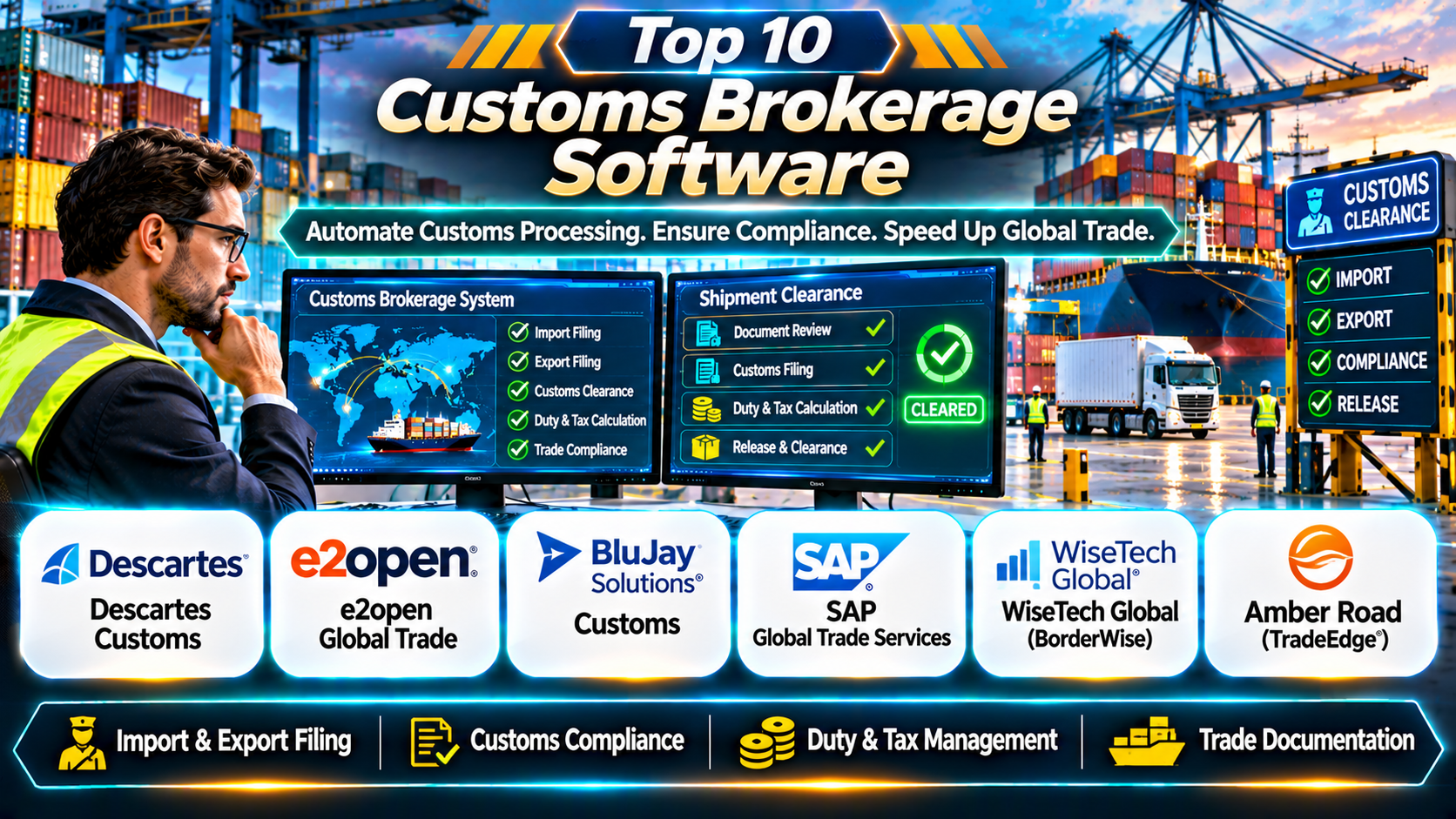
Introduction
Customs brokerage plays a critical role in international trade, helping businesses move goods across national borders while meeting applicable regulatory requirements. Importers, exporters, freight forwarders, and customs brokers must manage extensive documentation, product classifications, customs declarations, and financial obligations.
Traditional customs brokerage processes often rely on spreadsheets, manual document preparation, email communication, and disconnected government portals. These methods can increase administrative workloads, introduce declaration errors, and contribute to avoidable shipment delays.
Customs brokerage software provides centralized capabilities for preparing customs declarations, managing shipment documentation, calculating applicable duties, and communicating with supported customs authorities.
Modern customs brokerage platforms incorporate electronic filing, tariff classification assistance, regulatory information management, document automation, shipment visibility, and integration with transportation and enterprise applications.
Selecting the right customs brokerage solution requires careful consideration of geographic coverage, customs procedures, shipment volumes, regulatory requirements, government connectivity, and implementation costs. A broker operating in the United States may require substantially different filing capabilities from an organization handling European or Asian customs declarations.
This comprehensive guide examines ten customs brokerage software solutions, their key features, benefits, advantages, limitations, practical applications, and suitability for different international trade environments.
What Is Customs Brokerage Software?
Customs brokerage software is a digital solution designed to help customs brokers, freight forwarders, importers, exporters, and trade compliance professionals manage customs clearance activities.
These systems organize commercial invoices, packing lists, transportation documents, product classifications, country-of-origin information, customs values, and other information required for preparing customs declarations.
Depending on the jurisdiction and software configuration, customs brokerage platforms can transmit electronic declarations to supported government systems, receive processing responses, manage declaration amendments, and maintain historical clearance records.
Advanced customs brokerage solutions may also incorporate trade compliance screening, duty calculation, bonded warehouse management, financial accounting, shipment tracking, and integration with global trade management systems.
Software supports customs compliance but does not eliminate the responsibility of declarants, importers, exporters, or licensed customs brokers to provide accurate information and satisfy applicable legal requirements.
Common Applications of Customs Brokerage Software
- Import Declaration Management: Prepares and processes applicable customs declarations for goods entering a country.
- Export Declaration Management: Supports preparation and submission of required export information.
- Tariff Classification: Helps users organize product classifications and access applicable tariff information.
- Duty and Tax Calculation: Supports calculation of estimated customs duties and applicable import taxes.
- Electronic Customs Filing: Transmits declarations through supported government interfaces.
- Document Management: Organizes commercial invoices, packing lists, certificates, and transportation documents.
- Regulatory Compliance: Supports applicable trade controls, declaration requirements, and compliance review processes.
- Customs Clearance Monitoring: Tracks declaration responses, clearance status, outstanding requirements, and operational exceptions.
Essential Components of Customs Brokerage Software
| Component | Primary Function |
|---|---|
| Customs Declaration Management | Prepares import and export declarations |
| Electronic Filing | Communicates with supported customs authorities |
| Tariff Classification | Organizes commodity classification information |
| Duty Calculation | Estimates applicable customs duties |
| Tax Calculation | Supports relevant import tax calculations |
| Document Management | Maintains shipment and clearance documentation |
| Customer Management | Organizes importer and exporter information |
| Regulatory Data | Provides applicable customs reference information |
| Exception Management | Identifies declaration errors and outstanding requirements |
| Shipment Tracking | Monitors relevant clearance milestones |
| Financial Management | Supports brokerage billing and expense records |
| Compliance Screening | Supports applicable trade restriction checks |
| Audit Trails | Maintains historical declaration and approval records |
| Enterprise Integration | Connects logistics and business applications |
Customs Brokerage Software vs. Global Trade Management Software
| Software Category | Primary Focus | Typical Capabilities |
|---|---|---|
| Customs Brokerage Software | Customs clearance execution | Declaration preparation, electronic filing, documentation |
| Global Trade Management | International trade operations | Trade compliance, customs management, landed costs |
| Trade Compliance Software | Regulatory compliance | Screening, classification, licensing, trade restrictions |
| Freight Forwarding Software | International freight coordination | Shipment bookings, documentation, freight management |
| Transportation Management System | Transportation execution | Routing, carrier management, shipment tracking |
| Enterprise Resource Planning | Business operations | Purchasing, accounting, inventory, financial management |
These software categories frequently complement one another. An international logistics organization may use customs brokerage software for declaration processing, trade compliance software for regulatory screening, and enterprise applications for accounting and inventory management.
Top 10 Customs Brokerage Software
The following comparison includes dedicated customs brokerage applications, regional electronic filing platforms, and broader international trade management solutions with relevant customs capabilities.
The numbering organizes the comparison rather than representing independently benchmarked rankings. Government connectivity, filing permissions, supported declaration types, and regulatory coverage must be evaluated separately for each jurisdiction.
1. CargoWise
Short Description
CargoWise, developed by WiseTech Global, is an integrated logistics execution platform supporting freight forwarding, customs brokerage, warehousing, transportation, and related international logistics activities.
Its customs management capabilities help organizations prepare declarations, organize shipment documentation, coordinate clearance activities, and exchange information with supported customs authorities.
The platform connects customs brokerage workflows with freight forwarding and financial operations. This relationship can reduce duplicate data entry when shipment information is already available within the logistics system.
CargoWise is particularly relevant to multinational freight forwarders and customs brokerage organizations seeking an integrated operational environment.
Key Features
- Customs Declaration Management: Supports preparation and processing of declarations in applicable jurisdictions.
- Electronic Customs Connectivity: Exchanges information with supported government customs systems.
- Shipment Information Management: Connects customs records with relevant freight forwarding information.
- Tariff Classification Records: Maintains commodity classification information for declaration preparation.
- Duty and Tax Processing: Supports applicable customs financial calculations and records.
- Document Management: Organizes commercial and transportation documentation.
- Clearance Status Monitoring: Provides visibility into relevant customs processing milestones.
- Financial Integration: Connects brokerage activities with applicable accounting and billing workflows.
- Multi-Country Operations: Supports international logistics operations through available country-specific functionality.
Benefits
- Reduces duplicate shipment data entry.
- Improves customs documentation consistency.
- Supports integrated freight forwarding and brokerage.
- Facilitates centralized international logistics management.
- Improves visibility into clearance activities.
- Supports structured brokerage billing.
- Helps standardize multi-office operational procedures.
Pros
- Extensive international logistics ecosystem.
- Relevant customs brokerage functionality.
- Strong freight forwarding integration.
- Suitable for multinational logistics organizations.
- Supports multiple operational departments.
- Provides centralized shipment information.
Cons
- Implementation can require significant preparation.
- Commercial licensing requires evaluation.
- Customs connectivity varies by jurisdiction.
- Employee training may be extensive.
- Smaller brokerage firms may not need the entire platform.
Use Cases
- International Freight Forwarding: Connect freight shipment information with customs clearance workflows.
- Import Brokerage: Prepare applicable import declarations using existing shipment records.
- Export Clearance: Coordinate required export documentation and supported filings.
- Multi-Country Logistics: Manage customs activities across supported national environments.
- Brokerage Billing: Connect customs services with financial records.
- Enterprise Logistics Modernization: Consolidate disconnected forwarding and brokerage applications.
Best For
- Global freight forwarders.
- Large customs brokerage firms.
- Multinational logistics providers.
- Integrated transportation companies.
- Multi-office brokerage operations.
- Organizations requiring connected logistics execution.
2. Descartes Customs and Regulatory Compliance
Short Description
Descartes provides customs filing and regulatory compliance solutions within its extensive logistics technology portfolio.
Its customs applications support electronic declaration processing, regulatory information management, and communication with supported government authorities.
Descartes offers jurisdiction-specific capabilities rather than a single identical filing workflow for every country. Organizations can evaluate available applications according to their geographic operations and customs requirements.
The platform is particularly relevant to customs brokers, freight forwarders, carriers, and enterprises managing complex international trade activities.
Key Features
- Electronic Customs Filing: Supports applicable government declaration interfaces.
- Import and Export Processing: Coordinates supported customs declaration workflows.
- Regulatory Information Management: Provides access to applicable customs and trade reference information.
- Advance Cargo Reporting: Supports relevant pre-arrival and security filing requirements.
- Document Management: Organizes shipment and customs documentation.
- Trade Compliance Connectivity: Connects applicable regulatory screening and compliance capabilities.
- Declaration Response Management: Maintains relevant government processing messages.
- Operational Reporting: Provides visibility into customs processing activities.
- Logistics Integration: Connects compatible transportation and supply chain applications.
Benefits
- Supports structured electronic customs processing.
- Improves visibility into declaration responses.
- Reduces repetitive documentation activities.
- Facilitates regulatory information management.
- Supports international logistics coordination.
- Improves consistency of customs records.
- Provides access to complementary trade compliance technologies.
Pros
- Established logistics technology provider.
- Extensive customs and regulatory portfolio.
- Relevant jurisdiction-specific filing capabilities.
- Suitable for complex international operations.
- Provides complementary logistics applications.
- Supports enterprise integration opportunities.
Cons
- Product packaging requires careful evaluation.
- Country-specific functionality varies.
- Commercial pricing requires consultation.
- Integration may require specialist resources.
- Regulatory updates require ongoing operational attention.
Use Cases
- Electronic Customs Declarations: Prepare and transmit supported import and export filings.
- Advance Cargo Reporting: Submit applicable shipment information before arrival.
- International Brokerage: Coordinate customs activities across supported jurisdictions.
- Trade Compliance Integration: Connect declaration preparation with applicable compliance checks.
- Government Response Monitoring: Investigate declaration acknowledgments and errors.
- Enterprise Customs Modernization: Replace fragmented filing and documentation systems.
Best For
- International customs brokers.
- Freight forwarding companies.
- Global importers and exporters.
- Transportation carriers.
- Enterprise compliance departments.
- Organizations requiring jurisdiction-specific customs connectivity.
3. AEB Customs Management
Short Description
AEB provides cloud-based customs management and international trade software designed to support import, export, and regulatory compliance activities.
Its customs management solutions help organizations coordinate declaration preparation, maintain customs documentation, and connect with supported customs authorities or brokerage partners.
AEB also provides complementary trade compliance and logistics capabilities that can help businesses integrate customs operations with wider international trade processes.
The platform is particularly relevant to European businesses and multinational organizations requiring structured customs workflows across supported markets.
Key Features
- Import Customs Management: Supports applicable import declaration preparation and processing.
- Export Customs Management: Coordinates supported export clearance activities.
- Electronic Filing: Connects with available country-specific customs interfaces.
- Customs Broker Collaboration: Supports information exchange with external brokerage partners.
- Product Classification Management: Maintains relevant commodity classification information.
- Customs Documentation: Organizes declaration-related shipment records.
- Compliance Integration: Connects compatible trade screening and regulatory workflows.
- Enterprise Connectivity: Supports integration with applicable ERP and logistics systems.
- Process Monitoring: Provides visibility into declaration status and operational exceptions.
Benefits
- Improves customs workflow consistency.
- Supports centralized international trade operations.
- Reduces repetitive declaration preparation.
- Facilitates collaboration with brokerage partners.
- Improves visibility into customs processing.
- Supports enterprise system integration.
- Helps maintain organized regulatory records.
Pros
- Strong customs and international trade orientation.
- Relevant European customs capabilities.
- Cloud-based deployment options.
- Supports broker collaboration.
- Provides complementary compliance solutions.
- Suitable for multinational trade environments.
Cons
- Geographic filing coverage requires confirmation.
- Commercial pricing depends on selected services.
- Enterprise integration requires preparation.
- Local customs expertise remains necessary.
- Advanced configurations may require implementation support.
Use Cases
- European Import Operations: Coordinate supported import declarations.
- Export Customs Processing: Prepare applicable export information.
- Broker Collaboration: Exchange shipment and declaration information with external brokers.
- Enterprise Trade Integration: Connect customs activities with purchasing and sales systems.
- Classification Management: Maintain reusable product classification records.
- Multi-Country Customs Coordination: Standardize applicable customs processes across supported locations.
Best For
- European manufacturers.
- International distributors.
- Multinational importers.
- Export compliance departments.
- Customs management teams.
- Organizations integrating customs with enterprise systems.
4. MIC Customs Solutions
Short Description
MIC Customs Solutions provides global customs and trade compliance software for organizations managing complex international trade requirements.
Its product portfolio addresses customs filing, tariff classification, preferential origin management, export controls, and other international trade processes.
MIC helps multinational businesses coordinate country-specific customs requirements while maintaining centralized oversight of applicable trade information.
The platform is particularly relevant to enterprises operating across numerous jurisdictions and requiring integration with established ERP systems.
Key Features
- Global Customs Management: Supports applicable customs processes across available national environments.
- Electronic Declaration Processing: Connects with supported government customs systems.
- Tariff Classification Management: Organizes commodity codes and product classification records.
- Origin Management: Supports applicable preferential and non-preferential origin workflows.
- Trade Compliance Connectivity: Provides complementary export control and screening capabilities.
- Customs Procedure Management: Supports selected customs regimes and declaration requirements.
- Document Management: Maintains relevant customs and trade documentation.
- Enterprise Integration: Connects compatible ERP and logistics applications.
- Centralized Monitoring: Provides visibility into applicable international customs activities.
Benefits
- Supports coordinated multinational customs operations.
- Improves product classification consistency.
- Facilitates origin-related compliance management.
- Reduces fragmented country-specific workflows.
- Supports centralized regulatory oversight.
- Improves enterprise customs information exchange.
- Helps organizations manage complex trade requirements.
Pros
- Dedicated global customs technology focus.
- Relevant multi-country capabilities.
- Extensive complementary trade compliance functionality.
- Suitable for complex manufacturing supply chains.
- Supports enterprise integration.
- Provides centralized customs management opportunities.
Cons
- Enterprise implementation may be complex.
- Commercial pricing requires consultation.
- Country-specific capabilities require validation.
- Accurate product and supplier data are essential.
- Smaller brokerage firms may require simpler solutions.
Use Cases
- Global Manufacturing: Coordinate customs declarations across supported production locations.
- Automotive Trade: Manage international component classifications and customs requirements.
- Preferential Origin Management: Support evaluation and documentation of applicable origin requirements.
- Enterprise Customs Filing: Connect customs declarations with ERP shipment records.
- Trade Compliance Management: Coordinate customs activities with regulatory controls.
- International Process Standardization: Establish consistent customs information management procedures.
Best For
- Multinational manufacturers.
- Automotive companies.
- Global importers and exporters.
- Enterprise customs departments.
- International trade compliance teams.
- Organizations requiring multi-country customs management.
5. Customs4trade CAS
Short Description
Customs4trade provides CAS, a cloud-based customs management platform designed to help businesses manage customs declarations and related international trade workflows.
The platform focuses on digital customs processing, automation, and centralized visibility across supported customs environments.
Organizations can use CAS to organize shipment information, prepare applicable declarations, monitor processing responses, and coordinate customs activities with internal or external stakeholders.
CAS is particularly relevant to businesses seeking modern cloud-based customs management capabilities, especially within supported European and UK trade environments.
Key Features
- Cloud Customs Management: Provides centralized digital customs processing.
- Declaration Preparation: Supports applicable import and export declaration workflows.
- Electronic Customs Connectivity: Exchanges information with supported customs authorities.
- Workflow Automation: Reduces repetitive declaration preparation activities.
- Customs Status Monitoring: Displays relevant declaration responses and processing milestones.
- Product Data Management: Maintains reusable commodity and customs information.
- Exception Handling: Helps identify incomplete information and declaration errors.
- Document Management: Organizes relevant clearance documentation.
- Enterprise Integration: Supports compatible logistics and ERP information exchange.
Benefits
- Reduces repetitive customs administration.
- Improves declaration preparation consistency.
- Supports centralized customs visibility.
- Facilitates cloud-based trade operations.
- Helps identify processing exceptions.
- Supports integration with existing business systems.
- Improves coordination between customs stakeholders.
Pros
- Modern cloud-based customs platform.
- Strong declaration automation orientation.
- Relevant European customs capabilities.
- Supports centralized operational workflows.
- Provides integration opportunities.
- Suitable for digital customs modernization.
Cons
- Country-specific filing coverage requires confirmation.
- Commercial pricing requires evaluation.
- Automation depends on accurate source information.
- Complex customs procedures require specialist review.
- Global organizations may need complementary regional applications.
Use Cases
- Digital Import Declarations: Prepare supported import filings using centralized information.
- Export Processing: Coordinate applicable export clearance requirements.
- Customs Automation: Reduce repeated manual data entry.
- European Distribution: Manage customs activities across supported trade environments.
- Exception Management: Investigate incomplete or rejected declarations.
- Enterprise Integration: Connect customs information with shipment and order records.
Best For
- European importers.
- International distributors.
- Cloud-oriented customs departments.
- Freight forwarding organizations.
- Customs process automation teams.
- Businesses modernizing declaration workflows.
6. KlearNow.AI
Short Description
KlearNow.AI provides digital customs clearance and logistics technology focused on connecting shipment documentation, customs processing, and operational visibility.
Its platform uses automation to help organize shipment documents and extract relevant information for customs-related workflows.
KlearNow.AI also provides customs brokerage services in applicable markets, making its operating model different from conventional standalone brokerage software.
Businesses should evaluate whether they require a technology platform, managed brokerage services, or a combination of both.
Key Features
- Digital Document Processing: Organizes shipment and customs documentation.
- Automated Data Extraction: Supports extraction of relevant information from compatible documents.
- Customs Clearance Workflows: Coordinates applicable brokerage and clearance activities.
- Shipment Visibility: Provides information about relevant clearance and logistics milestones.
- Exception Identification: Helps identify missing or inconsistent shipment information.
- Stakeholder Collaboration: Connects applicable importers, brokers, and logistics participants.
- Centralized Records: Maintains relevant shipment and customs information.
- Operational Analytics: Supports visibility into selected clearance performance indicators.
- Managed Brokerage Connectivity: Provides access to applicable brokerage services according to market and agreement.
Benefits
- Reduces repetitive document processing.
- Improves shipment documentation visibility.
- Supports digital customs collaboration.
- Helps identify missing declaration information.
- Facilitates clearance status monitoring.
- Supports modern logistics workflows.
- Reduces dependence on fragmented email communication.
Pros
- Strong document automation orientation.
- Modern digital customs approach.
- Combines technology with applicable brokerage services.
- Supports centralized shipment visibility.
- Relevant to growing international businesses.
- Useful for replacing manual documentation processes.
Cons
- Service availability varies by market.
- Not identical to conventional broker-operated filing software.
- Commercial arrangements require evaluation.
- Automated extraction requires accuracy verification.
- Complex customs procedures may require additional expertise.
Use Cases
- Digital Customs Brokerage: Coordinate clearance through applicable managed services.
- Commercial Invoice Processing: Extract and organize relevant shipment information.
- Importer Collaboration: Improve communication between importers and customs professionals.
- Clearance Monitoring: Track applicable shipment processing milestones.
- Documentation Modernization: Replace fragmented document administration.
- International E-commerce: Coordinate customs activities for supported shipment types.
Best For
- Importers seeking digital brokerage services.
- Growing international businesses.
- E-commerce organizations.
- Logistics modernization teams.
- Businesses prioritizing document automation.
- Organizations seeking centralized customs visibility.
7. NetCHB
Short Description
NetCHB is a web-based customs brokerage software solution focused on United States customs processing and related brokerage activities.
Its capabilities help customs brokers prepare electronic entries, manage shipment information, communicate with supported government systems, and maintain brokerage records.
The platform is particularly relevant to organizations requiring US customs filing functionality without implementing a comprehensive global logistics suite.
Businesses should evaluate supported Automated Commercial Environment (ACE) transactions, entry types, partner government agency requirements, and commercial arrangements.
Key Features
- US Customs Entry Processing: Supports applicable electronic customs entry workflows.
- ACE Connectivity: Communicates with supported US Customs and Border Protection interfaces.
- Entry Summary Management: Supports preparation of applicable entry summary information.
- Importer Information Management: Maintains relevant importer and customer records.
- Tariff Classification Records: Organizes applicable Harmonized Tariff Schedule information.
- Partner Government Agency Processing: Supports available agency-related data requirements.
- Document Management: Maintains relevant entry documentation.
- Customs Response Monitoring: Provides visibility into applicable government processing messages.
- Web-Based Access: Supports authorized brokerage users through a browser-based environment.
Benefits
- Supports structured US customs brokerage operations.
- Reduces repetitive entry preparation.
- Improves visibility into customs responses.
- Facilitates centralized importer information management.
- Supports electronic declaration processing.
- Helps maintain organized brokerage records.
- Reduces dependence on disconnected filing workflows.
Pros
- Dedicated US customs brokerage orientation.
- Relevant electronic filing capabilities.
- Web-based operational approach.
- Suitable for independent brokerage firms.
- Supports practical customs entry workflows.
- Focused alternative to extensive logistics suites.
Cons
- Primarily oriented toward US customs requirements.
- International filing coverage is limited relative to global platforms.
- Supported transaction types require confirmation.
- Commercial pricing requires consultation.
- Broader freight forwarding functionality may require additional software.
Use Cases
- US Import Brokerage: Prepare applicable electronic import entries.
- ACE Filing: Transmit supported customs transactions.
- Importer Record Management: Maintain reusable customer information.
- Agency Data Processing: Coordinate applicable partner government agency requirements.
- Entry Exception Resolution: Investigate customs processing messages.
- Independent Brokerage Operations: Manage customs activities through a focused web-based platform.
Best For
- US customs brokers.
- Independent brokerage firms.
- US import specialists.
- Customs entry writers.
- Small and mid-sized brokerage operations.
- Organizations requiring focused US filing functionality.
8. ACELYNK
Short Description
ACELYNK provides cloud-based customs brokerage and international trade software focused on electronic customs processing.
Its solutions support applicable US customs filing workflows, shipment information management, and communication with supported government systems.
The platform is relevant to customs brokerage organizations seeking digital entry preparation, centralized operational records, and integration with compatible business applications.
Organizations should evaluate supported customs transaction types, regulatory interfaces, customer management capabilities, and current product availability.
Key Features
- Electronic Customs Filing: Supports applicable US customs declaration transactions.
- ACE Integration: Connects with supported US customs processing interfaces.
- Entry Management: Organizes relevant import entry information.
- Importer Security Filing: Supports applicable ISF workflows where available.
- Shipment Documentation: Maintains relevant customs and transportation records.
- Customer Information Management: Organizes importer and brokerage customer information.
- Exception Monitoring: Provides visibility into applicable declaration responses.
- Cloud-Based Workflows: Supports authorized users through a digital operating environment.
- System Connectivity: Supports applicable integration with existing business applications.
Benefits
- Supports digital customs entry processing.
- Improves consistency of brokerage records.
- Reduces repetitive documentation activities.
- Facilitates electronic government communication.
- Supports centralized customer information.
- Helps identify customs processing exceptions.
- Provides cloud-based operational flexibility.
Pros
- Focused customs brokerage functionality.
- Relevant US electronic filing capabilities.
- Cloud-oriented architecture.
- Suitable for brokerage modernization.
- Supports structured entry workflows.
- Provides applicable integration opportunities.
Cons
- Geographic coverage requires evaluation.
- Current product packaging should be confirmed.
- Commercial pricing requires consultation.
- Advanced global trade requirements may need complementary software.
- Regulatory accuracy depends on reliable source information.
Use Cases
- US Customs Entry Processing: Prepare supported electronic customs transactions.
- Importer Security Filing: Coordinate applicable advance shipment information.
- Brokerage Modernization: Introduce centralized cloud-based filing workflows.
- Customer Record Management: Maintain reusable importer information.
- Customs Exception Investigation: Review applicable processing responses.
- System Integration: Connect customs information with existing logistics applications.
Best For
- US customs brokerage firms.
- Cloud-oriented customs professionals.
- Import documentation teams.
- Independent brokerage organizations.
- Customs entry processing departments.
- Businesses requiring electronic filing capabilities.
9. Agency Sector Management Sequoia
Short Description
Sequoia, developed by Agency Sector Management (ASM), is a customs clearance software solution focused on United Kingdom customs and freight-related processes.
The software supports preparation and submission of applicable customs declarations through supported UK government interfaces.
Sequoia is particularly relevant to freight forwarders and customs agents managing UK import and export operations.
Its jurisdiction-specific approach makes it a practical option for organizations that require detailed UK customs functionality rather than a broad multinational logistics platform.
Key Features
- UK Import Declaration Processing: Supports applicable import clearance workflows.
- UK Export Declaration Processing: Coordinates supported export declaration requirements.
- Customs Declaration Service Connectivity: Communicates with supported CDS interfaces.
- Customs Procedure Management: Supports applicable declaration types and customs procedures.
- Shipment Information Management: Organizes relevant freight and clearance information.
- Government Response Monitoring: Provides visibility into applicable customs processing messages.
- Document Management: Maintains relevant declaration documentation.
- Operational Integration: Supports compatible freight and brokerage workflows.
- Regulatory Updates: Supports applicable software changes associated with UK customs requirements.
Benefits
- Supports UK customs declaration processing.
- Improves consistency of clearance information.
- Facilitates electronic government communication.
- Reduces repetitive declaration administration.
- Supports organized customs records.
- Helps identify declaration processing exceptions.
- Provides jurisdiction-specific operational functionality.
Pros
- Dedicated UK customs clearance orientation.
- Relevant CDS connectivity.
- Suitable for UK customs agents.
- Supports import and export workflows.
- Provides focused brokerage functionality.
- Relevant to established UK freight operations.
Cons
- Primarily focused on UK customs requirements.
- Not a complete global customs management suite.
- Supported procedures require confirmation.
- Commercial pricing requires consultation.
- International organizations may need additional regional applications.
Use Cases
- UK Import Clearance: Prepare applicable import declarations.
- UK Export Clearance: Coordinate supported export filing requirements.
- Freight Forwarding: Connect shipment information with customs activities.
- CDS Processing: Submit supported electronic customs transactions.
- Customs Exception Management: Investigate government processing messages.
- Brokerage Administration: Maintain organized clearance documentation.
Best For
- UK customs brokers.
- British freight forwarders.
- UK importers and exporters.
- Customs clearance departments.
- Regional logistics providers.
- Organizations requiring focused UK customs software.
10. SAP Global Trade Services
Short Description
SAP Global Trade Services, commonly known as SAP GTS, provides enterprise software for managing international trade compliance and customs-related activities.
Its capabilities help organizations coordinate customs procedures, product classifications, regulatory screening, preferential trade requirements, and international trade information.
SAP GTS can integrate with compatible SAP enterprise applications, allowing customs and compliance activities to connect with purchasing, sales, manufacturing, and logistics processes.
The platform is primarily an enterprise global trade management solution rather than a conventional standalone customs brokerage application. Its suitability depends on available country-specific customs functionality and the organization’s operating model.
Key Features
- Customs Management: Supports applicable import and export customs processes.
- Product Classification: Maintains relevant tariff and export control classification records.
- Compliance Management: Supports applicable trade restriction and regulatory screening workflows.
- Preference Management: Coordinates selected preferential trade and origin-related requirements.
- Customs Communication: Supports available electronic customs interfaces and integration arrangements.
- Enterprise Integration: Connects compatible SAP purchasing, sales, and logistics applications.
- License Management: Supports applicable trade authorization and licensing workflows.
- Audit Records: Maintains relevant customs and compliance processing information.
- Centralized Trade Monitoring: Provides visibility into applicable enterprise trade activities.
Benefits
- Connects customs with enterprise business processes.
- Supports centralized international trade governance.
- Improves product classification consistency.
- Facilitates structured regulatory screening.
- Supports complex manufacturing supply chains.
- Reduces fragmented trade information.
- Provides integration opportunities within SAP environments.
Pros
- Extensive enterprise trade management capabilities.
- Strong SAP ecosystem integration.
- Suitable for multinational organizations.
- Supports customs and complementary compliance processes.
- Provides structured product classification management.
- Relevant to complex international trade environments.
Cons
- Not primarily a standalone brokerage application.
- Enterprise implementation can be complex.
- Country-specific filing capabilities require validation.
- Commercial licensing requires evaluation.
- Specialist SAP and customs expertise may be necessary.
Use Cases
- Enterprise Customs Management: Coordinate applicable import and export procedures.
- Global Trade Compliance: Connect customs activities with regulatory controls.
- Manufacturing Supply Chains: Manage product classifications and international shipment information.
- Preferential Trade Management: Support applicable origin and preference requirements.
- SAP Logistics Integration: Connect customs processes with enterprise transaction records.
- International Trade Governance: Establish centralized oversight of customs and compliance activities.
Best For
- SAP-based enterprises.
- Multinational manufacturers.
- Global trade compliance departments.
- Enterprise customs teams.
- Automotive and industrial organizations.
- Businesses requiring integrated trade management.
Comparison Table: Top 10 Customs Brokerage Software
| Platform | Primary Function | Best For | Standout Capability | Pricing |
|---|---|---|---|---|
| CargoWise | Integrated logistics and customs | Global freight forwarders | Connected forwarding and brokerage | Commercial licensing |
| Descartes | Customs filing and regulatory compliance | International brokerage organizations | Jurisdiction-specific filing solutions | Custom quotation |
| AEB | Customs and trade management | European and multinational businesses | Customs and broker collaboration | Commercial subscription |
| MIC Customs Solutions | Global customs management | Multinational manufacturers | Multi-country customs coordination | Custom quotation |
| Customs4trade CAS | Cloud customs management | Digital customs operations | Declaration automation | Commercial subscription |
| KlearNow.AI | Digital customs and managed brokerage | Importers seeking automation | Document processing | Service-based pricing |
| NetCHB | US customs brokerage | Independent US brokers | Electronic customs entry processing | Commercial subscription |
| ACELYNK | Cloud customs filing | US brokerage organizations | Digital entry workflows | Commercial pricing |
| ASM Sequoia | UK customs clearance | UK customs agents | UK-specific customs processing | Commercial licensing |
| SAP GTS | Enterprise global trade management | SAP-based multinational enterprises | Integrated customs and compliance | Commercial licensing |
Pricing, current product availability, filing authorization requirements, and country-specific functionality should be confirmed directly with the relevant providers.
Geographic and Functional Comparison
| Platform | Geographic Orientation | Customs Filing | Broader Trade Compliance |
|---|---|---|---|
| CargoWise | Multi-country | Supported jurisdictions | Applicable capabilities |
| Descartes | Multi-country | Country-specific applications | Extensive portfolio |
| AEB | Europe and supported international markets | Supported jurisdictions | Complementary solutions |
| MIC Customs Solutions | Global enterprise | Supported jurisdictions | Extensive capabilities |
| Customs4trade CAS | Supported European and UK markets | Core orientation | Applicable capabilities |
| KlearNow.AI | Supported service markets | Through applicable workflows and services | Service-dependent |
| NetCHB | United States | Core orientation | US customs-related functionality |
| ACELYNK | Primarily United States | Core orientation | Applicable capabilities |
| ASM Sequoia | United Kingdom | Core orientation | UK customs-related functionality |
| SAP GTS | Global enterprise | Country and configuration dependent | Core orientation |
The geographic descriptions indicate general product orientation rather than exhaustive or verified lists of supported countries.
Which Customs Brokerage Software Is Right for You?
For Global Freight Forwarders
CargoWise is particularly relevant to freight forwarding organizations that require integrated shipment management, customs processing, and brokerage financial workflows.
Businesses should evaluate whether its supported national customs modules cover their operating locations.
For Multi-Country Customs Filing
Descartes provides a broad portfolio of jurisdiction-specific customs filing and regulatory compliance solutions.
Organizations should identify the exact applications required for each country and declaration type.
For European Customs Management
AEB and Customs4trade CAS provide relevant capabilities for organizations seeking digital customs processing across supported European environments.
AEB is also relevant to enterprises requiring broker collaboration and complementary trade compliance functionality.
For Multinational Manufacturing
MIC Customs Solutions provides relevant customs and trade management capabilities for complex international manufacturing operations.
Its broader classification and origin management functionality can be valuable when products move through multiple countries.
For Digital Brokerage Services
KlearNow.AI is relevant to importers seeking document automation and technology-enabled brokerage services.
Businesses should evaluate service coverage, brokerage responsibilities, and integration requirements.
For Independent US Customs Brokers
NetCHB and ACELYNK provide relevant electronic customs processing capabilities focused on US brokerage requirements.
Organizations should confirm supported ACE transactions and partner government agency filing functionality.
For UK Customs Agents
ASM Sequoia is particularly relevant to organizations requiring focused UK customs declaration processing.
Businesses should evaluate supported CDS transactions and relevant customs procedures.
For SAP-Based Enterprises
SAP GTS provides integrated customs and trade compliance capabilities for organizations operating compatible SAP enterprise applications.
Its suitability depends on available country-specific customs functionality and the organization’s integration architecture.
Best Customs Brokerage Software by User Type
| User Type | Platform to Evaluate | Primary Reason |
|---|---|---|
| Global freight forwarding director | CargoWise | Integrated logistics execution |
| International customs broker | Descartes | Jurisdiction-specific filing |
| European customs manager | AEB | Customs workflow coordination |
| Multinational manufacturing director | MIC Customs Solutions | Global customs management |
| Customs automation specialist | Customs4trade CAS | Cloud declaration processing |
| Importer seeking managed brokerage | KlearNow.AI | Digital documentation and services |
| Independent US customs broker | NetCHB | US electronic filing |
| Cloud-oriented US brokerage firm | ACELYNK | Digital customs workflows |
| UK customs clearance agent | ASM Sequoia | UK-specific declaration processing |
| SAP enterprise trade architect | SAP GTS | Integrated enterprise trade management |
How to Choose the Best Customs Brokerage Software
1. Evaluate Geographic Coverage
Customs regulations, declaration formats, electronic filing interfaces, and licensing requirements vary between countries.
Begin by identifying every jurisdiction in which the organization imports, exports, or provides brokerage services.
Determine whether the software supports the required customs authorities, declaration types, government interfaces, and local regulatory requirements.
A platform marketed as a global solution may still require separate modules or external brokerage partners for particular countries.
2. Assess Government Filing Connectivity
Electronic filing is a fundamental requirement for many customs brokerage operations.
Evaluate whether the platform supports direct government communication, intermediary filing services, or integration with external customs brokers.
For US operations, relevant requirements may involve ACE transactions and applicable partner government agency information. UK operations may require connectivity with the Customs Declaration Service.
Government connectivity alone does not establish that a business is authorized to submit declarations. Registration, credentials, representation arrangements, and applicable licensing requirements must also be addressed.
3. Review Tariff Classification Capabilities
Accurate commodity classification affects customs duties, statistical reporting, trade restrictions, and regulatory requirements.
Evaluate whether the platform supports reusable product classification records, jurisdiction-specific tariff codes, classification history, and approval workflows.
Organizations should also determine how tariff updates are maintained and communicated.
Automated classification suggestions should receive appropriate professional review, particularly for complex products or uncertain classification decisions.
4. Evaluate Customs Valuation and Duty Calculation
Customs values may differ from commercial invoice amounts depending on applicable valuation rules and transaction circumstances.
Evaluate whether the software supports relevant valuation adjustments, currency conversion, duty calculation, import taxes, and additional customs charges.
Organizations should confirm that calculations account for applicable product classifications, origin information, preferential treatment, and customs procedures.
Estimated duties should not automatically be treated as final legally payable amounts.
5. Assess Document Automation
Customs brokerage involves extensive shipment documentation.
Commercial invoices, packing lists, bills of lading, air waybills, certificates of origin, permits, and other supporting records may contain information required for declaration preparation.
Evaluate document ingestion, automated data extraction, validation rules, attachment management, and historical document retrieval.
Automated extraction should be monitored for errors involving quantities, product descriptions, currencies, classification codes, and commercial values.
6. Review Regulatory Compliance Functionality
Customs clearance and broader trade compliance are related but distinct activities.
Organizations may require restricted party screening, export control classification, licensing management, origin verification, and product-specific regulatory checks.
Determine whether these capabilities are included in the customs platform or require complementary software.
Compliance checks should be integrated into appropriate approval workflows without assuming that software can replace legal or regulatory expertise.
7. Evaluate Enterprise and Logistics Integration
Customs brokerage software frequently exchanges information with ERP applications, freight forwarding platforms, transportation management systems, warehouse management systems, and accounting software.
Relevant information includes purchase orders, shipment records, commercial values, product classifications, customer information, and clearance status.
Evaluate available APIs, electronic data interchange capabilities, file-based integrations, synchronization frequency, and exception management.
Reliable integration reduces duplicate data entry and improves consistency across operational departments.
8. Assess Brokerage Billing and Financial Controls
Customs brokers may need to manage service fees, duty advances, disbursements, taxes, and customer invoices.
Evaluate whether the platform supports brokerage billing, financial reconciliation, customer account management, and applicable payment workflows.
Organizations should distinguish amounts payable to customs authorities from brokerage revenue and other transportation expenses.
Appropriate approval controls and financial records are essential when handling funds on behalf of customers.
9. Review Security and Regulatory Recordkeeping
Customs platforms process commercially sensitive information, including supplier details, product values, customer records, and international shipment documentation.
Evaluate authentication, role-based permissions, encryption, audit trails, document retention, backup procedures, and business continuity arrangements.
Recordkeeping requirements vary by jurisdiction and transaction type. Organizations should establish retention policies that satisfy applicable legal obligations.
The software should also support traceability of declaration changes and approval decisions.
10. Calculate Total Cost of Ownership
Customs brokerage software costs may include licensing, filing transaction charges, regulatory content subscriptions, integration expenses, implementation services, employee training, and ongoing support.
Potential benefits include reduced administrative workload, improved declaration accuracy, fewer avoidable clearance delays, and more consistent customs documentation.
Financial assessments should distinguish actual cost savings from released employee capacity and theoretical risk reduction.
Organizations should also account for ongoing regulatory changes and the resources required to maintain compliant operating procedures.
Practical Example: Implementing Customs Brokerage Software in an International Distribution Company
Consider a hypothetical international distribution company importing industrial components and consumer products from multiple countries.
The organization processes 24,000 customs declarations annually across supported markets and works with several external customs brokerage partners.
Its existing customs processes depend on spreadsheets, manual document preparation, email communication, and disconnected shipment records.
Management wants to introduce customs brokerage software to improve declaration accuracy, reduce administrative workloads, strengthen regulatory oversight, and improve visibility into clearance activities.
All numerical values in this example are hypothetical. Duty rates, tax rates, and financial outcomes are illustrative rather than actual legal rates or measured software performance.
Step 1: Establish Operational Objectives
The company defines measurable objectives for its customs modernization project.
These include improving declaration accuracy, reducing repeated data entry, shortening document preparation time, improving classification consistency, reducing avoidable storage expenses, and strengthening customs recordkeeping.
Each objective receives a responsible manager and a defined performance measurement method.
The organization also establishes that regulatory compliance and declaration accuracy take priority over processing speed.
Step 2: Document Existing Customs Operations
| Operational Indicator | Annual Value |
|---|---|
| Customs declarations | 24,000 |
| Average monthly declarations | 2,000 |
| Active product records | 15,000 |
| International suppliers | 180 |
| External brokerage partners | 8 |
| Customs administration employees | 12 |
| Annual imported goods value | $60,000,000 |
The organization documents existing declaration types, operating jurisdictions, customs procedures, shipment characteristics, and regulatory responsibilities.
This assessment provides the foundation for software selection and implementation planning.
Step 3: Evaluate Candidate Platforms
The organization evaluates CargoWise and Descartes for integrated customs processing and international logistics capabilities.
AEB, MIC Customs Solutions, and Customs4trade CAS are considered for centralized customs management.
SAP GTS is evaluated if integration with the organization’s existing enterprise architecture provides sufficient operational advantages.
Each candidate is assessed against mandatory jurisdiction-specific filing requirements before broader functionality is considered.
Step 4: Establish a Centralized Product Classification Repository
The company creates controlled customs records for its 15,000 active products.
Each product record contains relevant descriptions, classification codes, country-of-origin information, applicable regulatory attributes, approval status, and supporting classification documentation.
Product classifications are reviewed by qualified customs professionals.
The organization establishes a process for updating records when products, suppliers, tariff schedules, or regulatory requirements change.
Step 5: Standardize Shipment Documentation
The company establishes consistent information requirements for international shipments.
Commercial invoices must provide relevant product descriptions, quantities, unit prices, currencies, and transaction information.
Packing lists and transportation documents are connected to corresponding shipment records.
Missing or inconsistent information is routed for investigation before declaration submission.
Step 6: Calculate an Illustrative Customs Value
Suppose an imported shipment has the following commercial information.
| Value Component | Illustrative Amount |
|---|---|
| Commercial invoice value | $50,000 |
| Applicable freight adjustment | $2,000 |
| Applicable insurance adjustment | $500 |
| Illustrative customs value | $52,500 |
Under the hypothetical valuation rules used in this example:
$50,000 + $2,000 + $500 = $52,500.
The actual treatment of freight, insurance, royalties, assists, and other adjustments depends on applicable customs valuation rules.
The organization must validate the correct valuation method for each jurisdiction and transaction.
Step 7: Calculate Illustrative Customs Duty
Assume the applicable hypothetical customs duty rate is 5%.
Estimated customs duty:
$52,500 × 5% = $2,625.
The software records the classification code, customs value, duty rate, and calculation method.
A customs professional reviews whether the applicable tariff rate, origin treatment, and customs procedure have been correctly selected.
Step 8: Calculate Illustrative Import Tax
Assume a hypothetical import tax rate of 10% and a tax base consisting of customs value plus customs duty.
Illustrative taxable amount:
$52,500 + $2,625 = $55,125.
Estimated import tax:
$55,125 × 10% = $5,512.50.
Total illustrative customs duty and import tax:
$2,625 + $5,512.50 = $8,137.50.
Actual import tax bases, exemptions, rates, and recoverability depend on the applicable jurisdiction.
Step 9: Estimate Shipment Landed Cost
Suppose the shipment also incurs $350 in brokerage fees and $400 in domestic delivery expenses.
| Cost Component | Illustrative Amount |
|---|---|
| Commercial invoice value | $50,000 |
| Freight | $2,000 |
| Insurance | $500 |
| Customs duty | $2,625 |
| Import tax | $5,512.50 |
| Brokerage fees | $350 |
| Domestic delivery | $400 |
| Total cash outlay | $61,387.50 |
If the import tax is fully recoverable under applicable rules, the illustrative landed cost excluding recoverable tax is $55,875.
The organization distinguishes recoverable taxes from non-recoverable expenses when calculating inventory costs.
Step 10: Measure Declaration First-Pass Acceptance
Suppose 21,120 of the company’s 24,000 annual declarations are accepted on their initial submission without requiring a technical correction.
Baseline first-pass acceptance rate:
21,120 ÷ 24,000 × 100 = 88%.
After introducing standardized product information and improved validation workflows, suppose 23,040 declarations receive first-pass acceptance.
Updated first-pass acceptance rate:
23,040 ÷ 24,000 × 100 = 96%.
The illustrative improvement is eight percentage points.
Government acceptance does not necessarily establish that every declaration is substantively correct. The company continues conducting compliance reviews and post-clearance audits.
Step 11: Evaluate Declaration Preparation Time
Suppose the existing customs process requires an average of 25 minutes of manual preparation per declaration.
Baseline annual preparation workload:
24,000 × 25 ÷ 60 = 10,000 hours.
After introducing document automation and reusable product information, suppose average preparation time decreases to 12 minutes.
Updated annual preparation workload:
24,000 × 12 ÷ 60 = 4,800 hours.
Released administrative capacity:
10,000 − 4,800 = 5,200 hours annually.
The organization validates whether processing improvements maintain declaration accuracy and appropriate professional review.
Step 12: Calculate Administrative Cost Benefits
Assume an illustrative administrative labor cost of $30 per hour.
The estimated value of released employee capacity is:
5,200 × $30 = $156,000 annually.
However, the company determines that only 2,000 hours represent avoidable overtime, temporary staffing, or other documented labor expenses.
Actual avoidable administrative expenses:
2,000 × $30 = $60,000 annually.
The remaining 3,200 hours represent additional operational capacity rather than direct financial savings.
Step 13: Evaluate Customs Clearance Duration
Suppose five representative shipments experience the following elapsed periods between complete declaration submission and customs release.
| Shipment | Baseline Duration | Updated Duration |
|---|---|---|
| Shipment A | 18 hours | 10 hours |
| Shipment B | 24 hours | 16 hours |
| Shipment C | 12 hours | 8 hours |
| Shipment D | 36 hours | 24 hours |
| Shipment E | 30 hours | 17 hours |
| Total | 120 hours | 75 hours |
Baseline average clearance duration:
120 ÷ 5 = 24 hours.
Updated average clearance duration:
75 ÷ 5 = 15 hours.
Illustrative reduction:
(24 − 15) ÷ 24 × 100 = 37.5%.
Actual clearance durations depend on customs authorities, inspections, shipment characteristics, documentation quality, and regulatory requirements.
Software cannot guarantee customs release within a particular period.
Step 14: Calculate Avoidable Storage and Delay Expenses
Suppose the organization incurs $240,000 annually in storage, demurrage, and other delay-related expenses.
An operational review identifies $100,000 associated with avoidable documentation problems and preventable administrative delays.
After implementation, suppose the company successfully avoids $70,000 of those expenses.
The organization records $70,000 in validated annual financial benefits.
Expenses associated with mandatory inspections, external disruptions, or unavoidable regulatory requirements are excluded from the savings calculation.
Step 15: Evaluate Validated Customs Financial Corrections
Suppose improved classification records and customs value verification help the organization identify $90,000 in potential historical duty overpayments.
After professional review, the organization determines that $50,000 is legally recoverable and successfully obtains the applicable corrections.
The company records the $50,000 as a one-time recovery rather than assuming the same benefit will recur annually.
The organization also establishes controls to identify underpayments and correct them according to applicable legal requirements.
Step 16: Calculate Annual Financial Benefits
Suppose the company validates the following non-overlapping recurring benefits.
| Benefit Category | Estimated Annual Value |
|---|---|
| Avoidable administrative expenses | $60,000 |
| Reduced storage and delay expenses | $70,000 |
| Reduced duplicate external processing expenses | $40,000 |
| Prevented validated recurring duty overpayments | $30,000 |
| Total gross annual benefits | $200,000 |
Suppose annual software, integration support, regulatory content, and administration expenses total $75,000.
Annual net operating benefit:
$200,000 − $75,000 = $125,000.
The separate $50,000 historical recovery is excluded from recurring annual benefits.
Step 17: Calculate Investment Payback and ROI
Suppose the initial implementation investment is $250,000.
Simple payback:
$250,000 ÷ $125,000 = 2 years.
The illustrative payback period is 24 months.
Assuming constant annual net operating benefits, simplified three-year return on investment is:
(($125,000 × 3) − $250,000) ÷ $250,000 × 100 = 50%.
These calculations exclude taxes, financing costs, discount rates, implementation delays, and one-time historical recoveries.
Step 18: Establish Continuous Customs Performance Monitoring
| Performance Indicator | Baseline | Illustrative Updated Result |
|---|---|---|
| Annual customs declarations | 24,000 | 24,000 |
| First-pass acceptance rate | 88% | 96% |
| Average preparation time | 25 minutes | 12 minutes |
| Annual preparation workload | 10,000 hours | 4,800 hours |
| Representative average clearance duration | 24 hours | 15 hours |
| Avoidable administrative expenses | Not measured | $60,000 saved |
| Avoided storage and delay expenses | Not measured | $70,000 saved |
| Annual gross financial benefits | Not applicable | $200,000 |
| Annual net operating benefit | Not applicable | $125,000 |
| Illustrative investment payback | Not applicable | 24 months |
The organization continues monitoring classification accuracy, declaration amendments, government responses, regulatory changes, brokerage performance, and financial outcomes.
Continuous improvement activities include periodic customs audits, employee training, product data reviews, and validation of software configurations.
Common Mistakes to Avoid When Implementing Customs Brokerage Software
1. Assuming Every Platform Supports Every Country
International customs software does not necessarily provide direct filing connectivity in every jurisdiction.
Verify supported countries, declaration types, government interfaces, and local authorization requirements before purchasing software.
2. Using Inaccurate Product Classifications
Incorrect tariff classifications can affect duty calculations, regulatory requirements, and declaration accuracy.
Maintain approved classification records and obtain appropriate professional review when classification is uncertain.
3. Treating Automated Classification as Legally Conclusive
Software-generated classification suggestions can support research but do not automatically establish the legally correct classification.
Use reliable regulatory information and qualified professional judgment.
4. Ignoring Customs Valuation Requirements
Commercial invoice values may require adjustments under applicable customs valuation rules.
Evaluate relevant freight, insurance, royalties, assists, related-party transactions, and other valuation considerations.
5. Overlooking Country-of-Origin Requirements
The country from which goods are shipped is not necessarily their legal country of origin.
Maintain appropriate origin documentation and validate eligibility before claiming preferential tariff treatment.
6. Neglecting Regulatory Screening
A technically accepted customs declaration does not necessarily establish compliance with every applicable trade restriction.
Integrate appropriate product controls, restricted party screening, licensing checks, and regulatory review procedures.
7. Underestimating System Integration
Disconnected logistics, customs, and accounting systems can create inconsistent shipment information.
Define information ownership, synchronization requirements, validation rules, and exception management procedures before implementation.
8. Failing to Maintain Regulatory Records
Customs authorities may require supporting documentation and historical transaction records.
Establish appropriate document retention, access controls, audit trails, and declaration change tracking according to applicable requirements.
9. Overestimating Financial Benefits
Not every identified duty discrepancy represents a legally recoverable amount.
Calculate benefits using validated corrections, actual avoided expenses, successful recoveries, and realistic operational assumptions.
10. Neglecting Employee Training and Regulatory Updates
Customs regulations, tariff schedules, filing interfaces, and documentation requirements change over time.
Maintain ongoing employee training, regulatory monitoring, software updates, and periodic compliance reviews.
Frequently Asked Questions (FAQs)
1. What is customs brokerage software?
Customs brokerage software helps organizations prepare customs declarations, manage international shipment documentation, calculate applicable charges, communicate with supported customs authorities, and monitor clearance activities.
2. Who uses customs brokerage software?
Customs brokers, freight forwarders, importers, exporters, manufacturers, distributors, logistics providers, and international trade compliance departments use customs brokerage software.
3. What is CargoWise?
CargoWise is an integrated logistics execution platform supporting freight forwarding, customs brokerage, transportation, warehousing, and related international logistics activities.
4. What is Descartes Customs and Regulatory Compliance?
Descartes provides customs filing and regulatory compliance solutions supporting applicable electronic declarations, government connectivity, regulatory information, and international logistics processes.
5. What is AEB Customs Management?
AEB Customs Management provides software supporting applicable import and export customs processes, broker collaboration, electronic filing, and enterprise trade integration.
6. What is MIC Customs Solutions?
MIC Customs Solutions provides global customs and trade compliance software supporting applicable customs declarations, product classifications, origin management, and international regulatory processes.
7. What is Customs4trade CAS?
CAS is a cloud-based customs management platform from Customs4trade supporting applicable declaration preparation, electronic filing, automation, and customs workflow visibility.
8. What is KlearNow.AI?
KlearNow.AI provides digital customs and logistics technology, including document automation and applicable managed customs brokerage services.
9. What is NetCHB?
NetCHB is a web-based customs brokerage software solution focused on applicable United States electronic customs entry processing.
10. What is ACELYNK?
ACELYNK provides cloud-oriented customs brokerage technology supporting applicable electronic filing, entry processing, and customs-related information management.
11. What is ASM Sequoia?
Sequoia is customs clearance software from Agency Sector Management focused on supported United Kingdom import and export declaration processes.
12. What is SAP Global Trade Services?
SAP GTS is an enterprise global trade management solution supporting customs management, product classification, regulatory compliance, preferential trade, and integration with compatible SAP applications.
13. What is a customs declaration?
A customs declaration is a formal submission containing information about goods entering, leaving, or moving under a customs procedure according to applicable regulatory requirements.
14. What is an HS code?
A Harmonized System code is a standardized commodity classification used in international trade. Countries may extend the internationally harmonized six-digit classification with additional national digits.
15. What is customs valuation?
Customs valuation is the process of determining the value of imported goods for applicable customs purposes according to relevant legal valuation rules.
16. What is customs duty?
Customs duty is a charge imposed on applicable imported or exported goods according to relevant tariff schedules, classifications, origin rules, and customs procedures.
17. What is the country of origin?
Country of origin identifies the country attributed to goods under applicable origin rules. It may differ from the country of shipment or the location of the seller.
18. What is preferential tariff treatment?
Preferential tariff treatment provides reduced or zero customs duty rates for eligible goods that satisfy applicable trade agreement or preference program requirements.
19. What is ACE in US customs processing?
The Automated Commercial Environment is the US Customs and Border Protection system used for applicable electronic trade processing and communication between government authorities and trade participants.
20. What is the Customs Declaration Service?
The Customs Declaration Service, commonly called CDS, is the United Kingdom’s electronic customs declaration processing system.
21. Can customs brokerage software calculate landed costs?
Yes. Applicable platforms can help estimate landed costs using commercial values, freight, insurance, duties, taxes, brokerage fees, and other relevant expenses. Actual accounting treatment depends on applicable rules.
22. Can customs software automate tariff classification?
Some platforms provide classification assistance, reusable product records, and automated suggestions. Qualified review remains important because classification errors can have legal and financial consequences.
23. Can customs brokerage software integrate with ERP systems?
Yes. Compatible platforms can exchange product, order, shipment, financial, and customs information with enterprise resource planning applications.
24. Can customs software guarantee faster clearance?
No. Software can improve documentation quality and reduce avoidable administrative delays, but customs authorities, inspections, regulatory requirements, and external conditions determine actual release timing.
25. Does customs software replace licensed customs brokers?
No. Software does not replace applicable licensing, authorization, representation, or professional responsibilities. Requirements depend on the jurisdiction and the activities being performed.
26. What is the difference between customs brokerage and trade compliance software?
Customs brokerage software focuses on declaration preparation and clearance execution. Trade compliance software focuses more broadly on regulatory screening, classification, licensing, origin requirements, and international trade controls.
27. How much does customs brokerage software cost?
Costs vary according to supported countries, declaration volumes, selected modules, filing charges, regulatory content, integration requirements, and commercial agreements.
28. How long does customs software implementation take?
Implementation duration depends on geographic coverage, declaration complexity, product data quality, government connectivity, enterprise integration, employee training, and organizational readiness.
29. How should customs brokerage performance be measured?
Organizations should evaluate declaration accuracy, first-pass acceptance, amendment frequency, preparation time, clearance duration, validated financial corrections, compliance findings, and administrative workload.
30. What makes customs brokerage software implementation successful?
Successful implementation requires accurate product classifications, reliable shipment documentation, appropriate government connectivity, qualified customs expertise, effective system integration, financial controls, regulatory recordkeeping, and continuous compliance monitoring.
Final Thoughts
Customs brokerage software helps organizations manage international declarations, improve shipment documentation, coordinate electronic customs filing, and strengthen visibility into clearance activities.
CargoWise and Descartes provide extensive logistics-oriented customs capabilities. AEB, MIC Customs Solutions, and Customs4trade CAS provide relevant customs management functionality for organizations seeking centralized international trade processes.
NetCHB and ACELYNK are relevant to US customs brokerage operations, while ASM Sequoia focuses on UK customs clearance. KlearNow.AI combines digital customs technology with applicable brokerage services, and SAP GTS provides broader enterprise trade management capabilities.
The most appropriate customs brokerage solution depends on operating jurisdictions, declaration types, government connectivity, regulatory requirements, shipment volumes, enterprise architecture, and available implementation resources.
Successful customs management requires more than electronic filing software. Accurate product classifications, reliable commercial documentation, appropriate professional oversight, secure financial controls, regulatory awareness, and continuous compliance improvement remain essential for efficient and lawful international trade.
