1. Introduction
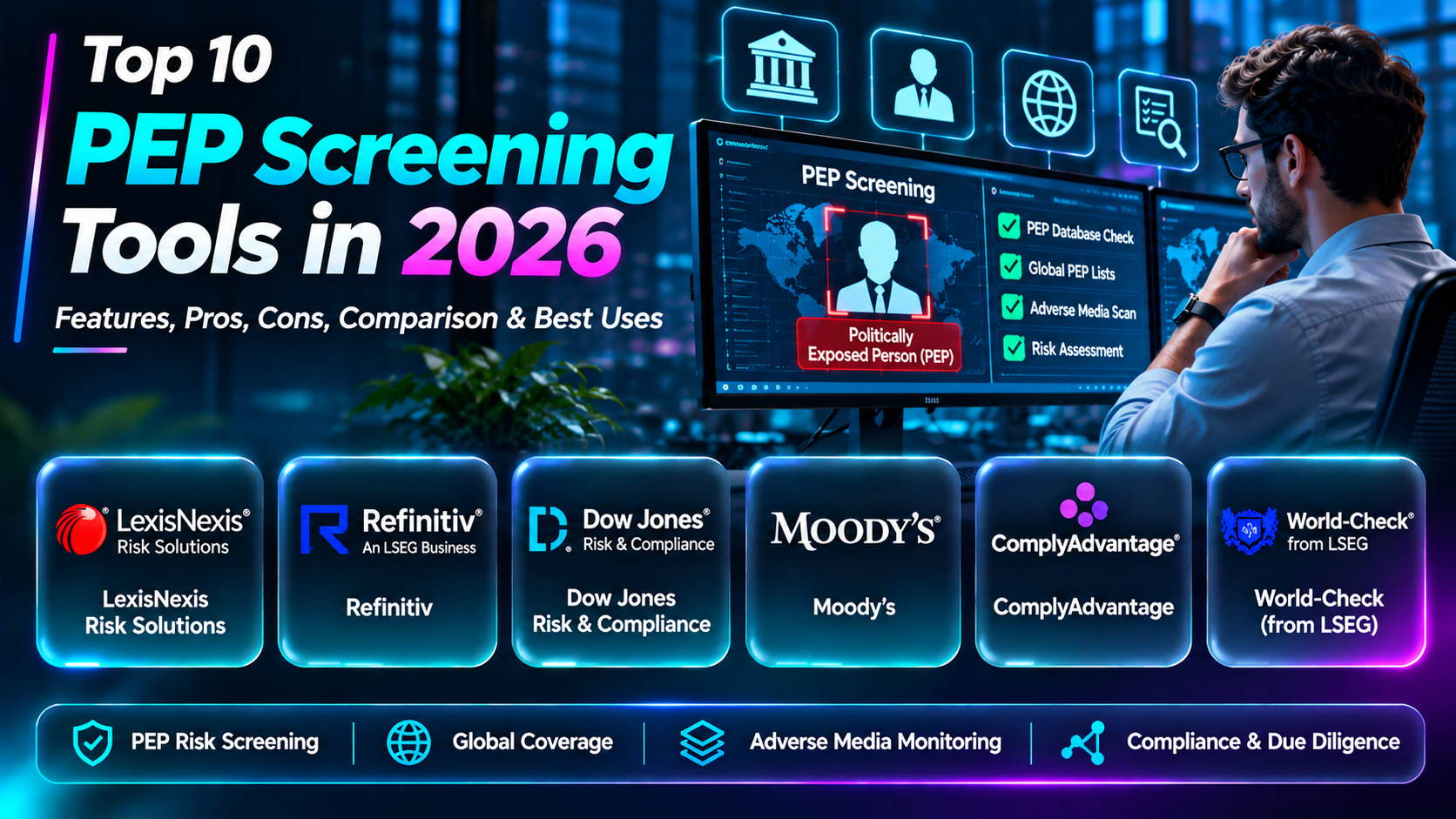
Politically Exposed Person (PEP) screening tools help banks, financial technology companies, insurers, investment firms, and other regulated businesses identify customers with relevant political exposure. In 2026, these tools support risk-based customer due diligence, financial crime prevention, and compliance with applicable Anti-Money Laundering (AML) requirements.
Traditional PEP checks often involve manual research, spreadsheet records, public information searches, and periodic customer reviews. These approaches can consume significant time, produce inconsistent results, and make it difficult to identify changes in political positions or relevant relationships.
Modern PEP screening platforms provide automated watchlist checks, fuzzy name matching, continuous monitoring, adverse media intelligence, and Application Programming Interface (API) integrations. Advanced solutions may also provide relationship mapping, risk scoring, investigation workflows, and centralized compliance reporting.
Choosing the right PEP screening platform matters because political exposure does not automatically indicate wrongdoing or prohibit a business relationship. Organizations need tools that help distinguish relevant matches, evaluate actual risk, and apply proportionate Enhanced Due Diligence (EDD) measures.
Important selection factors include geographic coverage, data quality, matching accuracy, subscription costs, regulatory obligations, and technical requirements. A small payment startup may prioritize simple API integration, while a multinational bank may require extensive international coverage and complex investigation workflows.
This guide examines ten PEP screening tools, their features, benefits, limitations, and practical applications. It also provides comparison tables, recommendations for different users, a seven-step screening workflow, and sixteen frequently asked questions.
2. What Are PEP Screening Tools?
PEP screening tools are software solutions that help organizations identify individuals who hold or have held prominent public functions. Depending on the applicable regulatory framework, screening may also cover family members, close associates, and relevant business relationships.
These platforms compare customer information with PEP databases, public records, and other relevant risk intelligence. Matching technology identifies potential relationships that compliance analysts must investigate before determining the appropriate customer risk classification.
For example, a bank receives an account application from a business owner who previously served as a senior government official. The compliance analyst screens the individual, verifies the potential match, evaluates the position and relevant relationships, and determines whether additional due diligence is required.
Automated PEP screening improves consistency by organizing risk information and reducing repetitive research. However, accurate decisions still require reliable customer information, regulatory interpretation, professional judgment, and documented review procedures.
Common applications of PEP Screening Tools include:
- Banking: Screen customers and beneficial owners for relevant political exposure during account opening. Document findings and apply additional due diligence where required.
- Financial Technology: Integrate PEP checks into digital onboarding and customer monitoring workflows. Escalate potential matches to compliance teams before making risk-based decisions.
- Insurance: Review policyholders, beneficiaries, and relevant associated individuals for political exposure. Maintain screening records supporting customer risk assessments.
- Investment Management: Screen investors and relevant counterparties before establishing financial relationships. Identify situations requiring enhanced due diligence or additional approvals.
- Private Banking: Evaluate high-net-worth customers and relevant family relationships for political exposure. Document source-of-wealth assessments and ongoing monitoring requirements.
- Corporate Banking: Screen company directors, beneficial owners, and other relevant controlling individuals. Assess whether political relationships create additional corruption or financial crime risks.
- Payment Services: Screen customers and relevant merchants during onboarding and periodic reviews. Route potential matches for investigation and appropriate risk classification.
- Professional Services: Evaluate relevant clients and business relationships where AML requirements apply. Maintain documented screening results and compliance decisions.
3. Top 10 PEP Screening Tools in 2026
The following products provide PEP intelligence, customer screening, ongoing monitoring, or related financial crime compliance capabilities. Their inclusion reflects different organizational requirements rather than a verified ranking of detection accuracy or overall product performance.
1. LSEG World-Check
Short Description
LSEG World-Check is a risk intelligence solution provided by London Stock Exchange Group. It supplies structured information about politically exposed persons, sanctioned parties, and other relevant risk subjects.
The solution is widely used by banks, investment firms, insurers, and multinational compliance departments. Organizations use it to support customer due diligence, investigate potential matches, and evaluate relevant political relationships.
Its technical strength lies in curated risk intelligence profiles containing identifying attributes and contextual information. These records help investigators distinguish relevant political exposure from unrelated individuals with similar names.
World-Check information can also support screening workflows through related LSEG products and compatible integrations. This makes it suitable for organizations requiring risk intelligence across multiple jurisdictions and business functions.
Key Features
- Global PEP Intelligence: Provides structured records about politically exposed individuals across multiple jurisdictions. Compliance teams can use these records to investigate relevant political exposure.
- Family and Associate Information: Includes information about relevant family members and close associates where available. These relationships can support enhanced customer risk assessments.
- Sanctions Screening Data: Provides information about sanctioned individuals and entities. Organizations can combine sanctions and PEP checks within appropriate screening workflows.
- Adverse Media Intelligence: Includes risk-related information from relevant public reporting and other sources. Investigators can use this information to examine potential corruption or financial crime concerns.
- Entity Profiles: Organizes names, aliases, identifying details, and relevant contextual information. These attributes help analysts resolve potential matches more accurately.
- Name Variation Support: Includes alternative names and spelling information where available. This can improve investigations involving transliteration and inconsistent customer records.
- Ongoing Monitoring: Supported screening services can identify relevant changes affecting previously screened customers. Compliance teams can reassess relationships when risk information changes.
- Integration Capabilities: Supports use of World-Check data through compatible applications and available interfaces. Organizations can incorporate screening into customer onboarding and compliance processes.
- Investigation Documentation: Provides information that supports documented customer risk decisions. Compliance teams can preserve relevant evidence in their approved case management systems.
Benefits
- Provides extensive political exposure intelligence.
- Supports international customer due diligence.
- Combines PEP, sanctions, and adverse media information.
- Improves contextual review of potential matches.
- Helps identify relevant political relationships.
- Enables integration with screening workflows.
- Strengthens ongoing customer risk assessments.
Pros
- Established global risk intelligence provider.
- Broad international PEP coverage.
- Detailed contextual risk profiles.
- Useful for complex due diligence.
- Supports enterprise integration.
- Relevant to multiple regulated industries.
Cons
- Commercial subscriptions can be expensive.
- Screening workflows may require additional products.
- Large datasets can generate substantial alert volumes.
- Integration requires technical planning.
- Potential matches still require human verification.
Use Cases
- Bank Customer Onboarding: Screen applicants for political exposure. Escalate relevant matches for enhanced due diligence.
- Private Banking Reviews: Examine customers with complex political or family relationships. Document source-of-wealth considerations.
- Corporate Beneficial Owner Screening: Check relevant company owners and controlling individuals. Identify political relationships requiring additional review.
- Investment Due Diligence: Screen investors and counterparties. Assess relevant political exposure before establishing relationships.
- Ongoing PEP Monitoring: Reassess customers when political positions or relationships change. Update risk classifications where necessary.
- Cross-Border Compliance: Review customers across multiple jurisdictions. Maintain consistent records of political exposure investigations.
Best For
- Multinational banks.
- Private banking teams.
- Investment management firms.
- Corporate compliance departments.
- International financial institutions.
- Enhanced due diligence specialists.
2. Dow Jones Risk & Compliance
Short Description
Dow Jones Risk & Compliance provides risk intelligence services covering politically exposed persons, sanctions, adverse media, and related financial crime concerns. Its information supports organizations conducting customer and counterparty due diligence.
The offering is relevant to banks, investment firms, multinational corporations, and professional services organizations. Compliance teams use its intelligence to investigate political exposure and understand associated risk factors.
A distinguishing strength is the combination of structured risk information with established research and news resources. This can provide additional context when investigating politically connected individuals and relevant business relationships.
Dow Jones data can be incorporated into compatible screening and compliance applications through available integration methods. Organizations should distinguish the underlying intelligence service from separate screening engines and case management products.
Key Features
- PEP Intelligence: Provides information about individuals holding relevant public functions. Compliance teams can investigate potential political exposure across jurisdictions.
- Relationship Information: Includes relevant family and associate information where available. This helps reviewers assess connections that may affect customer risk.
- Adverse Media Research: Provides risk-related information from relevant reporting. Analysts can examine allegations or concerns requiring further verification.
- Sanctions Data: Supplies information about sanctioned individuals and entities. Organizations can use it alongside PEP intelligence for broader customer screening.
- Entity Research: Provides identifying details and contextual information about relevant individuals and organizations. These records support potential match resolution.
- International Coverage: Supports research involving political exposure across different countries. Buyers should verify the coverage required for their customer populations.
- Risk Data Integration: Allows compatible applications to incorporate relevant intelligence. Organizations can connect research data with existing compliance processes.
- Ongoing Intelligence Updates: Maintains relevant changes to risk information through established data processes. Compliance teams can use updates to reassess existing relationships.
- Due Diligence Support: Provides contextual information useful for enhanced customer reviews. Investigators can document findings and evaluate relevant risk indicators.
Benefits
- Combines PEP intelligence with adverse media research.
- Supports detailed political exposure investigations.
- Improves contextual customer risk assessments.
- Helps identify relevant political relationships.
- Provides international risk intelligence.
- Enables enterprise data integration.
- Strengthens enhanced due diligence processes.
Pros
- Established risk intelligence provider.
- Strong adverse media research capabilities.
- Useful for complex political exposure investigations.
- Supports international due diligence.
- Provides contextual risk information.
- Relevant to enterprise compliance programs.
Cons
- Comprehensive subscriptions may be costly.
- Screening workflows may require additional software.
- Data coverage varies by jurisdiction.
- Integration can require specialist resources.
- Analysts must verify significant findings.
Use Cases
- Enhanced Customer Due Diligence: Investigate politically exposed customers. Examine relevant public positions and risk information.
- Private Wealth Reviews: Assess political connections involving high-net-worth clients. Document findings supporting risk-based decisions.
- Corporate Counterparty Screening: Research political relationships involving business partners. Identify cases requiring additional review.
- Adverse Media Investigations: Examine relevant reporting concerning politically connected individuals. Assess whether findings affect customer risk.
- International Banking Compliance: Research customers across jurisdictions. Maintain consistent political exposure records.
- Ongoing Customer Reviews: Reassess relevant risk information when new intelligence becomes available. Update due diligence records accordingly.
Best For
- Private banks.
- Corporate compliance teams.
- Investment firms.
- Due diligence investigators.
- Multinational enterprises.
- Financial crime researchers.
3. ComplyAdvantage
Short Description
ComplyAdvantage provides financial crime risk intelligence and compliance technology for regulated organizations. Its screening capabilities include PEP information, sanctions records, and relevant adverse media intelligence.
The platform is particularly relevant to financial technology companies, digital banks, payment institutions, and other financial services businesses. Users can incorporate PEP checks into automated onboarding and ongoing customer monitoring.
Its technical strengths include API-based screening, automated matching, and configurable risk workflows. These capabilities can reduce repetitive checks and help organizations investigate relevant customer risk changes.
ComplyAdvantage also provides related financial crime monitoring and investigation capabilities. Organizations can evaluate these products when seeking connected screening and customer risk management processes.
Key Features
- PEP Screening: Checks individuals against relevant political exposure records. Potential matches can be routed for compliance investigation.
- Sanctions Screening: Compares customers against relevant sanctions information. This supports broader financial crime due diligence.
- Adverse Media Screening: Provides risk-related news and intelligence. Analysts can examine findings during enhanced customer reviews.
- API Integration: Allows compatible applications to submit screening requests programmatically. Developers can connect checks with digital onboarding systems.
- Ongoing Monitoring: Supports monitoring existing customers for relevant risk changes. Organizations can configure review procedures for newly identified matches.
- Name Matching: Identifies potential matches involving spelling differences and incomplete information. Matching settings should be validated against representative customer data.
- Alert Management: Organizes potential matches for investigation and resolution. Compliance analysts can record decisions and supporting evidence.
- Risk Intelligence Updates: Maintains relevant financial crime intelligence used in screening. Organizations should verify source coverage and update arrangements.
- Compliance Workflow Integration: Supports connections with related financial crime activities. This can improve coordination between onboarding and ongoing monitoring.
Benefits
- Automates PEP screening during onboarding.
- Supports API-based compliance integration.
- Combines PEP, sanctions, and adverse media checks.
- Helps identify customer risk changes.
- Reduces repetitive manual screening.
- Improves alert investigation consistency.
- Supports digital financial services compliance.
Pros
- API-oriented screening capabilities.
- Relevant to fintech businesses.
- Supports ongoing monitoring.
- Combines multiple financial crime risk datasets.
- Configurable screening workflows.
- Suitable for automated onboarding.
Cons
- Costs depend on contracted services and usage.
- Matching settings require testing.
- False positives still need investigation.
- Integration requires development resources.
- Data coverage depends on selected products.
Use Cases
- Digital Banking Onboarding: Screen new account applicants for political exposure. Escalate relevant matches before approval.
- Payment Customer Screening: Evaluate customers and merchants. Apply additional due diligence where required.
- Automated Fintech Workflows: Connect PEP screening with digital registration systems. Record results through supported integrations.
- Ongoing Customer Monitoring: Reassess customers when relevant risk information changes. Update risk classifications when necessary.
- Enhanced Due Diligence: Combine political exposure findings with adverse media intelligence. Support deeper investigations of higher-risk customers.
- Compliance Case Reviews: Investigate potential matches through structured workflows. Preserve documented decisions for audit purposes.
Best For
- Financial technology companies.
- Digital banks.
- Payment service providers.
- Compliance technology developers.
- AML compliance teams.
- Digital onboarding operations.
4. LexisNexis Bridger Insight XG
Short Description
LexisNexis Bridger Insight XG is a financial crime screening solution from LexisNexis Risk Solutions. It supports screening against PEP information, sanctions lists, and other relevant risk datasets.
The platform is designed for banks, insurers, financial institutions, and enterprises requiring structured screening processes. Compliance teams can use it to investigate potential matches and manage customer risk reviews.
Its technical strengths include configurable matching methods and organized screening workflows. These capabilities help organizations balance screening coverage with the operational effort required to resolve alerts.
Bridger Insight XG also operates within a broader financial crime risk technology ecosystem. Organizations can evaluate related LexisNexis products when they need additional identity, risk, or compliance capabilities.
Key Features
- PEP Screening: Compares customer information against relevant political exposure datasets. Potential matches can be reviewed before customer approval.
- Sanctions Screening: Supports screening against applicable sanctions records. Organizations can combine relevant checks within their compliance processes.
- Watchlist Screening: Allows screening against additional configured risk lists. This supports broader customer due diligence requirements.
- Fuzzy Name Matching: Identifies possible matches involving name variations and spelling differences. Configurable sensitivity helps manage alert volumes.
- Customer Screening: Supports checks during onboarding and ongoing customer relationships. Teams can maintain consistent screening procedures.
- Alert Investigation: Organizes potential matches for compliance review. Investigators can document decisions and escalation outcomes.
- Risk Data Integration: Connects screening workflows with relevant risk intelligence content. Buyers should verify included datasets and subscriptions.
- Screening Configuration: Supports organization-specific screening rules and parameters. Proper configuration helps align screening with regulatory requirements.
- Audit Documentation: Maintains records of screening activity and decisions. These records can support compliance testing and examinations.
Benefits
- Automates customer PEP screening.
- Supports configurable name matching.
- Reduces repetitive watchlist searches.
- Provides structured alert investigations.
- Helps maintain screening evidence.
- Enables enterprise compliance workflows.
- Improves consistency across customer populations.
Pros
- Established enterprise screening technology.
- Configurable matching capabilities.
- Supports multiple risk datasets.
- Structured investigation workflows.
- Relevant to banking and insurance.
- Supports compliance documentation.
Cons
- Enterprise subscriptions may be expensive.
- Configuration requires specialist knowledge.
- False positives remain possible.
- Integration can increase deployment costs.
- Advanced functions depend on licensing arrangements.
Use Cases
- Retail Banking: Screen account applicants for political exposure. Escalate relevant matches for further review.
- Insurance Onboarding: Check policyholders and relevant associated individuals. Document customer risk findings.
- Corporate Banking: Screen beneficial owners and controlling individuals. Identify political relationships requiring additional due diligence.
- Customer Rescreening: Review existing customer populations against updated PEP data. Investigate newly identified matches.
- Compliance Investigations: Evaluate potential matches using available identifying information. Record resolution decisions.
- Enterprise Screening: Apply consistent screening procedures across business units. Maintain centralized investigation records.
Best For
- Commercial banks.
- Retail banks.
- Insurance companies.
- Enterprise compliance teams.
- Financial crime investigators.
- Customer due diligence departments.
5. Moody’s Grid
Short Description
Moody’s Grid provides risk intelligence covering politically exposed persons, sanctions, adverse media, and related risk subjects. Its information supports organizations conducting customer due diligence and financial crime investigations.
The platform is relevant to banks, investment firms, multinational corporations, and third-party risk teams. Users can research political exposure and relevant relationships when evaluating individuals and businesses.
A notable technical strength is the organization of entity information and relationship intelligence. This helps investigators examine potential connections between politically exposed individuals and associated organizations.
Moody’s also offers related entity risk and compliance solutions. Organizations should confirm which screening applications, data access rights, and integrations are included in their selected products.
Key Features
- PEP Intelligence: Provides information about individuals with relevant political exposure. Compliance teams can investigate potential matches across jurisdictions.
- Relationship Information: Supports research into relevant associations between individuals and organizations. These relationships can inform customer risk assessments.
- Sanctions Intelligence: Includes information about sanctioned parties. Organizations can use this data alongside PEP research.
- Adverse Media Information: Provides risk-related reporting relevant to due diligence. Analysts can examine concerns requiring additional investigation.
- Entity Profiles: Organizes identifying details and contextual information. Profiles help investigators distinguish relevant subjects from unrelated parties.
- Risk Data Integration: Supports use of intelligence in compatible compliance systems. Organizations can connect relevant data with screening workflows.
- Ongoing Risk Research: Supports reassessment of parties when relevant information changes. Compliance teams can update customer risk records accordingly.
- International Coverage: Provides information useful for cross-border investigations. Buyers should verify coverage for their relevant jurisdictions.
- Due Diligence Support: Helps analysts organize political exposure and related risk findings. Structured information supports documented compliance decisions.
Benefits
- Provides structured political exposure intelligence.
- Supports entity relationship investigations.
- Combines PEP and related risk information.
- Improves contextual due diligence.
- Helps identify relevant business associations.
- Enables integration with compliance systems.
- Strengthens international customer risk assessments.
Pros
- Established risk intelligence provider.
- Useful entity relationship information.
- Supports complex due diligence.
- Combines multiple risk categories.
- Relevant to international organizations.
- Supports enterprise data integration.
Cons
- Commercial subscriptions may be costly.
- Screening workflows may require separate products.
- Coverage varies across jurisdictions.
- Integration requires technical planning.
- Findings require professional verification.
Use Cases
- Corporate Beneficial Owner Reviews: Research political exposure involving company owners. Assess relevant relationships before onboarding.
- Investment Due Diligence: Screen investors and counterparties. Document political exposure and associated risk indicators.
- Private Banking: Investigate customers with complex personal or business relationships. Support enhanced due diligence decisions.
- Supplier Screening: Examine politically connected suppliers. Escalate relevant findings for additional review.
- Cross-Border Customer Reviews: Research individuals across multiple jurisdictions. Maintain consistent risk documentation.
- Ongoing Due Diligence: Reassess political exposure when relevant information changes. Update customer risk classifications.
Best For
- Corporate compliance teams.
- Investment management firms.
- Private banks.
- Third-party risk managers.
- Due diligence specialists.
- Multinational organizations.
6. Sanction Scanner
Short Description
Sanction Scanner provides financial crime compliance technology supporting sanctions, PEP, and related customer risk screening. Its software helps organizations automate checks against relevant risk datasets.
The platform is particularly relevant to financial technology companies, payment businesses, and compliance teams seeking API-based screening. Users can integrate checks into customer onboarding and ongoing monitoring processes.
Its technical strengths include automated matching, screening APIs, and structured alert management. These capabilities can reduce repetitive searches and help compliance teams manage potential matches.
Sanction Scanner also offers related AML compliance capabilities. Organizations can evaluate its broader product range when seeking connected screening and financial crime monitoring processes.
Key Features
- PEP Screening: Checks customers against relevant political exposure records. Potential matches can be investigated before customer approval.
- Sanctions Screening: Compares individuals and entities with applicable sanctions data. This supports broader customer risk assessments.
- Adverse Media Screening: Provides relevant negative news information. Analysts can use findings during enhanced due diligence.
- API Integration: Enables automated screening requests from compatible applications. Developers can incorporate checks into digital onboarding.
- Ongoing Monitoring: Supports repeated screening of existing customers. Teams can investigate newly identified risk information.
- Name Matching: Identifies possible matches involving spelling variations. Organizations should tune matching settings using representative records.
- Alert Management: Organizes screening alerts for review. Investigators can record findings and resolution decisions.
- Risk Data Updates: Maintains screening information through the service’s data processes. Buyers should verify relevant source coverage and update frequency.
- Compliance Reporting: Supports documentation of screening activity. Reports can assist internal reviews and audits.
Benefits
- Automates PEP and sanctions screening.
- Supports digital customer onboarding.
- Provides API integration capabilities.
- Reduces repetitive manual checks.
- Helps monitor existing customers.
- Improves alert documentation.
- Supports financial crime compliance workflows.
Pros
- API-oriented integration.
- Relevant to fintech companies.
- Supports ongoing monitoring.
- Combines PEP and sanctions screening.
- Provides alert management.
- Suitable for digital onboarding.
Cons
- Pricing varies with usage requirements.
- Coverage requires jurisdictional verification.
- False positives need human investigation.
- Integration requires development testing.
- Additional capabilities may require separate services.
Use Cases
- Fintech Onboarding: Screen new users for political exposure. Escalate relevant matches before approval.
- Merchant Screening: Check business owners and relevant individuals. Apply additional due diligence where required.
- Customer Monitoring: Recheck existing customers against updated PEP data. Investigate newly identified matches.
- Payment Business Compliance: Screen relevant customers and merchants. Maintain documented customer risk decisions.
- API-Based Screening: Connect PEP checks with customer applications. Automate screening submissions and results retrieval.
- Enhanced Due Diligence: Combine PEP findings with sanctions and adverse media information. Support reviews of higher-risk relationships.
Best For
- Financial technology startups.
- Payment service providers.
- Digital onboarding teams.
- AML compliance analysts.
- Small financial institutions.
- Compliance technology developers.
7. SEON
Short Description
SEON provides fraud prevention and financial crime compliance technology for digital businesses. Its compliance-related capabilities include PEP and sanctions screening within broader customer risk workflows.
The platform is relevant to financial technology companies, online marketplaces, payment providers, and digital onboarding teams. Organizations can combine selected compliance checks with fraud risk indicators during customer registration.
Its technical strength is the integration of digital risk signals with automated decision workflows. These capabilities can help organizations coordinate fraud prevention and customer screening activities.
SEON also offers device, behavioral, and digital footprint risk capabilities. Buyers should verify which PEP screening datasets and monitoring functions are included in the services they select.
Key Features
- PEP Screening: Supports checks against relevant political exposure information. Potential matches can be routed for compliance review.
- Sanctions Screening: Provides relevant sanctions checks through available compliance capabilities. Organizations can incorporate findings into customer risk decisions.
- Watchlist Screening: Supports screening against selected risk lists. Coverage depends on the contracted services.
- API Integration: Allows compatible applications to connect with screening and risk services. Developers can automate checks during onboarding.
- Digital Risk Signals: Provides information about digital behavior and identity-related fraud indicators. These signals can complement PEP screening but do not replace it.
- Customer Risk Assessment: Helps organizations evaluate multiple risk factors. Compliance teams can separate political exposure findings from fraud indicators.
- Workflow Automation: Supports configurable decision rules and review processes. Potential PEP matches should receive appropriate human assessment.
- Risk Reporting: Provides information about relevant screening and risk outcomes. Teams can review operational performance and investigation activity.
- Fraud and Compliance Coordination: Connects selected compliance checks with broader fraud prevention processes. This can reduce fragmentation in digital onboarding workflows.
Benefits
- Combines PEP checks with digital risk assessment.
- Supports automated onboarding workflows.
- Enables API integration.
- Helps identify potential political exposure.
- Provides additional fraud risk context.
- Reduces repetitive customer checks.
- Supports coordinated compliance operations.
Pros
- Relevant to digital businesses.
- API-oriented capabilities.
- Combines fraud and compliance risk signals.
- Supports automated onboarding.
- Configurable workflows.
- Broad digital risk assessment capabilities.
Cons
- Less specialized in complex PEP investigations.
- Data coverage depends on selected services.
- Fraud scores do not establish political exposure.
- Integration requires testing.
- Large banks may need dedicated screening systems.
Use Cases
- Digital Customer Registration: Screen new users for relevant political exposure. Escalate potential matches before approval.
- Online Marketplace Onboarding: Review merchants and associated individuals. Document relevant compliance findings.
- Payment Platform Risk Assessment: Combine PEP checks with fraud risk indicators. Route different findings to appropriate review teams.
- Fintech API Integration: Connect screening with customer registration systems. Maintain records of automated checks.
- Fraud and Compliance Reviews: Evaluate political exposure separately from digital fraud indicators. Apply appropriate risk-based procedures.
- Customer Risk Monitoring: Reassess relevant customer information through supported workflows. Escalate changes requiring investigation.
Best For
- Digital financial businesses.
- Online marketplaces.
- Fintech startups.
- Fraud prevention teams.
- Digital onboarding developers.
- Payment platforms.
8. Sumsub
Short Description
Sumsub provides identity verification and compliance technology for digital businesses. Its platform includes customer verification, business verification, AML screening, and related risk management capabilities.
The solution is relevant to financial technology companies, cryptocurrency businesses, payment providers, and online platforms. Organizations can combine identity verification with PEP and sanctions checks during onboarding.
Its technical advantage is the connection between identity verification and compliance screening within a shared workflow. This can reduce the need to transfer customer information between disconnected applications.
Sumsub also offers ongoing monitoring and additional compliance capabilities through its product ecosystem. Organizations should confirm which screening datasets, monitoring functions, and workflow features are included in their selected plans.
Key Features
- PEP Screening: Checks verified customer information against relevant political exposure datasets. Potential matches can be reviewed during customer risk assessments.
- Sanctions Screening: Supports checks against relevant sanctions records. Organizations can incorporate results into onboarding decisions.
- Identity Verification: Helps verify customer identities using supported documents and verification methods. Reliable identity information can improve screening quality.
- Business Verification: Supports verification of business information and relevant associated parties. This helps organizations assess corporate customer risk.
- Ongoing AML Monitoring: Supports repeated screening and monitoring through available compliance capabilities. Teams can review relevant risk changes.
- API and SDK Integration: Provides APIs and software development kits (SDKs) for compatible applications. Developers can embed verification and screening into digital products.
- Workflow Configuration: Supports configurable onboarding and compliance processes. Organizations can define review requirements according to risk.
- Case Review Tools: Helps compliance teams examine verification and screening findings. Reviewers can document relevant decisions.
- Compliance Reporting: Provides records associated with verification and screening activities. These records support internal oversight and audit preparation.
Benefits
- Combines identity verification with PEP screening.
- Supports automated customer onboarding.
- Reduces duplicate customer data collection.
- Enables API and SDK integration.
- Helps maintain screening records.
- Provides business verification capabilities.
- Supports ongoing customer monitoring.
Pros
- Integrated identity and compliance workflows.
- Relevant to digital financial businesses.
- Supports customer and business verification.
- API and SDK integration.
- Configurable onboarding processes.
- Ongoing monitoring capabilities.
Cons
- Pricing depends on verification and screening usage.
- Some capabilities require additional plans.
- False positives need manual review.
- Integration requires technical resources.
- Complex enterprise PEP research may need additional intelligence.
Use Cases
- Digital Bank Onboarding: Verify customer identities and screen for political exposure. Escalate relevant matches for enhanced due diligence.
- Cryptocurrency Customer Verification: Combine identity checks with AML screening. Document relevant risk findings before account approval.
- Business Onboarding: Verify company information and relevant individuals. Screen associated parties according to risk requirements.
- Payment Service Registration: Integrate verification and PEP screening into customer workflows. Maintain consistent compliance records.
- Customer Rescreening: Monitor existing customers for relevant risk changes. Update risk assessments when necessary.
- Enhanced Customer Reviews: Combine verified identity data with screening results. Support more reliable match investigations.
Best For
- Fintech companies.
- Cryptocurrency businesses.
- Digital banks.
- Payment platforms.
- Customer onboarding teams.
- Identity verification specialists.
9. Ondato
Short Description
Ondato provides identity verification, business verification, and compliance technology for regulated organizations. Its services include AML screening capabilities relevant to PEP and sanctions checks.
The platform is particularly relevant to financial technology businesses, financial institutions, and digital onboarding operations. Users can combine identity verification with compliance screening in connected workflows.
Its technical strength is the integration of customer identity processes with compliance-related checks. This helps organizations reduce fragmentation between onboarding, verification, and customer risk assessment.
Ondato also provides related business verification and ongoing compliance capabilities. Organizations should verify the available screening datasets, jurisdictions, and monitoring arrangements before procurement.
Key Features
- PEP Screening: Supports checks against relevant politically exposed person information. Compliance teams can investigate potential matches.
- Sanctions Screening: Compares relevant customer information against sanctions records. Results support broader financial crime risk assessments.
- Identity Verification: Provides customer identity verification capabilities. Verified information can improve screening consistency.
- Business Verification: Supports checks involving corporate customers and relevant business information. This helps organizations assess business onboarding risks.
- AML Screening: Combines selected compliance checks within customer risk workflows. Organizations can use results to determine whether further due diligence is required.
- Ongoing Monitoring: Supports monitoring capabilities through available compliance services. Teams can reassess relevant changes in customer risk.
- API Integration: Allows compatible applications to connect with verification and screening services. Developers can automate onboarding checks.
- Workflow Management: Supports organized verification and compliance review processes. Teams can route exceptions for additional investigation.
- Compliance Documentation: Maintains records associated with customer checks. These records can support audits and internal compliance reviews.
Benefits
- Combines customer verification and PEP screening.
- Supports digital onboarding.
- Reduces fragmented compliance checks.
- Enables API-based integration.
- Helps assess corporate customer risks.
- Provides structured verification records.
- Supports ongoing compliance monitoring.
Pros
- Integrated verification and compliance capabilities.
- Relevant to financial technology businesses.
- Supports individual and business checks.
- API integration.
- Structured onboarding workflows.
- Compliance documentation features.
Cons
- Pricing depends on selected services.
- Screening coverage requires verification.
- Complex PEP investigations may need additional research.
- Integration requires technical testing.
- Advanced features may depend on contracted modules.
Use Cases
- Financial Technology Onboarding: Verify new users and screen for political exposure. Escalate relevant matches before approval.
- Business Customer Verification: Check corporate information and relevant associated individuals. Document risk findings.
- Digital Banking Registration: Combine identity verification with compliance checks. Maintain organized onboarding records.
- Customer Monitoring: Reassess relevant risk information over time. Update compliance records when necessary.
- API-Based Compliance: Integrate screening into customer applications. Automate data exchange and review workflows.
- Enhanced Due Diligence: Use verified identity information to investigate potential PEP matches. Document final risk assessments.
Best For
- Fintech startups.
- Digital banks.
- Payment providers.
- Business onboarding teams.
- Compliance technology developers.
- Identity verification operations.
10. iDenfy
Short Description
iDenfy provides identity verification, business verification, and compliance-related screening technology. Its services include AML screening capabilities that can support PEP and sanctions checks.
The platform is relevant to financial technology businesses, online services, and organizations seeking automated customer verification. Users can combine identity checks with relevant compliance screening activities.
Its technical strength is the integration of verification and risk screening within digital onboarding workflows. This can help organizations improve consistency in customer information collection and review.
iDenfy also offers related fraud prevention and business verification services. Buyers should confirm the exact PEP data coverage, monitoring functions, and compliance capabilities available in their selected products.
Key Features
- PEP Screening: Supports screening against relevant political exposure records. Potential matches can be reviewed during customer due diligence.
- Sanctions Screening: Provides checks against relevant sanctions information. Organizations can use findings within broader AML procedures.
- Identity Verification: Supports verification of customer identity information. Verified attributes can help investigators resolve potential matches.
- Business Verification: Provides capabilities for reviewing corporate customer information. This supports risk assessments involving business relationships.
- AML Compliance Checks: Supports relevant customer risk screening processes. Compliance teams can evaluate findings and determine required follow-up.
- API Integration: Enables compatible applications to connect with verification and screening services. Developers can automate customer onboarding checks.
- Workflow Automation: Supports automated verification and review processes. Organizations can configure escalation procedures for relevant compliance findings.
- Fraud Prevention Integration: Provides related fraud risk capabilities. These signals can complement, but do not replace, PEP screening.
- Compliance Records: Maintains information about completed verification and screening activities. Teams can use records for internal reviews and audits.
Benefits
- Combines identity verification with PEP checks.
- Supports automated digital onboarding.
- Enables API integration.
- Reduces repetitive customer verification tasks.
- Helps maintain screening documentation.
- Provides related fraud prevention capabilities.
- Supports customer due diligence workflows.
Pros
- Integrated identity and compliance checks.
- Relevant to digital businesses.
- API-based integration.
- Supports business verification.
- Automated onboarding capabilities.
- Related fraud prevention services.
Cons
- Screening coverage depends on selected services.
- Pricing varies with usage and modules.
- Complex investigations may require additional intelligence.
- False positives need professional review.
- Enterprise compliance teams may need broader screening workflows.
Use Cases
- Online Customer Registration: Verify identities and screen for political exposure. Escalate potential matches for compliance review.
- Financial Technology Onboarding: Integrate PEP checks into digital applications. Maintain structured screening records.
- Business Customer Checks: Verify relevant corporate information. Screen associated individuals where required.
- Customer Risk Reviews: Combine identity data with relevant screening results. Document enhanced due diligence decisions.
- Fraud and Compliance Coordination: Evaluate fraud indicators separately from PEP findings. Route concerns to appropriate teams.
- Automated Compliance Workflows: Connect screening with customer management applications. Reduce repetitive manual data entry.
Best For
- Fintech startups.
- Online service providers.
- Digital onboarding teams.
- Payment businesses.
- Identity verification specialists.
- Small and midsize compliance teams.
4. Comparison Table: Top 10 PEP Screening Tools
The following table compares the ten tools by primary users, supported environments, distinguishing capabilities, and general pricing approaches. Actual costs depend on data coverage, screening volumes, modules, and contractual arrangements.
| Tool Name | Best For | Platform(s) | Standout Feature | Pricing |
|---|---|---|---|---|
| LSEG World-Check | Global PEP intelligence | Cloud and enterprise integrations | Detailed international PEP profiles | Paid subscription |
| Dow Jones Risk & Compliance | Complex due diligence | Data services and integrated platforms | PEP intelligence with adverse media research | Paid subscription |
| ComplyAdvantage | Fintech customer screening | Cloud and API | Automated PEP and financial crime screening | Paid subscription |
| LexisNexis Bridger Insight XG | Enterprise customer screening | Enterprise software environments | Configurable watchlist matching | Paid subscription |
| Moody’s Grid | Entity relationship investigations | Cloud and integrated data services | Political exposure and relationship intelligence | Paid subscription |
| Sanction Scanner | API-based PEP screening | Cloud and API | Automated screening and ongoing monitoring | Paid subscription |
| SEON | Digital onboarding risk checks | Cloud and API | Fraud risk signals with compliance screening | Paid subscription |
| Sumsub | Identity verification and screening | Cloud, API, and SDK | Integrated identity and AML checks | Paid subscription |
| Ondato | Customer and business verification | Cloud and API | Verification connected with compliance screening | Paid subscription |
| iDenfy | Digital identity and AML screening | Cloud and API | Automated identity and PEP checks | Paid subscription |
Note: Pricing, licensing, supported platforms, and available features can change. Check the official vendor websites for current plans, educational access, and regional availability.
5. Which PEP Screening Tool Is Right for You?
Different organizations require different PEP screening capabilities because their customer populations, geographic exposure, and compliance obligations vary. A private bank may need detailed political relationship intelligence, while a digital payment startup may prioritize automated screening during onboarding.
The best solution depends on data quality, matching performance, integration requirements, investigation complexity, and total ownership costs. Organizations should also distinguish standalone PEP intelligence services from platforms that combine screening with identity verification or fraud prevention.
For Beginners: Sanction Scanner and Sumsub
Organizations starting formal PEP screening should prioritize manageable workflows and reliable customer information. Sanction Scanner focuses on screening, while Sumsub combines screening with identity verification.
New teams should test screening accuracy using realistic customer records and relevant political exposure scenarios. They should also establish procedures for resolving false positives and escalating confirmed matches.
Choose Sanction Scanner if automated PEP screening is your main requirement. Choose Sumsub if you need identity verification and PEP checks within the same onboarding process.
For Banks: LSEG World-Check and LexisNexis Bridger Insight XG
Banks need reliable political exposure intelligence and structured investigation procedures. LSEG World-Check provides detailed risk data, while Bridger Insight XG supports configurable screening workflows.
Banking teams should evaluate jurisdictional coverage, customer volumes, matching performance, and investigation requirements. They should also confirm how screening results connect with customer risk assessments and enhanced due diligence.
Choose LSEG World-Check if detailed global PEP intelligence is your priority. Choose LexisNexis Bridger Insight XG if configurable enterprise screening workflows are more important.
For Private Banking: Dow Jones Risk & Compliance and Moody’s Grid
Private banks often manage customers with complex wealth structures, international relationships, and potential political exposure. Dow Jones provides contextual risk intelligence, while Moody’s Grid supports entity and relationship research.
Compliance teams should evaluate family relationships, business associations, adverse media information, and identifying attributes. They should also ensure that enhanced due diligence procedures are proportionate to the assessed risk.
Choose Dow Jones Risk & Compliance if detailed adverse media research is central to your investigations. Choose Moody’s Grid if entity relationships and ownership-related intelligence are your main priorities.
For Fintech Startups: ComplyAdvantage and iDenfy
Financial technology startups need screening processes that integrate with digital onboarding and customer management systems. ComplyAdvantage focuses on financial crime intelligence, while iDenfy combines identity verification with compliance checks.
Startups should evaluate API integration, data coverage, screening volumes, and operational costs. They should also confirm that their selected product supports the relevant regulatory obligations.
Choose ComplyAdvantage if financial crime screening is your primary requirement. Choose iDenfy if you want identity verification and PEP checks in a connected onboarding workflow.
For International Compliance: LSEG World-Check and Dow Jones Risk & Compliance
International compliance programs need information about political exposure across multiple jurisdictions. LSEG World-Check and Dow Jones Risk & Compliance provide intelligence relevant to cross-border investigations.
Organizations should examine geographic coverage, data update arrangements, and contextual information about public positions. They should also account for differences between domestic and foreign PEP requirements.
Choose LSEG World-Check if broad structured international intelligence is your priority. Choose Dow Jones Risk & Compliance if detailed contextual research is especially important.
For Digital Onboarding: Sumsub and Ondato
Digital onboarding teams need reliable identity information before conducting effective PEP screening. Sumsub and Ondato provide verification and compliance capabilities within connected workflows.
Organizations should test document verification, customer data quality, screening accuracy, and exception handling. They should also ensure that automated processes allow human review of significant matches.
Choose Sumsub if you need an integrated identity and compliance platform. Choose Ondato if your main priority is combining customer and business verification with screening.
For Corporate Due Diligence: Moody’s Grid and Dow Jones Risk & Compliance
Corporate due diligence often involves evaluating beneficial owners, directors, and business associates. Moody’s Grid and Dow Jones Risk & Compliance provide intelligence relevant to these investigations.
Teams should examine available entity relationships and verify information against reliable records. They should also document why a political connection is relevant to the specific business relationship.
Choose Moody’s Grid if entity relationship research is central to your workflow. Choose Dow Jones Risk & Compliance if adverse media and contextual risk analysis are your main priorities.
For Fraud and Compliance Teams: SEON and ComplyAdvantage
Digital businesses often need fraud prevention and financial crime compliance within the same customer journey. SEON provides broader digital fraud signals, while ComplyAdvantage emphasizes financial crime intelligence.
Organizations should maintain separate rules for fraud risk and political exposure. A fraud score does not establish whether a customer is a PEP or whether enhanced due diligence is required.
Choose SEON if fraud prevention and digital risk assessment are central requirements. Choose ComplyAdvantage if PEP, sanctions, and adverse media screening are the main priorities.
Best PEP Screening Tools for Different Users
| User Type | Recommended Software | Why? |
|---|---|---|
| Multinational bank | LSEG World-Check | Broad international PEP intelligence |
| Private banking investigator | Dow Jones Risk & Compliance | Contextual political exposure research |
| Fintech startup | ComplyAdvantage | API-based customer screening |
| Enterprise screening team | LexisNexis Bridger Insight XG | Configurable matching and alert workflows |
| Corporate due diligence analyst | Moody’s Grid | Entity and relationship intelligence |
| Small payment institution | Sanction Scanner | Automated PEP checks and monitoring |
| Digital marketplace | SEON | Fraud and compliance risk signals |
| Digital bank onboarding team | Sumsub | Integrated identity verification and screening |
| Business verification team | Ondato | Connected verification and compliance checks |
| Online financial service | iDenfy | Automated identity and PEP screening |
6. Practical Example: Screening a New Bank Customer for Political Exposure Using PEP Screening Tools
Consider a bank onboarding a corporate customer whose beneficial owner may have previously held a senior government position. The compliance team must determine whether the individual is a PEP and whether additional due diligence is required.
The bank could use LSEG World-Check, ComplyAdvantage, or LexisNexis Bridger Insight XG to support the screening process. The exact workflow depends on available data, screening configuration, and applicable regulatory requirements.
The objective is to identify relevant political exposure, verify potential matches, assess customer risk, and document an appropriate onboarding decision. The following seven-step process provides a practical approach.
Step 1: Collect Customer and Beneficial Owner Information
Begin by collecting the corporate customer’s legal name, registration details, ownership information, and relevant business records. Identify beneficial owners, controlling individuals, and other parties requiring screening under the bank’s compliance procedures.
For each relevant individual, collect reliable identifying information such as full legal name, date of birth, nationality, and address where appropriate. Accurate information helps reduce false matches and supports more reliable investigations.
Verify the information against approved documents and reliable sources before submitting screening requests. Record missing or inconsistent details for additional review.
Recommended information includes:
- Full legal name.
- Known aliases.
- Date of birth.
- Nationality.
- Residential country.
- Business role.
- Ownership percentage.
- Relevant identification reference.
- Customer relationship information.
Step 2: Configure PEP Screening Requirements
Identify the PEP categories and jurisdictions relevant to the bank’s regulatory obligations. These may include domestic PEPs, foreign PEPs, international organization officials, and relevant family members or close associates.
Configure the screening system to use appropriate risk intelligence datasets and matching parameters. Ensure that the screening policy distinguishes political exposure from sanctions restrictions and other risk categories.
Test the configuration using known scenarios before processing the customer. Confirm that relevant matches are identified and routed to qualified investigators.
Configuration checks include:
- Relevant PEP categories.
- Applicable jurisdictions.
- Family and associate coverage.
- Name matching sensitivity.
- Data update arrangements.
- Alert routing rules.
- Escalation requirements.
- Audit logging settings.
Step 3: Perform the Initial PEP Screening
Submit the verified individual information to the selected screening platform. The system compares the information against available PEP records and generates potential matches.
Review the returned records and identify those requiring further investigation. Do not classify a customer as a PEP solely because a similar name appears in the results.
Record the screening date, data source, matching details, and initial findings. Maintain a clear distinction between potential matches and confirmed political exposure.
Useful screening fields include:
- Customer reference number.
- Individual screening reference.
- Screening date.
- Data source.
- Potential match identifier.
- Relevant political position.
- Match status.
- Assigned investigator.
Step 4: Verify the Potential Match
Compare the customer’s identifying information with the details available in the potential PEP record. Review dates of birth, nationality, public positions, known relationships, and other relevant attributes.
Where necessary, consult reliable public records or authoritative information to clarify the individual’s identity. Document the evidence supporting confirmation or rejection of the potential match.
If the available information remains inconclusive, escalate the case according to the bank’s procedures. Do not automatically resolve an uncertain match without adequate supporting evidence.
Investigation checks include:
- Full name and aliases.
- Date of birth.
- Nationality and residence.
- Current or former public position.
- Relevant appointment dates.
- Family and associate relationships.
- Supporting records.
- Investigator conclusions.
Step 5: Conduct a Risk-Based Enhanced Due Diligence Assessment
For a confirmed PEP, assess the customer’s risk according to applicable law and internal compliance policy. Consider the nature of the public function, geographic exposure, business activities, transaction expectations, and relevant relationships.
Where required, obtain information about the customer’s source of wealth and source of funds. Source of wealth concerns how overall assets were accumulated, while source of funds concerns the origin of money involved in a particular relationship or transaction.
Review adverse media findings and other relevant risk indicators without assuming that political exposure establishes wrongdoing. Document the reasoning behind the final customer risk assessment.
Assessment factors include:
- Type of political position.
- Domestic or foreign exposure.
- Current or former status.
- Relevant family relationships.
- Source of wealth.
- Source of funds.
- Expected account activity.
- Geographic exposure.
- Relevant adverse media findings.
- Overall risk classification.
Step 6: Obtain Approval and Document the Decision
Prepare a structured due diligence report summarizing the verified political exposure and relevant risk factors. Include the screening evidence, investigation conclusions, and recommended risk controls.
Submit the case for appropriate approval according to regulatory requirements and the bank’s internal policy. Senior management approval may be required for certain PEP relationships, depending on the applicable framework.
Record the final decision and any conditions associated with the relationship. These may include enhanced transaction monitoring, more frequent customer reviews, or additional documentation requirements.
Final records should include:
- Confirmed PEP classification.
- Due diligence findings.
- Risk assessment.
- Source-of-wealth information.
- Required approvals.
- Monitoring conditions.
- Final onboarding decision.
- Review schedule.
Step 7: Establish Ongoing Monitoring and Periodic Reviews
Configure ongoing PEP monitoring according to the customer’s risk classification and the bank’s compliance requirements. Review relevant changes in political positions, relationships, adverse media, and customer activity.
Schedule periodic customer due diligence reviews and maintain clear responsibility for monitoring. Update the risk assessment when significant new information becomes available.
Prepare management reports showing relevant PEP screening activity and outstanding reviews. Use these reports to evaluate whether the monitoring process remains effective.
Recommended monitoring measures include:
- Number of customers screened.
- Potential PEP matches.
- Confirmed PEP relationships.
- False positive rate.
- Outstanding investigations.
- Enhanced due diligence completion.
- Overdue periodic reviews.
- Changes in customer risk ratings.
- Required management approvals.
- Quality assurance findings.
This workflow transforms customer information into a documented political exposure assessment through screening, verification, enhanced due diligence, and approval. It also establishes ongoing monitoring procedures that help the bank respond to changes in customer risk.
7. Frequently Asked Questions (FAQs)
1. What are PEP screening tools?
PEP screening tools are software systems that help organizations identify customers who hold or have held prominent public functions. They may also identify relevant family members, close associates, and associated business relationships.
These tools compare customer information against PEP intelligence databases and generate potential matches for investigation. Compliance teams use the findings to determine whether enhanced due diligence is necessary.
PEP screening supports risk-based financial crime compliance rather than automatic customer rejection. A confirmed PEP match does not establish criminal conduct.
2. Which PEP screening tool is best for beginners?
Sanction Scanner and Sumsub are relevant options for organizations beginning automated PEP screening. Sanction Scanner emphasizes screening, while Sumsub combines screening with identity verification.
Beginners should prioritize accurate customer data, understandable workflows, and appropriate risk intelligence coverage. They should also establish clear procedures for resolving potential matches.
A pilot using representative customer records can help evaluate matching quality and operational effort. Teams should confirm that the selected product supports their actual regulatory requirements.
3. Are free or open-source PEP screening tools available?
Some public information sources and open datasets contain information about political officeholders. Organizations can use these resources to support basic research and custom screening processes.
However, comprehensive PEP intelligence requires ongoing research into public positions, relevant relationships, historical records, and jurisdictional definitions. A simple name list may not provide sufficient information for reliable enhanced due diligence.
Open-source matching software can support technical screening, but organizations remain responsible for data accuracy and compliance controls. Commercial intelligence services may provide additional coverage and contextual information.
4. How does PEP screening differ from manual background checks?
Manual background checks involve researching individuals through public records, documents, and other information sources. These methods can be time-consuming and difficult to standardize across large customer populations.
PEP screening tools automate comparisons against structured political exposure datasets. They can also support ongoing monitoring and consistent investigation documentation.
Manual research remains important when potential matches require clarification. Automated screening should therefore complement professional due diligence rather than replace it.
5. Which PEP screening tool is best for private banking?
LSEG World-Check and Dow Jones Risk & Compliance are relevant options for private banking due diligence. Their intelligence can support investigations involving political exposure and complex personal relationships.
Private banks should evaluate the depth of contextual information, international coverage, and relevant relationship data. They should also assess how findings connect with source-of-wealth investigations.
The final choice depends on customer complexity and existing compliance systems. Both options should be tested using realistic private banking scenarios.
6. Which PEP screening tool is best for fintech onboarding?
ComplyAdvantage and Sumsub are relevant options for digital financial services. ComplyAdvantage emphasizes financial crime screening, while Sumsub combines identity verification with compliance checks.
Fintech businesses should evaluate API integration, screening speed, data quality, and investigation workflows. They should also confirm ongoing monitoring capabilities and applicable regulatory coverage.
The best choice depends on whether the organization already has an identity verification system. A business with established verification processes may prioritize a dedicated screening service.
7. Can PEP screening tools integrate with KYC and AML systems?
Many PEP screening tools support integration with KYC and AML platforms through APIs or compatible data interfaces. This allows organizations to incorporate political exposure checks into customer onboarding and monitoring.
For example, a KYC system may collect verified customer information and submit it to a PEP screening service. Potential matches can then be routed to compliance analysts for investigation.
Integration should preserve data accuracy, access controls, and audit records. Organizations should also test how system failures and incomplete screening results are handled.
8. What is the difference between PEP, RCA, EDD, and KYC?
A PEP is an individual who holds or has held a prominent public function. A Relative or Close Associate (RCA) is a person whose family or close relationship with a PEP may be relevant to customer risk.
Enhanced Due Diligence (EDD) refers to additional checks applied to higher-risk relationships. Know Your Customer (KYC) describes processes used to identify customers and understand relevant customer information.
These concepts serve different functions within financial crime compliance. PEP and RCA screening identifies relevant exposure, while KYC and EDD describe customer assessment processes.
9. How does risk-based PEP screening work?
Risk-based PEP screening evaluates political exposure alongside other relevant customer risk factors. It does not assume that every politically exposed person presents the same level of risk.
The process begins with identifying potential political exposure and verifying the match. Compliance teams then assess the public function, jurisdiction, relationships, customer activity, and relevant financial information.
The resulting assessment determines appropriate due diligence and monitoring measures. Decisions should be documented and reviewed when relevant circumstances change.
10. What is the difference between initial and ongoing PEP screening?
Initial PEP screening occurs when an organization establishes a customer relationship or performs another required screening event. It helps identify relevant political exposure before an onboarding decision.
Ongoing screening monitors existing customers for changes in political status, relationships, and relevant risk information. It can identify developments that were not present during the initial review.
Both approaches support effective customer risk management. Organizations should determine screening frequency according to applicable requirements and documented risk assessments.
11. Which PEP screening tool is best for corporate ownership investigations?
Moody’s Grid and LSEG World-Check are relevant options for researching political exposure involving corporate relationships. Their intelligence can support investigations into relevant individuals and associated entities.
Corporate investigators should verify beneficial ownership and control information using reliable records. They should also distinguish documented relationships from unsupported assumptions.
The appropriate product depends on available relationship intelligence and integration requirements. Complex investigations may require additional corporate registry information and legal research.
12. Can PEP screening tools be used outside banking?
PEP screening is relevant to insurers, investment firms, payment businesses, professional services, and other organizations subject to applicable financial crime requirements. Its importance depends on the organization’s regulatory obligations and customer risk exposure.
For example, an insurance company may screen relevant policyholders and beneficiaries. A professional services firm may screen clients where applicable AML rules require customer due diligence.
Organizations should define screening requirements according to their legal obligations. They should not assume that every industry must apply identical PEP procedures.
13. What hardware and system requirements do PEP screening tools have?
Many PEP screening services operate through cloud-based applications and APIs. Users typically need compatible systems, secure connectivity, and appropriate account permissions.
Hardware requirements depend on screening volumes, integration methods, and deployment architecture. Large financial institutions may require additional infrastructure for enterprise screening operations.
Organizations should evaluate encryption, authentication, system availability, and data residency requirements. They should also test performance and error handling before production deployment.
14. How should organizations choose the right PEP screening tool?
Begin by identifying customer populations, operating jurisdictions, applicable regulations, and required screening events. Determine whether the organization needs PEP intelligence, automated screening, identity verification, or a combination.
Next, compare data coverage, matching performance, investigation workflows, integration capabilities, and ownership costs. Test the tools using representative customer records and known screening scenarios.
Finally, conduct a controlled pilot and document acceptance criteria. Review data quality, operational workload, vendor support, and compliance oversight before selecting a platform.
15. What is the difference between PEP screening and sanctions screening?
PEP screening identifies individuals with relevant political exposure and associated relationships. A confirmed PEP match generally requires risk-based assessment rather than automatic rejection.
Sanctions screening identifies potential matches involving parties subject to legal restrictions. Confirmed sanctions exposure may require blocking, freezing, rejection, or other actions depending on applicable law.
The two processes are related but have different legal consequences. Organizations should maintain distinct decision rules and escalation procedures for each category.
16. Which PEP screening tool is best for enterprise-scale compliance?
LSEG World-Check, Dow Jones Risk & Compliance, and LexisNexis Bridger Insight XG are relevant options for enterprise PEP screening programs. They provide intelligence or screening capabilities suitable for complex regulated environments.
Large organizations should evaluate international coverage, matching quality, integration capabilities, and investigation workflows. They should also consider data governance, operational resilience, and ongoing monitoring requirements.
Enterprise screening performance depends on both technology and compliance processes. A controlled pilot should validate detection quality, investigation efficiency, and audit documentation before deployment.
8. Final Thoughts
PEP screening tools help organizations identify relevant political exposure and apply proportionate customer due diligence. Their effectiveness depends on accurate information, appropriate matching settings, professional investigation, and documented risk decisions.
LSEG World-Check is suited to global PEP intelligence, while Dow Jones Risk & Compliance supports contextual political exposure research. ComplyAdvantage is relevant to API-based financial crime screening, and LexisNexis Bridger Insight XG provides configurable enterprise watchlist screening.
Moody’s Grid supports entity relationship investigations, while Sanction Scanner provides automated PEP checks for digital financial businesses. SEON combines selected compliance screening capabilities with broader digital fraud risk assessment.
Sumsub is suited to integrated identity verification and PEP screening, while Ondato supports connected customer and business verification workflows. iDenfy provides automated identity and compliance checks for digital onboarding environments.
Before selecting a PEP screening platform, organizations should assess regulatory obligations, customer risk profiles, budget constraints, staff expertise, and integration requirements. Testing representative cases and evaluating available trials can help establish a reliable screening process.
