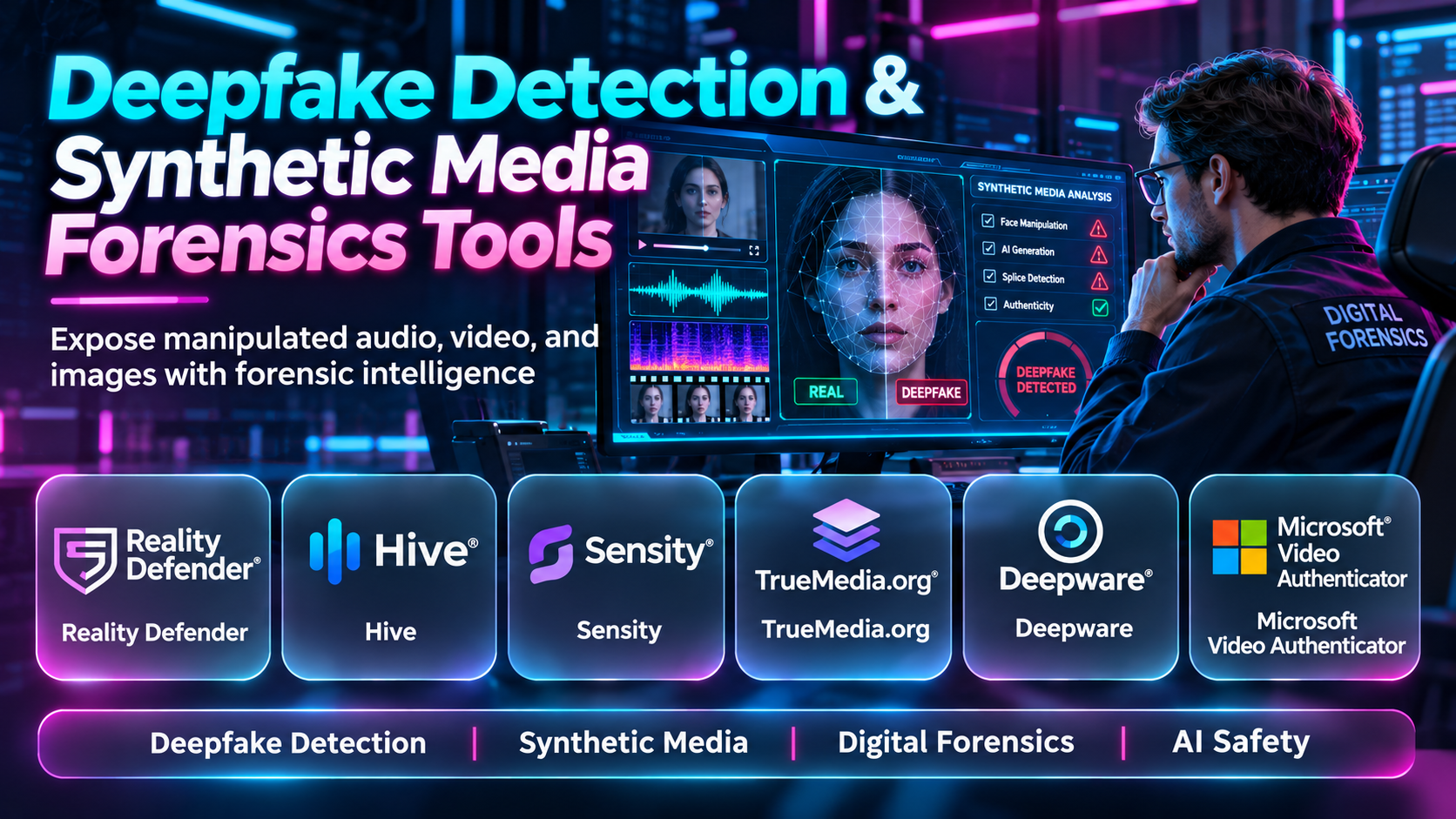
Introduction
Synthetic media has become increasingly realistic.
Modern AI systems can generate convincing faces, alter existing videos, reproduce speech patterns, and create fictional scenes that resemble authentic recordings.
These capabilities support legitimate creative and accessibility applications.
However, they can also be misused for impersonation, financial fraud, misinformation, harassment, and evidence manipulation.
Deepfake detection tools attempt to identify signs that digital content was generated or altered using artificial intelligence.
Synthetic media forensics goes further by examining technical artifacts, content inconsistencies, file structure, metadata, and other available evidence.
Organizations need these capabilities because a convincing image or voice recording can no longer be treated as reliable evidence solely because it appears realistic.
However, deepfake detection is not a solved problem.
Detection accuracy varies according to the generation method, media quality, compression, language, editing history, and adversarial techniques.
A tool may identify suspicious content without proving that it is synthetic.
Similarly, a detector may fail to identify sophisticated manipulation.
This guide compares ten technologies used in deepfake detection, media analysis, and synthetic content investigation.
What Are Deepfake Detection & Synthetic Media Forensics Tools?
Deepfake detection tools analyze media to identify patterns associated with synthetic generation or manipulation.
These tools may use machine learning, signal processing, computer vision, audio analysis, or combinations of techniques.
Common Detection Approaches
Visual artifact analysis: Looks for inconsistencies in textures, lighting, facial features, or image generation patterns.
Temporal analysis: Examines inconsistencies between video frames.
Audio analysis: Evaluates speech characteristics and signals associated with synthetic voices.
Multimodal analysis: Combines audio and video evidence.
Provenance verification: Inspects available signed origin information.
Metadata analysis: Reviews technical information associated with media files.
Human forensic review: Interprets findings alongside contextual evidence.
Detection Is Not Proof
A detection score should be treated as an assessment rather than an absolute verdict.
False positives can incorrectly flag legitimate content.
False negatives can allow manipulated media to pass undetected.
High-stakes decisions require corroborating evidence and appropriate human oversight.
Top 10 Deepfake Detection & Synthetic Media Forensics Tools
1. Reality Defender
Short Description
Reality Defender provides deepfake detection technology designed for organizations evaluating potentially manipulated or synthetic media.
Its solutions focus on detecting AI-generated or altered content across supported media types.
The platform is relevant to financial institutions, enterprises, and security teams facing impersonation risks.
For example, an organization may evaluate suspicious audio submitted during a customer interaction.
Reality Defender can provide detection-related signals that support further investigation.
Its enterprise orientation makes it relevant to workflows requiring APIs and automated analysis.
However, organizations must evaluate performance using realistic samples from their own environment.
Key Features
- Deepfake detection.
- Audio analysis.
- Image analysis.
- Video-related detection.
- Enterprise API integration.
- Automated assessment.
- Risk signals.
- Security workflow integration.
Benefits
Reality Defender helps organizations introduce synthetic media analysis into fraud and security workflows.
Pros
- Enterprise focus.
- Multiple media types.
- API integration.
- Fraud prevention relevance.
- Automated analysis.
Cons
- Commercial pricing.
- Detection errors remain possible.
- Integration requirements.
- Results need interpretation.
- Performance varies by content.
Use Cases
Identity fraud investigation, suspicious media review, enterprise security, and synthetic voice risk assessment.
Best For: Enterprises requiring automated deepfake risk analysis.
2. Sensity AI
Short Description
Sensity AI focuses on deepfake detection and synthetic media intelligence.
Its technology is relevant to organizations investigating manipulated media and online impersonation.
For example, a brand protection team may investigate suspicious videos or images circulating online.
Sensity’s approach can help identify potential synthetic content and support broader investigative workflows.
Its focus on synthetic media threats makes it relevant to security, fraud, and intelligence teams.
However, users should verify current product availability and supported detection capabilities.
Key Features
- Synthetic media detection.
- Deepfake analysis.
- Visual content assessment.
- Threat intelligence relevance.
- Media investigation.
- Automated analysis.
- Enterprise workflows.
- Risk reporting.
Benefits
Sensity AI can help organizations investigate suspected deepfake-related threats.
Pros
- Specialized focus.
- Investigation relevance.
- Enterprise applicability.
- Media analysis.
- Threat-oriented workflows.
Cons
- Commercial requirements.
- Detection limitations.
- Availability should be verified.
- Human review needed.
- Media coverage varies.
Use Cases
Brand impersonation, synthetic media investigations, fraud analysis, and online threat monitoring.
Best For: Security and intelligence teams investigating deepfake threats.
3. Hive AI
Short Description
Hive provides AI-based content analysis services, including capabilities associated with identifying AI-generated content.
Its API-oriented approach makes it relevant to platforms processing large volumes of user-submitted media.
For example, a social application may want to flag content that appears AI-generated for additional review.
Hive can contribute automated classification signals to such workflows.
However, AI-generated content classification is not the same as establishing malicious intent or proving manipulation.
Organizations should evaluate thresholds, error rates, and content-specific performance.
Key Features
- AI-generated content classification.
- Image analysis.
- API integration.
- Automated processing.
- Moderation workflows.
- Classification outputs.
- Platform integration.
- Scalable analysis.
Benefits
Hive can help digital platforms triage large volumes of potentially synthetic content.
Pros
- API-oriented.
- Platform relevance.
- Automated workflows.
- Scalable classification.
- Content analysis ecosystem.
Cons
- False positives and negatives.
- Commercial pricing.
- Limited explanatory evidence.
- Requires threshold calibration.
- Not a full forensic laboratory.
Use Cases
Content moderation, AI media labeling, platform trust, and synthetic content screening.
Best For: Online platforms needing automated AI content classification.
4. Deepware Scanner
Short Description
Deepware Scanner is a deepfake analysis service associated with video screening.
It provides a focused workflow for evaluating potentially manipulated video content.
For example, a journalist may use it as an initial screening method when investigating a suspicious clip.
Its relatively direct use case makes it relevant to individuals and teams needing preliminary analysis.
However, a screening result should not be treated as conclusive forensic evidence.
Users should also verify current service availability, upload policies, and supported formats.
Key Features
- Video deepfake screening.
- Automated analysis.
- Suspicious content assessment.
- User-facing workflow.
- Video processing.
- Detection output.
- Preliminary investigation support.
- Media screening.
Benefits
Deepware Scanner can provide an initial signal during suspected video manipulation investigations.
Pros
- Focused video use case.
- Accessible concept.
- Automated screening.
- Useful for triage.
- Limited setup for supported workflows.
Cons
- Video-oriented.
- Not conclusive.
- Availability may vary.
- Privacy considerations for uploads.
- Limited forensic depth.
Use Cases
Suspicious video screening, media verification, and preliminary deepfake investigation.
Best For: Users needing an initial assessment of questionable videos.
5. Intel FakeCatcher
Short Description
Intel FakeCatcher is a research-oriented deepfake detection technology associated with physiological signal analysis.
Its approach examines subtle signals that may help distinguish authentic video from synthetic content.
For example, facial video can contain small color changes associated with blood flow.
Analyzing such signals may provide additional information beyond visible facial artifacts.
This makes FakeCatcher important as an example of alternative detection methodology.
However, organizations should not assume it is available as a general-purpose supported commercial product.
Its practical relevance depends on available implementations and research conditions.
Key Features
- Physiological signal analysis.
- Video authenticity research.
- Facial signal processing.
- Detection modeling.
- Research-oriented methods.
- Real-time analysis concepts.
- Signal-based classification.
- Synthetic video investigation.
Benefits
FakeCatcher demonstrates how physiological evidence can contribute to deepfake detection research.
Pros
- Distinctive detection approach.
- Research relevance.
- Physiological signal focus.
- Useful technical methodology.
- Complements visual analysis concepts.
Cons
- Not a standard turnkey product.
- Deployment availability is limited.
- Environmental conditions matter.
- Performance depends on video quality.
- Requires technical expertise.
Use Cases
Research, forensic methodology evaluation, and experimental video analysis.
Best For: Researchers studying physiological approaches to deepfake detection.
6. Microsoft Video Authenticator
Short Description
Microsoft Video Authenticator is a research and demonstration technology associated with analyzing potential manipulation in images and videos.
It was introduced as part of broader work addressing synthetic media and misinformation.
Its approach examined subtle visual signals that may indicate manipulation.
The technology is useful for understanding the evolution of automated deepfake analysis.
However, it should not be treated as a generally available, actively supported enterprise detection service.
Organizations evaluating current products should distinguish historical research tools from production software.
Key Features
- Visual manipulation analysis.
- Image-related assessment.
- Video-related assessment.
- Detection research.
- Media authenticity signals.
- Classification concepts.
- Forensic research relevance.
- Synthetic media awareness.
Benefits
Microsoft Video Authenticator provides historical and methodological context for automated media authentication.
Pros
- Research relevance.
- Established technology organization.
- Visual forensic concepts.
- Educational value.
- Demonstrates detection approaches.
Cons
- Historical research technology.
- Not a current turnkey enterprise platform.
- Limited availability.
- No universal accuracy guarantee.
- Not suitable as a sole production control.
Use Cases
Research comparisons, educational analysis, and historical technology evaluation.
Best For: Researchers studying the development of deepfake detection techniques.
7. Pindrop
Short Description
Pindrop provides voice security and authentication technologies, including capabilities relevant to detecting synthetic speech and voice-related fraud.
Its solutions are particularly relevant to contact centers and organizations that authenticate customers through telephone interactions.
For example, a financial services contact center may need to identify suspicious calls involving synthetic or manipulated voices.
Pindrop can contribute voice-related risk signals within supported fraud prevention workflows.
Its strength is the connection between voice analysis and operational identity security.
However, synthetic speech detection should not be treated as the only factor in customer authentication.
Key Features
- Voice fraud analysis.
- Synthetic speech detection capabilities.
- Contact center integration.
- Call risk signals.
- Voice authentication workflows.
- Automated analysis.
- Enterprise security integration.
- Fraud investigation support.
Benefits
Pindrop helps organizations evaluate voice-related fraud risks in customer communication channels.
Pros
- Voice security specialization.
- Contact center relevance.
- Enterprise integration.
- Fraud prevention focus.
- Operational workflows.
Cons
- Commercial costs.
- Audio-specific scope.
- Integration effort.
- Detection errors possible.
- Requires broader authentication controls.
Use Cases
Call center fraud, voice impersonation, customer authentication, and synthetic speech risk management.
Best For: Financial institutions and contact centers.
8. Resemble AI Detect
Short Description
Resemble AI provides synthetic voice and audio-related technologies, including detection capabilities.
Its detection offering is relevant to organizations investigating whether speech recordings may have been artificially generated or manipulated.
For example, a security team may receive an audio recording that appears to contain instructions from a senior executive.
Audio analysis can help determine whether the recording warrants additional scrutiny.
However, synthetic audio detection must be evaluated across languages, accents, recording conditions, and different generation models.
Key Features
- Synthetic audio detection.
- Speech analysis.
- AI voice identification signals.
- API-related workflows.
- Audio screening.
- Fraud investigation relevance.
- Automated assessment.
- Security integration potential.
Benefits
Resemble AI Detect can support investigation of suspicious voice recordings.
Pros
- Audio specialization.
- Synthetic voice relevance.
- Automation potential.
- Useful fraud applications.
- Focused detection purpose.
Cons
- Audio-specific.
- Accuracy varies.
- Commercial requirements.
- Requires corroboration.
- Not a complete forensic platform.
Use Cases
Executive impersonation investigations, voice fraud, suspicious recordings, and synthetic audio analysis.
Best For: Organizations evaluating potentially AI-generated speech.
9. Deepfake-o-meter
Short Description
Deepfake-o-meter is a research-oriented platform for evaluating media using deepfake detection methods.
It is relevant to academic researchers and analysts interested in comparing detection approaches.
For example, a researcher may submit supported media and examine outputs from available detection models.
This can help illustrate how different detectors respond to the same content.
A key advantage of research platforms is that they can expose differences between detection methods.
However, model availability, service limits, and results may change.
Research outputs should not be interpreted as legal or forensic proof without additional validation.
Key Features
- Deepfake analysis.
- Research model access.
- Detection comparison.
- Supported media evaluation.
- Experimental workflows.
- Classification outputs.
- Academic relevance.
- Methodology exploration.
Benefits
Deepfake-o-meter helps researchers explore detection performance and disagreement between models.
Pros
- Research-oriented.
- Multiple detection approaches.
- Useful educational value.
- Supports comparative analysis.
- Helps reveal uncertainty.
Cons
- Not a complete enterprise product.
- Availability varies.
- Research limitations.
- Sensitive uploads require caution.
- Results are not definitive.
Use Cases
Academic research, detection benchmarking, and synthetic media analysis.
Best For: Researchers evaluating deepfake detection methods.
10. InVID-WeVerify Verification Plugin
Short Description
InVID-WeVerify provides tools that support verification and investigation of online visual media.
It is not primarily a machine-learning deepfake classifier.
Instead, it helps journalists and investigators examine video frames, images, and related evidence.
For example, a fact-checker may extract keyframes from a suspicious video and investigate whether the footage previously appeared in another context.
This can reveal misleading reuse even when the video itself has not been synthetically generated.
Its broader verification approach is important because misinformation can involve genuine media presented with false context.
However, effective use requires human analysis and familiarity with verification methods.
Key Features
- Video keyframe extraction.
- Visual media investigation.
- Reverse-search support.
- Verification workflows.
- Context analysis.
- Browser-based investigation.
- Fact-checking support.
- Media research utilities.
Benefits
InVID-WeVerify helps investigators evaluate media context rather than relying only on AI detection scores.
Pros
- Useful for journalists.
- Contextual verification.
- Practical investigation tools.
- Complements AI detection.
- Supports human review.
Cons
- Not a dedicated deepfake classifier.
- Manual investigation required.
- Results depend on available evidence.
- Learning curve.
- Does not establish authenticity automatically.
Use Cases
Journalism, fact-checking, misinformation investigation, and visual evidence review.
Best For: Investigators and journalists verifying suspicious online media.
Deepfake Detection Tools Comparison Table
| Tool | Main Focus | Best For | Main Limitation |
|---|---|---|---|
| Reality Defender | Multimodal deepfake detection | Enterprises | Commercial integration |
| Sensity AI | Synthetic media intelligence | Security teams | Availability and accuracy |
| Hive AI | AI content classification | Platforms | Classification uncertainty |
| Deepware Scanner | Video screening | Preliminary investigations | Limited forensic depth |
| Intel FakeCatcher | Physiological research | Researchers | Not turnkey |
| Microsoft Video Authenticator | Historical detection research | Research comparisons | Limited availability |
| Pindrop | Voice fraud | Contact centers | Audio focus |
| Resemble AI Detect | Synthetic speech | Voice investigations | Audio focus |
| Deepfake-o-meter | Research detection | Academics | Experimental |
| InVID-WeVerify | Media verification | Journalists | Not an AI classifier |
How to Choose Deepfake Detection Software
1. Identify the Threat
A bank investigating voice impersonation needs different capabilities from a newsroom evaluating manipulated videos.
2. Match the Media Type
Evaluate whether the tool supports images, videos, audio, or combinations of formats.
3. Measure Real-World Accuracy
Test representative samples, including legitimate content and synthetic content.
Measure false positives and false negatives separately.
4. Review Explainability
Investigators may need more than a probability score.
Look for useful supporting evidence and documented limitations.
5. Consider Privacy
Sensitive media should not be uploaded to third-party services without appropriate authorization and data handling controls.
6. Combine Independent Evidence
Use provenance, contextual verification, forensic analysis, and human review.
7. Establish Escalation Procedures
Define how suspicious content is handled and when additional investigation is required.
Best Deepfake Detection Tools by User Type
| User Type | Recommended Tools | Reason |
|---|---|---|
| Enterprise security team | Reality Defender | Automated analysis |
| Brand protection team | Sensity AI | Synthetic media investigations |
| Social platform | Hive AI | Content classification |
| Video reviewer | Deepware Scanner | Preliminary screening |
| Research laboratory | FakeCatcher, Deepfake-o-meter | Detection research |
| Contact center | Pindrop | Voice fraud |
| Audio investigator | Resemble AI Detect | Synthetic speech analysis |
| Journalist | InVID-WeVerify | Contextual verification |
Practical Example: Investigating a Suspected Executive Voice Deepfake
Consider a finance department receiving a voice message requesting an urgent transfer.
The recording appears to contain instructions from a senior executive.
Step 1: Preserve the Recording
Retain the original file and relevant communication metadata.
Step 2: Suspend the Requested Action
Do not authorize the transfer based solely on the recording.
Step 3: Verify Through an Independent Channel
Contact the executive using a previously established communication method.
Step 4: Analyze the Audio
Use an appropriate synthetic speech detection tool.
Step 5: Review Technical Evidence
Examine recording metadata and any available communication records.
Step 6: Correlate Findings
Compare detection results with identity verification and business context.
Step 7: Document the Investigation
Record evidence, uncertainties, and decisions.
Step 8: Improve Controls
Introduce approval requirements that cannot be bypassed by voice instructions alone.
Common Deepfake Detection Challenges
Model evolution: New generation techniques can reduce the effectiveness of existing detectors.
Compression: Social platforms may alter media and remove useful forensic signals.
False positives: Authentic content may be incorrectly flagged.
False negatives: Sophisticated synthetic content may evade detection.
Bias and coverage: Detection performance may vary across demographic groups, languages, and recording conditions.
Evidence handling: Uploading sensitive media can introduce privacy and confidentiality risks.
Frequently Asked Questions
1. What is a deepfake?
A deepfake is synthetic or manipulated media created using techniques that can realistically imitate people or events.
2. Can deepfakes be detected automatically?
Sometimes, but automated detection is not universally reliable.
3. Are deepfake detection scores proof?
No. They are assessments requiring interpretation.
4. Can audio deepfakes be detected?
Specialized tools can analyze synthetic speech signals.
5. Can deepfake detectors analyze videos?
Many tools support video analysis.
6. Can AI-generated images be detected?
Some tools attempt to identify AI-generated image characteristics.
7. What causes false positives?
Compression, unusual recording conditions, editing, or model limitations can contribute.
8. What causes false negatives?
Sophisticated generation, adversarial processing, and detector limitations.
9. What is synthetic media forensics?
It is the technical investigation of potentially generated or manipulated media.
10. Is metadata useful?
Yes, although metadata can be missing or modified.
11. Can provenance help?
Yes. Authenticated provenance can provide useful origin information.
12. Are watermark detectors the same as deepfake detectors?
No. Watermark detection checks for supported embedded signals.
13. Can journalists use these tools?
Yes, but they should combine them with independent verification.
14. Can businesses prevent voice fraud with detection alone?
No. Independent authentication and transaction controls remain necessary.
15. Is a genuine video always trustworthy?
No. Genuine footage can be presented in a misleading context.
16. Should suspected deepfakes be preserved?
Yes, when appropriate and lawful, original evidence should be preserved for investigation.
17. Can detection tools be used in legal proceedings?
Their usefulness depends on reliability, methodology, jurisdiction, and evidentiary requirements.
18. Do all detectors support every language?
No.
19. What is the safest response to suspicious media?
Verify the underlying claim through independent trusted sources.
20. Which deepfake detection tool is best?
The best choice depends on media type, operational requirements, accuracy, privacy, and investigative needs.
Final Thoughts
Deepfake detection is an important part of modern digital security, but it cannot replace broader verification practices.
Reality Defender, Sensity AI, and Hive AI support different automated detection workflows.
Pindrop and Resemble AI Detect address voice-related risks.
Deepware Scanner provides video-oriented screening, while FakeCatcher, Microsoft Video Authenticator, and Deepfake-o-meter illustrate research approaches.
InVID-WeVerify supports contextual investigation.
Organizations should evaluate tools using representative content and avoid treating any single score as definitive proof.
The strongest defense combines detection, provenance, independent identity verification, careful evidence handling, and human judgment.
