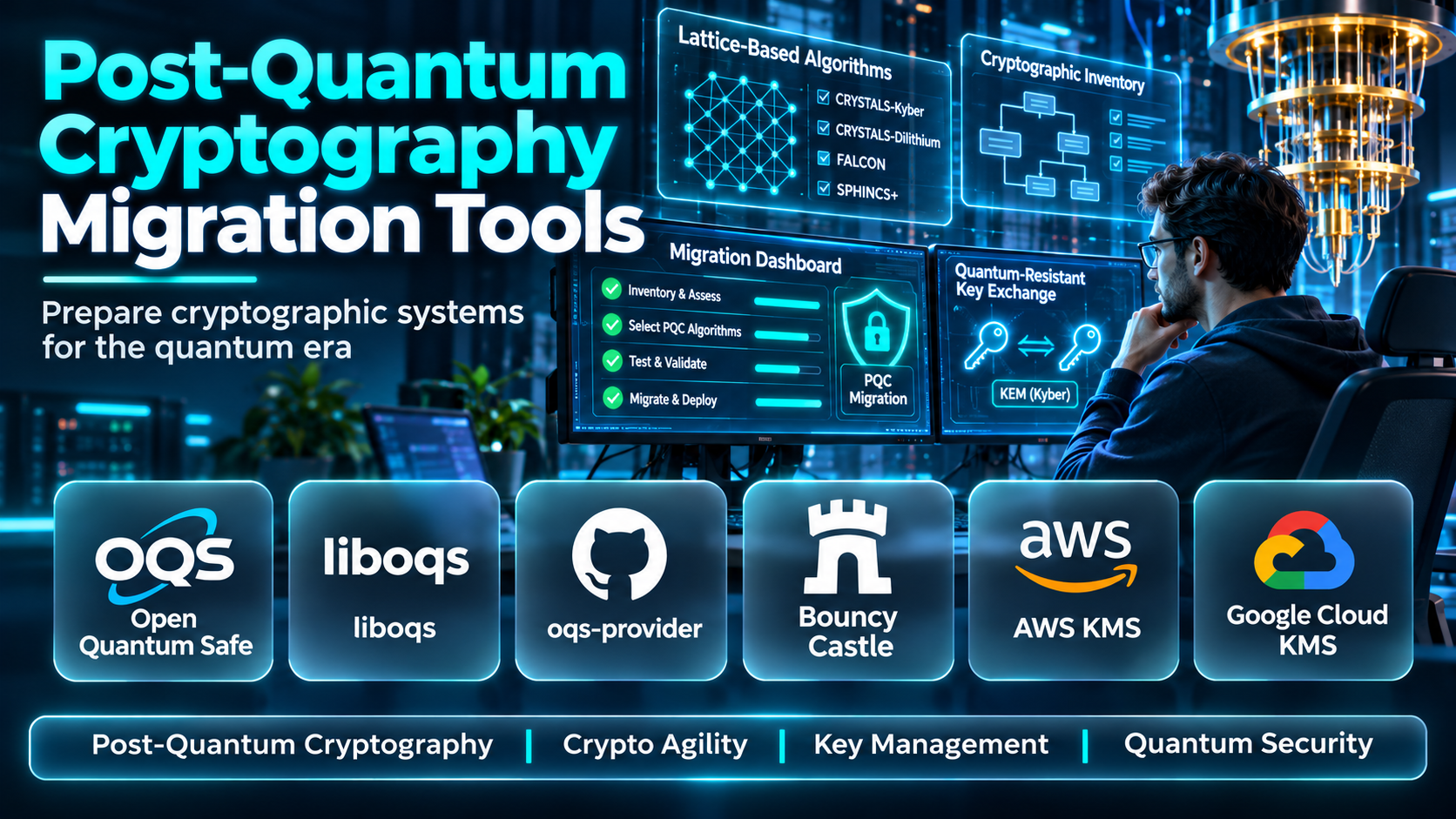
Introduction
Cryptography protects many of the systems people use every day.
Online banking, secure messaging, software updates, digital signatures, virtual private networks, and enterprise identity systems all depend on cryptographic algorithms.
Many current security systems use public-key cryptography based on mathematical problems that conventional computers cannot solve efficiently at sufficient key sizes.
However, sufficiently capable quantum computers could threaten widely deployed public-key algorithms such as RSA and elliptic-curve cryptography.
This creates a long-term security challenge.
Organizations must prepare to replace or supplement vulnerable cryptographic mechanisms with algorithms designed to resist known quantum attacks.
Post-quantum cryptography, commonly abbreviated PQC, addresses this requirement.
The migration is not as simple as installing a new encryption library.
Organizations must identify existing cryptographic dependencies, understand where vulnerable algorithms are used, evaluate compatible replacements, update applications, modernize certificate infrastructure, and test interoperability.
Some systems may require years of coordinated changes.
Post-quantum cryptography migration tools help organizations manage different parts of this transition.
This guide compares ten technologies covering cryptographic discovery, quantum-safe algorithms, key management, certificate infrastructure, and migration support.
What Are Post-Quantum Cryptography Migration Tools?
Post-quantum cryptography migration tools help organizations assess, plan, implement, and verify changes from quantum-vulnerable cryptographic mechanisms to quantum-resistant alternatives.
Different tools address different stages of the process.
Cryptographic Discovery
Discovery tools identify where algorithms, keys, certificates, protocols, and cryptographic libraries are used.
This is often the first major challenge.
An enterprise may have thousands of applications and devices using cryptography without centralized documentation.
Cryptographic Inventory
A cryptographic inventory records relevant information about the organization’s cryptographic assets.
It may include:
- Algorithms.
- Key lengths.
- Certificates.
- Certificate authorities.
- Cryptographic libraries.
- Applications.
- Network protocols.
- Hardware security modules.
- Business owners.
- Data sensitivity.
- Replacement dependencies.
- Migration priorities.
Quantum-Safe Algorithms
Post-quantum algorithms are designed to resist attacks from both conventional and quantum computers, based on current cryptanalytic understanding.
Important standardized algorithms include ML-KEM for key establishment and ML-DSA and SLH-DSA for digital signatures.
These algorithms have different performance characteristics and implementation requirements.
Cryptographic Agility
Crypto agility is the ability to change cryptographic algorithms, parameters, and implementations without redesigning entire systems.
It is an important long-term objective because cryptographic standards and threat models can evolve.
Top 10 Post-Quantum Cryptography Migration Tools
1. IBM Quantum Safe
Short Description
IBM Quantum Safe encompasses technologies and services intended to help organizations assess and address quantum-related cryptographic risks.
Its approach includes cryptographic discovery, risk assessment, and modernization capabilities across supported IBM offerings.
IBM is particularly relevant to large enterprises with complex application portfolios and established security governance requirements.
For example, a financial institution may need to identify applications using RSA or elliptic-curve cryptography across its infrastructure.
A quantum-safe assessment can help determine which systems require remediation and which changes should receive priority.
IBM’s broader enterprise technology ecosystem may also support integration with existing security and infrastructure environments.
However, organizations should evaluate the exact IBM products and services required for each migration phase.
No single tool automatically replaces every vulnerable cryptographic dependency.
Key Features
- Cryptographic discovery: Helps identify relevant cryptographic dependencies.
- Risk assessment: Supports evaluation of quantum-related exposure.
- Migration planning: Helps organize remediation priorities.
- Enterprise integration: Connects with supported business technology environments.
- Quantum-safe technology: Supports selected modern cryptographic approaches.
- Security governance: Helps align migration with organizational controls.
- Assessment workflows: Provides structured modernization activities.
- Crypto agility planning: Supports longer-term cryptographic adaptability.
- Enterprise services: Offers specialized implementation assistance through relevant offerings.
Benefits
IBM Quantum Safe can help large organizations organize complex cryptographic modernization programs.
Pros
- Enterprise-oriented.
- Broad security expertise.
- Discovery and planning relevance.
- Suitable for complex environments.
- Supports strategic migration programs.
Cons
- Product and service scope varies.
- Commercial costs.
- Implementation complexity.
- Enterprise integration requirements.
- Does not eliminate application-specific work.
Use Cases
Enterprise cryptographic assessment, quantum-risk planning, application modernization, and security transformation.
Best For: Large organizations coordinating enterprise-wide PQC migration.
2. SandboxAQ AQtive Guard
Short Description
SandboxAQ AQtive Guard is associated with cryptographic security management and discovery capabilities.
It is relevant to organizations seeking visibility into cryptographic assets and potential weaknesses.
Cryptographic discovery is particularly important for PQC migration because organizations cannot replace algorithms they do not know they use.
For example, an enterprise may have cryptographic dependencies distributed across applications, network services, and infrastructure components.
A discovery-oriented platform can help security teams understand where cryptography is deployed and identify systems requiring additional investigation.
The resulting inventory can support risk prioritization and migration planning.
However, cryptographic visibility does not automatically mean every affected system can be remediated through the same platform.
Organizations should validate current product capabilities, supported environments, and available integrations.
Key Features
- Cryptographic discovery.
- Cryptographic inventory.
- Risk visibility.
- Algorithm identification.
- Security posture analysis.
- Enterprise reporting.
- Migration planning support.
- Cryptographic governance.
- Continuous assessment capabilities.
Benefits
AQtive Guard can help organizations build the visibility needed for systematic cryptographic modernization.
Pros
- Discovery focus.
- Enterprise applicability.
- Inventory relevance.
- Risk prioritization support.
- Crypto agility alignment.
Cons
- Commercial licensing.
- Discovery coverage requires testing.
- Remediation may require other tools.
- Integration effort.
- Data quality affects decisions.
Use Cases
Cryptographic inventory, quantum-risk assessment, enterprise migration planning, and security governance.
Best For: Enterprises beginning with cryptographic discovery and prioritization.
3. Keyfactor
Short Description
Keyfactor provides machine identity and certificate lifecycle management technologies relevant to PKI modernization.
Its capabilities are important because digital certificates and public-key infrastructure are central to many enterprise cryptographic workflows.
Post-quantum migration may require organizations to update certificate issuance, signing algorithms, trust chains, and certificate-dependent applications.
For example, an organization may need to identify certificate authorities and services that rely on algorithms vulnerable to future quantum attacks.
Certificate lifecycle management can help organize this transition.
Keyfactor’s relevance lies in its machine identity and PKI management capabilities rather than being a universal PQC replacement engine.
Organizations must evaluate supported algorithms, certificate formats, integrations, and infrastructure readiness.
Key Features
- Certificate lifecycle management.
- PKI administration.
- Certificate discovery.
- Machine identity management.
- Automation.
- Certificate inventory.
- Policy management.
- Enterprise integrations.
- Crypto agility support.
Benefits
Keyfactor can help organizations manage certificate-related dependencies during cryptographic modernization.
Pros
- Strong PKI focus.
- Certificate automation.
- Enterprise integrations.
- Machine identity relevance.
- Useful migration governance.
Cons
- Not a complete application cryptography inventory.
- Commercial costs.
- PKI modernization complexity.
- PQC support varies by component.
- Integration planning required.
Use Cases
Certificate modernization, machine identity security, PKI transition planning, and enterprise certificate governance.
Best For: Organizations with extensive certificate and PKI infrastructure.
4. DigiCert
Short Description
DigiCert provides digital trust, certificate management, and PKI technologies relevant to quantum-safe cryptographic transition.
Organizations relying on digital certificates must evaluate how future algorithms affect certificate issuance, verification, and lifecycle management.
For example, an enterprise may need to plan a transition for internal PKI systems that authenticate devices and services.
DigiCert’s broader certificate ecosystem makes it relevant to this work.
Its technologies can support aspects of certificate inventory, automation, and quantum-safe readiness.
However, the availability of particular PQC algorithms depends on product support, interoperability requirements, and applicable standards.
Organizations should distinguish experimental capabilities from production-ready configurations.
Key Features
- PKI management.
- Certificate lifecycle automation.
- Digital certificate infrastructure.
- Cryptographic modernization support.
- Certificate discovery.
- Machine identity management.
- Enterprise trust services.
- Security policy integration.
- Quantum-safe readiness initiatives.
Benefits
DigiCert can support organizations modernizing certificate-based trust infrastructure.
Pros
- Established certificate ecosystem.
- Enterprise PKI relevance.
- Automation capabilities.
- Digital trust specialization.
- Migration planning applicability.
Cons
- Commercial licensing.
- Product-specific PQC support.
- Interoperability dependencies.
- Application migration remains necessary.
- Complex trust-chain transitions.
Use Cases
PKI modernization, enterprise certificates, machine identity security, and quantum-safe trust planning.
Best For: Organizations prioritizing certificate infrastructure migration.
5. PQShield
Short Description
PQShield develops post-quantum cryptography technologies and implementation capabilities for software and hardware environments.
Its offerings are relevant to organizations that need to incorporate quantum-resistant algorithms into products or infrastructure.
For example, a device manufacturer may need to implement PQC within embedded firmware or secure hardware.
This creates requirements involving memory consumption, performance, implementation security, and compatibility.
PQShield’s specialization makes it relevant to these technically demanding scenarios.
However, implementing PQC algorithms is only one part of enterprise migration.
Organizations still need cryptographic inventories, deployment planning, certificate compatibility, and long-term maintenance.
Key Features
- Post-quantum algorithm implementations.
- Software cryptographic integration.
- Hardware-oriented cryptography.
- Embedded system relevance.
- Implementation security.
- Standards alignment.
- Engineering integration.
- Quantum-safe product development.
Benefits
PQShield can help technology providers implement quantum-resistant cryptography in supported products.
Pros
- PQC specialization.
- Software and hardware relevance.
- Embedded applicability.
- Implementation expertise.
- Standards-oriented development.
Cons
- Specialized engineering focus.
- Not a full enterprise discovery platform.
- Commercial arrangements.
- Integration complexity.
- Hardware constraints.
Use Cases
Embedded systems, secure hardware, product development, and quantum-safe cryptographic integration.
Best For: Technology manufacturers implementing PQC in software or devices.
6. QuSecure QuProtect
Short Description
QuSecure QuProtect is a quantum-safe security platform focused on helping organizations transition toward post-quantum protection.
Its approach is relevant to enterprises seeking managed or integrated cryptographic modernization capabilities.
For example, an organization may want to introduce quantum-resistant protections into selected communication workflows without immediately replacing every underlying application.
A platform-based approach can potentially simplify some transition scenarios.
However, the effectiveness of any such architecture depends on where encryption occurs, how keys are managed, and which threats the implementation addresses.
Organizations should carefully examine the exact security model rather than assuming a product makes every connected system quantum-safe.
Key Features
- Quantum-safe security workflows.
- Cryptographic modernization.
- Enterprise integration.
- Key management concepts.
- Communication protection.
- Migration support.
- Security policy integration.
- Quantum-risk mitigation.
Benefits
QuProtect can support organizations evaluating managed approaches to quantum-safe protection.
Pros
- PQC-focused platform.
- Enterprise relevance.
- Migration-oriented approach.
- Security integration potential.
- Quantum-risk focus.
Cons
- Commercial pricing.
- Architecture-specific protection.
- Integration requirements.
- Scope must be validated.
- Does not replace all cryptographic dependencies.
Use Cases
Enterprise quantum-safe security, communication protection, and cryptographic transition planning.
Best For: Organizations evaluating platform-based quantum-safe security approaches.
7. Open Quantum Safe
Short Description
Open Quantum Safe is an open-source project that develops tools and integrations for experimenting with post-quantum cryptography.
Its ecosystem includes liboqs, a library providing implementations of selected quantum-resistant algorithms.
It also supports integrations with other cryptographic software for research and testing.
For example, a development team may use Open Quantum Safe to evaluate algorithm performance and application compatibility.
This is particularly useful during early migration planning when organizations need to understand technical tradeoffs.
However, experimental implementations and integrations should not automatically be considered suitable for production.
Organizations must review supported algorithms, implementation status, security guidance, and maintenance requirements.
Key Features
- liboqs cryptographic library.
- PQC algorithm implementations.
- Experimental integrations.
- Open-source development.
- Cryptographic testing.
- Performance evaluation.
- Developer experimentation.
- Standards-related research.
- Interoperability testing.
Benefits
Open Quantum Safe provides accessible tools for exploring quantum-resistant cryptography.
Pros
- Open-source.
- Research-friendly.
- Broad educational value.
- Useful testing infrastructure.
- Developer flexibility.
Cons
- Some integrations are experimental.
- Production suitability varies.
- Requires cryptographic expertise.
- Not an enterprise migration dashboard.
- Compatibility changes over time.
Use Cases
PQC research, algorithm benchmarking, application prototyping, and interoperability testing.
Best For: Developers and researchers evaluating post-quantum algorithms.
8. wolfSSL
Short Description
wolfSSL provides embedded and lightweight cryptographic software, including TLS-related technologies and supported post-quantum cryptography capabilities.
It is relevant to organizations developing devices, embedded applications, and systems with constrained resources.
For example, an industrial equipment manufacturer may need to evaluate quantum-resistant key establishment within a secure communication protocol.
Embedded systems create additional challenges because memory, processor capacity, and firmware update mechanisms may be limited.
wolfSSL’s focus on lightweight cryptographic implementations makes it relevant to these environments.
However, supported PQC capabilities depend on library versions, configuration, platform requirements, and interoperability.
Key Features
- TLS library.
- Embedded cryptography.
- Supported PQC capabilities.
- Cryptographic APIs.
- Platform portability.
- Performance optimization.
- Secure communication integration.
- Developer tooling.
- Embedded deployment support.
Benefits
wolfSSL can help embedded developers evaluate and implement quantum-resistant cryptography within supported communication stacks.
Pros
- Embedded specialization.
- Lightweight design.
- Cryptographic library ecosystem.
- Developer integration.
- Relevant to IoT.
Cons
- Requires application integration.
- PQC support varies.
- Embedded testing complexity.
- Commercial licensing considerations.
- Not a cryptographic inventory platform.
Use Cases
IoT security, embedded TLS, industrial systems, and quantum-safe communication development.
Best For: Embedded and IoT developers.
9. OpenSSL
Short Description
OpenSSL is a widely used open-source cryptographic library and toolkit.
Its importance to PQC migration comes from its extensive use in applications, network services, and security infrastructure.
Organizations evaluating quantum-safe cryptography must understand the capabilities of their OpenSSL versions and associated providers.
For example, a server application may require updates to support standardized post-quantum key establishment mechanisms.
OpenSSL can play a central role in testing and implementing these changes.
However, OpenSSL is not an enterprise cryptographic discovery platform.
Migration also depends on application compatibility, protocol negotiation, certificate support, and the versions deployed across infrastructure.
Key Features
- Cryptographic library.
- TLS support.
- Command-line utilities.
- Algorithm implementations.
- Provider architecture.
- Certificate operations.
- Developer APIs.
- Cross-platform use.
- Cryptographic interoperability.
Benefits
OpenSSL provides a major implementation foundation for cryptographic modernization in supported software environments.
Pros
- Open-source.
- Widely deployed.
- Extensive ecosystem.
- Developer flexibility.
- Important TLS relevance.
Cons
- Version-specific PQC support.
- Integration complexity.
- Not a migration management platform.
- Application compatibility requirements.
- Security updates require maintenance.
Use Cases
TLS modernization, application cryptography, cryptographic testing, and software infrastructure upgrades.
Best For: Developers and infrastructure teams modernizing OpenSSL-based systems.
10. ISARA
Short Description
ISARA is associated with post-quantum cryptography technologies and migration-related expertise.
Its work has focused on helping organizations address cryptographic risks arising from future quantum computing capabilities.
This includes areas such as quantum-safe cryptographic implementations and migration considerations.
For example, an organization planning long-term protection of sensitive data may need specialized assistance evaluating quantum-safe approaches.
ISARA is relevant as a specialist technology provider in the PQC ecosystem.
However, organizations should verify current product availability, ownership, licensing, and supported capabilities before considering a new implementation.
Its inclusion should not be interpreted as confirmation that every historical product remains commercially available.
Key Features
- Post-quantum cryptography expertise.
- Quantum-safe algorithm integration.
- Migration-related technologies.
- Cryptographic modernization concepts.
- Enterprise security relevance.
- Standards-oriented approaches.
- Integration support concepts.
- Quantum-risk assessment relevance.
Benefits
ISARA’s technologies and expertise provide useful context for specialized PQC implementation and migration approaches.
Pros
- PQC specialization.
- Migration expertise.
- Standards relevance.
- Enterprise security focus.
- Technical background.
Cons
- Current availability requires verification.
- Product history and ownership may have changed.
- Commercial scope varies.
- Not a universal migration platform.
- Integration requirements.
Use Cases
Specialized PQC evaluations, cryptographic modernization research, and migration technology assessment.
Best For: Organizations researching specialist quantum-safe technologies, subject to current availability.
Post-Quantum Cryptography Migration Tools Comparison Table
| Tool | Primary Focus | Best For | Main Limitation |
|---|---|---|---|
| IBM Quantum Safe | Enterprise migration | Large organizations | Complexity |
| SandboxAQ AQtive Guard | Cryptographic discovery | Security teams | Remediation requires integration |
| Keyfactor | PKI lifecycle | Certificate-heavy enterprises | PKI-focused |
| DigiCert | Digital trust and PKI | Certificate modernization | Product-specific support |
| PQShield | PQC implementations | Technology manufacturers | Specialized integration |
| QuSecure QuProtect | Quantum-safe security | Enterprises | Architecture-dependent |
| Open Quantum Safe | Open-source experimentation | Researchers | Production readiness varies |
| wolfSSL | Embedded cryptography | IoT developers | Platform constraints |
| OpenSSL | Cryptographic library | Software developers | Version-specific capabilities |
| ISARA | Specialist PQC technology | Migration researchers | Availability verification |
How to Choose Post-Quantum Cryptography Migration Tools
1. Begin With Cryptographic Discovery
Organizations should identify where vulnerable public-key algorithms are used before selecting replacement technologies.
2. Prioritize Long-Lived Sensitive Data
Information requiring confidentiality for many years may face particular exposure from harvest-now-decrypt-later threats.
3. Review NIST Standards
Use appropriate standardized algorithms and implementation guidance.
Avoid choosing experimental algorithms for production without a clear justification.
4. Evaluate Application Compatibility
Algorithm changes may affect key sizes, signatures, certificates, protocol messages, and performance.
5. Assess Hardware Constraints
Embedded devices may require special attention to memory, processor capacity, and update mechanisms.
6. Plan PKI Modernization
Certificate authorities, trust stores, hardware security modules, and certificate-dependent applications may require coordinated updates.
7. Establish Crypto Agility
Design systems so that cryptographic algorithms can be replaced as requirements evolve.
8. Test Hybrid Approaches
Where supported and appropriate, hybrid cryptographic mechanisms may help organizations transition while maintaining compatibility.
9. Include Vendors and Suppliers
Third-party systems may contain cryptographic dependencies that customers cannot modify directly.
10. Build a Multi-Year Roadmap
Prioritize critical systems and align migration with software maintenance and infrastructure replacement cycles.
Best PQC Migration Tools by User Type
| User Type | Recommended Tools | Reason |
|---|---|---|
| Enterprise CISO | IBM Quantum Safe | Program-level modernization |
| Cryptographic discovery team | SandboxAQ AQtive Guard | Inventory and risk |
| PKI administrator | Keyfactor, DigiCert | Certificate management |
| Hardware manufacturer | PQShield | Embedded PQC |
| Enterprise security architect | QuSecure | Platform-oriented approaches |
| Cryptography researcher | Open Quantum Safe | Algorithm experimentation |
| IoT developer | wolfSSL | Lightweight cryptography |
| Application developer | OpenSSL | Library integration |
| Specialist migration team | ISARA evaluation | PQC expertise |
Practical Example: Planning a Post-Quantum Migration for a Financial Institution
Consider a bank operating online services, internal APIs, payment infrastructure, and long-lived customer databases.
The bank wants to prepare for quantum-related cryptographic risks.
Step 1: Establish Governance
Create a migration team involving security, infrastructure, application engineering, compliance, and procurement.
Step 2: Discover Cryptographic Assets
Identify algorithms, certificates, libraries, keys, and protocols across critical systems.
Step 3: Build an Inventory
Record the business owner, application, algorithm, dependency, and migration constraints.
Step 4: Classify Data Sensitivity
Identify information that must remain confidential for extended periods.
Step 5: Prioritize Systems
Focus on critical systems with high exposure or long replacement cycles.
Step 6: Evaluate Standardized Algorithms
Determine where ML-KEM, ML-DSA, SLH-DSA, or other approved mechanisms are appropriate.
Step 7: Build a Test Environment
Evaluate interoperability, performance, certificate behavior, and operational requirements.
Step 8: Engage Vendors
Request product roadmaps and compatibility information from technology suppliers.
Step 9: Introduce Controlled Pilots
Deploy supported changes in lower-risk environments.
Step 10: Measure Performance
Monitor latency, handshake behavior, memory use, and operational reliability.
Step 11: Update Policies
Revise cryptographic standards, procurement requirements, and development guidance.
Step 12: Expand Gradually
Roll out approved changes across prioritized applications and infrastructure.
Common PQC Migration Challenges
Unknown Cryptographic Dependencies
Organizations often lack a complete inventory of cryptography embedded in applications and devices.
Interoperability Problems
Different systems may support different algorithms and protocol versions.
Larger Cryptographic Materials
Some post-quantum algorithms use larger keys, ciphertexts, or signatures than existing alternatives.
Embedded Device Constraints
Legacy devices may not have sufficient resources for new cryptographic implementations.
Vendor Dependencies
Organizations may need suppliers to provide compatible software updates.
Long Migration Timelines
Critical systems may require extensive testing, certification, or infrastructure replacement.
False Sense of Readiness
Deploying one quantum-safe library does not make an entire enterprise quantum-resistant.
Frequently Asked Questions
1. What is post-quantum cryptography?
It is cryptography designed to resist attacks using both conventional and quantum computers, based on current understanding.
2. Why is PQC migration important?
Future quantum computers could threaten widely deployed public-key cryptographic systems.
3. Is quantum computing already breaking RSA?
There is no established public evidence that current quantum computers can routinely break properly implemented large-scale RSA used in modern systems.
4. What is ML-KEM?
ML-KEM is a standardized post-quantum key encapsulation mechanism.
5. What is ML-DSA?
ML-DSA is a standardized post-quantum digital signature algorithm.
6. What is SLH-DSA?
SLH-DSA is a standardized stateless hash-based digital signature algorithm.
7. What is harvest-now-decrypt-later?
It describes collecting encrypted information today with the intention of decrypting it using future capabilities.
8. What is crypto agility?
It is the ability to update cryptographic mechanisms without extensive system redesign.
9. Does PQC replace all encryption?
No. Migration requirements differ between public-key and symmetric cryptographic systems.
10. What is a cryptographic inventory?
It is a record of cryptographic assets and dependencies.
11. Can OpenSSL support PQC?
Supported capabilities depend on the OpenSSL version, providers, and application configuration.
12. Is Open Quantum Safe suitable for production?
Organizations must evaluate the specific implementation and its documented production readiness.
13. What is hybrid cryptography?
It combines different cryptographic mechanisms, often to support transition and defense in depth.
14. Do digital certificates need to change?
Some certificate and signature infrastructures will require updates.
15. Are IoT devices affected?
Yes. Many embedded devices use public-key cryptography.
16. Can organizations migrate immediately?
Some systems can adopt supported changes sooner than others.
17. Does PQC guarantee permanent security?
No. Cryptographic confidence depends on continuing research, implementation quality, and operational security.
18. How should organizations prioritize migration?
Consider data sensitivity, system criticality, exposure, dependency complexity, and replacement timelines.
19. What is the biggest PQC migration challenge?
For many enterprises, it is discovering and coordinating changes across cryptographic dependencies.
20. Which PQC migration tool is best?
The best choice depends on whether the organization needs discovery, PKI modernization, cryptographic implementation, embedded support, or enterprise program management.
Final Thoughts
Post-quantum cryptography migration is a complex security modernization effort.
IBM Quantum Safe and SandboxAQ address important enterprise assessment and discovery needs.
Keyfactor and DigiCert are relevant to PKI and certificate modernization.
PQShield and wolfSSL support specialized implementation requirements.
QuSecure provides a platform-oriented approach, while Open Quantum Safe and OpenSSL support different development and experimentation workflows.
ISARA represents specialist expertise whose current offerings should be verified before adoption.
Organizations should begin with a reliable cryptographic inventory, identify critical dependencies, evaluate standardized algorithms, and establish a realistic migration roadmap.
The objective is not to replace every algorithm immediately.
It is to create a controlled, measurable transition toward cryptographic systems that can adapt to evolving security requirements.
