Introduction
Mining companies manage complex operations involving mineral extraction, heavy equipment, production planning, material transportation, workforce coordination, and environmental management. Maintaining efficient operations requires accurate information about equipment availability, production performance, operational costs, and resource utilization.
Traditional mining management practices frequently depend on spreadsheets, paper-based production reports, manual equipment inspections, and disconnected operational systems. These approaches can create information gaps, reporting delays, inefficient resource allocation, and difficulties coordinating activities across mining sites.
Mining operations management software helps organizations consolidate operational information, monitor production activities, manage equipment, coordinate mining fleets, and evaluate performance. These platforms provide mine managers, engineers, dispatchers, and maintenance personnel with structured information for operational decision-making.
Modern mining management solutions combine production monitoring, fleet management, mine planning, equipment performance analytics, material tracking, maintenance coordination, and operational reporting. Advanced platforms also support connected equipment, digital mining environments, and integration with enterprise management applications.
Selecting the right mining operations management software requires consideration of mining methods, site characteristics, equipment types, production objectives, workforce requirements, connectivity limitations, and existing technology infrastructure. Surface mines and underground operations often require different combinations of capabilities.
This comprehensive guide examines ten mining operations management software solutions, explaining their features, benefits, advantages, limitations, practical applications, and suitability for different mining organizations.
What Is Mining Operations Management Software?
Mining operations management software refers to digital applications designed to coordinate, monitor, analyze, and manage operational activities throughout mining environments. These platforms help organizations maintain visibility into production processes, equipment performance, workforce activities, material movement, and operational expenditure.
Mining operations involve interconnected activities extending from geological evaluation and mine planning to mineral extraction, transportation, processing, stockpile management, and equipment maintenance. Operational management software helps organizations connect information from these activities within structured workflows.
Specialized mining platforms provide capabilities such as fleet dispatch, production monitoring, short-interval control, mine scheduling, equipment tracking, and operational performance analysis. Other applications address complementary requirements involving maintenance management, geological information, and enterprise resource planning.
The objective of mining operations management software is to support informed decision-making, improve information consistency, coordinate operational resources, and identify improvement opportunities. Software does not replace qualified mining engineers, authorized equipment operators, established safety procedures, or applicable regulatory requirements.
Common Applications of Mining Operations Management Software
- Mine Production Monitoring: Track extraction volumes, material movement, production targets, and operational performance across mining activities.
- Mining Fleet Management: Coordinate haul trucks, loaders, excavators, and other mobile equipment according to approved operational requirements.
- Mine Planning and Scheduling: Organize production schedules, resource requirements, mining sequences, and operational planning information.
- Equipment Performance Management: Monitor equipment availability, utilization, maintenance histories, and relevant performance indicators.
- Material Tracking: Maintain information about extracted materials, transportation activities, stockpiles, and processing destinations.
- Workforce Coordination: Organize shift information, personnel assignments, operational responsibilities, and relevant production documentation.
- Maintenance Management: Coordinate approved preventive maintenance, corrective activities, equipment inspections, and spare parts administration.
- Operational Analytics and Reporting: Evaluate production performance, equipment utilization, operating costs, and other documented mining indicators.
Essential Mining Operations Management Components
| Component | Primary Purpose |
|---|---|
| Production Management | Tracks extraction and material movement |
| Fleet Management | Coordinates mobile mining equipment |
| Mine Planning | Supports production and resource planning |
| Equipment Monitoring | Tracks equipment performance and availability |
| Dispatch Management | Coordinates approved equipment assignments |
| Material Management | Maintains material movement and stockpile information |
| Maintenance Management | Organizes equipment service activities |
| Shift Management | Consolidates workforce and production information |
| Operational Analytics | Evaluates mining performance indicators |
| Enterprise Integration | Connects mining information with business applications |
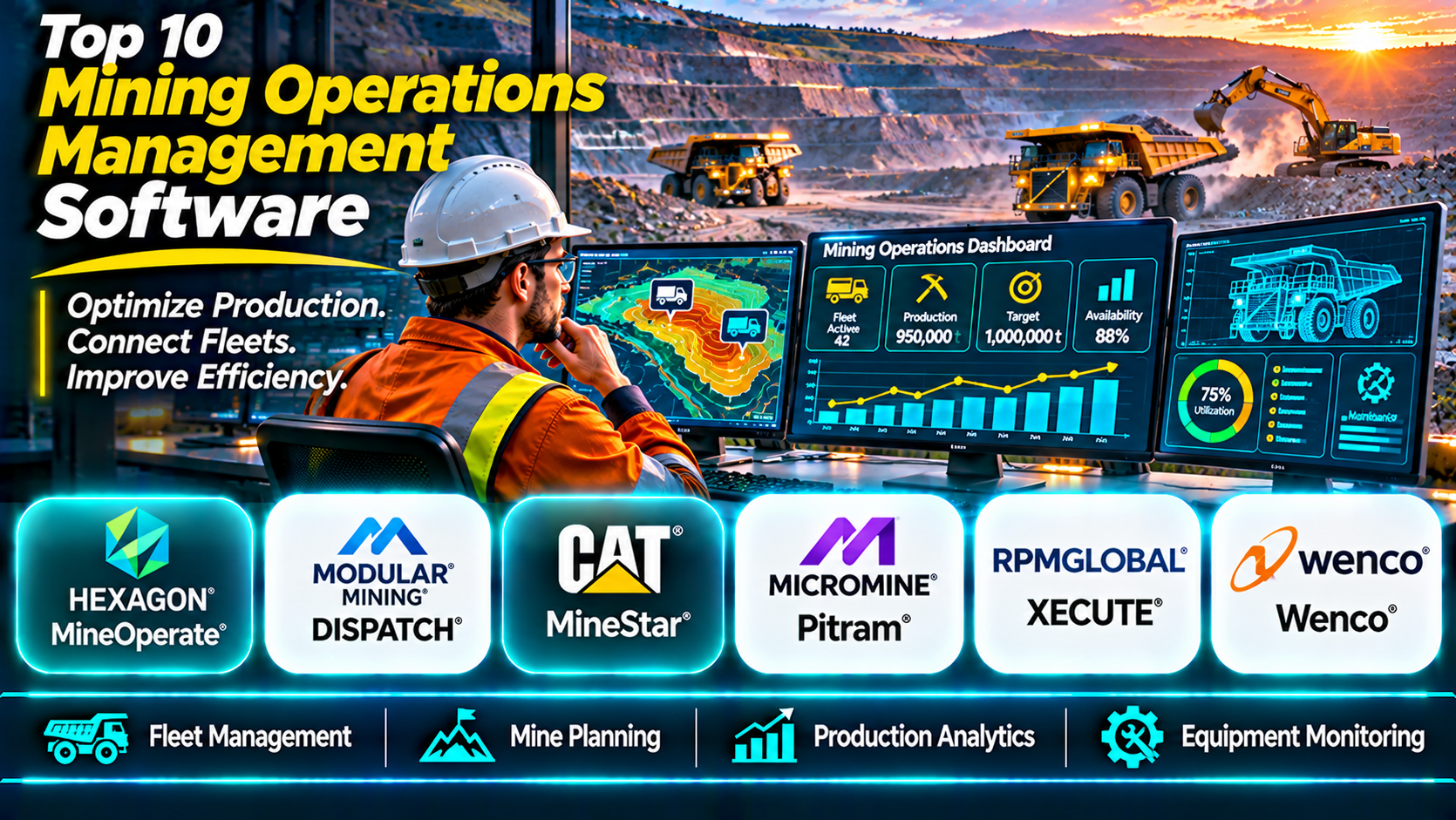
Top 10 Mining Operations Management Software
The following comparison includes dedicated mining operations platforms, fleet management systems, mine planning applications, and complementary enterprise asset management solutions.
The numbering organizes the comparison rather than representing independently tested rankings.
1. Hexagon MineOperate
Short Description
Hexagon MineOperate is a mining operations technology portfolio designed to support production management, fleet coordination, operational monitoring, and mining performance improvement.
The platform helps mining organizations connect information from mobile equipment, production activities, operational personnel, and relevant mining systems. Its capabilities are particularly relevant to operations requiring centralized visibility into complex equipment fleets.
Hexagon’s broader mining technology ecosystem includes mine planning, operational management, measurement, and safety-related technologies. Organizations can evaluate different applications according to their specific operational requirements.
MineOperate is particularly relevant to large mining companies seeking to connect production activities with equipment management and operational analytics.
Key Features
- Mining Fleet Management: Coordinates supported mobile mining equipment and operational assignments.
- Production Monitoring: Consolidates information about material movement and production activities.
- Equipment Tracking: Provides supported equipment location and operational status information.
- Dispatch Management: Helps organize equipment assignments according to configured operational requirements.
- Operational Analytics: Evaluates relevant production and equipment performance indicators.
- Shift Reporting: Consolidates documented operational information across mining shifts.
- Equipment Utilization Analysis: Supports investigation of equipment activity and utilization patterns.
- Mining Technology Integration: Connects with compatible applications within the broader mining ecosystem.
- Centralized Operational Visualization: Provides authorized personnel with relevant operational information.
Benefits
- Improves visibility into mining operations.
- Supports coordinated equipment management.
- Reduces fragmented production information.
- Facilitates operational performance analysis.
- Improves shift reporting consistency.
- Supports resource allocation decisions.
- Helps identify operational improvement opportunities.
Pros
- Dedicated mining industry specialization.
- Comprehensive mining technology ecosystem.
- Relevant fleet management capabilities.
- Suitable for large mining operations.
- Supports centralized operational reporting.
- Provides complementary mining technology applications.
Cons
- Enterprise pricing requires consultation.
- Implementation may require significant technical resources.
- Equipment integration depends on supported configurations.
- Employee training may be necessary.
- Smaller mining operations may not require its full capabilities.
Use Cases
- Surface Mining Fleet Coordination: Organize supported haulage and loading equipment assignments.
- Production Monitoring: Review documented material movement and extraction performance.
- Equipment Utilization Analysis: Investigate equipment activity patterns.
- Shift Performance Reporting: Consolidate production information across operating shifts.
- Mining Operations Visualization: Present relevant operational information to authorized personnel.
- Integrated Mining Management: Connect compatible operational and planning applications.
Best For
- Large surface mining operations.
- Mining fleet managers.
- Integrated mining companies.
- Production management departments.
- Mining technology teams.
- Equipment performance analysts.
2. Modular Mining DISPATCH
Short Description
DISPATCH is a mining fleet management system developed by Modular Mining, part of the Komatsu mining technology ecosystem. It focuses on coordinating mobile mining equipment and supporting efficient material transportation.
The platform helps mining organizations manage equipment assignments, monitor haulage activities, evaluate production performance, and maintain visibility into fleet operations.
Its fleet management orientation makes it particularly relevant to large open-pit mines where loading and transportation activities involve substantial equipment resources.
Organizations should evaluate supported equipment types, communication infrastructure, dispatch configuration, and integration with existing mining applications.
Key Features
- Fleet Dispatch Management: Supports coordinated assignments for compatible mining equipment.
- Haulage Management: Organizes relevant material transportation information.
- Equipment Location Tracking: Provides supported location information for fleet assets.
- Production Monitoring: Consolidates documented loading and hauling activities.
- Equipment Status Management: Maintains visibility into relevant equipment operating states.
- Operational Optimization: Supports configured fleet allocation and coordination objectives.
- Material Movement Tracking: Associates supported transportation records with material movement activities.
- Performance Reporting: Evaluates relevant fleet and production indicators.
- Mining System Integration: Connects with compatible operational technologies.
Benefits
- Improves fleet coordination.
- Supports more consistent dispatch processes.
- Facilitates production performance monitoring.
- Improves visibility into equipment availability.
- Helps identify transportation inefficiencies.
- Supports structured material movement reporting.
- Improves coordination between operational teams.
Pros
- Established mining fleet management specialization.
- Relevant large-scale haulage management capabilities.
- Suitable for complex surface mining fleets.
- Supports operational performance reporting.
- Provides centralized dispatch functionality.
- Established mining technology ecosystem.
Cons
- Implementation requires appropriate communications infrastructure.
- Commercial pricing requires evaluation.
- Equipment compatibility must be confirmed.
- Configuration requires mining operational expertise.
- Enterprise financial management requires complementary software.
Use Cases
- Open-Pit Fleet Management: Coordinate approved mobile equipment assignments.
- Haulage Performance Analysis: Review documented transportation performance.
- Loading Equipment Coordination: Support coordination between loading and hauling resources.
- Production Reporting: Consolidate material movement information.
- Equipment Status Monitoring: Review supported equipment availability and activity information.
- Fleet Performance Improvement: Identify operational patterns requiring further investigation.
Best For
- Large open-pit mines.
- Mining dispatch departments.
- Haulage fleet managers.
- Surface mining contractors.
- Production supervisors.
- Mining operational improvement teams.
3. Caterpillar MineStar
Short Description
Cat MineStar is a mining technology portfolio developed by Caterpillar to support fleet management, equipment monitoring, operational visibility, and applicable automation capabilities.
The portfolio includes applications addressing different mining requirements, such as equipment tracking, production management, machine guidance, condition monitoring, and supported autonomous operations.
Mining organizations can evaluate individual MineStar capabilities according to their equipment fleets, operational processes, and technology infrastructure.
MineStar is particularly relevant to organizations operating large equipment fleets and seeking closer integration between mining machinery and digital operational systems.
Key Features
- MineStar Fleet: Supports applicable fleet coordination and production management workflows.
- MineStar Terrain: Provides supported machine guidance and operational positioning capabilities.
- MineStar Health: Supports equipment condition information and performance monitoring.
- MineStar Detect: Provides applicable awareness and detection technologies through supported configurations.
- MineStar Command: Supports selected autonomous and remote-control mining technologies.
- Production Reporting: Consolidates relevant operational and equipment activity information.
- Equipment Performance Analysis: Supports investigation of machinery performance indicators.
- Operational Visualization: Presents supported equipment and production information.
- Connected Equipment Integration: Connects compatible machinery with relevant mining technology applications.
Benefits
- Improves equipment performance visibility.
- Supports integrated mining technology workflows.
- Facilitates fleet coordination.
- Improves access to production information.
- Supports equipment maintenance planning.
- Helps organizations evaluate operational efficiency.
- Provides a foundation for applicable mining automation initiatives.
Pros
- Established mining equipment and technology ecosystem.
- Comprehensive portfolio of mining applications.
- Relevant equipment condition monitoring.
- Supports large-scale mining operations.
- Provides complementary automation technologies.
- Useful integration with compatible mining machinery.
Cons
- Functionality depends on selected MineStar applications.
- Commercial arrangements require consultation.
- Equipment compatibility varies by technology.
- Automation implementation requires substantial engineering and operational preparation.
- Training and infrastructure requirements can be significant.
Use Cases
- Mining Fleet Coordination: Manage supported equipment assignments and operational information.
- Machine Performance Monitoring: Review relevant equipment condition indicators.
- Production Management: Consolidate documented extraction and transportation information.
- Equipment Maintenance Support: Investigate supported machinery performance trends.
- Machine Guidance: Support approved operational workflows using compatible technologies.
- Mining Automation Programs: Evaluate supported automation capabilities within authorized engineering programs.
Best For
- Caterpillar-oriented mining organizations.
- Large mining equipment fleets.
- Surface mining operators.
- Equipment reliability departments.
- Mining technology managers.
- Organizations evaluating mining automation.
4. MICROMINE Pitram
Short Description
Pitram is a mine control and fleet management solution developed by MICROMINE. It supports operational information management, production monitoring, equipment tracking, and mining performance reporting.
The platform is particularly relevant to underground mining operations, although applicable capabilities can also support other mining environments.
Pitram helps organizations consolidate information about equipment activities, production progress, material movement, and shift performance. This information supports coordination between mine control personnel and operational departments.
Its mine control orientation makes it useful for organizations requiring centralized visibility into activities occurring across complex mining environments.
Key Features
- Mine Control Management: Consolidates relevant operational information within a centralized environment.
- Production Monitoring: Tracks documented extraction and material movement activities.
- Equipment Tracking: Maintains supported equipment location and status information.
- Fleet Coordination: Supports organization of approved mobile equipment activities.
- Shift Management: Consolidates relevant production and equipment information across shifts.
- Material Tracking: Organizes supported material movement and destination records.
- Operational Data Collection: Captures compatible operational information from relevant sources.
- Performance Analytics: Evaluates production and equipment activity indicators.
- Mining Application Integration: Connects with compatible planning and operational technologies.
Benefits
- Improves centralized mine control visibility.
- Supports consistent production reporting.
- Facilitates underground operational coordination.
- Reduces fragmented shift information.
- Improves equipment activity documentation.
- Supports material movement visibility.
- Helps identify operational performance trends.
Pros
- Strong underground mining relevance.
- Dedicated mine control functionality.
- Relevant fleet and production management capabilities.
- Supports structured shift reporting.
- Suitable for complex mining environments.
- Established mining software ecosystem.
Cons
- Communication infrastructure affects available functionality.
- Commercial pricing requires evaluation.
- Implementation may require site-specific configuration.
- Equipment integration must be assessed.
- Specialized training may be necessary.
Use Cases
- Underground Mine Control: Consolidate relevant operational information.
- Equipment Activity Monitoring: Review supported equipment operating states.
- Shift Production Reporting: Maintain structured production records.
- Material Movement Management: Track documented material transportation activities.
- Fleet Coordination: Organize approved equipment assignments.
- Operational Performance Review: Evaluate documented production indicators.
Best For
- Underground mining companies.
- Mine control departments.
- Mining production supervisors.
- Underground fleet managers.
- Multi-site mining organizations.
- Mining operational analysts.
5. RPMGlobal XECUTE
Short Description
XECUTE is a mining operational planning and scheduling solution developed by RPMGlobal. It focuses on connecting mine planning objectives with operational execution and short-term production requirements.
The software helps mining organizations organize schedules, evaluate resource requirements, monitor progress, and maintain visibility into operational planning information.
Its capabilities are particularly relevant when mining companies need to coordinate short-term production plans with available equipment, operational constraints, and broader mine planning objectives.
XECUTE is primarily a planning and execution coordination application rather than a complete equipment fleet management or enterprise maintenance platform.
Key Features
- Operational Mine Scheduling: Organizes short-term production schedules and planned activities.
- Resource Planning: Supports evaluation of relevant equipment and operational resource requirements.
- Production Plan Management: Maintains structured information about planned mining activities.
- Schedule Visualization: Presents relevant production schedules and activity relationships.
- Progress Monitoring: Supports comparison of documented operational progress with planned activities.
- Scenario Evaluation: Helps investigate alternative planning assumptions.
- Planning Collaboration: Facilitates authorized coordination between planning and operational personnel.
- Performance Analysis: Supports investigation of production plan performance.
- Mining System Integration: Connects with compatible planning and operational applications.
Benefits
- Improves coordination between planning and execution.
- Supports consistent short-term scheduling.
- Facilitates resource planning.
- Improves visibility into production objectives.
- Helps identify deviations from approved plans.
- Supports structured planning collaboration.
- Reduces fragmented operational scheduling information.
Pros
- Dedicated mining planning specialization.
- Relevant short-term scheduling capabilities.
- Supports operational planning coordination.
- Suitable for complex production environments.
- Provides structured schedule visualization.
- Complements broader mining management systems.
Cons
- Not a complete fleet dispatch platform.
- Commercial pricing requires consultation.
- Planning effectiveness depends on source information quality.
- Specialist mining planning expertise may be required.
- Equipment maintenance requires complementary applications.
Use Cases
- Short-Term Mine Planning: Organize approved operational production schedules.
- Resource Allocation Planning: Evaluate documented equipment and resource requirements.
- Production Progress Review: Compare actual performance with planned activities.
- Schedule Scenario Analysis: Investigate alternative planning assumptions.
- Operational Planning Coordination: Connect mine planners and production departments.
- Production Schedule Reporting: Maintain structured planning documentation.
Best For
- Mining planning engineers.
- Production planning departments.
- Large mining organizations.
- Operational scheduling teams.
- Mine production managers.
- Organizations connecting planning and execution.
6. Dassault Systèmes GEOVIA
Short Description
GEOVIA is a mining and geological software portfolio developed by Dassault Systèmes. It supports activities involving geological modeling, mine design, resource evaluation, production planning, and mining operational decision-making.
The portfolio includes established mining applications such as Surpac, MineSched, and Whittle, which address different stages of geological and mining planning workflows.
Mining organizations can use applicable GEOVIA applications to connect geological information with mine design, production scheduling, and strategic planning.
GEOVIA is particularly relevant to organizations requiring comprehensive geological and mine planning capabilities. Dedicated fleet dispatch and maintenance management may require complementary software.
Key Features
- Geological Modeling: Supports development of geological representations using relevant source information.
- Mineral Resource Evaluation: Provides applicable tools for resource modeling and evaluation.
- Mine Design: Supports qualified engineering development of mining designs.
- Production Scheduling: Organizes planned mining activities through compatible applications.
- Strategic Mine Planning: Supports evaluation of long-term mining planning scenarios.
- Three-Dimensional Visualization: Presents geological and mining information within supported visual environments.
- Scenario Analysis: Helps investigate alternative geological and planning assumptions.
- Mining Data Management: Organizes relevant geological and engineering information.
- Planning Integration: Supports information exchange between compatible mining applications.
Benefits
- Improves geological information accessibility.
- Supports structured mine planning.
- Facilitates production schedule development.
- Improves visualization of mining environments.
- Supports multidisciplinary engineering collaboration.
- Helps organizations evaluate planning alternatives.
- Provides complementary geological and mining capabilities.
Pros
- Established geological and mining software portfolio.
- Comprehensive mine planning capabilities.
- Relevant three-dimensional modeling functionality.
- Suitable for complex mining projects.
- Supports multiple stages of mine planning.
- Established engineering technology ecosystem.
Cons
- Multiple applications may be required.
- Commercial licensing requires evaluation.
- Geological and engineering expertise is necessary.
- Fleet dispatch requires complementary systems.
- Implementation complexity varies by project.
Use Cases
- Geological Resource Modeling: Develop supported geological and mineral resource representations.
- Mine Design: Support qualified engineering design activities.
- Production Scheduling: Organize approved mining production plans.
- Strategic Mine Planning: Evaluate alternative long-term planning scenarios.
- Geological Visualization: Review geological and engineering information.
- Mining Project Evaluation: Support documented technical and planning assessments.
Best For
- Mining engineers.
- Geological modeling specialists.
- Mine planning departments.
- Mineral resource evaluation teams.
- Mining engineering consultancies.
- Large mining development projects.
7. Datamine
Short Description
Datamine provides a portfolio of mining software covering geological modeling, resource evaluation, mine planning, production scheduling, and operational management.
Its applications support mining organizations throughout different stages of the mining lifecycle, from geological information interpretation to operational production planning.
Relevant products within the portfolio include Studio applications for geological and engineering workflows and EPS for mine scheduling. Other applications address specialized mining information and operational requirements.
Organizations should evaluate individual Datamine products according to their mining methods, geological complexity, planning requirements, and existing technology infrastructure.
Key Features
- Geological Information Management: Organizes relevant geological and mineral exploration information.
- Resource Modeling: Supports applicable mineral resource modeling workflows.
- Mine Design: Provides engineering tools for qualified mining design activities.
- Production Scheduling: Supports development of structured mining schedules.
- Planning Optimization: Helps evaluate alternative planning scenarios.
- Three-Dimensional Visualization: Presents supported geological and mining representations.
- Operational Information Management: Provides relevant capabilities through selected portfolio applications.
- Technical Reporting: Supports preparation of geological and mining documentation.
- Application Integration: Connects compatible mining planning and information management workflows.
Benefits
- Supports integrated geological and mining workflows.
- Improves access to technical information.
- Facilitates production planning.
- Supports structured engineering documentation.
- Improves visualization of geological information.
- Helps evaluate alternative mining plans.
- Provides specialized mining software capabilities.
Pros
- Dedicated mining industry software portfolio.
- Relevant geological modeling capabilities.
- Comprehensive mine planning functionality.
- Supports multiple mining lifecycle stages.
- Suitable for diverse mining environments.
- Provides specialized technical applications.
Cons
- Product selection can require detailed evaluation.
- Commercial pricing varies by application.
- Specialist technical expertise is necessary.
- Information migration may require preparation.
- Comprehensive operational management may require multiple products.
Use Cases
- Mineral Resource Modeling: Develop geological and resource representations.
- Mine Production Planning: Organize documented mining production objectives.
- Engineering Design: Support qualified mine design activities.
- Operational Scheduling: Develop approved production schedules.
- Geological Information Analysis: Investigate supported geological datasets.
- Mining Project Documentation: Maintain structured technical records.
Best For
- Mining engineering departments.
- Geological modeling teams.
- Mineral exploration organizations.
- Mine planning specialists.
- Mining technical service providers.
- Integrated mining companies.
8. Deswik
Short Description
Deswik is a mining software portfolio specializing in mine planning, engineering design, production scheduling, and related technical workflows.
The software supports surface and underground mining organizations through applications such as Deswik.CAD and Deswik.Sched. These tools help qualified engineers develop mine designs and coordinate production schedules.
Deswik’s integrated planning approach helps organizations maintain relationships between engineering designs, scheduled activities, resource requirements, and operational objectives.
Its primary strengths involve technical planning and engineering coordination rather than comprehensive equipment fleet dispatch or enterprise financial administration.
Key Features
- Mine Design: Supports qualified engineering development of surface and underground mine designs.
- Production Scheduling: Organizes mining activities and associated planning information.
- Three-Dimensional Modeling: Provides supported visualization of mining environments.
- Resource Scheduling: Helps evaluate relevant equipment and resource requirements.
- Planning Scenario Analysis: Supports investigation of alternative production plans.
- Design and Schedule Integration: Maintains relationships between compatible design and scheduling workflows.
- Progress Evaluation: Supports comparison of documented production progress with planned activities.
- Technical Documentation: Organizes relevant mining engineering information.
- Planning Reporting: Presents structured schedule and resource information.
Benefits
- Improves mine planning consistency.
- Supports integrated design and scheduling workflows.
- Facilitates resource planning.
- Improves visualization of mining activities.
- Helps evaluate alternative production scenarios.
- Supports engineering collaboration.
- Reduces fragmented technical planning information.
Pros
- Dedicated mining engineering specialization.
- Strong design and scheduling orientation.
- Relevant surface and underground mining capabilities.
- Supports complex planning workflows.
- Useful three-dimensional visualization.
- Established mining software portfolio.
Cons
- Requires qualified mining engineering expertise.
- Commercial pricing requires consultation.
- Fleet dispatch may require other applications.
- Complex projects require configuration and information preparation.
- Enterprise maintenance management requires complementary software.
Use Cases
- Underground Mine Design: Support qualified engineering design activities.
- Surface Mine Planning: Develop documented mining plans.
- Production Scheduling: Organize approved operational activities.
- Resource Planning: Evaluate relevant production resource requirements.
- Scenario Evaluation: Investigate alternative mining schedules.
- Engineering Coordination: Connect design and planning information.
Best For
- Mining planning engineers.
- Underground mining organizations.
- Surface mine engineering teams.
- Technical services departments.
- Mining scheduling specialists.
- Engineering consultancies.
9. Wenco Mining Systems
Short Description
Wenco provides mining technology solutions focused on fleet management, equipment monitoring, production visibility, and operational coordination.
Its fleet management capabilities help mining organizations coordinate mobile equipment, maintain operational records, and investigate production and equipment performance indicators.
Wenco is particularly relevant to surface mining operations requiring centralized visibility into haulage fleets, loading equipment, material movement, and operational activities.
Organizations should evaluate supported equipment integrations, communications infrastructure, available applications, and compatibility with existing mining systems.
Key Features
- Mining Fleet Management: Supports coordination of compatible mobile mining equipment.
- Equipment Dispatch: Organizes approved equipment assignments and operational activities.
- Production Monitoring: Consolidates relevant extraction and material transportation records.
- Equipment Tracking: Provides supported equipment location and activity information.
- Material Movement Management: Organizes documented loading and transportation information.
- Equipment Health Integration: Supports relevant condition information through compatible technologies.
- Operational Analytics: Evaluates production and fleet performance indicators.
- Shift Reporting: Consolidates documented operational information.
- Mining Technology Integration: Connects with compatible mining applications and equipment systems.
Benefits
- Improves fleet operational visibility.
- Supports consistent equipment coordination.
- Facilitates material movement reporting.
- Improves access to production information.
- Helps identify equipment utilization patterns.
- Supports operational performance evaluation.
- Reduces fragmented fleet management records.
Pros
- Dedicated mining fleet management specialization.
- Relevant surface mining capabilities.
- Supports centralized operational monitoring.
- Useful production reporting functionality.
- Provides equipment integration opportunities.
- Suitable for large mining fleets.
Cons
- Commercial pricing requires evaluation.
- Equipment compatibility must be confirmed.
- Implementation requires suitable communications infrastructure.
- Site-specific configuration may be necessary.
- Enterprise planning and maintenance may require complementary applications.
Use Cases
- Surface Mining Fleet Coordination: Manage supported equipment activities.
- Haulage Management: Review documented material transportation information.
- Production Performance Analysis: Evaluate relevant mining indicators.
- Equipment Utilization Monitoring: Investigate equipment activity patterns.
- Shift Reporting: Consolidate operational information across shifts.
- Fleet Technology Integration: Connect compatible equipment and operational systems.
Best For
- Surface mining operators.
- Open-pit mining companies.
- Mining fleet managers.
- Production control departments.
- Mining dispatch teams.
- Large equipment-intensive operations.
10. IBM Maximo Application Suite
Short Description
IBM Maximo Application Suite is an enterprise asset management platform supporting industrial equipment lifecycle administration, maintenance management, inspections, inventory, and applicable asset reliability analytics.
Mining organizations can use Maximo to manage heavy equipment, processing machinery, conveyors, pumps, electrical infrastructure, and other physical assets.
The platform helps maintenance departments coordinate approved preventive maintenance, corrective activities, equipment inspections, spare parts administration, and maintenance expenditure.
Maximo is a complementary industrial maintenance and asset management solution rather than a dedicated mining production planning or fleet dispatch platform.
Key Features
- Enterprise Asset Register: Maintains structured equipment records and asset hierarchies.
- Work Order Management: Organizes approved maintenance and service activities.
- Preventive Maintenance: Supports recurring maintenance schedules and configured service requirements.
- Inspection Management: Provides applicable digital inspection workflows.
- Inventory Management: Tracks maintenance materials and replacement components.
- Asset Condition Monitoring: Incorporates supported equipment condition information.
- Mobile Maintenance: Supports applicable field maintenance documentation.
- Maintenance Cost Management: Organizes relevant labor, material, and service expenditure.
- Reliability Analytics: Provides applicable equipment reliability capabilities through selected applications.
Benefits
- Improves mining equipment maintenance visibility.
- Supports structured asset lifecycle management.
- Facilitates preventive maintenance coordination.
- Reduces fragmented equipment documentation.
- Improves spare parts administration.
- Supports maintenance cost analysis.
- Complements mining production management platforms.
Pros
- Comprehensive enterprise asset management functionality.
- Strong industrial maintenance orientation.
- Suitable for complex mining equipment portfolios.
- Supports configurable maintenance workflows.
- Relevant inspection and inventory capabilities.
- Established enterprise integration ecosystem.
Cons
- Not a dedicated mine planning or fleet dispatch platform.
- Enterprise implementation may require substantial investment.
- Commercial licensing requires consultation.
- Configuration expertise may be necessary.
- Existing asset information may require extensive preparation.
Use Cases
- Heavy Equipment Maintenance: Coordinate approved maintenance activities for mining machinery.
- Processing Equipment Management: Maintain equipment records and service histories.
- Preventive Maintenance Programs: Organize recurring maintenance activities.
- Spare Parts Administration: Track maintenance materials and replacement components.
- Equipment Reliability Management: Investigate supported equipment performance information.
- Maintenance Cost Reporting: Review documented maintenance expenditure.
Best For
- Mining maintenance departments.
- Industrial equipment reliability teams.
- Large mining enterprises.
- Mineral processing facilities.
- Asset-intensive mining contractors.
- Organizations requiring enterprise maintenance management.
Comparison Table: Top 10 Mining Operations Management Software
| Software | Primary Function | Best For | Standout Capability | Pricing Model |
|---|---|---|---|---|
| Hexagon MineOperate | Mining operations management | Integrated mining companies | Connected operational management | Commercial quotation |
| Modular Mining DISPATCH | Mining fleet management | Large open-pit mines | Fleet dispatch and haulage coordination | Commercial quotation |
| Cat MineStar | Connected mining technology | Large equipment fleets | Integrated equipment technology portfolio | Commercial quotation |
| MICROMINE Pitram | Mine control and fleet management | Underground mining operations | Centralized mine control | Commercial licensing |
| RPMGlobal XECUTE | Operational mine planning | Production planning departments | Short-term scheduling | Commercial licensing |
| Dassault Systèmes GEOVIA | Geological modeling and mine planning | Mining engineering organizations | Integrated geological and planning portfolio | Commercial licensing |
| Datamine | Mining technical software | Geological and engineering departments | Comprehensive mining lifecycle applications | Commercial licensing |
| Deswik | Mine design and scheduling | Mining planning engineers | Integrated design and scheduling | Commercial licensing |
| Wenco | Mining fleet management | Surface mining operators | Fleet and production visibility | Commercial quotation |
| IBM Maximo | Enterprise asset management | Mining maintenance departments | Equipment lifecycle management | Enterprise licensing |
Pricing, product packaging, equipment compatibility, and available functionality should be confirmed directly with software providers.
Mine planning applications, fleet management systems, and enterprise maintenance platforms address different operational requirements. A comprehensive mining technology architecture may require several complementary applications.
Which Mining Operations Management Software Is Right for You?
For Large Open-Pit Mining Operations
Modular Mining DISPATCH, Hexagon MineOperate, and Wenco provide relevant mining fleet management capabilities.
Evaluate equipment compatibility, dispatch requirements, material movement reporting, communications infrastructure, and operational performance monitoring.
For Underground Mining Operations
MICROMINE Pitram is particularly relevant to centralized mine control and underground production management.
Organizations should evaluate supported equipment tracking, communication requirements, shift reporting, material movement information, and operational coordination.
For Connected Mining Equipment
Cat MineStar provides a broad portfolio of connected equipment technologies.
Evaluate individual applications according to fleet composition, machinery compatibility, equipment monitoring requirements, and authorized automation objectives.
For Short-Term Production Planning
RPMGlobal XECUTE provides relevant operational planning and scheduling capabilities.
It is worth evaluating when an organization needs to connect production objectives with short-term operational activities and resource requirements.
For Geological Modeling and Strategic Mine Planning
Dassault Systèmes GEOVIA and Datamine provide comprehensive geological and mining planning capabilities.
Evaluate geological modeling, mineral resource information, engineering design, production scheduling, and integration with operational systems.
For Integrated Mine Design and Scheduling
Deswik provides specialized mine design and production scheduling capabilities.
It is particularly relevant to technical services departments requiring coordinated engineering and planning workflows.
For Mining Fleet Performance Management
Wenco, Modular Mining DISPATCH, and Hexagon MineOperate provide relevant fleet monitoring and operational reporting capabilities.
Compare supported equipment technologies, dispatch functionality, reporting requirements, and site-specific implementation needs.
For Equipment Maintenance and Reliability
IBM Maximo provides comprehensive enterprise asset management capabilities.
It is particularly relevant to mining organizations maintaining extensive equipment fleets, mineral processing facilities, and supporting industrial infrastructure.
Best Mining Operations Management Software by User Type
| User Type | Platform to Evaluate | Primary Reason |
|---|---|---|
| Mining operations director | Hexagon MineOperate | Integrated operational management |
| Open-pit dispatch manager | Modular Mining DISPATCH | Fleet coordination |
| Mining equipment technology manager | Cat MineStar | Connected equipment capabilities |
| Underground mine controller | MICROMINE Pitram | Centralized mine control |
| Short-term planning engineer | RPMGlobal XECUTE | Operational scheduling |
| Geological modeling specialist | GEOVIA | Geological and resource modeling |
| Mining technical services manager | Datamine | Comprehensive technical applications |
| Mine design engineer | Deswik | Integrated design and scheduling |
| Surface fleet manager | Wenco | Fleet performance visibility |
| Mining maintenance manager | IBM Maximo | Enterprise maintenance management |
How to Choose the Best Mining Operations Management Software
1. Define Your Mining Method and Operational Requirements
Surface mining, underground mining, quarrying, and mineral processing involve different operational processes.
Surface mining organizations may prioritize haulage coordination, fleet dispatch, material movement, and equipment utilization.
Underground mining organizations may require mine control, production coordination, specialized communications infrastructure, and shift management.
Document the operational requirements before comparing software platforms.
2. Evaluate Equipment Compatibility
Mining operations frequently use equipment from multiple manufacturers.
Review compatibility with haul trucks, loaders, excavators, drilling equipment, processing machinery, and relevant monitoring technologies.
Determine whether the platform supports existing equipment interfaces or requires additional hardware.
A representative equipment integration pilot can help identify practical limitations before full implementation.
3. Assess Fleet Management and Dispatch Capabilities
Mining fleet management involves coordinating equipment activities according to approved operational requirements.
Evaluate supported equipment assignments, operational status information, material movement records, and production reporting.
Automated recommendations should remain consistent with established operational procedures, authorized equipment capabilities, and appropriate safety controls.
4. Review Mine Planning and Scheduling Functionality
Effective mining operations depend on coordination between long-term plans and short-term production activities.
Evaluate mine design integration, resource planning, schedule visualization, progress monitoring, and scenario analysis.
Determine how approved planning information can be transferred into operational management applications.
5. Examine Communications Infrastructure Requirements
Mining environments may present significant communications challenges, particularly in underground operations and geographically remote locations.
Evaluate the platform’s connectivity requirements, supported communications technologies, information synchronization, and behavior during network interruptions.
Software implementation should account for actual operating conditions rather than relying exclusively on office-based demonstrations.
6. Assess Production and Material Tracking
Accurate production information helps organizations evaluate operational performance and coordinate material movement.
Review how the platform records extracted materials, transportation activities, stockpile information, processing destinations, and relevant production measurements.
Establish consistent measurement definitions and information reconciliation procedures.
7. Evaluate Maintenance Management Integration
Equipment availability directly influences mining production.
Review how the platform connects equipment activity information with maintenance schedules, inspection records, spare parts management, and approved work orders.
Dedicated enterprise asset management applications may be necessary when maintenance requirements extend beyond fleet monitoring.
8. Review Safety and Environmental Documentation
Mining organizations must maintain appropriate safety management and environmental management practices.
Evaluate how the software supports relevant documentation, authorized operational procedures, inspection records, and applicable reporting requirements.
Technology can support these activities but does not independently guarantee safe operations or regulatory compliance.
9. Assess Cybersecurity and Information Governance
Mining management platforms may contain sensitive geological information, equipment records, production figures, employee information, and commercial documentation.
Evaluate authentication, role-based permissions, encryption, backup procedures, audit records, and vendor security practices.
Connections between enterprise applications and operational technology environments require appropriate authorization and security architecture.
10. Calculate Total Cost of Ownership
Mining software costs may include licensing, equipment integration, communications infrastructure, implementation services, information migration, employee training, technical support, and ongoing administration.
Organizations should compare these costs with realistic operational objectives.
Potential benefits include improved information consistency, reduced administrative effort, better equipment coordination, and more effective production planning.
The lowest initial software price does not necessarily represent the lowest long-term operating cost.
Practical Example: Implementing Mining Operations Management at an Open-Pit Mine
Consider a hypothetical open-pit mining operation managing 40 haul trucks, eight loading units, and several supporting equipment assets.
The mine currently uses separate spreadsheets, manual production reports, equipment records, and maintenance applications.
Management wants to improve fleet coordination, production visibility, equipment availability, material movement reporting, and maintenance administration.
All figures in this example are illustrative and do not represent guaranteed software outcomes.
Step 1: Define Operational Objectives
The mining company establishes the following objectives:
- Centralize production information.
- Improve fleet activity visibility.
- Standardize shift reporting.
- Improve equipment availability monitoring.
- Maintain consistent material movement records.
- Coordinate approved maintenance activities.
- Improve operational cost reporting.
- Reduce repetitive administrative work.
These objectives guide software selection and implementation.
Step 2: Establish Equipment and Production Records
The organization creates structured records for mobile equipment, processing assets, production areas, material categories, and relevant operational resources.
Each equipment record includes an approved identifier, equipment type, applicable maintenance information, and relevant operational documentation.
Information quality is reviewed before migration into the selected platform.
Step 3: Evaluate Candidate Software
The company evaluates Hexagon MineOperate, Modular Mining DISPATCH, Cat MineStar, and Wenco for fleet management.
RPMGlobal XECUTE is considered for operational scheduling, while IBM Maximo is evaluated for enterprise maintenance management.
Representative operational datasets are used to assess compatibility, reporting, information synchronization, and integration requirements.
Step 4: Establish Production Reporting
Suppose the mine establishes an illustrative monthly material movement target of 1,000,000 tonnes.
Actual documented material movement during the reporting period is 950,000 tonnes.
Production target achievement:
950,000 ÷ 1,000,000 × 100 = 95%.
The illustrative production target achievement rate is 95%.
Management investigates the difference between planned and actual performance without compromising established safety, environmental, or engineering requirements.
Step 5: Calculate Equipment Availability
Suppose the mine’s equipment fleet has 20,000 scheduled equipment hours during a reporting period.
Documented unavailable time totals 2,400 hours.
Available equipment hours:
20,000 − 2,400 = 17,600 hours.
Equipment availability:
17,600 ÷ 20,000 × 100 = 88%.
The illustrative equipment availability rate is 88%.
The organization reviews maintenance records and other documented causes of equipment unavailability.
Step 6: Calculate Equipment Utilization
Suppose available equipment time totals 17,600 hours.
Of this amount, 13,200 hours are classified as operating time according to the organization’s documented methodology.
Equipment utilization:
13,200 ÷ 17,600 × 100 = 75%.
The illustrative equipment utilization rate is 75%.
Availability and utilization are different indicators. Equipment can be available without being actively used.
Step 7: Calculate Material Movement Productivity
Suppose the mining operation records 950,000 tonnes of material movement during 13,200 relevant equipment operating hours.
Average material movement productivity:
950,000 ÷ 13,200 = 71.97 tonnes per operating hour.
The illustrative productivity indicator is approximately 72 tonnes per operating hour.
This aggregate measurement should be interpreted according to the equipment population and activity definitions used in the calculation.
Step 8: Evaluate Production Plan Compliance
Suppose the operational planning department schedules 200 defined production activities during a reporting period.
Of these, 184 are completed within the approved reporting window.
Schedule completion rate:
184 ÷ 200 × 100 = 92%.
The illustrative schedule completion rate is 92%.
Management reviews incomplete activities and documents relevant operational constraints.
Step 9: Improve Maintenance Documentation
Suppose the maintenance department processes 500 equipment work orders during the reporting period.
Of these, 475 contain all required administrative completion records.
Maintenance documentation completeness:
475 ÷ 500 × 100 = 95%.
The illustrative documentation completeness rate is 95%.
The remaining records require appropriate administrative or technical review.
Work order completion does not independently establish equipment fitness for operation.
Step 10: Evaluate Fuel Consumption Intensity
Suppose the operation records 420,000 liters of diesel consumption associated with a defined material movement reporting boundary.
Documented material movement is 950,000 tonnes.
Fuel consumption intensity:
420,000 ÷ 950,000 = 0.442 liters per tonne.
The illustrative fuel consumption intensity is approximately 0.44 liters per tonne.
Comparisons between reporting periods should account for relevant changes in operating conditions, material characteristics, equipment types, and transportation requirements.
Step 11: Calculate Operating Cost per Tonne
Suppose the organization records the following monthly operating expenditure:
| Expense Category | Monthly Cost |
|---|---|
| Workforce expenditure | $1,400,000 |
| Fuel and energy | $850,000 |
| Equipment maintenance | $600,000 |
| Operating materials | $450,000 |
| Other allocated operating expenses | $500,000 |
| Total | $3,800,000 |
Documented material movement totals 950,000 tonnes.
Operating cost per tonne moved:
$3,800,000 ÷ 950,000 = $4.00.
The illustrative operating cost is $4 per tonne moved.
This figure represents the defined material movement cost boundary rather than the complete cost of producing a saleable mineral product.
Step 12: Evaluate Administrative Time Savings
Suppose production supervisors and administrative personnel previously spent 240 hours monthly consolidating production reports.
After implementing centralized reporting workflows, these activities require 100 hours monthly.
Monthly time saved:
240 − 100 = 140 hours.
Percentage reduction:
140 ÷ 240 × 100 = 58.33%.
Annual time saved:
140 × 12 = 1,680 hours.
At an illustrative fully loaded labor cost of $45 per hour:
1,680 × $45 = $75,600.
The hypothetical annual administrative capacity value is $75,600.
This represents staff time released for other activities rather than guaranteed cash savings.
Step 13: Evaluate Equipment Downtime Improvement
Suppose documented equipment unavailability decreases from 2,400 hours to 2,000 hours across comparable reporting periods.
Reduction in unavailable time:
2,400 − 2,000 = 400 hours.
Relative reduction:
400 ÷ 2,400 × 100 = 16.67%.
With 20,000 scheduled equipment hours, the new illustrative availability rate is:
18,000 ÷ 20,000 × 100 = 90%.
Equipment availability increases from 88% to 90%, representing an improvement of two percentage points.
The organization should investigate whether the change results from maintenance improvements, operating conditions, equipment composition, reporting changes, or other factors.
Step 14: Establish Continuous Operational Reviews
The mining company introduces periodic reviews of production performance, equipment availability, utilization, maintenance documentation, material movement, operating costs, and environmental indicators.
Production managers review operational performance. Maintenance personnel investigate equipment reliability. Planning engineers evaluate differences between approved plans and documented execution.
Management uses these reviews to identify improvement opportunities while maintaining established engineering, safety, environmental, and workforce requirements.
Mining operations management becomes a continuous organizational capability rather than a one-time technology implementation.
Common Mistakes to Avoid When Implementing Mining Operations Management Software
1. Selecting Software Without Defining Mining Requirements
A fleet management system may provide excellent equipment coordination while lacking geological modeling or production scheduling capabilities.
Document operational requirements and distinguish between planning, execution, maintenance, and enterprise management needs.
2. Ignoring Equipment Compatibility
Mining equipment fleets frequently contain machinery from multiple manufacturers.
Confirm supported interfaces, equipment configurations, communication requirements, and integration limitations before implementation.
3. Underestimating Communications Infrastructure
Remote mining locations and underground environments can present connectivity challenges.
Evaluate actual network performance and supported information synchronization capabilities.
4. Using Inconsistent Production Measurements
Production figures can become misleading when departments use different measurement definitions.
Establish consistent units, reporting boundaries, material categories, and information reconciliation procedures.
5. Confusing Equipment Availability with Utilization
Equipment availability measures whether equipment is available for use according to a defined methodology.
Utilization measures how much available equipment time is actually used.
Both indicators provide useful but different information.
6. Neglecting Maintenance Integration
Production management platforms provide limited maintenance value when equipment information cannot be connected with approved maintenance workflows.
Evaluate integration with work order management, inspections, spare parts administration, and equipment records.
7. Treating Automated Recommendations as Unrestricted Instructions
Mining software can support planning and operational decisions, but automated recommendations require appropriate oversight.
Maintain authorized operational procedures, engineering controls, equipment restrictions, and qualified personnel responsibilities.
8. Overlooking Employee Training
Mining technology implementation changes how employees collect information, review performance, and coordinate activities.
Provide appropriate training for equipment operators, dispatchers, supervisors, engineers, and maintenance personnel.
9. Underestimating Information Security
Mining applications may contain sensitive geological, operational, employee, and commercial information.
Establish appropriate access controls, secure integration practices, backup procedures, and information governance responsibilities.
10. Prioritizing Production Targets Over Responsible Operations
Production performance is important, but it must not override established safety, environmental, engineering, or regulatory requirements.
Use balanced performance indicators and qualified operational oversight.
Frequently Asked Questions (FAQs)
1. What is mining operations management software?
Mining operations management software helps organizations coordinate production activities, mining equipment, operational resources, material movement, maintenance, and performance reporting.
2. Who uses mining operations management software?
Mining companies, mine managers, production supervisors, fleet dispatchers, mining engineers, maintenance departments, and mining contractors use these platforms.
3. What is Hexagon MineOperate?
Hexagon MineOperate is a mining technology portfolio supporting applicable fleet management, production monitoring, operational coordination, and performance analysis.
4. What is Modular Mining DISPATCH?
DISPATCH is a mining fleet management system supporting equipment coordination, haulage management, production monitoring, and operational reporting.
5. What is Cat MineStar?
Cat MineStar is a mining technology portfolio supporting applicable fleet management, equipment monitoring, machine guidance, awareness technologies, and automation capabilities.
6. What is MICROMINE Pitram?
Pitram is a mine control and fleet management solution supporting production monitoring, equipment tracking, operational coordination, and shift reporting.
7. What is RPMGlobal XECUTE?
XECUTE is a mining operational planning and scheduling application supporting short-term production planning and coordination between planning and execution.
8. What is GEOVIA?
GEOVIA is a Dassault Systèmes mining software portfolio supporting geological modeling, resource evaluation, mine design, production scheduling, and strategic planning.
9. What is Datamine?
Datamine provides specialized mining software for geological modeling, mineral resource evaluation, mine planning, production scheduling, and related technical workflows.
10. What is Deswik?
Deswik is a mining software portfolio specializing in mine design, production scheduling, engineering coordination, and related planning activities.
11. What is Wenco?
Wenco provides mining fleet management and operational technology solutions supporting equipment coordination, production visibility, and fleet performance analysis.
12. What is IBM Maximo?
IBM Maximo Application Suite is an enterprise asset management platform supporting equipment lifecycle administration, maintenance, inspections, inventory, and applicable reliability analytics.
13. What is mining fleet management?
Mining fleet management involves coordinating mobile mining equipment, maintaining equipment activity information, and supporting approved operational assignments.
14. What is mine production management?
Mine production management involves coordinating extraction activities, material movement, production resources, and documented operational performance.
15. What is mine planning software?
Mine planning software supports qualified engineering activities involving mine design, production scheduling, resource planning, and evaluation of mining scenarios.
16. What is short-interval control in mining?
Short-interval control is an operational management approach that reviews performance over relatively short reporting periods to identify deviations and coordinate appropriate responses.
17. What is equipment availability in mining?
Equipment availability measures the proportion of defined scheduled time during which equipment is available for use according to an established methodology.
18. What is equipment utilization?
Equipment utilization measures equipment operating time relative to available or scheduled time, depending on the organization’s documented calculation method.
19. What is mining dispatch software?
Mining dispatch software supports coordination of mobile equipment assignments, material transportation activities, equipment status information, and related operational workflows.
20. Can mining software support underground operations?
Yes. Specialized applications such as MICROMINE Pitram support applicable underground mine control and operational management requirements.
21. Can mining software support open-pit operations?
Yes. Platforms such as Modular Mining DISPATCH, Hexagon MineOperate, Cat MineStar, and Wenco provide relevant surface mining capabilities.
22. Can mining software integrate with heavy equipment?
Many mining platforms support compatible equipment interfaces and monitoring technologies. Compatibility depends on equipment models, hardware, software configuration, and available integrations.
23. Can mining operations software manage maintenance?
Some platforms provide equipment monitoring and maintenance-related information. Enterprise asset management solutions such as IBM Maximo provide complementary maintenance administration.
24. Can mining software reduce fuel consumption?
Mining software can help organizations investigate equipment activity and transportation performance. Actual fuel consumption improvements depend on operating conditions, equipment, implementation quality, and operational decisions.
25. What is operating cost per tonne?
Operating cost per tonne divides defined operating expenditure by the corresponding material quantity. The cost and production reporting boundaries must be clearly documented.
26. What is the difference between mine planning and fleet management?
Mine planning focuses on engineering designs, production schedules, and resource requirements. Fleet management focuses on equipment coordination and operational execution.
27. Can mining software improve operational safety?
Mining technology can support awareness, documentation, monitoring, and authorized operational workflows. It does not replace established safety management systems, qualified personnel, or engineering controls.
28. How much does mining operations management software cost?
Costs vary according to mining site size, selected applications, equipment integration, communications infrastructure, implementation services, training, and ongoing support.
29. What should organizations test before selecting mining software?
Organizations should test equipment compatibility, operational reporting, communications requirements, production information accuracy, planning integration, maintenance workflows, and cybersecurity controls.
30. What makes mining operations management successful?
Successful mining operations management requires accurate information, qualified personnel, effective planning, coordinated equipment activities, responsible maintenance, established safety procedures, environmental management, and continuous operational improvement.
Final Thoughts
Mining operations management software provides an important foundation for coordinating complex mining activities, improving production visibility, managing equipment resources, and supporting informed operational decisions.
Hexagon MineOperate, Modular Mining DISPATCH, Cat MineStar, MICROMINE Pitram, and Wenco provide relevant mining fleet and operational management capabilities. These platforms are particularly useful for organizations requiring centralized visibility into equipment activities and production performance.
RPMGlobal XECUTE, Dassault Systèmes GEOVIA, Datamine, and Deswik provide specialized mining planning, geological modeling, engineering design, and production scheduling capabilities. IBM Maximo provides complementary enterprise maintenance and equipment lifecycle management functionality.
The most appropriate mining operations management software depends on mining methods, equipment fleets, production requirements, geological complexity, communications infrastructure, maintenance responsibilities, and long-term technology objectives.
Successful mining operations require more than automated dispatch, centralized dashboards, and digital production reports. Reliable information, qualified engineering judgment, responsible equipment management, established safety procedures, environmental stewardship, and continuous operational improvement remain essential.
