1. Introduction
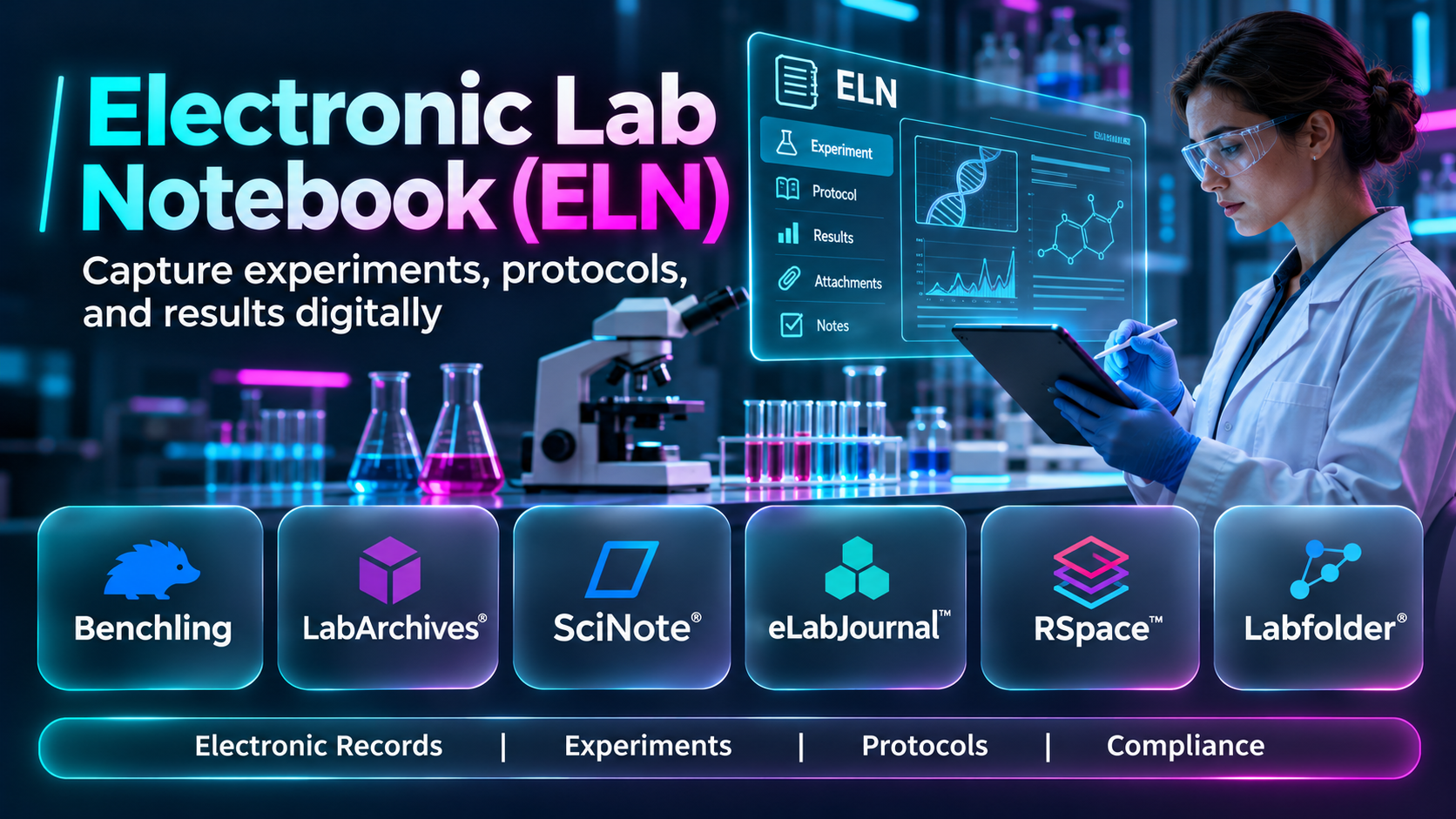
Electronic Lab Notebook (ELN) software helps researchers document experiments, observations, procedures, and results in digital records. It replaces or supplements traditional paper laboratory notebooks.
Research teams often need to connect experimental notes with datasets, images, instruments, and analytical results. Disconnected records can make scientific work difficult to reproduce or review.
Modern ELN platforms support structured templates, collaboration, search, and record histories. Some also provide inventory management, workflow automation, or connections with laboratory information systems.
Different laboratories have different requirements. An academic chemistry group may prioritize flexible documentation, while a regulated pharmaceutical laboratory may need controlled signatures and audit trails.
Choosing an ELN requires evaluating scientific workflows, data integrity, security, integrations, and export capabilities. Laboratories should also consider training, cost, and long-term access to research records.
This guide compares ten ELN tools and their practical strengths and limitations. It includes detailed profiles, comparison tables, selection guidance, an implementation workflow, sixteen FAQs, and SEO metadata.
2. What Is Electronic Lab Notebook Software?
An Electronic Lab Notebook is a digital system used to record scientific experiments and related research activities. It helps researchers maintain organized, searchable, and shareable laboratory records.
ELNs can contain experimental methods, observations, calculations, attachments, and results. Some systems also track versions, signatures, and review activities.
ELNs differ from Laboratory Information Management Systems, or LIMS, which generally emphasize samples, testing workflows, and laboratory operations. Some products combine elements of both categories.
A reliable ELN should support scientific traceability without making routine documentation unnecessarily difficult. The best configuration depends on the laboratory’s research and regulatory requirements.
Common Applications
- Academic research: Document experiments and scientific observations.
- Pharmaceutical research: Maintain controlled experimental records.
- Biotechnology: Track protocols, samples, and results.
- Chemistry laboratories: Record reactions, materials, and analytical data.
- Collaborative science: Share procedures and findings.
- Research reproducibility: Preserve experimental context.
- Laboratory audits: Review changes and approvals.
- Knowledge transfer: Maintain records when researchers change roles.
3. Top 10 Electronic Lab Notebook Tools in 2026
1. Benchling
Short Description
Benchling provides research and development software for life sciences organizations. Its platform includes electronic lab notebook capabilities and connected scientific data workflows.
The system is particularly relevant to biotechnology and pharmaceutical research. It can connect experimental documentation with structured scientific information.
Benchling may require substantial configuration for enterprise use. Laboratories should evaluate licensing, integration, and governance requirements.
Key Features
- Experiment records: Document scientific procedures. Maintain associated observations.
- Structured data: Organize research information. Support consistent scientific records.
- Biological entities: Connect experiments with relevant scientific materials. Improve traceability.
- Collaboration: Share authorized research information. Support team workflows.
- Templates: Standardize recurring experiments. Reduce inconsistent documentation.
- Search: Retrieve scientific records. Improve research efficiency.
- Data relationships: Connect related experiments and entities. Preserve context.
- Access controls: Manage permissions. Protect confidential research.
- Integrations: Connect compatible scientific systems. Reduce fragmented workflows.
Benefits
- Centralizes life sciences research records.
- Improves experiment traceability.
- Supports structured scientific data.
- Connects research teams.
- Reduces disconnected documentation.
- Supports standardized procedures.
- Improves scientific information retrieval.
Pros
- Life sciences specialization.
- Connected scientific workflows.
- Structured data capabilities.
- Collaboration features.
- Enterprise applicability.
- Integration potential.
Cons
- Enterprise pricing may be substantial.
- Configuration requires planning.
- Training is necessary.
- Specialized workflows may need customization.
- Data migration can be complex.
Use Cases
- Biotechnology: Document experiments.
- Pharmaceutical research: Manage scientific records.
- Molecular biology: Connect research entities.
- Research teams: Collaborate.
- Laboratory operations: Standardize templates.
- R&D management: Improve visibility.
Best For
- Biotechnology companies.
- Pharmaceutical research teams.
- Life sciences organizations.
- Molecular biology laboratories.
- Enterprise R&D departments.
- Structured research environments.
2. LabArchives
Short Description
LabArchives provides electronic laboratory notebooks for academic and research environments. It supports experiment documentation, file attachments, and collaboration.
The platform is relevant to universities and scientific research groups. Its capabilities can support both individual researchers and institutional programs.
LabArchives emphasizes organized digital records and accessible workflows. Institutions should evaluate export, security, and integration requirements.
Key Features
- Digital notebooks: Record experiments. Organize research activities.
- Templates: Standardize documentation. Improve consistency.
- File attachments: Connect data and notes. Preserve context.
- Collaboration: Share authorized records. Support teams.
- Search: Retrieve notebook content. Reduce manual searching.
- Record histories: Track applicable changes. Support accountability.
- Permissions: Manage access. Protect research information.
- Organization: Group notebooks and entries. Improve navigation.
- Export: Retrieve supported records. Support continuity planning.
Benefits
- Improves research organization.
- Reduces paper notebook dependence.
- Supports collaboration.
- Connects files with experiments.
- Improves record retrieval.
- Encourages consistent documentation.
- Supports institutional research programs.
Pros
- Academic research focus.
- Accessible notebook workflows.
- Collaboration support.
- Templates.
- Searchable records.
- Institutional offerings.
Cons
- Subscription costs apply.
- Specialized scientific integrations vary.
- Advanced enterprise workflows need evaluation.
- Large file handling requires review.
- Migration planning is necessary.
Use Cases
- University laboratories: Maintain experiments.
- Graduate research: Organize notes.
- Biomedical teams: Share procedures.
- Collaborative projects: Coordinate records.
- Research administration: Standardize notebooks.
- Teaching laboratories: Document practical work.
Best For
- Universities.
- Academic researchers.
- Graduate students.
- Biomedical laboratories.
- Research groups.
- Institutional ELN programs.
3. RSpace
Short Description
RSpace is an electronic lab notebook platform designed for research institutions. It supports experimental documentation and connections with research data infrastructure.
The platform is relevant to academic teams managing complex research records. It can support collaboration and research data organization.
RSpace may connect with compatible repositories and storage services. Institutions should test integrations and export workflows.
Key Features
- Experiment documentation: Record research work. Preserve scientific context.
- Collaboration: Coordinate research teams. Support shared projects.
- Project organization: Group records. Improve navigation.
- Data linking: Associate files with experiments. Reduce fragmentation.
- Repository connections: Support compatible deposit workflows. Improve lifecycle continuity.
- Search: Retrieve records. Improve productivity.
- Permissions: Control access. Protect confidential information.
- Record histories: Document applicable changes. Improve traceability.
- Export: Retrieve supported content. Support portability.
Benefits
- Improves experimental documentation.
- Supports connected research systems.
- Facilitates collaboration.
- Organizes project information.
- Improves data traceability.
- Supports repository preparation.
- Reduces fragmented records.
Pros
- Academic research relevance.
- Integration orientation.
- Collaboration tools.
- Organized notebooks.
- Data linking.
- Export capabilities.
Cons
- Licensing requires evaluation.
- Integrations need configuration.
- Training is necessary.
- Specialized workflows may need customization.
- Not a complete LIMS.
Use Cases
- University research: Manage experiments.
- Research institutes: Connect systems.
- Scientific teams: Collaborate.
- Data stewardship: Organize records.
- Laboratory projects: Maintain documentation.
- Repository workflows: Prepare outputs.
Best For
- Research universities.
- Academic laboratories.
- Research institutes.
- Data stewardship teams.
- Collaborative science.
- Integrated research environments.
4. eLabNext
Short Description
eLabNext provides laboratory software for electronic notebooks and related research management. Its products support experiment documentation and laboratory organization.
The platform is relevant to life sciences and academic laboratories. Available capabilities may include sample and inventory connections.
Organizations should evaluate product editions and configuration options. Integration and data export requirements should be confirmed.
Key Features
- Electronic notebooks: Document experiments. Maintain digital records.
- Sample management: Connect relevant samples with research work. Improve traceability.
- Inventory functions: Organize applicable laboratory materials. Support operations.
- Templates: Standardize experiments. Reduce variation.
- Collaboration: Share authorized records. Support research teams.
- Search: Retrieve experiments. Improve access.
- Permissions: Control user access. Protect data.
- Data attachments: Connect files with notebook entries. Preserve context.
- Integrations: Connect supported laboratory services. Improve workflows.
Benefits
- Connects experiments with laboratory resources.
- Improves research documentation.
- Supports sample traceability.
- Organizes materials.
- Reduces manual recordkeeping.
- Supports collaboration.
- Improves information retrieval.
Pros
- Laboratory-specific functionality.
- Notebook and sample connections.
- Inventory-related capabilities.
- Research team support.
- Templates.
- Integration options.
Cons
- Product modules require comparison.
- Subscription costs apply.
- Setup may require configuration.
- Training is important.
- Integration capabilities vary.
Use Cases
- Life sciences: Document experiments.
- Academic laboratories: Organize records.
- Sample-intensive research: Connect materials.
- Research teams: Share notebooks.
- Inventory workflows: Track supplies.
- Laboratory administration: Standardize processes.
Best For
- Life sciences laboratories.
- Academic research groups.
- Sample-intensive teams.
- Laboratory managers.
- Research institutions.
- Integrated notebook users.
5. SciNote
Short Description
SciNote is an electronic lab notebook and research management platform. It helps laboratories organize experiments, protocols, and research tasks.
The platform is relevant to academic and commercial research teams. It emphasizes structured workflows and scientific documentation.
SciNote can help connect experimental activities with project organization. Laboratories should evaluate integration, security, and plan limitations.
Key Features
- Experiment records: Document procedures and results. Maintain research context.
- Project organization: Group experiments. Improve oversight.
- Protocol management: Maintain reusable methods. Support consistency.
- Task tracking: Coordinate laboratory work. Improve accountability.
- Inventory connections: Associate applicable materials. Support traceability.
- Collaboration: Share research information. Support teams.
- Search: Retrieve records. Reduce manual effort.
- Audit information: Track applicable changes. Support review.
- Reporting: Produce selected research documentation. Support administration.
Benefits
- Organizes research projects.
- Improves protocol consistency.
- Supports laboratory collaboration.
- Connects tasks and experiments.
- Improves record traceability.
- Reduces fragmented documentation.
- Supports research oversight.
Pros
- Structured research workflows.
- Protocol management.
- Task organization.
- Collaboration.
- Scientific documentation.
- Laboratory focus.
Cons
- Advanced features may require paid plans.
- Configuration requires planning.
- Integration support varies.
- Training is necessary.
- Complex enterprise needs require validation.
Use Cases
- Research teams: Organize experiments.
- Biotechnology: Document protocols.
- Academic labs: Manage projects.
- Laboratory managers: Track tasks.
- Scientific collaboration: Share work.
- Research reporting: Maintain records.
Best For
- Small and medium research teams.
- Academic laboratories.
- Biotechnology groups.
- Project-oriented laboratories.
- Research managers.
- Protocol-intensive workflows.
6. Labguru
Short Description
Labguru provides laboratory management software with electronic notebook and research operations capabilities. It supports scientific documentation, samples, inventory, and related workflows.
The platform is relevant to biotechnology and pharmaceutical research. It can connect laboratory records with operational information.
Labguru may be suitable for organizations seeking broader laboratory management functionality. Buyers should evaluate available modules and configuration requirements.
Key Features
- Electronic notebooks: Record experiments. Maintain scientific documentation.
- Sample tracking: Organize research materials. Improve traceability.
- Inventory: Maintain laboratory supplies. Support operational planning.
- Project management: Organize research activities. Improve oversight.
- Protocols: Standardize recurring procedures. Reduce variation.
- Collaboration: Share authorized information. Support teams.
- Search: Retrieve laboratory records. Improve efficiency.
- Reporting: Produce selected research information. Support review.
- Integrations: Connect compatible applications. Reduce disconnected workflows.
Benefits
- Combines research and operational records.
- Improves sample traceability.
- Organizes laboratory inventory.
- Supports project coordination.
- Standardizes protocols.
- Improves collaboration.
- Reduces administrative fragmentation.
Pros
- Broad laboratory functionality.
- Electronic notebooks.
- Inventory support.
- Sample tracking.
- Research project management.
- Life sciences relevance.
Cons
- Configuration can be complex.
- Licensing requires evaluation.
- Training is necessary.
- Integrations need testing.
- Smaller laboratories may not need every module.
Use Cases
- Biotechnology labs: Manage experiments.
- Pharmaceutical R&D: Coordinate records.
- Sample management: Track materials.
- Laboratory inventory: Organize supplies.
- Research projects: Coordinate teams.
- Scientific documentation: Maintain protocols.
Best For
- Biotechnology companies.
- Pharmaceutical laboratories.
- Research organizations.
- Sample-intensive laboratories.
- Laboratory managers.
- Integrated research operations.
7. Dotmatics ELN
Short Description
Dotmatics provides scientific research software, including electronic lab notebook capabilities. Its products are relevant to chemistry, biology, and pharmaceutical research environments.
The platform supports scientific data documentation and connected research workflows. Product configurations can vary across disciplines and organizational requirements.
Dotmatics is particularly relevant to enterprises managing complex scientific information. Institutions should evaluate the current product portfolio and licensing structure.
Key Features
- Experiment documentation: Record scientific work. Preserve methods and results.
- Chemistry workflows: Support applicable chemical research records. Improve scientific context.
- Biology workflows: Organize relevant experimental information. Support life sciences research.
- Structured data: Maintain scientific information. Improve consistency.
- Collaboration: Share authorized research records. Support teams.
- Search: Retrieve experimental information. Improve productivity.
- Workflow connections: Link supported scientific applications. Reduce fragmentation.
- Access controls: Manage permissions. Protect confidential research.
- Reporting: Produce applicable scientific outputs. Support review.
Benefits
- Supports complex scientific research.
- Improves experiment traceability.
- Connects scientific applications.
- Organizes structured information.
- Supports enterprise collaboration.
- Reduces disconnected records.
- Improves research visibility.
Pros
- Scientific software specialization.
- Chemistry and biology relevance.
- Enterprise workflows.
- Structured records.
- Integration possibilities.
- Research collaboration.
Cons
- Enterprise costs may be substantial.
- Product selection requires care.
- Implementation can be complex.
- Training is necessary.
- Custom workflows need evaluation.
Use Cases
- Medicinal chemistry: Document research.
- Pharmaceutical discovery: Organize experiments.
- Biotechnology: Maintain scientific records.
- Enterprise R&D: Connect teams.
- Scientific informatics: Manage structured data.
- Research programs: Improve traceability.
Best For
- Pharmaceutical companies.
- Chemistry laboratories.
- Biotechnology organizations.
- Enterprise R&D teams.
- Scientific informatics departments.
- Complex research environments.
8. Signals Notebook
Short Description
Signals Notebook is an electronic lab notebook associated with Revvity Signals. It supports scientific documentation and collaboration across research workflows.
The platform is relevant to chemistry and life sciences organizations. It can connect experimental records with scientific information.
Signals Notebook may be used within broader research informatics environments. Buyers should evaluate integration, governance, and licensing requirements.
Key Features
- Digital experiments: Document scientific procedures. Maintain research context.
- Chemistry documentation: Support applicable chemical records. Improve organization.
- Scientific data: Associate results with experiments. Preserve traceability.
- Collaboration: Share authorized records. Support teams.
- Templates: Standardize documentation. Improve consistency.
- Search: Retrieve scientific information. Reduce manual effort.
- Access controls: Manage permissions. Protect research data.
- Record histories: Track applicable changes. Support accountability.
- Integration options: Connect compatible research applications. Improve workflows.
Benefits
- Improves scientific documentation.
- Supports collaborative research.
- Connects results with experiments.
- Standardizes notebook entries.
- Improves record retrieval.
- Supports research governance.
- Reduces disconnected files.
Pros
- Scientific research focus.
- Chemistry relevance.
- Collaboration.
- Structured experiment records.
- Enterprise applicability.
- Integration potential.
Cons
- Licensing requires evaluation.
- Configuration may be complex.
- Training is necessary.
- Integration needs testing.
- Data migration requires planning.
Use Cases
- Chemistry labs: Document reactions.
- Pharmaceutical research: Manage experiments.
- Life sciences: Organize records.
- Research teams: Collaborate.
- Scientific informatics: Connect data.
- R&D management: Review documentation.
Best For
- Chemistry researchers.
- Pharmaceutical R&D.
- Life sciences organizations.
- Enterprise laboratories.
- Scientific informatics teams.
- Collaborative research groups.
9. eLabFTW
Short Description
eLabFTW is an open-source electronic lab notebook and laboratory database application. It supports experimental documentation and structured organization of research information.
The platform is relevant to academic laboratories and institutions seeking self-managed software. It can support research groups with appropriate technical resources.
eLabFTW provides flexibility through open-source deployment. Laboratories should evaluate hosting, security, backups, and administrative responsibilities.
Key Features
- Electronic experiments: Record procedures and results. Maintain digital notebooks.
- Templates: Standardize recurring entries. Improve consistency.
- Database items: Organize laboratory entities. Connect records with experiments.
- Search: Retrieve information. Support research productivity.
- Permissions: Manage authorized access. Protect research records.
- Attachments: Associate files with entries. Preserve experimental context.
- Timestamps and histories: Record applicable changes. Support traceability.
- Export: Retrieve supported information. Support portability.
- Open-source deployment: Provide hosting flexibility. Enable institutional control.
Benefits
- Reduces proprietary licensing dependence.
- Improves experimental documentation.
- Supports searchable records.
- Organizes laboratory entities.
- Enables technical control.
- Supports research collaboration.
- Improves documentation consistency.
Pros
- Open-source software.
- Self-hosting flexibility.
- Notebook functionality.
- Templates.
- Searchable records.
- Academic relevance.
Cons
- Hosting requires administration.
- Security depends on configuration.
- Enterprise integrations may be limited.
- Technical support must be planned.
- Regulatory suitability requires validation.
Use Cases
- University laboratories: Maintain notebooks.
- Small research groups: Organize experiments.
- Open-source programs: Deploy ELNs.
- Teaching labs: Record work.
- Research institutions: Control hosting.
- Laboratory teams: Share records.
Best For
- Academic researchers.
- Small laboratories.
- Open-source adopters.
- Research institutions.
- Technical laboratory teams.
- Budget-conscious organizations.
10. Sapio ELN
Short Description
Sapio ELN is part of the Sapio Sciences laboratory informatics environment. It supports electronic experiment documentation and connected laboratory workflows.
The platform is relevant to organizations seeking ELN capabilities alongside broader laboratory information management. It can support configurable scientific processes.
Sapio ELN is particularly relevant to complex research and development environments. Buyers should assess implementation, validation, and integration requirements.
Key Features
- Experiment documentation: Maintain scientific records. Preserve research context.
- Configurable workflows: Adapt selected processes. Support laboratory requirements.
- Sample relationships: Connect experiments with relevant materials. Improve traceability.
- Data management: Organize scientific information. Reduce fragmentation.
- Collaboration: Support authorized teams. Improve coordination.
- Automation: Streamline applicable workflows. Reduce manual administration.
- Integration: Connect supported laboratory systems. Improve data continuity.
- Access controls: Manage permissions. Protect sensitive information.
- Audit information: Document applicable changes. Support review.
Benefits
- Connects notebooks with laboratory workflows.
- Improves sample traceability.
- Supports configurable processes.
- Reduces disconnected data.
- Improves collaboration.
- Supports laboratory automation.
- Strengthens documentation consistency.
Pros
- Integrated laboratory informatics.
- Configurable workflows.
- Sample connections.
- Automation potential.
- Enterprise relevance.
- Structured records.
Cons
- Implementation may be substantial.
- Enterprise licensing costs.
- Configuration requires expertise.
- Training is necessary.
- Validation responsibilities remain with users.
Use Cases
- Pharmaceutical R&D: Document experiments.
- Biotechnology: Connect samples.
- Enterprise laboratories: Standardize workflows.
- Scientific informatics: Integrate systems.
- Research teams: Maintain records.
- Laboratory automation: Coordinate processes.
Best For
- Pharmaceutical organizations.
- Biotechnology companies.
- Enterprise R&D teams.
- Integrated laboratory environments.
- Scientific informatics departments.
- Complex experimental workflows.
4. Comparison Table: Top 10 Electronic Lab Notebook Tools
| Tool | Best For | Main Focus | Standout Capability | Pricing |
|---|---|---|---|---|
| Benchling | Life sciences R&D | Connected scientific records | Structured biology workflows | Enterprise quote |
| LabArchives | Academic laboratories | Experiment documentation | Institutional notebooks | Subscription |
| RSpace | Research institutions | ELN and data connections | Repository integration | Commercial |
| eLabNext | Research laboratories | Notebook and sample workflows | Connected lab resources | Subscription |
| SciNote | Project-oriented research | ELN and project management | Protocol and task organization | Tiered or custom |
| Labguru | Biotechnology labs | Research operations | Inventory and experiment connections | Commercial |
| Dotmatics ELN | Enterprise scientific R&D | Scientific informatics | Chemistry and biology workflows | Enterprise quote |
| Signals Notebook | Chemistry and life sciences | Scientific documentation | Connected research records | Commercial |
| eLabFTW | Open-source laboratories | Electronic notebooks | Self-managed deployment | Open source; hosting costs |
| Sapio ELN | Integrated enterprise labs | ELN and laboratory workflows | Configurable scientific processes | Enterprise quote |
Pricing, modules, and deployment arrangements can change. Laboratories should verify current vendor offerings and contractual requirements.
5. Which Electronic Lab Notebook Is Right for You?
ELN selection should reflect scientific workflows, team size, and documentation obligations. Laboratories should test realistic experiments rather than relying only on feature descriptions.
1. Biotechnology Companies
Benchling is relevant to structured life sciences research. Teams should evaluate scientific entity management and integrations.
2. University Laboratories
LabArchives and RSpace support academic research documentation. Institutions should prioritize usability and data portability.
3. Open-Source Research Teams
eLabFTW provides a self-managed option. Organizations must plan for hosting and security.
4. Chemistry Laboratories
Signals Notebook and Dotmatics ELN are relevant to chemical research. Laboratories should test scientific notation and data workflows.
5. Project-Oriented Research Groups
SciNote combines experiment documentation with task organization. It may suit teams coordinating multiple studies.
6. Laboratories Managing Samples and Inventory
eLabNext and Labguru offer connected laboratory workflows. Buyers should verify sample and inventory capabilities.
7. Enterprise Research Organizations
Sapio ELN supports configurable research environments. Implementation planning is particularly important.
8. Research Institutions With Connected Infrastructure
RSpace can support integration-oriented workflows. Institutions should evaluate repository and storage connections.
Best ELNs by User Type
| User Type | Recommended Tool | Main Reason |
|---|---|---|
| Life sciences companies | Benchling | Structured research data |
| Academic laboratories | LabArchives | Research documentation |
| Research institutions | RSpace | Connected research workflows |
| Sample-intensive labs | eLabNext | Laboratory resource integration |
| Project-oriented teams | SciNote | Protocol and task organization |
| Biotechnology labs | Labguru | Research operations |
| Enterprise chemistry teams | Dotmatics ELN | Scientific informatics |
| Chemistry researchers | Signals Notebook | Experiment documentation |
| Open-source labs | eLabFTW | Self-managed notebooks |
| Integrated enterprise labs | Sapio ELN | Configurable workflows |
6. Practical Example: Implementing an ELN in a Biotechnology Laboratory
A biotechnology laboratory uses paper notebooks and shared folders to record experiments. Researchers often struggle to locate procedures and supporting datasets.
The organization decides to introduce an ELN. Its objectives include better traceability, collaboration, and reproducibility.
Step 1: Document Laboratory Workflows
The project team reviews existing experiment documentation. Researchers identify recurring procedures and recordkeeping problems.
The laboratory defines minimum documentation requirements. These include methods, observations, materials, and results.
Action checklist: Experiment types, required fields, workflow mapping, researcher needs, project ownership.
Step 2: Evaluate Data Integrity Requirements
The organization reviews security and record history needs. It also considers applicable regulatory expectations.
Administrators define review and approval responsibilities. Electronic signatures are evaluated where required.
Action checklist: Data integrity, access controls, audit histories, approvals, regulatory review.
Step 3: Configure Notebook Templates
Scientists create templates for common experiments. Each template includes required observations and supporting information.
The laboratory tests templates with actual research tasks. Unnecessary fields are removed.
Action checklist: Experiment templates, required metadata, sample references, file attachments, usability tests.
Step 4: Connect Laboratory Systems
Technical staff identify relevant instruments and storage services. They test supported integrations.
The laboratory establishes procedures for importing results. Manual entry remains controlled where automation is unavailable.
Action checklist: Instruments, data storage, integration testing, file formats, error handling.
Step 5: Train Researchers
Researchers practice creating and reviewing notebook entries. Training covers documentation consistency and data access.
Laboratory managers explain record ownership and retention policies. Staff receive support materials.
Action checklist: Researcher training, review procedures, retention rules, support contacts, practice exercises.
Step 6: Run a Pilot
One research group begins using the ELN. Managers evaluate record completeness and researcher feedback.
The team corrects workflow problems before expansion. Data export is tested during the pilot.
Action checklist: Pilot group, record quality, user feedback, export tests, issue resolution.
Step 7: Expand and Maintain
The organization introduces the system across additional teams. It monitors adoption and documentation quality.
Periodic reviews help improve templates and permissions. Continued governance supports reliable research records.
Action checklist: Rollout plan, usage monitoring, record audits, permissions review, continuous improvement.
7. Frequently Asked Questions (FAQs)
1. What is an Electronic Lab Notebook?
An ELN is software for documenting scientific experiments. It stores procedures, observations, and related records digitally.
2. Can beginners use ELN software?
Many ELNs offer accessible interfaces. Training helps users maintain consistent scientific documentation.
3. Are free ELN tools available?
Yes, eLabFTW is an open-source option. Hosting and support can still create expenses.
4. Can laboratories continue using paper notebooks?
Yes, some laboratories use paper or hybrid workflows. Digital systems may improve search and collaboration.
5. Are ELNs suitable for universities?
Yes, academic laboratories commonly use ELNs. Institutions should evaluate licensing and export.
6. Can pharmaceutical companies use ELNs?
Yes, several platforms support pharmaceutical research. Regulated use requires appropriate validation and procedures.
7. Do ELNs integrate with laboratory instruments?
Some provide integrations or import workflows. Compatibility varies by product and instrument.
8. What do ELN and LIMS mean?
ELN means Electronic Lab Notebook. LIMS means Laboratory Information Management System.
9. How does ELN version tracking work?
Systems may record changes to notebook entries. Available histories and controls vary.
10. Is an ELN the same as a LIMS?
No, an ELN emphasizes experiments and scientific notes. A LIMS generally emphasizes samples and laboratory operations.
11. Which ELNs support collaboration?
Benchling, LabArchives, RSpace, and others provide collaborative workflows. Permissions should be tested.
12. Can ELNs support research reproducibility?
They can preserve procedures and observations. Reproducibility also depends on accurate scientific practices.
13. What technical requirements matter most?
Security, data export, integrations, and record histories are important. Laboratories should also evaluate backups.
14. How should a laboratory choose an ELN?
Test representative experiments and team workflows. Compare usability with governance requirements.
15. Can ELNs replace all laboratory software?
Usually not, because specialized systems manage other activities. Inventory, instruments, and testing may require additional tools.
16. Can ELNs support large organizations?
Many enterprise platforms support multiple teams. Implementation depends on configuration and governance.
8. Final Thoughts
Electronic Lab Notebooks help laboratories document research in searchable, organized records. They support scientific collaboration and improve access to experimental information.
Benchling, Dotmatics ELN, Signals Notebook, and Sapio ELN are relevant to complex research environments. Their capabilities should be evaluated against specific scientific workflows.
LabArchives and RSpace provide options for academic and institutional research. SciNote emphasizes structured project documentation.
eLabNext and Labguru connect notebook functions with broader laboratory resources. eLabFTW offers an open-source alternative for organizations with technical support.
The best ELN should balance usability, scientific traceability, security, and data portability. Careful implementation and researcher training are essential.
