Introduction
Customers interact with businesses through websites, mobile applications, email, SMS, customer portals, and other digital channels. During these interactions, organizations may request permission to collect information, use tracking technologies, or communicate with customers.
Managing these permissions becomes complicated when customers interact through multiple systems. A person may accept optional website cookies, unsubscribe from promotional emails, and continue receiving essential account notifications.
These choices have different meanings and should not be combined into a single permission.
Customer consent and preferences centers help organizations provide interfaces where individuals can review and manage relevant choices about data processing and communications.
A well-designed center explains the available options in understandable language. It also helps organizations maintain accurate records and apply customer choices across supported systems.
For example, an online retailer may allow customers to choose whether they receive promotional emails, SMS offers, product recommendations, or personalized advertising.
The retailer must distinguish between preferences that describe what customers want and consent decisions that establish permission for particular processing activities.
Privacy regulations and customer expectations have made these distinctions increasingly important.
Organizations also need to consider how consent is collected, whether it can be withdrawn, how records are maintained, and how changes are communicated to downstream systems.
Customer consent and preferences centers can improve transparency and operational consistency, but implementing one does not automatically establish legal compliance.
The appropriate solution depends on the organization’s regulatory obligations, communication channels, customer data architecture, and required integrations.
This guide compares ten customer consent and preference management solutions, explains their capabilities, and provides a practical framework for selecting the right platform.
What Are Customer Consent & Preferences Centers?
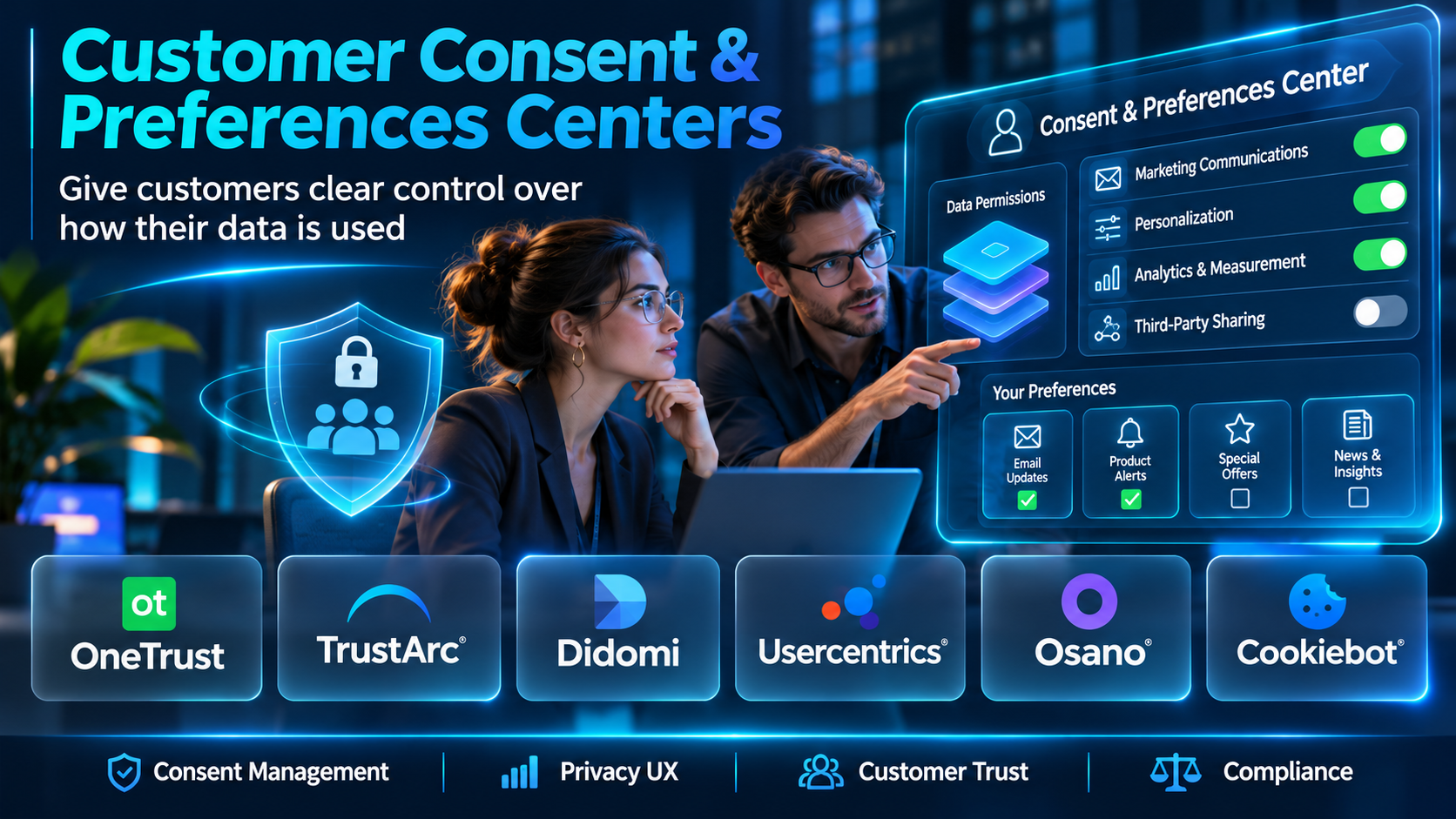
Customer consent and preferences centers are interfaces and supporting systems that allow individuals to manage selected permissions, communication choices, and data-related preferences.
They may operate as standalone customer-facing portals or as components of larger consent management, privacy management, marketing automation, or customer data platforms.
Their purpose is to make customer choices understandable, accessible, and operationally enforceable.
For example, a customer might use a preferences center to:
- Subscribe to a monthly newsletter.
- Unsubscribe from promotional emails.
- Choose preferred product categories.
- Select SMS communication preferences.
- Manage optional website tracking choices.
- Update personalization preferences.
- Review relevant marketing permissions.
- Change communication frequency.
- Withdraw previously provided consent.
- Access applicable privacy-related controls.
Not every platform supports every function.
Consent Management vs. Preference Management
Although these concepts are related, they serve different purposes.
Consent management focuses on recording, maintaining, and applying permission decisions for activities that rely on consent.
For example, an organization may need to record whether an individual agreed to receive promotional email messages.
Preference management focuses on customer choices that influence communication and experiences.
For example, a customer may prefer weekly product updates rather than daily messages.
Some preferences are independent of legal consent. Others operate within the boundaries established by consent and applicable law.
A customer who has withdrawn marketing consent should not receive promotional messages merely because an older preference record indicates interest in a product category.
How Customer Consent & Preferences Centers Work
A typical implementation includes several stages.
1. Preference and consent definition: The organization identifies the choices customers should be able to manage.
2. Interface design: Customers receive a clear interface explaining available options.
3. Identity association: Choices are associated with an appropriate customer, account, or browser context.
4. Choice collection: The system records relevant decisions and updates.
5. Record management: The organization maintains appropriate evidence, timestamps, versions, and related metadata where required.
6. Integration: Changes are communicated to authorized systems.
7. Enforcement: Downstream applications apply the choices according to their purpose and applicable requirements.
8. Ongoing monitoring: Teams validate synchronization, withdrawal handling, and data quality.
Common Applications
Customer consent and preferences centers are used for:
- Marketing email subscriptions.
- SMS communication choices.
- Website and application tracking permissions.
- Personalization preferences.
- Newsletter topic selection.
- Customer communication frequency.
- Privacy preference management.
- Cross-channel marketing permissions.
- Customer account settings.
- Consent withdrawal workflows.
Key Benefits
A properly implemented center can improve customer transparency, reduce unwanted communications, strengthen consent records, support more consistent preference enforcement, and simplify customer self-service.
It can also help organizations reduce manual preference updates across disconnected systems.
However, effectiveness depends on accurate integration, understandable interfaces, appropriate identity management, and consistent downstream enforcement.
Top 10 Customer Consent & Preferences Centers
1. OneTrust
Short Description
OneTrust provides privacy, consent, and preference management capabilities used by organizations operating complex digital environments.
Its offerings support relevant consent collection, preference management, and privacy governance workflows.
OneTrust is particularly relevant to enterprises that need to coordinate choices across websites, applications, customer systems, and marketing technologies.
For example, a multinational retailer may operate regional websites and several marketing platforms.
The organization may need to present appropriate consent choices, maintain relevant records, and coordinate updates across supported systems.
OneTrust’s broader privacy management ecosystem can help organizations connect these activities with governance processes.
Its capabilities are especially relevant when consent and preferences must be managed alongside other privacy obligations.
However, implementation requires careful configuration of legal purposes, interface language, integrations, and enforcement rules.
Organizations should verify which capabilities are included in the selected OneTrust products and commercial arrangements.
Key Features
- Consent Management: Supports relevant collection and management of customer consent decisions.
- Preference Management: Enables applicable customer communication and data-use choices.
- Customer-Facing Interfaces: Supports configurable consent and preference experiences.
- Consent Records: Maintains relevant information about collected decisions.
- Integration Capabilities: Connects with supported websites and business systems.
- Privacy Governance: Fits broader enterprise privacy management workflows.
- Consent Updates: Supports relevant changes and withdrawal processes.
- Multi-Channel Applications: Addresses selected web, application, and customer communication scenarios.
- Administrative Controls: Helps teams configure and manage consent-related operations.
Benefits
- Centralizes relevant consent operations.
- Supports customer self-service.
- Helps maintain consent records.
- Improves preference consistency.
- Connects privacy and marketing workflows.
- Supports complex enterprise environments.
- Reduces manual consent administration.
Pros
- Broad privacy management ecosystem.
- Consent and preference capabilities.
- Enterprise integration relevance.
- Configurable customer experiences.
- Governance-oriented workflows.
- Suitable for multinational organizations.
Cons
- Implementation can be complex.
- Commercial pricing requires consultation.
- Configuration requires privacy expertise.
- Integration effort varies.
- Incorrect settings can undermine intended protections.
Use Cases
Enterprise Consent Management: A multinational company coordinates customer choices across regional websites.
Marketing Preferences: A retailer provides subscription and communication options.
Privacy Governance: An enterprise connects consent operations with broader privacy processes.
Customer Self-Service: Individuals update relevant permissions through supported interfaces.
Best For
Large enterprises, multinational organizations, privacy teams, and businesses requiring comprehensive consent and preference management.
2. Didomi
Short Description
Didomi provides consent and preference management capabilities for organizations seeking to coordinate privacy choices across digital environments.
Its offerings are relevant to businesses that need configurable consent experiences and customer preference workflows.
Didomi is particularly associated with digital consent management and privacy-conscious customer engagement.
For example, a publisher may need to manage website consent choices while allowing subscribers to update marketing preferences.
The organization may also need to communicate relevant decisions to supported downstream systems.
Didomi can support these workflows through its consent and preference management capabilities.
Its suitability depends on the organization’s channels, technical architecture, and required integrations.
Businesses should evaluate the available consent models, preference interfaces, reporting, and implementation requirements.
Key Features
- Consent Management: Supports relevant digital consent collection.
- Preference Management: Enables selected customer communication and data-use choices.
- Configurable Interfaces: Supports customized consent experiences.
- Consent Records: Maintains relevant choice information.
- Cross-Channel Applications: Supports selected web, application, and customer workflows.
- Integration Capabilities: Connects with supported business systems.
- Consent Updates: Supports relevant changes to customer choices.
- Privacy Reporting: Provides applicable operational visibility.
- Centralized Configuration: Helps administrators manage consent-related settings.
Benefits
- Supports consistent consent experiences.
- Helps coordinate customer preferences.
- Reduces disconnected choice records.
- Supports privacy-conscious digital operations.
- Enables customer self-service.
- Improves consent administration.
- Connects relevant downstream systems.
Pros
- Consent management specialization.
- Preference management capabilities.
- Configurable interfaces.
- Cross-channel relevance.
- Integration options.
- Enterprise privacy applications.
Cons
- Advanced requirements may increase implementation effort.
- Commercial pricing requires evaluation.
- Integration coverage varies.
- Legal configuration remains the organization’s responsibility.
- Not every feature is available in every product package.
Use Cases
Publisher Consent Management: A media company manages relevant website choices.
Customer Preferences: A brand allows customers to update communication settings.
Digital Privacy Operations: An organization coordinates consent-related workflows.
Multi-Channel Consent: A business manages supported choices across digital touchpoints.
Best For
Publishers, digital brands, marketing teams, and organizations requiring consent and preference management across customer channels.
3. Usercentrics
Short Description
Usercentrics provides consent management solutions for websites, applications, and other digital environments.
Its capabilities are particularly relevant to organizations seeking to manage tracking permissions and related privacy choices.
Usercentrics is commonly considered by businesses implementing consent experiences for digital properties.
For example, an e-commerce company may need to explain optional analytics and advertising technologies to website visitors.
The company may also need to record relevant decisions and adjust tracking behavior accordingly.
Usercentrics can support consent-related workflows within its supported environments.
However, businesses should distinguish between a cookie consent interface and a broader authenticated customer preference center.
A solution that manages website tracking choices may not automatically provide comprehensive email, SMS, and account-level preference management.
Organizations should verify the capabilities required for their intended customer experience.
Key Features
- Website Consent Management: Supports relevant tracking consent workflows.
- Application Consent Support: Addresses selected mobile application scenarios.
- Consent Interfaces: Provides configurable customer-facing experiences.
- Consent Records: Maintains applicable choice information.
- Tracking Technology Management: Supports relevant consent-related configurations.
- Integration Options: Connects with supported website technologies.
- Consent Updates: Enables visitors to revise relevant decisions.
- Administrative Reporting: Supports applicable consent operations.
- Digital Privacy Configuration: Helps manage relevant website and application settings.
Benefits
- Supports digital consent collection.
- Helps communicate tracking choices.
- Provides configurable consent interfaces.
- Supports relevant consent records.
- Enables preference changes for supported purposes.
- Helps coordinate website tracking behavior.
- Simplifies selected privacy operations.
Pros
- Digital consent specialization.
- Website and app applications.
- Configurable interfaces.
- Relevant tracking integrations.
- Consent record capabilities.
- Suitable for online businesses.
Cons
- Broader customer preference needs may require additional systems.
- Implementation depends on website architecture.
- Consent design requires legal review.
- Integration capabilities vary.
- Advanced functionality may involve additional costs.
Use Cases
E-commerce Website Consent: A retailer manages optional tracking choices.
Publisher Privacy Controls: A publisher presents relevant consent options.
Mobile Application Consent: An application manages supported privacy decisions.
Digital Tracking Governance: A company coordinates consent-related technology settings.
Best For
Website owners, e-commerce companies, publishers, and digital businesses prioritizing web and application consent management.
4. TrustArc
Short Description
TrustArc provides privacy management technology, including capabilities associated with consent and preference management.
Its offerings are relevant to organizations seeking to coordinate privacy operations across business systems.
TrustArc is particularly suitable for enterprises that require structured privacy governance alongside customer-facing consent experiences.
For example, a financial services organization may need to manage relevant marketing permissions and website tracking choices.
The organization may also require documented privacy processes and internal oversight.
TrustArc can support selected consent and privacy management workflows.
Its broader platform may help connect operational privacy activities with organizational governance requirements.
However, organizations should evaluate the exact consent and preference functionality available in their selected products.
Implementation still requires appropriate legal definitions, technical integrations, and downstream enforcement.
Key Features
- Consent Management: Supports relevant consent collection and administration.
- Preference Management: Provides applicable customer choice capabilities.
- Privacy Governance: Connects consent-related operations with broader privacy processes.
- Consent Interfaces: Supports selected customer-facing experiences.
- Record Management: Maintains relevant consent information.
- Integration Capabilities: Connects with supported business systems.
- Administrative Workflows: Helps privacy teams manage operational processes.
- Reporting: Provides relevant privacy management visibility.
- Enterprise Configuration: Supports complex organizational requirements.
Benefits
- Supports structured privacy operations.
- Helps maintain relevant consent records.
- Connects customer choices with governance.
- Supports enterprise privacy programs.
- Improves operational consistency.
- Enables selected customer-facing controls.
- Reduces fragmented privacy administration.
Pros
- Enterprise privacy specialization.
- Consent-related capabilities.
- Governance integration.
- Administrative workflows.
- Reporting applications.
- Suitable for regulated organizations.
Cons
- Platform complexity may be significant.
- Commercial pricing requires consultation.
- Implementation requires privacy expertise.
- Integration effort varies.
- Product scope must be verified.
Use Cases
Enterprise Privacy Operations: A company coordinates consent and governance processes.
Customer Marketing Permissions: A business manages relevant communication choices.
Website Consent: An organization implements supported tracking controls.
Privacy Program Management: Teams maintain documented consent-related workflows.
Best For
Large enterprises, regulated organizations, privacy departments, and businesses requiring consent management within a broader governance platform.
5. Ketch
Short Description
Ketch provides privacy and data permission management capabilities designed to help organizations operationalize customer choices.
Its approach is relevant to businesses seeking to connect consent and preference decisions with downstream data systems.
A common challenge in consent management is that collecting a choice does not necessarily mean the organization consistently enforces it.
For example, a customer may withdraw permission for a particular marketing purpose, but disconnected systems may continue using older information.
Ketch focuses on privacy-related data control and permission workflows that can help address these operational challenges.
The platform is relevant to organizations managing complex data environments.
However, effective enforcement depends on supported integrations, correct data mapping, and appropriate system configuration.
Organizations should examine the current product capabilities and the extent of downstream enforcement available for their infrastructure.
Key Features
- Consent Management: Supports relevant customer permission decisions.
- Preference Management: Enables applicable customer choices.
- Privacy Data Controls: Supports selected data-use restrictions.
- Integration Capabilities: Connects with supported data systems.
- Permission Enforcement Workflows: Helps operationalize relevant choices.
- Customer-Facing Experiences: Supports configurable privacy interfaces.
- Consent Record Management: Maintains relevant decision information.
- Privacy Operations: Supports selected organizational workflows.
- Administrative Configuration: Helps manage permission rules.
Benefits
- Helps connect consent collection with enforcement.
- Supports customer preference management.
- Reduces disconnected privacy workflows.
- Improves operational consistency.
- Supports data-use governance.
- Enables relevant customer controls.
- Helps coordinate privacy decisions across systems.
Pros
- Privacy operations focus.
- Consent and preference capabilities.
- Data permission applications.
- Integration-oriented approach.
- Customer-facing controls.
- Enterprise relevance.
Cons
- Integration coverage requires evaluation.
- Implementation can be complex.
- Commercial pricing requires consultation.
- Enforcement depends on correct configuration.
- Legal obligations remain with the organization.
Use Cases
Permission Enforcement: A business applies customer choices across supported systems.
Customer Privacy Center: Individuals manage relevant data-use preferences.
Marketing Consent: A company coordinates communication permissions.
Enterprise Privacy Operations: Teams manage consent-related data workflows.
Best For
Data-driven enterprises, privacy engineering teams, and organizations prioritizing operational enforcement of customer choices.
6. Securiti
Short Description
Securiti provides data security, privacy, and governance capabilities, including relevant consent and preference management functions.
Its offerings are particularly relevant to enterprises that want to connect customer permissions with broader data governance activities.
Organizations often struggle to identify where customer information resides and how it is used.
Consent management becomes more difficult when information is distributed across cloud applications, databases, and marketing systems.
Securiti’s broader platform can help organizations coordinate selected privacy and data management processes.
For example, an enterprise may need to maintain customer choices while also understanding which systems process relevant personal information.
However, organizations should distinguish between consent management capabilities and the platform’s broader data security functions.
Buyers should confirm which products and integrations support the intended preference center.
Key Features
- Consent Management: Supports relevant customer permission workflows.
- Preference Management: Provides applicable customer choice capabilities.
- Privacy Operations: Supports selected organizational privacy processes.
- Data Governance Integration: Connects with broader data management functions.
- Customer-Facing Controls: Supports relevant consent experiences.
- Consent Records: Maintains applicable decision information.
- System Integration: Connects with supported enterprise environments.
- Administrative Reporting: Provides relevant operational visibility.
- Enterprise Data Management: Fits complex data governance programs.
Benefits
- Connects consent with broader governance.
- Supports customer permission management.
- Helps coordinate privacy operations.
- Improves organizational visibility.
- Supports enterprise data environments.
- Reduces fragmented workflows.
- Enables relevant customer controls.
Pros
- Broad data governance ecosystem.
- Privacy management applications.
- Consent-related capabilities.
- Enterprise integrations.
- Administrative workflows.
- Suitable for complex organizations.
Cons
- Broader platform may exceed smaller organizations’ needs.
- Commercial pricing requires evaluation.
- Implementation may be substantial.
- Specific preference center functionality must be verified.
- Governance remains an ongoing responsibility.
Use Cases
Enterprise Consent Management: A company coordinates customer permissions.
Data Governance: Teams connect privacy choices with relevant data processes.
Customer Preference Center: An organization provides supported self-service controls.
Privacy Operations: Administrators manage consent-related workflows.
Best For
Large enterprises, data governance teams, and organizations seeking consent capabilities within a broader privacy and security platform.
7. Osano
Short Description
Osano provides privacy management technology with capabilities associated with consent management and privacy operations.
It is relevant to organizations seeking to manage website consent and related privacy requirements.
Osano is particularly attractive to businesses that want a more accessible approach to implementing digital privacy controls.
For example, a growing software company may operate a marketing website with analytics and advertising technologies.
It may need to present appropriate choices and maintain relevant consent information.
Osano can support selected consent workflows and broader privacy management activities.
However, website cookie consent is only one component of customer preference management.
Organizations requiring authenticated email, SMS, and product preference centers should verify whether the available capabilities meet those needs or require additional systems.
Key Features
- Cookie Consent Management: Supports relevant website tracking choices.
- Consent Interfaces: Provides configurable visitor experiences.
- Consent Records: Maintains applicable consent information.
- Privacy Management: Supports selected organizational privacy workflows.
- Website Integration: Connects with relevant web technologies.
- Consent Updates: Allows visitors to revise supported decisions.
- Administrative Controls: Helps manage consent settings.
- Reporting: Provides relevant operational visibility.
- Privacy Operations Support: Addresses selected business privacy requirements.
Benefits
- Simplifies website consent management.
- Supports customer-facing tracking choices.
- Helps maintain consent records.
- Provides privacy operations capabilities.
- Reduces manual administration.
- Supports growing organizations.
- Improves visibility into consent workflows.
Pros
- Website consent specialization.
- Accessible privacy management approach.
- Configurable interfaces.
- Relevant reporting.
- Consent record capabilities.
- Suitable for growing businesses.
Cons
- Broader preference management may require additional systems.
- Advanced needs depend on product scope.
- Integration requirements vary.
- Legal configuration remains necessary.
- Commercial costs require evaluation.
Use Cases
SaaS Website Consent: A company manages optional tracking technologies.
Marketing Website Privacy: A business provides visitor choices.
Privacy Operations: A growing organization coordinates selected processes.
Consent Record Management: Teams maintain relevant decision information.
Best For
Small and medium-sized businesses, SaaS companies, and organizations prioritizing website consent and privacy management.
8. Sourcepoint
Short Description
Sourcepoint provides privacy and consent management technology with a strong focus on digital media and advertising environments.
Its offerings are particularly relevant to publishers, media companies, and organizations operating advertising-supported digital properties.
These businesses often manage complex combinations of advertising technologies and consent requirements.
For example, a publisher may need to present consent choices to website visitors and communicate relevant signals to participating advertising systems.
Sourcepoint can support selected consent management workflows in these environments.
Its capabilities may also be relevant to mobile applications and other supported digital channels.
However, organizations should distinguish advertising consent management from a broader authenticated customer preference center.
The platform’s suitability depends on the specific channels, consent frameworks, and integrations required.
Key Features
- Digital Consent Management: Supports relevant consent collection.
- Publisher Applications: Addresses advertising-supported digital properties.
- Consent Interfaces: Provides configurable visitor experiences.
- Advertising Technology Integration: Connects with supported advertising workflows.
- Consent Signal Management: Supports relevant permission communication.
- Cross-Platform Applications: Addresses selected website and application environments.
- Consent Records: Maintains applicable decision information.
- Administrative Configuration: Supports consent experience management.
- Privacy Reporting: Provides relevant operational insights.
Benefits
- Supports publisher consent operations.
- Helps coordinate advertising permissions.
- Provides configurable visitor experiences.
- Connects with relevant ad technology.
- Supports consent record management.
- Reduces fragmented consent workflows.
- Helps manage digital privacy choices.
Pros
- Publisher and media specialization.
- Advertising consent applications.
- Configurable interfaces.
- Relevant ad technology integrations.
- Cross-platform capabilities.
- Privacy operations focus.
Cons
- Less directly suited to general customer preference centers.
- Advertising integrations require maintenance.
- Implementation complexity varies.
- Commercial pricing requires consultation.
- Consent configuration requires legal review.
Use Cases
Publisher Consent: A news website manages relevant advertising choices.
Advertising Privacy: A media business communicates consent signals.
Mobile Application Consent: An app implements supported privacy interfaces.
Digital Media Operations: Teams coordinate consent-related workflows.
Best For
Publishers, media companies, advertising-supported websites, and organizations requiring specialized digital consent management.
9. SAP Customer Data Cloud
Short Description
SAP Customer Data Cloud provides customer identity and access management capabilities alongside consent and preference-related functions.
It is relevant to enterprises that want to associate customer choices with authenticated customer identities.
This distinction is important because many preference centers operate within customer accounts rather than anonymous website sessions.
For example, a consumer brand may allow registered customers to manage marketing permissions, communication preferences, and account information.
SAP Customer Data Cloud can support relevant customer identity and consent workflows.
Its capabilities are particularly useful to organizations operating complex customer account environments.
However, implementation requires careful coordination between identity management, consent records, customer interfaces, and downstream systems.
Organizations should verify the exact features available in the current SAP offering.
Key Features
- Customer Identity Management: Supports relevant customer account workflows.
- Consent Management: Maintains applicable customer permission information.
- Preference Management: Supports selected customer choices.
- Authenticated Customer Experiences: Associates preferences with relevant accounts.
- Customer Profile Management: Organizes applicable customer information.
- Integration Capabilities: Connects with supported enterprise systems.
- Consent Record Management: Maintains relevant decision information.
- Enterprise Identity Workflows: Supports complex customer environments.
- Customer Self-Service: Enables relevant account-based controls.
Benefits
- Connects consent with customer identities.
- Supports authenticated preference centers.
- Improves customer profile consistency.
- Helps coordinate enterprise systems.
- Enables customer self-service.
- Supports relevant consent records.
- Fits large customer account environments.
Pros
- Customer identity integration.
- Consent-related capabilities.
- Authenticated customer workflows.
- Enterprise applications.
- Customer profile management.
- SAP ecosystem relevance.
Cons
- Implementation may be complex.
- Commercial costs require evaluation.
- Integration effort can be substantial.
- Product capabilities vary by configuration.
- Privacy governance remains essential.
Use Cases
Customer Account Preferences: A brand lets registered customers update relevant choices.
Marketing Consent: A retailer manages permissions associated with customer accounts.
Enterprise Identity Integration: A company connects customer identity and consent systems.
Customer Self-Service: Users manage supported account and communication settings.
Best For
Large enterprises, SAP ecosystem organizations, consumer brands, and businesses requiring authenticated consent and preference management.
10. Salesforce Marketing Cloud
Short Description
Salesforce Marketing Cloud provides marketing engagement capabilities that can support customer subscription and communication preference management.
It is relevant to organizations already using Salesforce for customer engagement.
Unlike dedicated privacy management platforms, Salesforce Marketing Cloud primarily focuses on marketing operations.
Its preference management capabilities are therefore best understood within the context of subscriptions, communication choices, and supported marketing workflows.
For example, a business may allow email subscribers to choose which newsletters they receive.
Salesforce Marketing Cloud can support relevant subscription and preference center experiences.
However, these capabilities should not be confused with a comprehensive enterprise consent management platform.
Organizations requiring legal consent records, website tracking controls, or centralized privacy governance may need additional Salesforce products or specialized solutions.
Key Features
- Subscription Management: Supports relevant email subscription choices.
- Preference Center Workflows: Enables selected customer communication settings.
- Email Marketing Integration: Connects preferences with supported email operations.
- Subscriber Data Management: Maintains relevant customer communication information.
- Segmentation: Supports audience grouping.
- Customer Engagement Workflows: Coordinates supported marketing communications.
- Integration Capabilities: Connects with applicable Salesforce systems.
- Communication Personalization: Uses relevant customer preferences.
- Marketing Reporting: Provides selected engagement insights.
Benefits
- Supports customer subscription choices.
- Helps reduce unwanted marketing messages.
- Connects preferences with email campaigns.
- Enables customer self-service.
- Improves communication relevance.
- Fits Salesforce marketing environments.
- Supports segmentation and engagement.
Pros
- Marketing workflow integration.
- Subscription management.
- Preference center capabilities.
- Salesforce ecosystem alignment.
- Audience segmentation.
- Customer engagement applications.
Cons
- Not a dedicated enterprise privacy management platform.
- Advanced preference centers may require customization.
- Consent governance may require additional systems.
- Commercial costs vary.
- Capabilities depend on the specific Marketing Cloud product.
Use Cases
Newsletter Preferences: Subscribers select relevant email topics.
Marketing Subscriptions: A company manages promotional communication choices.
Customer Engagement: Teams use authorized preferences to personalize campaigns.
Salesforce Marketing Operations: Businesses coordinate subscriber information.
Best For
Salesforce Marketing Cloud customers, email marketing teams, and organizations requiring communication-focused preference centers.
Comparison Table: Top 10 Customer Consent & Preferences Centers
| Platform | Primary Focus | Best For | Main Differentiator |
|---|---|---|---|
| OneTrust | Enterprise consent and preferences | Large enterprises | Broad privacy management ecosystem |
| Didomi | Consent and preference management | Digital brands | Cross-channel consent applications |
| Usercentrics | Digital consent management | Websites and apps | Tracking consent experiences |
| TrustArc | Privacy governance and consent | Regulated enterprises | Privacy operations integration |
| Ketch | Privacy permission operations | Data-driven enterprises | Consent enforcement workflows |
| Securiti | Data governance and privacy | Large enterprises | Broader data governance integration |
| Osano | Website consent and privacy | Growing businesses | Accessible privacy operations |
| Sourcepoint | Digital media consent | Publishers | Advertising consent specialization |
| SAP Customer Data Cloud | Customer identity and consent | Consumer enterprises | Authenticated customer preferences |
| Salesforce Marketing Cloud | Communication preferences | Marketing teams | Email subscription integration |
Important distinction: These products are not identical. Dedicated consent management platforms, customer identity systems, and marketing subscription tools solve overlapping but different problems.
How to Choose the Best Customer Consent & Preferences Center
1. Define the Types of Choices
Identify whether customers need to manage marketing subscriptions, tracking permissions, personalization settings, or other data-use decisions.
Do not assume one interface should manage every type of permission.
2. Separate Consent From Preferences
Document which choices represent legal consent and which represent optional customer preferences.
Ensure that preference settings cannot override withdrawn consent.
3. Identify the Customer Channels
List websites, applications, email systems, SMS platforms, customer portals, and other relevant channels.
Determine where each choice must be collected and enforced.
4. Review Identity Requirements
Decide whether choices belong to an anonymous browser context, authenticated customer account, or another identifier.
Avoid incorrectly combining preferences across shared devices or unrelated accounts.
5. Evaluate Consent Records
Review whether the platform can maintain appropriate timestamps, policy versions, purposes, and other relevant evidence.
Requirements depend on the applicable processing activity and jurisdiction.
6. Examine Withdrawal Handling
Customers should be able to change relevant choices through appropriate mechanisms.
Evaluate how quickly updates reach downstream systems.
7. Review Integration Capabilities
Determine whether the platform connects with CRM systems, marketing automation, customer data platforms, websites, and other applications.
8. Evaluate the Customer Experience
Interfaces should use clear language and avoid confusing or manipulative design.
Customers should understand what each choice means.
9. Assess Governance and Reporting
Review administrative permissions, auditability, monitoring, and exception handling.
10. Calculate Total Cost
Include licensing, implementation, integrations, interface customization, maintenance, and privacy operations.
Best Customer Consent & Preferences Centers by User Type
| User Type | Recommended Platform | Reason |
|---|---|---|
| Multinational enterprise | OneTrust | Comprehensive consent and privacy capabilities |
| Digital consumer brand | Didomi | Consent and preference workflows |
| E-commerce website | Usercentrics | Website tracking consent |
| Regulated enterprise | TrustArc | Privacy governance integration |
| Privacy engineering team | Ketch | Permission enforcement orientation |
| Enterprise data governance team | Securiti | Broader data management applications |
| Growing SaaS business | Osano | Website consent management |
| Digital publisher | Sourcepoint | Advertising consent specialization |
| Customer identity team | SAP Customer Data Cloud | Authenticated customer preferences |
| Salesforce email marketing team | Salesforce Marketing Cloud | Subscription and communication choices |
Practical Example: Building a Customer Consent & Preferences Center for an Online Retailer
Consider an online retailer selling clothing, electronics, and home products.
The company communicates through email, SMS, its website, and a mobile application.
Customers complain that they receive too many promotional messages and cannot easily update their choices.
Step 1: Define the Customer Choices
The retailer identifies the settings customers should manage.
These include promotional email subscriptions, SMS marketing, product interests, communication frequency, and relevant personalization choices.
Step 2: Classify Each Setting
The privacy team distinguishes legal consent decisions from ordinary preferences.
It documents the applicable requirements for each activity.
Step 3: Audit Existing Systems
The retailer reviews its CRM, email marketing platform, SMS provider, website, and customer database.
It identifies where current choices are stored.
Step 4: Select the Appropriate Platform
The organization evaluates OneTrust, Didomi, SAP Customer Data Cloud, and relevant marketing platform capabilities.
It prioritizes customer experience, integrations, governance, and downstream enforcement.
Step 5: Design the Customer Interface
The retailer creates a clear preferences center.
Customers can understand the available choices without navigating confusing language.
Step 6: Configure Identity Association
Authenticated customer choices are associated with the appropriate account.
Anonymous website tracking decisions are handled separately where necessary.
Step 7: Integrate Downstream Systems
The platform communicates relevant updates to supported email, SMS, and marketing systems.
The retailer establishes rules for resolving conflicting records.
Step 8: Test Withdrawal and Preference Changes
The team verifies that unsubscribing from promotional email updates the appropriate systems.
It also checks that changing product interests does not inadvertently restore withdrawn consent.
Step 9: Monitor Synchronization
Administrators review failed updates, inconsistent records, and customer complaints.
They investigate any cases where preferences are not enforced.
Step 10: Review the Experience Regularly
The retailer updates the center when communication channels, business purposes, or legal requirements change.
It also uses customer feedback to improve clarity.
Common Mistakes to Avoid
1. Combining Consent and Preferences Into One Setting
Different choices may have different legal and operational meanings.
2. Using Confusing Interface Language
Customers should understand the consequences of each decision.
3. Failing to Synchronize Downstream Systems
Collecting a choice is insufficient if relevant systems continue using outdated information.
4. Restoring Withdrawn Consent Through Profile Updates
Preference synchronization should not unintentionally reverse a valid withdrawal.
5. Ignoring Anonymous and Authenticated Contexts
A browser-level choice should not automatically be treated as a verified account-level decision.
6. Maintaining Incomplete Consent Records
Organizations may need appropriate evidence of relevant consent decisions.
7. Treating All Communications the Same
Promotional messages, service notifications, and legally required communications may involve different rules.
8. Assuming a Consent Platform Guarantees Compliance
Legal compliance depends on the complete implementation and applicable requirements.
9. Making Withdrawal Unnecessarily Difficult
Customers should have appropriate, accessible ways to change relevant choices.
10. Failing to Monitor Integration Errors
Disconnected systems can continue processing outdated preferences.
Frequently Asked Questions
1. What is a customer consent center?
A customer consent center is an interface and supporting system for managing relevant permission decisions.
2. What is a customer preferences center?
It allows customers to manage selected communication, personalization, and account-related choices.
3. What is the difference between consent and preferences?
Consent concerns permission for relevant activities, while preferences describe customer choices within applicable boundaries.
4. Why do businesses need consent centers?
They help customers manage relevant decisions and support more consistent permission records and enforcement.
5. Can one center manage email and SMS preferences?
Yes, when the platform supports the relevant channels and integrations.
6. Can customers withdraw consent?
Where consent is the relevant legal basis, applicable laws generally establish requirements for withdrawal.
7. Does unsubscribing from email withdraw all consent?
Not necessarily. The scope depends on the specific choice and applicable rules.
8. Can a preference center manage cookie choices?
Some platforms support cookie-related choices, while others focus on authenticated customer preferences.
9. What is consent synchronization?
It is the process of communicating relevant consent updates between connected systems.
10. What is consent enforcement?
It means applying relevant customer decisions to actual data processing or communication workflows.
11. What is a consent record?
It is information documenting a relevant permission decision and associated context.
12. Should consent records include timestamps?
Timestamps are commonly useful, although exact requirements depend on the applicable circumstances.
13. Can preference centers improve customer experience?
Yes. They can make communication choices easier to understand and update.
14. Can preference centers reduce unsubscribes?
They may help by offering relevant communication options, but results depend on the customer experience and messaging practices.
15. What is an authenticated preference center?
It is a preference interface associated with a verified customer account or session.
16. Can anonymous visitors manage consent?
Yes. Website and application consent interfaces commonly support relevant choices without requiring a customer account.
17. What is the difference between a CMP and a preference management platform?
A consent management platform typically focuses on relevant consent decisions, while preference management may cover broader communication and experience choices.
18. Is OneTrust suitable for enterprise consent management?
Yes. Its offerings include relevant enterprise consent and preference capabilities.
19. Is Didomi a consent management platform?
Yes. Didomi provides consent and preference management capabilities.
20. Is Usercentrics suitable for website consent?
Yes. It is relevant to website and application consent management.
21. Can Salesforce Marketing Cloud provide a preference center?
It supports relevant subscription and communication preference workflows.
22. Can SAP Customer Data Cloud manage consent?
It provides consent-related capabilities associated with customer identity workflows.
23. Are consent and preferences centers required by law?
Specific obligations depend on jurisdiction, processing activities, and applicable legal requirements. A particular product or interface is not universally mandated.
24. Does a consent management platform guarantee GDPR compliance?
No. Compliance depends on the organization’s complete processing practices.
25. Can consent centers support multiple languages?
Many enterprise solutions support configurable multilingual experiences, but exact capabilities vary.
26. What happens when systems contain conflicting preferences?
Organizations need defined rules for resolving conflicts while respecting applicable consent and legal requirements.
27. Can customers manage communication frequency?
Yes, when the preference center and connected marketing systems support that option.
28. How long does implementation take?
Implementation time depends on integrations, interface complexity, governance requirements, and data quality.
29. What should organizations test before launch?
They should test choice collection, identity association, synchronization, withdrawal, recordkeeping, accessibility, and downstream enforcement.
30. How should businesses choose the best consent and preferences center?
They should evaluate required choices, customer channels, consent records, integrations, enforcement, user experience, governance, and total cost.
Final Thoughts
Customer consent and preferences centers help organizations provide clearer choices and maintain more consistent records of customer decisions.
OneTrust, Didomi, TrustArc, Ketch, and Securiti are relevant to organizations requiring broader consent and privacy management capabilities.
Usercentrics, Osano, and Sourcepoint are particularly relevant to selected website, application, and digital advertising consent use cases.
SAP Customer Data Cloud supports consent and preferences associated with customer identity workflows.
Salesforce Marketing Cloud is useful for subscription and communication preferences within supported marketing operations.
The best platform depends on whether the primary objective is managing legal consent, website tracking permissions, authenticated customer preferences, or marketing subscriptions.
Organizations should not assume these requirements are interchangeable.
A successful implementation requires understandable interfaces, appropriate records, reliable integrations, and consistent enforcement of customer decisions.
It also requires clear rules for identity association, consent withdrawal, conflicting records, and ongoing monitoring.
When implemented responsibly, customer consent and preferences centers can improve transparency, reduce unwanted communications, and help organizations manage customer choices more consistently across digital channels.
