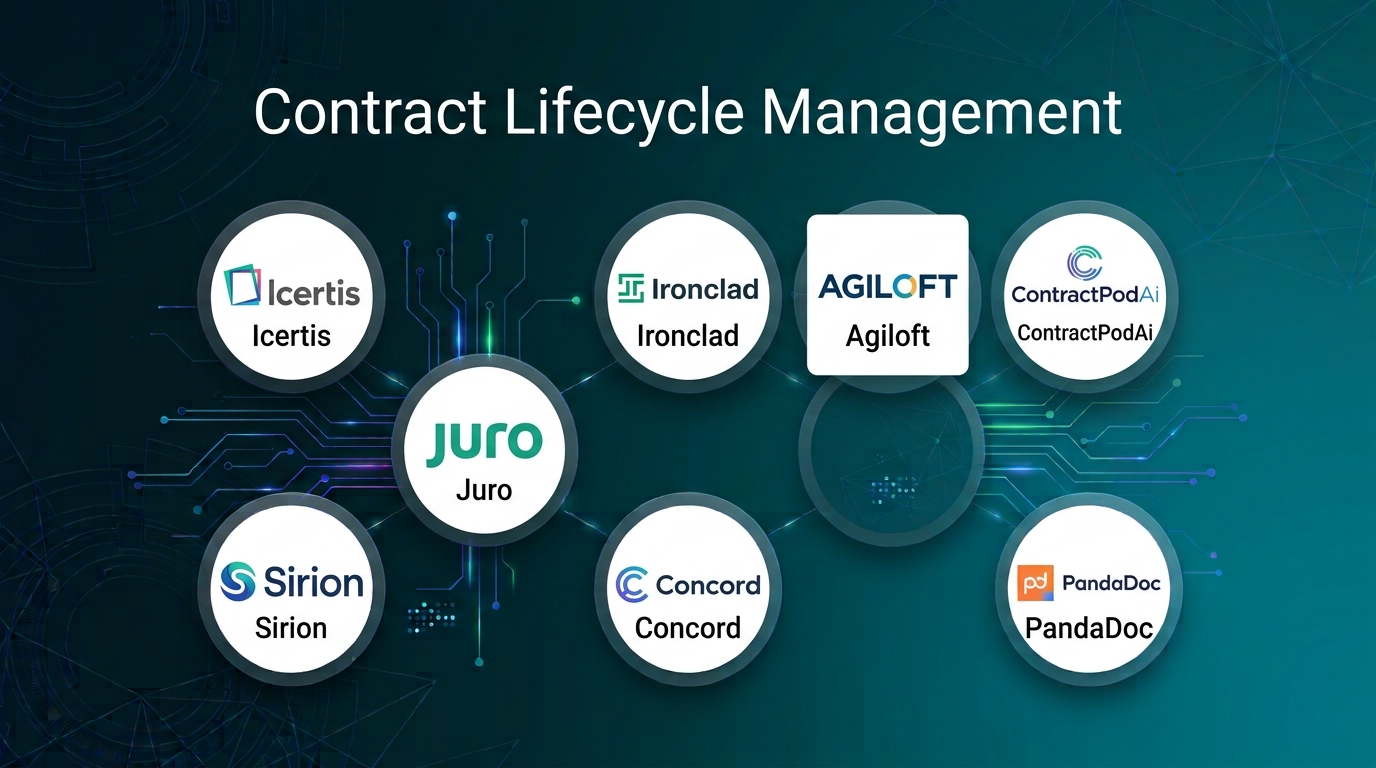
When legal contracts are negotiated via emailed Word attachments, stored across local hard drives, and tracked in manual spreadsheets, two operational breakdowns follow: high-value commercial deals stall in multi-week legal review queues, and post-signature obligations quietly expire—triggering unintended auto-renewals or uncollected volume rebates.
Contract Lifecycle Management (CLM) software turns legal agreements into structured, searchable data assets—governing the end-to-end contract journey across authoring, pre-approved clause assembly, redline collaboration, approval workflows, e-signature, and post-execution obligation tracking. Evaluating CLM software requires distinguishing between enterprise multi-department legal suites, collaborative browser-first contract platforms, and sales-ops-focused quote-to-contract tools.
Five Core Capabilities That Separate Modern CLM From Document Storage
Basic cloud folders store PDFs; a functional CLM system manages commercial risk and operational velocity through five core controls:
- Pre-Approved Clause Libraries and Dynamic Generation: Equipping commercial and sales teams with self-service contract generation (NDAs, MSAs, SOWs) driven by conditional questionnaires—locking critical legal boilerplate while dynamically inserting pre-approved fallback clauses based on deal parameters.
- Collaborative Browser-Based Redlining and Version Control: Providing a unified negotiation workspace where internal teams and external counterparties negotiate contracts in real time—tracking changes, resolving comments, and reconciling Microsoft Word redline rounds without file-name fragmentation (
MSA_Final_v3_revised.docx). - Automated Approval Workflows and Stage-Gate Governance: Routing contracts dynamically to Legal, Finance, InfoSec, and Executive signatories based on contract value, custom terms, governing jurisdiction, or high-risk deviations from standard terms.
- Post-Signature Obligation, SLA, and Renewal Tracking: Extracting critical contract terms, payment milestones, termination notification windows, and renewal dates into actionable alerts—ensuring commercial teams give timely non-renewal notices and uphold regulatory commitments.
- AI Metadata Extraction and Legacy Repository Ingestion: Ingesting thousands of historical PDF contracts using Optical Character Recognition (OCR) and machine-learning models to extract key metadata (governing law, indemnity caps, force majeure, assignment clauses) into a structured, queryable contract repository.
Leading Contract Lifecycle Management (CLM) Platforms
Icertis Contract Intelligence (ICI)
Icertis is the enterprise benchmark in global Contract Lifecycle Management, particularly for Fortune 500 corporations operating across complex supply chains, regulated industries, and multinational operations. Built as an enterprise-wide platform, Icertis Contract Intelligence structures contract data across procurement, sales, corporate governance, and HR—integrating natively with SAP S/4HANA, Oracle, Workday, and Salesforce.
Global enterprises needing deep regulatory compliance (FAR/DFARS, GDPR), multi-tier contract hierarchies, and AI-driven obligation governance across millions of agreements standardize on Icertis. Its primary trade-offs are significant implementation complexity, higher services investment, and the need for dedicated administrative ownership.
Ironclad
Ironclad built its market leadership by uniting rigorous legal governance with consumer-grade software design. Centered on its intuitive Workflow Designer and Ironclad Editor (which enables native browser-based Word redlining alongside external counterparties), Ironclad allows in-house legal teams to design, modify, and launch automated contract workflows in hours without specialized engineering resources.
High-growth technology enterprises, corporate legal departments, and mid-market organizations seeking rapid user adoption, collaborative redlining, and deep Salesforce/HubSpot integration favor Ironclad.
Agiloft
Agiloft delivers a highly configurable, no-code CLM platform recognized for architectural flexibility and rapid deployment. Offering pre-built contract modules alongside deep customization capabilities, Agiloft adapts to bespoke procurement, legal, and commercial processes without hardcoded software modifications, while providing a native Microsoft Word add-in that keeps attorneys inside their preferred drafting environment.
Mid-market to large enterprises with complex, non-standard contract routing requirements that demand custom data models without enterprise platform lock-in rely heavily on Agiloft.
ContractPodAi and Sirion (AI-Native Contract Governance Suites)
- ContractPodAi provides an end-to-end legal platform powered by its proprietary legal AI assistant (Leah), excelling at automated contract analysis, third-party paper redlining, and legal intake triage.
- Sirion focuses heavily on large enterprise supplier and customer contract performance—extracting contract obligations and matching them automatically against invoice and ERP telemetry to prevent post-signature value leakage.
PandaDoc, Concord, and Juro (Agile & Mid-Market Contract Platforms)
For agile commercial teams, fast-growing startups, and mid-market organizations that find enterprise CLMs unnecessarily complex:
- Juro is a modern, browser-native contract platform engineered for fast-moving sales and HR teams—combining template generation, browser redlining, and native e-signature in an all-in-one workspace.
- Concord delivers an accessible, collaborative contract platform offering unlimited guest negotiations, automated approvals, and straightforward deadline tracking for growing businesses.
- PandaDoc blends basic contract creation, CPQ quoting tables, and e-signatures for sales teams focused on quick proposals and agreements.
Contract Lifecycle Management Tools Comparison
| Platform | Architectural Scope | Drafting & Redlining Experience | AI Metadata & Legacy Extraction | Ecosystem & ERP/CRM Fit | Best Fit |
| Icertis | Global enterprise contract intelligence | Advanced Word integration & structured multi-tier clause rules | Very High (Enterprise AI obligation tracking & risk modeling) | Deep native SAP, Oracle, Salesforce & Workday links | Global enterprises with complex multi-department contract webs |
| Ironclad | Modern enterprise & mid-market CLM | Best-in-class browser editor + Word sync & counterparty portal | High (AI contract summarization & automated tagging) | Salesforce, HubSpot, Coupa, Slack, Google Drive | Fast-growing scale-ups & corporate legal departments |
| Agiloft | Highly configurable no-code CLM | Native Microsoft Word add-in + configurable web redlining | High (AI clause recognition & automated risk scoring) | Broad REST APIs, Salesforce, NetSuite, Dynamics | Enterprises needing custom contract workflows & data models |
| Sirion / ContractPodAi | AI-first enterprise contract governance | AI-assisted third-party paper review & redlining assistants | Very High (Deep post-signature invoice & SLA performance audit) | Enterprise ERP, S2P & CRM connectors | Large enterprises focused on post-signature supplier performance |
| Juro / Concord | Agile browser-native contract platforms | Collaborative in-browser negotiation & counterparty access | Moderate (Standard metadata extraction & search) | Slack, Zapier, HubSpot, Salesforce, Google Drive | Mid-market businesses & modern tech teams scaling self-serve contracts |
| PandaDoc | Sales proposal, quote & contract builder | Web template drag-and-drop editor + built-in e-sign | Basic (Focuses on transactional document fields) | Native CRM connectors (HubSpot, Salesforce, Pipedrive) | SMB commercial teams pairing basic contracts with sales quotes |
Common CLM Implementation Pitfalls to Avoid
- Digitizing Chaotic, Undefined Legal Workflows: If an organization has four regional legal teams using contradictory indemnity policies and no standard approval matrix, configuring that chaos into a CLM will freeze sales operations. Standardize contract templates, fallback clauses, and approval thresholds before software implementation.
- Underestimating Third-Party Paper Negotiation Realities: If 80% of your business deals negotiate on customer-provided contract paper rather than your company’s standard templates, a CLM that only excels at self-service template generation will fail to relieve the legal bottleneck. Verify that the platform includes automated third-party paper parsing and redlining.
- Leaving the CLM Disconnected From Procurement and Invoicing: Storing signed vendor contracts in a CLM without syncing payment terms, minimum commitments, or auto-renewal dates to your ERP (NetSuite, SAP) or AP platform ensures that renewal deadlines will continue to be missed.
Selecting the Right Contract Lifecycle Management Tool
Match your CLM platform to your contract complexity, primary counterparty paper mix, and administrative resources:
- For Enterprise Scale Across Global Operations and Regulated Supply Chains: Standardize on Icertis or Sirion.
- For High-Growth Tech and Corporate Legal Teams Balancing Rigor and Speed: Choose Ironclad for high user adoption, modern browser-based editing, and robust workflow automation.
- For Organizations With Unique, Bespoke Legal Workflows Requiring No-Code Customization: Deploy Agiloft.
- For Fast-Moving Startups and Mid-Market Teams Seeking Lightweight Self-Service Contracts: Evaluate Juro or Concord to eliminate contract generation bottlenecks quickly.
