Introduction
Modern IT environments have become highly complex due to rapid cloud adoption, microservices architecture, containerization, and distributed systems. Enterprises today manage thousands of applications, APIs, and infrastructure components that generate massive volumes of operational data every second. In such environments, traditional IT monitoring and manual troubleshooting approaches are no longer sufficient.
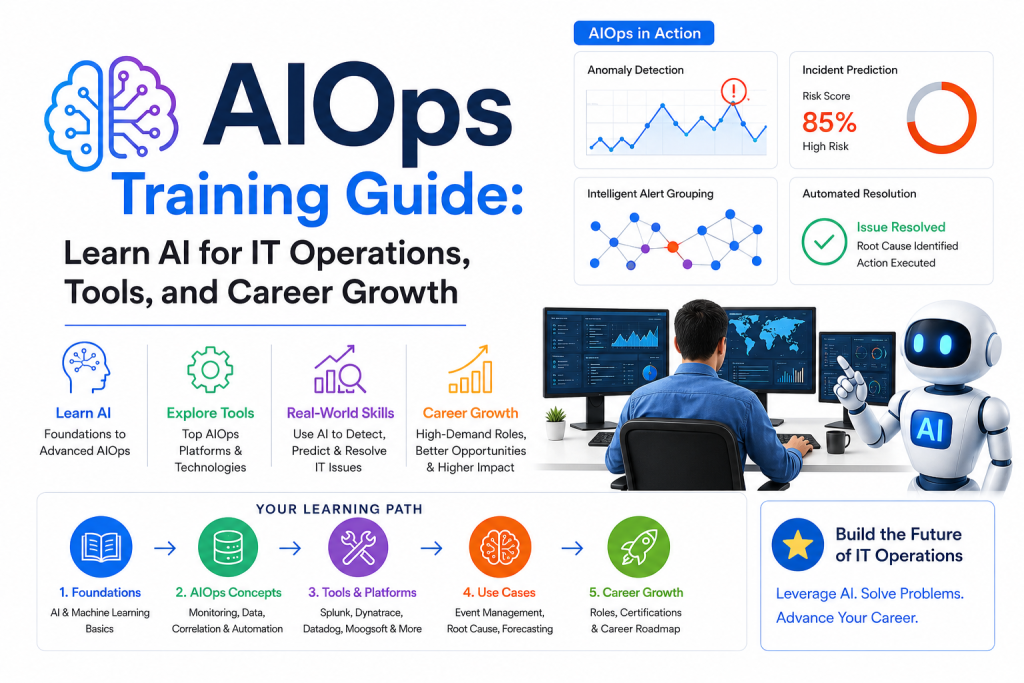
This is where AIOps certification plays a critical role in bridging the skills gap between traditional IT operations and modern AI-driven automation practices. AIOps, or Artificial Intelligence for IT Operations, integrates machine learning, big data analytics, and automation to improve how organizations detect, diagnose, and resolve IT issues.
Professionals who undergo structured AIOps training gain practical knowledge in observability, anomaly detection, root cause analysis, and IT operations automation. At the same time, organizations benefit from reduced downtime, faster incident resolution, and optimized operational costs.
This blog explores how AIOps certifications help both IT professionals and enterprises improve operational efficiency, reduce costs, and enable digital transformation at scale.
Understanding AIOps and Modern IT Operations
AIOps refers to the use of artificial intelligence and machine learning techniques to enhance IT operations. It enables systems to analyze large volumes of operational data from multiple sources such as logs, metrics, events, and traces.
Modern IT operations rely heavily on:
- Cloud infrastructure
- Kubernetes and container orchestration
- Distributed microservices
- Hybrid and multi-cloud environments
- Real-time application monitoring
In this complex ecosystem, AIOps platforms help automate key operational tasks such as:
- Event correlation across systems
- Intelligent alerting and filtering
- Predictive analytics for potential failures
- Automated remediation workflows
AIOps certification helps professionals understand how these systems work in real-world enterprise environments and how to implement them effectively.
Why Organizations Need AIOps Today
Organizations are under constant pressure to deliver faster, more reliable, and more scalable digital services. Customers expect uninterrupted availability, while IT teams struggle with increasing system complexity.
Key reasons organizations adopt AIOps include:
- Explosion of operational data from cloud systems
- Increasing frequency of incidents and alerts
- Demand for real-time system availability
- Need for faster digital transformation
- Pressure to reduce operational costs
Without AI-driven operations, IT teams often face alert fatigue, slow incident response times, and inefficient manual troubleshooting processes.
AIOps provides a structured way to modernize IT operations through automation and intelligence.
Common Challenges Faced by Modern IT Teams
Even advanced IT organizations face several operational challenges, including:
- Too many alerts from monitoring tools
- Difficulty identifying root causes quickly
- Lack of visibility across distributed systems
- High mean time to detect (MTTD) and resolve (MTTR)
- Manual dependency on experienced engineers
- Inefficient incident escalation processes
For example, in a large e-commerce platform, a minor database slowdown can trigger hundreds of alerts across services. Without AIOps, engineers may spend hours manually identifying the root cause.
How AIOps Helps Reduce Operational Costs
AIOps significantly reduces operational costs by automating repetitive and time-consuming tasks.
Key cost-saving mechanisms include:
Reduced Manual Effort
Automation reduces dependency on large support teams for routine monitoring and troubleshooting.
Faster Incident Resolution
Early detection and automated alerts reduce downtime costs.
Efficient Resource Utilization
Cloud resources are optimized based on predictive analytics.
Reduced Downtime Impact
Even a few minutes of downtime can cost enterprises thousands of dollars. AIOps minimizes this risk.
For example, a financial services company using AIOps can automatically detect transaction latency issues and trigger remediation workflows before customer impact occurs.
How AIOps Improves Incident Detection and Resolution
AIOps transforms incident management by introducing intelligence into every stage of the lifecycle.
Key improvements:
- Anomaly Detection: Identifies unusual patterns in system behavior
- Event Correlation: Groups related alerts into a single incident
- Root Cause Analysis: Pinpoints underlying issues faster
- Predictive Alerts: Warns before failures occur
- Automated Remediation: Executes predefined fixes automatically
In enterprise environments, this reduces Mean Time to Resolution (MTTR) significantly and improves service reliability.
Benefits of AIOps Certifications for IT Professionals
Professionals who complete AIOps certification gain both technical and career advantages.
Career benefits include:
- Strong understanding of AI for IT operations
- Better job opportunities in DevOps, SRE, and Cloud roles
- Higher salary potential due to specialized skills
- Readiness for enterprise-scale infrastructure management
- Expertise in automation and observability tools
AIOps training also strengthens related certifications such as DevOps certification, SRE certification, Kubernetes certification, and cloud operations certification.
Benefits of AIOps Certifications for Organizations
Organizations that invest in AIOps-trained professionals experience measurable improvements in IT performance.
Key organizational benefits:
- Improved operational efficiency
- Reduced incident response time
- Lower IT operational costs
- Better system reliability and uptime
- Faster digital transformation initiatives
Enterprises also gain better alignment between IT operations and business goals through automation-driven decision-making.
Key Skills Learned Through AIOps Training
AIOps certification programs focus on practical skills required in modern IT environments.
Core skills include:
- Event Correlation
- Anomaly Detection
- Predictive Analytics
- Root Cause Analysis
- Observability
- Incident Management
- Automation and Remediation
- Machine Learning in Operations
These skills help professionals manage complex systems with greater accuracy and speed.
Popular Professionals Who Can Benefit from AIOps Certifications
AIOps training is valuable for multiple IT roles, including:
- DevOps Engineers
- SRE Engineers
- Cloud Engineers
- Platform Engineers
- System Administrators
- IT Operations Teams
- Security Professionals
- Technology Managers
Each role benefits differently, but all gain improved efficiency in managing IT systems.
AIOps vs Traditional IT Operations
| Aspect | Traditional IT Operations | AIOps-Based Operations |
|---|---|---|
| Monitoring Approach | Manual monitoring tools | AI-driven monitoring and analytics |
| Incident Detection | Reactive alerts | Predictive anomaly detection |
| Root Cause Analysis | Manual investigation | Automated correlation and analysis |
| Automation | Limited automation | High-level intelligent automation |
| Scalability | Difficult in large systems | Highly scalable |
| Operational Cost | High due to manual effort | Optimized through automation |
| Response Time | Slow and reactive | Fast and proactive |
| Business Impact | Frequent downtime risks | Improved service reliability |
How AIOps Certifications Support Digital Transformation Initiatives
Digital transformation requires enterprises to modernize IT infrastructure and operations. AIOps certifications support this journey by enabling:
- Automation-first operational models
- Cloud-native monitoring strategies
- Data-driven decision-making
- Faster application delivery cycles
- Improved system resilience
Organizations adopting AIOps are better equipped to handle hybrid and multi-cloud environments.
Why Continuous Learning Is Important in Modern IT Operations
Technology evolves rapidly, and IT professionals must continuously upgrade their skills.
Continuous learning helps professionals:
- Stay updated with modern tools and frameworks
- Adapt to AI-driven operational models
- Improve career growth opportunities
- Handle evolving cloud-native architectures
- Contribute to enterprise innovation
AIOps certification ensures structured learning aligned with industry needs.
How AIOpsSchool Helps Professionals Build Industry-Relevant Skills
AIOpsSchool provides structured training programs designed for real-world enterprise environments.
Key features include:
- Industry-Focused Curriculum
Designed based on real IT operations challenges - Expert Trainers
Learn from experienced industry professionals - Hands-On Learning
Practical labs and simulation-based exercises - Real-World Use Cases
Enterprise-level incident and monitoring scenarios - Certification Programs
Structured learning paths for career advancement - Career Advancement Opportunities
Preparation for DevOps, SRE, and cloud roles - Flexible Learning Options
Suitable for beginners and working professionals
Future of AIOps, DevOps, and Intelligent Operations
The future of IT operations is moving toward fully autonomous systems. AIOps will continue to evolve alongside DevOps, DevSecOps, and SRE practices.
Key future trends include:
- Autonomous incident resolution
- AI-driven infrastructure optimization
- Predictive cloud scaling
- Unified observability platforms
- Intelligent security operations (SecOps)
Organizations adopting AIOps early will gain a significant competitive advantage in operational efficiency.
FAQs
1. What is AIOps certification?
AIOps certification is a professional training program that teaches AI-driven IT operations, including monitoring, automation, and incident management in modern systems.
2. Who should pursue AIOps training?
DevOps engineers, SREs, cloud engineers, IT operations teams, and system administrators can benefit from AIOps training.
3. Is AIOps useful for DevOps engineers?
Yes, AIOps enhances DevOps practices by improving automation, monitoring, and incident response efficiency.
4. How does AIOps reduce operational costs?
It reduces manual work, improves automation, and minimizes downtime, leading to significant cost savings.
5. What skills are required to learn AIOps?
Basic understanding of IT operations, cloud computing, monitoring tools, and scripting is helpful.
6. What is the difference between AIOps and DevOps?
DevOps focuses on development and operations integration, while AIOps uses AI to enhance IT operations efficiency.
7. Is coding required for AIOps?
Basic scripting knowledge is helpful, but advanced coding is not mandatory for most AIOps roles.
8. What industries use AIOps?
AIOps is used in banking, e-commerce, healthcare, telecom, and cloud service industries.
9. How long does it take to complete AIOps certification?
It typically takes a few weeks to a few months depending on the training program.
10. Why choose AIOpsSchool for AIOps training?
AIOpsSchool provides structured, industry-focused training with real-world use cases and career-oriented learning paths.
Conclusion
AIOps certification has become a key enabler for modern IT professionals and organizations aiming to improve operational efficiency and reduce costs. As IT environments continue to grow in complexity, traditional methods are no longer sufficient to manage large-scale systems effectively.
By adopting AIOps training, professionals gain valuable skills in automation, observability, anomaly detection, and incident management. Organizations, on the other hand, benefit from faster issue resolution, reduced downtime, and optimized operational costs.
AIOps is not just a technology upgrade; it is a strategic shift toward intelligent, automated, and data-driven IT operations. With platforms like AIOpsSchool, professionals can build the skills needed to stay ahead in this evolving landscape.

This is a well-written introduction to AIOps and its growing role in modern IT operations. The article explains the concepts in a simple way and provides useful insights for anyone interested in building a career in this field. Great read
I liked how the guide explains AIOps in a simple and easy-to-understand way. It gives a clear overview of the skills, tools, and career opportunities without feeling too technical. Thanks for sharing such useful information