Introduction
The AWS Certified Solutions Architect – Associate is a cornerstone for any professional aiming to master cloud infrastructure and distributed systems. This guide is designed for software engineers, Site Reliability Engineer professionals, and technical leaders who need to bridge the gap between code and scalable architecture. In the modern era of platform engineering and cloud-native development, understanding how to design resilient and cost-effective systems is no longer optional. This comprehensive roadmap helps you evaluate the certification’s technical depth, its career impact, and how it integrates with specialized domains like DevSecOps and FinOps.
What is the AWS Certified Solutions Architect – Associate?
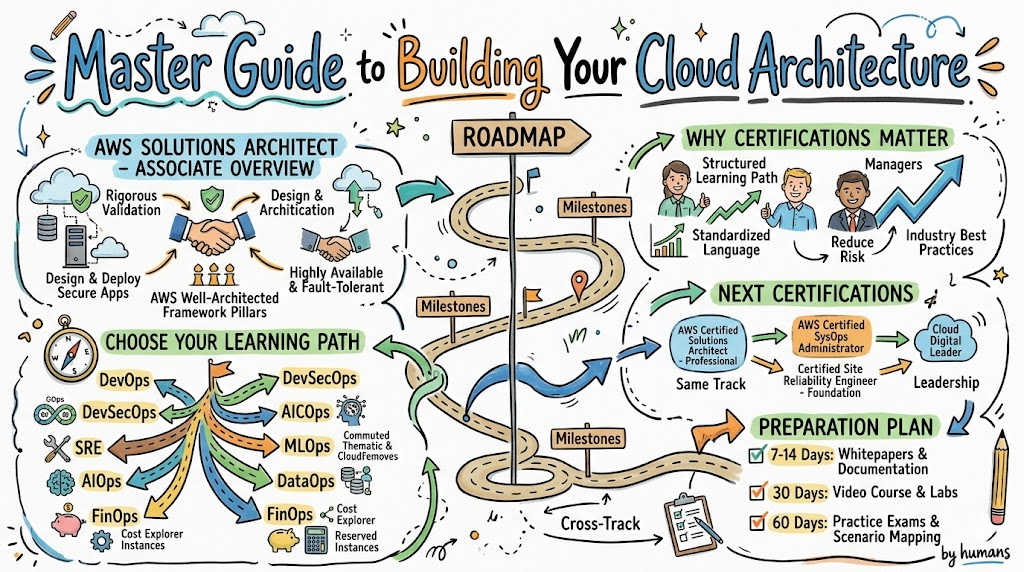
AWS Certified Solutions Architect – Associate is a rigorous validation of an individual’s ability to design and deploy robust and secure applications on AWS technologies. It focuses on the core pillars of the AWS Well-Architected Framework, ensuring that you can translate complex business requirements into scalable cloud solutions. For a professional, it represents a shift from merely using cloud services to architecting systems that are highly available and fault-tolerant. It serves as a middle-tier benchmark that proves you have the hands-on experience required to manage AWS resources effectively in a production environment.
Why it Matters in Today’s Software, Cloud, and Automation Ecosystem
The modern technology stack relies heavily on automation, managed services, and serverless architectures to maintain competitive speed. As organizations move toward SRE and DevOps methodologies, the ability to design infrastructure that supports continuous integration and rapid scaling is critical. This certification ensures that architects understand how to utilize load balancing, auto-scaling, and managed databases to reduce operational overhead. By mastering these AWS components, you contribute to an ecosystem where automation handles the heavy lifting, allowing the business to focus on feature delivery.
Why Certifications are Important for Engineers and Managers
For engineers, certifications provide a structured learning path that fills knowledge gaps often missed during ad-hoc project work. They offer a standardized language for technical teams, ensuring everyone understands the implications of architectural choices on security and cost. For managers, certifications serve as a validation of the team’s technical maturity and readiness to handle high-stakes cloud migrations. Having a certified team reduces the risk of costly architectural errors and ensures that the organization is following industry best practices for data protection and system reliability.
Why Choose DevOpsSchool?
DevOpsSchool has established itself as a premier destination for technical training by focusing on practical, industry-aligned curriculum. Unlike platforms that focus solely on passing exams, this site emphasizes the application of AWS concepts within the broader DevOps and SRE lifecycle. The training methodology ensures that students understand how AWS services interact with third-party automation tools and security protocols. By choosing this provider, learners gain access to expert mentors who bring real-world production experience to the classroom, making the transition from theory to practice seamless and efficient.
Certification Table
| Track | Level | Who it’s for | Prerequisites | Skills Covered | Recommended Order |
| Cloud Architecture | Foundation | Beginners, Sales, Marketing | None | Basic Cloud Concepts, Billing | 1 |
| Cloud Architecture | Associate | Developers, SREs, Admins | 1 Year AWS Experience | Design, Deployment, Security | 2 |
| Cloud Architecture | Professional | Senior Architects, Leads | 2 Years Experience | Complex Orgs, Migration | 3 |
| Specialty | Advanced | Security Engineers | Associate Level | Encryption, Incident Response | 4 |
| Specialty | Advanced | Data Engineers | Associate Level | Data Lakes, Warehousing | 4 |
Detailed Guide for Each AWS Certified Solutions Architect – Associate Certification
What it is
This certification validates your ability to design and deploy functional, secure, and resilient applications on AWS. It confirms you can use the right services to meet specific technical requirements while optimizing cost and performance.
Who should take it
It is ideal for Cloud Architects, DevOps Engineers, and System Administrators with at least one year of hands-on experience. It is also suitable for technical leads who oversee cloud-native projects and infrastructure migrations.
Skills you’ll gain
- Designing resilient architectures using Multi-AZ deployments and Auto Scaling.
- Implementing high-performing compute, storage, and database solutions.
- Securing applications with IAM, VPC security groups, and encryption.
- Optimizing costs by selecting appropriate instance types and storage tiers.
Real-world projects you should be able to do
- Migrating a three-tier on-premises application to a scalable AWS VPC.
- Setting up a serverless web application using Lambda, API Gateway, and S3.
- Implementing a disaster recovery strategy with cross-region replication and Route 53.
Preparation plan
- 7–14 days: Focused review of the AWS Whitepapers and the Well-Architected Framework documentation.
- 30 days: Complete a structured video course and perform labs for core services like EC2, S3, and RDS.
- 60 days: In-depth study including specialty services, multiple practice exams, and complex architectural scenario mapping.
Common mistakes
- Overlooking the nuances of VPC networking and CIDR block assignments.
- Failing to understand the specific differences between various S3 storage classes.
- Not spending enough time on IAM policy structures and the principle of least privilege.
Best next certification after this
- Same-track option: AWS Certified Solutions Architect – Professional.
- Cross-track option: AWS Certified SysOps Administrator – Associate.
- Leadership option: Certified Site Reliability Engineer – Foundation.
Choose Your Learning Path
DevOps Path
For those in DevOps, this certification serves as the structural foundation for CI/CD and Infrastructure as Code (IaC). You will learn how to architect environments that can be provisioned through Terraform or CloudFormation. This path emphasizes the integration of developer tools with scalable infrastructure to ensure rapid delivery. It prepares you to manage the underlying AWS resources that power your deployment pipelines and container orchestration platforms.
DevSecOps Path
The DevSecOps path focuses on integrating the security principles learned in the Associate exam into the automated delivery cycle. You will learn how to use AWS native security tools to build a “security-first” architecture. This involves mastering IAM, VPC flow logs, and AWS WAF to protect applications at every layer. Professionals in this path transition from manual security checks to automated governance and compliance monitoring.
SRE Path
Site Reliability Engineers use the knowledge from this certification to build systems that meet strict Service Level Objectives (SLOs). You will focus on high availability, fault tolerance, and monitoring via CloudWatch and X-Ray. The goal is to design systems that can self-heal and scale automatically based on real-time traffic patterns. This path ensures that reliability is “baked into” the architecture from the very first day of design.
AIOps Path
In the AIOps domain, this certification provides the compute and data storage foundation required to run AI-driven operations tools. You will understand how to set up the high-performance computing clusters and data lakes needed for operational analysis. This path focuses on using AWS services to ingest massive amounts of log and metric data for automated troubleshooting. It bridges the gap between traditional infrastructure and intelligent, data-driven system management.
MLOps Path
The MLOps path builds upon the AWS storage and compute fundamentals to create production-grade machine learning pipelines. You will learn how to choose the right instance types for model training and how to deploy models using SageMaker or EKS. This involves managing the lifecycle of data and models within the AWS ecosystem. It ensures that ML models are not just research projects but are scalable, reliable, and integrated into the business application.
DataOps Path
DataOps professionals utilize this certification to master the architectural requirements of data pipelines and real-time processing. You will focus on services like Kinesis, Redshift, and Glue to manage the flow of data across the organization. This path emphasizes the “plumbing” of the cloud—ensuring data is stored securely and is accessible for analytics. It helps in building automated, repeatable data workflows that reduce the time from data collection to insight.
FinOps Path
The FinOps path leverages the cost-optimization pillars of the Solutions Architect exam to drive financial accountability in the cloud. You will learn how to use Cost Explorer, AWS Budgets, and Reserved Instances to manage cloud spend effectively. This path is about aligning architectural decisions with business value and budget constraints. It empowers professionals to design systems that are not just technically sound but also financially sustainable for the enterprise.
Role → Recommended AWS Certified Solutions Architect – Associate Certifications
| Role | Recommended Certifications |
| DevOps Engineer | AWS Solutions Architect Associate, AWS DevOps Engineer Professional |
| SRE | AWS Solutions Architect Associate, Certified Site Reliability Engineer – Foundation |
| Platform Engineer | AWS Solutions Architect Associate, CKA (Certified Kubernetes Administrator) |
| Cloud Engineer | AWS Solutions Architect Associate, AWS SysOps Associate |
| Security Engineer | AWS Solutions Architect Associate, AWS Security Specialty |
| Data Engineer | AWS Solutions Architect Associate, AWS Data Engineer Associate |
| FinOps Practitioner | AWS Solutions Architect Associate, FinOps Certified Practitioner |
| Engineering Manager | AWS Solutions Architect Associate, Cloud Digital Leader |
Next Certifications to Take After AWS Certified Solutions Architect – Associate
Same Track Progression
Advancing to the AWS Certified Solutions Architect – Professional is the logical next step for those who want to reach the pinnacle of cloud design. This advanced certification covers complex organizational requirements, including multi-account strategies and large-scale migrations. It proves your ability to handle the most challenging architectural problems an enterprise can face. Professionals at this level are often the primary decision-makers for an organization’s entire cloud strategy.
Cross-Track Expansion
Broadening your skills by pursuing the AWS Certified Developer or SysOps Administrator Associate allows for a more holistic understanding of the cloud. While the Architect track focuses on design, these tracks focus on implementation and ongoing operations. This cross-training makes you a more versatile “T-shaped” professional who can both design a system and troubleshoot its low-level execution. It is particularly valuable in smaller, agile teams where roles often overlap.
Leadership & Management Track
For those transitioning into leadership, moving toward certifications like the Certified Site Reliability Engineer – Foundation is highly beneficial. This shift focuses on the cultural and operational aspects of managing technical teams and high-scale systems. It moves beyond “how to build” into “how to operate and lead” in a modern engineering culture. These certifications validate your ability to manage both the technology and the people who keep it running.
Training & Certification Support Providers for AWS Certified Solutions Architect – Associate
- DevOpsSchool DevOpsSchool offers a deeply immersive training experience that combines theoretical cloud architecture with intensive hands-on labs. Their programs are specifically designed to help professionals master AWS services within a DevOps context, making them ideal for career changers. With a focus on real-world scenarios and expert-led mentorship, they ensure that every student is prepared for both the certification exam and the challenges of a production environment.
- Cotocus Cotocus specializes in providing high-end technical consulting and training that focuses on the practical implementation of cloud-native technologies. Their approach to AWS certification training involves deep dives into architectural patterns that are currently used by top-tier tech companies. They offer a unique perspective on how to integrate AWS services with specialized automation tools to achieve high levels of operational efficiency.
- Scmgalaxy Scmgalaxy is a robust community-driven platform that provides extensive resources for software configuration management and cloud engineering. Their training modules for AWS are known for being highly detailed and focusing on the integration of version control and CI/CD with cloud infrastructure. It is an excellent choice for engineers who want to understand the intersection of development workflows and cloud architecture.
- BestDevOps BestDevOps focuses on delivering streamlined, high-impact training programs that prioritize the most critical skills needed in the modern job market. Their AWS training is designed to be efficient, helping professionals gain the necessary skills and certification in a shorter timeframe without sacrificing depth. They provide excellent practice materials and situational workshops that mirror the complexity of the actual Associate exam.
- Devsecopsschool Devsecopsschool is the leading provider for professionals who want to place a heavy emphasis on security within their cloud journey. Their AWS training integrates security at every layer, teaching students how to build architectures that are secure by design. This provider is essential for anyone looking to enter the high-demand field of cloud security and automated compliance within the AWS ecosystem.
- Sreschool Sreschool focuses on the reliability and observability aspects of cloud architecture, making it the perfect partner for aspiring SREs. Their AWS certification support emphasizes how to use cloud services to build systems that meet high availability targets. They provide unique training on monitoring, logging, and incident response within the AWS framework, ensuring that architects know how to keep their systems running.
- Aiopsschool Aiopsschool provides cutting-edge training that explores the intersection of artificial intelligence and IT operations on the AWS platform. Their curriculum helps AWS architects understand how to utilize machine learning services to automate routine operational tasks and predictive maintenance. This is a forward-looking provider that prepares students for the next generation of intelligent infrastructure management.
- Dataopsschool Dataopsschool focuses on the data-centric services within AWS, helping professionals build scalable data lakes and real-time analytics platforms. Their training ensures that architects can design the complex data pipelines required for modern business intelligence. They provide hands-on experience with services like AWS Glue and Redshift, focusing on data integrity, speed, and cost-efficient storage.
- Finopsschool Finopsschool addresses the critical need for financial management in the cloud by integrating FinOps principles into AWS architectural training. They teach students how to design systems that provide maximum business value for every dollar spent on cloud resources. This training is vital for architects who want to play a strategic role in their organization’s financial planning and cloud governance.
Frequently Asked Questions (General)
1. How difficult is the AWS Solutions Architect Associate exam?
The exam is considered moderately difficult and requires a solid understanding of how various AWS services interact in a production environment.
2. How much time does it take to prepare for this certification?
Most professionals with some IT background spend between 30 to 60 days preparing, depending on their existing hands-on experience with AWS.
3. What are the prerequisites for taking the Associate exam?
There are no formal prerequisites, but AWS recommends having at least one year of hands-on experience designing and deploying cloud applications.
4. What is the validity period of the AWS certification?
The certification is valid for three years, after which you must undergo a recertification process to remain active.
5. Does this certification help in getting a higher salary?
Yes, it is consistently ranked as one of the highest-paying IT certifications globally due to the high demand for skilled cloud architects.
6. Can I take the exam online from my home or office?
Yes, AWS offers online proctored exams through testing partners, allowing you to take the test from a convenient and quiet location.
7. What is the passing score for the Associate exam?
The passing score is typically 720 out of 1000, with the exam using a scaled scoring model based on the difficulty of the questions.
8. Is the Cloud Practitioner exam mandatory before taking the Associate?
No, you can skip the Cloud Practitioner and go directly to the Associate level if you already have basic cloud knowledge.
9. How many questions are on the exam and what is the duration?
The exam consists of 65 questions, including multiple-choice and multiple-response, and you are given 130 minutes to complete it.
10. What happens if I fail the exam on the first attempt?
You must wait 14 days before you are eligible to retake the exam, and you will need to pay the full registration fee again.
11. Are there lab-based questions in the current version of the exam?
As of the current version, the exam primarily focuses on scenario-based multiple-choice questions rather than live lab environments.
12. Is the AWS Solutions Architect Associate better than the Developer Associate?
Neither is better; the Architect track focuses on design and structure, while the Developer track focuses on building and deploying code on AWS.
FAQs on AWS Certified Solutions Architect – Associate
1. What are the most important AWS services to study for this specific exam?
You should focus heavily on VPC, EC2, S3, IAM, and RDS, as these form the core of most architectural scenarios.
2. How does the exam test your knowledge of the Well-Architected Framework?
Questions are often framed around the five pillars: Operational Excellence, Security, Reliability, Performance Efficiency, and Cost Optimization.
3. Do I need to know how to write code for the Solutions Architect Associate?
While deep coding isn’t required, you should understand basic scripting concepts and how APIs interact with infrastructure.
4. How much weight is given to networking and VPCs in the exam?
Networking is a significant portion of the exam, as it is the foundation for all secure and scalable cloud architectures.
5. Are there many questions about cost optimization on the test?
Yes, several questions will ask you to identify the most cost-effective solution among several technically viable options.
6. Should I focus more on managed services or traditional EC2-based setups?
The exam focuses on both, but there is an increasing emphasis on managed services and serverless architectures like AWS Lambda.
7. How deep is the coverage of database services like DynamoDB and Aurora?
You need to know when to choose NoSQL over Relational databases based on performance and scaling requirements.
8. Are hybrid cloud scenarios covered in the Associate level exam?
Yes, you should understand how to connect on-premises data centers to AWS using VPNs and Direct Connect.
Conclusion
The AWS Certified Solutions Architect – Associate is a definitive milestone for any professional aiming to master the complexities of modern cloud engineering. It shifts the focus from simply operating services to designing integrated, resilient systems that solve actual business problems. In a technical landscape where scalability and reliability are the primary drivers of success, the ability to apply the Well-Architected Framework is a significant competitive advantage. This certification provides the structural foundation and industry-standard validation required to lead technical teams and manage enterprise-grade cloud environments. Ultimately, it is a practical and high-impact investment for engineers and managers committed to building stable, secure, and cost-effective solutions in the global IT market.

I built stronger understanding of scalable cloud architecture and deployment models, and I will use this knowledge to design efficient, future-ready enterprise systems.
Designing Resilient Digital Infrastructure Systems Enhances technical proficiency while building strategic problem-solving skills for successful personal growth and advanced career progression within modern enterprise technology landscapes successfully.
A helpful guide that simplifies cloud architecture concepts and presents them in an easy-to-understand way. Great resource for anyone building a strong cloud foundation.